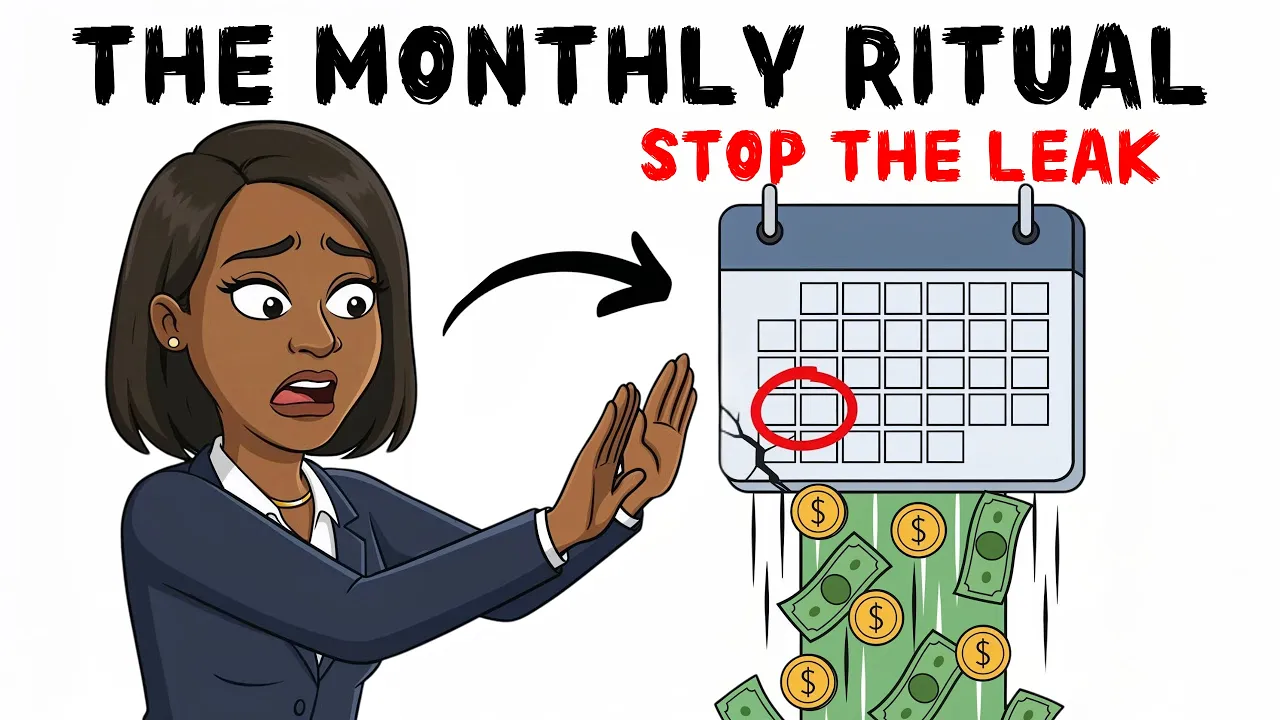
There's a specific ritual that separates people who build wealth from people who wonder where their money went. And it happens once a month like clockwork. Skip it even a few times and you'll fall so far behind financially that catching up becomes almost impossible.
I'm talking about something that takes maybe 30 minutes, costs nothing, and has more impact on your long-term wealth than your salary, your investment returns, or any financial advice you'll ever receive. Most people never do it. The ones who do it religiously end up financially free while everyone else stays broke wondering what they're doing wrong.
My name is Alicia and I've watched thousands of people struggle financially despite earning good money. And the difference between them and people who build serious wealth always comes down to whether they do this one monthly practice. If you're tired of feeling like you're working hard but getting nowhere financially, or if you want to understand the simple habit that creates millionaires while everyone else stays stuck, make sure to subscribe to the channel and hit that like button if this information helps you out.
Here's what's really happening. Most people treat their finances like a mystery box. Money comes in, money goes out, and they have this vague sense that they should probably be saving more, but they're not really sure where all their money is going.
They might check their bank account balance occasionally, maybe stress about bills when they're due, possibly look at their credit card statement and feel vaguely guilty about how much they spent, but they never actually sit down and do a complete financial review where they look at everything that happened with their money over the past month and make deliberate decisions about what happens next month. This is why people making $60,000 a year feel just as broke as people making $30,000 and why people making $150,000 are somehow still living paycheck to paycheck. It's not about how much you earn.
It's about whether you're actively managing what happens to your money or just passively watching it disappear. And the difference between active management and passive hope is a monthly money meeting with yourself where you review everything, adjust your strategy, and make sure you're actually moving toward your goals instead of just treading water. Let me show you exactly what this monthly practice looks like and why skipping it will destroy your financial future, even if you're doing everything else right.
The first week of every month, you need to block out 30 to 60 minutes on your calendar. Not optional. Not when you feel like it.
Not if you remember. Every single month without exception, you sit down and you do a complete financial review. And here's what that review consists of.
First, you pull up every account where you have money. Your checking account, your savings accounts, your credit cards, your investment accounts, your retirement accounts, everything. You write down the current balance of each account.
Not because you're going to do anything with this information right now, but because you need to see your complete financial picture. Most people have no idea what their actual net worth is because they never look at all their accounts at the same time. They know they have some money in checking and some debt on credit cards and maybe something in a retirement account somewhere, but they've never added it all up to see if they're moving forward or backward.
So, you write down every balance. Checking account has $2,300. Savings account has $8,000.
Credit card one has $3,200 owed. Credit card 2 has $1,800 owed. Student loans have $18,000 left.
Retirement account has $45,000. Investment account has 12,000. Whatever your numbers are, you write them all down.
Then you do simple math. Add up everything you own, subtract everything you owe, and that's your net worth. This is your financial scoreboard.
This is how you know if you're winning or losing at money. Here's why this matters. Most people have no idea if they're making progress.
They might feel like they're doing okay because they're paying their bills on time. Or they might feel stressed because they had some unexpected expenses, but they're making financial decisions based on feelings instead of facts. When you track your net worth every single month, you can see exactly what's happening.
Did your net worth go up this month? Then you're doing something right. Did it go down?
Then something needs to change. Without this monthly check-in, you could be slowly going broke and not even realize it until you're in serious trouble. Next, you review every single transaction from the past month.
Every dollar that came in, every dollar that went out. This is where most people completely fall apart because it sounds tedious and boring and they don't want to face what they actually spent money on. But this is also where all the power lives.
You cannot manage what you don't measure. And if you're not reviewing your spending every month, you're not managing it. You're just hoping it works out.
You go through your bank statements and credit card statements line by line. You're not judging yourself or feeling guilty. You're just observing.
You spent $120 at restaurants last month. You spent $60 on coffee shops. You spent $280 on groceries.
You spent $45 on subscription services. You spent $350 on entertainment. Whatever the numbers are, you write them down in categories.
Food, transportation, housing, utilities, entertainment, shopping, whatever categories make sense for your life. This process takes maybe 20 minutes if you're doing it monthly. It would take hours if you tried to do it for an entire year, which is why most people never do it at all.
But when you do it every month, you start to see patterns that are completely invisible. If you're just living dayto-day, you realize you're spending $400 a month on restaurants and you didn't even notice because it's $20 here and $30 there and it never feels like a lot. You realize you're paying for three streaming services you barely use.
You realize you spent $200 on random Amazon purchases that seemed necessary at the time, but you can't even remember what you bought. These insights are gold because they show you exactly where your money is leaking out of your life. Not in a judgmental way, but in a factual way.
You're spending $400 a month on restaurants. That's $4,800 a year. Is eating out worth $4,800 to you annually?
Maybe it is. Maybe eating out is one of your genuine pleasures and you're happy to spend that money. Great.
Keep doing it. But maybe you'd rather have $4,800 in your investment account growing for your future. and you didn't realize you were making that trade-off until you saw the numbers.
This is the power of the monthly review. You get to make conscious decisions about your money instead of just letting it happen to you. Most people never actually decide where their money goes.
They earn it. They spend it on whatever seems important at the moment and then they wonder why they never have anything left over. The monthly review forces you to see what you're actually doing with your money versus what you think you're doing.
After you've reviewed your spending, you compare it to your budget. And yes, this means you need a budget. Not a restrictive deprivation plan where you can never have fun, but a simple allocation system where you decide in advance roughly how much you want to spend in each category.
Maybe you budgeted $300 for restaurants, but you actually spent $400. That's fine. It's just information.
But now you know that you either need to adjust your budget to match reality or adjust your spending to match your budget. Without the monthly review, you just keep spending $400 while thinking you're spending 300, and you'd wonder why you can never save as much as you planned. Here's what separates people who build wealth from people who stay broke.
Wealthy people treat their budget as a living document that gets reviewed and adjusted every month. Broke people either don't have a budget at all or they made one 5 years ago and never looked at it again. Your budget isn't something you create once and follow forever.
It's something you adjust every month based on what actually happened and what's coming up next month. Maybe you spent more on transportation this month because gas prices went up. Okay, adjust the budget.
Maybe you spent less on entertainment because you were busy with work. Great. Move that surplus to savings.
The monthly review is where you make these adjustments. You look at what happened last month. You think about what's coming next month and you update your plan accordingly.
This keeps your budget realistic and useful instead of just being this fantasy document that bears no relationship to your actual life. Now, here's the part that really makes the difference. After you've reviewed your accounts and your spending and adjusted your budget, you make one specific decision about your savings rate.
Every month, you look at how much money you saved or invested, and you ask yourself if you can increase it even slightly. not doubling it, not making some massive unsustainable jump, just increasing it by one or two%. Let's say you're currently saving 8% of your income.
That's pretty good. Most people aren't saving anything. But during your monthly review, you notice you spent less on entertainment than you budgeted.
Instead of just letting that surplus disappear into random spending next month, you increase your automatic savings transfer by 1%. Now you're saving 9%. Most people would never notice the difference of 1% less in their checking account.
But over time, that extra 1% compounds into significant wealth. This is how you build wealth without it feeling painful. You're not trying to go from saving zero to saving 20% overnight.
You're just increasing your savings rate by 1% every few months during your monthly review. In a year, you've gone from 8% to 14%. In 2 years, you're saving 20% of your income, and you barely notice the increase because it happens so gradually.
But here's the critical part. This only works if you're doing the monthly review. Without the monthly check-in, you never create these small incremental increases.
You just save whatever you happen to save and hope it's enough. With the monthly review, you're actively managing your savings rate upward over time, and that's what creates financial freedom. Let me show you what happens when someone does this monthly review religiously versus someone who doesn't.
Meet Rachel and Michelle. They're both 28 years old, making $55,000 a year. Rachel does a monthly money meeting with herself.
On the first Sunday of every month, Michelle thinks about money randomly when she's stressed about bills, but never sits down for a formal review. At the beginning of the year, they're both saving 5% of their income. That's about $230 per month.
Rachel does her monthly review in February and realizes she's spending $150 a month on subscription services she barely uses. She cancels half of them and increases her savings rate to 6%. Michelle keeps paying for all her subscriptions because she doesn't realize how much they're costing her.
In April, Rachel's monthly review shows she got a 3% raise. Instead of just spending the extra money, she increases her savings rate to 8%. Michelle got the same raise, but her lifestyle expanded to match it, so she's still saving 5%.
In July, Rachel's monthly review reveals she's been spending $300 a month on takeout. She decides that's excessive and commits to meal prepping more. She reallocates $150 per month to investments and increases her savings rate to 10%.
Michelle is still getting takeout constantly and hasn't noticed how much it's costing her because she never reviews her spending. By December, Rachel is saving 12% of her income through a combination of cutting wasteful spending and small increases whenever she found surplus money. Michelle is still saving 5% because she never did the work to find the leaks in her spending or deliberately increase her savings rate.
Over one year, Rachel saved about $6,000. Michelle saved about $2,700. That's a $3,300 difference from the same salary, and it all came from doing a monthly review.
But it gets more interesting over time. In year two, Rachel continues her monthly reviews and keeps finding small optimizations. She increases her savings rate to 15%.
Michelle still isn't tracking anything and is actually saving less now because her spending has crept up. By year five, Rachel is saving 20% of her income and has built significant wealth. Michelle is still struggling despite making more money because she never took control of her spending.
The monthly review creates a compounding effect that goes beyond just the money you save. Every month that you review your finances, you get a little bit better at managing money. You start noticing patterns.
You start making smarter decisions automatically because you've trained yourself to think about money strategically. You start seeing opportunities to save or invest that you would have missed before. This skill compounds over time and after a few years of monthly reviews, you're operating at a completely different level financially than someone who never developed this habit.
Here's something else that happens during your monthly review that's almost more valuable than the money itself. You check in on your financial goals. At the beginning of the year, maybe you set a goal to save $15,000.
During your monthly review, you see that you're on track to save 12,000 at your current rate. Now, you know you need to find an extra $250 per month somewhere to hit your goal. Without the monthly review, you'd get to December and be disappointed that you only save 12,000, but you wouldn't have had the opportunity to course correct during the year.
The monthly review lets you manage your goals actively instead of just hoping they work out. You can see if you're ahead, behind, or on track, and you can make adjustments. Maybe you need to cut spending somewhere.
Maybe you need to increase your income with a side project. Maybe you need to adjust your goal to be more realistic. Whatever the answer is, you can only find it if you're checking in monthly.
This brings us to the final piece of the monthly review. You spend 5 minutes visualizing your financial future, not in some woowoo manifestation way, but in a concrete strategic way. You look at your current net worth.
You calculate where you'll be in five years if you maintain your current savings rate. You think about whether that future excites you or scares you. If it excites you, great.
Keep doing what you're doing. If it scares you, you need to change something now. Most people never do this visualization.
They just kind of drift through life financially, assuming things will work out somehow. Then they wake up at 45 with minimal savings and wonder what happened. The monthly review forces you to confront your financial trajectory every single month.
You can't ignore it. You can't pretend everything is fine if the numbers show you're falling behind. And that uncomfortable confrontation is what motivates you to make the changes necessary to actually build wealth.
Here's the brutal truth. If you're not doing a monthly financial review, you're falling behind. I don't care how much you earn.
I don't care if you're investing in your 401k or if you have a budget written down somewhere. If you're not sitting down every month to review what happened, adjust your strategy, and actively manage your progress toward your goals, you are losing ground to people who are doing this work. They're optimizing their spending every month while yours slowly creeps up.
They're increasing their savings rate while yours stays stagnant. They're catching and fixing problems while yours compound into bigger issues. The gap between people who do monthly reviews and people who don't starts small, maybe a few hundred a month.
But over 5 years, 10 years, 20 years, that gap becomes enormous. The person doing monthly reviews has built wealth through a thousand small optimizations and deliberate decisions. The person not doing reviews has watched their money disappear through a thousand small leaks they never noticed.
And here's what makes this even more painful. The monthly review takes 30 to 60 minutes. That's it.
You're telling me you can't find 30 minutes once a month to manage the thing that determines your entire financial future? You'll spend 3 hours scrolling social media in a day, but you can't spend 30 minutes reviewing your finances once a month. That's insane.
That's how people stay broke despite working hard and earning decent money. So, here's your choice. You can keep doing what you've been doing, which is probably nothing or close to nothing in terms of active financial management.
You can keep wondering where your money goes. You can keep feeling stressed about finances without understanding why. You can keep hoping things will somehow work out.
And in 10 years, you'll be in basically the same place financially that you are now, possibly worse, because inflation and lifestyle creep will have eaten away whatever progress you thought you were making. Or you can start doing monthly reviews today. Not next month.
Not after you get your next paycheck. Today. Block out time on your calendar for the first Sunday of every month.
Sit down and review everything. Track your net worth. Review your spending.
Adjust your budget. Increase your savings rate. Check your goals.
Visualize your future. Do this every single month without exception. And in one year, you'll be shocked at how different your financial situation looks.
In 5 years, you'll be wealthy while your peers who skip this practice are still broke wondering what your secret is. The secret isn't complicated. It's not some investment strategy or side hustle or inheritance.
It's 30 minutes a month of active financial management that most people are too lazy or too scared to do. That's it. That's the difference between building wealth and staying broke.
Do this every month or fall behind.