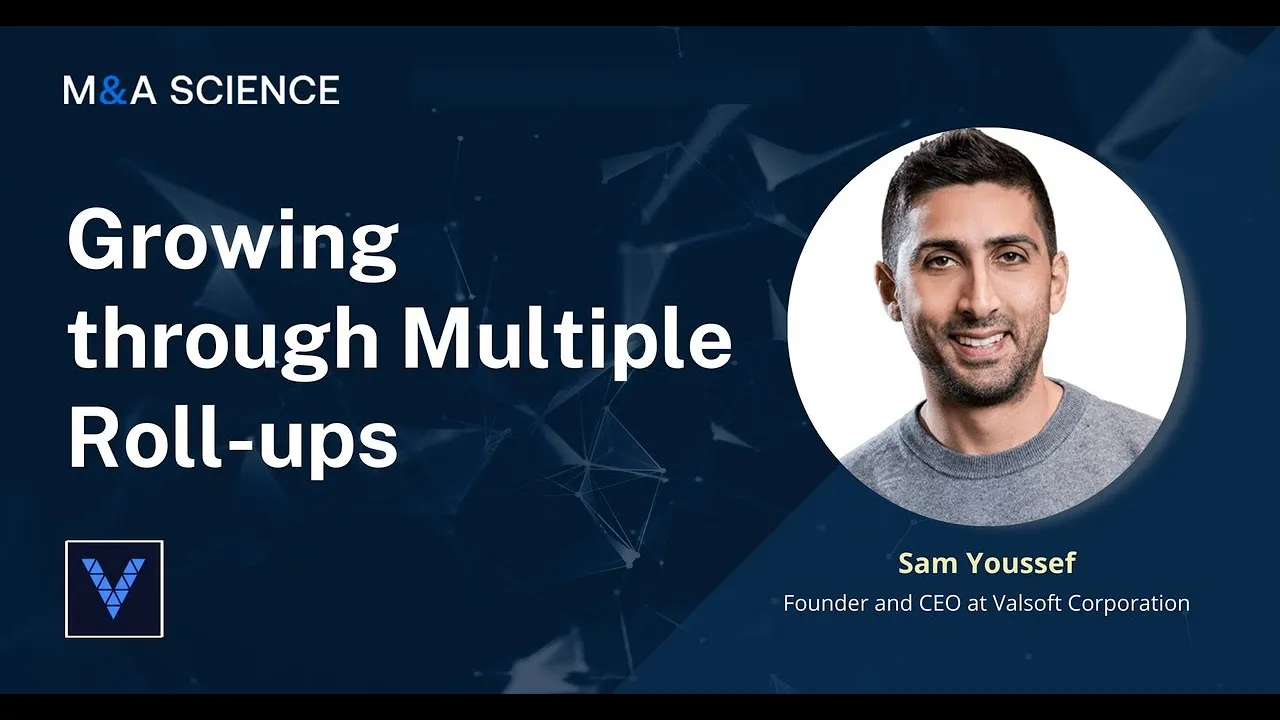
welcome to m a science where we curate Knowledge from the best in m a to continuously improve if you're interested in keeping up the latest from m a science subscribe to our free newsletter at mascience. com every week we share highlights from our interviews invitations to events m a role openings and other resources as we build the greatest community of forward-thinking M A practitioners again that's mascience. com I'm your host kisan Patel CEO and founder of m a science joining me today is Sam Joseph founder and CEO at valsoft Corporation valsoft is a company that acquires and grows vertical software businesses that provide Mission critical Solutions in their respective Niche or Market today we're going to talk about Roll-Ups in the software business [Music] Sam how are you doing today very good very good kisan thanks a lot for having me on on your podcast hey thanks for taking a break from doing all these deals to teach me a few things here can we kick things off with a little bit about your background I've been an entrepreneur since I'm a teenager I've had a bunch of businesses that I've started sold some businesses uh around around web marketing and then in in around in 2010 we got together my partners and I put uh 20 million dollars together or so and started an investment company called valsaf capital and then valsaf Capital started investing uh in the stock market and then we started learning a lot about the world of investment and how to compound capital and what type of businesses we're good and what the businesses were bad and we invest in more and more businesses and and we got it we fell in love with the software industry throughout throughout that study period we were investing a lot in acquisitive companies because we found they tended to be undervalued in the market because a lot of the value they brought was through Mna and the market doesn't have a good ability to predict that into the future so it didn't discount it properly in the price so a lot of these good acquisitive companies tended to be undervalued by the market so we got to learn a lot about companies that do Roll-Ups and we studied very many of them and uh and then in 2015 we decided to do our own so we we bought our first software company and then three more the year after and then eighth more the year after and this year we're gonna buy 30 of them or so you went through your life story so quickly that was like a minute and a half but you you went from the Teenage entrepreneur which we could probably unpack in the whole interview there uh and then you you went through some exits and in that process uh got together with some folks put together some capital and it seems like there still was a lot of learning there to come to this conclusion or an area to focus on with acquisitive companies so what what started it what was their first business uh we had a few businesses all focused on affiliate marketing and advertising then we had a really large uh adult company which we sold because we were uncomfortable with with the business and uh but how old were you you said you're a teenager back then no I was in my in my early 20s early 2004 to 2010 we started many businesses ad networks a few a few different web marketing businesses a lot of that knowledge came back later in our lives when we uh also we have another business that buys uh web companies called valnet but our primary activity today is is a software companies we buy software company and we still actively trade the equities so it's really a passion for investing there's the the part I'm trying to point out is these parts in your background that lend to this pedigree that I think you look at m a a little different because when you understand how a business really operates in and out and even ground up as you've built one I'm just curious of how do you look at that you know we'll get into the investment size but functionally of buying and growing companies through acquisitions yeah I think I think uh you know Warren Buffett said I'm a better investor because I'm a businessman and I'm a better businessman because I'm an investor I think I found that to be really true with it's my experience my knowledge of business has helped me invest better in my knowledge of investment has helped me manage our businesses a little bit better so in that period from 2010 to 2015 we really really learned a lot I mean I used to I used to maybe read something like 2 000 Pages a week of 10ks analyst reports I used to listen to earning calls and I I used to really deep dive into companies to understand their economic characteristics what made them great what made them good companies to be able to predict which companies are likely to do well into the future because that was my job at the time and then invest in them and you know when I studied roll-ups uh I I found that you know a lot of them that did well they were buying the underlying businesses they were buying were businesses that lent themselves well to uh decentralized investment strategy or by bringing the businesses together uh they had the tremendous competitive advantage to roll up the next business but in every case they sort of had a clear reason why they earned the right to acquire and then there's a lot of other companies that engaged in acquisitive activities and just wasted shareholder Capital because they were putting businesses together with no real purpose and they hadn't earned the right to be an acquirer you earned the right to be an acquirer by managing the the businesses better than they were previously managed because you could drive more growth out of them or you could drive more profitability out of them or you have something to bring to these businesses that will make them better in one way or the other right and uh and we advise our strategy around that and our investment Playbook around that and we try to buy companies that are intrinsically very good businesses and and then we try to run them a little bit better than they were run previously so you looked at all kinds of companies investment strategies came to this realization the companies that did good acquisitions were better Investments undervalued um it's almost like they they kind of have this forward trajectory that you found to be a little more predictable is that fair to say I was personally comfortable with it because I could sort of uh so in my life and in my business career I found that people drove outcomes uh in business so if I could predict how somebody thinks how the management team of a company thinks and how they're likely to behave into the future through looking at what they've done in the past and and mne was part of their past and they added a lot of value through that then I was able to you know look into the future and I was able to underwrite that into my my um my price at which I'm ready to buy the company and then we were able to buy companies uh that the market thought was were expensive but we thought they were really cheap because uh we were underwriting Capital deployment that would that was gonna be a creative into the future uh companies like cushard companies like transline companies like constellation software companies like Berkshire hath or a lot of those companies you know um sort of framed our investment model for what uh what we would later build it's interesting so you look at this element around Acquisitions you distinguish between good Acquisitions and bad Acquisitions and then within and so their bad acquire they're not creative in Acquisitions not a good thing you want to weed those out but on the good acquirers do you distinguish with the strategy because it sounds like part of what you're referencing is they could be very focused on more of an economies of scale or doing a traditional roll-up or being more strategic in nature do you distinguish between those two and it mainly would be those two and look favor one over the other or is that well we looked at Bolton we invested in both for example uh you look at a company like uh like Salesforce a very strong require what they would do is that they had a base of customers and then they would append product that were uh that would add value to these customers and would make the customers more sticky and they would leverage these customer relationships further and provide them more products that they needed so every time they bought a company it looked very expensive but they paid for it versus the the revenues and profits the company had at the time but then you expose this product to the to the large customer base of Salesforce and and their revenues would go up a lot so then it would become cheap and then this is this is one of the strategy that's allowed Salesforce to compound at a very high rate for a very long time and it's not very different than a strategy that like a company like Microsoft employed for many many years then you look at a other requires let's see you look at a trans line where the the companies would would keep running independently so they weren't necessarily have a lot of synergies with each other the products but they developed expertise at running these companies in a way that allowed them to extract more revenues they had best practices through learning from 50 different Acquisitions that every time they bought a company they're like we're gonna these These are the the this is the Playbook we run to make this company more efficient higher revenues higher profits and they had earned the right to be an acquirer every time they made an acquisition they would add value to their shareholders whereas a lot of other companies they would just buy they would just buy companies to grow their revenues but they really would not add any value uh to the shareholders or to the customers or to the companies that were acquiring themselves right so we don't invest in those and then we invest in the form regardless it's either you're looking for their capability to drive synergies off the revenues or an element around the operational efficiency yes one of the two okay ideally both I agree both that's on our that's that's how we sort of uh studied the choirs and determines which one I'd like you to dwell and we did really really good with it how did you figure out the segment and maybe you can help me get a a sense of even company size that we're talking about because I it sounds like there's a spot I remember what I was talking about before that you really laser in on so first of all if I get to software before before I I get into the size so we were studying these companies and then you're investing passively into businesses on the stock market you're looking for companies that have certain characteristics so you want a lot of predictability because you're not managing the company every day you want your own sort of be able to model in your head and a spreadsheet what's this company going to look at like in a few years so we found software companies had a very high level of predictability a lot of them had pricing power due to the fact that they were very important to their end customers they had a low charity rate enabling us to sort of we're starting next year with 98 of the revenues we have this year it's much easier business to manage than if you start from scratch next year right so this this made us really focus on software and then we started studying a lot of software companies and we invest in a lot of software companies and then we're like okay maybe we could do that on our own so then we started looking you know where where can we add value in the marketplace where is there uh a gap in the market that we could fill where we would earn the right to be an acquirer and make good acquisitions that would add value to our shareholders into the whole constituencies the the companies that sell to us the employees are the companies that sell to us and everybody else so we're like there's there's in the vertical Market software there's about 30 000 of those companies and most of them tend to be in the in the you know to to 20 million dollar range because the vertical markets themselves are small so the vast then there's the a few bigger companies maybe a thousand of the three thousand or larger companies the larger companies are to a certain extent usually easier to manage so if you if you have a large Revenue base you'll ever you leverage one r d budget across much more customers and they're usually in bigger verticals that tend to attract venture capital and private Equity a lot more so we didn't feel that you know we would bring tons of value there but at the small and mid-sized markets they have to be operated a lot more efficiently uh to bring value and we felt Within valsoft by learning how to operate those properly we would become you know a good exit strategy for these companies we would provide something valuable for these entrepreneurs that have those companies and that you know want to move on or the companies needed to to go to their next step we would buy them and we would help them make that transition right they're a different phase of their life cycle sometimes you know they're operating in a market that's uh that's saturated so the the deploy money in r d and sales and marketing but uh there's no new customers to grab because everybody's vended they all have software Solutions so you have to go get them from your competitors but these competitors have sticky Solutions just like you do so the company has reached a point in its life cycle where it's sort of uh blocked from growing right and it's mature and in a mature company you tend to lose your best employees it tends to be less fun to work there when there's limited growth so we come in we'll buy these companies and we'll be like okay you know what now I'll give you money and expertise to go buy your competitors and then acquire your growth and then create a dynamic company where you have a much bigger customer base to which you could sell more product and then we'll go buy other adjacent product that serve that vertical and create a really Dynamic uh mini conglomerate around that company we initially acquire and that we found brings a lot of value to the employees that the companies require the owners of the companies we acquire and and and our shareholders and employees as well I like how you explain it it's simple to understand it gets me fired up makes me want to go find a sector to roll up yeah it worked well for us we've scaled the company's significantly over the last I think over the last uh five years we completed over 60 acquisitions now when you look at that 60 are there a number of platforms that you look at saying hey here's a platform play and then you did all your add-ons around it yeah we usually gonna enter a new vertical with a platform company so in vertical Market software and software in general you're building one product and you're selling it to many customers right so if you have a lot of customers the same r d budget gets levered across much higher Revenue base right so if you start with a very small company in a New Vertical you're starting a week right so you have to start with a company that has a little bit of pedigree in a vehicle you enter strong you have staying power in that vertical and then you look to buy companies that have interesting customer relationships right and you bring those into your platform and then you could buy uh companies that have interesting products and then you could sell those to the bigger base of customers uh and and there's a lot more you could do and that's that's our strategy but all the companies that we buy independently uh we usually manage them in a decentralized fashion meaning we keep most management teams in place and and whatnot and all the companies we buy we need them to be Mission critical to their customers we need them to have a certain level of of um uh strength in their customer base meaning they've been around for a little bit of time and they've shown that they bring a lot of value to their customers and yeah the the companies by themselves have very interesting uh economic characteristics that have allowed them to you know we bought a company this year that had been around since 1955.
so this company is a small company and independently they've weathered think about what's happened over the life cycle of this company seven years and it's remained independent and it's remained successful and it's weathered every attack upon it's it's uh its domain so there must be something about this company that's special right big common point I'm seeing in your approach is around this operational efficiency and driving value out of improving that and then as you acquire companies when you start with your platform then you start looking for those revenue synergies is it something adjacent that gives you an opportunity to cross the upsell solutions to create the additional Revenue yeah I mean though for us for us first of all we got to buy the company at a price that makes sense we underwrite each acquisition on a standalone basis and we underwrite it to our irr unlevered irr that we will get from this acquisition so I've studied like I said the amount of information we've gathered on on successful and unsuccessful acquirers is our IP it's the IP of our Investment Group it's what's allowed us to be successful across two Roll-Ups so far and a third one coming a lot of acquirers are gonna be like my stock is trading at 15x ebitda I could buy companies at 10x seminar this is a creative to my shareholders I make a good deal my stock is going to trade up on the news let's do it those always fail in the great in in the long term those those why will always fail well it's simple like what your stock trades at is a moment in time there's a very this could very very widely and when you're purchasing an asset this is a long time long-term investment you're making with your shareholders Capital you need to make sure you're making a good deal Standalone you need to look at the irr of this investment on a standalone basis modeling and very conservative terminal value because the further out your your modeling the the less certain it is because the world changes a lot in five ten years right It's A New Concept for me again yeah you know I mean a lot of people don't use that right the the market is high well it's been that crazy yeah right yeah the market is hot so we buy and then our stock trades up but you know what now it's not trading up anymore and now you're on the road three percent that now you're gonna be your your debt is going to move to eight percent when you refinance it and and what happens to to your investment then did you really make a good investment or with your shareholders capital uh we operate by the philosophy that you know opportunity is sure to come back but destruction of capital is permanent so for us uh you need to be really careful in amazing and um the way we we we do it is we need to have a lot of looks so we have 60 people full time in everything uh always looking for opportunity and looking all around the world for good opportunities for us to deploy our capital and at any moment in time we have over 20 due diligences uh projects ongoing the reason we do that is to be able to you know really be selective in which companies we invest if you're looking at three companies and you're looking to do M A and I mean the the the the the pickings are Slim Right you you don't get uh really to choose your opportunity effectively so first we want to make sure that if we do everything will do good everything for shareholders and we have no problem not doing any uh so Capital discipline is a big part of this which I like you to stick to the values of irr and the stuff that really makes sense despite Market fluctuations you know I guess I was I was thinking about negotiations on this stuff when you are engaging with these companies and you have the sizable team are they engaging with the owners directly when do when do you get involved my job at this point is more of like uh risk officer or I may I I'm just making sure that at the end when we write a check we're making a good decision a lot of our many activities are done by our Investment Partners we're one of the few companies that has a decentralized capital allocation strategy so we have Investment Partners that each run their own investment organization they each have a portfolio of assets and they're responsible for the returns the growth and the deployment of capital for that portfolio of assets and they they are the ones that speak to owners they make deals and occasionally I'm going to get involved with it's a bigger deal and I want to know more but generally speaking our Investment Partners investment directors are the ones that are making the investment decisions advanced so I was going to ask you how do you differentiate yourself from the PE firms first of all the type of the smaller the smaller the company the harder it is for a PE firm to run right so it's rare we see p firms coming in the sub 20 million dollar market because uh often you know putting one of their management teams in the way they run business it's it's not going to be there's not going to be enough scale to war in the effort when you have five billion dollars to deploy right um so we run into them less and also in our in our uh field we provide a very attractive uh exit strategy for owners let's say we keep our businesses forever so you sell more you sell to us a very rarely are we are we ever going to sell a business only if it's the best thing to do for the business but as far as well soft is concerned we want to keep all our businesses and um basically we buy we hold the business we invest in the business with a 40-year horizon we make investments that might not pay off for five years uh and we buy businesses that we expect to stay around for a very long time that's a very different strategy than a company that's gonna and a p firm that's going to buy a business with the goal of selling it in five six years you're going to make very short-term Investments you're going to make cuts and staff you're going to run things very differently than we would um given our model it's like a bootstrapped uh model at scale because you're really disciplined about how you run those businesses we have a valsoft system so A playbook that we apply and we have best practices on how to manage these companies and we have like leadership Summits that we run to educate all our our CEOs and how to better run their businesses also this is something a lot of that we learned from our own experiences like sometimes running a company is a very lonely experience you're at the top of the company and everybody listens to you and you don't really have the peers to uh to to run things by and we bring these companies together and we give them like a network of peers that can help them it makes their lives and their uh careers more interesting like I've had this saying here people make decisions based on what makes their lives better not necessarily always what puts the most money in their pockets right so a lot of owners care about money but they also care about their employees their future their careers within the acquirer so there's a lot of things we bring that private Equity doesn't necessarily bring to the table uh I get a sense of some of that that you focus on the smaller deals this the financial structure I'm still a little lost on because you said 40-year Horizon you're investing on I you're not I'm familiar with the firm operating on a structured fund and investing in with the time Horizon to exit then you have more of these um sponsored activity you know you got a search fund or a fundless sponsor and you're a little more ad hoc about putting the capital and I've seen some interesting things around that where people find their approach of getting the Visa investor money and they populate and fund on more of an ad hoc basis and then realize the value on the individual exits of those deals but you have a really long-term strategy how do you yeah what's the mechanics behind that I'll tell you a little bit about it so when when uh sold a few businesses I was 27 years old 28 years old uh got together with our partners we're like we retired we were retired for like six months hated it absolutely hated it so we're like we want to work we're going to do something with our lives when the sense of purpose that work gives you is sort of important and we're gonna put this company together and our advantage is going to be our time Horizon we're gonna do things that you know other people giving their Capital structures cannot do so you know we started these investment activities like some that a lot of things we do other people can do because we start everything with our own money so it was all our own Capital we started this world we start businesses these we started buying these businesses within valsoft would intent to keep them and then these businesses would make us money and we would buy other businesses with them and then we got an external investor in in 2020 to February of this year uh that came into valsoft and then valsoft now makes its own cash flows there's no need for for incremental Capital the on the cash flows the company makes is enough to found the equity to fund the Acquisitions we make eventually we'll take valsoft public will retain a very large stake in valsoft and valsoft will keep deploying this long term uh Capital allocation strategy where we seek to build value for our shareholders for the very long term the goal is not to sell it the goal is to eventually bring it public whoever wants liquidity could have it alsaf will retain most of its take and will keep working at deriving value for shareholders yeah it's interesting you want to build a platform that caters to these smaller businesses and supporting their acquisition strategy while you broadly support their initiatives with your operational efficiency framework it's also pretty pretty cool model the same the same Capital discipline that we bring to the acquisition side we bring to the investment side internally into r d project sales and marketing efforts new product developments and all that whether we allocate Capital internally or externally we look at it with the same return Criterion what do you think are like the real key things to making this work because I got a good sense of your strategy and I like it and it's getting me fired up to think of our own m a strategy here um what do you think are those key things because I'm I want to get I want to understand ahead of time where are my big hurdles going to be so I can focus on asking you better questions to get over them I could tell you maybe a little bit of of uh my failures some of the failures I've I've had in some other parts of our business careers so we own this other company called valnet another company sponsored by the valsad group with the goal to deploy cap but towards websites so we own Brands like screen rent like moms. com like hot cars and and give me sport in the UK some very very large web publishing Brands early on in the development of this company I tried to do the similar Playbook I'm I'm deploying at valsoft which is buying independent companies and independently decentralized descent managing a decentralized fashion and make good investment and it didn't work uh the reason it didn't work was these companies needed to be very well managed uh to have staying power because the competition is so Fierce that they are constantly attacked and unless you have remarkable editorial ability or remarkable ability to drive advertising revenues and then redeployed that and great editorial and video content you these businesses tended to do poorly so they would do good for the first year and then like second third year they would like die or not do not do well so then we switched the acquisitive strategy and we started buying sort of we start developing Val Net's competitive Advantage so we developed the network of freelance content writers and we had you know 4 000 freelance content writers around the globe that could sort of produce content for our properties in a very cost-effective scalable Manner and then we built the the the advertising engine that would power our properties to be world scale so every time we buy a company we could generate a lot more money than they did from the companies because of the ad relationships we had and the strategies we had around that so and then we started buying companies that were much more established and already had staying power and brand Authority so then we would buy these companies we would plug in our Superior content strategy and our super monetization strategy and then we would increase the viewership to our content increase the monetization through our ad strategy redeploy the capital we make into uh into Superior content and then the business would start growing really nicely and you know screen rate became one of the biggest publishing groups in the world uh and we have many other such success stories at the moment but the initial Lesson Learned was you have to earn the right to be an acquirer if you haven't yet you need to invest internally in your business to be strong enough to give you that right yeah so so uh so that that's uh sort of uh one of the Lessons Learned there and the lesson learned number two is you have to buy businesses that have staying power because often when a company goes through the acquisition process it's gonna be mismanaged for a little bit you go through some some team members don't adapt well to the new acquire and the integration process can be tumultuous so you need to buy companies that on on their own have staying power right and and they're they're not fickle uh uh and these are some of the the lessons I've learned in my career the thing I'm picking up on is you're you deliver on those synergies when you have a plan on these Acquisitions and how you're gonna drive value from it and basing it off those synergies it sounds like you execute and deliver on those how do you do that well we have to I mean this is our this is our job it's it's most people don't do that they talk about it and they don't and they pretend they do and then people ask questions and that's not good for us for us every acquisition is we build a business acquisition thesis the day we buy the company and then we have integration reviews uh weekly for a period of six months and after six months we have a business acquisition review going over the results of the of the integration and did did our original six-month plan pan out two years later we have another business acquisition review and this is something we do diligently for the 60 Acquisitions we run and we include large pool of team members in these business acquisition thesis and business acquisition reviews to sort of what are the lessons learned where did we mess up on this one so we constantly get better and then knowledge sort of if you're running one company you're learning from one set of experiences if you're running 60 companies you're learning from 60 different sets of experiences if you're able to have a good uh strategy to share that knowledge then your knowledge should compound much faster than the independent than the knowledge compounds of the independence and you should become stronger and stronger over time and this is something that's true for everybody that acquires businesses right and and learning from from that for your future acquisition activities is very very important how much of this is you Hands-On and I Know It evolves from the early days to where you're at now but really getting the right people in the right seats you know I almost feel like there's you need to build a team to execute this I'm curious who the cute people are there and then we can get into the knowledge sharing it's tools process and people right yeah first of all if if you're not if you're not using a deal room you don't know what you're what you're doing you have no chance [Laughter] then your process Rome is your process for continuous Improvement and success so you gotta have the right process to be successful and the most important thing overall is if you have the wrong people no matter the quality of your tool you could be using deal room but if you have the right people here you're not you're not going to be successful so we put we have a culture here we call it a meritocracy so our goal is to be fair so we don't run our culture is not a family so not everybody is welcome no matter what our culture is a sports team we're going out there to win we're going in the marketplace it's an environment where people are competing with us every day and coming to eat our lunch and we're out there to win and to deserve to be a member of the team you have to earn your spot on the roster and you have to deliver for the other members of the team because they all want to win together right so that means that the the spoil's got to go to the people that deliver and sometimes people that don't bring enough to the team well you have to move on and they're just not the right person at the right time for that team to win and being fair in a company and an investment organization is very very difficult it's much easier to say than to do I that's a really great way you put it I think it's the right philosophy is you need that competitive drive and building it more as a sports team yeah I mean this is this is uh this is the reality of the markets we operated how do you share learnings or how you come describe the way you compound learnings into a way that gives people up to speed faster driving value faster leadership Summits that we run every year we're bringing leaderships of all our new and existing companies together and share explicitly over three days it's an off-site environment in a nice environment where people come they're looking forward to it they're there a bit of a vacation but they learn at the same time and and people that have gone through certain interesting experiences are going to share that with everybody else and then people are going to share the results and the performances of their businesses and other people are going to ask questions so there's these official forums then we have groups where where leaders are encouraged to post and to contribute to the to the community within their groups like in the r d groups the r d leaders are going to contribute knowledge there the the m a peoples we do we have investment seminars once a month where we go over uh a lot of the deals we looked at okay what did we bid the right amount on this business did we under bid did we overbid this is also we'll do a lot of our business acquisition thesis because business acquisition reviews during these monthly investment meetings and these things take time but we find they bring tremendous amount of value because the rest of your month becomes a lot more efficient you could know how to allocate your time units a lot more efficiently uh with this information yeah the other thing time management because I don't see how the hell you could do all this I was curious on who what gets delegated like those holding those kind of programs and development of it yeah you know is there like a CEO you have that does a lot of that or you know no I mean I mean uh we have a very large and a large and quality group of people and all that is it a community effort right like the leadership Summits it's going to be you know 10 different people contributing data or 20 different people contributing it's it just sort of we only put the schedule together and invite people and then it doesn't come from the top valsoft is a decentralized so we have a lot of CEOs within our our business that you know probably would have the ability to do my job so it's a very deep bench of of talent uh here yeah you got the culture and my role is is uh predict the things that could hurt us and sail the ship in a way that will avoid us going there right so look look around the corner and uh what do you call it guide the direction forward yeah and constantly look at deepening the mode that's around our business you know what what what Trends exist that could make us less competitive and what do we need to do to become more competitive five years from now these seeds need to be planted today uh if we're going to be successful in the future look at you know the biggest market caps in 2000 and how many of those are still the biggest market caps today or look at the biggest market caps in 1980 how many of those were still the biggest market caps in 2000 the answer is usually not right it's usually you constantly companies die and I think the job of a SEO is to make sure that your your ship is strong and you foresee these events and capital allocation and how you Orient the capital allocation of your company is a very important job for a CEO and too few CEOs are poor at it and you know I try to be good at it too few or is it too many too many CEOs are poor at it too many CEOs are poor at it you know often seals raised through the ranks of the companies because they're professional organizers or or uh they're great leaders and I think those skills are necessary but as a company scales the capital how what you do with with your money is very important and how effective you are at deploying that is very important any big advice for companies that want to do roll-ups you know I'm just trying to think any other key challenges to overcome but what's your I think my biggest advice would be before you you get into M A and like most M A is destructive shareholder value most companies are gonna buy in years like you saw deal making in 2021 was an all-time high and 2021 were deal making was at an all-time high is also a generational peak in valuations so most companies bought companies at all-time highs right so a lot of that M A is going to end up being destructive to shareholder value and a lot of that is going to lead to these companies being weaker as a result of those M A efforts rather than stronger I would say I read a lot about this about the trends and who was successful at it and start with that start with rather than start with a blank sheet of paper start with who was successful at it and identify uh patterns in the behavior of these companies so read about that um and then make sure your company has you're not acquiring just to grow you're acquiring because you will do something with this company that will make your overall company stronger and better and improve the forward trajectory of your company Acquisitions for the purely growth are usually not good either so put some thought into it it's not it's not always obvious right and then you look at m e this year now q3q4 2022 and it's at uh it's at a very low level right whereas right now is probably the best time start buying because the prices are lower right and and there's less buyers out there than there was in the future so now is probably a good time to start looking for uh mme especially if you got cash yeah that's the that's the thing is it's harder to come by these days before we wrap things up Sam can you tell me what the craziest thing you've seen in m a the craziest things I've seen amen there's there's some uh there's some messed up stuff I've seen and maybe I've seen a lot of of uh what's the craziest I could tell you two are the best Acquisitions I've seen there one of the best Acquisitions I've seen would be uh YouTube's acquisition by Google and Instagram's acquisition my my Facebook those were legendary value creation acquisitions I remember I remember Microsoft buying an ad tech company uh for for uh 6. 2 billion dollars I think it was in the mid-2000s and they rolled off the whole 6.