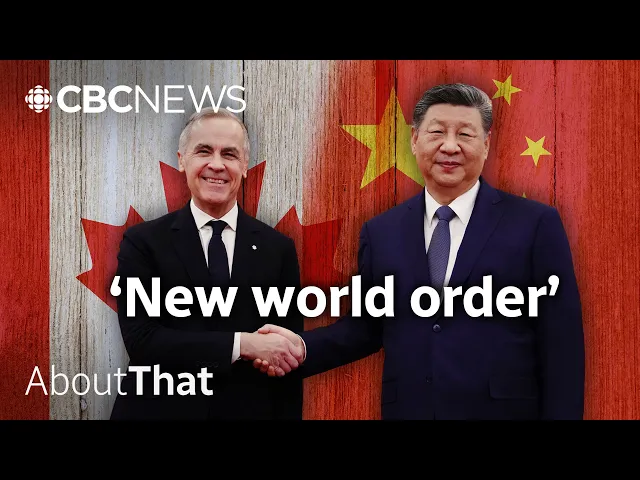
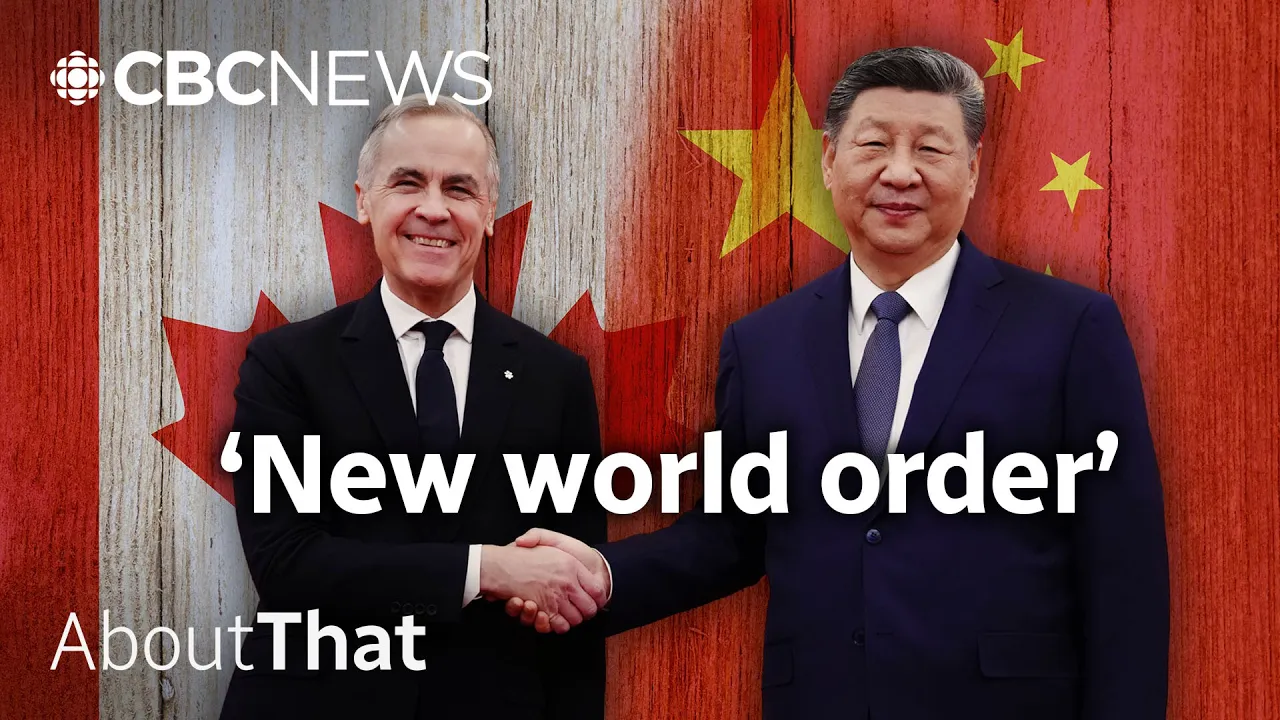
And I believe the progress that we have made in the partnership sets us up well for the new world order. >> Mark Carney has just made a series of deals with the Chinese government >> after years of frozen diplomacy. China and Canada have just signed multiple pledges on economic cooperation.
>> And that first part is important too. This is very much deicing a very cold Canada relationship. There's no natural magnetism here.
From the Canadian arrest of a Chinese CEO to China's multi-year detention of Canadian citizens to each country spending the past year imposing tariffs designed to hurt the other. Up to 100% tariffs in both cases. Plus the fact that before Carney's trip a few days ago, the last time a Canadian prime minister visited China was in 2017, almost 10 years ago.
This wasn't so much a pull as it was a push. The economic order is becoming rewired. It is necessary for us to diversify our trading partners and to grow non US trade.
>> And it's not just China. Carney has sought a new relationship with Qatar as well, an energy superpower among the wealthiest countries per capita on the planet. Because why >> the multilateral system that has been developing these is being eroded to use a polite term undercut use another term.
So the question is what gets built in that place from even before Trump's first day in office one year ago to the day that this video goes out. Donald Trump openly talked about Canada as a country to be controlled. >> Canada should be a 51st state.
You get rid of that artificially drawn line and you take a look at what that looks like. >> This was just a threat, of course, albeit one that dragged on and on for some time. >> I called him Governor Trudeau.
I said, "Listen, what would happen if we didn't subsidize you? " >> But there was also another much more serious attack. We're going to put very serious tariffs on Mexico and Canada.
>> This was the start of an all-out trade war with Canada. >> The USC Canada relationship is on very shaky ground and there's really only one person to blame for that and that's Donald Trump. >> Canada's steel and aluminum industry is bracing for a seismic hit from US President Donald Trump.
25% tariff on all steel and aluminum imports. >> 25% on softwood lumber could come in April. >> We don't need the cars.
We don't need their lumber. He has been clear he wants to essentially destroy the Canadian auto and steel sectors and he's been hugely uh detrimental to the forestry sector as well imposing massive tariffs and levies and duties. >> It's the combined effect.
You're undermining trust uh trust in the relationship that took generations to build. And one part of what may have undermined the trust between Canada and the US was that unlike in many past disputes between the two countries, the rationale for tariffs didn't actually always make sense. >> We're thinking in terms of 25% on Mexico and Canada because they're allowing vast numbers of people.
Canada's very bad abuser also vast numbers of people to come in and fentinel to come in. Less than 1% of the illegal migrants, less than 1% of the fentinel that comes into the United States comes from Canada. So, we're not a problem.
>> There is just such a small amount of fentanyl going from Canada into the US. If you look at the latest data from the US Customs and Border Protection, 3 lb went from Canada to the US and was seized by border officials in the last 3 months. that is smaller than even the smallest bag of potatoes you could find at the grocery store.
>> The subsequent actions that they've taken have had absolutely nothing to do with fentanyl. They used fentanyl to declare an emergency to gain powers to be able to impose tariffs and then they completely it seems dropped the fentanyl issue. >> Still Canada would play the game.
It appointed a fentinel zar, announced more than a billion dollars in investments in deploying new Blackhawk helicopters and surveillance drones. But this only appeared to delay, not stop, Trump's tariffs. >> Just hours before Donald Trump's 25% tariffs on Canadian goods were supposed to kick in, the US president suddenly put them off.
The tariffs he's long threatened and sometimes delayed came in with what's feared will be devastating effect. Negotiations around Canada's military spending and its contributions to the NATO military alliance would also be the source of a lot of friction because it wasn't just a disagreement about spending. >> They have a very small military.
We they rely on our military. We basically protect Canada. >> It was also an explicit threat.
>> One of the presidents of a big country stood up said, "Well, sir, uh, if we don't pay and we're attacked by Russia, will you protect us? " No, I would not protect you. In fact, I would encourage them to do whatever the hell they want.
>> And Trump's demand to purchase Greenland to force its sale by Denmark, a fellow NATO country, by way of quote unquote blackmail, a series of escalating tariffs on several European countries until Denmark agrees to sell to the US these 2 million kilometers of its own territory. Canada has a very clear position on that, too. >> It's a serious situation.
Uh and uh we're we're concerned we're concerned about this escalation uh to be absolutely clear >> where all of these issues are headed. Who knows? But that's the problem from the point of view of Mark Carney's government.
As in, who knows what the hell the position of the United States is going to be on anything going forward. A major one, by the way, being the trade deal Trump himself signed with Canada and Mexico during his first term, but which this coming year he wants to renegotiate. We'll either let it expire or we'll maybe work out another deal with Mexico and Canada.
But uh look, Mexico and Canada have taken advantage of the United States like just about every other country. >> KSMA is absolutely critical to Canadian uh trade and it's uh very important for the manufacturing sector in Canada, small and mediumsiz enterprise. It's not just steel.
It's not just aluminum. It's not just lumber. >> The Canada US relationship is fundamentally different now than it was a year ago.
And Canada and Canadians have taken a big step back from the United States. And there really is a lot of data to prove that >> it's had a corrosive impact. It takes generations to build trust.
It takes moments to destroy trust. It's going to take generations, I think, to build it back. Everything is all right.
>> Everything is excellent. >> Mr President, together we can build on the best of what this relationship has been in the past to create a new one, adapted to new global realities. >> What's sometimes hard to figure out whenever you have world leaders doing their thing, smiling, shaking hands, signing deals for the cameras, is what any of it really amounts to.
Welcome. >> Good morning. >> The China deal, for example, is for now more of a reversal of past aggression than it is a brand new bilateral adventure.
Before Canada imposed a 100% sir tax on Chinese EVs last year, it used to charge just 6. 1%. The most recent deal is simply a return to 6.
1%. and applied only to a limited number of imports, 49,000 Chinese cars at this preferential rate. China, in return, is planning to drop its previous retaliatory tariffs on Canadian canola products down from 100% to about 15% over the next month and a half.
But beyond that, there is more. More agreements to cooperate, for example, on clean energy, on Canadian oil exports, on improving communication between the two countries generally, and also a new series of strategic partnerships with Qatar in the Middle East as well. >> This is the first ever visit by a sitting Canadian prime minister to Qatar.
We've chosen to create greater stability, security, and prosperity together. You're going to hear those words and words like it a lot from Mark Carney. >> In the shared pursuit of peace, stability, and security, we've often worked together to pursue peace, security, and stability in the world.
>> Because this isn't, according to the Canadian government, just posturing, it's policy. >> It is time to swing for the fences again. And this is what the upcoming budget will be about.
building, taking control, and winning. >> Chapter two of the most recent federal budget is called shifting from reliance to resilience. It says the United States is fundamentally transforming all of its trade relationships.
We cannot rely on our most important trade relationship as we once did. There's talk of transforming our economy by tapping into diverse international trade partners. And then over and over again, $75 million over 5 years towards finding new markets.
$500 million over three years for market and product diversification. $5 billion over six years to secure new markets. The approach moving in two directions.
First, becoming our own best customer, meaning Canadians doing more business with Canadians. And second, growing Canada's trade with the world, doubling non- US exports over a decade, generating $300 billion dollar more in trade. Now, I'm not just taking all this at face value and supposing it will work.
I'm just saying they're trying. >> The strategy is creating optionality. Not all companies are or should leave the US, but for those that need to, we need to strengthen the ability of those companies to look at other markets to build supply chains with like-minded partners.
So, here's the problem. For the version of Canada that thinks it can diversify away from the United States, it can. But all of this is just laying the very first bricks of a very long road.
>> You can't just flick a switch and start selling your goods and services to the rest of the world. You're looking at 5 years, in some cases 10 years. >> Because the thing to remember is when Canada does business on the world stage selling the stuff that it makes, one country clearly matters more than every other.
And it's not even close. That's the United States who bought about 77% of what Canada exported in 2024. And the next most important buyer is nowhere near as important.
China, the UK, Japan, Mexico, South Korea. Not meaningless, but certainly not American either. >> You know, roughly 75 80% of our trade is with the US.
And that's not a coincidence. It's economics. The larger two economies are and the closer they are geographically, the more they trade with each other.
It's a bit like physics. The shorter the distance, the lower the transaction costs, the more you can trade. And for Canada, that is a crushing structural reality.
>> They will always be together. They will always have this connection because of geography and culture. The United States is so fundamentally important to Canada and our future and that will likely never change.
That's just the cold hard truth. And this is a relationship steeped in hundreds of years of history where the infrastructure for moving everything important. Roads, rails, pipes, cables, the entire Canadian economy is based around the immutable fact that Canada and the US are neighbors.
So the reality check here is that steering Canada's economy away from the US, it's like carefully untangling two trees that have knotted together over centuries. But on the other hand, that work, as painstaking as it may be, appears to be underway. And if Canada feels its money is better spent with China than with the US, then the US isn't just pushing away a key ally, it's pushing that ally into the hands of its greatest rival.