and the elastic collision the word collision here we go is define as two objects hitting each other sometimes they reversed by the way the step together explosion will happen separates them too but two objects track each other and in which the net external force is zero or very very small we call that a collision now usually most collision half conservation of kinetic energy which means the kinetic energy before I equals the kinetic energy after but any collision in which the kinetic energy is not not conserved it does not equal to each other is known as an elastic collision just out of curiosity was there a word for if the force is Marsh like well as you call it the force is large yeah yeah just time I know what large force would be called if there's an m4 it if I'm not aware like humongous force now so what is them an elastic collision basically if to object hit each other and stick together that's definitely an elastic collision or they were stuck together explosion half and that the spaceship that's how the spaceship by the will work on that logic they used to put the astronaut in the capsule when they come home first they live together and the whole thing then at the end when the right to come home they move to the back end of the spaceship it's a little capsule that close the door little explosion will happen they want that explosion because that explosion will separate the two pieces will ship that the payload forward and they bring the other piece back to earth you know so that's called an elastic collision so inelastic collision an inelastic collision the final linear momentum we still have conservation of linear momentum that the kinetic energy does not equal the final one does not equal to the initial one so we can use the kinetic energy for an elastic and when they stick together we call that way completely inelastic and that's what we're going to use so when they definitely stick together that's what we're talking about completely inelastic collision I was watching the women's soccer world cup yesterday and you saw their load he is hitting the ball with their head the ball doesn't stick to it bounces away that's not in your lastic that's elastic collision you watch a train coming in or you try it toward trailer behind you you move your truck backward backward backward to the hooks on that trailer then they start to move together that's elastic collision completely lost like they're stuck together and they move together or you see the train coming in hoaxed another one continue moving forward those are elastic collision you see the sports too and hard especially on football when a person runs in tackles somebody they grab them hold them down and they go together that's elastic collision I mean I'm elastic I'm sorry just stick together elastic window bounced like and hockey sometimes they don't stick together they do bump each other that's you look like elastic because they don't stick together but if they grab them and hold them and they move do it together I can football that's any elastic so let's take an example with an elastic Oh completely inelastic let's say we have this is the before versus the after we have a train one of us is moving forward has a mass of 10,000 kilogram and is moving to the right add velocity of I don't know 5 m/s hits another part has a mass of 15,000 kilogram that is not moving after work that we were talking about trains it all happen visual stick together so after the impact they can look like this they get coupled together and now the system is going to move I'm assuming full of velocity V the question how fast it might be moving with the speed there now that's completely inelastic collision that means the initial linear momentum should equal the final than your limit what's the initial linear momentum mass times velocity or for the first one this is number one this is number 2 this is 1 and this is 2 the mass of the first one times the velocity of the first one plus the mass of the second one times the velocity of the second one here the stick together the mass they become it the mass of the first plus the mass of the second it becomes one object and that's how habit object terms of velocity to the right what's the mess of the first one 10,000 was the velocity five what's the mass of the second one 15,000 was the velocity of the second 10 equals the combined mass which is with 10,000 plus fifteen thousand times V 50,000 equals what's that 25,000 times V what's v equal to 2 meters per second notice it's positive value that means the direction i assumed is going to move it is correct I'll take another one that happens to me all the time I have a standard for a car and a lot of times i'm not paying attention i notice the tires rolling backward some on a hell they're stopped at the light there but here's the problem the mass of my car is that's fifteen hundred kilogram and i wasn't this card number one I wasn't paying attention my car was rolling backward because my foot was not on the clutch all the way there or on the brake that on the clutch but I wasn't pushing the break that far it's moving backward is rolling backward of velocity of what 1500 the velocity is backward lizards five meters per second well I'm just doing the direction when i get to the numbers i William now there's a small curve here smartcare coming behind me you know the only that much maybe 500 kilogram and is moving in this direction this of a speed of 1. 5 meters per second to the right he's moving forward rolling forward and moving backward we hit each other and somehow the bumpers got stuck together so this is the before now what happens after his car is stuck under my car see you stuck together so the two cars are stuck together and I've no idea which way they're moving so i'm going to see we're going to be going what do you think up or down okay let me change this to two instead of 1. 5 2 meters per second or 10 m/s not to moving which waving up or down now up okay then make the assumption you moving upward now if you're still going to be done but that's okay I don't want you to know I want to be wrong intentionally so let me define this direction is positive let me define this direction is negative so this is the after and we're not sure which was going to move so i put it going up I took a wad guess so the initial momentum before equals the final momentum the initial equals the final then we meant them before equals the momentum after what was momentum before I get the mass of that smart car let's label this car is called to hear the smart one this is 1 this is 2 this is 1 so its color on mass 1 times v1 plus mass of the second one times v2 after the impact the two masses the stuff together the two cars we are them to other times the velocity V and let's put the numbers in years positive and negative based on the direction for car one was the mess 1500 though is the velocity what is it yep negative 5 4 car to lose the mess 500 what was the velocity positive 10 when you put the two cars together what do you have for a mess two thousand times the velocity 5 5 times 5 is 25 is that negative 75 100 i think- 2500 2002 get v we divide by two thousand negative 1 point 2 5 m/s notices my velocity is negative which means what my direction i assume is going up what is wrong is going to be coming down so the net velocity rate still going to be done over the value of 1.
2 5 meters per second they're going to probably tell you on the software like going up going down you know so if they say going down then you go 1. 25 for you know it's going down then they're probably going to ask you for the speed which means a vector but they have to specify loss for the speed if I made this 15 guess what will happen they'll stop they hit stick together and stop drama at 15 because this side will be a 0 now 2000 0/2 thousands ero so I can play with the numbers make it go up down if I made so 15 will make them stop and they're 15 they rolled down more than 15 the little guy will push this one upward yeah the reason I know that's 15 because if you look at the mass this is three times that number see that 1500 25 this velocity it has to be three times that number to cancel it so 3 times 5 is the 15 anything below that this is too much momentum going so it's going to come down anything over the 10 this will have more momentum going up within this one will push it forward now just to show you that the kinetic energy is not really conserved let's look at the kinetic energy what was the kinetic energy before the kinetic energy after this should not equal to each other I'm setting them equal to each other but let's prove it what was the kinetic energy for this one kinetic energy is one-half the mass the mass of the first card is 1500 times the velocity squared ok can I use one-half MV squared and when was the kinetic energy after it's one half the mass is the combination of the two masses that's two thousand times the velocity squared and if I do my math this side that are not equal to that side eighteen thousand 750 25 files here 15-5 of 1560 2. 5 and when you have the numbers no it's not even close what the hell this enemy text message for that / on silent no is there an equal to each other love verizon you use 75% of your data plan you should buy some more but my data plan expires on the twenty-third it was today why would I buy more I still have twenty five percent the power of numbers you know okay just where bread lines then on a touchdown attempt we have two people are going to be blocking each other so we get there's two people this running back that's the running back of the girl with him once caught touchdown his mass is 95 kilogram and he's running a velocity or speed of three point seven five meters per second here we got a big guy try to block him linebacker the mass of the linebacker here is 111 kilogram and it's moving with the velocity so this one in back is going this way this one is running that way the velocity of this one is with 4.
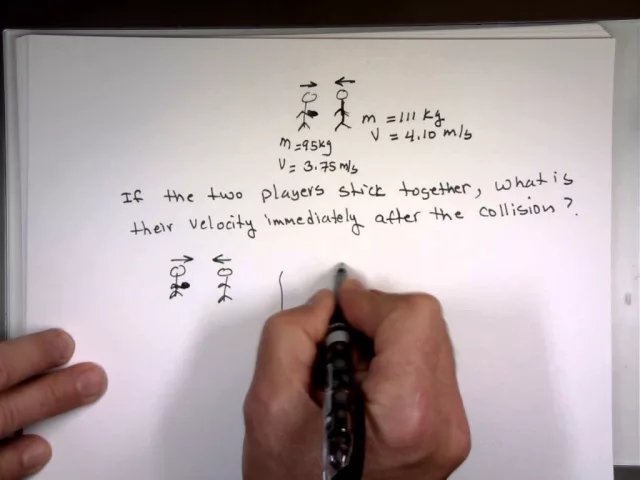
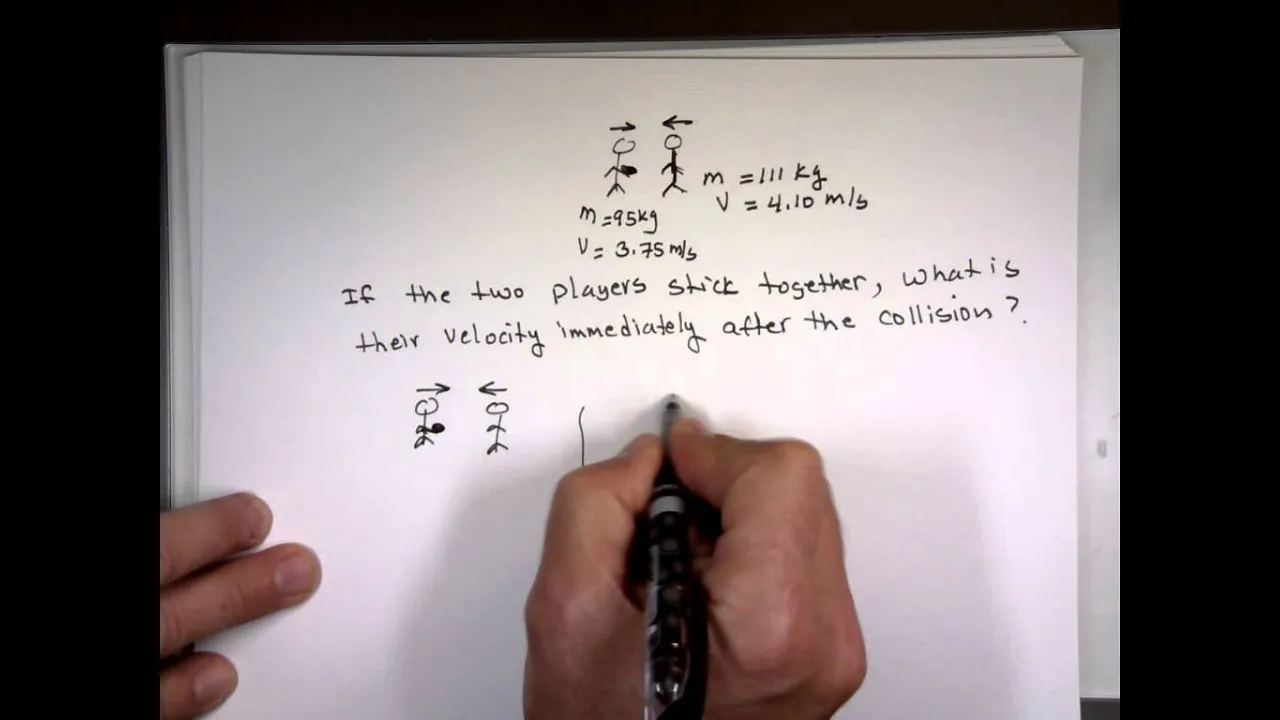
10 meters per second and we're moving well the block of their linebacker meets the running back head-on and holds him if the two players stick together here we go if the two players take together so if that's the case what is their velocity immediately after the collision what is their velocity immediately after the collision so here we go this is the before and after that before this is the running back carrying the ball this is the tackler running at him after to hold each other moving together so let's look at the linear momentum before now do we know which we're going to move the two players so which we want to make them go I'm going with the left Alex Alex want to make them go to the left and I kind of agree with Alex why this one has more momentum coming tom it's heavier moving faster this has less momentum so he's well it's going to go to the bit if you don't know it doesn't matter don't even think about just throw a direction if the value comes out negative is your direction is wrong it's backward so the before many years to the right is positive to the left is negative so now look at the linear momentum before the running back has a massive with 95 kilogram he is running to the right of a speed to 3. 75 the linebacker is going to tackle him has a mass of 111 but a velocity of negative 4. 10 now they stick together so with the combined mass is it 206 1 11 + 95 I think it's 206 and the velocity is negative V I'm saying is going to go to the left so I'm using negative to indicate to the left let's do the math and see what their number 95 x 3.
75 I can do the whole thing in one shot minus 1 11 times 4. 10 the left side is minus ninety eight point eight five what is V equal to and negative divided by a negative is positive point 4 8 meters per second that says I was right with my assumption notice point 4 8 it says yep your assumption the direction you go into the left is correct and how fast they're going to move together with initial speed 2. 4 8 meters per second if I made it go to the right and say they left this would be a positive V which will make the number negative that tells all the direction should be backward this is one of my favorite experiment we do sometimes in the lab wouldn't use guns in the lab but imagine this get a block of wood attached to a string by pendulum somebody fired a bullet at it it's a big block of wood here comes the bullet the bill is moving so the mass of the bullet what is very small let's say what ten grams has a velocity is moving really fast of I don't know I 600 miles per hour strike the block of wood this board goes inside the block of wood the wood here mass of the wood let's say it's two kilogram and his dangling as initial speed before the bullet hits it of with zero what happens as the wood as the board goes into the wood that would be grows in solid it didn't come out other than because why the word swung like this and moved up and the question how how did it go what's the height of it and the boat still inside it so traveling through that piece of wood the piece were attached to a string the string moves forward with it with the block and the piece of wood stuck inside it this is at your two problems in one here is the first part the first part is the bullet feminine the block of wood is sitting here the mass of this is two kilogram the velocity of this is zero the loss of this Tim Graham which is point zero one kilogram the velocity of this 600 miles per hour / 2.
24 which is 267 that's equal to hundred and sixty seven point nine meters per second it goes inside that and then I question was that velocity initial velocity right there or the final velocity so what's that velocity rather once the board goes inside the wood can you tell me what that velocity is in one side now it goes in it now they're going to swing so what was that velocity there what kind of collision we have here here it has the completely inelastic so if i take the mass of the bullet times the velocity of the bullet plus the mass of the wood times the velocity of the wood it should equal to it the mass of the billet plus the mass of the wood because I step together now times the velocity which is V what is the mass of the bullet point O one with the velocity 267 point nine plus the mass of the wood two kilogram times the velocity which is with zero equal the combined mass 2. 01 times V 2 points 6 7 9 plus 0. 67 nine can I get what V equal to it is 1.
33 if you kill all the digits m/s yes because that's the mass per hour so that's equivalent to two hundred and sixty seven point nine meters per second that doesn't really help me the question is how high did the block and the bullet rise okay since use the original one the reason one only if you go in one dimensional is your projectile was it if we assume there is no friction on the top like where this one attached it wasn't rubbing friction there we can use conservation of energy if we neglect the wind there that potential on the kinetic energy here equals potential on the kinetic energy right there so as the second part of it is right there has a mass now 2. 0 1 kilogram it's moving with the velocity of 1. 33 and it's going to go like this is going to go right here the Nasts still to be won the boat stuck inside that what the velocity on you to that point it will give formats and height stop moving so this is H if I use this as reference now I have conservation of mechanical energy if i take the potential energy plus the kinetic energy should equal the final potential energy plus the final kinetic energy number potential energy its mass times gravity times height kinetic energy it's one-half MV squared so how do we grow the potential it's the mass gravity which is 9.
8 what was the initial height zero the kinetic energy one-half the mass times the velocity squared equals what is the potential energy when you reach the peak there the mass times gravity which is with nine point eight times the height which is wit h plus the kinetic energy one-half the mass times the velocity square what's the velocity zero will you to the peak so I know these two numbers because you're multiplying by zero they go to zero so i end up with 0 point five times 2 point 0 1 times 1 point 3 3 squared 1 point 7 8 equals 19. 7 times h can you sell for h-here 1. 78 / 19.
6 point or nine years which is nine centimeter so the block of wood prison now nine centimeter with the bullet inside of it and I'm not sure how heavy the bullet be honest I've made it 10 grams couldn't tell you what real bullets are if we known that and we probably could I get a bigger answer with better answer and also made the block of wood heavy here as the combined mass one more thing on this then we've done with this section and that is every example i did with collision here and elastic collision was one dimension notice one dimension moving to the right moving up and down this road that's one dimension they're tackling each other one dimension in this direction one dimension so what happens if two dimensions did you stab them with two dimensions like what you get to this road here this big intersection so this is called call number one has a mess of 950 kilogram and this coming to this intersection is going this way velocity of 16 meters per second now we get a minivan here here we go it has this car number to her the minivan his number to the mass of the minivan a little bit bigger heavier has some kids in it wouldn't want to kill anyone 130 kilogram in thirteen hundred kilogram on hand 30 he has a velocity the minivan was going 21 m/s going to a soccer game speeding up a little bit there they get to the intersection neither one of them slows down well that's what's going to happen they hit each other but let's assume for the sake of this is stuck together so now here we go there's the car all dented there's the minivan inside the car is and they got trouble in that direction basically that's what's going to happen the team stuck together let's find the velocity here how fast they're going to be moving and also the direction theta what's that angle what we need to do look at in the X direction in the Y direction okay X Direction X direction that's to the right that's the X direction and this is the right direction in the X direction the initial linear momentum should equal the final linear momentum let's look at the initial linear momentum in the X direction car number one was the mass of that car 950 what was the velocity of the car 16 card number to go was the mass 1300 was the velocity of car number two in the x-direction 0 it wasn't going in the x direction the net result now the two class stick together they become one mass and how happy that car now is it 2209 50-plus 1300 I'll do it like this I'll use a character for that and what was the velocity in the X Direction here what was the velocity in the X direction of these yep can't be 0 going that way yep V cosine theta whatever this value tends the cosine to get the value in that direction so we know this piece goes to 0 so we have 9 50 times the 16 15,200 equals 9 50 plus 1302 250 times V cosine theta so if i'll divide by 2 250 i have 6. 76 equals V times cosine theta notice that two unknowns in this equation now let's look at the Y direction so this was the X direction right here let's look at the Y direction in the wild direction let's look at the car here the 950 was the velocity in the Y direction of this car how fast was this car going up and down 0 plus the minivan which is the last thirteen hundred times the velocity in that direction which is what 21 equals the combined mass and what was the velocity in the Y Direction V sine of theta 27 300 equals 2 250 v sine theta i'm going to divide both sides by 2 250 v sine theta equals what 12. 1 and that's my second equation so now i have two equations by two unknowns just a matter of solving them this is one this is the other one so let me write the two equations down try to solve them physics is over now is the math G sine theta equals 12.
1 the other one V cosine theta equals 6. 76 and now solve them I can solve these anyway I want that in your substitution or I can just take the two equations and divide them if i'll divide this by that the v's will cancel each other out what's sine divided by cosine tangent let's 12. 1 / 6.
76 1. 79 to get theta it's always the inverse tangent second tangent to second tangent 1. 79 60.
8 degrees and you can grab you that equation now sign 60. 8 i took that equation to solve for v so take the sine of 60. 8 12.
1 equals V times point eight seven so what is V equal to 12. 1 / point eight seven 13. 9 m/s 13.
9 m/s how many miles per hour 2. 25 or four going 31 miles per hour approximately so the two cars will hit each other stick together instead of staying on the road they're going to move over the grass in that direction velocity of 13.