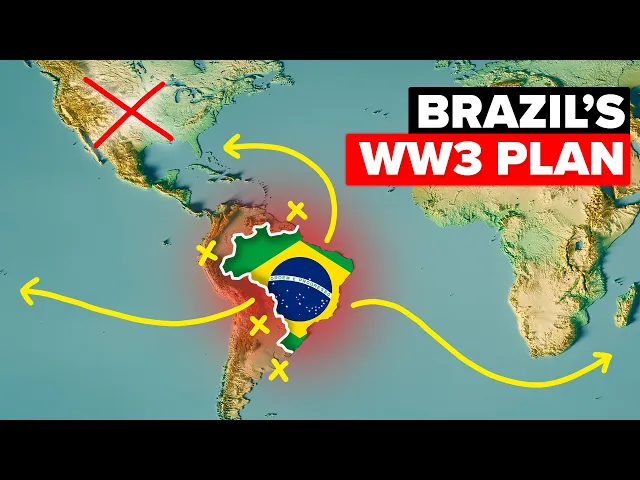
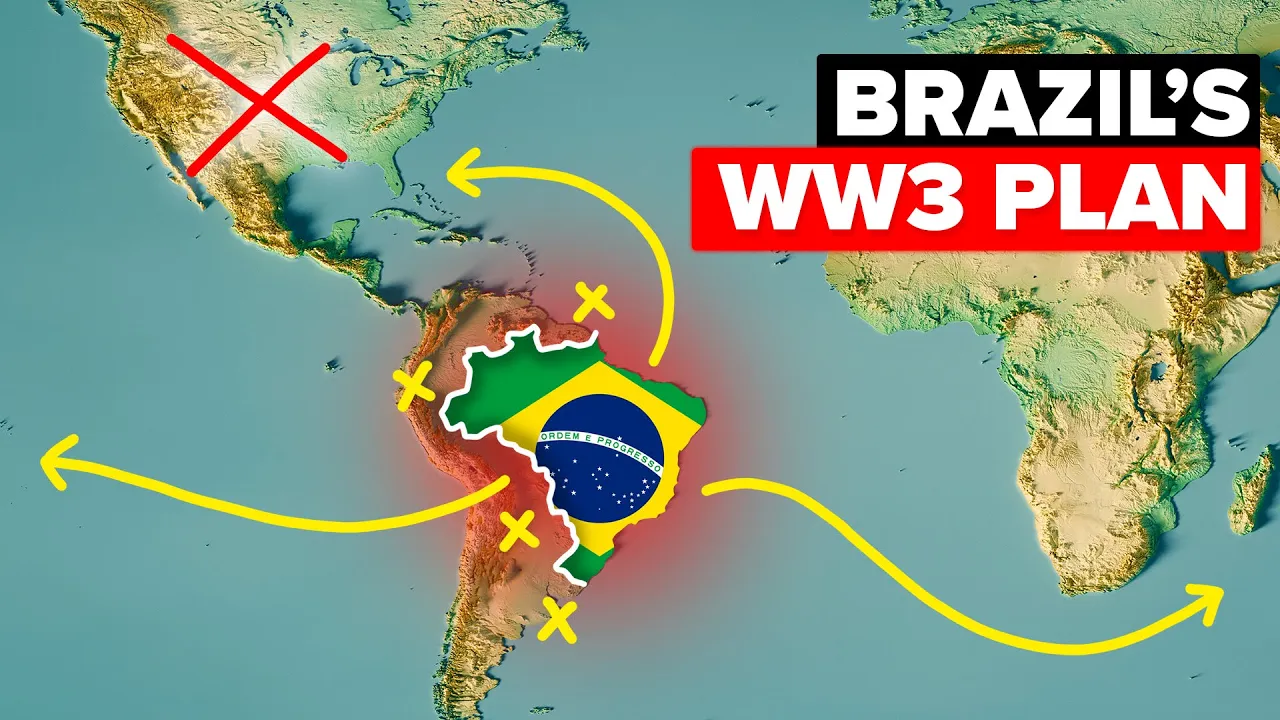
Brazil may seem far removed from any truly global conflicts, but the most powerful South American country finds itself at a crossroads that could put it in the crosshairs of either the US or China in a third world war. How does Brazil plan to navigate a third world war, and what side would it find itself in? South America may seem too distant from Europe to have had much involvement in either world wars, but Brazil found itself caught up in the global conflicts anyways.
During the First World War, Brazil supported Britain and its allies, helping patrol the waters of the south Atlantic and sending a small expeditionary force to the western front towards the end of the war. But in World War II it found itself playing a larger role. When the war started, most might have assumed Brazil would throw its weight behind the allies once more- but Brazil had changed significantly in the two decades since the First World War.
It was now Germany's 9th largest trading partner and had a significant population of Germans living inside its borders, all actively working to push Brazilian politics closer towards a pro-German agenda. When the war broke out, Brazil remained neutral and trade with both sides. Slowly but surely though Brazil would be pulled towards the Allies, most notably with the creation of the Joint Brazil-US Defense Commission, which ostensibly had the goal of strenghtening military ties between the two countries but was largely focused on preventing the Axis powers from using Brazil as a naval base of operations to attack US shipping lanes in the Atlantic.
After the Japanese attack on Pearl Harbor and the declaration of war by the United States against the Axis powers, the US launched the Pan American States Conference in Rio de Janeiro. There the US offered south american nations a deal: back us and cut tie with the axis in exchange for economic assistance. Brazil agreed and quickly cut off ties with Germany Japan, and Italy.
In exchange for help developing its steel industry, Brazil agreed to let the US create air bases in the north of the country, with one of those bases becoming the largest overseas US base in the world. It also allowed the US Navy to station US Task Force 3 off its coast, with the goal of attacking submarines and enemy merchant shipping. With the US and China locking horns over the issue of Taiwan and south Pacific security, a third major war is now on the horizon, and Brazil may end up playing a smaller but critical role.
Brazil would likely try to remain neutral once more, but inevitably both China and the US would put significant pressure on Brazil to pick a side. This may be more difficult than it was in either world war due to Brazil's numerous ties to both potential combatants. Today, China is Brazil's biggest trading partner, with China making up 31% of its exports and almost 23% of its imports.
This is in comparison to the US' 11% of exports and almost 18% of imports. China is a big importer of Brazilian minerals, as the nation's roaring economy and prodigious building spree has consumed a significant amount of the world's steel and iron. But China's rate of construction has slowed significantly and is expected to continue slowing, as its economic boom cannot last forever, thus the amount of exports to China is likely set to also dwindle.
In 2001, Brazil helped lead the charge for the formation of BRICS, a global trade organization made up of the emerging economies of Brazil, Russia, India and China. In 2010 South Africa would join the group, and together the organization's goal was to build an alternative to the western, US-dominated global economic order by focusing on development in emerging economies. Today, Brazil remains committed to BRICS, but the organization itself is finding itself in increasingly shaky footing.
Russia's disastrous war in Ukraine and China's increasingly agressive threats towards Taiwan and its neighbors is forcing Brazil to rethink its continued partnership with two nations that are quickly becoming global pariahs. The solidifying of the western position against Russia, an unexpected development from both the west and Russia, showed the world that the west could truly be unified at a time when its rivals expected western nations to largely seek their own self-serving agendas. Further adding tension is emerging rivalries within the organization itself.
Chinese-Indian relations have been steadily deteriorating for decades, with full-blown border clashes between troops armed with clubs and riot batons leaving dozens dead. The anticipation of a military showdown with China has even prompted India to make the unprecedented step of moving closer towards a formal partnership with the US and its Pacific allies. Known as 'the Quad', the informal association of the US, Japan, India, and Australia has been meeting with increasing regularity to discuss a variety of Asian security concerns- and China is chief amongst all of those concerns.
Russia and China also find their relationship under increasing strain, despite claims of a “no limits partnership” by Russia, China has quickly corrected this statement a year later by flatly stating that their partnership did in fact have hard limits. While it would seem a natural fit, as both Russia and China face the exact same international rivalries and consider the western liberal world order a threat to their own existence- or at least the existence of their authoritarian leaders- China and Russia have their own host of issues that sour a potential partnership. The war in Ukraine has shown Russia to be fundamentally weak, and China has smelled blood in the water, using Russia's waning influence to exert its own influence over central Asian states as it seeks to secure supplies of oil, gas, and minerals from former Soviet republics.
Russia sees this as a direct challenge to its own authority, considering nations like Kazakhstan to be firmly within its own sphere of influence. But Russia is living in the Soviet past, and today it's not even sure it can hang on to its own republics. The Russian Far East sees ever increasing investments from Chinese companies, as well as an influx of both legal and illegal Chinese immigrants at a time that ethnic Russians steadily migrate out of the area.
In just a few years time, the resource-rich Russian Far East will be far more Chinese than Russian, possibly prompting China to move towards a plan for annexation. China's belt and road initiative is also posing a public perception risk for Brazil. Known as “debt trap diplomacy”, China is offering loans to countries it knows can't pay them back.
To pay off some of the debt, China is simply given legal rights over major infrastructure in those countries, and these seaports and railways could one day be hosting Chinese ships and moving Chinese troops around. While Brazil may have once looked towards BRICS as an alternative to the western financial order, BRICS may now be more of a liability than a benefit in an increasingly polarized world. And its relationship with the United States could suffer from it.
Currently, Brazil and the US have a good relationship despite Brazil's inclusion in BRICS. The US and Brazilian military regularly train together, and in 2019 Brazil became a non-NATO US ally. The US provides Brazil with direct assistance for counter-drug operations as well as environmental programs meant to help Brazil protect the biodiversity of its sprawling rainforests.
The military relationship is what's of most importance though, and here the two nations enjoy robust cooperation including joint research and development programs. Brazil also signed an agreement to allow the US to launch space assets from its Alcantara Space Center, as well as signing the Artemis accords in 2021, partnering with the US to establish a common civil governance for space exploration. However, despite this the US-Brazil relationship has had its hiccups as of late.
Brazil's new president, Luiz Inacio Lula da Silva has been criticized for blaming the US and the west for provoking Russia into invading Ukraine by arming the nation. He has also been criticized for his encouragement of peace talks between Ukraine and Russia at a time where those peace talks would naturally favor Russia. In exchange, Russia praised Brazil's president- and when you're on the receiving end of Russian praise you really have to check your place in history.
The US responded by claiming that Lula is simply parroting Russian and Chinese propaganda, and and he was met with increasing scorn when he demanded that the west stop providing Ukraine with arms altogether. This would naturally lead to a complete collapse of the Ukrainian military, and with statements like that, one has to ask on which side of the conflict does Brazil truly stands on, and just how much longer will the US and Brazil remain allies? It's no secret that China has attempted to increase its influence in South America in order to complicate the US geopolitical position, and to say that America is taking this lightly would be an understatement.
But if China could move Brazil away from the US, it would be a significant political victory- especially if China could gain basing rights for its navy and military inside Brazil itself. So what would Brazil's World War III plan look like? That might depend on which side of the conflict South America's greatest military power found itself on.
Brazil is strategically important as it sits astride some of the largest trade arteries in the world, and from Brazil's coasts, a joint naval/air force could seriously complicate the south Atlantic trade for either side. However, for China, a partnership with Brazil could allow it to move air and naval assets out of the South China Sea and into the Atlantic, from where they could harass US trade. Chinese H-6 bombers flying from Brazil could strike at US oil infrastructure in the Gulf of Mexico, and even launch stand-off attacks against the American mainland itself- something that hasn't happened since the War of 1812.
Currently, America's greatest strength in any conflict is its ability to keep any adversary at arm's length. The US is the boxer with the longest arms in the world, and it can be difficult to defeat a military power who's basic infrastructure or even global trade is basically untouchable. China may be able to sink much of the US Pacific fleet, but it can't touch US shipyards building new ships, and it can't project power far enough to cut off US global trade.
But a close Brazilian-Chinese partnership could change all of that, and put the US on the backfoot for the first time in two centuries. Brazil however would be risking a great deal directly allying itself with China in case of global war, for very little gain. The last thing that Brazil wants is to pick a fight with its much bigger, more capable northern neighbor- whom even if distracted by a war in the Pacific, would still have enough firepower to make Brazil regret its decision.
With around 120 vessels, the Brazilian navy is a significant force- though it’s best suited for power projection in its immediate geographic vicinity. It has six diesel submarines which lack the endurance to truly assist its current ally, the United States, in any conflict far away in the Pacific. Its eight large surface combat vessels, six of which are frigates and 2 corvettes, are also best suited for local operations rather than supporting an expeditionary effort- though it wouldn't be the first time Brazilian ships have sailed far from home ports.
With the retirement of its one aircraft carrier, Brazil lacks the ability to launch sorties far from home, but it could still put its considerable naval weight into assisting its US ally in interdicting Chinese shipping along the south Atlantic. With the Suez Canal becoming a choke point where Chinese ships could be easily intercepted after exiting into the Meditarranean, routes traveling closer to Africa's western coast may be more favorable- and this is where Brazil's navy could come into play. No doubt taking lessons from Russia's vast experience in sanction busting, Chinese vessels would seek to evade sanctions by flying under false colors or using other underhanded techniques- and Brazilian ships dedicated to the task of sniffing out these sanction busting ships would free up the US Navy for the kinetic fight in the Pacific and Indian oceans.
Likewise, Brazil's air force is poorly suited for anything but local defensive operations. Currently it has a fleet of 42 American F-5 fighters, a light fighter aircraft best suited for defense. Its 46 AMX attack aircraft are excellent for providing close air support over uncontested skies, but lack the endurance to assist a US-led effort against invading Chinese troops in Taiwan and would likely be desotryed if they faced the Chinese air force.
Its small fleet of 5 Swedish Grippens, with 27 more on order, are likewise more a defensive than offensive aircraft with limited range and limited payload, of no use in a pacific scenario. Brazil's armed forces are significant, but any war against China will feature very little ground combat by those on the US' side. Simply put, it would be too difficult to put allied troops on Taiwan without utterly decimating the Chinese navy and air force, at which point there would be no need for ground troops as allied naval and air power cuts off invaders from resupply and pounds them mercilessly from above and afar.
Currently, Brazil's role in a third world war would be as a guarantor of regional security, and unless something dramatically changes in the Brazil-US relationship, Brazil would be best put to use helping interdict Chinese shipping in the south Atlantic. However, all this could change significantly if Brazil were to swing completely into the Chinese camp, to the point of allowing the basing of Chinese forces off its own soil. But that would require such a dramatic change in current reality as to be bordering on pure fiction.
If it were to pass though, Brazil's land forces could be called upon as there is no chance the US would tolerate a significant Chinese military presence in its own backyard. The US historically can be kind to its friends, but is absolutely merciless against anybody that threatens American security in its own hemisphere. Now go check out France's World War III Plan, or click this other video instead!