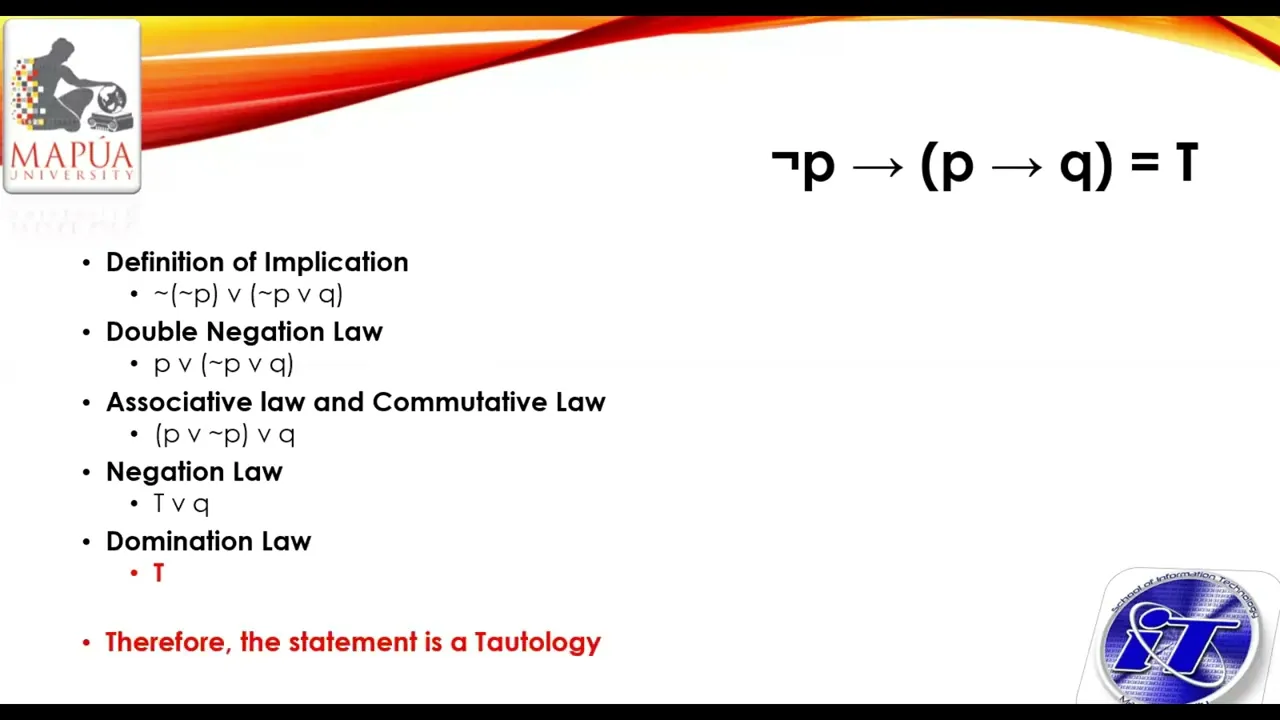
[Music] let's continue our discussion about proposition equivalents we're going to use logic rules to determine if the given proposition or compound propositions are equivalent tautology or contradiction so let's start with this first example we're going to determine if this equation is a tautology so we have p and q implies p to evaluate this equation we need to remove the implication first so how to do that we're going to implement definition of implication rewriting this equation to its second form so second form is not of antecedent or to consequence so antecedence is p and q consequences
p therefore the new form will be not of b and q or p and then the next step will be we're going to distribute the notation from the shared negation so how to do that we're going to implement de morgan's de morgan's law so the result will be not p or not q or p and disregarding the in addition the functions that we have is or so therefore we could use associative blow and community blow we're going to associate not b with b okay so the result will be the association community blow will be not
p or p or not q and if you're going to evaluate this group or this term not p or p so this is you are ordering or we or a proposition to its negation and we all know that we could use negation law for that and the result is true not b or b is true and anything or to true based on domination law is true therefore the statement is a tautology okay let's move on in the next example p implies p or q so same as with previous example we need to remove the implication
function so by implementing definition of implication the result will be not p or p or q and disregarding the negation the main function is or so therefore we could implement associative law and commutative law we're going to associate p to not p and we all know that that p or p will yield to a true statement based on negation law and anything or to true based on domination law the result is true therefore this equation is a tautology okay now let's move on to the next not b implies that is to p implies q so
again same as before we're going to remove the implication function related to its second form so the result will be not not b or not b or q and based on the first term we have double addition so we could remove it so using double negation law the result will be b or not p or q and we're going to um group not b to b since the main function disregarding not is or so we could implement associative and committed law so we have not p or not p or q and we all know that
anything or to its negation based on negation law the result will be true so true or q based on domination law and the order true is true therefore the statement is a tautology therefore this is valid okay next example where b and q implies 2 b implies q same as with the previous slides we need to remove all implication function so using definition of implication we have not of p and q or 2 not p or q and we want to remove this shared notation so using de morgan's law we have not b or not
q or not p or q disregarding the nut we only have or operation therefore we could implement associative and community blow associate not b with not b not q with q and this is the new grouping and the new way of writing our equation so we have not be or not p or two not q or q and we all know that not p or not p is basically not p okay and for not q or q the result is true anything or to true based in domination law the result is true therefore the statement
is a tautology next example not of p implies q implies p again same as with the previous slides we're going to remove all the implications by implementing definition of implication so we have not not not p or q or p and since these two negation is for the whole term for the net p or q so therefore we could implement double addition to cancel it so we have not b or q or to p and we could associate that with b since the mean or the operations that we have is on is or so the
result will be not p or p or q and we all know that anything or to its negation is true based on negation law and anything ordered true based on domination is true therefore the statement is a tautology next example not of b implies q implies not q it's a tautology same as for the previous slide remove all implication first so we have not of not not p or q or to not q okay so since this two notation again negates this whole term the first term we could cancel it out using double negation so
we have not b or q or to not q and disregarding not we only have or therefore you could use associative law and committed to law so associate q with not q and and the result of this not q or q is true based on negation law anything ordered through base and domination is true therefore the statement is a tautology so that will be our last example for this video lecture more example on the next bridge lecture thank you for listening see you [Music]













![Kaffara Episode 59 - [Eng Sub] - Ali Ansari - Laiba Khan - Zoya Nasir - 22nd September 2024](https://img.youtube.com/vi/DRKRI5kv8eU/maxresdefault.jpg)