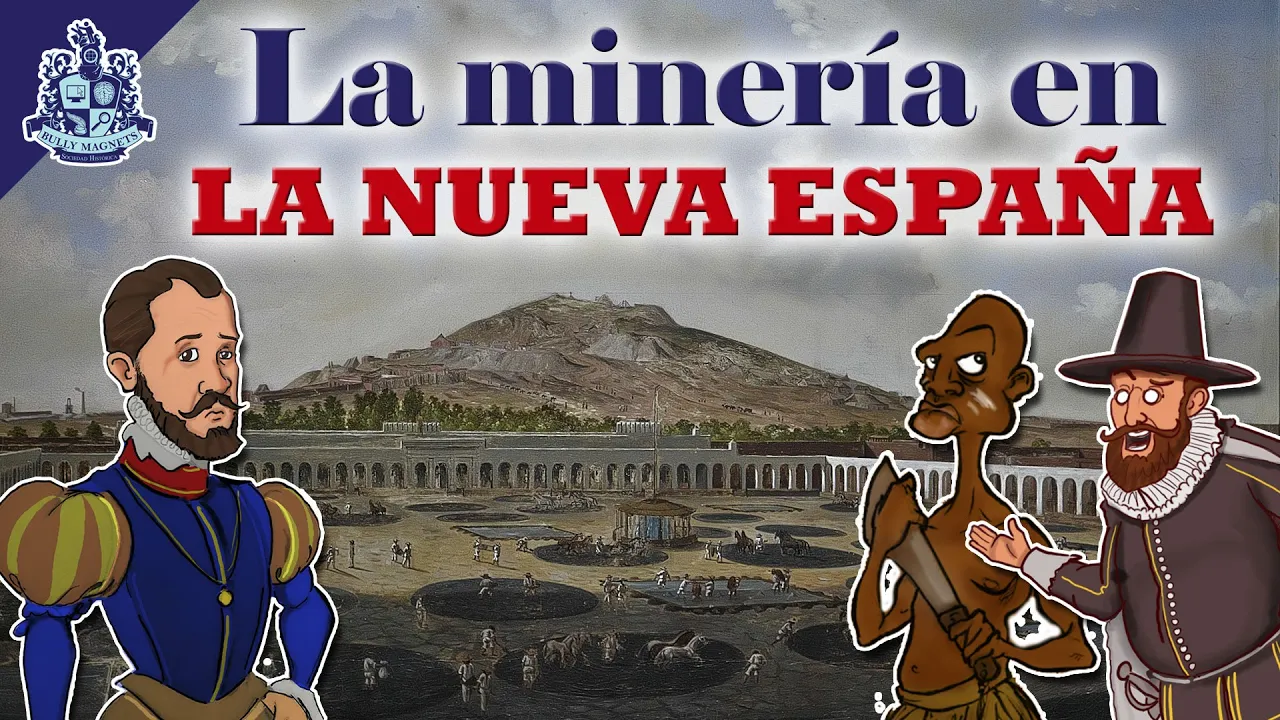
Bully Magnets presents: After the conquest of Tenochtitlan by the Spanish, one of the great reasons for Europeans to travel to the new Spain was the existence of great mineral wealth that existed in the new world. The gold, the silver, the precious stones! And it is that mining during the viceroyalty of New Spain was the most lucrative activity for the Spanish empire for a long time, so mining was the great engine for the exploration of the territory and the appearance of new cities and towns, without a doubt.
, a fundamental topic to understand the colonial era, so put on your helmets and take out your pickaxes, because we are going to introduce ourselves to 300 years of history of the new Spain. In the first years after the conquest, the Spanish began their search for gold and silver with the information that the indigenous people themselves had, the exploitation of these minerals that were practically at ground level were quickly mined and just as quickly word spread from this to Europe. Come on, it's time to get rich in America The first great mine to be exploited was Taxco, which in 1536 was already yielding great returns and attracted both miners and those who wanted to earn money indirectly, such as merchants, ranchers and artisans, in addition to that same year the mint was founded in Mexico City where much of that silver was minted.
However, the most important discovery of the time occurred in Zacatecas in 1546, the abundance of silver mines and other metals there meant that in just 2 years there were already 50 active mines and it became the second most important city in Zacatecas. New Spain Everyone come to mine, it's silver fever, guys The boom in mining exploration gave way to the creation of haciendas and towns throughout central and northern Mexico, and some of them, in the future, they became large cities, such as Guanajuato, Pachuca, Durango and Chihuahua. This first stage was practically a competition to take everything that could be taken, mining did not require much excavation, slaves and encomienda Indians were used for work, regulation it was minimal and there was everything to explore, in addition to the fact that in these first explorations it was still easy to find gold deposits Years later, in 1557, Bartolomé de Medina made the first discovery born in the new world, it was the benefit of patio or amalgamation system, a method of extracting silver that was faster and cheaper than what was known until then and for which only salt, mercury and copper pyrite were needed , which accelerated the production of coins and silver bullion.
For 1567 the New Compilation was applied, a section of laws in which benefits were given to the Spaniards who administered the mines, from that moment they were considered nobles based on their economic contribution to the crown and both they and their children they had the right to exercise military, political or ecclesiastical positions, in addition to that they could not be imprisoned and they had the right to exercise the law within their mines and haciendas as they saw fit, basically it was the creation of the elite class of the early days of the viceroyalty. In addition to these incentives, they only had to pay the crown 10% of what they extracted from those mines, it was an excellent deal . On the other hand, the workers in the mines could be Indians from encomiendas, slaves or free Indians who signed up for work that, unlike work on the haciendas or in the fields, they had more freedoms and a higher salary, although the risk and danger was also much greater.
This without counting the possibility of fraud and scams, since the workers had the possibility of taking with them a percentage of what was extracted at the end of the day, but they could be deceived by the owner with stones of lesser value, such as iron or pyrite, a mineral bright yellow that may look like gold to the naked eye, but is actually worth nothing. Pyrite, also known as fool's gold At the beginning of the 17th century, Spain had several open war fronts, which caused difficulties for rapid and constant communication with the new world and with it the lack of imports of mercury that was necessary to The extraction of silver in New Spain The extraction of silver also decreased at that time due to several problems, the first was the lack of indigenous labor, which was the cheapest, but was scarce due to the high rate of deaths derived from illnesses, for which workers had to be hired or slaves bought, which made the whole operation more expensive, all this without taking into account that work in the mines was dangerous and there were no guarantees in case of not leaving the mines alive . There is nothing of nobility or prizes for the slaves The problem of the importation of quicksilver or mercury had strong consequences in New Spain as it was the main basis for extracting gold and silver from rough stones, without this substance the entire process stopped, so it became very precious, so much so that the only one that could distribute it was the government of the crown.
And this gave way to an enormous corruption in the government of the viceroyalty, the thing was very simple because when the ships arrived with the quicksilver, only 85 pesos per quintal had to be paid, that is, for 100 kilos of the substance, but since there was a shortage, officials came to sell it for up to 300 pesos a quintal, which was clearly an act of corruption and speculation. Of course, here we come to get rich The monopoly of mercury by the crown was somewhat problematic, but at the same time it was a control measure to control the economy of the viceroyalty, because, although on some occasions mercury exploration was encouraged in New Spain, it was only temporary and they returned again to the quicksilver import system from Europe or Peru. The period between 1650 and 1750 was one of stagnation for mining, the lack of labor, speculation, corruption with mercury, the increase in bureaucracy, the lack of roads and flooding in the mines, made this a bad business.
, especially for new miners. At this stage the great miners who were already consolidated increased their wealth, bought titles of nobility and lived in large palaces and estates, while the new miners played their luck and used to be in debt and begging to get a new opportunity, finally there were some others who found riches at first in new mines, but quickly ran out, leaving them in debt and unable to maintain the lifestyle they aspired to. I was rich for a few years.
. . now I will be poor all my life Already during the 18th century and with the Bourbon reforms, there was a new boom in mining in New Spain, an attempt was made to combat bureaucratic corruption and tax evasion In addition, the so-called real mine populations were reinforced and many new ones were created.
By the end of the century, the most important royal mines were those of Guanajuato, Catorce, Zacatecas, Real del Monte, Sombrerete, Tasco, Batopilas, Zimapán, Fresnillo, Ramos and Parral, all of them with a legal structure and administration for gold extraction. , silver, iron and other important metals for the empire. In 1783 the general mining ordinances were issued that created 3 new institutions to regulate the activity, a court, a bank and a college, which brought specialization to the field and the arrival of new Europeans with academic knowledge who joined the also recently Science house created Thanks to that and as a curious fact, Andrés del Río, an expert in minerals, discovered the first chemical element in Mexico, Panchrome, a mysterious reddish metallic element that was taken to France at the hands of Alexander Humboldt I was involved in all the interesting things of the time It was 30 years later that the Swedish chemist, Nils Gabriel Sefström baptized the new element with the name of Vanadium, and although in the end the credit went to the Swede, the contribution has never failed to be recognized of Andrés del Río and vanadium as the first chemical element of the New World.
Finally, we are left to reflect on the importance of mining during the viceroyalty, because in 300 years it brought great material wealth that can be seen in the form of palaces, cathedrals and entire cities, as well as an economic engine with silver that transformed the colonies already the very economy of Europe and of practically the entire planet. But the bad part was the decline generated by corruption, price gouging, and the countless people who lost their lives inside the mines, as well as all the adventurers who came in search of wealth and only found debts and a great deception in mines that could give them little . Live like a rich man or die trying!
Finally, at the beginning of the 19th century, the Spanish empire lost strength and independence in America arrived, so it only remains to calculate the amount of money that was extracted from each of the territories of the empire until 1821, where clearly, New Spain It was the great exporter of gold and silver during the Spanish rule. So there you have it, a brief summary of mining in the new Spain, did you know all this information about the operation of the mines, do you live or have you visited a city that was founded just because of mining during the colonial era ? If so, tell me in the comments, as well as all your comments about it, I will love to read them and put the heart of the community in each of your comments, in addition to that I take the opportunity to thank the patreons and community members who support us every month , with your help you allow us to continue with this project week by week both here and on the bully podcast, really, thank you very much, I'm Reijard, I'll leave the bibliography at the end, and see you until next time.





![La fundación de los Virreinatos en América [El imperio americano Ep.05] - Bully Magnets - Documental](https://img.youtube.com/vi/WjgVB0hk9ZM/maxresdefault.jpg)