Welcome to lecture 3. In the previous session, we spent some time looking at the synoptic gospels. We were looking at Matthew, Mark, and Luke and understanding how they're similar yet different. One of the things that we saw as we looked at the synoptics is that Mark was the first of the synoptics written and Mark had brevity compared to the others and it also moved at a very quick pace. It was breathless in his pacing as Mark wrote. He would quite often finish a story or finish a teaching of Jesus and then quickly move on to
what was next. He often used the word euthus which is immediately. So Jesus did something and then immediately he went on to what was next. He did this and immediately went on to what was after that. is a way that Mark was using to understand the help people understand the impact that Jesus was having on the land and the culture and the people around him that Jesus was a man of action. And as we looked at the study in Matthew, Mark, and Luke, we were looking at the actions Jesus had been doing. But today we're
going to take a step back as we look at the Gospel of John, the fourth gospel. It is a very different approach to the life of Jesus. We're calling this the word made flesh, the study of the Gospel of John. Now, in John's case, he made a shift from talking about all the things that Jesus was doing and he slowed down and moved back. He ascended to the heights of eternity. He he wasn't looking at things in the way that the previous authors had looked at them and starting with Jesus birth or in Mark's case
just starting when he was an adult. He was looking at a broader spectrum of Jesus and who he is. If we think about the synoptics as a photograph, taking a picture of what happened, we can think of John more as an artist painting a painting, trying to give us an impression of what was happening and more importantly who Jesus is. John wants us to see the beauty and the artistry as well as the majesty of who Jesus is. And so he gave us a different view than the others. John's focus was not the same as
the synoptics. In the synoptics, they told us what Jesus did. He went here and did this. He went here and did that. Yes, John tells us some of that. But what John is trying to convey is not the historicity, not trying to giving us chronology. John is really trying to help us understand who Jesus is. And so because of that, he was very specific in the stories that he chose. And in the miracles that he chose to highlight, the teachings that he chose to emphasize, the question that I want to give to you now and
then come back to the at the end is, do you trust in the finished work of the word made flesh? And you maybe say, what what do you mean the word made flesh? Well, the word made flesh is referring to Jesus who came in the flesh. Jesus came to do a work and he completed that work. And do you trust him? and trust in this finished work. Keep all that in mind as we go through this study today. Now, before we move on, I want to pause and remind you, don't just study about the scriptures,
study the scriptures. Hopefully, you've taken some time to read through Matthew, Mark, and Luke. If you have not, this would be great time to do it. Uh, take some time to dig in. But I especially want to encourage you to do that when it comes to the Gospel of John. The Gospel of John, if you sit down and read it at a leisurely pace, should take you about an hour to an hour and a half to read everything. Some of you are like me. You've taken speed reading courses and you could probably read it in
15 minutes. Uh I wouldn't recommend that unless you just want to get some sense of it and highlights, but really go and dig in and spend some time reading the Gospel of John. You can do that before you continue with this video or you can watch the video and then maybe go back with some of the insights we share today and look at the Gospel of John in light of what I've had to say. So let's move on. One of the things we need to understand about John is that he uses a lot of symbolism.
And think about the early church symbol for the Gospel of John. We talked about how the different gospels were seen as different nature creatures and the gospel of John was looked at as the eagle. And the reason for this is because he soared to such lofty heights. While the other evangelists were walking on earth, they were looking to the stories of Jesus, the dust of walking through Galilee. John is soaring into the theological heavens. He doesn't start with a story. He starts with something that describes who Jesus is and then moves on from there. We'll
come to that in a moment. It's such an important piece that Martin Luther, Martin Luther, the minister, not Martin Luther King, the minister, but Martin Luther, the original, uh, over 500 years ago said, "This is the unique, tender, genuine, chief gospel, and every Christian should not only acquaint be acquainted with it word for word, but actually feed on it as the daily bread of the soul. If a tyrant should succeed in destroying the holy scriptures and only a single copy of the epistle to Romans and the gospel according to John escape him, Christianity would be
saved. Now that's a lot of words. What is he saying by all this? Martin Luther is saying that if we lost all of scripture, some tyrant came in and destroyed them all and all we had left was the gospel of John and the letter from Paul to the Romans, we would have enough understanding of Christianity and who Christian who Jesus is that Christianity could continue on. He's not advocating getting rid of the rest, but he's saying these two parts of the New Testament are that important. So our goal today is to understand John as best
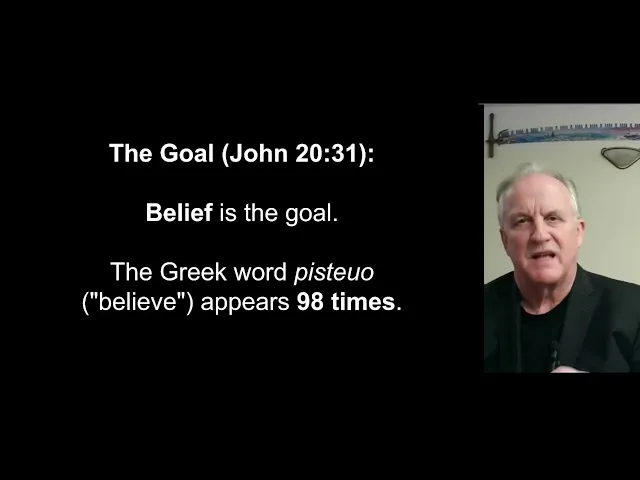
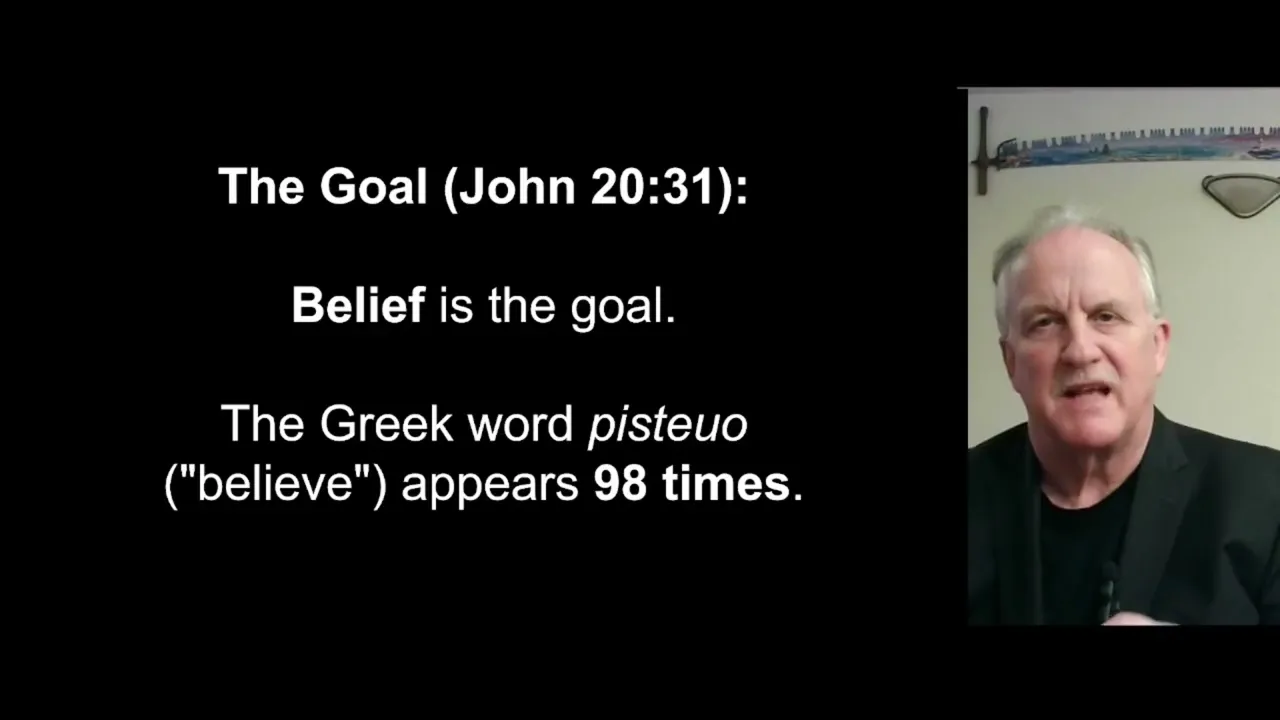
we can in our limited time. We want to explore the deity of Christ, the logos and the ultimate purpose why John wrote his gospel that we may believe and thereby live. So let's dig in. We're going to break this down in a few sections. The first part we're going to look at is the prologue, the logos doctrine. Well, the the prologue is John 1:es 1-18. So, how we see this set up, let's think again about the end and build into it. John 20:31 helps us understand that belief is the goal. As a matter of fact,
if you were to study the book of John, you do a word search, you can do it on a Bible app or some Bible software, you can look for the word believe in the Gospel of John, which comes from the Greek word pisto and it appears 98 times almost a hundred times the word believe appears in the Gospel of John. Why? Because that is John's goal. His goal is to make you believe, to help you believe. He can't force it, but he wants you to see the evidence that God's spirit speaking in you can take
that evidence and help you understand who Jesus truly is. So, where do we start with all this? Well, we don't begin like we do in Matthew and Luke where we start with the the birth of Jesus, the Christmas story. We don't start there. He doesn't begin with birth, but he begins before time itself. In John 1, John takes us back much farther than the birth of Jesus. He says in John 1 through through 1 through8 about Jesus being the word. This is what we're calling the prologue. The prologue being the introduction to everything else that's
going to happen. Think about walking into a beautiful cathedral in Europe. And when you come in, you come into the foyer and you see all these mosaics and statues and history and it's giving you a taste of what you're going to see when you go in and explore the rest of this cathedral. Well, this is what John is doing in the first chapter of the Gospel of John. He's giving us a prologue that paints a picture of what is to come. Right from the beginning, he tells us who Jesus is. And then he spends the
rest of the gospel convincing us of what he had to say. Think of it like your favorite uh mystery movie or adventure movie where they give you a a piece of what is to come. They show you what's happening towards the end to give you that little taste and anticipation. Then they go back in time and they build that story, that case that leads up to that climax moment. That's what gospel the gospel of John does. It starts by telling us who Jesus is and then spends the rest of the book demonstrating the fact that
what John had to say about Jesus is in fact the truth. So his focus is to establish exactly who this person is, who Jesus is. He wants us to understand his very nature. He does this by explaining to us that he's always been In John 1 1-3, it talks about the word being pre-existent. Now, as we get ready to read this passage, remember whenever you see the word, it's talking about Jesus. Instead of saying the word, you could put insert Jesus there. And we'll explain why it was important that Jesus was described as the word.
John 1:1 in the Christian Standard Bible says, "In the beginning was the word, and the word was with God, and the word was God." The Gospel of John is an invitation to trust the word made flesh. In the beginning was the word, and it tells us that that word was God. Let's look at the next couple of verses. He was with God in the be beginning and through excuse me he was with God in the beginning all things were created through him and apart from him not one thing was created that has been created. Now
if you've been to one of the live s uh sessions that we've done the live conferences you may have heard me speak on John one. I'm sure you remember everything I've ever said, but one of the things you might remember if you heard it is when I spoke from John 1, I said, "This is one of my favorite passages in all of scripture because it talks about who Jesus is and it demonstrates his power and his majesty and the ability he has as creator. It is also a very beautiful portrayal. It is basically poetry describing
to us the majesty of Jesus. And it starts with saying that Jesus is the word. In the beginning was the word and the word was God and the word was with God. And goes on to say he was with God in the beginning and all things were created through him. This beautiful word Jesus has always been. He was not created by God the father. He is eternal like God the father and God the holy spirit. God in three persons from the beginning of time before the beginning of time. The term logos that John uses to
describe Jesus logos is the Greek word for word. Now you may say what does that mean? Why is the word word that important? Well it was very important to the people to whom John was writing. And remember when we study we need to think about the life situation or as is said in German the laben the that's a theological term for studying the the situation of those people to whom it was written. We need to understand that to understand why this word was used and why it's so important. First of all to the Jews logos
was the creative power of God. Think back to Genesis 1. Genesis 1 in Hebrew says bar elohim ashame thou wavohu. Brachath bar elohim is where we actually get the title Genesis. It's a beginning. And what it literally means is brachath is breath. Barra is of Elohim is God. Breath of God. it when it was saying in the beginning it was saying God breathed and that's how things came into being. And as we go on to look at Genesis 1, we see that the way God breathed is he spoke. He spoke and said let there be
light and there was light. He he said let there be separate the water from the dry ground. He spoke things and they happened. He created the animals by speaking them. He created man by speaking him uh speaking him into existence. The word is powerful. God is so powerful that he just had to say something and it happened. Imagine that kind of power. Wouldn't you just love to be able to say something and it took place? Well, God doesn't have to love it. God is it. God speaks it and it happens. And we see that in
Genesis and we see that in Psalms. The creative power of God. And it's saying that Jesus is that creative power. Tells us that he is the one who is at the beginning who spoke those things into existence. Now logos was not only important to the Jews. This Greek word uh which is the creative power of God. It was important to the Greeks meaning the non-Jews, the Gentiles. It was important to them as well because in Greek thought there was a great rationale for creation. it there was a logic to it that it it had to
work together and they didn't fully understand it but there were somehow in rational principles and rational thought thought there were things that brought about the creation of everything and John is telling them you're right but it's not a concept that brought it all together it's a person and that person that logos that word that you're looking for is Jesus this was A powerful statement by John when in choosing to use this word a powerful statement to both Jews and to Greeks. So what was he claiming in this powerful statement? Well, the first thing is he's
claiming that in the beginning was the word. It didn't say he was the first thing created. It says in the beginning was the word. He was preexistent. Before the beginning of time, Jesus was. He always has been and he always will be. Jesus is beyond time. God is beyond time. The second claim is the word is the distinct personality of Jesus. It says the word was with God. Now may sound like we're mixing it. He said he was God, but it says he's with God. Well, in this case, it's saying he was with God. It
referring to God the Father. Jesus was the word. He was God, but he was with God. He was distinct from God the Father and he's distinct from the Holy Spirit. He's a distinct personality of the triune Godhead. The third thing that we see is he says the word was God. Jesus was God. Now this is not like he was God and then he quit being God. He's saying he was God from the very beginning. In his essence he is God. In his essence, he is deity. He is God Almighty. It goes on from that through
this passage to describe more of how Jesus was involved in creation and that nothing was created that unless it was created with him. But let's move down. If you got your Bibles there, you can follow along. Go down to verse 14 of John 1. And uh this is another beautiful passage. It says the word became flesh and dwelt among us and we beheld his glory. We beheld his glory. Jesus was God but he chose to become flesh and dwell among us. Now that that word dwelt or dwell is a very important word. It's chosen for
a a specific purpose. See in Greek skinnu the word for dwell literally means to pitch a tent or a tabernacle. Think back to the old testament the tabernacle in which God's uh the ark of the covenant and the ten commandments were there and God's presence came to be with the people that he dwelt among them was in a tabernacle or tent. This was prior to King Saul and then King David and then ultimately King Solomon and King Solomon building a temple, a permanent structure or what they thought was permanent, but a a building, not a
tent. That was the temple. But prior to that, when they worshiped God, they came together at the tabernacle. They worshiped at this special tent that God chose to use for himself. And so they use this term in the New Testament to say just like God in the Old Testament came and dwelt with the people Israel when they were traveling in the wilderness and Moses was leading them and and after they had been let go from Egypt. He came and dwelt with them. Then Jesus is doing the same thing. Now he's coming to dwell but in
physical form with the people. And this is the central miracle of the gospel of John, especially the first chapter, is that the infinite God, the great deity, the God above all became an infant. That's the miracle of Christmas. We love the manger story. We love things about Christmas, but we we need to not get so caught up in the trappings that we miss. What a huge miracle this is that the great God Almighty who is be above all chose to become an infant. Uh try to think about this in these terms. Let's say you saw
a bunch of ants and uh you you said I want to help these ants and I'm going to become from a person to an ant and go down and help them out and save them. That is nothing that we're still so far from the comparison of what it is for God to come and and come from being God of all to coming down and being a a human and living life here on earth, living a perfect life, living a sinless life, suffering all that he did and being tortured and crucified and humiliated and yet after
being buried in the tomb to come and have life. It's all an incredible miracle that starts with that central miracle of becoming human in the first place. And I almost hesitate to use that illustration of me or you becoming an insect because the difference between God and us is far greater than us and a little ant. He is the creator of all, the God of all, and he in Jesus' case gave it up. Scripture says that he emptied himself. There's a term in Latin called ex nihilo which means he literally poured out his godlike essence.
He emptied himself of that to come in a miraculous form and become an infant for our sake. Our next section, part two, we're going to talk about the purpose and structure of John. Moving on from the prologue, we're going to see a couple of different sections and the importance of them. The first one of these sections we call the book of signs. The book of signs. This is where John organizes material around a specific purpose. He's not just telling us things in a chronological order. He's not doing like Matthew, Mark, and Luke where he said,
"Hey, we want you to know all the events." How Luke said, "Dear Theophilos, I'm telling you this in an orderly fashion so you can understand what happened." John is telling us the truth. He's telling us what happened, but he's telling it to us from the lens of helping us understand who Jesus is and what our response to that should be. He has a very specific purpose as he writes this passage which is inspired by God and the living, true, and holy word of God. The thesis statement is found at the very end of this book.
And we're going to go through this passage a little bit more. I mentioned it earlier. We'll come back to it. But in this passage in John 20:es 30 and 31, I want to break it down for you in three parts. The first thing it says is Jesus performed many other signs of the presence of his disciples that are not written in this book. Now, why is that an important statement? What he's saying is there are so many things that Jesus did and said, so many signs that he performed that we can't even get them all
down. But I've picked these to illustrate who Jesus is. I've picked these ones out of all the ones he did for a purpose. The second thing we see is that the these are written so that you may believe that Jesus is the Messiah, the son of God. They're written for a very important purpose and it's that you believe and that the readers believe. those back in in the New Testament times as well as those today would read this and understand that Jesus is the Messiah, the promised one that was to come who is the son
of God. And that once you believe, you may have life in his name. Believing isn't just a head knowledge. Yeah. Yeah, I believe it. It's Yeah, I get it. But it's a trust that is in God that is saving. It is a transformation by the power of the Holy Spirit that saves you. It's not anything you can do for yourself other than to receive the gift that he is offering you and the gift of his son. The signs that we're talking about in here in this passage in John 20 and and other places are signs.
They're miracles. Simeon, they point to Jesus identity. J John called them signs for a reason. The book of signs, not because they they just are amazing things, but signs point to something. If you're on a road and you see a sign, it's pointing you to something or it's telling you to do something or telling you not to do something. It is trying to get you to move in a certain way, in a certain direction. And John is doing the same thing with the miracles that he he chose. He's trying to point you to Jesus and
who he is. So let's go back to that structure again. The first part of the gospel of John uh after the prologue starting in chapter one after the prologue going through chapter 12 this these are the books of signs the book of signs where he shows us specific things about who Jesus is. The second thing that we see in the Gospel of John starting in verse 13 and going through the end of John is the book of glory. And the book of glory talks about some teachings of Jesus, some important things that he taught the
disciples at the last supper and then going to the garden of Gethsemane and being captured and being tried and being beaten and being crucified, buried and resurrection resurrected. That's takes us from 13 to the end of John. So let's look back at the first part, the go the book of signs and and take a look at seven of the signs that John has for us there. Uh John wants us to see these point to Jesus as the master over all creation. These signs show his power and that he can be trusted for whatever we face.
The first sign was Jesus' first miracle, turning water into wine. So Jesus and others, including Jesus' mom, were at a wedding feast. And at the wedding feast, the cardinal sin happened. They ran out of wine. Now, I'm not here to debate with you how much wine is too much wine or how much wine is too little wine. We're not getting into, you know, how much alcohol you should consume. What we're telling you is this was a major embarrassment to the hosts and and to those who were important in in the wedding. And so Jesus' mother
came to him and said, "You need to do something about this. You need to solve this problem. She even then before Jesus had fully done his ministry and all his miracles knew there was something different about her son and you need to take care of this. You need you need to do it." And Jesus said, "It's not my time yet." And he said it to his mom in an endearing way. It says,"Woman, it's not my time with yet." And in in English, that sounds like if I called my mom, if I said woman, that would
sound very disrespectful. But this was actually a term of endearment to Jesus, to his mom, saying, "It's not my time." And Jesus' mom told the servants, "Do whatever he tells you." And when it was his time, Jesus told them to go and get large jugs of water. And they dipped into the water. And when they dipped into it and brought out what was then, it was wine. And it wasn't just any wine. The head of the the wedding feast pointed out the fact that this is much better than the first wine. And most people save
the good wine or use the good wine at first and save the inferior wine for when they've had too much to drink and they don't notice as much. But instead, here is the good wine. Now, I don't know this for a fact, but I I would feel fairly confident in believing that this was the best wine there ever was because Jesus himself made it. And what I want us to see from this is that when Jesus does stuff, he doesn't do it halfway. He does things well. He has a quality about him and about what
he does that supersedes anything else. You know, the second miracle we see is the healing of the official son. And the official son was far off. And the official uh wanted Jesus to heal his son. And just and had faith to know that if Jesus just spoke the word, his son would be healed. And Jesus did, and the son was healed. So, here is someone far off that Jesus didn't even have to go to see that he could heal because he's not limited by proximity as you or I might be. Another thing that we see
in miracles is Jesus healing the paralytic. That it doesn't matter how long something's gone on or how short it's gone on, Jesus has power over it. The paralytic had been paralyzed for 38 years. Yet when Jesus showed up uh he was able to heal him immediately though that longevity didn't matter. Another thing we see from Jesus is he could heal in large or he could do things in large scale. The feeding of the 5000. So, as we know the story of the feeding of the 5000, Jesus uh disciples came up with five loaves and two
fish. And Jesus gave thanks for it and he broke it and continued to break it. Which by the way, that's no small miracle to be breaking up that much food. Uh but he broke up enough where it fed not only 5,000, that was how many men were there. That didn't count the women and children. That was how they counted in those days. I'm not not trying to offend anyone, but they counted the men and said there were women and children beside. So, it could have been 15, 20,000, maybe more. Uh, and Jesus was able to
feed them in such a way that they didn't just barely have enough. They had baskets left over that they they could carry from that time. Uh, 12 baskets full. Then there was also the feeding of the 4,000. and and they had seven large baskets full after that one. Jesus could do things of large quantity. Another thing that we see is that Jesus had the ability to do signs above the laws of nature when he walked on the water. Now, I don't know if you've ever tried it. You may have got been like some people where
it's like there's some stones and they try to make it look like they're, you know, you're faking out your friends and pretending you're walking on water, but you know, you're really not. But Jesus actually was walking on the sea. He was walking on water and also cause Peter to do so. Jesus is the Lord over all creation and all nature. He can do what he wants. Another thing we see is that Jesus can help those that are have Misfortune. Misfortune doesn't mean you've always done something bad. Doesn't mean you're always getting what you deserve. Misfortune
implies that you're receiving a fortune that is missed. Something bad's happened to you that's beyond your control. But Jesus can fix that as well. Jesus healed the man born blind. He was able to heal somebody who had never seen and made it where he could see. And then we come to the ultimate sign, master over death. Jesus was able to raise his friend Lazarus from the grave. Jesus knew Lazarus was dead. He even wept on hearing that he was dead. But Jesus spoke, "Lazarus, come forth." And Lazarus did. It's good thing he did say, "Lazarus,
come forth. He might have raised the whole cemetery, the whole grave area." but instead he called Lazarus and brought him back to life. And in John 11, this story is actually a foreshadowing of Jesus own resurrection where God raised him from the dead. Even death cannot contain him. He has ability to do more than we can even imagine. In our third part, we're going to look at the I am statements and understand more of Jesus deity. The I am statements. What what does that mean? What is an I am statement? Well, let's dig in. We
were looking at the different signs. And in the signs, they they point you to something. They demand a verdict. John is constantly putting out there in these signs about who Jesus is. And he wants to know if you see who he is and if you believe who he is. But in the I am statements, he is very emphatically telling you who Jesus is. The seven I am statements parallel the signs that we've been studying about. What does it mean to have an I am statement? Well, I am is referring to the claim to be God.
Yahweh's claim that he is God. Think back to the time of Moses. And remembering the story of Moses, we won't do his whole life, but as as he fled from Egypt, he goes into the wilderness, he meets his future wife and and future father-in-law. He's he ends up uh getting married. He has he becomes a shepherd for his father-in-law's flocks. And one day uh he is out with the with the herd and he sees a burning bush. Yet the bush is not consumed. It's on fire but it's not burning up. And he goes and has
a conversation with God. And that's when God says, "Moses, I want you to go deliver my people Israel from Egypt." Egypt had been captive for hundreds of years. And God was sending Moses back to talk to Pharaoh and to bring the people out. And Moses was arguing with God about it. Well, I'm not eloquent and they won't believe me. And at one point, he says, "Who should I tell them sent me?" And he said, "Tell them I am sent you." God is so above everything else. You can't use anything else to describe him. You can't
say I am and then compare him to something else or someone else there. He's incomparable. So his answer was I am. And so as a Jew, a Jew would notice that if you were talking about the great I am, you were talking about God. Yet Jesus, as he's speaking to the Jews and he's he's addressing people that are are hearing him, following him, he keeps using statements saying, "I am." The first statement that he uses, he says, "I am the bread of life." He's telling us that he is the one that gives life, that gives
sustenance. I am the bread of life. The second thing he says is, "I am the light of the world." By light, he is the one we go to for wisdom and knowledge and understanding. He is the light to our path that leads us to God. I am the light of the world. He says, "I am the gate." Meaning that he is the he is the passage way to God. We see this later on in some other verses. He's saying, "I'm the only way. I am the gate to heaven. I am the gate to the kingdom.
I am the gate to the father. He says, I am the good shepherd. A good shepherd. A good shepherd. It tells us that the sheep knows their shepherd's voice. They won't follow a stranger, but they'll follow their shepherd when he calls. And he is the one we are to follow. But he's also the good shepherd, the one that lays down his life for us. Think back to that gate we were just talking about. In a shepherd's pen, there'd be like a a round enclosure with a small opening that a sheep could fit through, but a
shepherd would lay across that opening at night, being the gate. A good shepherd would be the gate that would would allow uh not allow the sheep to escape, but also would not let predators in. And Jesus is our shepherd laying down his own life for us. I am the resurrection and the life. He's telling us he's our only hope to life beyond and the life that we have not only after death but life that we have in him now. Jesus again stating I am. And then he goes on to say I am the way, the
truth and the life. No one comes to the father except by me. Jesus is the only path. This idea of universalism that is so popular today is false. There are not many paths to God. Jesus very very clearly says there's one path and he is that path. And then he says I am the true vine. We are the true vine. He's the true vine that connects us as the branches to the father, but also connects us to what we need to grow as believers to have life, to have nourishment. And by being connected to the
vine, we as his disciples are able to produce much fruit. And if we don't, he tells us we're cut off. He is the true vine that we need to be connected to. And then the absolute claim. This is the one where he left absolutely no doubt to those that were hearing him. He was being conf confronted by some leaders. And in John 8:58, he says this. Truly I tell you, before Abraham was, I am. Truly I tell you, before Abraham was, I am. Now, you may be thinking, well, this was originally written in Greek. This
is just poor English grammar to say I am because you would say truly I tell you before Abraham was I was. But that's not what he's saying. He said before Abraham was I am. Meaning I am and have always been God. I have always been present and always will be. He uses what's known as the eternal present tense. Now this is important. The eternal present tense in scripture is talking about something that's always been that way and will always be that way. Jesus is saying when he says, "I am," he has always been God and
always will be God. He is forever. And in case you're wondering if they didn't understand what he was saying, the Jews picked up stones to kill him because what he was saying, if it was false, was blasphemy. And they assumed it was false. So they were going to stone him, but they were not able to. And he he was able to leave them. But they wanted to kill him because they thought he was speaking out against God when in fact he was telling them the truth. So the conclusion that we get from all this is
Jesus was making the strongest possible claim to deity. He was saying I am God. There was no doubt in his mind, no doubt in his followers minds and no doubt in the minds of those who stood against him. He was claiming to be God and John is trying to help us see that he was telling the truth. In our fourth part, we're going to look at dualism, regeneration, and eternal life. We want to see that John uses a dualism, a Johannine dualism if you will, where he has strong themes that go between opposites. Let me
give you some examples. Light versus darkness, life versus death. He would make his point by contrasting them. above, things of above versus things below, the truth versus lies. John would make this point in his imagery as he told stories of distinguishing between good and evil, God and those who opposed him, the truth and lies. And one of the greatest uh things that he did in this was by demonstrating where we are and where we need to be. Think of John chapter 3. Uh if if Martin Luther said, you know, we just got to have John
in Romans, if he said he had to have uh just one verse, one chapter from John, he probably would pick John 3. Because in John 3, we see the doctrine of being born again. Uh this is when Nicodemus, who is a religious leader of the time, came to Jesus in secret at night. And as soon as he starts the conversation, there's no small talk. Jesus just flat out says to him in verse three, "Truly I tell you, unless someone is born again, he cannot see the kingdom of God." Well, so much for small talk. He
just laid it out. He knew Nicodemus came for a reason, which was to understand his teachings. And Jesus just said, "You have to be born again." And Nicodemus raised the question. He goes, "Can I reenter my mother's womb and be born again?" to which Jesus points out to him, there's a physical birth and there's a spiritual birth. You've been born of the physical birth, the born of water, but you must be born spiritually as well. And that spiritual birth comes through your willingness, but really comes through the act of God. A sovereign act of the
Holy Spirit is what regenerates you. You cannot regenerate yourself. You can never be good enough. I don't care if you're Billy Graham or Mother Teresa or insert your favorite hero here of the faith. Uh you cannot be good enough to regenerate or regeneration meaning coming back to life. You cannot have a new life by your own ability. That comes through the moving of the Holy Spirit. And John 3:8 puts it this way. The blend the the wind blows where it pleases. and you hear it sound, but you don't know where it comes from or where
it is going. So it is with everyone born of the spirit. You can't understand how the Holy Spirit does it. But you can see the evidence just like you can see the evidence of the wind blowing. You can see the he evidence the Holy Spirit changing you, giving you life a new and making you a new creature in Jesus. That is the evidence of the Holy Spirit. Well, how does that happen? It happens by the gift that God has given us in his son Jesus. The most famous verse in all of scripture is John 3:16.
And it is the heart of the gospel of the New Testament and the Gospel of John. In John 3:16, it says, "For God loved the world in this way. He gave his one and only son so that everyone who believes in him will not perish but have eternal life. Everyone who believes, you need to believe. But then the Holy Spirit, as we saw in verse eight, does his work. God sent his son, his one and only son, Jesus here. All that he suffered for us, all that he did for us. And if we believe in
him, we have a promise. Not that we might not perish, but we will not perish. We will have eternal life. And it sounds kind of funny in some ways because you say will not perish like, well, am I not going to die? Well, yes, at some point your physical body will die. But we're told that you will have eternal life. Not someday, but you'll have eternal life. That eternal life in Greek is aonius. It is not just endless time. It is a vibrant way of being. It is a life in Jesus. In verse 17, excuse
me, chapter 17:3, it explains that eternal life. It says, "This eternal life, this is eternal life that they may know you, the only true God and the one you have sent, Jesus Christ." Let's do that again. Think about it. This is eternal life. What's eternal life? that they may know you, the one true God, and the one you have sent, Jesus Christ. He's saying that eternal life is knowing God the Father, and the one he sent is Jesus. Well, that doesn't sound like living forever. Think about it. To have true joy and happiness and life,
we must be in the presence of God. That is what makes heaven heaven. It's not streets of gold and all the other things we read about. Yes, that's part of it, but it's the presence of God that makes heaven heaven. It tells us in Revelation that there's no sun or moon that is not needed because Jesus just lights it up himself. What makes hell hell, as awful as fire and brimstone are, and there is a literal hell, is awful as those things are, what truly makes it awful is the absence of God. the absence of
his life and his love. That is the distinction. That's that dualism between heaven and hell, the separation. So to have that eternal life, placing our trust in being transformed, that happens the moment that you believe. You don't get an eternal life after you die. You get eternal life the moment that you trust yourself, your life to Jesus Christ as your Lord and Savior. It's something that if you haven't done I encourage you to do even today. And our last section, part five and the conclusion, glory, coronation, and belief. Glory, coronation, and belief. Let's look at
the book of glory, chapters 13- 21. Now, it's interesting. We've had 12 12 chapters where we went from before time all the way through Jesus' life up until the last week of his life. So almost half of the gospel of John, about 40% of it is the last week of Jesus' life. And actually verses or chapters 13- 17 are what's known as the farewell discourse. This all happened during the Lord's last supper with his disciples. So he's got his whole life there and even back to beginning of time yet four excuse me 13 14 15
16 17 the five chapters um are all happening at that dinner and it's all the teachings all the things that Jesus is talking to them about and he's praying for them and he's praying for himself that's all part of those five chapters just that one evening and in these five chapters he talks about the promise of the Holy Spir spirit, the pariclete. Now, pariclete, I don't know about you, but outside of scripture, pariclete is not a word that I use in everyday language. But what a paraclete is is someone who's an advocate. Think like a
legal term, like an attorney coming and standing there and making the case on your behalf. And the Holy Spirit stands before the father and says the these are these are your children. He makes the case for us. And so Jesus is promising after he goes that the holy spirit who indwells within us who are believers the holy spirit will come. Another thing that we see is after that dinner in those great discourses is the coronation. Now Mark talks about Jesus as the suffering servant. But in John he talks about the same suffering and the same
crucifixion but he portrays it as Jesus the sovereign king. Jesus did not come in in meekness and Jesus did not come and had things happen to him that were beyond his control. He willingly gave up his life for us. He was not forced in these things but he chose to do these things. He is the sovereign king not just the suffering servant. So think about even at the arrest of Jesus. Jesus said um I am he. When they came to look for him they said who are you looking for? They said we're looking for Jesus.
And when he heard that he said I am he. And it says the soldiers took a step back and fell to the ground because they were in the presence of majesty. They were in the presence of God Almighty and they fell to the ground at that point when he made the statement I am he. He was also victorious even on the cross when he was there. It wasn't a cry of despair but it was a cry of completion. John wants us to see that Jesus came to do something. He came to do miraculous things, to
do these signs, to teach us, but ultimately the miracle of sacrificing himself. And that was not something of defeat, but was something of victory. And the victory word is this to telly. To telly means it is finished. It's something that's used in in uh finance or bookkeeping, if you will. It's a way of saying paid in full. When Jesus said to Telsty, he's saying it is done. I have paid for everyone's sins. Anyone that receives that gets full payment. So this wonderful gift from Jesus, the question is what do we do with this? What do
we do with the gospel? All that we see through the scripture of John in the in the signs and the teachings and the prayers of Jesus and the sacrifice that he went through and the great payment in full that we see as he gave his life on the cross. What do we do? We believe. Remember that throughout scripture, throughout John, 98 times, like I said before, the gospel of John told us O the Greek word for believer for believe is it throughout scripture. We are to believe, believe and believe and by this we too can
have life. The word of flesh, the word was made flesh and dwelt among us and we beheld his glory, the glory of the father. Do you believe? Let me pray for you. I pray for your belief. God, I pray that you will help us all to believe. Help us to overcome any doubts, but to truly trust in the presence of your son, the gift of your son. And we pray that your holy spirit will help us to see the truth and to turn to you. I pray for those that are listening now, Lord, that they
would commit themselves to you. uh that if they are your children already, they commit themselves a new to the to serve you and to love you in honor of the gift you've given, but not of their own strength, Lord, by the power of the spirit living within them. And those who don't know you yet, Lord, I pray that right now they would give their lives to you, that they would trust themselves to you and be yours for all eternity. We thank you for the gift of your son. We thank you for the gift of your
spirit. We are so blessed to be your children. We worship you and we praise you. In Jesus' name we pray. Amen. God bless you. See you next time.