hello everyone thanks for carving out 15 minutes of your day to spend some time learning a little bit about the contextual approach to family therapy in another video we talked about bowen's approach and in this one we're going to take a closer look at what it means to practice contextual family therapy now before i get into the specifics of the theory itself it's always fun to mention that the person who is credited with this theory has a very challenging name to pronounce i'm going to do my best and i'm going to give you a hint
as to how you can refer to him in the future so his first name's not so bad ivan but then it's and i'm not even sure if i got that right so pretty much everybody refers to him as naj and i suggest you do the same and our text talks specifically about how a socioculturally attuned contextual therapist would utilize third order change by addressing how the larger social context and societal power inequities affect the balance of fairness in people's lives and so you're going to be hearing a lot about those kinds of terms whether it's
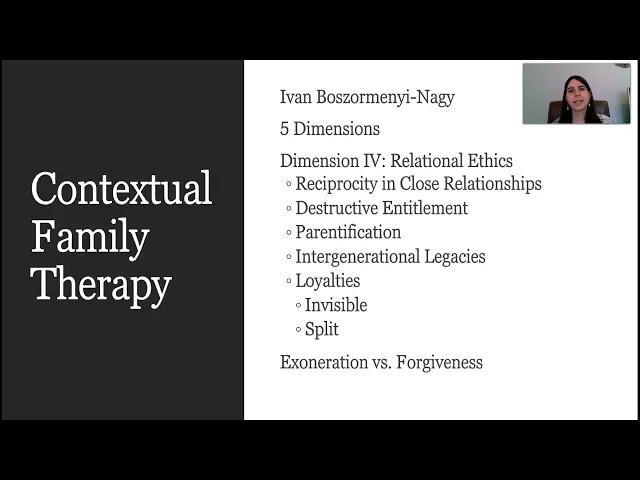
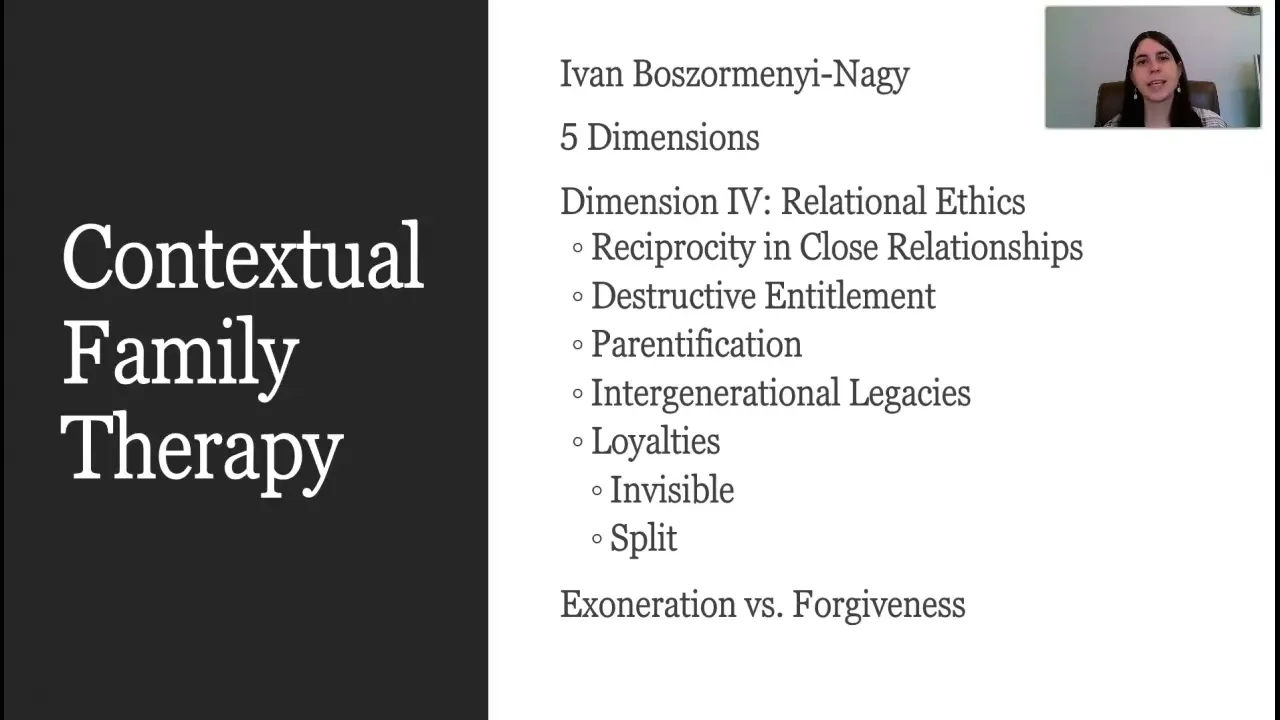
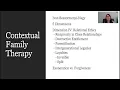
fairness or justice or power there are these five dimensions and they are referred to as number one facts number two psychology number three systems and transactions number four relational ethics and number five the ontic dimension but as i said before most of the attention is given to that fourth dimension which is called relational ethics so when you're thinking about what it means to be a therapist practic practicing this approach one of the concepts that's important to keep in mind is multi-directed partiality and multi-directed partiality is when therapists demonstrate empathy to everyone while highlighting these issues
of relational ethics that we're going to talk about and so therapists will align with different people in the family system at different times and then use their power as the therapist to help balance the relational ledger so let's start off by talking about reciprocity in close relationships reciprocity in close relationships is all humans in a sense keep this mental ledger of what they give to others and what they receive from them and people have who have received due concern from others then become obligated to them and their refusal to recognize this indebtedness would constitute an
injustice so when you think about relationships and you think about particularly close relationships you probably can bring to mind examples of a mental ledger that you have about what somebody has done for you or not done for you and what perhaps you might owe to them or they might owe to you and so contextual therapy talks about these different kinds of injustices specifically distributive injustice which occurs when a factual element detrimental to the life of one person or family lead to this so for example this would be something like perhaps a health diagnosis or something
in the dimension of facts which i mentioned earlier then there is the retributive injustice and that occurs within relationships as the result of exploitation or lack of fairness between the parties and it is possible to identify one person as the perpetrator of the injustice and the other as the victim so you'll see retributive injustices much more when it comes to two people trying to figure things out with their relationship with each other it is important to keep in mind that justice within a family system can never be separate from justice within the larger societal context
and so as you keep that in mind we're going to move down to destructive entitlement which is the relational impact of justice that can be understood so people who have been hurt or wronged expect justice right that makes sense if you've been hurt or wronged you want something to be done about it but when no one can be blamed for the damage of when the perpetrator of the injustice doesn't repair it people have two choices forget about the injustice or seek it somewhere else and so when this happens in a relationship there might be some
form of imbalance and then in order to get that imbalance righted you're looking for it somewhere else now you've probably heard the term parentification when it comes to family systems and i think it's important that we clarify parentification as a concept that's somewhat different from how maybe other people use it so parentification is a specific manifestation of the destructive entitlement that i've just mentioned in other words people who have not received do care from let's say their parents will turn to their spouses and their children to get the love and attention they missed while growing
up and so contextual therapists look at parentification in terms of exploitation of one generation by the other not in terms of role reversal so you might hear somebody say oh that child is being parentified but parentification from a contextual perspective is much more about the exploitation of one generation by the other not just because a child is being asked to step up and take on responsibilities that don't belong to them loyalties in contextual family therapy occur all over the place and again i would ask you to cast your mind back and think on relationships that
you have and the kinds of loyalties that you have in those relationships and so loyalties are the commitments that people make to play place the interests of the persons who have helped them before the interests of those who have not and specifically when you think about this from two different perspectives there are invisible loyalties and split loyalties invisible loyalties is where individuals cannot show their loyalty in a direct fashion whereas split loyalties is when both parents maybe have a similar attitude the child cannot express loyalty to one parent without being blamed for being disloyal now
let me cycle back to intergenerational legacies because i think that's really important and what we're talking about here in intergenerational legacies parents strive for fairness in their world and every child is born in a context of expectations which may or may not be realistic and at some point people will need to sort out their legacy expectations of their family and figure out a way to address these expectations and so this is especially where you'll see loyalties being expressed and loyalties coming to the surface now before we go to some practical applications of this it's important
to mention something else which is exoneration and so in exaggeration you come to reflect on what happened and see you know other people they did not hurt me intentionally but because they were unable to give more than they themselves had received from life so the shortcomings that they've displayed become more understandable and the nature of the injustice that those after them incur change and i like the concept of exoneration because there are some similarities there to forgiveness and while some people may not necessarily be ready to forgive somebody for what they did whether they think
it was intentional or not they may be able to come to a place of exoneration where they're able to see some of the ways that that person was influenced and how that eventually led to them treating that initial person the way that they did so for example if you have a family system where one child was unfortunately hurt in some way by their parents will say they were physically and emotionally abused they may have a hard time with the idea of forgiving their parent for that but when they think back to what they know about
their parents life growing up they may understand that their parents experience not just physical abuse not just emotional abuse but mental verbal sexual abuse and so they might see that they were unable to give more than they had received and that they did the best that they could and so they might not be at the place of forgiveness yet but they might be able to exonerate them so let's look at some practice guidelines in our text there are seven practice guidelines for thinking about how to work with a contextual approach with clients and the first
is practicing multi-directed sociocultural attunement this is where therapists seek to understand and attune to each person's socio-cultural experience and empathize with empathize with it setting the stage for clients to experience empathy for each other then you want to discuss the socio-historical context and background so focusing on justice as a bridge between the past and the future and then naming the socio-political context of family legacies i said this in the other video context matters and nothing happens in a vacuum so when you're looking at what's in front of you you want to keep in mind this
was affected by years that preceded it by people that preceded it and so discussing that context and background is going to be helpful as you move forward to identifying and acknowledging unfairness so as a contextual therapist you're assessing the balance of fairness within relationships and social experiences i mentioned before that mental ledger that people have and contextual sees this ledger and wants to look at what is the balance of fairness within these relationships and how is that playing out and so one of the things i think that is a real strength of this approach is
the idea that you're also going to assume that people want to give right so if i assume that people want to give to others i'm gonna then approach my clients with that expectation that they're not just here to take but that they're also here to give and as you go through the chapter on contextual i think there's a couple really great examples of how that plays out and what that looks like as you're navigating that conversation with clients then you're going to want to encourage due crediting so giving the other credit for positive contributions to
one's life and to the relationship so if we take these two together right we assume that people want to give but we also want to encourage do crediting so it's not just this expectation of taking but giving and giving can also include giving credit for the positive contributions that have taken place and going back for a minute to what i said earlier about exoneration this is one of those places where if somebody isn't present for family therapy or perhaps they're no longer alive you might be able to encourage a client to think about the positive
contributions that that person made even if there were challenges that they had in their relationship with them and then you want to encourage accountability so attending to how relational accountability intersects with societal power dynamics i think encouraging accountability can be understood really well when you think about it from a responsibility perspective but also as you keep in mind what other societal power dynamics influence the position that this person is in and so are they being asked to be accountable for something that was outside of their control in relation to societal power dynamics and are they
being held accountable for example in the context of societal power dynamics so then the last one is to focus forward being intentional about how they want to interrupt the impact of family and societal justice and i think this particular guideline has a lot of power when you're dealing with families who are looking at the intergenerational legacies that affected them and the ways in which they want to be making changes so that this doesn't happen to their family to their children and where it keeps going further on down the road and so they're ready to interrupt
what's going on here and part of how you help them to do this is by getting them to focus forward so that's a little bit about contextual family therapy and i look forward to talking with you more about it the next time that we meet