[Music] hi everyone Welcome to our first video class in this moment we're going to study about a very important discussion that is made in the methodology teaching subject that is about approach method and technique well you're seeing the most popular methods discussed in the subject of teaching languages not only English so we have here gramar translation method directed method AUD lingualism Community language learning the Silent Way suggestopedia communicative language learning task based approach Total Physical response multiple intelligences natural Pro and The Lex Co approach each of this have different meanings different purposes and impacting the
students uh we're not going to discuss about these methods here but just to know these are the most popular ones and used um during many decades so to start let's know Edward Anthony he was the responsible guy for bringing up the ideas of approach method and technique in the year of 1963 he was a linguistic uh scholar who was responsible to influence many other theoretical researchers who adapted improved his ideas but the fact is we are talking about methods today because of him he had the idea of discuss seriously this points so he assumed that
approach was a set of assumptions dealing with the nature of language both learning and the teaching so it was about the beliefs or ideas about the nature of learning which was translated into the classroom so an approach is exatic it was very difficult to go against it and we may say that the approach is about the Mind Center you know um and into an approach uh it could be used different methods to achieve the idea of practicing that purpose for learning for teaching so we have different methods according to H method was described as an
overall plan for systematic presentation of language based upon a select approach so method was a systematic way of doing something we have a word that is similar to Method today methodology that is basically how we do something um so this was the basic way to put into practice what was being said in theory so we have a different methods like for example the communicative method is a way to discuss the idea to put in practice the idea that students need to speak that is students need to listen to repeat to speak for himself or herself
to develop the fluence but how do we do this how do we apply the communicative meth method well then came the techniques Anthony said that the techniques was the specific activities manifested in the classroom that were consistent with a method and therefore they were in harmony with an approached as well so all of these three are connected none of them is a against one or other no there is harmony between them and the techniques is the way we apply the method the activities we use it the resources of them let's check the next board maybe
looking to this board it gets easier for you uh their approach may be set as a view a theory the method a way of doing something and the technique is the technical the mechanical skills that we use to apply so for example the technique is putting uh the students to listen so the song the activities they do is the technique so techniques carry out a method which is consistent with an approach to understand in practice to visualize the three elements working together let's read the example below so a teacher May for example at the approach
level affirm the ultimate importance of learning a relaxed state of mental awareness just above the limit of Consciousness the method that follows might resemble say suggestopedia techniques could include playing baric music while reading a passage in the foreign language getting students to sit in their yoga positions while listening to a list of words or having Learners adopt a new name in the classroom and the role plays that new person so as you may see here we have the three elements working together we have the theoretical level we have the method suggestopedia it's a very nice
one that we are going to study in the 30 Unity that is about working with music but with a purpose that relaxes students and makes easier for them to learn so suggestopedia is a method but how do we use a gpedia what activities we can use um you saw here we have different types of activities different scenarios that we can put our students into to get the um learning process doing in the real thing as I told you Anthony was the first one to discuss about approach method and technique but all the scholars improved his
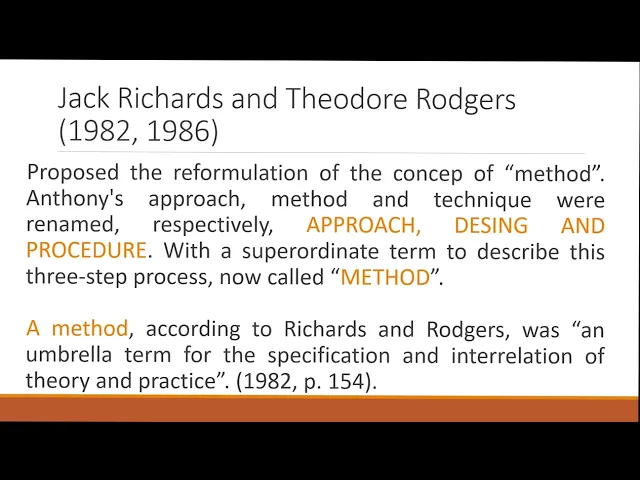
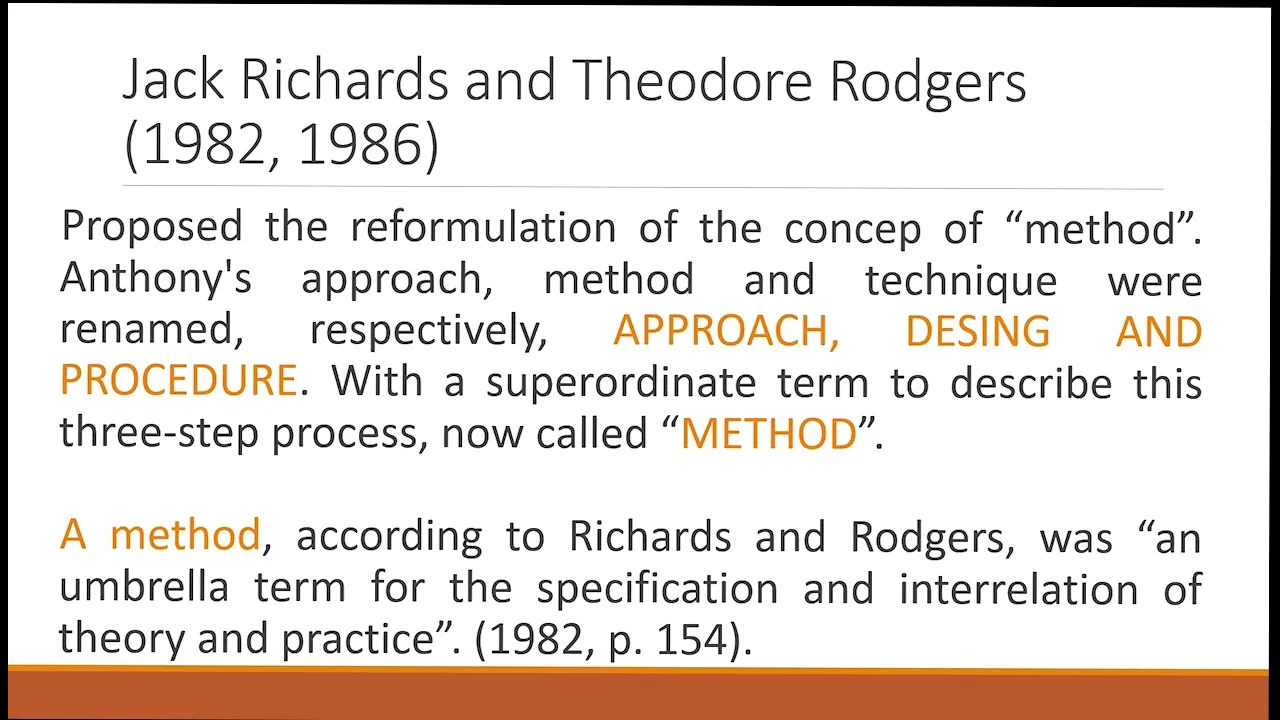
ideas just like Richards and the Rogers they tried to refine his ideas by introducing a more detailed model for the language teaching so they proposed the reformulation of the concept of method inem approach method and techniques were renamed respectively to approach design and procedure the methods now it's called design the techniques is now called procedure so with a subordinate term to describe this three-step process now called a method this this word method here is used to describe the whole connection between approach design and the procedure so to Richards and Rogers a method was an umbrella
THM for the specification and interrelation of theory and the practice we're talking about the theory of language learning as a whole Theory and practice it so the way the language is learned so for then you going to see that the approach doesn't change so much so they Define an approach as assumtions beliefs and theories about the nature of language just well as language learning you're going to see that we have more details in the design field so in the design we specify the relationship of those theories to classroom materials and activities so in the design
now we have more details about this process for example we have the objectives what we want to acquire in this class we have the syllabus that would be the organization of the content to be taught we have the types of learning and the teaching activities we have the learner grow and the teacher roles so we have the rowes of each one and as well the responsibilities of both students and teachers and we have the instructional materials so we have here the materials that would be used during the learning process we have discussing we have discussions
about all these aspects how they should work what is expect of them and we have the procedures there are the techniques and the practices that are derived from the one's approach and the design you're going to check the next in the next slide more details about how they work I suggest you to take a minute to read uh each one of these topics because it would make clear for you to understand what is each one of them so basically guys um if we compare the Anthony's and the Richard's and Rogers ideas we're going to see
that Anthony but the approach as a general theory of how languages are learned and taught but preaching and bres they includes theories about the nature of language and how it is learning this is the main idea um for Anthony the method is the general teaching plan based on the approach right however for then Richard and they divided into design so we have as you have as you see here all the details about objectives syllabus activities rows materials but beside these we have the procedures so the specific techniques that are practiced that are used and for
the procedures uh that Anthony called the techniques the procedures for Anthony would be the specific strategies and activities in the classroom and for Richard and Rogers is a part of the procedure detailing specific practice specific behaviors in the classroom for the students and for the teachers well I need you to think about the two main contributions to our understanding of a method well virtually all my gr teaching methods make the oversimplify assumption that what teachers do in the classroom can be conventionalized into a set of procedures that affit all contexts uh we are now all
too aware that such is clearly not the case and it's because we have classroom realities um although when when you read the theory my suggest you that that method could be applied in any context it's not the case because we have different Realties of students of context of the classroom of the materials the age of students um although communicative method is so well known it doesn't work for all students all contexts for example do you think that a communicative method that is a a method to put students to listen and talk fluently all the time
could be applied in the public school imagine a classroom with 40 students you think that works every class no right because we have different students different needs we have different levels and support so it's complicated you need to know that all methods are good all methods have the importance but we need to adapt and then to the reality of our students of our work the whole concept of separate method is no longer Central issue in language teaching practice instead we currently make ample reference to methodology as our superordinate umbrella THM reserving the THM method for
somewhat specific compatible to classroom techniques this was the problem during the moment Richard and Rogers proposed the idea of the word method to connect the three points of Anthony's idea so Richards and R's reformulation of the concept of method was soundly conceived however they attempt to give a new meaning to an old term did not catch the pedagogical literature it was a little bit complicated to associate the idea how is there a new meaning to an old a node word that's why we call today the word methodology instead of method it's much more appliable understandable
for us when we look into the past we may be able to see that what worked in one moment didn't in another one what was considered as Innovative change it to not so effective and that's why we need to change ws and shift Sands so a glance through the past Century or so of language teaching will give an interesting pictory of how variet the interpretations have been of the best way to teach a foreign language so when we consider the moment people were were having during the 60 during the 70s the 80s they would have
limitations of day time of the perspectives of the resources so all these methods evolved through the times in a moment the grammar translation method was considered amazing but in in a specific moment they saw well it doesn't fit all the abilities it doesn't Feit the people who need to communicate in real situations where is they speaking practice and then it came in the directed method but but then they saw well it has um weak point we may get it better it came in the old lingualism and then came the natural approach then came the communic
ative approach so people change the idea of the best way to teach and that's the point so as disciplinary schools of thought as psychology Linguistics and education for example have come and gone so have language teaching methods W said and weed in popularity in one moment they have more popularity in another moment they had less popularity and that's fine Alward saw this change of winds and shifting Sands as a psychical pattern in which a new method emerged about every quarter of a century each new method broke from the old but took with it some of
the positive aspect of previous practices so when we read a cycle pattern in which a new method emerged about every quarter of a century it's because people change reality change so during 25 years many things change even less right so we have a first method and in in specific moment people saw well it doesn't fit our reality it doesn't fit for this type of students for this specific need of then or for my reality in the classroom and what I want them to achieve so all these methods evolved in a specific moments and somehow all
of them are connected because the most popular the most modern ones they learned with the previous ones the oldest so none of them might be considered as villain or hero no each one has its has its role and it might be applied in different situations for you in your classroom and in specific day you use the grammar translation method and not one use the directed method that's fine uh we're going to see how this method Works in practice in the next classes I hope you enjoyed this one and that's it for today [Music]