Okay it's my pleasure to introduce unwell and dress as today's local unit speaker mana was visiting us from Cal Tech he did his master's degree at the illness Gutenberg University of mice and this PhD at the LMU Munich and Fox pump Institute of quantum objects in the group of developers go where he did primary work developing the first quantum taxol microscopes as a tool for probing strongly correlated many body Systems with single atom resolved image he did a brief since for one year post off in the theory group of Ignacio xerath before the sighting he
missed experimental physics and going to Harvard to the group of Michel Lucan where he developed a method of building from the bottom up arrays of individual atoms in optical tweezers as a starting point for quantum information processing applications and since 2016 he's been at how Tech where he's begun in applying This technique to state-of-the-art optical technology and also to realize record-breaking fidelity event angling dates between neutral atoms he's been recognized for his work with numerous awards the Otto Hahn medal of the Max Planck Society for its PhD thesis and more recently with a Young Investigator
award from the Air Force Office of Scientific Research and with the NSF Career Award so we're very fortunate to have him here with us today and if You're about this latest work Thank You Monica do you hear me okay it's not too loud it was a little out earlier okay so thanks for a really nice introduction and for inviting me and for hosting me this has been a really wonderful visit so far and I hope to see more of you tomorrow and one-on-one meetings and maybe for dinner later so as Monica said I'm Arnold interest
from Caltech and and I talked about a set of techniques and results that we Have been developing over the past few years five years maybe which concern basically trying to build up atomic systems from atom by atom escape basically doing it from the ground up by trapping individual atoms and reshuffling them in a specific way and one of the tools that we are using is tweezer arrays it's not the only tool that that you can use for that but I will mainly be talking about that and then give you some introduction to that Let me
start pretty broad since it's a colloquium with some sort of the context of where we live so what we do is experimentally quantum science in the widest sense and there's many different systems attritional solid state systems do you see that okay a super contact in qubits and so on and cause atomic system photonic systems so we worked with cold atomic systems neutral atoms and I'll briefly mention ions also in my talk and I always find it fascinating that in This in this context despite this this large array of different experimental methods there's some sort of
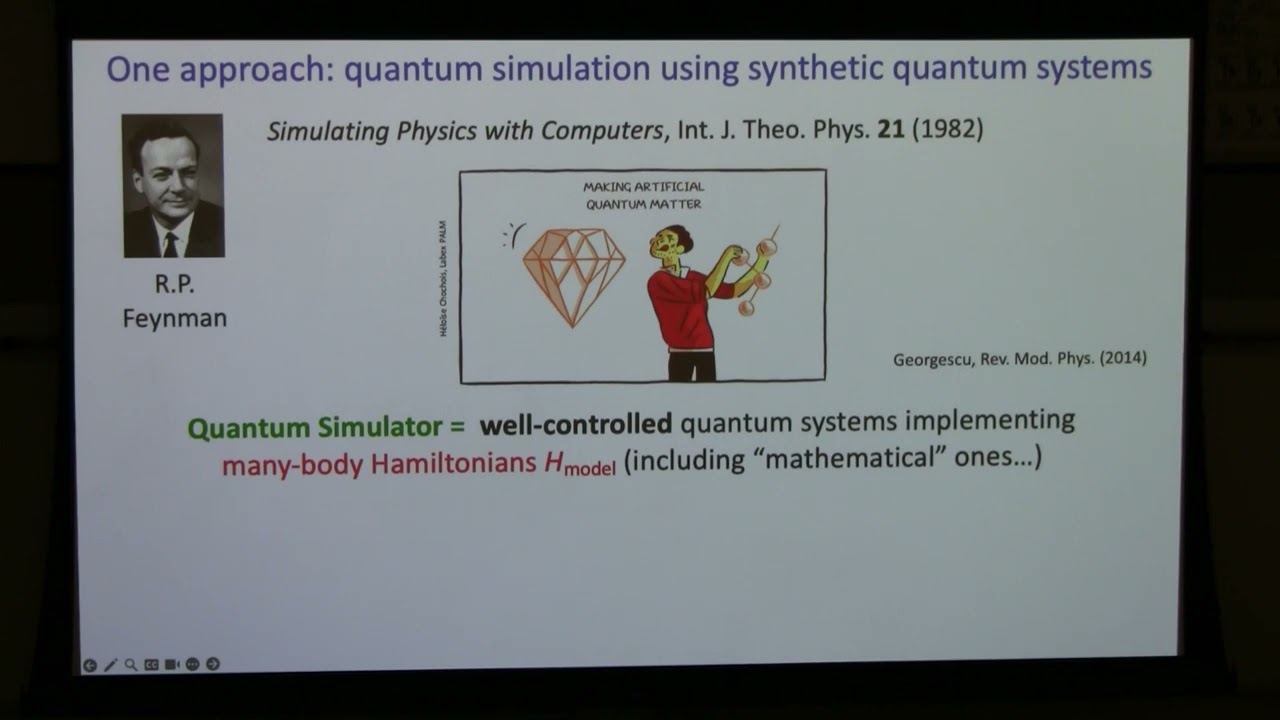
a set of common goals of what we want to do and a set of common challenges to a certain degree and the goal is roughly speaking for most of us is first of we would like to build quantum computers let's apply a set of gates to cupid's to do maybe tasks that are hard to calculate classically a second one that's what I I'm coming from for my PhD is quantum Simulation that is basically some sort of a specialized quantum computer that would solve a problem in the quantum many-body context which is generically hard on a
classical computer third one is quantum metrology which is traditionally very mo systems have their strengths and essentially is to use a quantum state or system for precision measurement that quantum state my may or may not be entangled but in principle it's a question of quantum control and Then using them for measurements and third of all we would like to connect quantum systems by a quantum networks either for improving precision measurements or for connecting quantum computers or for all kind of things anyway so for these things usually we need large and highly controlled systems and at
the same time we need in many cases really to do something that is non classical entanglement across the full system and This is really a challenging partes for most of these experiments and more specifically I would like to point out two key challenges the first one is a technical one and essentially it's it's trying to reach scalable you know very large and homogeneous systems and at the same time trying to keep controllability at a single atom a single spin level that's just technically extremely hard to do because you have to address everything you need to
know how to scale It up and still maintain resolution okay that's a technical challenge and and it's basically an engineering question that's a more physical challenge that I think is maybe the more severe one actually and that is that typically as I said you need to crow entanglement in these systems and and if you don't have all to all interactions as in a cavity which also at the same time restricts your states that you can reach if you don't have all do all in the actions The time that you need to really build up entanglement
in a system across the system size so typically across with the linear dimension of the system this is why there's an N to the one T and so this the latter you make the system the longer it takes basically and at the same time if you really think about coherence in these systems every individual spin no atom that you have in there can decohere individually and if it's uncorrelated the coherence the Coherence time actually decreases with one over n okay if you really think about it you think about quantum jumps or something like this you
can basically do a process that is the coherence and this can happen for all of them's if you really think about it multiplies up actually and then this is actually the fundamental challenge so if you really try to scale something up and you try to make a very large coherent state or entangled state It hits you twice so first of all it takes you longer to grow and tank them and at the same time you have higher decoherence rate so this is actually why it's so hard to make entangled states that are larger than a
twenty cupid's or something like that and so these challenges are somewhere inherent to all platforms and then specifically what I will talk about is how we can tackle some of these challenges through new techniques for controlling individual Atoms and specifically then I'll switch in some part of the talk to echo line less atoms which are two valence electron atoms and before I move on I should say ask questions at any time so the talk is maybe slightly shorter then I should say and just say something during the talk and I'm open for questions this is
the outline you know so I will first introduce optical tweezers and a specific technique that we A comparative assembly which is some sort of atomic legal and then I will talk about a specific mechanism for creating interactions and entanglement in the system is based on exciting atoms to highly line route to X takes and then I'll switch to what we're doing at Caltech specifically which is trapping alkaline earth atoms in in visa erase and then we developed a few techniques for narrow line cooling I'll talk about how we imaged them and then I'll show You
some very recent results on how to achieve very high fidelity route back excitations in them and I also talked a little bit about clocks transition control and how we can actually put optical atomic clocks in this erase of individual atoms okay so this is somewhat of the menu and I have a little bit of an Outlook that zooms back to this more general questions that I have in the beginning before I move on I'd like to acknowledge the team so the work Is done mainly by these four guys in here so if I LaMotta our
office to lead a grad student and Adam Shaw as a grad student check over with a senior postdoc was applying for jobs these days and then we also have a collaboration with the chap propulsion lab at at Caltech which is a NASA lab and actually they took quite a lot of atomic physics which is somewhat surprising and they have a unit that works on clocks and we collaborated in all this clock research With them so I should say that we're always looking for new members so if you're interested in coming over for in any capacity
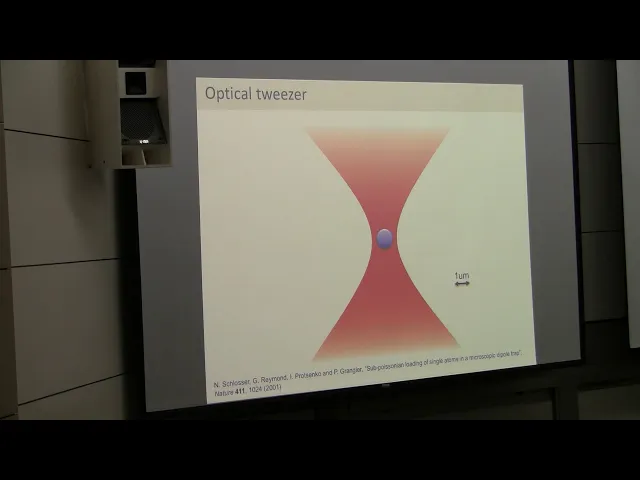
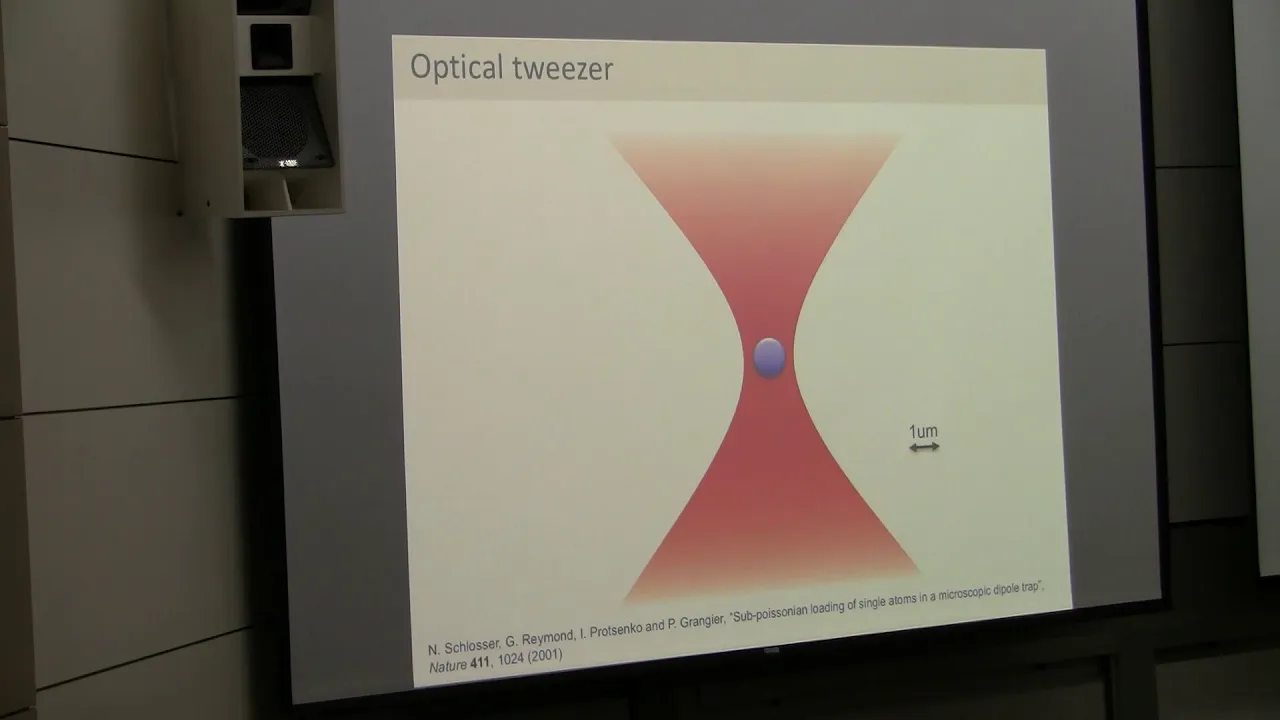
summer students PhD and so on just write me in then and I should also thank the Harvard team so some of the data is from Harvard in there okay so this is the outline and I'll start quite simple with optical tweezers on this atom by atom assembly which is relatively easy to understand so what's an optical tweezers so optical tweezer Is essentially a very tightly focused laser beam that you make with a high resolution objective or just a lens and essentially provides trapping for single atoms because this visas extremely tight and as these guys in
in Paris showed quite some years ago if you do this right you can trap exactly 1 Utama 0 atoms so there's some mechanism that prevents tupple occupation in this in these traps I won't go into details its light assisted collisions so essentially When two atoms try to go into that visa they collide and fly out so this prevents you from ever trapping two atoms and the mechanism can be done with extremely high fidelity that's important for why this whole thing works and so you basically end up with a system that you have either a single
atom what or no atom entities and typically you load this visa for my magneto-optical trap so there's a guess of cold atoms and you just stick it in and then you Can trap a single atom so that's at visa so what we do now is we generate large-scale tweezer arrays and I think the first paper that I know which really did that is down here some of 2014 yeah yes missing from an Toronto always the use spatial light modulator to do that we do a little bit of a different trick so we use acousto optical
deflectors so now it's an acoustic reflector that's essentially a cousteau optical modulator that many of you lose in a lab so it's a Device that has a crystal inside and in this crystal you have a sound wave that is propagating and now if you send a laser beam through that sound wave it can get basically get refracted and now the diffraction angle you can get depends on the RF frequency that you send through this device you can basically scan the diffraction angle with two RF frequency linearly okay so this is if you only send in
one RF wave want one now the trick is here for this System that I'll show you is that we send in basically an RF frequency comp so you send multiple frequencies in so in the simplest case you have two frequencies and you get basically two diffracted beams out and each of the beams you can control with one of the RF frequencies okay and then in our case we send up to 100 our F frequencies in here and you can control 100 individual beams and can steer that direction okay so this is in 1d and then
in 2d you can Cross another LDL make it basically copy the whole thing to a 2d array okay so this is how we make this tweezer erase and then you send this whole thing's through an optical high resolution platform and then this makes individually focused beams and you can have a lot of things so and a lot I mean you could have 10,000 of them pretty easily so this is a picture of optical of the optic light field not the atoms but it's extremely how much genius Actually and this is 100 100 array of these
three cells okay so that's not so hard you can even make it in 3d so the optically this is not not challenging the challenging part is in the end twofold so you need enough laser power to actually trap atoms so it has to be sufficiently deep as a trap and the other one is you want basically a homogeneous filling in so generically if you just stick these guys into a cloud of atoms it's a Stochastic loading process you have a lot of holes in there so and I'll show you a technique in a second and
how to actually reduce this this entropy you have in the trap so it's hard to scale it up and it's hard to fill it homogeneous ly but it's not hard to make a lot of tweezers but that's that's a proof of principle okay so so how is it business loading so as I said if you stick this visa into some cold gas and you try to trap atoms out of them you Typically have only 0 or 1 in each t visa and this is basically now a video that i'll show you where you see repeated
shots so this is a tweezer array I don't know but like 10 by 10 approximately and then so this would be a square array and you see already that only some of the traps are full so whenever you see a white dot your trap is filled when you see nothing yes zero and then what you do is you load the gas you stick that visas in you let the Guest disperse you image the tweezer array if you see one of these shots and then you start from scratch okay so you load it again and you
see another picture and this is this video okay so you see this itself so it's completely stochastic completely uncorrelated they just fill in and then what you find is that they're filled with about 50 percent probability there's a single atom okay you can in this case I need to remember a few micrometers okay so in This case is few micrometers and you can go down to micron scale distance so there's some limitation so how close you can get it's so complicated in the end did they start to interfere that's the tricky part but essentially it's
a micron scale okay so you can average this thing and you get this nice arrays but usually do you have a stochastic feeling underlying these nice pictures that people often show so now the generic problem is if I really want to Build a quantum computer a quantum simulator I wanted to something extremely controlled I don't want to start with a stochastic Liefeld array like that so I want it to be compacted so on the probability you really find something that's completely defect free it's very low if you go to large atom trap so it's 50%
to the power of n and if n is 20 it's already almost zero right so there's nothing left so the chances to see this thing completely Fill this extremely low so how do we really overcome that and this is now where this atom per atom assembly technique comes in that I developed with Swiss co-workers at Harvard a few years ago so that is the following so you note tweezers from a magneto-optical trap as I said and you make a large array and I showed you how to make the arrays and then you see that some
of these atoms some of the tweezers are filled and some of them are empty And if you have a very good imaging system you can identify this in a single imaging step with high fidelity and then you can say okay since I have the control over this RF waveforms I can just switch off RF tours for the ones that are empty okay and then obviously it's everything is filled but they're still now basically entropy in the position of the traps they just have to remove that entropy so you basically just reshuffle everything into a compact
Array so that's the idea so you basically and you do that by changing the RF frequency of each of these pincers you can move them around so it points down to an exercise in our F friction frequency generation and high fidelity imaging so that's the idea and here's some sort of before-and-after pictures so this is an array in 1d now with 100 visas and about 50 of them are filled and you always see a picture before that rearrangement step in the Picture after the rearrangement step and that's how it looks like so it's this and
we compactify in this case to the left so you see it works in almost all cases you get this very nice filled arrays so there's a single shot pictures and you can also vary the geometry because you have control over all this RF frequencies you can decide where to put the tweezers in the final image so you can do clusters of 2 or clusters of 10 and I'll come back to this you can Basically draw stuff Misty's fix and there's some sort of success probability I'll come back to this in a second but this is
essentially how it works so this atom by atom assembly so questions for that we'll move on okay just you know throw out questions feel free ok so this was in about 2016 and where we published a paper back to back with our own progress group and carries they have a slightly different scheme that I don't wanna explain in detail they can do a Scheme in 2d there's a few more groups who do this there's a group in Korea and then Dave Rice has a yet another scheme that works an optical lattices which is somewhat of
a similar idea and there's a few others and we do it at Caltech now as I'll show you later so this has developed in some sort of its own subfield by now and it's used in a few different context so a maybe that bottom line of this is that you can arrange defect free arrays of about 50 Atoms at the moment in 1d 2d and to a certain degree in 3d the atomic distance is adjustable down to a micrometer up to 100 micrometers whatever you want and geometry is flexible in each arrangement so I can
just basically program the different geometry for each shot that I wanted to reach to an experimental repetition and one thing that's also important that somehow not always mention is that the repetition rate of these experiments is much higher than a Traditional cold atom experiments or traditional code atom experiment yeah yeah yeah this is there's many different schemes for 2d actually so what they do in this case is they have two lattices once that's fixed so they have basically a base letters and the sorting to visa so in that case they just take one letters and
they trap atoms in there and then they take one visa which just moves one atom at a time until it's compact and this works surprisingly well there's A new scheme where you have one base letters and then you have multi-boot visas it's like a machine and it just does everything in parallel that's better but just original one is just want visa yeah but it's up here so much faster repetition rate so if you do a traditional cold atom experiment usually involves a evaporative cooling step which is very lengthy and this does not have an evaporative
cooling step to get very controlled arrays and so typically The repetition rate of these experiments is about 100 milliseconds also you need very small magneto-optical traps only because you only have to pick out an at about 10 or 50 or something like that so this makes experimenting with them easier in any case there's some limits to that so it's not some sort of a metric thing you know so it's the same limitation that you had before so the probability of success to have nothing no hole is exponentially small you know It's P to the N
with your success probability to place one atom somewhere basically so we have some single atoms transport proper pillage and imaging probability and so on and if you can see in this scaling its P to the end that if you really want to scale this up to a thousand atoms you have to have a very high fidelity for each single atom to move them around and position them and you're not allowed to lose them right so if you really want to Avoid holes it's extremely hard okay and this is also to a certain degree where there's
only 50 atoms and at the same times you need a large number of traps so it's a laser power limitation okay so it just tells you something about scalability okay questions good I'll come back to this actually we see seven minutes now it's very long so we can do that under cooling so if you don't cool the core quite quick but under cooling at seven minutes okay more questions yes Okay good so the point is now you have basically some sort of an initial array but they don't interact so it's neutral atoms and at the
micron scale they're basically the interaction energy is basically zero so the question is how do you make them in the acting in this case so you could bring atoms very close together and they could start tunneling between tweezers and some people are working on this or you could work on long range interactions so that's Actually what we are doing and there's different types of long range interactions phonons dipole-dipole interactions of some sort and we use root pack states I'll explain this in a second so you could have molecules with a permanent dipole moment for example
and another way is to use photo mediated interactions for example in cavities which is something that Monica is pursuing of course here and also you can combine these techniques with tweezers I Think and people have done it for example with photonic crystals so I talked in detail about Ruth back interactions and this is a particularly fruitful marriage between rhythmic excitations and then these trees arrays for various reasons that I'll explain okay so Rick back excitations and its limits how does this work so what's a route back atom to starkness so no more normally you're used
to atoms in its ground state or Close to ground state so for example this is Ruby diem in its absolute ground station and the size of the electronic wave functions quite small as you all know and then once you excite these guys to very high quantum numbers and that's what we call a ripped back atom basically the electronic wave function gets very large and it's surprisingly large the first time I thought about this I found there's a very large number 200 nanometers is ginormous right This essentially explains all the properties of this and I have
hand wavy way so in particular you get an extremely strong interaction between atoms that so funder vaults and types from the vaults in directional induced dipole interactions that means there's no permanent dipole moment but there's fluctuating dipole moments in a way and the reason why they are so strong it has to do with the fact that electronic orbit is so large Essentially this electrons they can fumble around very easily you can move they're very easy little isn't a large polarizability essentially and then because these electrons move around a little bit you have induced dipole dipole
interactions and they typically scale with this one over a six so one thing that is then surprising is that it scales so extremely with the quantum number so it's n to the eleven so because of this n to the eleven scaling You can have basically insane interaction energies on atomic physics scales at very large distances if you go to two microns which is a typical scale in this tweezer arrays you can afford in gigahertz interaction which is extremely strong and that's something we utilize in these applications in quantum computing and simulations as I will show
you in a second so this is the important part so that in the actual range or the strengths of interactions that you can Have on typical atomic distances in these two these arrays can be can be very high so that's the trick of this recognize okay so how does this look like in practice and practice you have this kind of arrays and now you drive basically all atoms so that's the simplest case we drive at all atoms simultaneously to a root back state and then a simplified fashion you can transcribe this as a two-level system
where you have a ground state in the rip Back state so this ground state is supposed to be a repeat your madam or something that is close to the ground state and then you assume the ground state is not interacting but the root back state can be extremely strongly interacting and what's the Hamiltonian for such an array so I assume everything is assemble everything is disorder free it looks like that in a rotating frame so there's a typical atomic physics you basically have a spin operator that Describes the drive so it's a sigma six-six operator
in the spaces then you have a detuning term that just depends on how far is YouTube from residency and then there's this interaction term in here and this is the action term again then only acts on a route back state so this is a projector on the route back up here so in the ground state does not interact so it's essentially the Hamiltonian in a nap and this gives you a strongly Interacting many buddy system just right from the scratch at these atomic distances and now the cool thing this is a racist that you can
basically tune the interaction term at will by changing the spacing and because it's one over six interaction you can change it over many orders of magnitude but just programming in a different pattern so that's the trick and now the question is in the end so how coherent is all of that and what kind of many body physics can you see And also can you basically use this this type of amazonian as an engineering tool for quantum computing or for quantum optimization of these kind of tasks and I won't say too much about it I will
briefly go about some kind of generic features just to kind of poke your interest so if you just look at the ground States the many-body ground states of the same Etonian in 1d on the simplest possible geometry it's already extremely complex so there's multiple Ordered faces they are called root pack crystals so if we can basically drive systems into crystalline phases I won't go into details and and there's multiple types of crystalline phases there's multiple types of quantum phase transitions involved and then if you think more about it you will find that there's lines that
are close to in Decorah bility there's conformal field theories all kind of things going on just in the simplest 1d case so my point Is this richness thing comes basically from an interplay of quantum effects so it's a strongly interacting quantum systems you have two long-range interactions and this long-range interactions drive these different types of crystalline phases and you have a strange you can put it on different types of geometry and this this really gives two extremely rice two extremely rich physics so now that ground state physics is understood somewhat in Bondi But actually even
this phase diagram is not completely understood and 2d not much is known actually it's quite complicated and then if you really think about non equilibrium dynamics does it's an extremely rich playground to study questions of many party non equilibrium dynamics and I don't want to go into details as things that have to do with quantum chaos you could study in decrepit Li and these kind of things and then more generically if you think of Systems where you have more control and and you do single side addressing you can use these things for sort of quantum
engineering in a way so there's mechanisms for example to engineer cheatsy States and so on don't want to go into details that is my point is it's a rich playground for quantum science in general specifically for quantum simulation and if you think forward for corner information and I will show you some things for metrology In the end but there's some good experimental progress but I think we really have only seen the tip of the iceberg of what you can do with it so it's really kind of really early early stages we've worked with this now
for essentially three years or so that's it so there's a lot to be done and the question is also a little bit what are the limits and and where does it go when I want to come back in a quick interlude to this slide I had in the beginning About what I actually the challenges in this in this emergent quantum science field and one is of course I want to do something where I can beat a classical computer one way or another that's what everyone's trying to do and one simple test case here is can
I perform cannabis some sort of quantum dynamics experiment or quantum simulation experiment that could beat at least classical numerix a state-of-the-art classic numerix and you can start to ask this question and then Go through some test cases and see what happens under realistic conditions and that's something I truthfully go through and I'll tell you why this is so hard so the case study that we did numerically is quantum chaotic dynamics in a 2d root pack Hamiltonian so 2d is very little known but what you know is that for some generic choice of parameters the system
is chaotic and and you want a chaotic Hamiltonian for task like this because you want to avoid any kind of analytical Or in decrepit description so you want to be far away from any point that you could describe perhaps so this t1 xq and then in this quantum chaotic regime you can basically just run many body dynamics in that system and see how entanglement spreads in the system so you start with an initial product state or spins and you try to see how correlations basically build up and our fastest course you can look at basically
entanglement as a function of time as a Function of subsystem size and what you see it basically cross and but at the same time what we did in this mo marix we actually ran it with dissipation so we ran at this state coherence mechanisms on the top so we for example included here just the PEI spontaneous emission of this route back states as some simplest possible case so and then you will see for example that you have some sort of a tech coherence proper period so this is the probability that System observes a single Trump
basically from an excited state to a ground state by spontaneous emission okay and you can ask the following question what's the probability to have no chump so this is this orange tie a time at some time that a system has basically grown maximally in its entanglement so you try to spread entanglement in the system across the full system time scale and you ask yourself what's the probability to have not a coherence event so it's a Probability that you coherently pacifically thermalized the whole system and spread entanglements throughout and then asking why no trumpets it's basically
some sort of a sub sector of the dynamics where we have note the coherence event it's it's a hard question it's a tough for experiment in the end if you run a quantum computation without error correction that's what you have to do for example and this tells you why harder is so what you see here Is that so the time that you need for this entanglement it grows basically this is a subsystem size of generically flows with the system size and then we went into details and you see the following scaling so for example you
see what I told you initially that this taker humans rate that you have an it's trivial and this case case with N and then you can actually ask yourself how long does it take to entangle the full System and you see that it scales with n to the one D that's the linear size so it's a 1d system it's linear and a system size if it's 2d it's square root in a system size if it's 3d is three half in a system size it's just basically some sort of a linear spreading and if you put
these things together you come up with some sort of generic loss or the probability for not a coherence event at the entangling time it's this generic law so it's Exponentially suppressed again and then you see some sort of pre factors that have to do with the coherence rate and the energy scale you have in your Hamiltonian and then there's a geometric factor so what you see is that you have to improve and that's trivial in a sense to take coherence rate compared to the energy scale in your in your Hamiltonian just have to be faster
but you see that these two factors combined so there's the N and the one and D and they combine To this n1 plus 1t so does what I mentioned in the beginning it kind of hits you twice so it's extremely hard to do that and you can run through the numbers and what you see is that in pretty much any system not just repair systems jump probability is about 50% for twenty cubits you know in 1d or 2d like maybe Google guys are slightly better but not much better so that's about it And this this
is extremely challenging it has to do with this number so these numbers have to be extremely good you know and the question is then specifically in the context of this route back simulations and route pricks this is also similar 20 cubits maybe slightly a slightly larger but that's that's it so what are really the limits now now can I go forward to release something fundamentally different so what are the limits so the limits to Start with as I mentioned and I know where this goes on so fast so the first of all this route back
states they have a finite lifetime and this lifetime is 100 microseconds you have to be much faster than that not just effective to but effective 100 if you want to take 100 cubits something like that then typically in in alkali atoms and that's all the results that have people been doing it's a two photon transitions you have to go why an intermediate state and This intermediate state gives you an additional decay time of about 50 microseconds and so typically you have 50 microseconds time that's all you have and additionally a finite temperature and laser noise
this basically all adds up in some sort of an effective coherence time for these systems there's something that's not often said is that these experiments with people show results they actually done in free flight so generically this route back States are extremely strongly MD trapped in that visa so what you do is you cool atoms in the tweezers and then before you switch off this route back lasers to induce this repair dynamics you actually switch off the laser at a trap quickly you switch it off and then as I will show you in a second
timescale for driving this route back excitations extremely fast compared to emotional timescale so these atoms they only move a very tiny bit and if that motion is Small compared to the dynamics then you can basically do everything in freefall but the point is that this freefall doesn't last forever so eventually these atoms they drift too far and you cannot track them anymore afterwards so you have about 10 microseconds and this sets a maximum timescale that you have for this experiments and at the same time limiting factors then how fast you can do this and this
basically depends on the laser power you have in this route Back beam and this gives you around a few megahertz so basically have to compare this 10 microseconds to this timescale this is all you can do in a way this this gives you a fundamental limit and then system size wise ideally would like to be large so there 50 atoms and you know I can limit it right this survival probabilities I talked about and then another little bit is actually if you really want to do many body Physics you have to look at many party
observables and then in the end you run into a detection limit so the detection fatality for this route back States is about 96% roughly speaking okay and so this is the kind of state-of-the-art at the moment for 4th peg atoms and then I'll tell you in a second what we do different you know do you have any questions about route back is a little fast yes a rest different schemes it's a good question so typically so this Grants that is really some sort of absolute ground state of the atom and then in in in e.coli
atoms there's in an immediate state that you can automatically eliminate by going off resonant and then you have this route back state so this Hamiltonian of wrote down for example is in the basis of this ground state and the route back state and this guy's somehow neglected that's what you do now and this is the generic setting and maybe come back to this is Just a generic setting how you would do this many party quantum simulation experiments it's usually written in this type of system and what generally it's usually a three level system I'll come
back to this often you use two ground States that are much more long lifts 100 microseconds not very long so you have two hyperfine ground States and I'll come back to optical crown States but you have two hyperfine crowns said that they live for hours for example and that What if you say you wanted to a quantum gate as an example what you want to do is entangle the hyperfine ground States why are some intermediate step of mediating entanglement via this other m Tony I'm just reducing the talk slightly to this problem simulation the idea
yeah so but this is so far all in this plan to route back bases and I should say I'm focusing on that because in in cold atoms we know how to control hyperfine levels extremely event you can Do this with extreme high fatality the limiting factor for example for route packet and I'll come back to this has been the fidelity with which you can do this with back operations so how well can I have to drive this route back a transition and how well can i generate entanglement or this repair transition this has been a
limiting factor by far so this is why I focus on that part questions okay then let me move on so what we do at Cal Tech Is now asked us this kind of question so can we improve on on these limits by using different types of atoms so maybe I can play atomic physics tricks to really eliminate some of these some of these ideas and also when I use a different type of atom maybe I have ideas for really qualitatively different applications and specifically we just meant one one column up in a periodic table so
usually the experiments are done this Aguila atoms so far and we use Alkaline earth so what are : earth atoms atoms with two valence electrons and they have a very specific level structure that basically consists of of singlet and triplet competition transitions and this triplet transitions can be extremely narrow because the dipole for pitting usually and then this is the specific case of strontium value here extremely narrow transitional setting kilo hertz compared to a standard transition and alkali which is More six megahertz and then you have even narrower transition decided so called clock transitions which
have extremely long lifetime and extreme lower line width and typically these atoms are used now in an optical lattice clocks and then basically people try to stabilize later lasers to these optical transitions and and you have some of the pioneers of this of course here in the audience and generically people in the past 10 years or so have have really Reached a tremendous amount of control of these atoms of this narrow line lasers and so on there's been extreme amount of progress and we are leveraging some of this progress now so what we want to
do is really use this peculiar level structure of narrow transitions and even having this very long-lived metastable States for purposes in in quantum simulation and computing and really use use them combined with this visa techniques what we want to do is Really control a race of individual icon line as atoms and control them atom by atom but at the same time also with very high spectral frequency control and see what we can do with that there was some of the premise of what we set out to do and I'll walk you through some of the
results that we have along these lines and I go relatively brief on each of them I first show you how we to narrow line cooling optically cooling industry sis and then I show you how we Use this for high fidelity imaging and then I briefly call come back to route back and how we improve on some of this report fatalities now and I'm very in the very end I'll show you how we can control this clock transition and how we can build a clock out of it so let's go faster but just interrupt me I'll
skip some stuff in the end okay so for the experts this is all which strontium 88 okay okay so first narrow line cooling so this was one of the reasons why I Originally wanted to work with strontium so strontium has this very narrow 7 kilohertz transition and if you think about what happens in a trap so these atoms are in a trap and it's basically at the bottom of the trap you can describe this as a harmonic oscillator so these atoms they just Rumble around down here and then if this is a nice trap it
basically has an harmonic oscillator motional spectrum and then if you use the right wavelengths the Excited state here is trapped with the same Vista same track okay and now if this if the line width of your optical transition is narrower than the motional trap spacing here you can basically address these these levels individually and we are actually in that in that regime so for us the spacing of this motion levels is around 100 kilohertz or higher and the optical transition line was the 7 kilo Hertz you're basically essentially in a Standard sideband cooling regime so
what you can do is you can basically take atoms say that N equals 1 motionless state drive them to N equals 0 and then they preferably decay down to N equals 0 so if you apply this correctly you can basically to a red sideband cooling and this is a typical sideband cooling spectrum that you get if you do this right and we can cool basically very close to the ground state mister Sideband cooling so this is one thing and this is kind of new in a sense you can do single atom direct sideband cooling basically
here another thing that we discovered this was somewhat unexpected so we always thought that you have to be in this what's called a metric trapping condition which is that the ground and excited state have the same trapping potential it turns out if the excited set has a vastly different trapping potential you run into a regime That's a textbook what's called Susie for schooling regime and what happens in here is that because the line width here is so narrow compared all the energy scales of this trap so you have to mention so this is a seven
kilohertz line within that that thing is basically ten megahertz deep or something like this or makes up megahertz system so that means that in a classical picture of what you can do if this the ground and excited states have Different trap input centers you can create a local resonance in space so I can tune this laser and basically on a very narrow shell in the trap I can scan through the trap and I can tell you about atom get excited with extreme precision because the seven kilo Hertz versus megahertz is so I can basically a
source of energy share like an excited atom and if you clever about that you can now in this specific configuration tune this such that you only excited the Very bottom of the trap and what happens now if you have an atom are still aiding in here it will roll down and then only gets so excited here and then roll up and then emit at some random point at some kind of classical turning point but that turning point will be further out and then it's the emission process gets stalled and you roll down but if you
now compare what happens in this whole process you're actually losing energy because you roll up here and then you Roll down only this year so you gain this kind of potential energy difference and it's a classic example of Susa for schooling what's called the Sisyphus cooling because we kind of tried to repeat it you go up and go down so and we see basically the Zeus which was cooling on a single atom level in these tweezers now I don't want to show the results but we have very clear evidence that this is happening and the
nice part is that this is extremely robust so we Use actually this type of Sisyphus cooling scheme for almost everything that we do now and and one of the reasons why we do that that's a little bit for the laser cooling experts you only need one beam so normally if you two sideband cooling you have to go from all three sides so if you do laser cooling using you have to go from all three sides and this happens to cool in all three directions with only one beam and it's because all the recoil comes From
the trap and it's extremely practical for cooling and during imaging because you don't get photons into a camera it's a bit of a sight line okay so it's extremely robust and also with the suit surface we see in practice we get extremely close to the crown stairs a bit of tricky questions those ends up where is exit row so it's very robust and you get close to the counter with only one beam so it's extremely simple experimentally and it's important in the End to be so cold for repair coherence I come back to this imaging
fidelity and all these things so this is how we cool okay so cooling is import how do we image so what we do is basically we keep on cooling on this one transition trying to keep the atoms cold and then we scatter photons on another transition that heat them a little bit and then the balance things out such that they stay in some equilibrium and you essentially just collect photons From this 30 megahertz line this is the blue line and the imaging setup is super simple one cooling pin one excitation payment and it just imaged
on a camera with a high resolution objective and then this is what you see so you see this a tweezer array and this is now strontium 88 atoms this is a single-shot this is average to see the single shots look very very clean and if you go into details you can look at this photon counting statistics that's the way this Is normally done so what you do is you basically make a box around one of these spots here and then you count basically in this pops how many MC CT counts you see on your camera
in each shot and you make a histogram out of this okay and then you see two peaks here of this count distribution one is down here at zero and one is up here and if you go would go up higher you wouldn't see anything else and these two peaks correspond to cases where you have no Atom and one atom and this is how you basically discriminate these things in experiment you basically put a threshold here and SFC more counts it's one atom if you see no counts as a single atom and then the key for
the single atom imaging is you have histograms like this where this is extremely well separated okay and this is an extremely well separated case and then you can really figure out what's the fidelity you have with which you can distinguish an empty Form a full trap and this fatality turns out to be four nines and upwards for us and we can go through the mass it's extremely high and another important factor is the survival probability so you can just drink it an empty from a full trap but if you have a full trap also what
to have to trap to be fooled the next time i image i want to do something method so it's a survival probability and this turns out to be also three nines and upwards and these Numbers are important for basically deep parking systems but they're also important in this rearrangement scheme so because if you take a first image and you lose an atom the probability to have a hole later on is again the same probability ^ n so you have to have this high fidelity x' to go to thousands of atoms you actually need three nines
upwards to go to a thousand atoms as I said earlier so we have extremely long lifetimes and this is the key to Reach this fatality so their lifetime in the trees are now seven minutes so it's more almost like an ion trap experiment at this stage so this is really really what we what we reached and to our knowledge these are the best values in terms of detection fidelity and survival probability that have been demonstrated for neutral atoms in general and again it's important for a large-scale assemblies you could go to a thousand basically now
and deep locking high Fidelity quantum operations okay questions about that you good okay so he basically can image these guys with high fidelity and and then they stay there it's the point okay a quick interlude so we figure out this assembly scheme also for strontium what I want to say too much so we can do this which transhuman right nice pictures it's essentially the same with a slightly different algorithm that will publish essentially at some point and I'll use this in a second for This route back every size so we can image them and we
can put the assembly on top now with alkaline earth atoms so we can do all of that okay let me come back to route back so I told you a little bit about route back and quantum simulation and so on and about a few a few limits that we have in there and so a key feature that we use now in a : earth is we make use of this metastable state so this is the level structure to the absolute ground state so you start Atoms in here and then you transfer them somehow up here
and I'll show in a second how and we use this basically as a new ground state so this thing lives for 100 seconds you forget about this guy for a second and then you can go with a single-photon excitation to an s route back state normally you cannot do that because of dipoles electrodes but here you can so you park them here and then you go up and this basically replaces this two photon scheme so it's A stepwise two photon scheme instead of a fad attune to photon scheme and has a lot of advantages you
can get very high Rabi frequencies so the type of matrix element is high you don't have to go where it is to photon thing and the atoms are very cold in our case because we use this sideband cooling and we have new detection scheme I'll show in a second and the rickrack states actually in principle can be trapped why are the polarizability of the iron core and then Okay so we did that very recently so we transferred the atoms up here and the shine in this laser and then we basically look at just Rabi oscillations
between the ground and root backstage so Delta zero in this case it's on resonance and we place the atoms using item by atom eccentric so far away that the interaction between the rep X States doesn't matter to start this so that's another advantage I can just basically dial in a system configuration that's Completely non interacting just to debug everything so that's what we do here and this is a typical Rabi oscillations that you see so it's basically a textbook Rabi oscillation between this ground and respect state so you see first of all there's almost no
decay on the level of a two pi and then you see this goes up really it's a really full contrast one oscillation and this is not corrected for any kind of detection efficiency or anything this bad data so we didn't do Anything and so first of all this is the first Rabi oscillation with single iCal on us on this route back levels and then one thing is to track Rabi frequency see if we can reach our almost an order of magnitude higher than in etheline us that's important for this entanglement spreading questions and then the
Fidelity's that we reach is basic if you ask the question what's the fidelity to do a PI or 2 pi piles it's about ninety nine five and this is correct not Correcting for preparation and detection errors and this is by far a record for for routeburn atoms after say usually they don't go up completely up here so this is not just doing it with a new platform but we also in the first shot with in doing this for four months or five months have have new fidelity records and detection efficiency records and I'll show you
how the detection works in a second so this is the non-interacting case questions about That okay good you can do it for longer time I will skip over this for a second so we can drive it for longer times and see up to 40 to 50 oscillations which is also a record in terms of long term coherence now the interacting cases is the really interesting one so we can use notice a simply scheme to basically prepare pairs of atoms but each pair doesn't interact with another pair but within the pair they are so close that
this interaction energy is really the Dominating energy scale and then basically what you expect is some sort of a mini tablet system that oscillates and you have a bunch of copies of them just to get more statistics essentially and the physics is quite quite simple so you have two atoms in a cloud state so there's four levels ground ground ground RR grr and if you're far away you to basically try this Rabi oscillation a shorter but if you put them really close by such that this Back into action up here it's extremely strong the second
process of going to RR s completely for Pitons if you're really in that regime what happens is effectively if you think about it a little longer step you drive an oscillation from both atoms in the ground state only into this manifold and because of the symmetry of the Hamiltonian you couple only to one symmetrize state here so it's actually Chi R plus Archie with Sun face that you Don't know to start with HDR betray so essentially what you expect in this blockhead regime is a Rabi oscillation between this state and this state and this is
also what we observe in the data so this is a different type of probabilities and she essentially the probability to be either in GG or an RR and this probability goes from 1 to relieve extremely close to 0 to 1 to extremely close to 0 and so this is oscillating between these two states and Then more precisely we develop the technique to figure out entanglement fatality that you have so essentially at this point where you try for pi pilots you expect to be in this state and you can ask yourself what's the fatality that I
have for reaching this Bell state essentially and the penn state fidelity is about 98% if we don't correct for preparation and measurement if you correct for preparation of measurement it's 99 5 and this is also to my Knowledge a record for neutral atoms actually PI 5 used to be 97 if you're correct for detection of preparation errors and 94 if it's unconnected so we really make it work quite a quick jump now and this 99 5 is actually as good for example a superconducting qubits I negate I should say there's not a food gate yet
so you have to do more steps but this used to be by far the limiting factor for gate so if you put that thing together with other techniques for gates I think you can reach these numbers in a 2 cubed gate another thing we did is we did the same thing in trap so this all in free fly this is for expert sweet you don't have to switch off the trap and it still works with high fidelity and that's actually important if you want to pull the computer I don't want to switch your traps on
and off all that time it's not good for you ok so this also works and you can do it long term and that's Actually one of the results that I found the most surprising that it works like this you can drive this blockaded oscillations for 60 oscillations so there's a 60 times you go into an entangled state and back this is actually I found it surprising as it works that that okay good how much how I might I'm gonna almost done five more minutes okay so let me explain this because I find it interesting so
how do we Actually detect if you're on a ripped back state or not so normally what people do is they they basically okay they try said is Rabi oscillation and say in a super 50-50 superposition and then you want to distinguish route back from crown state what you do is you switch this Jesus back onto very high death and then everything that's in the route back state is extremely ended trapped and flies out of the trap and then you basically just catch the Grounds that Adams image them so he is basically destructive in a way
such that route back atoms are very quickly lost and this is basically it's the detection scheme and that's not very high fidelity because on the timescale that the atoms escape from this to visa they can decay back to the ground state and if you're not fast enough you get a detection in fidelity from atoms that decayed back down before you like basically image them now what we do is actually quite Different so we use an outdoor ionization schemes and for this the idea is that we convert route backs very quickly to ions and I'll show
in a second how this works and this extremely fast and then the image remaining ground state atoms and essentially the ions to something that we don't understand it doesn't matter but the ironstone appear in the picture because they completely have completely different level structure that we don't image anymore That's the idea so it's a loss based outer ionization scheme so how does it work so essentially the object that I showed you the whole time that does this Rabi oscillation in a nutshell is a is it's a two valence electron atom that you shoot one electron
into a very high line orbit but you have a core iron left so it's an iron with a tightly bound electron so the strontium plus iron down here and so this is the root back state and then what you can do is you can Basically excite this core iron on a standard keyboard d2 line you should shoot this electron once more higher and then there's an electron electron collision such that one electron can fall out and the other go falls back so there's a standard outer initiation process in a nutshell and we use this and
it's extremely fast that's the thing and then our detection efficiency that we can get this this is also extremely high so we have a lower bound just from Measuring it with three nines upwards and it's an upper bound in terms of comparing timescales which is some sort of limit limit but also not fully old limit which is some sort four nines of it so you can have extremely high detection efficiency for this route back states and that's another big factor that we can now mr. cycle on us items okay so this is a fiction scheme
now you can ask a stupid question so what happens with the I you Know it's just iron is still there or not and so first of all this process as far as we understand it almost doesn't heat the atom because the electron is very light just goes out and then the iron basically doesn't get much recoil so it should be not that much and on the same at the same time so this iron core still has optical transitions and if you choose to write trapping wavelengths originally the iron will also still be trapped so we
think actually that these Ions are still there up to stray magnetic fields so if you make this tweezers deep enough and you start with a ground state good neutral atom and you do this process correctly I think you could still have a ground state cooled ion in the tweezer automatically something we haven't demonstrated but generically should be possible and this just gives you a new route basically to iron through six in a way if you want unfortunately we don't have electrodes In a system otherwise we would have tried that already I think our stray fields
are too high but if you put an experiment is just you will see it for sure so there's a new way to ayats or this way i want it's already talked about this originally any so let me hurry up so i showed you so i basically claimed that we transfer atoms from the crown set to this metastable state and you have to do this by a narrow transition Which is this clock transition and we can drive this transition and in a strong magnetic field with relatively high Rabi frequency and an achieve basically pi transfer efficiency
about 9999 and then we have some additional optical pumping this is how we go there and and we have used this in this route back experiments only as a preparation step but you can ask a different question so you can ask what's the minimum line widths that you can Actually achieve in a tweezer and then a generic optical clock is basically just a stabilizing a laser system to this transition so can you use this tweezer arrays instead of an optical lattice to build a clock okay this is a one slide i'll show you in a
second so we basically did that you shine in a clock laser you probe this transition you use the single atom readout that you have and you're basically feedback - this clock laser system and we did That so you can basically do a double probing sequence to get an error signal and then just do that so we demonstrated this in this paper there's a parallel plate by the chilla group they short basically spectroscopy with extremely coherence extremely long coherence and we really showed a basically a stabilized clock system and and really using single atom readout in
detail so the point is this is average signal but now what is really exciting about this Is that you can probe this this two-level system here which basically hurts never love sup hurts level precision pop I have two single atom readout on control on top so in particular for example we can look at error signals that are really hurts level and then atom resolved so there's 81 atoms in that visa and you see our signal it's Hertz level resolved for all of them and you can resolve frequency differences like supper at 700 Millivolts level and
so we played with all this kind of stuff in this paper and details you can do all kind of shenanigans with it but one thing I want to say is that this is some sort of met a marriage of precision measurement single Admiral control and not just one atom but like 80 atoms and in principle thousands of atoms and I think this is the one of the main messages of this talk that I think this will happen more and more so I think there will be a new Generation of experiments at my prediction where you
see this not just for clocks but also for EDM measurements of these kind of things because these visas and these techniques and principle they've worked for almost anything and it works even for stuff that you cannot even trap anomaly the optical trap I think actually so this is I figure extremely powerful technique value to single atom trapping and then precision measurement on top and it's the main Part online so and in terms of clocks what we did it some wherever kind of hybrid between an iron clock and an optical lattice clock in terms of capabilities
okay alright and these are the two schemes are short your shortest this route back scheme where you can really engineer strong interactions and a no problem you have this clock state which is which are narrow transitions and one thing would plan to do in the future is really combine them so you can Basically use this route back state to engineer gates on this clock transition and you can think of entanglement and hence metrology mediated basically by this with back states so that's one idea okay so I'll conclude and and and go to a brief outlook
so the summary is that we basically managed to trap these I : sorry Cole and Adams in tweezers and demonstrate a narrow line cooling and there's parallel efforts in chiller and Princeton who also shot that and then we followed up on this with really high fidelity imaging so this is 4/9 upwards fidelity records and also records in lifetime so this is a short paper we published very shortly afterwards we now very recently managed to really do record fidelity Ripper hypothesis detection and entanglement also in alkaline earth atoms and then a paper from from last year's
also this first visa array optical clock where we Really did all our standard clock techniques were v2 to clock comparison systematic errors on a single tweezer level and all this kind of stuff and what we really look forward so in the future is we think really have the coherence time to do quantum simulation between like really beyond numerix with 80 qubits upwards that's something that we're currently working on and we'll look into gates and explore ideas for quantum and hence metrology for example Together with Monica so I'm gonna zoom out for the last minute so
I think this is one of the main points so I started with all these different areas and I think I convinced you to a certain degree that this is useful for quantum simulation and metrology I think you can also to quantum computing and they have some ideas for kind of networks one thing I think that we learned is that somewhat this one one thing that is known is that if you have Entanglement and you can control a system very well it can eight precision measurements you can build a bit a clock or detect a signal
data that's one thing that's known so what we also learned is that if you can do precision measurements it also aids these other things so that's one of the things you don't miss this alkaline earth items if you can do narrow line cooling if you have metastable States and you have clock techniques so something that did Not talk about so how do we align repaired beams realign route back beams by looking at shifts on the clock transition to rehearse level this is how I get a such a homogeneous system that I get two three four
nines that's what we use we do spectroscopy on route back states with two clock comparison now so use these techniques and a condom simulation or quantum computing context so this is a very fruitful marriage at leave for us and what generally I think This this transform and the Tokyo Marais is it's a unified platform for doing computing and simulation and metrology in the same platform so what I believe you will see in ten years as an array of 10,000 items a thousand atoms where can do gates and that can run a clock at the same
time a 3d lattice clock so I can really program entanglement in there and make use of this and and vice versa and as some sort of the dream that is slowly emerging out of this over of these ideas And and the question is about scalability also and I think if you really push it you could go to ten to the four if you're lucky in the fidelity's we have you can have three nines or four nines I think in terms of intrinsic limits that are set by atomic physics and I think that's very exciting in
terms of all these quantum science applications so there's a lot more to be done and maybe the conclusion is that these arrays are found so it's a new Platform and we really can enter early stages like iron trappers were like 15 years or 20 years ago and it's very promising already so we can for quantum science in general ok so this is my conclusion thank you for attention [Applause] [Music] that is a very good question swing up so I mean there's multiple statements one can make one is upon systemic effects I think that's what you're
asking is there Shifts at these shifts I kind of introduced almost on purpose the one that I showed this comes from this acousto optic deflectors actually is kind of crazy so this acousto optic deflector changes the frequency of the optical beam by plus minus thirty megahertz so there's a terahertz hundreds of terahertz and we see that shift basically and that shift comes basically because you change it change it away from a metric wavelengths by ten Megahertz and you see it but there's other trapping techniques but you don't have that so if you use a special
light modulator that's gone I think that's not the point of it so it's not the point of staying at visa I think what you really want to do is you want to go back into a lattice see because the letters always the cleanest system so you use these tweezers to put stuff into a lattice you run a clock in a letters and used it visas for the readout that's the Cleanest clock and you have seen atom control at the same time just gets rid of the systemic effects in terms of stability there's still a little
bit away but I think this will is a matter of a year or two and you will see a clock like this with the stability of a lattice clock yeah you just need more atoms in a good laser I think you will see it there's no good reason to believe that it shouldn't work it's good question what's the best clock in 50 Years I would put some money on something like this yeah Lisa chaos okay so what we know is that one of the fundamental limitation is laser face noise enough this is related to chaos
I don't know probably I mean the system they just like the frequency of these lasers is not ultimately stable and and over the years we have become experts in laser face noise because it made us four o'clock for sure I mean to build a clock that has competitive Stability you need a multi-million dollar laser system and only one person has that at the moment it's a chili chili this is if you want to beat this records that's the only way to do it and so it's a face most question for clocks for sure and then
veto and also it's a face most question for wit back yes so having a good laser is important and if that's the right answer it does actually it does yes so in principle you you can't there's a noise Factor in the stability that you can have if you have systemic effects and you could correct for that because you know the error signal of each of them so if it shifted a little bit you can actually in the feedback you can do a programmable feedback but you wait the feedbacks and shift them differently it's an appendix
of a paper but in principle you can do that that's right and you can put two clock comparisons between two different sides to see this Kind of shifts that's right and we also use it for example the diagnosis sometimes you don't know if you actually laser face no is limited or not and we do the law orbit to the clock where you can change the number of atoms one by one and you change it from one to 100 and you look at the scaling you see standard quantum scaling and the top of a lasers you
can basically wire the technique isolate the laser frequency noise experimentally you can do tricks Like that yes yeah yeah it's essentially this fatality number that I quoted you take that number to the number of n that's a loss but the loss is not limited by the route back lifetime so I don't think at the root baclofen is limiting in the repect lifetime is eventually limiting in how good of a cake you can do but that gate operation if you just take the route back lifetime and this Rabi frequencies Is like there's five nines or something
like this between four and nine for four and five nights that's all limit limit yes yes very high yes yeah yeah one person to ask if you're trying to figure this out right now so that's one who does that in Paris you need some kind of tunable lens you can do it holographically but not fast enough so there's a tunable lens so you could do it in 2d and then and then move it around I think that I mentioned in The threat it's not as large if you just do tweezers so in one direction usually
have a hundred one hundred five hundred and then maybe you have like 10 20 layers were still a lot on his like ten thousand times 20 I mean I don't know that's not the limitation in me and for me it's harder to fill them yes I mean I think they showed up to 20 or 30 in this direction with if this nice Eiffel Tower say French people Eiffel Towers but technically in the middle