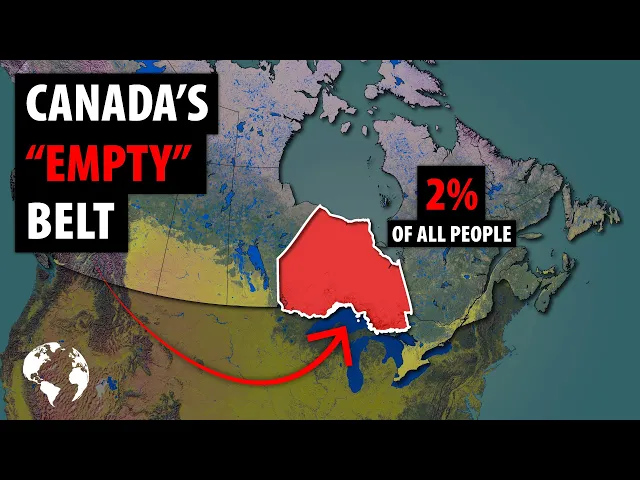
Canada is a huge country with a relatively small population of about 38 million people and because of this Canada's population is largely broken out into the eastern half and the Western half of the country but right in the middle is a large swath of land from the Hudson Bay to the Great Lakes where very few Canadians live so why don't more people live in Canada's empty belt welcome to another episode today we're off to explore another region of Canada that I've termed Canada's empty belt but is perhaps more officially known as Northern Ontario because if
you look just to the east and west of this region there are some pretty dense settlements but right here in the middle very few Canadians call this place home and as usual there's a geographic reason for this and if you're interested in this topic you should absolutely check out this podcast on the 2023 Canadian wildfires it's an incredible story but also one that's quite harrowing you can listen to it right after this video by clicking this link or by checking out the description [Music] below Canada's empty belt is a vast region in the middle of
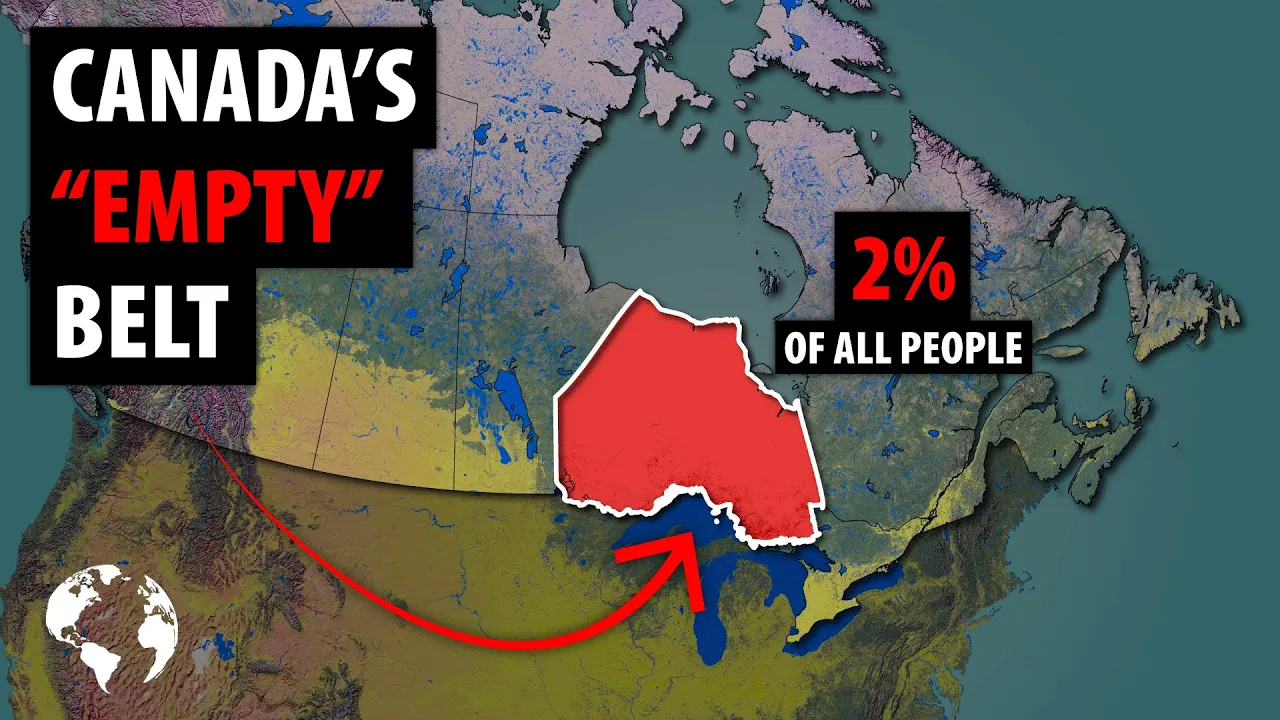
the country that splits the dense Urban clusters of Eastern Canada with the less dense but still fairly populated provinces of western Canada it stretches from the Hudson Bay in the north down to the US border and Lake Superior and Lake Huron in the South and this region is so interesting because well if you look at the population of Canada in a similar vein as the United States empty belt there are very few people living here effectively splitting the country into two larger population bases and while I've termed this region Canada's empty belt it's probably best
known locally as Northern Ontario Northern Ontario is an expansive region characterized by a wealth of Natural Resources breathtaking Landscapes and a hugely different environment from its Southern counterpart it's so different in fact that the way in which both region of Ontario developed are almost directly contrasting with each other and at about 82,000 km Northern Ontario accounts for nearly 90% of the land area of the province but is home to just about 6% of its population and the geography of this region of Canada play a huge part in why so many Canadians live to the east
and west of it but not in it one of the most defining features of Northern Ontario is the presence of the Canadian Shield a geological formation that encompasses Northern Ontario and much of Canada at large the presence of the Canadian Shield means that this area is rich in minerals but very poor in soil quality and because of this the region has been mostly left alone with hundreds of undisturbed lakes rivers and a vast expanse of dense boreal forests in fact Northern Ontario by itself is home to about 700,000 Square km of forest which would equate
to about 2% of the entire planet's Forest coverage for a single province in a single country that's a a lot of trees further north lies the expansive Hudson Bay lowlands a region that is predominantly covered by muskegg a type of acidic Wetland formed of waterlogged decaying plant material known as Pete one of the most fascinating aspects of the Hudson Bay lowlands is its geologic history the region was heavily impacted by glaciation during the last ice age as the glaciers receded they left behind a flat landscape with poor drainage contributing to the formation of the extensive
Wetlands we see today today it serves as an important ecosystem with a variety of plants and Wildlife that have adapted to its unique conditions black Spruce tamarak and various types of mosses and lyans are common plant species while the region serves as habitat for animals like moose caribou and a multitude of waterfoul but what's perhaps most interesting about the geography of Northern Ontario is just how much it directly contrasts with that of Southern Ontario the southern region of the province has been called the Golden Horseshoe of Canada for a reason it has an incredible amount
of fresh water provided by the Great Lakes a booming Metroplex region of about 10 million Canadians and a fairly temperate climate by contrast Northern Ontario is almost the exact opposite in every way aside from a similar abundance of water and it's this exact contrasting geography that enabled many early British Canadian settlements to set up in Southern Ontario leaving Northern Ontario very sparsely inhabited Northern Ontario splits Canada in half on the east side is where most Canadians live in the major cities of Toronto and Montreal and on the west side is the smaller but still sizable
cities of Winnipeg Calgary Edmonton and Vancouver but in the empty belt very very few Canadians but before we explore why that might be if you're enjoying this video hit that subscribe button more fun geography videos are just a single click [Music] away the westward expansion of Canada is a story of opportunity struggle and the interplay between human ambition and the natural environment Northern Ontario holds a special place in this narrative serving as both a Gateway and a formidable barrier to the country's growth the initial push into Northern Ontario was largely fueled by the fur trade
in the 1600s European settlers and Traders primarily from France and later England found themselves navigating the vast inland waterways seeking valuable animal pelts indigenous peoples who had been living in these regions for Millennia became vital partners but were often exploited and displaced in the process however it was the discovery of Natural Resources like Timber and minerals that truly accelerated the settlement and development of Northern Ontario the Canadian Pacific Railway completed in 1886 was a transformative project aimed at connecting the East to the west but Northern Ontario presented formidable challenges to this endeavor dense forests Rocky
terrain from the Canadian Shield and numerous lakes and rivers had to be navigated nevertheless the railway succeeded in traversing this difficult geography opening up not only the Northern Ontario region itself but also facilitating the larger Westward Expansion towards Manitoba Saskatchewan and eventually the Pacific coast the construction of the Canadian Pacific Railway also had far-reaching social and economic implications towns sprang up along the rail line primarily as resource extraction outposts sudberry for example became a significant hub for nickel and copper mining these settlements were often multi cultural attracting immigrants from various parts of Europe and other
regions who came in search of employment and a better life but at the same time the exploitation of natural resources and the establishment of new settlements led to the further marginalization of indigenous communities the completion of the rail line had a geopolitical impact as well prior to the railway the connection between eastern and western Canada was tenuous at best and the fear of American expansionism was palpable the Canadian Pacific Railway helped unify the country providing a tangible link between its disparate regions and strengthening Canadian sovereignty over its vast territory but despite being such an integral
part of Canada's push Westward Northern Ontario never really developed in the same way that Western provinces did leading it to become Canada's empty [Music] belt if you haven't picked up on it yet Canada's empty belt more officially known as Northern Ontario is not home to very many people in fact of the entirety of can Canada's population fewer than 800,000 people call this vast area home that would be less than 2% of Canada's total population and while it's easy to Simply blame the cold remember that the single city of Edmonton is home to approximately 1.5 million
people and is far more north than any of Northern Ontario's small cities suffice it to say there are a number of reasons why Canadians don't live in this region specifically historically the area was primarily the homeland of various indigenous peoples who had adapted to it challenging conditions meanwhile early European settlers were less interested in these more remote areas and instead more attracted to the fertile lands in the South which were far more suitable for agriculture and easier to access eventually after natural resources in the north were discovered settlements did emerge but they were far more
focused on resource extraction like Mining and logging rather than on building large sustainable populations today the economic landscape of Northern Ontario further explains the population disparity the region is known for Industries like mining forestry and more recently tourism but while these industries provide jobs they don't offer the same diversity of employment opportunities that cities in southern Ontario do Southern cities like Toronto Ottawa and Hamilton have diverse economies with growing Industries in Tech Healthcare education and various other sectors that attract a broad range of people from Young professionals to immigrants seeking better jobs and living conditions
and of course there are a range of geographic and environmental factors that make Northern Ontario a difficult place for Mass settlement the area is part of the Canadian Shield a rocky mineral Rich Plateau with poor soil for agriculture the climate is also a significant factor Winters are long and harsh while summers are short and Mild which deters many from making the north their home furthermore the vast distances and limited Transportation infrastructure make travel and trade more challenging than in one of the more densely populated Southern regions lastly there's an element of population inertia people tend
to live where people have lived the population centers that exist today are often the result of a long history of settlement economic activity and Social Development it's hard to shift that momentum in a significant way without equally significant incentives or changes in circumstances for this region specifically Toronto has become all consuming in terms of population growth and momentum leaving little for other cities within Northern on iio today Canada's empty belt is home to just three cities with populations larger than 50,000 people in the Southeast closer to Canada's Golden Horseshoe but not part of it lies
greater sudberry with about 170,000 people this is followed by Thunder Bay in the western half of Ontario with about 120,000 people Sue St Marie is home to about 75,000 people and exists On the Border across from Michigan's Upper Peninsula on the St Mary's River and if you haven't noticed all all three of these major cities are pretty far south and that's due in large part to the Canadian [Music] Shield the Canadian Shield an expansive geologic formation that covers nearly half of Canada's land mass is a defining feature of the country's geography and has had a
profound influence on its development composed mainly of pre-cambrian Rock The Shield stretches from the Arctic Ocean in the North to the great lakes in the south from Labrador in the east to Saskatchewan in the west it's rich in minerals like nickel Gold Silver and copper but its Rocky terrain and poor soil make it a terrible place for agriculture due to the lack of Agriculture the mining industry spurred by the discovery of Precious Minerals became a Cornerstone of economic activity in Northern Ontario towns sprang up around mines and the minerals extracted became valuable exports this pattern
of resource extraction has been both a boon and a challenge while it provides jobs and revenue it also subjects local economies to the boom and bust Cycles inherent in resource dependent Industries in terms of environmental impact the Canadian Shield is a significant carbon sink with its vast boreal forest playing a critical role in the global carbon cycle however the exploitation of mineral resources poses environmental challenges including habitat destruction and water pollution which have long-term implications for this delicate ecosystem this is also the same type of boreal forest that end Ed incredibly destructive wildfires in 2023
which makes Northern Ontario particularly susceptible to this in the future despite its harshness and relative inaccessibility the Canadian Shield is deeply woven into the national identity of Canada it's a landscape that has inspired artists writers and musicians capturing the imagination with its Untamed Beauty at the same time its natural resources Have Been instrumental in shaping the economic landscape of the country Canada's empty belt is home to very few people and the ones that do live there live almost as far south as they possibly can despite this this region of Canada still offers a bounty of
Natural Resources minerals and forests that will inevitably be instrumental in the global fight to reverse climate change I hope you enjoyed learning more about Canada's empty belt if you want to learn more about Canada and its 2023 Wildfire season be sure to check out this podc episode all about it otherwise you can watch another video by me right here and don't forget to subscribe if you like what you watch today thanks for watching see you next time