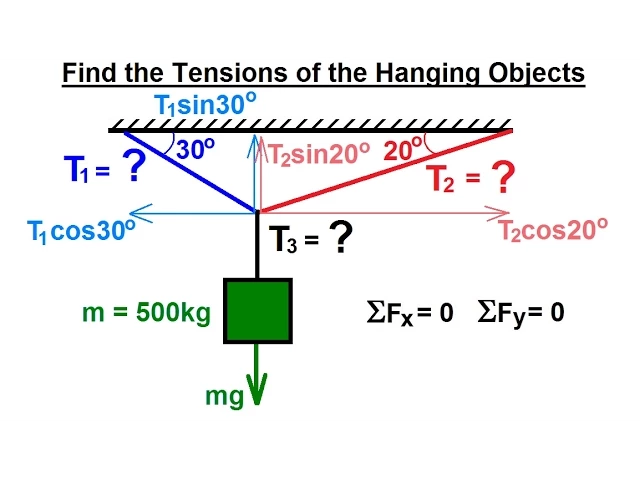
welcome to lecture online and in this example we're seeing something that's fairly common with other words an object that's suspended from two cables in this case two cables making a different angle with the ceiling from which it's suspended from notice that the mass of the Opus at 500 kgam and we're trying to find the tension in each of the three cables of course to find the tension in cable 3 is fairly easy because if we draw a free body diagram of this right here and let me go ahead and do that you can see that the only two forces acting on this object right here is simply the tension pulling it up and of course then the force of gravity pulling it down mg which means that in this case tension 3 must equal mg which makes it easy and we can then write that t sub3 is equal to mg and therefore T sub3 is equal to the mass of the object which is 500 kg times acceleration due to gravity which is 9. 8 m/s squared and that gives us tension 3 to be equal to uh that would be 4,900 Newtons all right so that allows us to find tension three but to find tension one and tension two that is a little bit more challenging for that we need to find the two components of each of the forces because again it's a situation it's a it's a a problem where everything is in equilibrium and if if everything is in equilibrium we know that the sum of the forces in the X direction must add up to zero and the sum of the forces in the y direction must add up to zero which means we need to find the X and Y components of each of the forces there now notice of course tension three will be acting in a downward direction there's only one component so we don't have to divide that into the components and note that that will be equal to 4,900 Newtons in a negative Direction but for tension one and tension two realizing that tension one relative to this point where everything is connected will be acting in this direction tension two will be acting in this direction so the these are the directions of tension one and tension two so to find the components for tension one that would be equal to this component right here and this component right here so this would be tension one in the y direction and this would be tension one in the X Direction we'll find out in just a moment what those are equal to using a different color and let's use um H let's use Brown here here we can see that this would be tension 2 in the X Direction and this here would be tension two in the y direction so we have to find all four components so to find tension one in the X direction we need to find the angle notice that this angle here and this angle would be the same right so these are alternate interior angles so this is 30° and then this here if this is 20° and this is 20° as well those are alternate interior angles so here we can see that t1x will be equal to T1 that would be the hypotenuse T1 times the co s of 30° because that's the adjacent angle relative to this Force right here T1 in the y direction that would be the opposite component so this would be equal to T1 * the S of 30° we can do the same for T2 T2 in the X direction would be equal to T2 time the cine of 20° and T2 in the y direction would be T2 * the S of 20° all right uh since we don't know what those forces are we just leave it like that and then we can go ahead and plug that into our two equations right up there so in the X Direction sum of the forces in the X direction is equal to notice that t2x is in the positive X Direction so that would be a positive t2x and T2 in the Y dire T1 in the y direction is negative so it would be minus t1x and so that would would be equal to T2 * a cine of 20° minus T1 * a cosine of 30° so let's go ahead and figure out what those are so 20 take the cosine of that that is equal to n397 so it would be equal to 0. 9397 * T2 minus take the cosine of 30 that would be 0.
866 * T1 and that would be equal to zero because the sum of the force in the X direction would have to add up to zero so there's my first equation the one I got from the summation of the forces in the X Direction we'll now do the same for the force in the y direction so the sum of the forces in the y direction is equal to we have this Force right here which is T2 in the Y Direction that's positive and and do we have anything in the negative there oh we have another one T1 y so it would be plus T1 y they're both both components are in the positive y direction and then we of course have the minus 4,900 Newtons in the y direction which is the weight of the object all right and plug in what those are equal to so that would be equal to zero so 0 is equal to T2 y T2 y would be T2 * the S of 20° plus T1 * the S of 30° - 4,000 that's a 3 - 4,900 Newtons equal Z all right finding out what the S of 20 is so the S of 20 would be 0. 342 so 0 = 0. 342 * T2 plus the S of 30° is 1/ 12 so 0.
5 * T1 1 - 4900 NT equal Z I already have equals 0 all right so there's my second equation now those two equations have two unknowns they both have unknown T1 and T2 T1 and T2 so we have to solve one of the equations for one of the variables and then substitute that into the second equation so what would be the easiest thing to do well let's go ahead doesn't really matter so let's take this equation right here and solve for T2 in terms of T1 so we have 0. 93 97 T2 if I put this on the other side it becomes positive so it would be equal to positive 0. 866 T1 therefore T2 is equal to 0.
866 T1 divided by 0. 939 7 so 866 / n397 equals so I know that T2 is equal to 0. 926 * T1 so that allows me to find what T2 is in terms of T1 then I can go ahead and plug that into my equation right right here okay went a little too far so I'm going to go ahead and plug that into T2 my second equation so that means that 0 is equal to 0.
342 * T2 is now going to be 0. 9 216 T1 plus 0. 5 T1 - 4900 all right now I have to solve that equation for T1 which means I'm going to take the 4900 newtons that are negative to the other side becomes positive flip the whole equation around multiply this to add it together and what do we get so time 342 equal so that gives me 0.
3152 * T1 + 0. 5 T1 is equal to 4,900 Newtons so I went ahead and multipli this together and moved the 4,900 Newtons to the other side flipped the equation around so this becomes 0. 815 2t1 = 49 100 Newtons and finally I divide both sides by the coefficient of T1 so +5 equals and take the inverse time 4900 equals so that means that T1 is equal to 6, 11 Newtons now that I have T1 I can plug that back into my other equation to find T2 so T2 is going to be equal to 0.