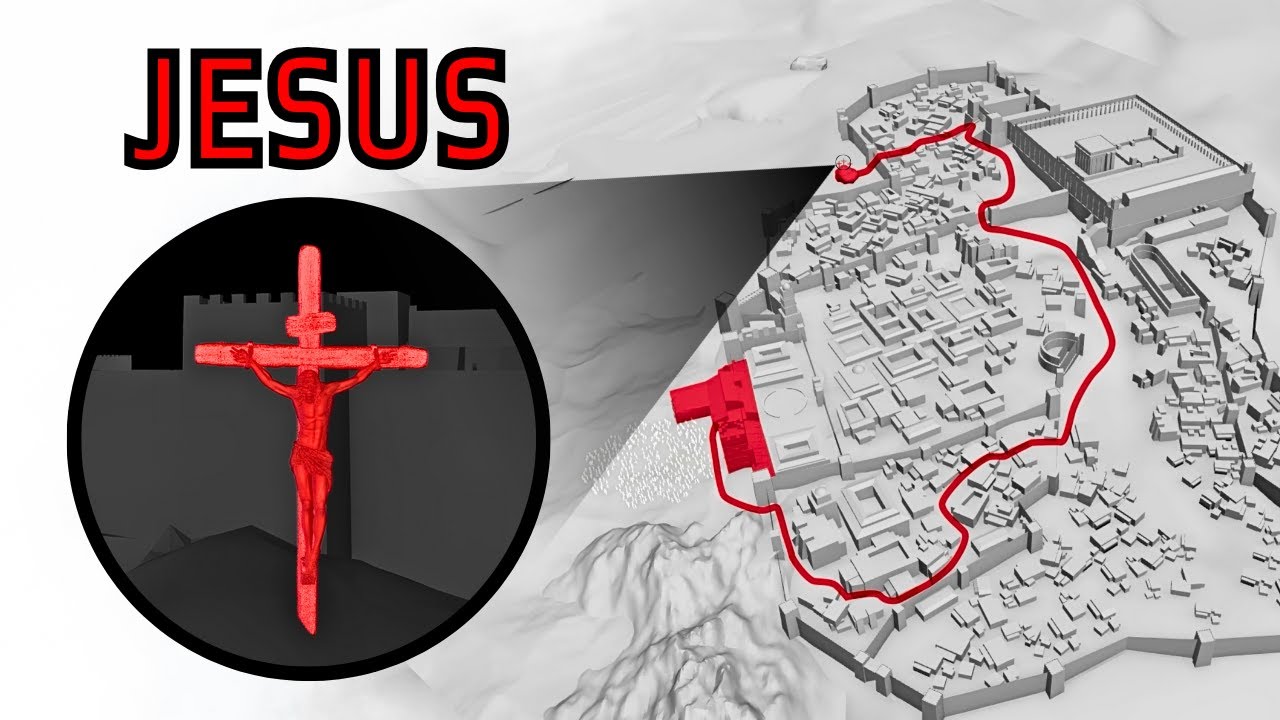
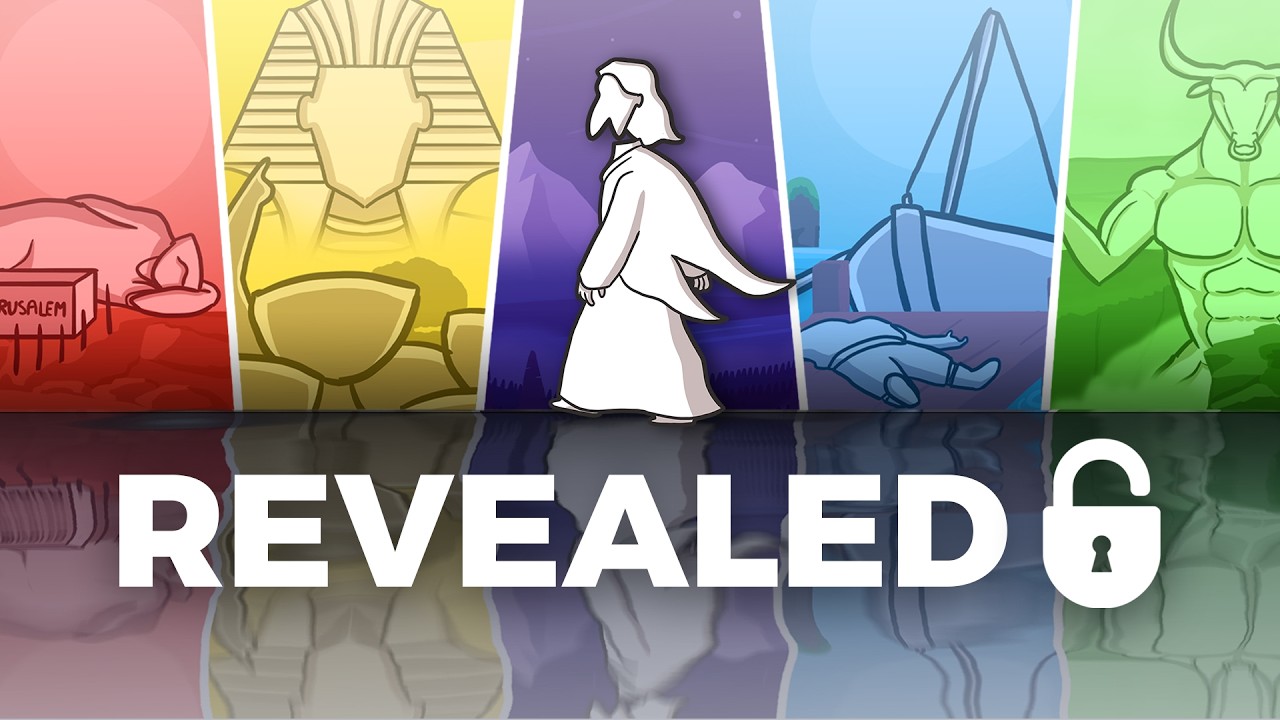
Here's a map of Jesus' final destinations during his earthly life. Most of you will have heard this story before, but in this video, we'll be going deeper. Did you know that when Jesus said, "Take this cup from me," in the Garden of Gethsemane, he was referring to a specific cup with an infamous history?
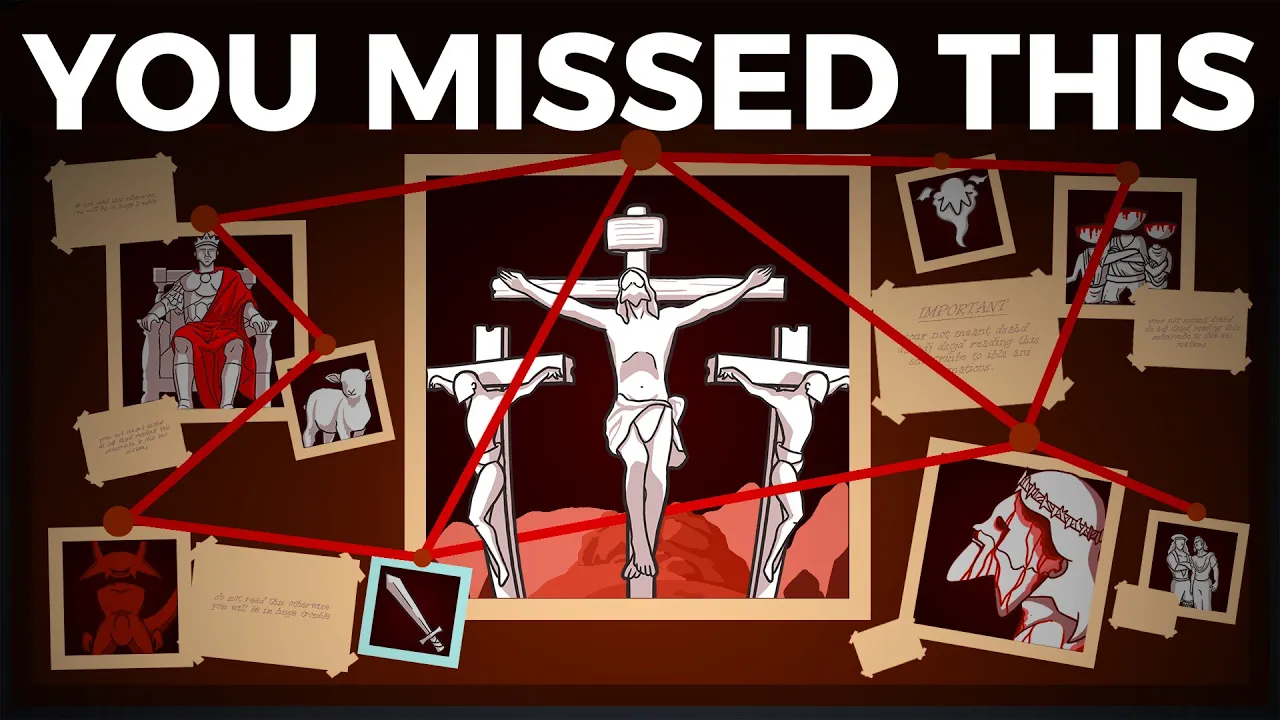
Did you know that the injuries suffered by Christ were foreshadowed in ancient religious tradition? Or what about the irreplaceable yet often overlooked role of Barabbas during Jesus' trial? We currently understand this story at a surface level, but at each stop, we'll explore five deeper meanings that act as puzzle pieces, and once placed together, they reveal the true depth of Jesus' sacrifice at Easter.
Join me on a journey through the Bible as we examine each part of the passion of the Christ and see this story through eyes open wider than ever before. Our journey begins with friends and food reclining around a table as they celebrate the saving of their families. It's the night of the Passover, a time when Jewish people remembered how God rescued them from the clutches of Pharaoh and the Egyptians.
Thousands of rooms were filled with families and friends sharing bread and wine. But this room was different. While the other rooms were brimming with joy, this one had a somber tone.
That's because it would be the last meal this group would share together, and it started in an unexpected way. Their teacher got up from the meal, took off his outer clothing, and began to wash his disciples' feet. This was an unusual reversal of service.
How is it that the teacher is doing the job of a servant and washing his disciples' feet? When God made his dwelling among humans, he instructed Moses to create a washing basin because anyone who entered his presence without washing their hands or feet would die. Jesus' service here has cosmic symbolism.
By leaving the table, he showed how he left the feast of heaven. By taking off his outer clothing, he showed how he emptied himself of his divinity. And by washing his disciples' feet, he demonstrated the profound reversal of how God would serve man when it should, in all realities, be the other way around.
The teacher sat down and picked up the bread, broke it in his hands, and told them it symbolized his body that would be broken. He distributed the bread to them, and they ate. Not only is this a moving picture of how the flesh of the bread is torn apart to be shared by many, but it also hearkens back to the first time God provided bread for his people.
In the desert, the people grumbled against Moses. They complained that in Egypt they had meat to spare, but now they've been taken into the wilderness to starve. God heard their cries and sent manna from heaven to grant them life in a land of death.
In the same way, Christ's physical body was the ultimate fulfillment of God's plan to bring life to all humanity—the bread of life that has come down from heaven for God's people. After passing out the bread, he turned to the wine. Grabbing it, he poured it out, filling the cups of his disciples.
"This is the new covenant in my blood, which is poured out for you," he said. "This symbol has the same strong imagery as the first. " The disciples' cups could not be filled until the bottle had been poured out.
This is a powerful illustration of the exchange that happened as Christ's blood was being shed. But it doesn't stop there. A cup in the Old Testament was a metaphoric basin of God's wrath, as we'll explain later in this video.
But in this story, the cup is redefined. Instead of a cup of wrath, Christ offers a cup of salvation. What was once offered by humans to God as a sacrifice was offered in reverse by God to humans in an act of completely undeserved love.
Jesus reinterprets the wine as his blood. But where the millions of gallons of animal blood couldn't remove a single sin from a single man, in this sacrifice, even the smallest drop of Christ's blood was enough to forgive the entire race of humanity. But this historic moment was halted by a shocking announcement from the teacher—an announcement that would leave his disciples speechless and insecure.
Jesus predicted one of his close friends would soon betray him. The betrayal storyline is certainly an emotional one, but it isn't original. In fact, we can build most of the story from verses written hundreds of years before Judas was even born.
One of the psalms has these striking words: "Even my close friend, someone I trusted, one who shared my bread, has turned against me. " Or what about these emotive words in another psalm? "If an enemy were insulting me, I could endure it.
If a foe were rising against me, I could hide. But it is you, a man like myself, my companion, my close friend, with whom I once enjoyed sweet fellowship at the house of God. " But this final connection has to be the most profound.
In Zechariah, God tells Zechariah to shepherd a flock of sheep marked for destruction. He obeys, removing the three shepherds who were there before. But the sheep detested Zechariah, and he grew tired of caring for them.
Then Zechariah said something very interesting. After snapping his staff in rage, he asked the farmers, "If you think it best, give me my pay, but if not, keep it. " So, what did they decide to pay Zechariah for looking after their sheep?
Thirty pieces of silver. But listen to God's response: "Throw it to the potter, a handsome price at which they valued me. " God's sarcastic response reveals that the stubborn people of Israel had put a value on God the shepherd.
The value was 30 pieces of silver. This, of course, is the very amount the chief priests paid Judas to reveal the location of Jesus, leading to his arrest and trial. But once convicted, the Bible says Judas threw the silver back at the chief priests, which they used to buy a potter's field.
The parallels are incredible, and the fact that God had outlined Judas's betrayal shows just how nothing in this story happens without reason. Though the Last Supper with Jesus and his disciples had a somber tone, it actually fulfilled an unlikely prophecy. In Isaiah, there's talk of a glorious feast on the mountain of the Lord that includes all people.
The mountain of the Lord is a symbolic place described in a heavenly sense—a place where God works. But, strangely enough, this feast is just the beginning of an incredible salvation that God promises to achieve on this very mountain. The promise includes incredible words like, "He will swallow up death forever, and he will wipe away the tears from our faces, and he will remove the people's disgrace from all the earth.
" It's clear that on this mountain and during this feast, the Lord had planned to bring about salvation for the entire human race to invite them to the eternal feast on His heavenly mountain someday. This tells us that the Last Supper, despite the name, is only just the beginning. Jesus takes His disciples to a garden just beyond the walls of Jerusalem.
Here, He would wrestle with a suffering no man had ever experienced. The garden itself represented another familiar garden in Genesis—none other than the Garden of Eden. Eden was a place where heaven and earth crossed over, where God walked with man.
But that paradise didn't last, as Adam took the forbidden fruit and ate. Jesus is given the title the "second Adam" in the New Testament. In the Garden of Perfection, the first Adam failed to resist the devil, and through him, all of humanity was plunged into darkness.
In the garden of Gethsemane, the second Adam succeeded in resisting the temptation of the flesh—the desire to flee and protect Himself. Instead, He obeyed His Father and there restored humanity to the light. Both gardens are pivotal moments of human choice with cosmic consequences—disobedience in Eden and obedience in Gethsemane.
In the garden, Christ charged His disciples to pray so they'd not fall into temptation. He then withdrew and prayed to His Father alone. Surrounded by olive trees, the symbolism couldn't be more perfect.
The word "Gethsemane" means "oil press" in Hebrew. A vivid image comes to mind of olives being crushed and converted into oil. Oil, like wine, was a valuable commodity, but it couldn't be obtained without crushing both the grapes to make wine and the olives to make oil.
While surrounded by fruit to be crushed, the Son of God grieved His coming torture to the point of sweating blood. Isaiah depicts this in graphic and gut-wrenching detail. He was crushed for our iniquities.
In the crushing of His body, our sins were crushed too. And not only our sins, but the devil and even death itself. The olive motif adds so much depth to the agony Christ endured for us in that garden.
As Jesus prays to God in the garden, we see a fascinating exchange. "Let this cup pass from me" is His plea. But what cup is He talking about?
As mentioned before, the term "cup" has a rich history in the Old Testament with a multitude of meanings. But the one Jesus meant becomes clear very quickly—it's the cup of wrath. This is a concept mentioned all over the Old Testament—a phrase used to illustrate how God's wrath works.
It's poured out like a drink over those subjected to it, delivering righteous judgment to wicked sinners. But in the garden, something unbelievable happens. For thousands of years, the cup of wrath had been filling with only minor judgments throughout history.
However, the sheer volume of sin committed over time demanded an exorbitant amount of justice. If that cup was rightly poured out onto us, we would be dead thousands of times over, left to suffer for eternity. Instead, God saw fit to send Christ, His own Son, to drink the cup that should have been ours.
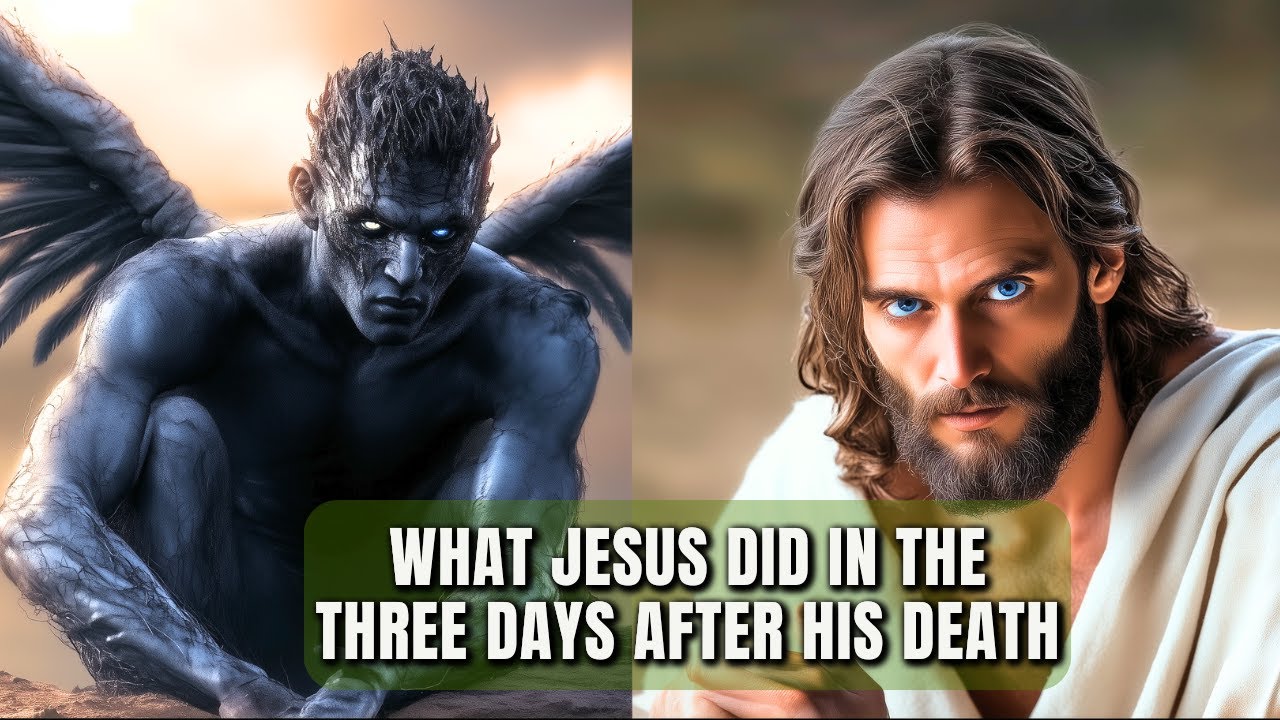
Jesus, instead, drinks the full wrath of God on our behalf, bearing the torture of the cross so that the cup of wrath is finally drained, and the passage to God is clear once more. As the red drops, entangled with sweat, fell from His face, Christ was met by an angel. Since His disciples had quickly failed their job of staying awake, His Father comforted Him by sending someone to strengthen Him.
This, although seemingly minor, fulfills a hugely significant story at the start of the Gospels—Jesus' temptation in the wilderness. I've talked about this subject many times on this channel, as it seems to be central to many biblical mysteries. This one is no less fascinating than the others.
In the second temptation, Satan takes Christ to the top of the temple and beckons Him to jump, a seemingly random request. But he has a plan. Satan quotes Psalm 91, where it says, "For he will command his angels concerning you to guard you in all your ways.
" During His testing in the wilderness, Christ resisted this challenge and was comforted later by angels. Likewise, in the testing of His very life, God sent an angel to comfort Him once again. With the entirety of humanity at stake, He could feel every inch of the pressure in His human skin.
It shows the often misconstrued heart of God the Father during Jesus' passion. He was not angry or distant, leaving His Son to tick the box. He instead meets Him in prayer and sends Him comfort from above.
By now, Jesus' disciples were fast asleep. They had. .
. failed to keep watch, and it was now time for his betrayer to arrive. The disciples awoke to see their fellow disciple Judas leading a small army of Pharisees and guards carrying clubs, torches, and weapons.
Christ stepped forward and received a kiss on the cheek from his old friend. Jesus turned to the army and mocked them. It was as if Christ were a savage bandit that they needed an army to restrain.
Yet he taught publicly in the temple courts every day. But all this, he said, must take place so that the Scriptures are fulfilled. At this, they arrested him, and his disciples scattered.
The Gethsemane climax is littered with deeper meanings and symbolism. But there's a moment before Christ's arrest that we missed. One of his disciples launched at the guard named Malchus and swung for his head, cutting off his ear.
But instead of praising the disciple for his valiant defense, he condemned him, telling him to drop the sword. He then did the unexpected and healed the man's ear. The confusion comes from Luke 22, where Jesus tells his disciples to buy swords.
So why tell them to buy swords, then condemn them for using them? Well, Peter, the disciple who cut off Malchus' ear, has just attacked the servant of the high priest and thus has committed a capital crime worthy of the death sentence. Jesus stepped in and healed the ear, erasing all evidence of Peter's crime and freeing him from his sin at that moment.
It goes without saying that this is a hugely significant deeper meaning in the atonement healing Christ achieved at the cross. Jesus had walked side by side with his disciples for over three years now. They'd shared everything: food, water, shelter, and unforgettable experiences.
Yet now he was bound and taken to an illegal trial. All alone. Where had his disciples gone?
Well, right after the events in Gethsemane, it says the disciples scattered. This is a very specific word used to draw a connection to an interesting Old Testament prophecy: "Awake, sword, against my shepherd, against the man who is close to me," declares the Lord Almighty. "Strike the shepherd, and the sheep will be scattered.
" The symbology in this prophecy is palpable. Christ makes it clear that he is the good shepherd and does everything he can to protect his sheep. But when the shepherd is struck, the flock scatters.
This is exactly what we see in the scattering of Jesus' disciples right before he would be struck with the injustice of a brutal trial. Betrayed by his friends and turned against by the very people he came to save, it's hard to imagine how things could get any worse. Facing an unfair court swayed heavily against him, Jesus received accusation after accusation.
False witnesses hounded him in hopes he would say or do something worthy of death. But despite the lies, Jesus stood silent before his accusers. Yet another fulfillment of ancient prophecy.
Frustrated with their lack of progress, Caiaphas spoke up. His anger seethed against this usurper, this threat to his power, binding him with an oath before God. Ironic, since he was talking to God, demanding Jesus tell him whether he is the Christ, the Son of the living God.
Jesus took a deep breath. They had hated the truth, and they would hate it even more now, identifying himself with the Son of Man foretold in Daniel. Jesus admitted that it was as Caiaphas said; he is the Christ, and he is the Son of God.
Now, in an absolute frenzy, the mob beat him and took him before Pontius Pilate, the Roman governor. Surprisingly, after spending some time with Jesus, this Gentile gave Jesus fairer treatment and eventually became convinced that Jesus is innocent. I find it oddly appropriate, or rather not odd at all, that the Lamb of God, who takes away the sin of the world, as told by John the Baptist, is a completely innocent sacrifice.
In fancier words, he is an unblemished Passover lamb, which was a sign established by God all those years ago. These people Jesus himself had once led out of Egypt and saved from death were now handing him over to be killed. It is as if the whole congregation of Israel had gathered to slaughter this lamb.
Bruises formed, and vision blurred as fists flew from all directions. "Prophesy to us who hit you? " they cried out.
The cruel crown dug into his head. Every facial twitch became absolute agony. Barbs dug into his back again and again as the whip ripped away chunks of flesh.
Blood pooled on the ground beneath him as the whip came again and again. The pool became bigger and bigger and bigger. The execution of the Savior was an incredibly bloody affair.
But why? Why is it that so much blood had to be shed? Moses, when implementing the covenant God had made with Israel, had young bulls killed and sprinkled the blood over the children of Israel.
To usher in the old covenant, the children of Israel had the blood of the sacrifice put onto them. Once again, we see God's awesome power at work. Pilate had washed his hands of Jesus' death, saying he wanted no responsibility for it, but the Jewish people were happy to take it upon themselves.
So, in other words, God had ensured that Jesus' blood would be sprinkled onto his people, ushering in the new covenant in an unsettling but powerful image of the first. And it has to be said that God himself explains the purpose of blood in atoning for our sins. In fact, he provided the blood in the first place and explains that life itself is in the blood.
No wonder Jesus, giving up his life, bled for you and made atonement for your soul. In the midst of this trial, a moment of deep spiritual significance stands out. Pilate, thinking to himself.
. . As to how he might spare what seemed like a passive, if delusional, rabbitic teacher, he was suddenly given an idea.
During the Passover feast, he would customarily release a prisoner to the crowd. And he had the perfect candidate to choose from: one person, a man without blemish—someone who seemed perfect in his estimation—versus Barabbas, a man who was violent, full of evil, and disliked by the general public. He posed a question to the raging mob: "Which of the two would you like me to release?
" he cried out, confident that the sight of a real criminal would turn the crowd's brains on. But to his astonishment, they wanted Barabbas released, saying that Jesus should be crucified in his place. This is completely abnormal behavior.
Jesus is crucified in Barabbas's place. So, something spiritual must be going on here. Well, this moment is undoubtedly referring to an old Jewish custom, starting with the first high priest, Aaron.
Way back then, Aaron would take two goats and determine by lot the roles of these two goats. One goat would be sacrificed, and the other would have all the iniquity of Israel confessed upon it. It would then be released alive into the wilderness.
This reveals something deeply profound for us in the wake of Christ's death. We were the Barabbas in the story. We were on death row, awaiting our execution.
But Christ stepped in and became the sacrifice on our behalf. Jesus died in Barabbas's place. And Barabbas, despite having all this sin upon him, was allowed to go free.
Alas, a decision has been made. But in fact, it was a decision Israel had made years ago. The Messiah had been rejected, and the very people Jesus came to save are now calling for his death.
The man Jesus, who claimed to be the king of the Jews, is rejected outright. Pilate, perhaps provoking the crowd, asks them, "Shall I crucify your king? " Enraged, the chief priests roar back, "We have no king but Caesar.
" Believe it or not, there's another biblical story that follows this almost to the letter. In 1 Samuel 8, the Jews begin complaining, saying that they want a king to rule over them like the surrounding nations have. They whine and whine, wanting so desperately to be like their wicked neighbors.
In response to this, God says something spectacularly insightful, something directly applicable to Jesus' trial. Samuel, who was the judge over Israel at the time, hears these words from God: "Obey the voice of the people in all that they say to you. For they have not rejected you, but they have rejected me from being king over them.
" By declaring they have no king but Caesar, the chief priests were rejecting God as their king, repeating the sin their forefathers had made centuries ago. And just like that, Jesus was taken to be crucified. Death approaches the man on the cross—the Savior—with a sign above his head.
His body is completely battered; his skin absolutely eviscerated. To those who know him, he seems unrecognizable. Every breath is agony; every attempt to speak is impossible.
The agony of the cross is described by the four main Gospel writers. But what if I told you the Bible contains another section that tells us exactly what Jesus was thinking during that time? That Jesus himself actually tells us what it felt like to be beaten, tortured, and nailed to that tree.
You might call me a liar, but I don't care because I'm telling the truth. Many biblical scholars believe that Psalm 22 is a psalm given to David by direct inspiration from Jesus. In other words, Jesus himself is communicating his feelings through David via Psalm 22.
Jesus describes himself as being a worm and as being mocked. In fact, the psalm goes into precise details about the exact nature of the mocker: "He trusts in the Lord; let him deliver him; let him rescue him, for he delights in him. " I'm sure the words of this psalm echoed in Jesus' mind as the chief priests and scribes mocked, saying, "He saved others, but he cannot save himself.
He is the king of Israel. Let him come down from the cross, and we will believe in him. He trusts in God; let God deliver him now if he wants him, for he said, 'I am the son of God.
'" In fact, we know this psalm was on Jesus' mind as he quotes verse one, saying, "My God, my God, why have you forsaken me? " We get more of an insight into Jesus' pain: "I am poured out like water, and all my bones are out of joint. My heart is like wax; it is melted within me.
My strength is dried up like a potsherd, and my tongue sticks to my jaws. You lay me in the dust of death. " It begs the question: how did Jesus go through all of this?
Why did he? The answer lies in Psalm 22 itself. Jesus rejoices that all the ends of the earth have come to know the Lord, that all the families of the nations shall worship before the Father.
If you combine this with a certain verse from Hebrews, you get an awesome insight into the mind of our God and Savior. We're told that Jesus endured the cross for the joy set before him—that joy being you and me in relationship with him. Although everything seems to be going wrong, it is, in fact, going exactly right.
As was demonstrated time and time again, God provides the sacrifice we cannot—a pattern established since the dawn of time. In fact, did you know that the very first animal sacrifice was made by God? After their fall in the Garden of Eden, Adam and Eve sowed fig leaves together to cover their shame.
But as you can imagine, the thin fig leaves didn't do much to help. It's safe. .
. to assume that their efforts to cover up their shame just made things worse. When God found them, He should have struck them down and started again.
But God does something totally unexpected. He kills an animal and clothes Adam and Eve in its skin. The first animal sacrifice was performed not to God, but by God.
Some even believe it was, in fact, a lamb that was slain. I'm not sure it matters much since what is important is that God made the covering for Adam and Eve. A similar theme follows in the story of Abraham and Isaac.
God asks Abraham to sacrifice Isaac, his only son. Abraham is naturally reluctant to, but despite his reluctance, he resolves to obey God. Isaac is clued in enough to ask where the sacrificial lamb is, and Abraham nervously tells him that the Lord will provide.
The mountain is climbed. Abraham's palms sweat. He ties up Isaac, sets up the altar, pulls out his knife, and before striking the final blow, the angel of the Lord stops him.
At that moment, he sees a ram caught in a thicket and realizes that God has provided a sacrifice for him. God has again provided the sacrifice for mankind. So just like with Abraham, God has provided a sacrifice for you and for me.
And just like the ram, that sacrifice will save us—the sacrifice of God's very own Son. While hanging on the cross, Christ's body had become something unrecognizable. But the same was happening on a spiritual level.
The Bible grants us some fascinating passages that make Jesus hanging on the cross far more disturbing than it already is. Deuteronomy states that any dead body must not be left hanging overnight. The religious leaders knew this well, hence why they put the pressure on Pilate to remove the bodies before the Sabbath.
But what's interesting to me is the wording here: anyone who is hung on a pole is under God's curse. This seems a haunting condition. As Christ's physical body was tortured, He was also considered to be cursed by God.
But Paul offers another interesting glimpse into this curse and what it might mean. He states that anyone who relies on the works of the law is under a curse, a fate we all once faced. But Paul drops this incredible line and reveals to us how this all fits together: Christ redeemed us from the curse of the law by becoming a curse for us.
It was necessary for Christ to become a curse by hanging on a pole in order that we might be freed from the curse of the law and live in Christ instead. People surrounded the cross of Christ at Golgotha on that fateful day. There may have been hundreds of onlookers gazing upon the body of a once heralded teacher.
But little did they know that by observing the crucifixion, they played a part in fulfilling an incredible promise from God in the Old Testament—but not in the way you'd expect. In Numbers 21, the Israelites are swarmed by fiery serpents that kill many of their people. The survivors scream out in agony and beg Moses to intercede on their behalf, asking God to remove the snakes from their camp.
So, Moses prayed to God, but His answer was not what he expected. God told Moses to craft a bronze serpent and fasten it to a staff. He then promised that anyone who looked upon the bronze serpent would be healed of their snake bites and live.
Christ fulfills this story in an incredible way, and the meaning is absolutely profound, even for us. The gospel can appear complicated, but the truth is that anyone who looks at Christ in faith will be saved. Like the Israelites who put their faith in Moses and looked upon the bronze serpent for healing, so are we who put our faith in God and look upon Christ for our salvation.
With a final breath and final words, Jesus, now fully prepared to die, gave up His spirit. However, the Roman soldiers didn't know that. And as the Sabbath was approaching, they had been ordered by Pilate, on behalf of the Jewish leaders, to break the legs and take the bodies down.
The soldiers smashed the legs of the two robbers. Screams of agony were heard all around. But the third man was unlike the others.
This man hadn't sworn. He hadn't muttered a single curse. In fact, he had only spoken blessings over his killers.
Still, they had to check that he was dead. A quick jab with a spear in the side proved that he had indeed already died. Blood and water rushed out of the wound—a significant detail that we'll cover later.
But we should know that what looks like a routine kill for a Roman soldier actually proved Jesus was the Passover lamb even more strongly. In Exodus 12, Moses is given instructions that the Passover lamb shall not have any of its bones broken. Another promise related to this is found in Psalm 34, which says that the righteous person may have many troubles, but the Lord delivers him from them all.
He protects all his bones; not one of them will be broken. He's righteous, and He has all His bones intact, which certainly sounds like Jesus to me. So, I'll ask again: what's with the blood?
To those of us who know the Exodus story, the Israelites were spared from the death of their firstborn if they painted the blood of the Passover lamb on their doorframes. In other words, if you accept the blood of this Passover lamb—blood that stained the wooden beams of the cross—God's judgment will pass over you. So the hero lies dead, broken and defeated.
His friends are scattered and distraught, and His enemies are rejoicing at His defeat. It all felt so strangely surreal. Our friend, our Savior.
. . Our Messiah, He is dead.
One day goes by, then two. Finally, the start of the week commences. Mary, along with her friends, has prepared a selection of spices for the body of her great friend Jesus.
He was dishonored in His final moments, but she was determined to honor Him in the little time she had left. But things don't go according to plan. Upon arrival, she finds the stone has been rolled away, and the body of Jesus is missing.
Has it been stolen? Has it been hidden? Luckily for her, she had been given the answer while Jesus was still alive.
But she needed a quick reminder. Two angels appeared, asking her some rather obvious questions. "Why do you look for the living among the dead?
" they proclaim. "He has risen just as He told you in Galilee. " So the obvious question is, "What did Jesus tell them?
" Well, it's a message repeated throughout all Scripture. He claimed that the temple, being His body, would be destroyed and raised up in three days. He said that the sign that would be given to this generation was the sign of the prophet Jonah, a sign that involved being buried in the earth and coming back three days later.
Hosea also prophesied, saying of Israel that God will restore Israel on the third day. These prophecies make clear that Christ would be resurrected not years, months, or even weeks after His death, but a mere three days. Over the next forty days, Jesus would appear to His disciples.
He shared food and joy. He imparted wisdom and teaching. Part of His teaching would be centered around fruit.
You may have heard the phrase before that Jesus was the first fruits of those who have fallen asleep. But besides sounding kind of cool, what does this actually mean? If we jump back to Leviticus, a book often overlooked, you'll see the significance of this phrase come to light.
When reaping the harvest of any land God had given them, the Israelites were to bring a bundle of the first fruits of their harvest to the priest. On the day of the Sabbath, the priest would wave this bundle in the air, and an unblemished lamb would be offered to the Lord as a sacrifice. In this way, Jesus, the unblemished lamb, who was raised the very day of the first fruits tradition, is intrinsically tied into this offering of the first fruits and thus is described as a pleasing aroma to the Lord.
And we are to God the very same sweet aroma in Christ. But that's not all. Let's look again at the first verse we discussed here.
Jesus is described as the first fruits from among the dead. When a farmer receives the first fruits from their vineyard, it's not only a cause for celebration but a promise—a promise that there will be many, many more to come. So if Christ is the first fruits of the resurrection, there are surely billions and billions of Christians who will join Him in the air with their new glorified and resurrected bodies at the end of time.
After much celebration and many doubts quelled, particularly Thomas's, the disciples brace themselves. Jesus emphasizes that soon He will depart. But I don't blame them for being concerned.
Last time He spoke like that, He died. But despite seemingly leaving His friends and family behind, He makes a promise—a promise that He will send an advocate to us when He goes, some kind of substitution. This was yet another fulfillment of biblical prophecy.
Before, God had poured out His spirit on a select few: prophets, kings, and the odd gentile. But now He promised to pour the spirit out on everyone. And perhaps even better, we now had a promise that the spirit would dwell in us, echoing God breathing His life into man, making him a living being.
The Son, who was intricately involved in creation, was now creating a new being. Breathing into them, He imparted a priceless gift. And with this exultant exhalation, He fulfilled a prophecy of Ezekiel.
For the first time, the spirit of God would indwell believers, leading them into all truth. After denying Christ three times and losing everything he hoped for, Peter returned to where he had begun—fishing. It's here that the resurrected Christ meets him anew in a strikingly familiar encounter.
After fishing all night, Peter and his crew come up with nothing. This reminds us of the first time Jesus met the boys: fishing all night with no success. Christ tells the men from the shore to cast on the opposite side of the boat, and they are once again rewarded with a divine catch.
Over 150 fish were dragged to shore by His disciples. But in this story, there's an interesting twist. This time, Jesus awaits them on the shore, and when they arrive, He already has prepared a campfire with cooked fish on it.
Though the miracle was flashy and even lucrative, Jesus was making a point. He doesn't need the fish. In fact, He doesn't even need the sacrifices anymore.
He has achieved on the cross what no lamb ever could. Instead, He requests one thing: your heart. He asks Peter that famous question three times, "Do you love me more than these?
" echoing his three denials. What are "these"? It could be his friends.
It could be the fish. It could be his career. Whatever the "these," the answer ought always to be yes.
By now, Jesus had been observed by many, and the substitution was fast approaching. It was nearly time for Christ to ascend into heaven and trade places with the Spirit who raised Him from the dead. Though His emotional words and departure left His disciples hurting, this isn't how it was meant to happen.
Psalm 68 states that God ascended on high, leading a host of captives in His train. This idea again. .
. Brought up by Isaiah, where the message of hope is proclaimed to the captives. But in his ascension, Christ disappears in the clouds alone.
Well, these prophecies certainly will be true, but not yet. Why not? Because God's people have work to do on earth.
In exchange for the Son of God, we received his Holy Spirit. That very Spirit dwells in our mortal bodies and grants us eternal life. And this Spirit can be shared by believers with others.
So, what are you doing? Staring at the clouds, waiting for Christ to return? There's work to be done for the Kingdom: sharing the gospel, encouraging the believers, and developing a personal relationship with God for yourself.
So, if you haven't already, what are you waiting for? You've watched this far into the video and learned about all the incredible depth hidden in the death and resurrection of Christ. What are you going to do now?
The answer is entirely up to you.