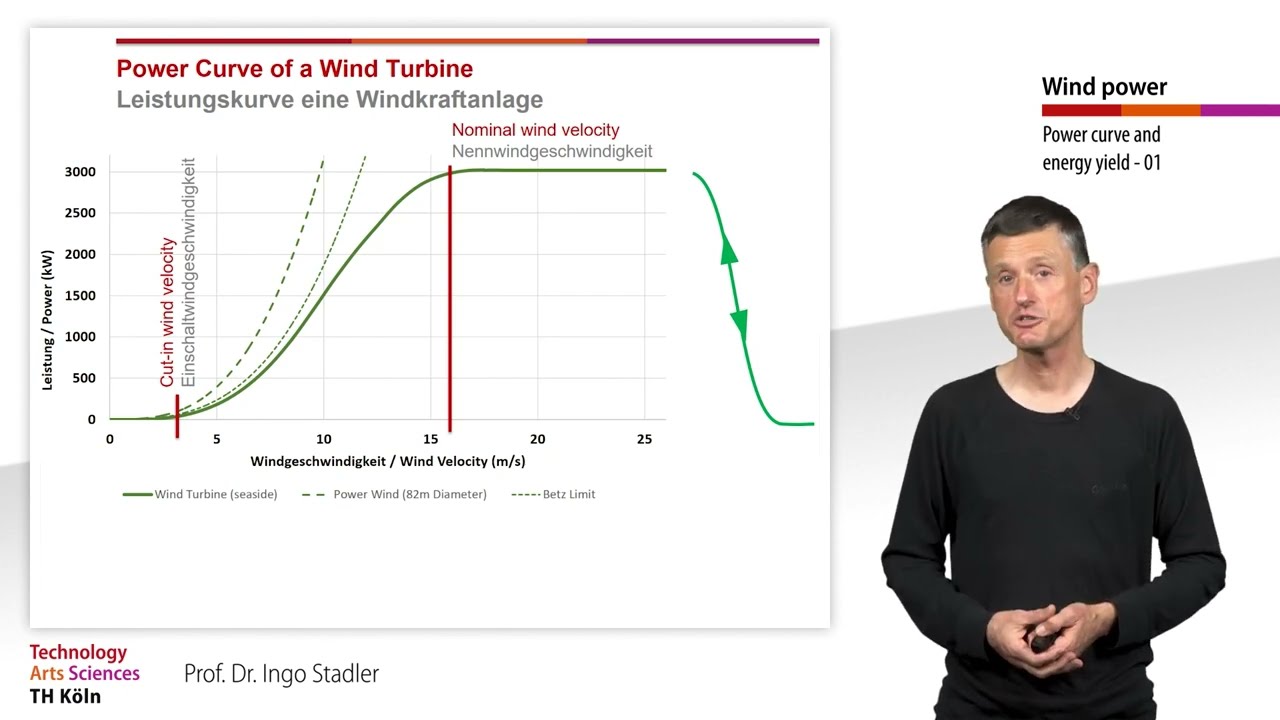
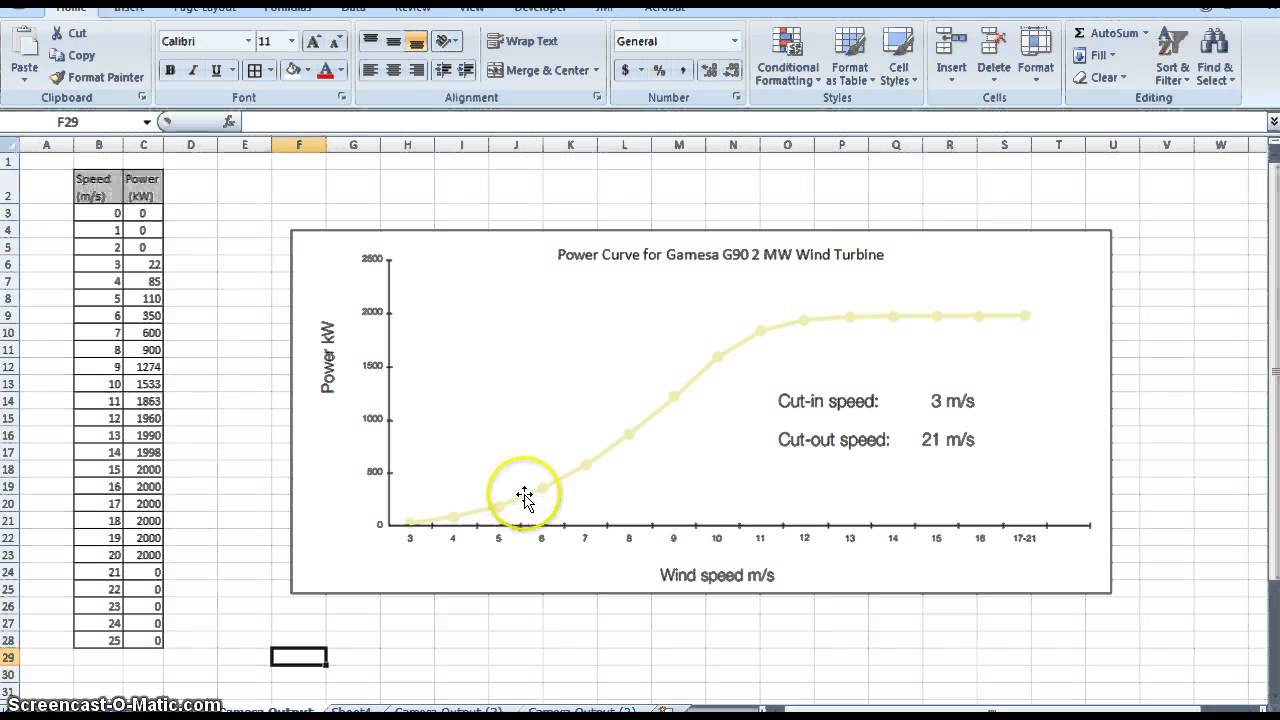
Hello and welcome. In the last video of this series, we will now discuss whether the power curve is really the complete truth that I told you that we get the correct relation between the wind speed and the power output of a wind turbine. To be honest, it only displays the relation between the wind velocity and the power output.
But the power in the wind not only depends to the velocity to the free of the wind speed, but also is proportional to the air density. And air density is not really a constant. We always use the air density rule of 1.
225 kilograms per cubic meter, and that is only true at sea level for a temperature of 15 degrees Celsius. But whenever we have different pressures, different heights, different temperatures, this well, you of 1 to 2 kilograms per cubic meters changes slightly. So we have the pressure p zero at sea level at these 15 degrees Celsius of almost one bar.
And then we can calculate we have a temperature gradient of alpha equivalent to -0. 0065 kelvin per meter. That means the higher we get, the colder the air is getting.
And that is below that constant. Between sea level zero meters and almost 11,000 meters above sea level. And the higher we are not building and constructing wind turbines.
With that we can calculate the temperature at a certain height is the temperature t0 at sea level plus alpha times the difference in the two heights. And with that we then also can calculate the pressure at a certain height, which is the pressure at sea level times. This expression within the brackets to the minus, better and better, is the gravity constant 9.
81 meter per second to the square divided by the specific gas constant 287 to per kilogram and kelvin times over. And when we consider all of that, we get the formula to the lower right part that we can calculate the air density rule at a given height. And when we do so and we will have a look again to this power curve, that is the standard condition at sea level and 15 degrees Celsius.
But we go to know what temperature in a very cold winter or let's say minus ten degrees Celsius, then we see that the power output even is higher than the power curve. But when we go to a beautiful location at a beach in summer and have, for example, a 40 degrees Celsius, then we see that the power curve is decreasing. Those curve seem to be close together, but we more need to look to the difference within one wind velocity, and then the difference between the two or three curves is not so small.
So there is a significant influence of the air density. It is not that dominant like the velocity, but we need to consider also here the density. And then we can have the same look, but we don't have look at sea level but go 2000 meters above sea level.
And then we see that we also have a lower power output and when we even go to mountains of 3000 meters, then we see that the decrease in power output is even stronger. So when we do our calculation just on the sheet of paper, we always use this 1. 2 kilograms per cubic meter.
But when we apply a software like Wind Pro, for example, they consider already this behavior also of the intensity and then closing with an aspect. I didn't tell you completely the truth. I said we can see everything of the wind turbine in the power curve from the wind speed until to the power output of the.
Wind turbine after the inverter. But to be honest, before we feed the energy to the crate, most often we need to pass a transformer station. And again, we have slightly small losses and those losses are not integrated into the power.
So that we need to keep in mind when we do the complete calculation of a wind turbine or a wind park. But with that, I would like to close and to say thank you very much for your attention.