Before the big cities emerged and before the empires had names, there was a fertile valley, shining and full of [Music] promise. But behind its riches, something dark was hidden. A silent cry rose from the earth to the heavens.
a cry of injustice, wickedness, and cruelty. And God listened. The skies began to change.
The clouds closed in. The air became heavier. And the time the time seemed to hold its breath.
[Music] It was the start of a trial, but also the beginning of a story that the world would never [Music] forget. Because there, in the middle of the desert, when everything seemed lost, a man stood up. His name was Abraham.
called by God, guided by faith, and witnessed to the day when heaven descended to earth, not with peace, but with [Music] fire. Abraham stood on a hill, gazing toward the horizon. The wind stirred his robe, and his gray hair danced in the hot desert breeze.
His eyes reflected serenity, but also the weight of knowledge that few dared to carry. He had heard the voice of God. Abraham, leave your land and your relatives and go to the land I will show you.
I will make of you a great nation. His faith was his compass and obedience, his path. With him was his nephew Lot, a young, ambitious man, enticed by the wealth and fertile lands of the south.
But over time, the herds grew, the servants multiplied, and conflicts inevitably arose between Abraham's shepherds and Lot. One morning while walking among the tents, Lot said, "Uncle, it's not fair for our servants to live in conflict. The land is vast.
Let's separate, each going our own way. " Abraham, with a slight nod, responded wisely. "Let there be no strife between you and me, for we are brothers.
Here is the whole land before you. Choose where you will go, and I will take the opposite side. Lot lifted his eyes.
To the south, a fertile valley stretched out like an emerald carpet. It was the Jordan Valley where the cities of Sodom and Gomorrah were located. They shone in the distance with their towers and hanging gardens like jewels set in the desert.
Then Lot said firmly, "I choose the Jordan Valley. That's where I will prosper. Abraham silently agreed, watching him leave with his tents and flocks, heading towards the cities that although prosperous, were steeped in wickedness.
Days later, Abraham was alone when the voice of the Lord echoed again. Lift up your eyes. All you see, I will give to you and your descendants forever.
I will make your descendants like the dust of the earth, so that if anyone can count the dust of the earth, they can also count your children. Moved, Abraham fell to his knees, tears streaming down his face. The sky, once stormy, now opened up with a ray of golden light that fell directly on him.
It was the seal of the divine promise. Meanwhile, Lot entered the gates of Sodom, surrounded by wealth, applause, and curious glances. The men from the cities were handsome and arrogant, the women vain and provocative.
At every corner, idols were erected. In every square, festivals were celebrated where pleasure was the supreme god. However, Lot did not see everything or perhaps preferred not to see.
In the stillness of the night, Abraham walked among the tents under the moonlight when he looked up and saw a column of smoke on the horizon far in the distance. It was thin, almost imperceptible, but it announced that something was catching fire even before judgment. He closed his eyes and prayed silently.
The story not yet revealed to men was beginning to unfold. The next morning, Abraham built an altar to the Lord as he always did when he settled in new lands. On top of the stacked stones, he placed wood and an offering.
The fire rose to the sky like invisible incense. The old patriarch closed his eyes and murmured, "You are just, oh, God of the heavens and also merciful. " Meanwhile, in Sodom, Lot tried to maintain his integrity.
He was a just man in the midst of a blind city. His heart was heavy. At the table, his daughters told stories of what they saw in the squares.
His wife, increasingly fascinated by the luxurious life, silently judged him with her looks. While trying on fine linen garments, she said, "Not everything is evil, Lot. Maybe we should adapt.
" He wouldn't respond. He would just go to the courtyard and look north towards the hills where he knew Abraham was still praying. The nights in Sodom were long.
The parties lasted until dawn. Children were taught to ignore goodness. Elders were mocked.
Justice had been banned. And the sky, the sky was listening. Above, invisible to human eyes, the angels were already walking.
The time for intercession was approaching and with it the weight of judgment. In the darkness of dawn, distant thunder echoed through the hills. Lo woke up startled, feeling a weight on his chest that he couldn't explain.
In his dreams, he had seen fire falling from the skies and screams crossing the stone walls. His hands were shaking. He looked at his sleeping wife and then at his daughters.
Something was coming. Something bigger than he could imagine. In the distance, Abraham was also waking up.
His eyes turned to the south. And then the sky started to move. Dawn was approaching and with it the footsteps of the eternal.
The heavens would not remain silent for much longer. Judgment would come soon. The morning light timidly emerged over the walls of Sodom, but the golden glow of the sun barely touched the city, as if the light itself hesitated to rest there.
The streets, still dirty from the previous night's parties, were beginning to fill again with voices, mocking laughter, and hurried steps. There was a rush to sin. The markets opened with luxurious products.
Women adorned with gold and painted eyes openly flirted on the corners. Children ran among the merchants, imitating the vices of the adults. The city throbbed with vanity, lust, and mockery.
He watched from the window, his heart heavy in his chest. He tried to believe that there was still hope for that city. His daughters, already young women, looked fascinated at the city girls.
His wife spent more time with the local women, listening to secrets and learning their ways. He prayed, but his voice seemed to be lost in the void. That same morning, a few days walk from there, Abraham sat at the entrance of his tent as he did during the calmst hours of the day.
The morning breeze was gentle. Suddenly, he looked up. Three men were approaching.
There was something different about them. Their expressions were serene, but their presence carried authority, as if the entire sky was with them. Abraham ran to meet them and bowed down to the ground.
My lord, if I have found favor in your eyes, I beg you not to pass by your servant without resting. Quickly, he ordered them to prepare bread, meat, and milk. The three sat in the shade of the trees.
While they ate, Abraham stood reverently. Then one of them spoke with a voice that pierced the soul. Or where is Sarah, your wife?
And Abraham answered, it's in the tent. Then the visitor said, "I will return to you at the appointed time, and Sarah will give birth to a son. " Inside the tent, Sarah heard and laughed silently.
Then the visitor asked, "Why did Sarah laugh? Is there anything too difficult for the Lord? " Abraham realized they were not ordinary men.
They were angels. One of them was the Lord himself in visible form. When they got up to leave, they looked towards Sodom.
The Lord's expression became serious. Then he spoke in a voice that the wind carried to the trees. Shall I hide from Abraham what I'm about to do?
The outcry of Sodom and Gomorrah has increased. Their sin is very grave. Abraham upon hearing this approached with fear and compassion.
Will you destroy the righteous along with the wicked? Perhaps there are 50 righteous people in the city, will you destroy the whole place and not spare it because of the 50? Even if I find 50 righteous people, I will spare the whole city for their sake.
And what if it's 45, 40, 30, 20? I won't destroy it. I ask you, Lord, do not be angry if I speak just one more time.
What if there are only 10 righteous people? The gentleman looked at him with eyes that knew the future. I will not destroy it for the sake of 10.
And then the angels left. A deep silence fell upon Abraham. The patriarch was alone looking at the valley in the distance.
The sun was already higher, gilding the plains that seemed so peaceful. But he knew the sky was about to respond to the call of the earth. Meanwhile, in Sodom, Lot was sitting at the city gate.
That was where the judges gathered, where the leaders made speeches and decreed laws. Lot tried to influence with justice, but his voice was muffled. The men of the city tolerated him only out of convenience.
They no longer saw him as a stranger, but neither as an equal. That late afternoon, two different men crossed the gates of Sodom. Their clothes were clean, their faces serene, their eyes shone with a fire that no mortal could contain.
They walked with firm steps, and even the dogs silenced when they saw them pass. Lo saw them and immediately recognized them. They were not ordinary men.
He stood up, bowed, and said, "Gentlemen, I ask you to come into my house, wash your feet, and spend the night. You will leave safely in the morning. " They nodded, but the city would not let them go unnoticed.
At night, when silence enveloped the houses, a sound of footsteps spread through the streets. Men from all over the city, young and old, surrounded Lot's house. Their faces were filled with blind desire and perversity.
They shouted, "Where are the men who came to you tonight? Bring them out so that we may know them. Lo left and closed the door behind him.
The heart was beating like a drum inside his chest. My brothers, I ask you, "Do not commit such evil. " And they mocked, "Get out of the way.
Who are you to judge us? You came to live as a foreigner and now want to be a judge. " They advanced, tried to break down the door, but suddenly a brilliant light burst from the entrance.
The angels pulled Lot inside and closed the door with supernatural strength. Outside, the men were struck with blindness. Confused, they stumbled, shouted, and hit each other, unable to find the door they once knew so well.
Inside the house, one of the angels stared at Lot. Is there anyone else here? Your sons-in-law, sons, daughters.
Get them out of this place because we are going to destroy this city. Its outcry has become great before the Lord and he has sent us to destroy [Music] it. Lot's face turned pale.
The time for mercy was running out. Lot left his house with hurried steps and a troubled face. The darkness of the night weighed on the city like an omen.
Each shadow seemed to watch him. He ran through the narrow streets, dodging the drunks who were still staggering after the parties. Knocked at the sons-in-law's door, waking them urgently.
Get up. The Lord is going to destroy this city. We have to leave now.
But the young men mocked him. One of them laughed loudly while the other twirled a wine glass between his fingers. Destruction.
Lo, it's already too late for dreams and too early for stories. Go back to your house. We'll talk about it tomorrow.
L tried to insist but the doors closed before his eyes. Alone in the streets, he ran back upon entering. The angels were standing.
One of them reached out and said, "Quickly, take your wife and your daughters who are here so that you will not perish on the injustice of the city. " They still hesitated. Lot's wife's heart was trembling.
The daughters were crying. Lot was trembling. Then the angels took them by the hands and pulled them out.
As I crossed the gates, the sky roared. Thunder tore through the skies like a blazing sword. At the top, a light began to descend.
It was not ordinary fire. It was judgment. One of the angels shouted, "Flee for your lives.
Do not look back. Do not stop anywhere on the plane. Flee to the mountains so that you are not consumed.
" The goose was packing. "No, please. Behold, your servant has found favor in your eyes, and you have shown me great mercy.
But I can't run to the mountain. I would die on the way. Let me escape to that small town over there.
It is insignificant. Let me live there. The angel looked at him.
Behold, I have also granted you this. Go, but hurry up. I can do nothing until you have arrived [Music] there.
The sun was starting to rise. The sky, once purple, was now filled with embers. When Lot and his family arrived in the small town of Zor, the world behind them was already about to collapse.
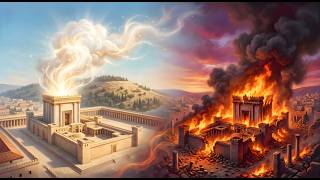
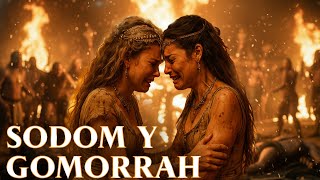
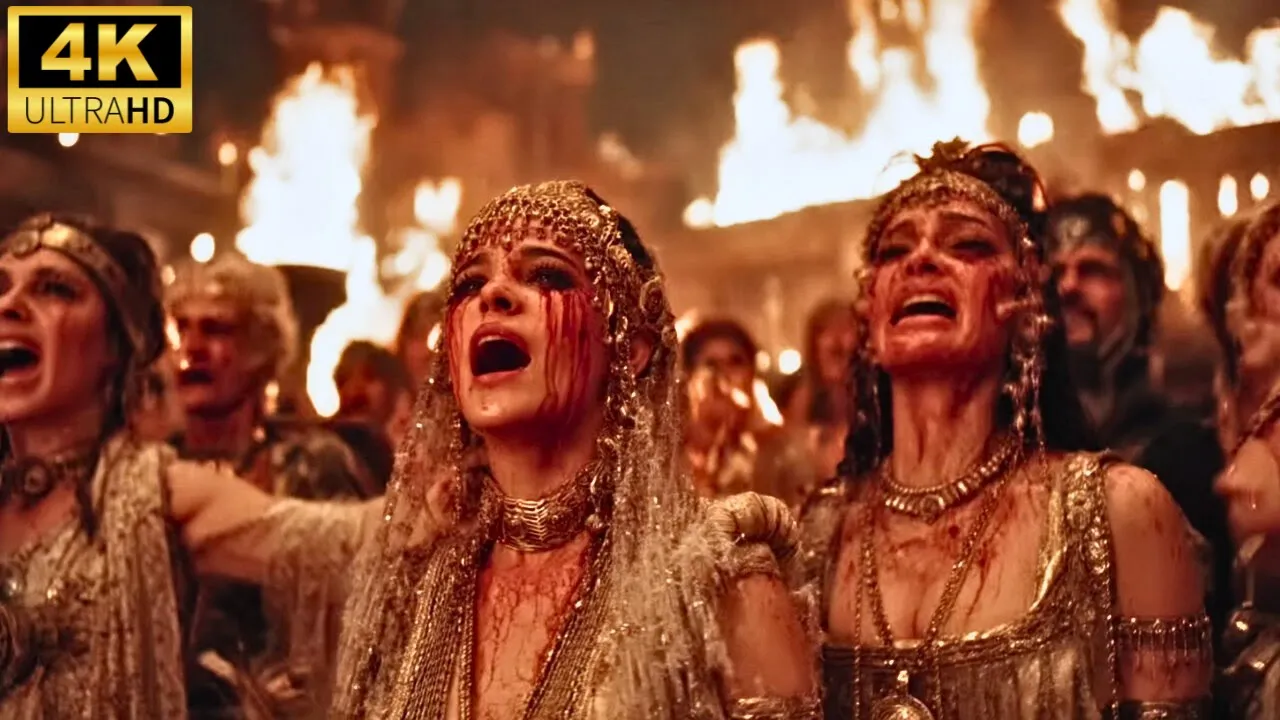
That's when it happened. Flames fell from the sky like rivers of embers. The ground shook violently.
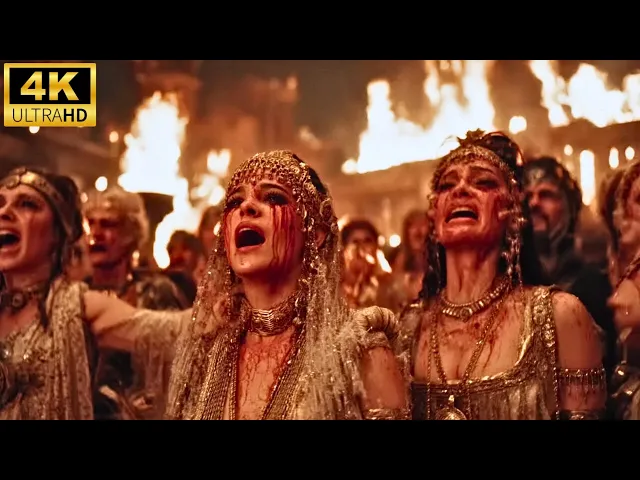
Towers split in half. The walls of Sodom crumbled like sand. The fire of judgment licked the houses, the markets, the temples.
Screams echoed through the valleys, but no one heard them. And amid all this, Lot's wife stopped just for a moment and looked back. Her eyes were searching for something.
Perhaps her children, perhaps the past, perhaps the ornaments and luxury she left behind. But in that look, there was more than just longing. There was attachment.
And then in front of the flames and the raging sky, she transformed. Her body hardened, frozen in time. Her eyes open, turned towards Sodom, a solitary statue of salt on the burning plain.
Low fell to his knees. The daughters screamed, but nothing could be done. From above, among fiery clouds, the angels watched in silence.
God's judgment had been complete. In the hills to the north, Abraham woke up to the noise. He left the tent and ran to the top of a hill.
From there, he saw smoke rising from the land like the smoke of a huge furnace. His eyes filled with tears. He prayed silently.
The Lord remembered Abraham and for his sake saved Lot from destruction. For days the smoke kept rising thick and dark as a reminder to the world of what happens when evil goes too far. Zor, the small town where Lot had taken refuge, had become a silent shelter.
Its inhabitants looked in awe at the burning horizon, not daring to ask what had really happened. There were rumors, whispers, but no one dared to approach the devastated plains. Lot mourning couldn't stay there for a long time.
The stairs, the whispers, the memory of his wife turned into salt. Everything was an unbearable burden. Their daughters walked silently with their eyes lost on the ground.
So Lot said one morning, "Let's go to the mountains. Zuir is also not a safe place anymore. " With few provisions, they climbed the hills.
They found shelter in a solitary cave far from everything. The silence was deep and the nights were cold. There were no laughs, just memories.
Lot's daughters, distressed by the destruction of everything they knew, and believing the world had been reduced to ashes, began to fear for the future of their father's lineage. So said the older sister, "There is no man left on earth who comes to us in the way of all the earth. Let us give our father wine and lie with him that we may preserve offspring.
" That night they got Lot drunk. He didn't notice when the older one lay with him. The next day they did the same with the youngest.
Thus, each one conceived a child with their father. The oldest was named Moab, father of the Moabites. The youngest, Benami, father of the Ammonites.
Even after judgment, the consequences of the trauma echoed. The sin of Sodom had been destroyed, but the impact of corruption still resonated among those who escaped. In the scorched plains where once the cities of the valley flourished, silence now rained.
No bird flew, no grass sprouted. The soil was blackened, cracked, impregnated by the fire of judgment. It was as if time itself had abandoned that place.
an open scar between the hills, an eternal witness to God's wroth against unrepentant sin. Meanwhile, in distant regions, other peoples were hearing rumors. The caravans passing through Zora carried stories of destruction from the sky.
Some said that the gods were angry, others that a prophet had cursed the cities, but few dared to mention the name of the Lord of Abraham. Abraham in his tent was reflecting. He observed the sky, and even with the weight of the tragedy, his faith remained strong.
God had spared Lot, but the memory of the cries that had risen from the cities stayed with him. The lesson was etched in his spirit. The righteous walks with God even when the world is lost.
Meanwhile, in the mountains, Lot was aging quickly. Life in the cave was harsh, just like his soul. He was unaware of what his daughters had done.
To him, the days were just survival. The nights were haunted by memories and regrets. He who once sat among the city judges now dwells among rocks and silence.
The daughters raised their children far away from everything. Moab and Benami grew up like wild children without the presence of experienced mothers, without culture, and without direction. The seeds sewn in despair would germinate in the future as rival peoples of Israel.
The mistake, even if it comes from a good intention, would carry consequences for generations. In the heavens, the angels who had witnessed the destruction watched in silence. The mission was accomplished, but God's heart did not rejoice in the destruction.
His justice was perfect, yet it was also filled with sorrow. For the creator takes no pleasure in the death of the wicked, but rather that he turns and lives. And it was at that same time that in other parts of the earth kingdoms were formed, men exalted themselves, towers were erected, empires were born from arrogance.
Sodom and Gomorrah became a legend, a warning, a shadow in the memories of the nations. But few understood the true reason for the destruction. It was more than immorality.
It was a conscious rejection of good. It was pride amidst the cries of the weak. It was violence, oppression, and a complete lack of remorse.
God had waited, warned, sent signs, and finally executed. Lot's descendants spread out, formed tribes, and became strong. But the memory of the destruction never completely left their lands.
On quiet nights, the campfires still cast shadows in the caves, and the elders told stories of how the sky once opened in fire. Abraham continued his journey. Sarah would conceive the promised son and the story would take a new turn.
But the echo of Sodom and Gomorrah would resonate through the scriptures, the prophets, the nations until the times of the Messiah. Lot in turn disappears from the pages of sacred history. His existence became a reflection of a just man who escaped with his life but lost everything valuable.
It became a symbol of salvation through mercy but also a warning to those who flirt with the world. In the sands of time the winds began to blow again. Over the ruins only ashes, but between the skies and the earth justice had been served.
A few generations later, the name of Sodom was no longer spoken out loud. In tents, palaces, and mountains, parents told their children stories about a people who challenged the Almighty and vanished from the earth. Prophets centuries later would raise their voices and say, "Remember Sodom.
" And the words would be feared. But there was something else. a seed sprouting in silence.
Two descendants of Lot, despite their turbulent origins, would have unexpected encounters with the divine plan. Among the Moabites, a woman named Ruth would be born. She would leave behind her people's idols to follow the God of Israel, becoming an ancestor of King David and centuries later of the Messiah himself.
Even in the ruins of the fall, God could redeem. Sodom had been consumed, but the story didn't end in ashes. Amidst the judgment, mercy still flourished.
It was as if behind the curtains of fire and smoke, an invisible thread was weaving the eternal plan of salvation. The cities of sin had fallen, but the promise remained alive. And now far away, a boy was about to be born.
A child of promise, a laughter named Isaac. The time to laugh would come, but the memory of crying would never be forgotten. Time passed.
The dust of destruction was carried away by the wind, but the memory of Sodom and Gomorrah remained etched in the scriptures and hearts. The ashes of judgment became an eternal symbol of divine justice. The prophets would not stop using them as a warning.
The Lord himself in future centuries would mention these cities as an example of final judgment. But there in the heart of the desert while the world advanced in its ways, Abraham saw another part of the promise fulfilled. Sarah had conceived and given birth to a son.
Abraham named him Isaac because Sarah had laughed. And now everyone would laugh with her. The birth of the boy brought light to the tent and hope to a story marked by trials and miracles.
The God who judges is also the God who fulfills promises. And while life renewed itself, the memory of the devastated cities became a necessary contrast to the holiness of God. Even so, the world had not changed.
Nations were exalting themselves. Peoples were getting lost in their pride. And the descendants of Lot, the Moabites and Ammonites, began to take shape as established peoples.
They built cities, erected altars to foreign gods, and inherited not only the blood of Lot, but also the marks of a turbulent origin. And as expected, conflicts with Abraham's descendants were not long in coming. The promised lineage and the wounded lineage would walk side by side, sometimes in peace, often in war.
war. From the heavens, the Most High watched, his justice firm, his mercy extended, his plan unshakable. Sodom had been judged, but it was not the only city that deserved fire.
Everywhere man's heart remained corrupt, inclined to evil. But the Lord was patient. He was waiting for the right time because in the end, even judgments point towards salvation.
[Music] In Abraham's tent, Isaac grew under his father's watchful eyes. He was strong, curious, and full of questions. At night, he looked at the stars and asked, "Father, was this the sky that God opened when he spoke to you?
" Abraham smiled. "Yes, my son, and it is the same sky that heard the cry of Sodom. " "Does God still speak today?
" Abraham looked up silently. "Talk, always talk, but not everyone wants to listen. The stories about the destroyed cities began to be told along with the promises of the Almighty God.
Isaac would grow up knowing that the same God who destroys with justice also builds with love. And Abraham, an old man but full of faith, would set up altars wherever he went, reminding the world that there is a God over all nations, and that no cry goes unnoticed before him. Once Abraham took Isaac to the top of a hill, where the wind blew harder, and the silence was profound.
There he pointed to the south, to the lands where the valley cities once stood. There was Sodom and Gomorrah. Isaac frowned, curious, "What happened to them?
" Then Abraham replied in a serious voice. They were consumed because they forgot God. Because they chose evil and called it good.
because they heard the cries of the righteous and responded with mockery. Could God destroy them again? Abraham knelt before his son, placed his hand on his shoulder, and replied, "The same God who judges is also the one who forgives.
He gives time, gives signs, sends messengers. But when a person chooses to reject the light and embrace darkness, judgment comes. Isaac remained silent, absorbing every word as if engraving an eternal secret on his soul.
In the years that followed, the descendants of Abraham multiplied. Nations arose, peoples waged wars, kings rose and fell. But the name of Sodom remained like an ancestral scar, like a name forbidden to be used in vain.
Prophets like Isaiah, Jeremiah, and Ezekiel would recall the example of the destroyed cities. Even in the New Testament, the apostles would use Sodom as a symbol of rebellion and disbelief. [Music] Abraham, already old, was watching the sunset.
The shadows stretched over the mountains, and he heard Isaac's laughter in the distance. A pure sound, a sound that carried the hope of a new era. He stood up and walked to a stone altar.
He lit the fire, closed his eyes, and prayed. Lord, may my descendants never forget. May the children of my children remember your name.
Even if they fall, let them return to you and never become like the lost cities. The sky turned golden at that moment, as if God himself was confirming his prayer. A gentle breeze passed between the tents and a star shone brightly in the southern sky.