Good morning. This is Horizon's Middle East stands Africa. Our top stories this morning.
Dollar decline. Investors weigh President Trump's threats to Sack the Fed Chair Jay Powell, along with continued trade talks as China warns against any deals which harm its interests moving forward. Iran says progress was made in nuclear talks with the U.
S. in Rome on Saturday. A third round of discussions are scheduled for this week in Moscow.
And Ukraine's Vladimir Zelensky accuses Russian forces of violating Vladimir Putin's 30 hour Easter Sunday truce while iterating his proposal to extend the cease fire for a month. Well, it's just gone. AM across the Emirates everybody.
I'm Joumanna Bercetche in Dubai. Well, for most of Europe and UK, it is a day off today. So slightly thinner trading than usual, an opportunity to take stock.
U. S. markets will be open, But, you know, the news flow over the weekends really hasn't subsided, even though it was technically Easter weekend.
What we now have as far as U. S. investors are concerned, is not just a trade war to contend with, but the very real possibility of Trump wanting to remove the Fed chair, Jerome Powell, from his position.
So you're not only dealing with the consequences of tariffs and all of that, but also a lot of questions about the future direction for the Fed and whether it actually is feasible for Trump to remove the Fed chair. So on the back of that sentiment is pretty negative. As you can see behind me, a lot of red on the board.
We've got the S&P down 8/10 of a percent, NASDAQ down a similar amounts shaping up to be a big week in terms of data as well. Watch out from manufacturing numbers all over the world, from Asia to the US and Europe. Big PMI numbers to watch out for.
And then also as far as the Magnificent Seven are concerned, we have the results come through from Alphabet and test set to watch out for this week as well. That in mind though for the year it's always good to take stock. S&P is still down 10%.
NASDAQ is down 15. 6% year to date. So still a lot of red as far as these equities are concerned.
The Nikkei this morning taking a bit of a tumble to down 1. 2%. And this some people are pointing to the strength of the yen versus the U.
S. I'll get there in a second. But ten year yields, what we are seeing is once again a move upwards.
So three basis points higher today. And this despite some of the stabilization that came through towards the end of last week, Remember, we've got to run for 25. We're yet again pushing higher as the older assets get sold.
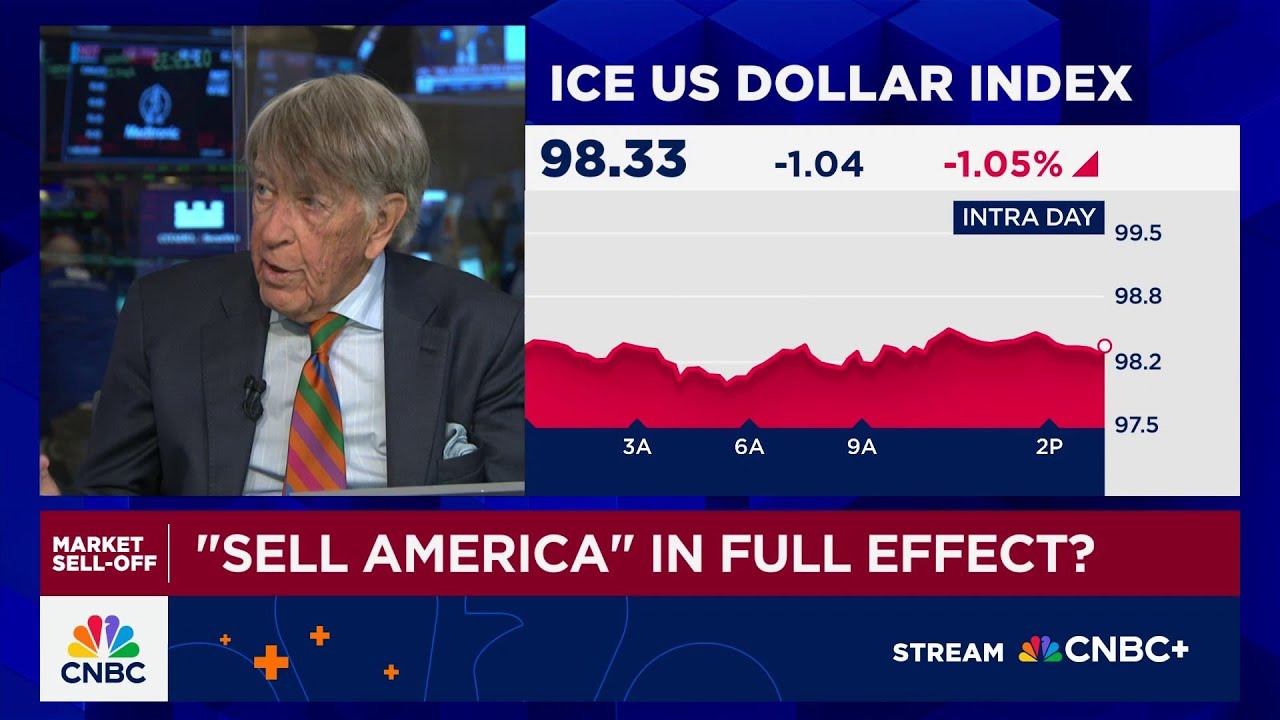
Flip the board, because what you're going to see now is once again, we are seeing the dollar get sold. The Bloomberg U. S.
dollar down 7/10 of a percent. Now back to levels not seen since January 2024. So playing continuing with that theme of dollar underperformance versus other currencies around the world, take a look at the euro through 150 now 1% firmer versus the U.
S. So very stark contrast over there. Similar theme, as I said, with the yen, the yen continues to gain ground versus the USD.
It's 11% firmer this year versus the dollar's similar theme for the euro as well. And so far this month, dollar yen has seen two days of 2% declines and this is shaping up to be another one of them. So as we talk about the strength of the USD at the strength of the yen, keep an eye on on that currency pair as well and the impact it's having on the Nikkei this morning.
And then gold once more making a record all time high earlier on in the session we got to I believe, 3385 earlier on in the day but still 1. 6% firmer. No surprise there with the weakness in the U.
S. Lots of uncertainty still prevailing geopolitically and questions about this U. S.
exceptionalism theme, all of that propelling money to go into gold. So that is the theme as we set out for this trading week. That's a little lighter than usual.
But for now, let's get to Rashmi Garg, senior portfolio manager at LW Capital, who joins us. Rashmi, I want to put to you, I want to put to you some of the comments that the French Finance Minister Eric Lombard, made on Friday, and he said that if Trump fired Powell, he would put the credibility of the dollar on the line and would destabilize the U. S.
economy. Is that how most investors will perceive it? Hi.
Good morning to man. And yes, I think, you know, in addition to all the uncertainty that we were already having related to the tariff talk, we now have this on the table with Trump talking about Pablo's termination not coming soon enough. And this basically tells us that he might be deliberating and seeing if that is possible.
Clearly, I would consider this to be a negative. I would consider this to be a negative for U. S.
stock markets, for for treasuries, as well as to trade in the U. S. dollar.
And for the reason for that is that the central bank independence is extremely important. And so far what we've seen from foul of or from the Fed is that they've acted prudently in the face of inflation, in the face of the labor markets that the U. S.
is facing. Now, whatever the Trump administration might think, the right policy at this point in time when no tariffs are staring in the face and which could lead to higher inflation, is that, you know, Fed stays put. They see what is going to happen finally when things stabilize and that is when they take the next course of action.
So clearly, if Trump is thinking about terminating poverty, that is a negative. Yeah. You know what I find ironic about all of this is before all of the talk about the trade war, about obviously the recent events with with Powell and Trump's comments on Powell, the US was doing just fine.
And we're heading into the week of the IMF annual meetings. And if you look at the IMF growth forecasts, the US most recent forecast that they had the economy growing at 2. 7%.
Now people are talking about the possibility of a US recession in this environment. Do you still see scope for this U. S.
exceptionalism theme to actually play out or just given all of the policy uncertainties, is it going to be difficult for investors to have any strong conviction about where the U. S. is going?
So I would agree on the latter point you made your manner. I think it's very difficult to have conviction right now. And the reason for U.
S. exceptionalism fading and investors mind is not related to the individual companies. I still believe that the U.
S. has got great companies which are at the forefront of innovation. These are cash rich companies.
These are making very good breakthroughs in terms of, you know, their products. They are generating good revenues. But the problem is macro.
And the macro uncertainty is stemming clearly from Trump's policies. What we are seeing, first of all, the flip flops that they're making every day on the tariff front, then you know, this talk about, you know, undermining the independence of the Fed. I think what we've seen in the US dollar and Treasury markets, clearly there is some flight of capital from the US as people seek to diversify their exposure in the face of this uncertainty.
So clearly, yes, I think macro and the uncertainty is the reason why this exceptionalism period is fading out. Yeah, apart from gold, where do you find opportunities in these markets with all of that? Not just us stemming uncertainty, but global uncertainty about where we're headed?
Yeah, it's it's a tough one to manage right now because, you know, it's like, okay, you know, we don't even know what we are dealing with because till we get some stability, till we get some clear guidelines in terms of, okay, what is the end game going to be like? It's like, okay, we are trying our best for, you know, being prepared for the worst. So we are diversifying our exposure.
We like China right now because we feel that, you know, Chinese market valuations in any case were attractive. They've been so for some time. But we also feel there's a huge amount of innovation that is coming from China and that comes with limited resources as they've been, you know, slapped with sanctions on certain products which are needed for innovation, especially on the technological side.
Yet they have been within those limitations, are able to produce very good products. We've seen deep sea, we've seen some global dictations. So that is something that is, you know, interesting for us.
India is another market that we are looking at. And the reason for that is India hasn't been so punitively, you know, targeted as some other economies and India remains a very good counterweight to China. Plus, the domestic story in India also is fairly healthy right now.
So we also like Europe. You know, European defense is another sector that we are, you know, positioning ourselves and we've been positioning there for quite some time now. So we like, you know, diversifying across these teams.
And then we're also, you know, preparing with some hedges within the portfolio. Yeah. Fresh meat.
Very quickly. You say that you're bullish on China, but at the same time, the tariff war is going to have a huge impact on China. GDP 30% of China's GDP last year came from the export sector.
Analysts are shaving off anything from one and a half percent to 2% of GDP growth. How can you be bullish, China, when when growth is going to take such a beating? Yeah, so you're right.
You know, I mean, what we are already seeing is the effort from China to diversify away from from the U. S. because, you know, what will be hit is really their exports to the U.
S. So we are already seeing the other allies of the effort towards other alliances. That is one thing.
The second thing is we do expect that in the face of this external pressure, there should be some stimulus from the government that should be positive. And within China, also, we are focusing more on domestic demand oriented stocks of stocks which do not really get impacted as much by the tariffs. And that is where we are trying to focus our efforts right now.
Yeah. Makes sense. Russian oligarch.
Always good to talk to you. Thanks for joining our show. Senior portfolio manager at LRB Capital.
Well, as I mentioned at the top of the show, the Bloomberg dollar index touched its lowest level since January 2024. As traders weigh President Trump's threat to sack Fed Chair Jay Powell, as well as further trade talks. For more on what's shaping up to be actually quite a big day in forex, let's bring in Bloomberg's Asian markets executive editor Paul Dobson.
So maybe let's just start with the price action that we're seeing today. What is it about this latest Fed criticism and what could come out of Trump's comments that is really setting this market alight today? Yeah, hi, Jim.
And I think you heard it pretty well from Rashmi, to be honest, talking about this idea of the challenges to the Fed's authority and independence which markets don't like. It's another sort of sign of the Trump administration kind of leaning against the orthodoxy in a way for financial markets. And people don't like that and I think is to effects one.
Just challenging the authority of the Fed in general is a sort of thing that would be off putting for global investors. But also the effect that he wants to have of lower interest rates, all things being equal, would lead to a weaker dollar in any case and a steep yield curve, which is what we're seeing in the markets today. So you have that sort of double whammy playing out when the dollar was already under pressure for a number of other matters related to the actions that the Trump administration has taken since this election.
Yeah, and we've clearly passed through some key levels were through the lows that were put in last September. Now back to the lows not seen since January 2024. Do we have any sense for next technical levels to watch out for or how investors think?
This dollar weakness can can run much longer for? Yeah. So one big level to watch out for is on dollar yen.
We're coming up to 140 below that. We have 139 and a half more or less, which is the weakest level for the dollar against the Japanese currency that was touched in September last year. That seems like quite strong as there's a pool breaking through that could open up room for further moves in that cross.
But I think more generally, if you look at not just levels but the sort of positioning, we have very long speculative bets on currencies like the Dow, like the yen, I beg your pardon and are short dollar positions. And we also have other factors lining up. If you look at the options market, the skew very much in favor of a weak, again, a weaker dollar as well.
And if you add those two things out together, you might think that at some point there will be a pause for breath and the dollar's declines before we go too much because the positions are already quite overloaded. Yeah, interesting. So one $48 yen, one €15 is where we are at right now.
Bloomberg's Asia markets executive editor Paul Dobson in Singapore. Thank you so much. Well, Beijing says it's firmly opposed to any party reaching a trade deal at the expense of Chinese interests.
That follows reports that the U. S. is looking to pressure other countries to curb trade with China as part of their reciprocal tariff negotiations.
The Ministry of Commerce is warning Beijing will take countermeasures if the US uses its tariffs to coerce other countries to restrict trade with China. And coming up, US Iran talks continue with Tehran, citing progress. We discuss the likelihood of a deal with Alan Ayar from the Middle East Institute next.
This is Bloomberg. Welcome back to Horizon's Middle East and Africa. I'm Joumanna Bercetche in Dubai.
Iran says nuclear deals with the US moving forward after a meeting on Saturday. The Iranian foreign minister said his country has a better understanding with Washington on a range of principles. Discussions are set to continue in Muscat this week to discuss.
Joining us now is Alan Ayer, a distinguished diplomatic fellow at the Middle East Institute. Good to have you with us, Alan. Also, maybe I would say constructive, the fact that these talks are actually continuing into a third round over the course of this next week.
Do you feel like we have a better understanding now of what each side is looking for? Because there was a bit of, I would say, back and forth last week with some comments that Steve Whitcomb made about the full disarmament of the nuclear program versus just a stalling of nuclear enrichment. Where do you think we are right now in terms of what the US one versus what Iran are willing to give up?
Well, first, thanks for having me on, Jomana. Yeah, you're exactly right. Even though it's early going in the negotiations, so far, so good.
As you alluded to, there was some initial confusion here out of Washington as to what President Trump's administration's red lines were. There was talk of the Libya model, meaning full dismantlement of Iran's nuclear program. There was also allusions of possibly extending the talks to include the missile program or Iran's support for its proxies.
What we can see so far after two rounds of negotiations is that there doesn't seem to be a conflict between the two sides red lines. The U. S.
indeed seems to be going for the basic contours of what was in the JCPOA deal, which is significant restrictions on Iran's nuclear program, consistent with President Trump's stated announcement that he will not let Iran have a nuclear weapon. And Iran, on its part, has a red line of it, wants to keep enriching and it will not dismantle its nuclear program fully. And it also seems to be willing to to drastically lower its reserves of enriched uranium.
So, as I said, a good sign is that the no conflict is so far between the two sides, red lines. A second good sign is the fact of the pace of negotiations. They met two Saturdays in a row and as you alluded to, there's going to be a meeting this Wednesday at the expert level.
And that's very important because once you agree on general principles, you've got to get down to detail. So this Wednesday, there's going to be an experts meeting in Oman, followed by another meeting at the senior level on Saturday. So the pace is important because they're working against the clock here.
Yeah. And some people are saying that they have to get something agreed to by October, which is when the original JCPOA is set to expire. Do you think that there will be something wrapped up by then?
Is that your expectation? I have no expectation, but it's certainly doable. You're right.
There's two types of deadlines. President Trump has has alluded to a two month deadline. I don't know how hard or how soft that is.
We always have to remember during nuclear negotiations, it was true when I was doing it in the last administration. And it's true this administration, that public statements are not necessarily what's being said behind the doors to the negotiating room. So the U.
S. administration says there's a two month deadline. But more importantly, as you alluded to, in mid-October, the UNSCR, the U.
N. Security Council resolution that codify the JCPOA ends. And so what happens is all the a lot of things happens, one of which is that the sanctions on Iran, the U.
N. sanctions get lifted. So, yes, there is a very hard deadline to get resolution and to get a deal in place before mid-October and before the current UNSC or the U.
N. Security Council resolution expires. Hmm.
What is the likelihood of us seeing military action in the absence of the two sides agreeing to a deal and, by the way, not necessarily by the U. S. , but by Israel, because the Israeli prime minister has hinted or actually said it out loud explicitly, that in case Iran is not restrained or in case their nuclear program is not restrained, they would have no option but to resort to a military attack.
That seems to be a real possibility. President Trump has threatened military action. We know from recent revelations and U.
S. media and world media that Israel is actively planning either a limited strike against Iran nuclear negotiations or a broader one. So, yeah, that's a real possibility.
And the consequences of that would be it would be very dangerous to contemplate in the sense that that a strike by whomever on Iran's nuclear facilities would possibly solve the problem temporarily. But, you know, in the Middle East, when you roll the dice on military action, the dice are usually loaded toward bad consequences. If Iran were attacked, if its nuclear facilities were attacked, it's likely that it would pull out of the nonproliferation treaty and kick out the U.
N. inspectors who are currently monitoring Iran's nuclear program. So we'd be blind on Iran's nuclear program.
There's also, obviously, the ability to go ahead. Yeah, I was going to say we are Europe and all of this because they originally, you know, the E3 also signed on to the JCPOA. They're not actively being included in these discussions.
Do you foresee them to have any active role at all in the future? They would have to because if there were a deal, then they would have to wait at a minimum de minimis, participate in whatever the U. N.
does towards a new resolution. Just like the IAEA, the International Atomic Energy Agency, would have to play a key role in verification, because whatever measures are agreed upon in terms of verifying Iran's restrictions on its nuclear program, in all likelihood, it would be the IAEA who would be verifying this. Foreign Minister Iranian Foreign Minister Araqchi said as much.
He said Director General Grossi was also in Rome last weekend. They didn't meet there, but Grossi met with Steve Wood Goff and he also Araqchi also said that any verification under a new deal would have to be done by the IAEA. So the IAEA and Europe and Russia and China, all the P5 plus one countries have a role to play, but not yet.
For now, it's still bilateral between the U. S. and Iran, which makes things easier in many ways.
Good. Yeah, Great to get your perspective. Thank you so much for joining our show today.
Alan Ayer, a distinguished diplomatic fellow at the Middle East Institute. We appreciate it. Now coming up, Russia and Ukraine blame each other for violating a short term Easter Sunday truce.
We'll discuss the details later this hour. This is Bloomberg. Boeing has begun flying 737 max jets back to the U.
S. after they were refused by Chinese airline customers. According to data from Flightradar24, a jet intended for delivery to Shannon Air flew back to Guam after arriving in China last month.
Bloomberg reported last week that China has told state run airlines to stop taking delivery of Boeing jets. Some of China's best humanoid robots raced against human marathon runners over the weekend in Beijing, but only four out of the 21 robots ended up completing the race. One fell at the starting line, another's head fell off and rolled on the ground and one collapsed and broke into pieces.
The man versus machine competition was presented as a showcase for China's ambition in areas from AI to robotics to semiconductors. And honestly, there are some things that you just cannot unsee. All right.
Still ahead, the Israeli army dismisses a commander over an attack on aid vehicles that killed 15 Palestinians in Gaza. The details next. Good morning.
This is Horizon's Middle East and Africa. Our top stories this morning, dollar decline. Investors weigh President Trump's threats to sack Fed Chair Jay Powell, along with continued trade talks as China warns against any deals which harms its interests.
Moving forward, Iran says progress was made in nuclear talks with the U. S. in Rome on Saturday.
A third round of discussions are scheduled for this week and muscat's. And Ukraine's Volodymyr Zelensky accuses Russian forces of violating Vladimir Putin's 30 hour Easter Sunday truce while reiterating his proposal to extend the cease fire for a month. And it's just gone.
8:30 a. m. across the Emirates.
I'm Joumanna Bercetche in Dubai. It is Easter Monday. So most of these UK and European markets are closed.
U. S. markets will be back online later, but slightly thinner than usual trading this morning.
As you can see behind me, it is risk off. And this is because the markets aren't only contending with the possibility of this trade war and tit for tat on tariffs, but also now with President Trump's latest salvo, which is he wants fed the Fed chair Jerome Powell, removed from his position. So once again, what you are seeing is a theme of dollarization and markets, selling investors, selling U.
S. assets. Today, S&P down 8/10 of a percent.
These are futures, obviously. Nasdaq down 8/10 of a percent as well. As we get into more of an earnings season, we've got reports from Tesla and Alphabet heading this week.
So will be interesting to see whether they can give any guidance about coming quarters giving the uncertainty around Paris. Nikkei this morning taking a bit of a beating as well, down 1. 2%.
That can be pointed back to the strength in the yen. I'll get there in a second given the dollar is selling off and then ten year yields. Obviously, we're in the eye of the storm.
A couple of weeks ago when President Trump specifically said that he was watching the bond market, we've now started to move back up again. We're about four basis points higher. Remember a few weeks ago, the talk was of hedge funds deleveraging of investors, reducing their positioning.
But today what you are seeing is broad based dollars selling. Let's switch over the USD once again on the back foot, the Bloomberg DAX White index back to levels not seen since January 2024. So another 7/10 of a percent weaker today.
Take a look at the euro, very strong performance up through 115, 1% firmer versus the U. S. we're about 11% firmer versus the dollar year to date.
Similar theme for the Diana was saying that the yen strength is one of the reasons why the Nikkei is taking a bit of a tumble today. It's about 9/10 of a percent firmer versus the USD. We've had a couple of days of moves of more than 2% in the last month, and it looks as though today also we're shaping up to see a sizable price action there.
And then gold continues to benefit from the global uncertainties, geopolitical uncertainties and also the fact that dollar is on the back foot. We were early on in the session at once again, another all time record high 3374 is where we're at now. The likes of Goldman saying that we could reach $4,000 by mid next year.
So analysts continue to upgrade their forecasts of where we could get to four gold. Now in geopolitical news that both Ukraine and Russia have accused each other of violating a short term Easter Sunday truce declared by President Vladimir Putin, which give is offering to extend for a month. Ukrainian President Volodymyr Zelensky says the Russian army is trying to create a general impression of a ceasefire.
But in some places it is still making individual attempts to advance from war. Bloomberg senior editor Bill Faries joins us from Singapore. Well, Bill, it sounds as though the cease fire was a cease fire in name only.
Both sides are reporting multiple violations in the last 24 hours. That's right. So far, we haven't really seen any major attacks, major attacks on Ukrainian cities or counterattacks, but both sides saying that there were at least hundreds of violations by opposing forces during the supposed 30 hour cease fire.
Ukraine, of course, calling for that cease fire to be extended for a full month. Said they're willing to take that step. No response from Russia.
But of course, there's long been in the cards, a potential 30 day cease fire. The two sides haven't been able to agree on that. And basically, it looks like the war has just effectively continued through the Easter holiday.
And yet last week we got a little bit more information. According to Bloomberg reporting, the US presented European allies with a potential peace deal proposal. What do we know about the details of that draft proposal?
Bill? Yeah, some of the outlines of that deal would include things that have been reported for a while. They they would they would kind of rule out NATO's membership for Ukraine in the future and they would effectively freeze forces along the lines that they're in now.
So that would put Russian forces in control of almost 20% of Ukrainian territory, if you include Crimea. Interestingly, interestingly enough, we're also reporting that the US says it can envision basically acknowledging Russian control, recognizing Russian control over Crimea territory it's held since 2014. But that will be a very tough swallow for for Ukraine and President Selenski, they continue to push.
For forces to be to go back to the original lines of control, the original recognized borders. So we don't really necessarily see much of a breakthrough here. But looming over all of this is the idea that the U.
S. could withdraw from peace negotiations and see some of its continuing support for Ukraine. Yeah, and certainly that was one of the other big comments that President Trump made towards the end of the week last week.
And people have taken note the US threatening to withdraw from a mediating bill, Faries says. Bloomberg senior Editor Thank you so much for the latest. Now the Israeli army has dismissed a commander and reprimanded another over an attack on aid vehicles last month in Gaza that killed 15 Palestinians.
The IDF says the incident resulted from the misidentification of some of the men as Hamas fighters. Bloomberg Surveillance joins me now from Jerusalem. Look, this was a pretty astonishing event that took place about a month ago.
There was a lot of international scrutiny as to what exactly went down and why those medics were killed by IDF officers. What what are the Israeli side saying now? Well, good morning.
Yes. As you noted, this, more than a year and a half old war hasn't been short on awful incidents, tragedies, and this is definitely one of them. I think given that there was no real dispute from the outset that Israel carried out this attack, actually a series of attacks over a space of an hour and a half on a dark desert road outside the southern town of Rafah in the Gaza Strip.
What was in dispute was two issues, whether this was wanton killing of humanitarian workers and whether there was an attempted cover up. Given that the Israelis buried these bodies in a mass grave and even added to them the six vehicles that were struck. Israel has now issued the findings of an operational study that it did an operation investigation.
It says a military police investigation could follow with potential further ramifications for the soldiers involved. It has expressed regret for the deaths of innocents in this convoy. However, it has said six of them haven't given names, but it said six of them were Hamas members.
Hamas being the ruling satisfaction with which Israel is at war in the Gaza Strip and, as you noted, has described this as a case of the troops mistaking the ambulances for potentially Hamas vehicles, the occupants for Hamas fighters in a confusing dark situation. Just five days after fighting resumed in the Gaza Strip last month with the end of the last truce there. Yeah.
Yeah. With truly no real hope in sight for progress on those cease fire talks either, Don. But let me just turn you to another set of discussions that are taking place now, and that is between the Iran and U.
S. about a so-called nuclear deal. Equally, we keep hearing rhetoric from from Israel, from the Israeli Prime Minister Netanyahu, suggesting that they, in the absence of a deal, would be willing to go down the roots of a military attack on Iran's nuclear facilities.
What is the likelihood that that actually happens? Do you think this is the site of the year? I think it's very unlikely in the absence of some kind of agreement by the Trump administration.
That statement by an unnamed Israeli official really isn't anything new. That's been a national credo going back almost 20 years now. To some observers, it's actually worn quite thin.
We've had Israel warning, veiled warnings, threats going back a long time. This has often been seen as a way of focusing minds in Iran on a diplomatic alternative to an Israeli strike. It's worth remembering that when Israel struck the Iraqi nuclear reactor in 1981, a Syrian nuclear reactor in 2007, there was no forewarning, no threats whatsoever.
I think what the Israelis are doing here is reminding the world that though Trump, the Trump administration, the U. S. appears to be forging its own path diplomatically, there are indications it may be okay with Iran keeping some kind of uranium enrichment under a deal.
This is something Israel has long opposed, as well as many other conservative voices in the United States. If that happens, Israel is saying it will still act independently to prevent a bomb, a military threat by Iran from that nuclear program. Again, the big question is whether it could pull it off operationally beyond causing some limited short term damage without U.
S. support and whether it would be willing to cross swords with President Trump. A president Israel is described as its best friend ever in the White House, but someone who doesn't necessarily approve of being crossed, especially by its friends.
Yeah. Bloomberg. Stan Williams in Jerusalem, thank you so much for the reporting.
Now, the Houthis in Yemen say the US has attacked a key oil port controlled by the Iran backed militants that killing dozens of people. The attack raises the specter of a widening conflict in the Middle East. Assaults on the Iraqi fuel import terminal is one of the biggest and deadliest since U.
S. President Donald Trump ordered an aerial campaign against the Houthis in mid-March. Sunday ahead.
Bloomberg's senior Middle East reporter. Joins me now. Let me just bring us up to speed on the attacks that took place in Yemen over the last over the course of the last couple of days.
Absolutely. Good to be with you. So we had last week this attack on Iraqi sites, an old oil terminal north of Al Hudaydah, which is the port that the Houthis control on the Red Sea.
And according to their health ministry, it's at least 80 people killed and almost 180 wounded. It is actually potentially one of the deadliest attacks since Donald Trump ordered the latest campaign on Yemen. And then just in the past couple of days, over the weekend, we had further attacks on Hodeidah itself, the airport, the port.
There have been reports from the Houthis at a market in Sana'a, the capital which they control, was targeted, killing at least a dozen people. And let's not forget, it's probably the deadliest attack since that now infamous signal events where we're a bunch of us. Trump officials were discussing the attacks, that they had plans for the Houthis.
I'm interested in some reporting that you put out last week suggesting that the opposition groups in Yemen were having discussions with the US and some Gulf Arab allies to potentially think about a land incursion in Yemen. What do we know about this story? Yeah, I mean, these are discussions at this stage and no decision has been made.
And the discussions are being had with Yemeni forces on the ground that are that have been fighting against the Houthis for a year. One person has been kind of the focal point of these discussions is a a general, a former general called Target Saleh. He's the nephew of the former president of Yemen, Ali Abdullah Saleh.
He commands over 50,000 men on the Red Sea south of Hudaydah. So he's been talking to the Americans, he's been talking to the UAE. He's been talking to Saudi Arabia, to whom he's been moving a bit closer lately.
The UAE denied that it was involved in such talks and called the reports unsubstantiated. A Saudi defense minister did not respond to a request for comment. CENTCOM just referred us to a statement put out to a when General Carillo, the commander of CENTCOM, visited the region earlier this month and met with all these officials, including the Yemeni chief of staff in Riyadh.
Yeah, I mean, people say that Houthis are, you know, part of this sort of axis of resistance around the Middle East region, you know, associated to Iran, that they seem to behave a bit autonomously. And I wonder to what extent what happens with the Houthis could be actually also linked to the discussions between the U. S.
and Iran now about a nuclear deal. Yeah, I mean, that's what say countries like Saudi Arabia are hoping to happen. For instance, when Prince Khalid visited Tehran last week, he was accompanied by the Saudi ambassador to Yemen.
I mean, that tells you that Yemen was definitely right there on the agenda. But, I mean, the talks between the U. S.
and Iran are mainly focused on the nuclear file, but there's hope that they would also talk about Iran's support for proxies. I mean, we have to be careful. Yes, the Houthis get tremendous support from from Iran, but they are the most independent of its so-called proxies, according to many experts who've been studying the movement for years.
And they have their own agenda, I mean, particularly their interventions post October 7th, targeting shipping in the Red Sea and saying they're doing it in solidarity with the Palestinians in Gaza that has really raised their profile in the region, and they seem determined to press ahead with their own agenda. And everybody say, I mean, this is a group that's been fighting the government in Yemen for decades. Right.
And it fought then a U. S. I'm sorry, a Saudi led coalition for almost a decade, and it failed to oust it from the capital, Sana'a, which they captured in 2014.
And this is why people now are saying again, well, the only way we can put pressure on this group is to deny it territory. Yeah. Yes.
Fascinating reporting. Thank you so much for bringing us the latest. Bloomberg senior middle east reporter Thank you.
Now coming up, we discuss abu Dhabi's continued development of cultural projects in the emirate despite the slump in oil. That's next. This is Bloomberg.
Welcome back to Horizon's Middle East and Africa. I'm Joumanna Bercetche in Dubai. Well, Abu Dhabi has spent the past few years funneling oil revenue into building everything from splashy museums to new office towers amid an influx of financial firms.
That pace of development is likely to continue despite a recent slump in oil prices. The head of the tourism and culture Department, Mohamed al Mubarak, told Bloomberg that the focus is on long term benefits. For more, we're joined by our Mideast Money reporter Zainab Fattah.
Well, good to have you with us. Talk to us about what exactly Abu Dhabi have been doing and how they've been channeling this revenue, not just from oil, but other parts of the economy as well. So Abu Dhabi is has been on a drive.
It's spent north of 0 billion on building museums, infrastructure, a lot of highways and homes, offices, you name it. In the past, in the past week, they opened up Teamlab. It's one of those large museums, digital art one.
And just across the road you have a natural history museum coming up. And there is another museum called Zayed Museum. Of course, next year Guggenheim is going to be opened.
We've been looking for that for a long time. And as as you mentioned, Al-mubarak was telling me they have plans for two mega-projects coming up and will be announced soon, and that will maintain the momentum on future projects and additional development within the city and city. What's the thinking behind all of these projects?
Why is there so much focus on momentum in this part of the economy? And this this is basically creating diversifying the economy, creating other sectors within the economy that maintain it beyond the oil and the ups and downs of oil price. So when you are building up all of this entertainment economy and you think of like the Coldplay concerts and the NBA games, that brings a lot of people who come to Abu Dhabi and the tourists who come to Abu Dhabi and rent the hotels and use the restaurants and move the economy.
But also the additional you know, we have the expats who are coming in huge numbers. We've seen the banks, the hedge funds, the asset management companies there, a lot of crypto firms and so on. Most people to Abu Dhabi.
And those have needs, whether it's newer offices, more modern offices and homes and infrastructures and cultural and restaurants and so on. So it's part of this whole drive. Now, the UAE is an economy compared to Saudi Arabia.
It's a lot more diversified Now. I was speaking to the economy minister about a month ago, and he said 70% of the economy comes from non-oil revenues. That being said, the price of oil has been dropping is are they going to get to a point where there will be have to be a mark to market on how much they can spend on projects like this given the decline in the price of oil?
I mean, I guess it depends, but as he said, that 55 to 100 will be totally fine. We're going. Don't forget, this is a city that has around .
5 trillion in wealth. That's an asset. Asset management and the sovereign wealth fund firms.
And they can deploy outside, but they can also redirect money inside when they need to. Their break even oil prices around $68. So it's not that far from where oil is right now.
Yeah. So interesting. Zainab, thank you so much for bringing us that reports.
And for more of these stories, looking into the intersection of wealth and power in the region, sign up for our Mideast Money newsletter on Bloomberg. com. It comes out some Monday afternoon.
So you want to be on that list. This is Bloomberg. A presidential executive order is circulating amongst U.
S. diplomats, proposes a sweeping reshaping of the State Department. The document says the changes to be made by October would eliminate dozens of positions and departments, including those dealing with climate, refugees, democracy and Africa.
And it posts on acts of state. Marco Rubio called the reported overhaul fake news and a majority of white Zimbabweans who lost their farms during a land grab more than 20 years ago have rejected an offer of dollar bonds as part of a government payoff. Zimbabwe's government made the offer as part of the push to restructure its debts and restore access to creditors.
For more, we're joined by Bloomberg Ray Ndlovu I write Talk us through what the offer included and why it wasn't enough for some of those Zimbabwean farmers. Good morning, Jomana. So indeed, the majority of farmers, former farmers in Zimbabwe, rejected an offer by the government.
They offered them $308 million in bonds and also made a cash payment of about 3 million. That's to be shared between 378 of the farmers. So by and large, the farmers are saying that the bond, which is a maturity of ten years and a 2% coupon rate, you know, is just way too long for them to wait out to receive any payment from that.
The majority of these were displaced back in 2008. You know, they are now old and pretty much the group that we spoke to say that they are destitute and they're desperate for for for money right now to receive some form of payment. And a ten year journey is something that that is simply unacceptable for them.
So that's really where the current, you know, deal is and the difficulties in sort of like finding closure to this issue, which has been long been. But it's a big deal, right? Because it's part and parcel of broader discussions they're having about restructuring the debt.
And so where does this lead the potential to restructure Zimbabwe and that if this proposal was rejected? Yeah, I think this is the next thing that we're watching in terms of what the creditors say, but is part of that discussion. And so the implications are if the majority of them, you know, are not happy with the deal, there may be some sort of like push back around Zimbabwe's attempts to get its tough monitored program from the IMF, which is something that they were hoping to have, you know, picked up and been approved in February.
So this also presents new hurdles right now in terms of, you know, where the entire deal is going to go to in terms of, you know, this rejection that we've received from the from the farmers themselves. Yeah. Ray and Lovell, thank you so much for bringing us the latest on Zimbabwe and that proposal.
All right. Let's take a quick look at the markets, see how they're faring. It is a risk off session as we were talking about earlier.
The market now is focusing on some of those comments that President Trump made about potentially removing Fed Chair Jerome Powell from his post. And the mood is one of risk off a lot of red on the board today. S&P futures down 9/10 of a percent.
And the European markets, which are close today, leaning towards the red as well. That was it for Horizon, Middle East and Africa. I'm Joumanna Bercetche in Dubai.
This is Bloomberg.