Translator: Rhonda Jacobs Reviewer: Peter van de Ven How many of you have had a eureka moment where you suddenly realized the answer to a problem you had been working on for a long time, maybe a problem at work or a relationship problem? How many of you have had that kind of an experience? How many of you have had an incredibly intense experience that not only changed the direction of your life but actually changed the very essence of your being and changed everything that you knew and understood about the nature of life itself?
How many have had that experience? Well, what do we call this experiences? Can we call them enlightenment?
And what is enlightenment? How does it happen? And how can we find our own path to enlightenment?
Well, I want to start this discussion by telling you a little bit about my own personal story. You see, when I was growing up as a child, I had lots of questions. These, to me, were the big questions, the questions about the nature of reality itself.
You know, I was always very disturbed by the idea of we're all looking out at the same world, so can we have different religions, different political ideas, different moral ideas? It didn't make any sense to me. And I spent a lot of time working on it in my own mind.
I looked to science as a way of trying to understand the answer to these questions. But that didn't seem to get me there, and I decided, I'll look at some of the different religious and spiritual traditions. I'll look at what different philosophers have said throughout the centuries.
And yet as much as I tried, I still could not find an answer to these questions. Finally, after college, I had this little window of a couple of months before medical school where I said, if I'm going to be a doctor, I've really got to find the answer to these questions, I've got to know what I'm thinking about before I go forward in my career. I remembered one of my old philosophy professors, who said, "Sometimes you have to try to find the answer to the questions, and sometimes you just have to sit there and wait, and let them come to you.
" And somehow the answer still never came to me. I kept struggling. And somewhere between the angst of trying to find the answer, between the struggle of trying and not trying, at one point it finally hit me.
And it was an experience that the best way I can describe is something I refer to as infinite doubt. I came to this experience that everything that I ever knew, thought, felt, experienced, everything I thought about myself and about the world around me was unknowable. There was no way I could ever find an answer to these kinds of questions.
A couple of years ago, I was telling my colleague Mark Waldman about this experience, and he said, "That must have been one of the worst experiences you could have ever had. Here you are trying to find the answers, and you've come to the conclusion that there is no way you will ever find the answers to these questions. " I though about that for a moment, and I said, "But you know, the funny thing about it was, it was actually one of the most calming, most blissful kind of experiences that I had ever had.
I completely surrendered to this sense of doubt, and suddenly, I didn't need to find the answer to these questions anymore, and it was incredibly comforting. " So as I started to think about all of those experiences, I started to think about what these experiences meant to me and to other people who've had them, it actually set up a whole path of my career to be able to explore the nature of these experiences and to try to understand them. And it has led to a culmination, if you will, about two lines of research that I've been involved in over the last 20 years.
One of them is the use of brain scans to peer into the brains to see what the activity is in people who are engaged in these kinds of practices. And the other is an online survey I've run over the past five years, asking people to describe for me their most intense spiritual, enlightenment types of experiences, with the hope that somewhere between understanding the biology of these experiences and the subjective aspect of these experiences, that we could somehow get a better understanding of what enlightenment is all about and help all of us find our own paths towards enlightenment. So I came to the idea that there are five core elements of the enlightenment experience, and the first one is a sense of intensity.
And here's a description of that intensity in a 42-year-old man who gave us the information on our website. He said, "I was traveling down an infinite roller coaster, like waves of pure white ecstatic light. The ecstasy was overwhelming and the light was infinitely more real than anything I had ever experienced.
" Well, where in the brain does this happen? I want to show you several different brain scans, and these are all brain scans that look at changes in blood flow in the brain. Blood flow mirrors activity - the more active a particular area of the brain is, the more blood flow it gets.
The red areas are the most active, followed by the yellow, blue and black. So if something goes from yellow to red, it increases in activity. If it goes from red to yellow, it decreases.
There's an area of our brain, where this arrow is, which is looking at what's called the limbic system, that helps us with our emotional responses. And when anything of great importance happens to us, something very intense happens, our limbic system is the area of our brain that seems to light up when that happens. So if you look at this resting state of the brain and compare it to what's going on when the person is engaged in a practice like meditation, where they feel this incredible intensity of experience, this area lights up, it becomes all red, and that's what helps us to experience enlightenment as one of the most intense experiences that you can possibly have.
The second core element of enlightenment experiences is a feeling of clarity, as described by this 37-year-old scientist. She said, "Everything in life seemed to click. I had this clarity, and it was as if I was looking at life from the inside out .
. . " Now, this is a very important aspect of these experiences because people, when they have them, it's like they "get it" for the first time.
They understand life. They understand themselves. They have figured it out.
Where does this happen in the brain? Just above the arrow is a very central structure of the brain called the thalamus, and the thalamus takes our sensory information and helps us to construct our view of reality. And you can see that at rest, both sides of the thalamus are pretty equal.
But when a person engages in a practice like meditation or prayer, where they feel this intense sense of clarity and understanding, something dramatic changes in the thalamus. One side becomes much more active. And this helps us to understand how our brain rearranges and feels that sense of clarity as the person has this profound experience.
The next core element is a sense of unity, oneness or connectedness, as described by this 65-year-old Jewish woman. She said, "I felt an energetic merging and being at One with the most powerful Creative Force in and beyond all universes. " Well, where does this happen in the brain?
Well, at the back of our brain is a part of our brain called the parietal lobe, which takes all of our sensory information and helps us to construct the sense of ourself and how that self relates to the world. It's denoted by the arrow here on this scan. And you can see when the person is at rest, all the different parts of the brain and the parietal lobe are all acting about the same.
But when the person experiences that profound sense of oneness and unity, the activity in that area goes away. And as that area decreases, what normally is a sense of self that it creates, that sense of self goes away, and the feeling of unity and oneness and interconnectedness of all things permeates the person's experience. The fourth core element of these experiences is a feeling of surrender, as described by this 55-year-old agnostic male.
He said, "I surrendered my past, my future, any conception of myself, and any conception of spirituality . . .
" Where does surrender occur in your brain? Well, right behind your forehead is your frontal lobe. Studies have shown that when you are concentrating, when you're purposefully trying to do something, you turn on your frontal lobe.
That's the seat of the will. That's what helps you to make things happen. Well, what we have observed in a number of different practices where the person feels that they surrender themselves to the experience, they surrender to the feeling itself, the activity in this frontal lobe, the red areas of activity, they kind of melt away.
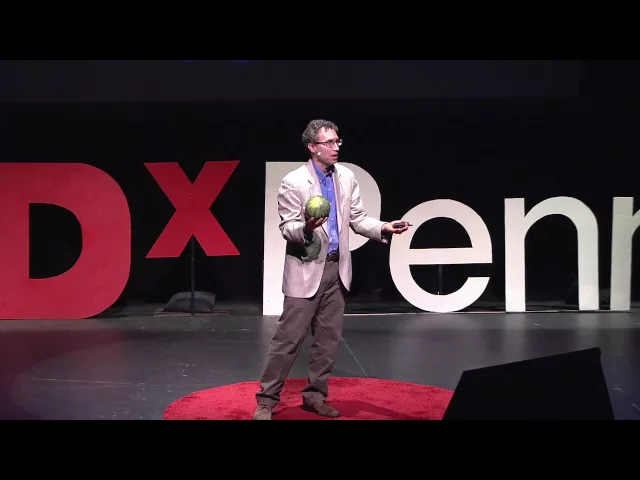
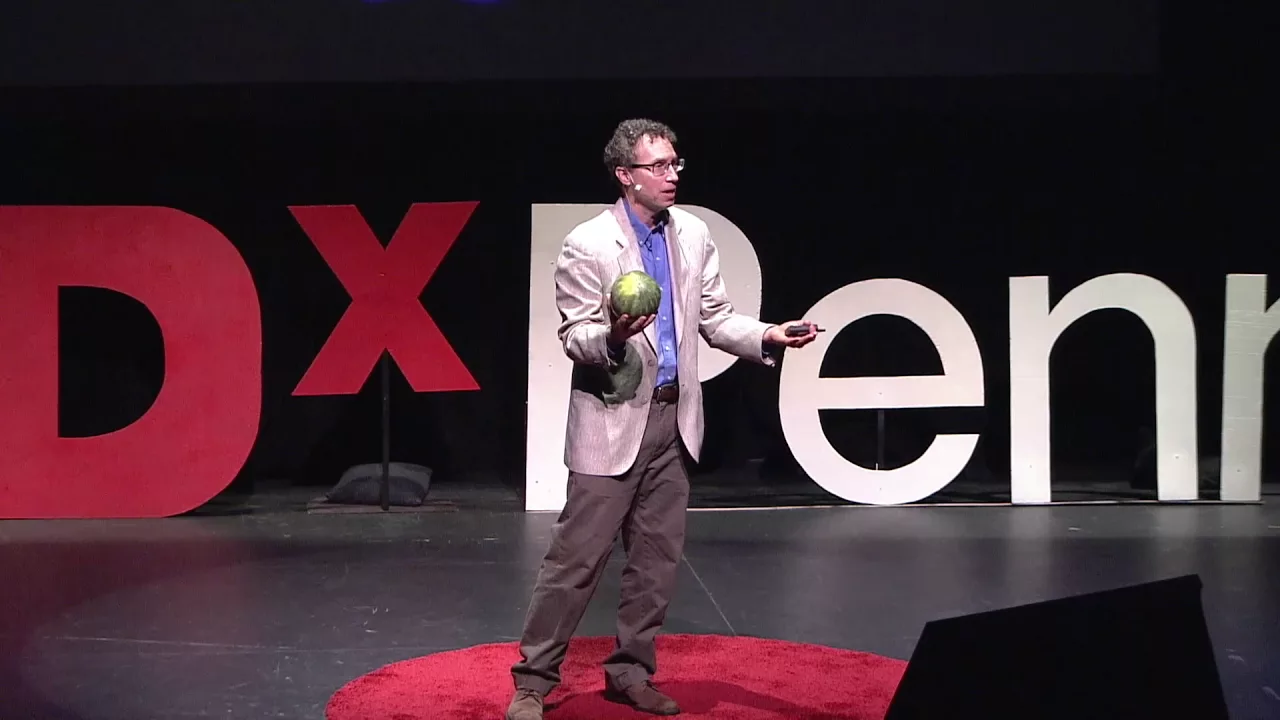
And that makes sense because if this area is normally on when we're trying to make things happen, when that area shuts down, we begin to feel that sense of surrender, we let our purposefulness go. Now, I was thinking about how I might be able to demonstrate this a little bit more visually for you because it's not just that there's a decrease, but it is the magnitude of that decrease. And I've thought about this for a while, and I was really struggling with it, and I actually had a little epiphany myself because I was in the grocery store, and I reached over, and I got this little watermelon for my daughter.
And I thought, you know, it kind of looks like the size of your head a little bit. And I started to think about the analogy of this watermelon in relation to our brain and enlightenment. And I thought, you know, this really is a great analogy for our brain because inside is where our brain is, just like it's inside of our skull.
And it doesn't really have a clear way of connecting to the outside world. I mean, sure, I could knock on it, and I guess maybe you'd hear the sound inside. But there's no way to really no way to connect the outside world to the inside of this watermelon.
Now, if I wanted to enlighten this watermelon and expose it to the light of the universe, so to speak, one way to do it would be something very rational. I could cut through it, open it up, and to some degree, I've exposed part of it to the world. But that still isn't exactly what I'm talking about.
I would like to find a way to really radically open this watermelon up. If I really wanted to try to change this watermelon, I'd have to climb up to the rafters or climb up onto the ceiling and see what would happen if I were to drop it all the way from there. So let's take a look at this video to show you a little bit about what that would look like.
(Video) (Short, vibrational sound) (Video ends) It is a permanent effect. Right? There's no way to put that watermelon back together again.
And when people have this enlightenment experience, there's no way to put themselves back together again in the same exact way. In fact, when we asked people in our survey, "How did this experience change who you are? " they said that it changed everything about them.
It changed their sense of relationships, their sense of life, death, their sense of health and well-being, their sense of religious and spiritual selves, and almost all, universally, for the better. So this is an incredible experience that transforms your life, totally and permanently, and we can see exactly how this happens in the brain. This is going to be the last scan I want to show you because this is actually my scan.
And it turn out that over the years, I've found a way to connect back to that feeling of infinite doubt. If I just do a little meditation, I can rest within that feeling of infinite doubt. And one time when we had a new MRI scanner, I volunteered to go into it; I just wanted to see what was going on in my brain, and I didn't even tell them what I was doing.
I just went into the scanner, but I did this little meditation where I experienced my feeling of infinite doubt. And when they showed me the scan, they said, "What were you doing in there? " I said, "Well, I was .
. . " I explained it to them.
They said, "Uh huh. " But when you look at the scan itself, we see two areas of significantly decreased activity. One, where the upper arrow is, is my frontal lobe, and the other, the bottom arrow, is in my parietal lobe.
So those feelings of surrender and those feelings of oneness that I have are also reflected in the scan of my own brain, and it helps me to understand what these experiences do, not only for me, but for everyone else around me. So can we use all of this information in some helpful way that each one of you can find your own path to enlightenment? And I think that we can.
I think we've learned enough now to be able to set up a series of steps that perhaps everyone can follow. Now, obviously, there's never a guarantee - and I would never stand here and tell you that I could do that - but if you think about these different steps, you can try every one of them on your own. The first is a desire to change.
Of course, perhaps all of you would say, "Yes, I would love to have this kind of an experience. " One of the things I often recommend to people is to go home and take out a piece of paper and write down why you would like to have enlightenment and what enlightenment means to you. Try it.
It's a good way to start that path, to take that first step. The next step is to prepare yourself for this experience. As I said, it is a scary experience, and it's important to find ways of being okay with it, of being able to relax with it, doing certain types of relaxation exercises, yoga, meditation.
The third step is perhaps the most important. This is creating your own personal ritual or practice. And it could be a meditation; it could be prayer.
Like me, it could be just trying to find the answer to big questions. It could be music or creativity, some of the things you heard today. But try to find that ritual because what that does is it ratchets up that level of activity, it ramps up the activity in your brain and in your frontal lobe, so that when you get to Step 4 and you surrender to the experience, you really have that sudden drop, and you have that incredible experience.
And then finally, reflecting on your experience, because that's what helps you to bring that experience back into who you are as a person - what it means to you and how you can understand it. So what have we learned? What's the big take-home message?
I think one of the most important things - because in our survey, we had a couple of thousand people tell us about their experiences - I think the most important thing is that enlightenment is not just for the Buddhas of the world. It is an experience that anyone can have, and it's an experience that everyone can have. And you can imagine what a great world this would be if we all found our own path to enlightenment.
And to some degree, we all have a brain that's capable of doing it. When you look at all the brain scans, our brains are about five percent different from each other, so we're all capable of having these experiences. So what have I given you today?
Hopefully, I've given you a map, I've given you a guideline to your own path of enlightenment. Maybe some of you will find a spiritual enlightenment, maybe some a scientific one, perhaps some will find infinite doubt. But ultimately, as with any map, it is only as good as if your willingness to take that first step.
But if you take that first step, it will be an amazing and wondrous journey, and that is something that I have no doubt about. Thank you.