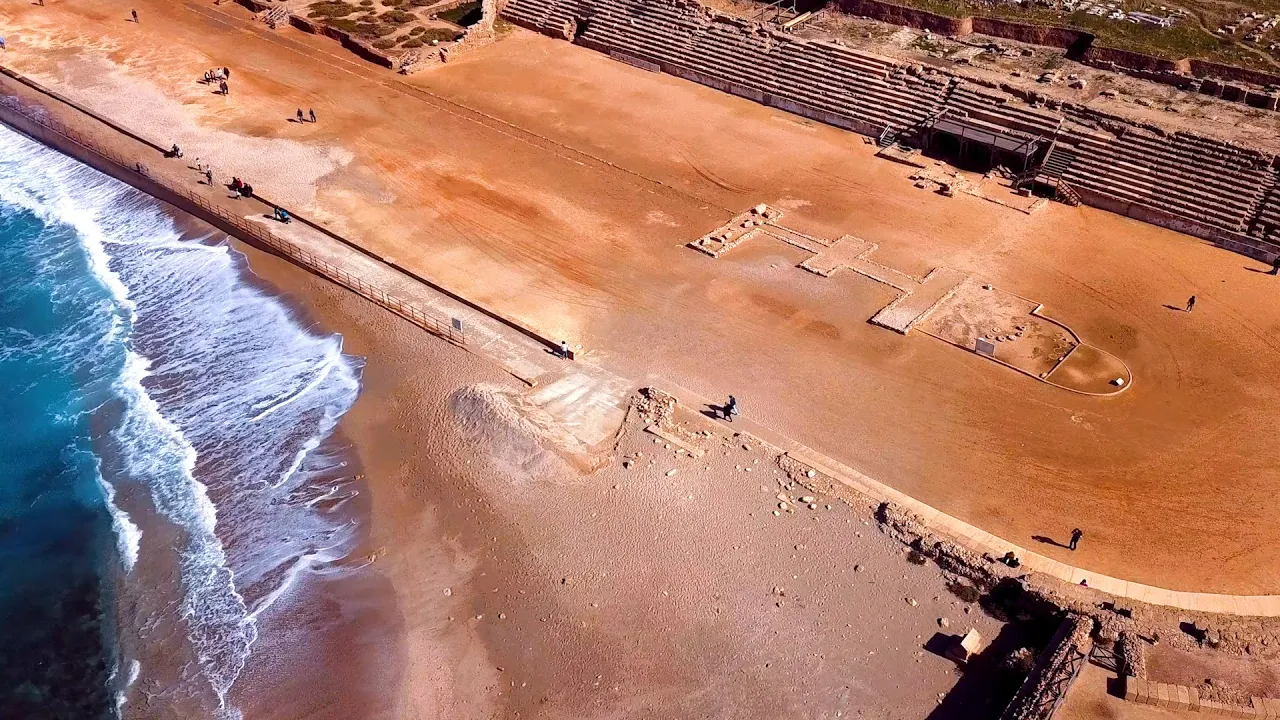
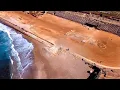
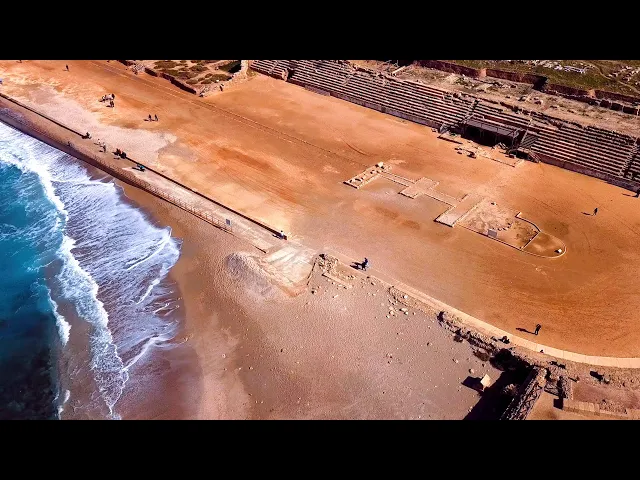
On the shores of modern day Israel Lies the ruin of Caesarea This Roman city was positioned dramatically on the wavy coastline. It had a massive chariot racetrack this theater bath houses and markets an ancient swimming pool, cut into the rock. aqueducts bringing fresh water from miles way and it's crown jewel an artificially constructed harbor a marvel of ancient engineering.
Caesarea is located halfway between Tel Aviv and Haifa, on a long straight coastline with very few natural bays. The city was built by Herod the Great, a local ruler, but a puppet of the Romans, who made him King of Judea in 40 BC. In the decades leading up to the year zero Judea was technically not a Roman province yet, but a client kingdom meaning that it was autonomous for its Internal affairs, but had to serve the geopolitical interests of Rome.
Herod was their yes man, as he owed them his power. He set out to build a monumental city, Roman style. In order to demonstrate his loyalty to Rome, he dedicated his city to Augustus whose official title was Caesar Augustus and so the city was named Caesarea Herod was an Edomite, from the tribe of Edom, which converted to Judaism a century before.
But the Jews did not consider him a true Jew and definitely not their legitimate King. He was also very Hellenized, meaning that he subscribed to Greco-Roman values just like you should subscribe to my channel, if you like this type of content. This Hellenized city did not look east to Jerusalem as its guiding star but west towards Rome.
Herod clearly looked up to the Romans, and wanted to impress them so much so that he outdid them, and had the audacity to build the largest artificial harbor in the Roman world. Directly in the open sea. And he did this in an unfavorable terrain, that long and unprotected coastline that's exposed to wind, waves and shifting sands which would have made construction extra difficult.
These modern harbor jetties that you're looking at are only a third of the size of the ancient ones, but they sit on its foundations. This satellite image clearly shows the massive ancient jetties crumbled and submerged below the water. They would have looked like this more or less.
As they crumbled into the sea over time, the debris spread out over the sea floor, and now sits 5 meters below the surface. But when they were still operational, they formed a huge engine port that could harbor many large ships. To give you a better idea of how big it was, a modern aircraft carrier of the U.
S Navy, which is 1100 feet long, or 335 meters would be this big inside the harbor. This comparison is measured accurately to scale. It fits well within but would be kind of useless if it couldn't get out.
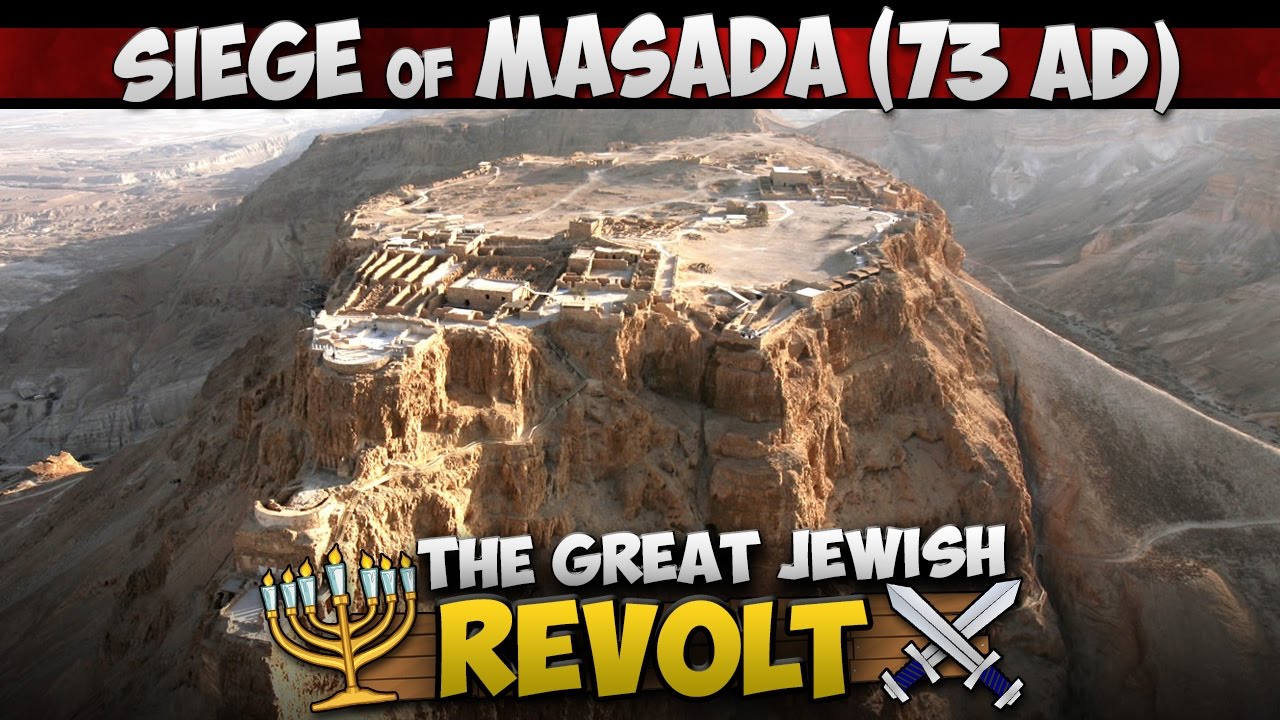
King Herod undertook many other impressive mega projects in Judea including the Herodium, which was a palace and fortress on top of an artificial mountain. Talk about a mega project The infamous Masada, where he built another massive palace which later became the last standoff, in the war between the Jews and the Romans. The Cave of The Patriarchs in Hebron, which is the site where Abraham, Isaac and Jacob are buried, along with their wives.
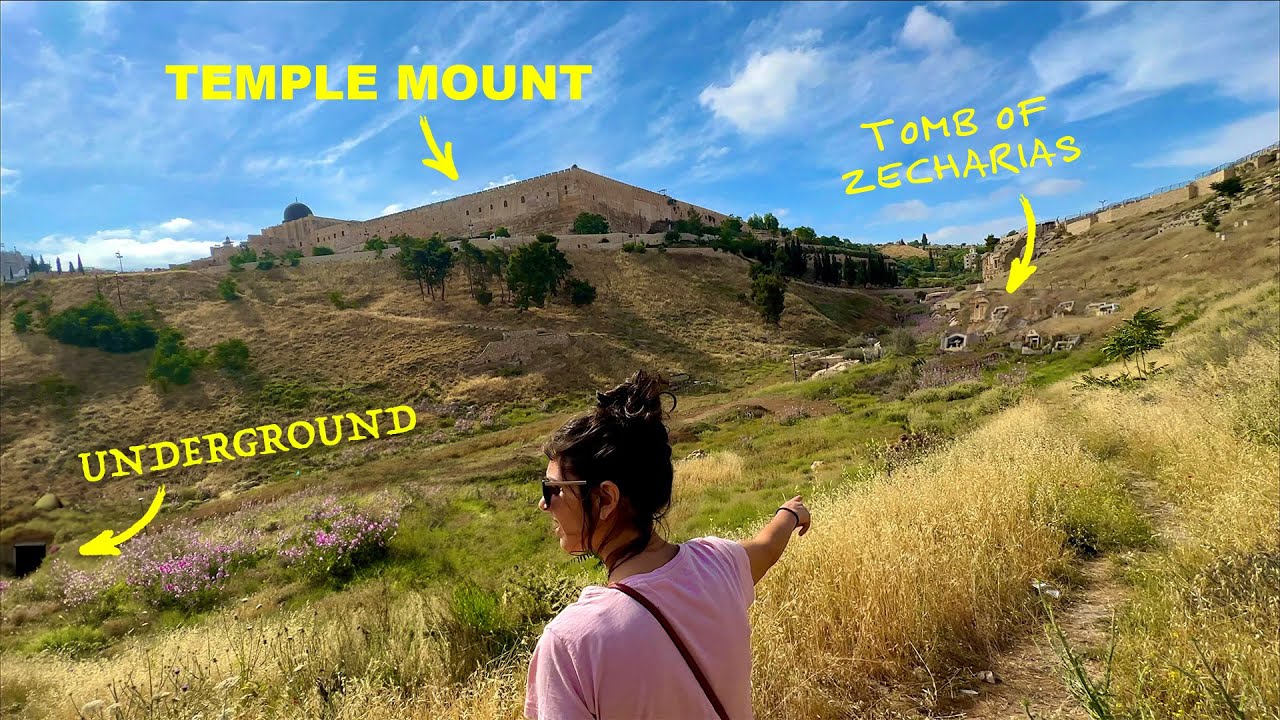
and he also upgraded the Jewish temple in Jerusalem and built these huge retaining walls around the Temple Mount which enlarged the plaza around it, and a massive fortress to protect it. Today's Western Wall is a piece of that Herodian retaining wall. Because the Jews despised him, he built the religious sites in order to win favor with them.
So it can't be said that he didn't do anything for them, as these buildings still are incredibly important to the Jewish faith and identity today. But for the purposes of preserving his own power, and his link to Rome, the harbor at Caesarea, was his greatest asset. Sea travel was the fastest form of travel, So having a solid harbor on that coastline, gave him fast communication with Rome across the Mediterranean, which was the highway linking all the important cities of the empire.
Caesarea was now port city, and it was its harbor that put it on the map, giving it access to that well developed trade network. It took him 7 years to build the two jetties, which is impressive for 2000 years ago, considering how difficult it was to build in the open sea. First needed to build underwater concrete foundations.
To make Roman concrete, a key ingredient was Pozzolana, a special volcanic ash that was sourced from the town of Pozzuoli, in the Bay of Naples. This is the Roman Amphitheater of Pozzuoli. The rest of the ancient city is covered up by the modern one.
The volcanic ash sourced from this town was the secret to Roman concrete. When it was mixed with the other ingredients and came into contact with water, it would harden into a very strong and durable material. It could even solidify underwater, what's known as hydraulic concrete.
Archaeologists speculate the Herod's men constructed these wooden molds with double walls, which were floated into position. When the molds were above the right spot, they filled the double walls with mortar to make them sink to the sandy floor. Then they would pour the liquid concrete into the rest of the molds, where it would settle and harden underwater.
They also estimate the Herod needed to import 50,000 tons of this Pozzolana ash, in up to 150 shiploads, all the way back to Caesarea. This shows how interconnected the Roman world was, where specific materials needed in one place, were sourced from another, thousands of kilometers away. A true example of ancient globalization.
It also demonstrates when an immense budget Herod had at his disposal, for just a small king, which put in immense strain and tax burden on his people, and only increased their frustration towards him, as a king who doesn't truly look out for them, but is more concerned about preserving his own power, and his relationship with Rome. Monuments like this hippodrome and theater, which are ultimately built for fun and entertainment, must have been a particular sore spot for the Jews. Especially because the games held in them were a Roman custom, not a Jewish one.
But Herod was able to hold on to his power, until 4 BC, when he fell ill, and died. The years that followed were marked by turmoil and unrest, until 6 A. D when Judea was annexed as an official Roman province, so that Rome could have more direct control over it.
Caesarea then replaced Jerusalem as the official capital of Judea, being more strategically connected to Rome, and simply for being a new Roman style town. unlike Jerusalem, which was an established Jewish City, already ancient by those days. As a Roman provincial capital, Caesarea became a large and bustling cosmopolitan city.
With a mixed population of Romans, Greeks, Jews, and other cultures from around the Mediterranean. While Jerusalem was the spiritual heart of Judea, Caesarea was the city of business and commerce with the outside world. It was in the perfect position to receive direct orders from Rome, then implement them into the hinterland.
And was the Roman headquarters out of which Pontius Pilate governed, the governor of Judea who gave the order to crucify Jesus. Interestingly in 1961, a limestone block mentioning Pilate was discovered at Caesarea. providing the only archaeological evidence for his existence.
All other mentions of him are literary, including the New Testament, and a few contemporary historians like Josephus, who documented the war between the Roman and the Jews, that was sparked here in Caesarea in 66 A. D. Josephus who was also a Jew, sucked up to the Romans, and praised Caesarea and its harbor.
However, it was this harbor that brought the destruction of his own people, as it would have been the key entry point into Judea, for the Roman military. Used for shipping in troops, logistical support for the war, and receiving orders from Rome. This war resulted in the utter defeat of the Jews by the Roman war machine the sacking of Jerusalem and destruction of their temple in 70 A.
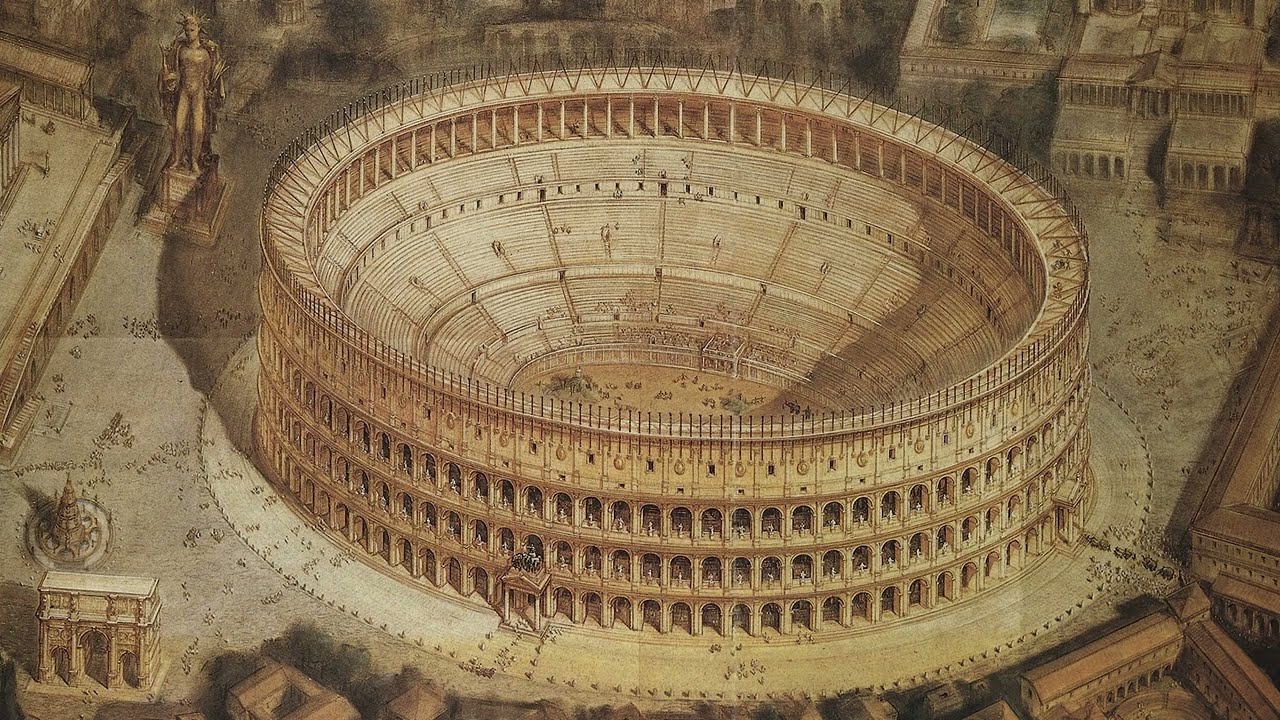
D and the deportation of much of their population, to the rest of the empire. The Colosseum itself was most likely funded with the spoils of that war, as it was built right after it. It was also likely constructed by Jewish slaves brought over to Rome as captives.
This was such a cataclysmic event for the Jews, that modern history of the region is still being shaped by it, 2000 years later. In the first century, when Christianity was spreading out from the Holy Land, Caesarea's port again became a key instrument in serving that wave of history. It was that well established trade network that existed in the Mediterranean under the Romans, that facilitated the fast spread of goods and ideas, and with it, the new ideas of Christianity.
Saint Paul himself left on his famous voyages across the empire from this very port. Saint Peter also came through this city. Historically it's always been urban centers, especially port cities, that have been the key players in transmitting new ideas and new trends of history.
This is because they were the most connected to the outside world, and to influences from other port cities. as well as having the highest population densities. More people living together and talking to one another, means that an idea can spread faster, and Christianity was no exception.
It was the key urban centers of the Roman Empire, that first received Christianity, as well as other ancient religions that came from outside Rome, like Mithraism. To illustrate this, The Great Fire of Rome in 64 A. D.
, which Nero allegedly started and then blamed on the Christians, was only 3 decades after the death of Jesus. This means that just 30 years after, there were already enough Christians in Rome that they were a well known minority, used as scapegoats for the fire. Things took time in the ancient world, so for them to be this numerous by the time of Nero, means that the very first ones must have arrived in Rome just a few years after.
And they would have left from Caesarea, and traveled on that well connected trade network, which enabled Christianity to spread quickly, between all the different ports. In fact the term 'Pagan' which today means the worship of many gods, back then just meant in Latin, "a person living in the countryside". What this tells me, is that when Christianity must have already been well established, and replacing the old Roman religion, those who still continued worshiping the old Roman gods, were the folks living in the countryside.
Pagans. Further indication that it was the cities and ports that were spearheading the spread of Christianity, in the early stages. But back to our own beloved port, it did not fair so well, the test of time.
Archaeological analysis of the submerged concrete, indicates that it wasn't actually the best quality compared with other Roman harbors in Italy. So although ambitious, the harbor was a little on the weak side Then in 115 A. D something BIG happened to the north, This is the Turkish city of Antakya.
It sits on an intersection of multiple fault lines, and has suffered from earthquakes throughout all its history. It was one of the hardest hit cities in the last massive earthquake in February 2023. Which devastated southeast Turkey and northwest Syria.
In Roman times, Antakya was called Antioch, one of the largest and most important cities in the empire. and the same thing happened in the year 115. A massive earthquake so devastating, that historians speculate a quarter million people died.
Half the city's population. The earthquake triggered a tsunami that traveled all the way down the coast, and is known to have hit the harbor at Caesarea. It probably didn't destroy it completely, but would have seriously damaged it.
And remember that its concrete was not the strongest to begin with. And so this tsunami, was the beginning of the end, for our beloved harbor. It must have remained usable for some time though, because in later centuries, Caesarea became an important Byzantine city.
So surely it would have had an operational port, even if not as glorious. But by the 5th Century, further local seismic activity, and the relentless waves of that exposed coastline, ate away at the weakened structure, and the jetties were well on their way to the bottom. When the Crusaders conquered the Holy Land in 1100 A.
D. they needed ports along that coastline. They recognized the strategic value of this place, so they rehabilitated the harbor, albeit a smaller version of it.
The modern jetties that you see today, correspond somewhat to the smaller Crusader harbor. But after that wacky endeavor came to an end, and the Mamluks kicked the Crusaders out for good, Caesarea basically died as a significant port city, and the site slowly became a ruin. One that you can enjoy today, if you go visit Israel.
A well preserved Roman city, that lived through the turbulent events of history, and under the numerous cultures, that have controlled this fascinating region.

![The Siege of Jerusalem (70 AD) - The Great Jewish Revolt [FULL DOCUMENTARY]](https://img.youtube.com/vi/y741QbT1YEo/maxresdefault.jpg)