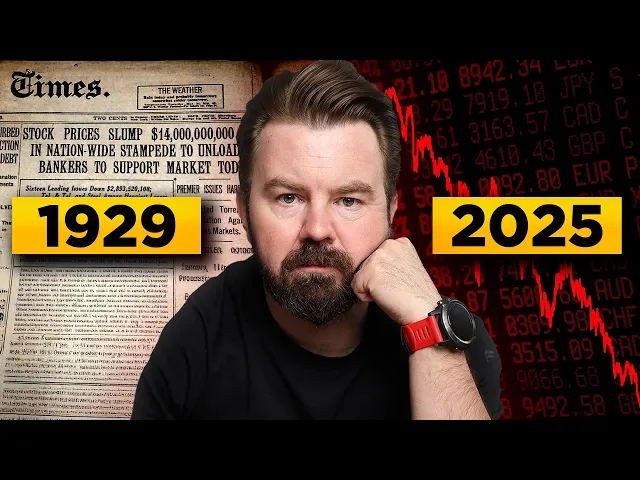
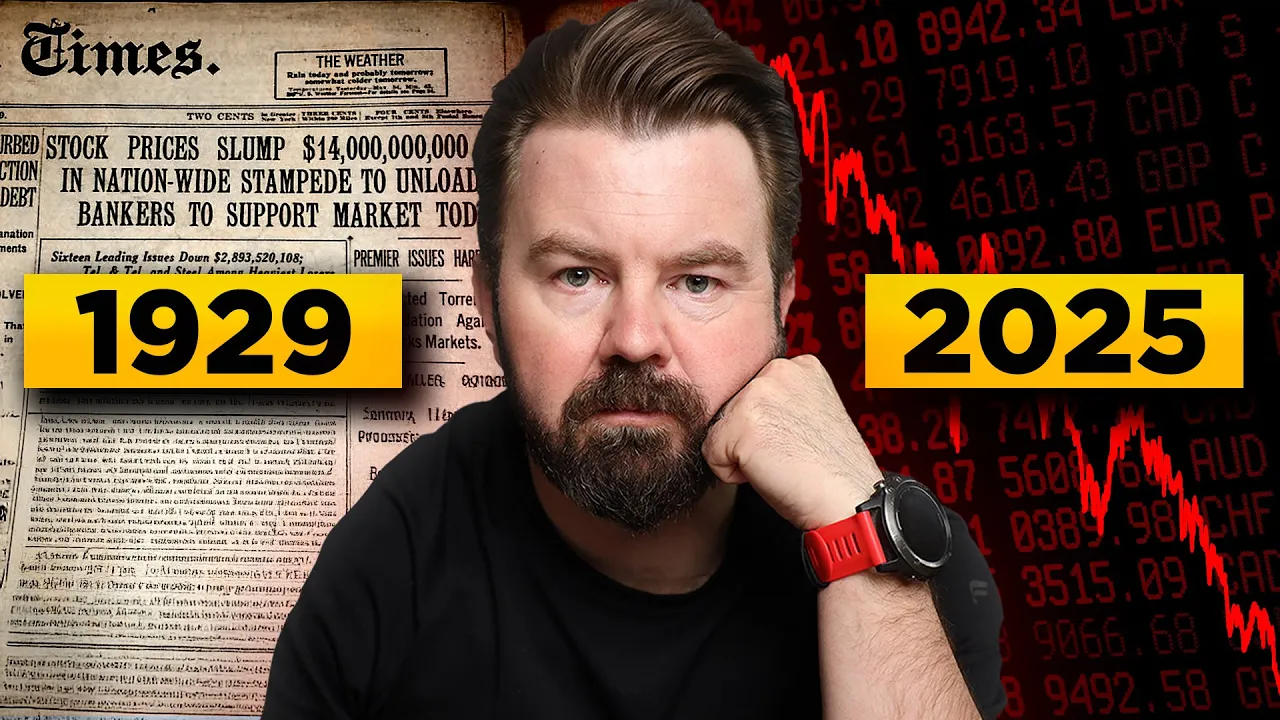
The 1929 crash wiped out 86% of investor wealth. 2008 erased $8 trillion in value. The.
com bubble bust vaporized $5 trillion. And every single time, the smart money always saw it coming. They didn't just survive, they thrived.
What did they know that others didn't? Well, today I'm going to reveal the four unmistakable warning signs that preceded every major market crash in history. These aren't just theories.
I'll show you the exact patterns backed by hundreds of years of market data that signal when the wealthy start quietly moving their money. By the end of this video, you'll know how to spot these signals yourself and more importantly, how to position yourself and your portfolio to protect and potentially grow your wealth while others panic. But before we start, we need to understand the anatomy of market crashes.
And let's start by looking at 1929 and the Great Depression. Markets peaked in September of 1929, but by 1932, 86% of the value in the stock market had been vaporized. It took 25 years from then to recover.
Now, there were a lot of reasons why the stock market crashed in 1929. But the reason why so much wealth was wiped out was largely due to the fact that people believed that stocks could only go up in value, which led to a lot of risky behavior like borrowing a whole ton of money in order to invest and not thinking about the potential repercussions. And that led to a very very painful lesson that excessive leverage destroys generational wealth.
Then fast forward to Black Monday 1987, the largest single day drop in US market history. It was a 22. 6% decline in a single day, largely driven by program trading that nobody even realized was a potential problem.
But when the stock market started to fall, the market mechanics amplified that crash, making things worse and worse and worse. Then there was the 2000. com bubble.
The NASDAQ fell 76. 8% from the peak. It took a full 15 years to recover.
And guess what? Just like in 1929, it was fueled by the belief that tech stocks could go nowhere but up. And obviously, we all now know that this just wasn't true.
And most importantly, especially for those who are investing in things like Bitcoin right now, you need to understand that the new paradigm thinking proved dangerous because even though the dot stocks were something that had never been seen before and Bitcoin is something that has never been seen before, we have many times over history seen people believe that this new thing is the next big thing only to not see the massive failure that's right around the corner. Then there was 2008, the financial crisis. The S&P dropped about 50%.
8 trillion in wealth was destroyed. And this was the single biggest meltdown in the US economy and the global economy since the Great Depression. And ironically, it was also triggered, much like Black Monday, by something that nobody saw coming.
Well, there was a few people that saw it coming, but most people, 99. 9999% of people didn't see it coming. And it was subprime mortgages and more specifically complex financial instruments that hid massive risks just like the complex trading systems of black Monday in 1987 and most recently there was the 2020 co crash the fastest 30% drop in history.
Now the one big thing here is we had seen big drops in the past and the government arguably knew what to do kind of and there was an unprecedented government response. Money was flooded into the economy in order to make sure that the economy didn't completely implode. But the important lesson here was that an external shock, something nobody expected, a global pandemic could lead to a significant crash pretty much overnight.
Because while on March 10th everything seemed fine, by March 15th it was clear it wasn't. And this demonstrated how volatile and how vulnerable markets can be to things that nobody sees coming. But even though nobody saw these things coming, there were definitely clear warning signs.
So in all of these scenarios, the thing that tipped the scales was unpredictable. However, there were warning signs in every single scenario that something bad could occur if things just went slightly the wrong way. And the first big warning sign is overvaluation.
In almost all of these cases, the Buffett indicator, the total market cap to GDP ratio was way out of whack, well over the 140% danger threshold. Now what's the total market cap to GDP ratio? Well, that is the market cap, the value of all US stocks combined relative to the GDP, so the production of the United States economy.
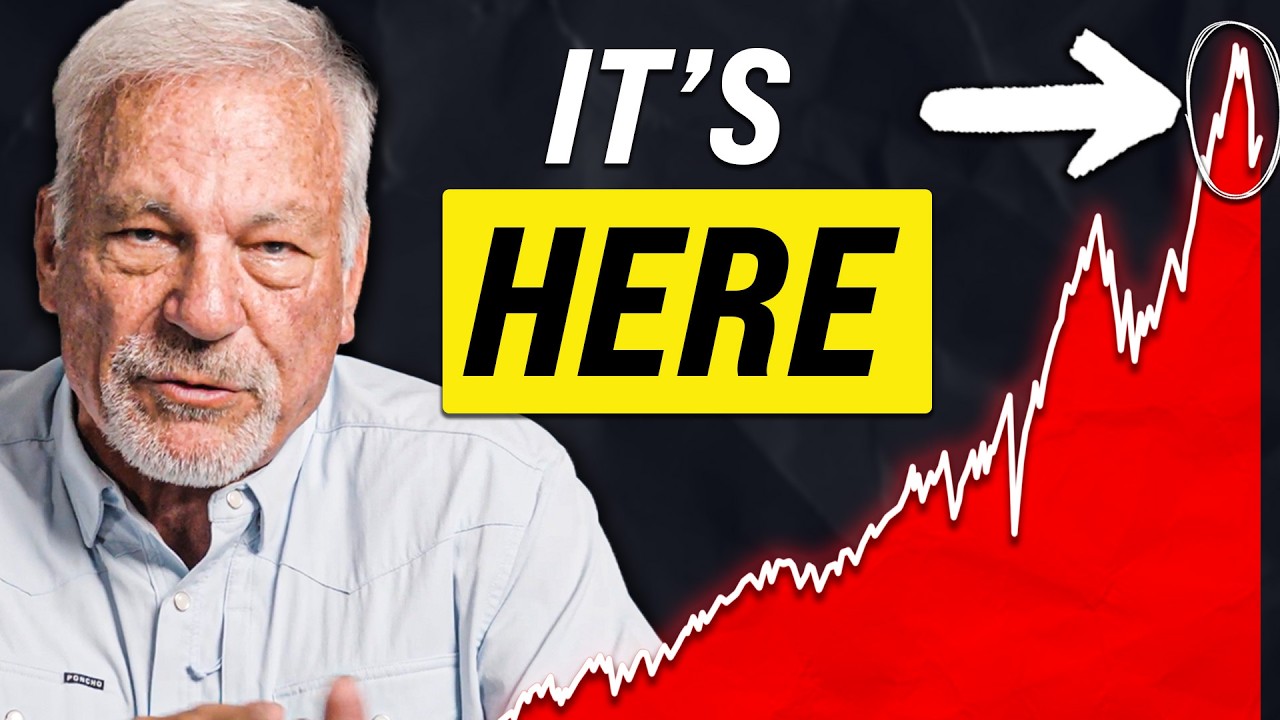
And when that market cap starts to exceed the GDP, that's usually a sign that danger is right around the corner. It's a sign that investments are way too expensive. And I'm not even going to tell you what these numbers are right now because they're absolutely insane.
But go ahead and search Buffett indicator and take a look for yourself. Then there's the second massive warning sign and that's excessive speculation. This is when people start boring money to invest in things.
They do things that are crazy like pull money off of credit cards in order to buy Bitcoin because they think that they just can't lose even though it's going to cost them 20% a year to borrow that money off the credit cards. Now, that can be compounded by things like risky derivatives or other types of crazy investment strategies that people just tend to not understand. And when people start talking about the new trending way to invest, that is really incomprehensible to most people, it's usually a sign that things are getting crazy.
And then when your taxi driver or your barber or some other person that shouldn't be providing investment advice starts telling you about this new investment you need to invest in, well, that's also usually a sign that things are getting overheated. And it's not just stocks. It can be things like Bitcoin.
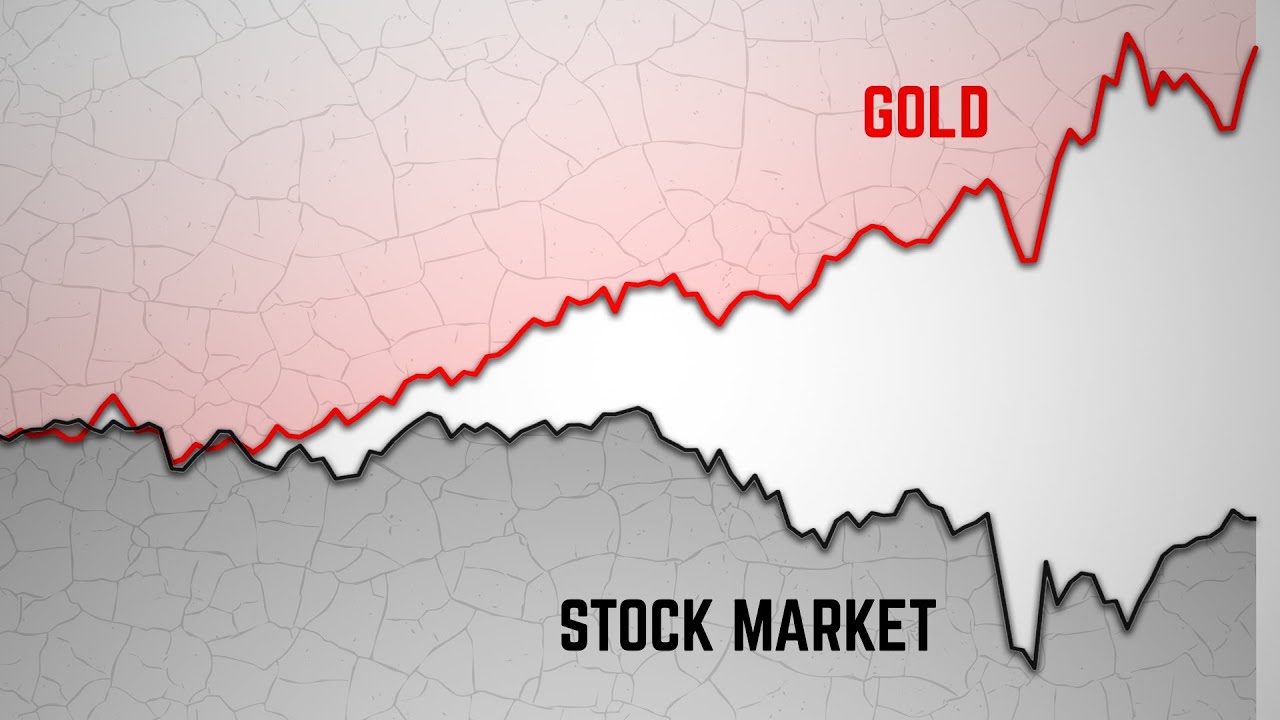
It can be things like gold. It can be things like housing pre208 where everyone thought that houses could only go up in value. When everybody starts doing it, it's usually a sign that a house of cards is about to fall.
Then there's the next sign, market euphoria. The this time is different narratives. Like I mentioned previously, the taxi drivers giving stock tips, media celebrating new highs, $84,000 for Bitcoin, or a new record high almost every single daily in the S&P 500.
And it's when this stocks or investments only go up in value mentality is at its frothiest that you need to start paying attention. As we're filming this video, the only go up mentality would be something that I might apply to things like gold and Bitcoin. And then last but not least, there's the volatility patterns.
You start to see increasing market swings, big ups, big downs, frequent 1% daily moves, and trading volume spikes out of essentially nowhere. And when all four of these things start to happen all at one time, it usually means that one little thing, one negative piece of news could have catastrophic results on the market. So, if you start to see things like overvaluation, excessive speculation, market euphoria, and crazy volatility all at the exact same time, well, it's definitely time to make sure that you're diversified and not putting all of your money into the things that are seemingly too good to be true because they probably are.
Now, these are the warning signs, but the next thing we need to talk about is the psychology of these market crashes because the psychology is actually the most important piece. So, when you look at the market psychology right before a crash, there are certain things that lead really good people to lose a lot of money. And it's important to check yourself at every stage of your investment journey to make sure these things aren't driving you.
So, for example, if there's the fear of missing out, you didn't get into an investment 2 or 3 years ago and everyone else has gotten rich and you're thinking about putting your money into the thing that's already been driven up in price, it's probably a good sign not to invest in that thing or at least be cautious about the amount of money that you do invest. or when you're looking at potential investments and you're going, I have to get in because if I don't, I'm going to get left behind and you start to ignore rational analysis and all of the reasons why you shouldn't that are clearly right in front of you. Things like investing in real estate when it is at the top of the market and everybody is bidding for properties and paying way too much for them.
And then there's the herd mentality. And this is even more important when you're following everyone else. Because if you are just getting in as the last of the last get in, it's going to be too late.
And when that moment of fear, that news article, that thing that nobody expected hits the news, that's when the panic selling starts. And that's when people start to lose the most money. So the question is, how do you protect yourself?
And the answer to that is really simple. You diversify your investments for risk. You make sure that you are never allin on one type of investment.
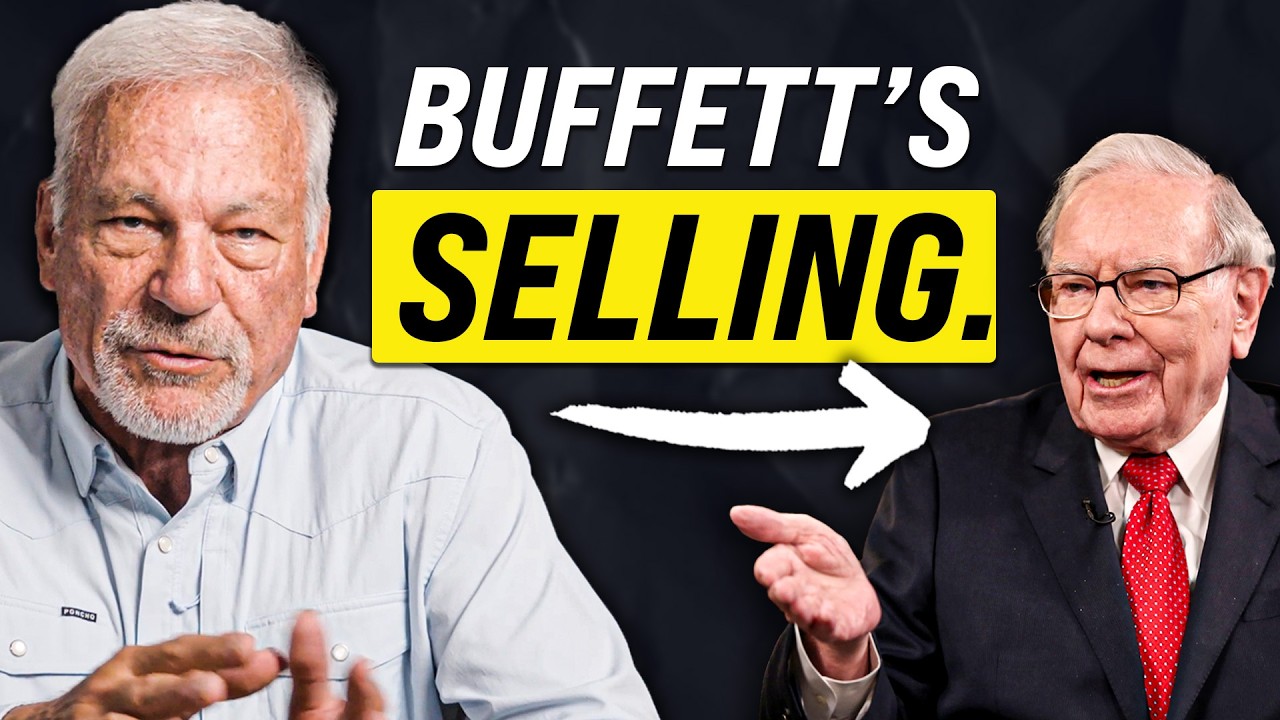
You take lessons from guys like Warren Buffett, who when his Apple stock went up so much in value that it made up 50% of his portfolio, he started to sell it so that if it went down, it didn't take the whole portfolio with it. Because here's the real secret to building wealth. It's actually not losing money, protecting yourself from the big drops.
And the way you do that, like I said, is by diversifying your portfolio. Not for different types of investments, but for risk. And the best way to do that is, at least as far as I can tell, with the all-weather portfolio.
So, the all-weather portfolio made famous by Ray Dalio seems to be the best way to diversify yourself for risk. The strategy is simple. You put 30% in stocks, 40% long-term bonds, 15% in intermediate bonds, 7 12% in gold as crisis insurance, and 7 12% in commodities.
And all of these investments that are balanced, like I said, for risk, have a different function in the portfolio. Stocks are there for long-term growth. Bonds are there for deflation protection.
Intermediate bonds are there for stability. Gold is there for crisis insurance. And commodities are for inflation protection.
And when things like stocks start to crash, other investments tend to go up in value. And by using something like the all-weather portfolio and rebalancing regularly, you put yourself in a position where the crashes in any single investment tend to not have as big of an impact on your portfolio. And the reason why this seems to work is because it balances your risk exposure.
As one investment perhaps goes down, others make up for it. And it's also designed to perform in all economic environments. So if there's high inflation, it works.
If there's deflation, it works. If there's high growth in the economy, it works. If there's low growth in the economy, it works.
The balance simply makes it less volatile. And most importantly, especially for amateur investors, is it reduces emotional decision-making. All you do is rebalance your portfolio once a month or once a quarter or once a year, which means you're always buying the things that are the best deal, that have gone down in value, and not when they are the most expensive.
And this is why this portfolio tends to have the most success through crashes. Now, on top of that, it's important to also make sure that you're always investing in it. Do what's called dollar cost averaging, which means every single month when you get paid, you put a little bit more into the portfolio.
You buy the things that are the best deal and leave the things that are getting more expensive alone. This removes the pressure of trying to time the market, trying to buy at the right time or sell at the right time. You're simply buying the stuff that is out of whack with respect to its portfolio value.
And when bonds drop or stocks drop or gold drops or commodities drop, guess what? You're buying those things and you're taking advantage of the reduction in the prices. And this is why it reduces the overall risk.
And at the end of the day, it's this kind of systematic investing that makes people wealthy because the wealthy in reality don't get rich by predicting crashes. They get rich by being prepared for them. They get rich by having a portfolio that's designed to take advantage of when people are fearful.
And while history doesn't exactly repeat, it always rhymes. And if you can always be prepared for the next market crash by having a portfolio that is set up in a way that you can take advantage of lower prices when they make themselves available, that's how you win. Oh, and by the way, if you want to see a video on some of the biggest mistakes you can make when the market crashes, make sure you check out this video right here.