The wisdom of Life by Arthur schopenhauer introduction in these pages I shall speak of the wisdom of life in the common meaning of the term as the art namely of ordering our lives so as to obtain the greatest possible amount of pleasure and success an art the theory of which may be called udim minology for it teaches us how to lead a happy existence such an existence might Perhaps be defined as one which looked at from a purely objective point of view or rather after cool and mature reflection for the question necessarily involves subjective considerations
would be decidedly preferable to non-existence implying that we should cling to it for its own sake and not merely from the fear of death and further that we should never like it to come to an end now whether human life corresponds or could possibly correspond To this conception of existence is a question to which as is well known my philosophical system returns a negative answer on the ud demonistic hypothesis however the question must be answered in the affirmative and I have shown in the second volume of my chief work ch49 that this hypothesis is based
upon a fundamental mistake accordingly in elaborating the scheme of a happy existence I have had to make a complete surrender of the higher metaphysical and Ethical standpoint to which my own theories lead and everything I shall say here will to some extent rest upon a compromise in so far that is as I take the common standpoint of every day and embrace the error which is at the bottom of it my remarks therefore will possess only a qualified value for the very word udim minology is a euphemism further I make no claims to completeness partly because
the subject is inexhaustible and partly because I Should otherwise have to say over again what has been already said by others the only book composed as far as I remember with a like purpose to that which animates this collection of aphorisms is cardens to utilit exit versus capena which is well worth reading and may be used to supplement the present work Aristotle it is true has a few words on UD demonology in the fifth chapter of the first book of his rhetoric but what he says does not come to very much as Compilation is not
my business I have made no use of these predecessors more especially because in the process of compiling individuality of view is lost and individuality of view is the kernel of works of this kind in general indeed the wise in all ages have always said the same thing and the fools who at all times form the immense majority have in their way to acted alike and done just the opposite and so it will continue for as Vol says we Shall leave this world as foolish and as wicked as we found it on our arrival how do
you find this book any thoughts about the book or the author any suggestion for improvement please take a moment to share your thoughts in a comment if you like it share it with your friends who might enjoy it as well subscribe to keep in touch visit complete audiobooks.com for more quality content chapter 1 division of the Subject Aristotle 1 divides the blessings of life into three classes those which come to us from without those of the soul and those of the body keeping nothing of this division but the number I observe that the fundamental differences
in human lot may be reduced to three distinct classes one what a man is that is to say personality in the widest sense of the word under which are included health strength Beauty temperament moral Character intelligence and education two what a man has that is property and possession possessions of every kind three how a man stands in the estimation of others by which is to be understood as everybody knows what a man is in the eyes of his fellow men or more strictly the light in which they regard him this is shown by their opinion
of him and their opinion is in its turn manifested by the honor in which he is held and by his Rank and Reputation the differences which come under the first head are those which nature herself has set between man and man and from this fact alone we may at once infer that they influence the happiness or unhappiness of mankind in a much more vital and radical way than those contained under the two following heads which are merely the effect of human Arrangements compared with genuine personal advantages such as a great mind Or a great heart
all the Privileges of rank or birth even of Royal birth are but as kings on the stage to Kings in real life the same thing was said Long Ago by metrod orus the earliest disciple of epicurus who wrote as the title of one of his chapters the happiness we receive from ourselves is greater than that which we obtain from our surroundings two and it is an obvious fact which cannot be called in question that the principal element in a man's Well-being indeed in the whole tenor of his existence is what he is made of his
inner Constitution for this is the immediate source of that inward satisfaction or dissatisfaction resulting from the sum tootal of his sensation s desires and thoughts whilst his surroundings on the other hand exert only immediate or indirect influence upon him this is why the same external events or circumstances affect no two people alike Even with perfectly similar surroundings everyone lives in a world of his own for a man has immediate apprehension only of his own ideas feelings and volitions the outer world can influence him only in so far as it brings these to life the world
in which a man lives shapes itself chiefly by the way in which he looks at it and so it proves different to different men to one it is Barren dull and superficial to another Rich interesting and full of meaning on Hearing of the interesting events which have happened in the course of a man's experience many people will wish that similar things had happened in their lives too completely forgetting that they should be envious rather of the mental aptitude which lent those events the significance they possess when he describes them to a man of Genius they
were interesting Adventures but to the dull perceptions of an ordinary individual they would have been stale Everyday occurrences this is in the highest degree the case with many of gerta's and Byron's poems which are obviously founded upon actual facts where it is open to a foolish reader to Envy the poet because so many delightful things happen to him instead of envying that Mighty power of fantasy which was capable of turning a fairly common experience into something so great and beautiful in the same way a person of Melancholy temperament will make a scene in a tragedy
out of what appears to the sanguin man only in the light of an interesting conflict and to a fmatic soul as something without any meaning all of which rests upon the fact that every event in order to be realized and appreciated requires the cooperation of two factors namely a subject and an object although these are as closely and necessarily connected as oxygen and hydrogen in water when therefore the Objective or external factor in an experience is actually the same but the subjective or personal appreciation of it varies the event is just as much a different
one in the eyes of different persons as if the objective factors had not been alike for to a blunt intelligence the fairest and best object in the world presents only a poor reality and is therefore only poorly appreciated like a fine landscape in dull weather or in the reflection of a Bad camera obscura in plain language every man is pent up within the limits of his own Consciousness and cannot directly get Beyond those limits any more than he can get Beyond his own skin so external Aid is not of much use to him on the
stage one man is a prince another a minister a third a servant or a soldier or a general and so on mere external differences the inner reality the kernel of all these appearances is the same a poor player with all the Anxieties of his lot in life it is just the same differences of rank and wealth give every man his part to play but this by no means implies a difference of inward happiness and pleasure here too there is the same being in all a poor mortal with his hardships and troubles though these May indeed
in every case proceed from dissimilar causes they are in their essential nature much the same in all their forms with degrees of intensity which vary no No doubt but in no wise correspond to the part A man has to play to the presence or absence of position and wealth since everything which exists or happens for a man exists only in his Consciousness and happens for it alone the most essential thing for a man is the constitution of this Consciousness which is in most cases far more important than the circumstances which go to form its contents
all the pride and pleasure of The world mirrored in the dull consciousness of a fool are poor indeed compared with the imagination of Cervantes writing his Don kote in a miserable prison the objective half of life and reality is in the hand of fate and accordingly takes various forms in different cases the subjective half is our self and in Essentials is always Remains the Same hence the life of every man is stamped with the same character throughout however much his external Circumstances May alter it is like a series of variations on a single theme no
one can get get Beyond his own individuality an animal under whatever circumstances it is placed remains within the narrow limits to which Nature has irrevocably consigned it so that our endeavors to make a pet happy must always keep within the compass of its nature and be restricted to what it can feel so it is with man the measure of the happiness he can attain is Determined beforehand by his individuality more especially is this the case with the mental Powers which fix once for all his capacity for the higher kinds of pleasure if these powers are
small no efforts from without nothing that his fellow men or that fortune can do for him will suffice to raise him above the ordinary degree of human happiness and pleasure half animal though it be his only resources are his sensual appetite a cozy and cheerful Family Life at the most low company and vulgar Pastime even education on the whole can Avail little if anything for the enlargement of his Horizon for the highest most varied and Lasting Pleasures are those of the Mind however much our youth May deceive us on this point and the pleasures of
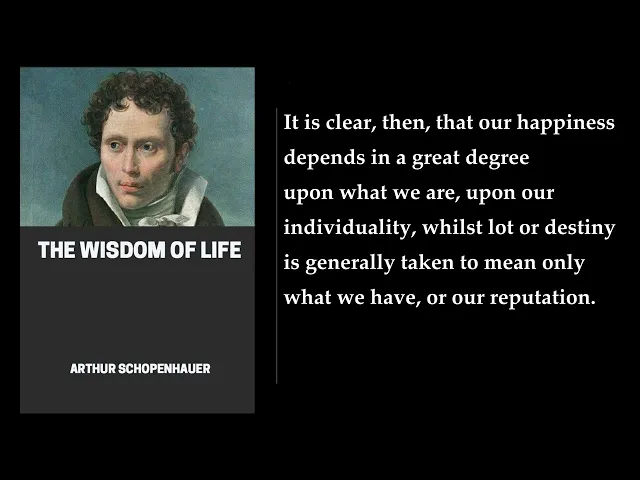
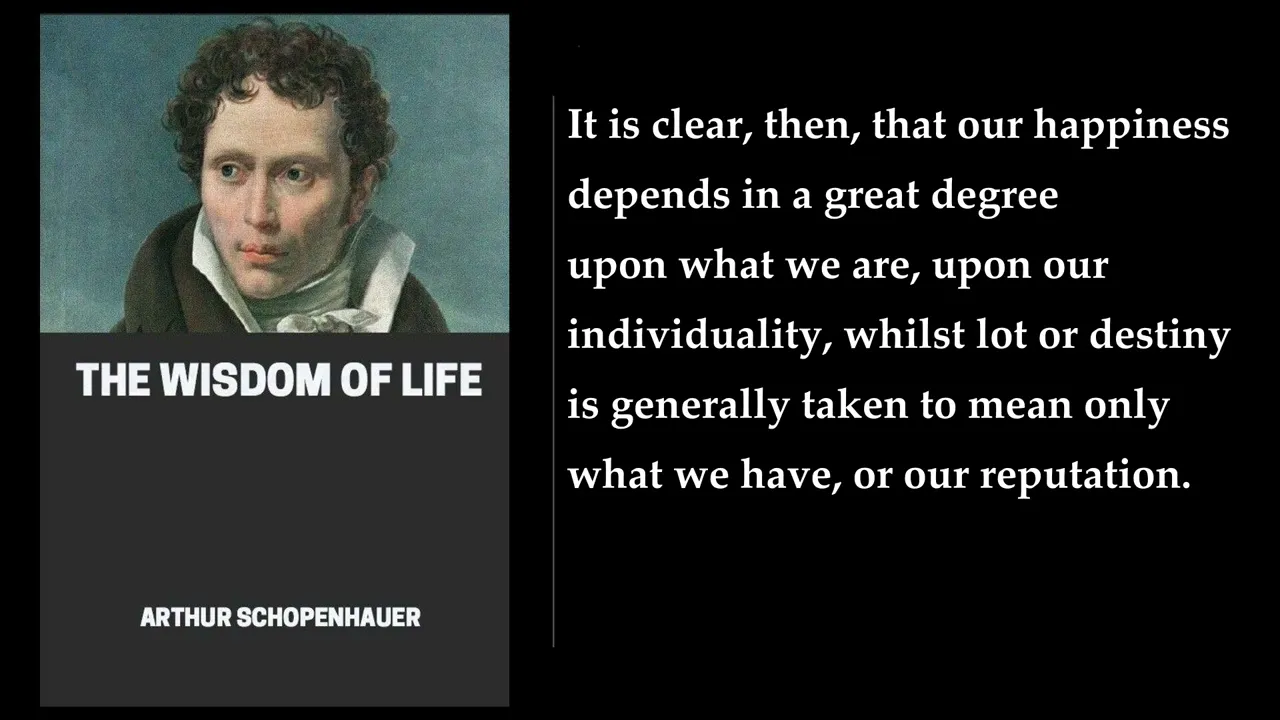
the Mind turn chiefly on the powers of the mind it is clear then that our happiness depends in a great degree upon what we are upon our individuality whilst lot or destiny is Generally taken to mean only what we have or our reputation our lot in this sense May improve but we do not ask much of it if we are in wly rich on the other hand a fool remains a fool a dull Blockhead to his last hour even though he were surrounded by hurries in Paradise this is why Gera in the west Olean Divan
says that every man whether he occupies a low position in Life or emerges as its Victor testifies to Personality as the greatest factor in happiness voke you and de connect you and the upper Winder C Jan Zu jerite Haw clu burden Kinder say ner pite everything confirms the fact that the subjective element in life is incomparably more important for our happiness and pleasure than the objective from such sayings as hunger is the best sauce and youth and age cannot live together up to the life of the genius and the saint Health outweighs All other blessings
so much that one may really say that a healthy beggar is happier than an alien king a quiet and cheerful temperament happy in the enjoyment of a perfectly sound physique an intellect clear Lively penetrating and seeing things as they are a moderate and gentle will and therefore a good conscience these are privileges which no rank or wealth can make up for or replace for what a man is in himself what accompanies him when he is alone What no one can give or take away is obviously more essential to him than everything he has in the
way of possessions or even what he may be in the eyes of the World an intellectual man in complete Solitude has excellent entertainment in his own thoughts and fancies while no amount of diversity or social pleasure theaters excursions and Amusements can ward off boredom from a dard a good temperate gentle character can be happy in needy circumstances Whilst a Covetous envious and malicious man even if he be the richest in the world goes miserable NE more to one who has the constant Delight of a special individuality with a high degree of intellect most of the
pleasures which are run after by mankind are simply Superfluous they are even a trouble and a burden and so Horus says of himself that however many are deprived of the fancy Goods of Life there is one at least who can live without them gemas Marmar Eber Terina sigilla tabelas argentum vests gelo murus Tinus Sun Canan habant EST Canan Cur habira and when Socrates saw various articles of luxury spread out for sale he exclaimed how much there is in the world I do not want so the first and most essential element in our life's happiness is
what we are our personality if for no other reason than that it is a constant Factor coming into play under all circumstances Besides unlike the blessings which are described under the other two heads it is not the sport of Destiny and cannot be rested from us and so far it is endowed with an absolute value in contrast to the merely relative worth of the other two the consequence of this is that it is much more difficult than people commonly suppose to get a hold on a man from without but here the all powerful agent time
comes in and claims its rights and Before its influence physical and mental advantages gradually waste away moral character alone remains inaccessible to it in view of the destructive effect of time it seems indeed as if the blessings named under the other two heads of which time cannot directly Rob us were Superior to those of the first another Advantage might be claimed for them namely that being in their very nature objective and external they are attainable and everyone is presented With the possibility at least of coming into possession of them whilst what is subjective is not
open to us to acquire but making its entry by a kind of divine right it remains for Life immutable inalienable and inexorable Doom let me quote those lines in which Gera describes how an unalterable Destiny is assigned to every man at the hour of his birth so that he can develop only in the lines laid down for him as it were by the conjunctions of the stars and how The Cil and the prophets declare that himself a man can never Escape nor any power of time Avail to change the path on which his life is
cast we in Dem tag d d well flyen daon Stan Zoom grust plain 10 B also bald un fort fort giden knock gaset Wan do jettin so must do do Nick and fleen so tag 10 Shan C and profen Kan Zite Kan mocked zult JEA form th leban sit and twickel the only thing that stands in our power To achieve is to make the most advantageous use possible of the personal qualities we possess and accordingly to follow such Pursuits only as will call them into play to strive after the kind of perfection of which they
admit and to avoid every other consequently to choose the position occupation and manner of Life which are most suitable for their development imagine a man owed with Herculean strength who is compelled by Circumstances to follow a sedentary occupation some minute Exquisite work of the hands for example or to engage in studying mental labor demanding quite other powers and just those which he has not got compelled that is to leave and use the powers in which he is preeminently strong a man placed like this will never feel happy all his life through even more miserable will
be the lot of the man with intellectual powers of a very high order who has to leave Them undeveloped and unemployed in the pursuit of a calling which does not require them some bodily labor perhaps for which his strength is insufficient still in a case of this kind it should be our care especially in youth to avoid the precipice of presumption and not ascribe to ourselves a superfluity of power which is not there since the blessings described under the first head decidedly outweigh those contained under the other two it Is manifestly a wiser course to
aim at the maintenance of our health and the cultivation of our faculties than at the amassing of wealth but this must not be mistaken as meaning that we should neglect to acquire an adequate supply of the necessaries of Life wealth in the strict sense of the word that is great superfluity can do little for our happiness and many rich people feel unhappy just because they are without Any true mental culture or knowledge and consequently have no objective interests which would qualify them for intellectual occupations for beyond the satisfaction of some real and natural necessity ities
all that the possession of wealth can achieve has a very small influence upon our happiness in the proper sense of the word indeed wealth rather disturbs it because the preservation of property entails a great many unavoidable Anxieties and still men are a thousand times more intent on becoming rich than on acquiring culture though it is quite certain that what a man is contributes much more to his happiness than what he has so you may see many a man as industrious as an ant see ceaselessly occupied from morning to night in the Endeavor to increase his
heap of gold beyond the narrow Horizon of means to this end he knows nothing his mind is a blank and consequently unsusceptible to Any other influence the highest Pleasures those of the intellect are to him inaccessible and he tries in vain to replace them by the fleeting pleasures of sense in which he indulges lasting but a brief hour and at tremendous cost and if he is lucky his struggles result in his having a really great pile of gold which he leaves to his Heir either to make it still larger or to squander it in extravagance
a life like this though Pursued with a sense of earnestness and an air of importance is just as silly as many another which has a fool's cap for its symbol what a man has in himself is then the chief element in his happiness because this is as a rule so very little most of those who are placed beyond the struggle with pen feel at bottom quite as unhappy as those who are still engaged in it their minds are vacant their imagination dull their Spirits poor and so they are driven to The company of those like
them for simile simil gadet where they make common pursuit of Pastime and entertainment consisting for the most part in sensual pleasure Amusement of every kind and finally in excess and libertinism a young man of Rich family enters upon life with a large patrimony and often runs through it in an incredibly short space of time in vicious extravagance and why simply because here too the mind is empty and Void and so the man is bored with existence he was sent forth into the world outwardly rich but inwardly poor and his vain Endeavor was to make his
external wealth compensate for his inner poverty by trying to obtain everything from without like an old man who seeks to strengthen himself as King David or marital directs tried to do and so in the end one who is inwardly poor comes to be also poor outwardly I need not insist upon the Importance of the other two kinds of blessings which make up the happiness of human life nowadays the value of possessing them is too well known to require advertisement the third class it is true may seem compared with the second of a very ethereal character
as it consists only of other people's opinions still everyone has to strive for reputation that is to say a good name rank on the other hand should be Aspired to only by those who serve the state and Fame by very few indeed in any case reputation is looked upon as a Priceless treasure and fame as the most precious of all the blessings a man can attain the Golden Fleece as it were of the elect whilst Only Fools will prefer rank to property the second and third classes moreover are reciprocally cause and effect so far that
is as petronus Maxim haves habab Baris is true and conversely the favor of others in all Its forms often puts us in the way of getting what we want chapter 2 personality or what a man is we have already seen in general that what a man is contributes much more to his happiness than what he has or how he is regarded by others what a man is and so what he has in his own person is always the chief thing to consider for his individuality accompanies him always and everywhere and gives its color to all
his Experiences in every kind of enjoyment for instance the pleasure depends principally upon the man himself everyone admits this in regard to physical and how much truer it is of intellectual pleasure when we use that English expression to enjoy oneself we are employing a very striking and appropriate phrase for observe one says not he enjoys Paris but he enjoys himself in Paris to a man possessed of an ill-conditioned individuality all Pleasure is like delicate wine in a mouth made bitter with Gull therefore in the blessings as well as in the ills of Life less depends
upon what befalls us than upon the way in which it is met that is upon the kind and degree of our general susceptibility what a man is and has in himself in a word personality with all it entails is the only immediate and direct factor in his happiness and Welfare all else is mediate and indirect And its influence can be neutralized and frustrated but the influence of Personality never this is why the Envy which personal qualities excite is the most impliable of all as it is also the most carefully dissembled further the constitution of our
Consciousness is the everpresent and Lasting element in all we do or suffer our individuality is persistently at work more more or less at every moment of our life all other influences are Temporal incidental fleeting and subject to every kind of chance and change this is why Aristotle says it is not wealth but character that lasts three Greek Hagar fusus BB and o t and just for the same reason we can more easily bear a misfortune which comes to us entirely from without than one which we have drawn upon ourselves for fortun may always change but
not character therefore subjective blessings A noble nature a capable head a joyful temperament bright Spirits a well-constituted perfectly sound Physique in a word men sa incorpor Sano are the first and most important elements in happiness so that we should be more intent on promoting and preserving such qualities than on the possession of external wealth and external honor and of all these the one which makes us the most directly happy is a genial flow of good spirits for This excellent quality is its own immediate reward the man who is cheerful and merry has always a good
reason for being so the fact namely that he is so there is nothing which like this quality can so completely replace the loss of every other blessing if you know anyone who is Young handsome rich and esteemed and you want to know further if he is happy ask is he cheerful and genial and if he is what does it matter whether he is young or old straight or hump acted Poor or Rich he is happy in my early days I once opened an old book and found these words if you laugh a great deal you
are happy if you cry a great deal you are unhappy a very simple remark no doubt but just because it is so simple I have never been able to forget it even though it is in the last degree a truism so if cheer fearfulness knocks at our door we should throw it wide open for it never comes an opportunely instead of that we often make Scruples About letting it in we want to be quite sure that we have every reason to be contented then we are afraid that cheerfulness of spirits May interfere with serious Reflections
or weighty cares cheerfulness is a direct and immediate gain the very coin as it were of happiness and not like all else merely a check upon the bank for it alone makes us immediately happy in the present moment and that is the highest blessing for beings like us whose Existence is but an infinitesimal moment between two eternities to secure and promote this feeling of cheerfulness should be the Supreme aim of all our endeavors after happiness now it is certain that nothing contributes so little to cheerfulness as riches or so much as health is it not
in the lower classes the so-called working classes more especially those of them who live in the country that we see cheerful and contented faces and is it Not amongst the rich the upper classes that we find faces full of ill humor and vexation consequently we should try as much as possible to maintain a high degree of Health for cheerfulness is the very flower of it I need hardly say what one must do to be healthy avoid every kind of excess all violent and unpleasant emotion all mental overstrain take daily exercise in the open air cold
baths and such like hygienic measures for without a proper amount of daily Exercise no one can remain healthy all the processes of life demand exercise for the due performance of their functions exercise not only of the parts more immediately concerned but also of the whole body for as Aristotle rightly says life is movement it is its very essence ceaseless and Rapid motion goes on in every part of the organism the heart with its complicated double syy in Di hastily beatss strongly and Untiringly with 28 beats it has to drive the whole of the blood through
arteries veins and capillaries the lungs pump like a steam engine without intermission the intestines are always in peristaltic action the glands are all constantly absorbing and secreting even the brain has a double motion of its own With Every Beat of the pulse and every breath we draw when people can get no exercise at all as is the case with the countless numbers who are condemned to a sedentary Life there is a glaring and fatal disproportion between outward inactivity and inner tumult for this ceaseless internal motion requires some external counterpart and the want of it produces
effects like those of a motion which we are obliged to suppress even trees must be shaken by the wind if they are to thrive the rule which Finds Its application here may be most briefly expressed in Latin Onis motus qu celerier eus Motus how much our happiness depends upon our spirits and these again upon our state of health may be seen by comparing the influence which the same external circumstances or events have upon us when we are well and strong with the effects which they have when we are depressed and troubled with ill health it
is not what things are objectively and in themselves but what they are for us in our way of looking at them that makes us happy or the Reverse as epic tetus says men are not influenced by things but by the thoughts about things and in general 9/10 of our happiness depends upon Health alone with health everything is a source of pleasure without it nothing else whatever it may be is enjoyable even the other personal blessings a great mind a happy temperament are degraded and dwarfed for want of it so it is really with good reason
that when two people meet the First thing they do is to inquire after each other's health and to express the hope that it is good for good health is by far the most important element in human happiness it follows from all this that the greatest of folies is to sacrifice health for any other kind of Happiness whatever it may be for gain advancement learning or fame let alone then for fleeting sensual Pleasures everything else should rather Be postponed to it but however much health May contribute to that flow of good spirits which is so essential
to our happiness good spirits do not entirely depend upon health for a man may be perfectly sound in his physique and still possess a Melancholy temperament and be generally given up to sad thoughts the ultimate cause of this is undoubtedly to be found an innate and therefore unalterable physical Constitution especially in the more or Less normal relation of a man's sensitiveness to his muscular and vital energy abnormal sensitiveness produces inequality of spirits a predominating Melancholy with periodical fits of unrestrained liveliness a genius is one whose nervous power or sensitiveness is largely in excess as Aristotle
4 has very correctly observed men distinguished in philosophy politics poetry or art appear to be all of a Melancholy Temperament this is doubtless the passage which Cicero has in his mind when he says as he often does aristo's 8 omnes ingeniosos melancolicos five Shakespeare has very neatly expressed this radical and innate diversity of temperament in those lines in The Merchant of Venice Nature has framed strange fellows in her time some that will ever more peep through their eyes and laugh like parrots at a bag Piper and others of such vinegar aspect That they'll not show
their teeth in way of smile though Nester swear the just be laughable this is the difference which Plato draws between Greek Yuko and Greek discos the man of easy and the man of difficult disposition in proof of which he refers to the varying degrees of susceptibility which different people show to pleasurable and painful Impressions so that one man will laugh at what makes another despair as a rule the stronger the Susceptibility to unpleasant Impressions the weaker is the susceptibility to Pleasant ones and vice versa if it is equally possible for an event to turn out
well or ill the Greek discos will be annoyed or grieved if the issue is unfavorable and will not rejoice should it be happy on the other hand the Greek yukos will neither worry nor fret over an unfavorable issue but Rejoice if it turns out well if the one is successful in nine out of 10 undertakings he will Not be pleased but rather annoyed that one has miscarried whilst the other if only a single one succeeds will manage to find consolation in the fact and remain cheerful but here is another instance of the truth that hardly
any evil is entirely without its compensation for the misfortunes and sufferings which the Greek osalo that is people of gloomy and anxious character have to overcome are on the whole more imaginary and therefore less real than Those which befall the gay and careless for a man who paints everything black who constantly fears the worst and takes measures accordingly will not be disappointed so often in this world as one who always looks upon the bright side of things and when a morbid affection of the nerves or a derangement of the digestive organs plays into the hands
of an innate tendency to Gloom this tendency May reach such a height that permanent discomfort produces a Weariness of life so arises an inclination to Suicide which even the most trivial unpleasantness may actually bring about nay when the tendency attains its worst form it may be occasioned by nothing in particular but a man May resolve to put an end to his existence simply because he is permanently unhappy and then cooly and firmly carry out his determination as may be seen by the way in which the sufferer when placed under Supervision as he usually is eagerly
waits to seize the first unguarded moment when without a shudder without a struggle or recoil he may use the now natural and welcome means of affecting his release six even the healthiest perhaps even the most cheerful man May resolve upon death under certain circumstances when for instance his sufferings or his fears of some inevitable Misfortune reach such a pitch as to outweigh the Terrors of death the Only difference lies in the degree of suffering necessary to bring about the Fatal act a degree which will be high in the case of a cheerful and low in
that of a gloomy man the greater The Melancholy the lower need the degree be in the end it may even sink to zero but if a man is cheerful and his spirits are supported by Good Health it requires a high degree of suffering to make him lay hands upon himself there are countless steps in the scale between the two Extremes of suicide the suicide which Springs merely from a morbid intensification of innate Gloom and the suicide of the healthy and cheerful man who has entirely objective grounds for putting an end to his existence beauty is
partly an affair of Health it may be reckoned as a personal Advantage though it does not properly speaking contribute directly to our happiness it does so indirectly by Impressing other people and it is no unimportant Advantage even in man beauty is an open letter of recommendation predisposing the heart to favor the person who presents it as is well said in these lines of Homer the gift of beauty is not likely to be thrown away that glorious gift which none can Stow save the gods alone greeko ER Adora aaken doen Eon duk and tis Aloo seven
the most General survey shows Us that the two foes of human happiness are pain and boredom we may go further and say that in the degree in which we are fortunate enough to get away from the one we approach the other life presents in fact a more or less violent oscill ation between the two the reason of this is that each of these two poles stands in a double antagonism to the other external or objective and inner or subjective needy surroundings and poverty produce pain while if a man is More than well off he is
Bored accordingly while the lower classes are engaged in a ceaseless struggle with need in other words with pain the upper carry on a constant and often desperate battle with boredom at the inner or subjective antagonism arises from the fact that in the individual susceptibility to pain varies inversely with susceptibility to boredom because susceptibility is directly proportionate to mental power let me explain a dull Mind is as a rule associated with dull sensibilities nerves which no stimulus can affect a temperament in short which does not feel pain or anxiety very much however great or terrible it
may be now intellectual dullness is at the bottom of that vacuity of Soul which is stamped on so many faces a state of mind which betrays Itself by a constant and Lively attention to all the trivial circumstances in the external world this is the true source of boredom a Continual panting after excitement in order to have a pretext for giving the Mind and Spirit something to occupy them the kind of things people choose for this purpose shows that they are not very particular as witness the miserable pastimes they have recourse to and their ideas of
social pleasure and conversation or again the number of people who gossip on the doorstep or gape out of the window it is mainly because of this inner vacuity of soul That people go in quest of society diversion Amusement luxury of every sort which lead many to extravagance and misery nothing is so good a protection against such misery as inward wealth the wealth of the mind because the greater it grows the less room it leaves for boredom the inex exhaustible activity of thought finding ever new material to work upon in the multifarious phenomena of self and
nature and able and ready to form new combinations of them there you Have something that invigorates the mind and apart from moments of relaxation sets it far above the reach of boredom but on the other hand this High degree of intelligence is rooted in a high degree of suceptibility Greater strength of will greater passionateness and from the union of these qualities comes an increased capacity for emotion an enhanced sensibility to all mental and even bodily pain greater impatience of obstacles greater resentment of Interruption all of which Tendencies are augmented by the power of the imagination
the Vivid character of the whole range of thought including what is disagreeable this applies in various degrees to every step in the long scale of mental power from the various duns to the greatest genius that ever lived therefore the near anyone is either from a subjective or from an objective point of view to one of those sources of suffering in human life the farther he Is from the other and so a man's natural bent will lead him to make his objective World conform to his subjective as much as possible that is to say he will
take the greatest measures against that form of suffering to which he is most liable the wise man will above all strive after freedom from Pain and annoyance quiet and Leisure consequently a tranquil mod life with as few encounters as may be and so after a little experience of his so-called fellow men he will elect to Live in retirement or even if he is a man of great intellect in solitude for the more a man has in himself the less he will want from other people the less indeed other people can be to him this is
why a high degree of intellect tends to make a Man unsocial true if quality of intellect could be made up for by quantity it might be worthwhile to live even in the great world but unfortunately aund fools together will not make one wise man but The individual who stands at the other end of the scale is no sooner free from the pangs of need than he Endeavors to get Pastime and Society at any cost taking up with the first person he meets and avoiding nothing so much as himself for in solitude where everyone is thrown
upon his own resources what a man has in himself comes to light the fool cool and fine rment groans under the burden of his miserable personality a burden which he can never throw off whilst the man of Talent people's the waste places with his animating thoughts senica declares that Folly is its own burden omnis dotia laborat ftios way a very true saying with which may be compared the words of Jesus the son of sirak the life of a fool is worse than death N9 and as a rule it will be found that a man is
sociable just in the degree in which he is is intellectually poor and generally vulgar for One's Choice in this world does not go much Beyond Solitude on one Side and vulgarity on the other it is said that the most sociable of all people are the Negroes and they are at the bottom of the scale in intellect I remember reading once in a French paper 10 that the blacks in North America whether free or enslaved are fond of shutting themselves up in large numbers in the smallest space because they cannot have too much of one another's
snubnosed company the brain may be regarded as a kind of parasite of The organism a pensioner as it were who dwells with the body and Leisure that is the time one has for the free enjoyment of one's Consciousness or individuality is the fruit or produce of the rest of existence which is in general only labor and effort but what does most people's Leisure yield boredom and dullness except of course when it is occupied with sensual pleasure or folly how little such Leisure is worth may be seen in the way in which it is spent and
As ariosto observes how miserable are the idol hours of ignorant men oioo diam ignoranti ordinary people think merely how they shall spend their time a man of any Talent tries to use it the reason why people of limited intellect are apt to be bored is that their intellect is absolutely nothing more than the means by which the Motive Power of the will is put into Force and whenever there is nothing particular to set the will in motion it rests and their intellect Takes a holiday because equally with the will it requires something external to bring
it into play the result is an awful stagnation of whatever power a man has in a word boredom to counteract this miserable feeling men run to trivialities which please for the moment they are taken up hoping thus to engage the will in order to Rouse it to action and so set the intellect in motion for it is the latter which has to give effect to these motives of the will Compared with real and natural motives these are but as paper money to coin for their value is only arbitrary card games and the like which have
been invented for this very purpose and if there is nothing else to be done a man will twirl his thumbs or beat the devil's tattoo or a cigar may be a welcome substitute for exercising his brains hence in all countries the the chief occupation of society is card Playing 11 and it is the gauge of its value and an outward sign that it is bankrupt in thought because people have no thoughts to deal in they deal cards and try and win one another's money idiots but I do not wish to be unjust so let me
remark that it may certainly be said in defense of card playing that it is a preparation for the world and for business life because one learns thereby how to make a clever use of fortuitous but unal able Circumstances cards in this case and to get as much out of them as one can and to do this a man must learn a little dissimulation and how to put a good face upon a bad business but on the other hand it is exactly for this reason that card playing is so demoralizing since the whole object of it
is to employ every kind of trick and mination in order to win what belongs to another and a habit of this sort learned at the card table strikes route and pushes its way Into practical life and in the Affairs of every day a man gradually comes to regard mum and tuum in much the same light as Cs and to consider that he may use to the utmost whatever advantages he possesses so long as he does not come within the arm of the law examples of what I mean are of daily occurrence in Mercantile life since
then Leisure is the flower or rather the fruit of existence as it puts a man into possession of himself those are happy Indeed who possess something real in themselves but what do you get from most people's Leisure only a good Forno fellow who is terribly bored and a burden to himself let us therefore Rejoice dear brethren for we are not children of the Bond woman but of the free further as no land is so well off as that which requires few Imports or none at all so the happiest man is one who has enough in
his own inner wealth and requires little or nothing from Outside for his maintenance for imports are expensive things reveal dependence entail danger occasion trouble and when all is said and done are a poor substitute for home produce no man ought to expect much from others or in general from the external world what one human being can be to another is not a very great deal in the end everyone stands alone and the important thing ISO it is that stands alone here then is another application Of the General truth which Gera recognizes in daang yui warai
book three that in everything a man has ultimately to appeal to himself or as Goldsmith puts it in the traveler still to ourselves in every place consigned our own Felicity we make or find himself is the source of the best and most a man can be or achieve the more this is so the more a man finds his sources of pleasure in himself the happier he will be Therefore it is with great truth that Aristotle 12 says to be happy means to be self-sufficient for all other sources of Happiness are in their nature most uncertain
precarious fleeting the sport of chance and so even under the most favorable circumstances they can easily be exhausted nay this is unavoidable because they are not always Within Reach and in old age these sources of Happiness must necessarily dry up love leaves us then and wit desire to travel Delight in horses aptitude for social intercourse friends and relations too are taken from us by death then more than ever it depends upon what a man has in himself for this will stick to him longest and at any period of life it is the only genuine and
Lasting source of Happiness there is not much to be got anywhere in the world it is filled with misery and pain and if a man escapes These boredom lies in wait for him at at every corner Ney more it is evil which generally has the upper hand and Folly makes the most noise fate is cruel and Mankind is pitiable in such a world as this a man who is rich in himself is like a bright warm happy room at Christmas Tide while without are the frost and snow of a December night therefore without doubt the
happiest Destiny on Earth is to have the rare gift of a rich individuality And more especially to be possessed of a good endowment of intellect this is the happiest Destiny though it may not be after all a very brilliant one there was a great wisdom in that remark which Queen Christina of Sweden made in her 19th year about deart who had then lived for 20 years in the deepest Solitude in Holland and apart from report was known to her only by a single essay M deart she said is the happiest of men and his condition
seems To me much to be envied Point 13 of course as was the case with theart external circumstances must be favorable enough to allow a man to be master of his life and happiness or as we read in Ecclesiastes 14 wisdom is good together with an inheritance and profitable unto them that see the son the man to whom nature and fate have granted the blessing of wisdom will be most anxious and careful to keep open The Fountains of Happiness Which he has in himself and for this independent and Leisure are necessary to obtain them he
will be willing to moderate his desires and harbor his resources all the more because he is not like others restricted to the external world for his Pleasures so he will not be misled by expectations of office or money or the favor and Applause of his fellow men into surrendering himself in order to conform to low desires and vulgar Tastes nay in such a case he will follow the advice that Horus gives in his epistle to msus .5 NEC sonum ple Lotto sat Altium NEC OSHA deicious arabam Liber mamudo it is a great piece of folly
to sacrifice the inner for the outer man to give the whole or the greater part of one's quiet Leisure and Independence for splendor rank pump titles and honor this is what Gera did my good luck drew me quite in the other direction the truth which I am Insisting upon here the truth namely that the chief source of human happiness is internal is confirmed by that most accurate observation of Aristotle in the nicoman ethics 16 that every pleasure presupposes some sort of activity the application of some sort of power without which it cannot exist the doctrine
of Aristotle that a man's happiness consists in the free exercise of His Highest faculties is also enunciated by stobus in his exposition Of the paretic philosophy 17 happiness he says means vigorous and successful activity in all your undertakings and he explains that by Vigor Greek Arte he means Mastery in anything whatever it be now the original purpose of those forces with which Nature has endowed man is to enable him to struggle against the difficulties which beset him on all sides but if this struggle comes to an end his unemployed forces become a burden to him
and he has To set to work and play with them to use them I mean for no purpose at all Beyond avoiding the other source of human suffering boredom to which he is at once exposed it is the upper classes people of wealth who are the greatest victims of boredom lucretius long ago described their miserable State and the truth of his description may be still recognized today in the life of every great Capital where the rich man is seldom in his own Halls because it bores him to be there And still he returned turns thither
because he is no better off outside or else he is away in post haste to his house in the country as if it were on fire and he is no sooner arrived there than he is bored again and seeks to forget everything in sleep or else hurries back to town once more exit SE for is mag exed asile IDI qu subo revat quip Forest nus ceni curret agan Manos ad vilum precipitant auxilium tectus quasi F Arabus instan otic stmo tedit Kum Lon ail aut a bit inum gravis at oblivia querit aut edium crin Urban PE
at revisit 18 in their youth such people must have had a superfluity of muscular and vital energy powers which unlike those of the Mind cannot maintain their full degree of vigor very long and in later years they either have no mental Powers at all or cannot develop any for want of employment which would bring them into Play so that they are in a wretched plight will however they still possess for this is the only Power that is inexhaustible and they try to stimulate their world by passionate excitement such as games of chance for high stakes
undoubtedly a most degrading form of vice and one may say generally that if a man finds himself with nothing to do he is sure to choose some amusement suited to the kind of power in which he excels bowls it may be or chess hunting or Painting horse racing or music cards or poetry heraldry philosophy or some other diletante interest we might classify these interests methodically by reducing them to expressions of the three fundamental Powers the factors that is to say which go to make up the physiological constitution of man and and further by considering these
Powers by themselves and apart from any of the definite aims which they may subserve and simply as Affording three sources of possible pleasure out of which every man will choose what suits him according as he excels in One Direction or another first of all come the pleasures of vital energy of food drink digestion rest and sleep and there are parts of the world where it can be said that these are characteristic and National Pleasures secondly there are the pleas measures of muscular energy such as walking running wrestling dancing Fencing riding and similar athletic Pursuits which
sometimes take the form of sport and sometimes of a military life and Real Warfare thirdly there are the pleasures of sensibility such as observation thought feeling or a taste for poetry or culture music learning reading meditation invention philosophy and the like as regards the value relative worth and duration of each of these kinds of pleasure a great deal might be said Which however I leave the reader to supply but everyone will see that the nobler the power which is brought into play the greater will be the pleasure which it gives for pleasure always involves the
use of One's Own powers and happiness consists in a frequent repetition of pleasure no one will deny that in this respect the pleasures of sensibility occupy a higher place than either of the other two fundamental kinds which exist in equal nay in a Greater degree in brutes it is this preponderating amount of sensibility which distinguishes man from other animals now our mental powers are forms of sensibility and therefore a preponderating amount of it makes us capable of that kind of pleasure which has to do with mind so-called intellectual pleasure and the more sensibility predominates the
greater the pleasure will be 19 the normal ordinary man takes a vivid Interest in anything only in so far as it excites his will that is to say is a matter of personal interest to him but constant excitement of the will is never an unmixed good to say the least in other words it involves pain card playing that Universal occupation of good Society everywhere is a device for providing this kind of excitement and that too by means of interests so small as to produce slight and momentary instead of real and permanent pain car Playing is
in fact a mere tickling of the will Point 20 on the other hand a man of powerful intellect is capable of taking a vivid interest in things in the way of mere knowledge with no admixture of will nay such an interest is a necessity to him it places him in a sphere where pain is an alien a diviner air where the gods live Serene Greek fusus BB and oo reun 21 look on these two pictures the life Of the masses one long dull record of struggle and effort entirely devoted to the petty interests of personal
welfare to misery in all its forms a life beset by intolerable boredom as soon as ever those aims are satisfied and the man is thrown back upon himself whence he can be roused again to some sort of movement only by the wild fire of passion on the other side you have a man endowed with a high degree of mental power leading an existence rich in thought and full of Life and meaning occupied by Worthy and interesting objects as soon as ever he is free to give himself to them bearing in himself a source of the
noblest pleasure what external promptings he wants come from The Works of Nature and from the contemplation of human Affairs and the achievements of the great of all ages and countries which are thoroughly appreciated by a man of this type alone as being the only one who can quite understand and feel with them and so it Is for him alone that those great ones have really lived it is to him that they make their appeal the rest are but casual hearers who only half understand either them or their followers of course this characteristic of the intellectual
man implies that he has one more need than the others the need of reading observing studying meditating practicing the need in short of undisturbed leisure for as volter has very rightly said there are no real Pleasures without real needs and the need of them is why to such a man Pleasures are accessible which are denied to others the varied beauties of Nature and art and literature to he these Pleasures around people who do not want them and cannot appreciate them is like expecting gray hairs to fall in love a man who is privileged in this
respect leads two lives a personal and an intellectual life and the latter gradually comes to be looked upon as the True one and the former as merely a means to it other people make this shallow empty troubled existence and end in itself to the life of the intellect such a man will give the preference over all his other occupations by the constant growth of insight and knowledge this intellectual life like a slowly forming work of art will acquire a consistency a permanent intensity a Unity which becomes ever more and more complete compared with which a
life Devoted to the attainment of personal Comfort a life that may broaden indeed but can never be deepened makes but a po show and yet as I have said people make this baser sort of existence an end in itself the ordinary life of every day so far as it is not moved by Passion is tedious and insipid and if it is so moved it soon becomes painful those alone are happy whom Nature has favored with some superfluity of intellect something beyond what is just necessary To carry out the behests of their will for it enables
them to lead an intellectual life as well a life unattended Ed by pain and full of vivid interests mere Leisure that is to say intellect unoccupied in the service of the will is not of itself sufficient there must be a real superfluity of power set free from the service of the will and devoted to that of the intellect for as senica says odium sign literus mors SD Vivi ham SE illiterate Leisure is a form of death a living tomb varying with the amount of the superfluity there will be countless development in this second life the
life of the mind it may be the mere collection and labeling of insects birds minerals coins or the highest achievements of poetry in philosophy the life of the mind is not only a protection against boredom it also Wards off the pernicious effects of boredom it keeps us from Bad Company From the many dangers misfortunes losses and extravagances which the man who places his happiness entirely in the objective world is sure to encounter counter My Philosophy for instance has never brought me in a six pence but it has spared me many in expense the ordinary man
places his life's happiness in things external to him in property rank wife and children friends society and the like so that when he loses them or finds them disappointing the Foundation of his happiness is destroyed in other words his center of gravity is not in himself it is constantly changing its place with every wish and whim if he is a man of means one day it will be his house in the country another buying horses or entertaining friends or traveling a life in short of General luxury the reason being that he seeks his pleasure in
things outside him like one whose health and strength are gone he tries to regain By the use of jellies and drugs instead of by developing his own vital power the true source of what he has lost before proceeding to the opposite let us compare with with this common type the man who comes midway between the two in doubt it may be not exactly with distinguished powers of mind but with somewhat more than the ordinary amount of intellect he will take a diletante interest in art or devote his attention to some branch of science botany for
Example or physics astronomy history and find a great deal of pleasure in such studies and amuse himself with them when external forces of Happiness are exhausted or fail to satisfy him anymore of a man like this it may be said that his center of gravity is partly in himself but a diletante interest in art is a very different thing from creative activity and an amateur pursuit of science is apt to be superficial and not to penetrate to the Heart of the matter a man cannot entirely identify himself with such Pursuits or have his whole existence
so completely filled and permeated with them that he loses all interest in everything else it is only the the highest intellectual power what we call genius that attains to this degree of intensity making all time and existence its theme and striving to express its peculiar conception of the world whether it contemplates life as the subject of Poetry or of philosophy hence undisturbed occupation with himself his own thoughts and works is a matter of urgent necessity to such a man Solitude is welcome Leisure is the highest good and everything else is unnecessary nay even burdensome this
is the only type of man of whom it can be said that his center of gravity is entirely in himself which explains why it is that people of this sort and they are very Rare no matter how excellent their character may be do not show that warm and unlimited interest in friends family and the community in general of which others are so often capable for if they have only themselves they are not inconsolable for the loss of everything else this gives an isolation to their character which is all the more effective since other people never
really quite satisfy them as being on the whole of a different nature NE more Since this difference is constantly forcing itself upon their notice they get accustomed to move about amongst mankind as alien beings and in thinking of humanity in general to say they instead of we so the conclusion we come to is that the man whom Nature has endowed with intellectual wealth is the happiest so true it is that the subjective concerns us more than the objective for whatever the latter may be it can work only indirectly Secondly and through the medium of the
former a truth finally expressed by Lucian Greek aludo Hotes pyes plutus monos EST ales talad pona tanan 22 the wealth of the soul is the only true wealth for with all other riches comes a bane even greater than they the man of inner wealth wants nothing from outside but the negative gift of undisturbed leisure to develop and mature his intellectual faculties that Is to enjoy his wealth in short he wants permission to be himself his whole lifelong every day in every hour if he is destined to impress the character of his mind upon a whole
race he has only one measure of happiness or unhappiness to succeed or fail in perfecting his powers and completing his work all that else is of small consequence accordingly the greatest minds of all ages have set the highest value upon undisturbed Leisure as worth Exactly as much as the man himself happiness appears to consist in Leisure says Aristotle 23 in diogenes larus reports that Socrates praised Leisure as the fairest of all possessions so in the nicoman ethics Aristotle concludes that a life devoted to philosophy is the happiest or as he says in the politics 20
for the free exercise of any power whatever it may be is Happiness this again tallies with what Gera says in wilh hel Meister the man who is born with a talent which he is meant to use finds his greatest happiness in using it but to be in possession of undisturbed leisure is far from being the common lot nay it is something alien to human nature for the ordinary man's Destiny is to spend life in procuring what is necessary for the subsistence of himself and his family he is a son of struggle and need not a
free Intelligence so people as a rule soon get tired of undisturbed leisure and it becomes burdensome if there are no fictitious and forced aims to occupy it play Pastime and hobbies of every kind for this very reason it is full of possible danger and eilus in Osio is a true saying it is difficult to keep quiet if you have nothing to do on the other hand a measure of intellect far surpassing the ordinary is as unnatural as it is abnormal but if it exists and The man endowed with it is to be happy he will
want precisely that undisturbed Leisure which the others find burdensome or pernicious for without it he is a Pegasus in harness and consequently unhappy if these two unnatural circumstances external and internal undisturbed Leisure and great intellect happen to coincide in the same person it is a great piece of Fortune and if the Fate is so far favorable a man can lead the higher life the life protected from The two opposite sources of human suffering pain and boredom from the painful struggle for existence and the incapacity for enduring Leisure which is free existence itself evils which may
be escaped only by being mutually neutralized but there is something to be said in opposition to this view great intellectual gifts mean an activity preeminently nervous in its character and consequent ly a very high degree of Susceptibility to pain in every form further such gifts imply an intense temperament larger and more Vivid ideas which as the Inseparable accompaniment of great intellectual power entail on its possessor a corresponding intensity of the emotions making them incomparably more violent than those to which the ordinary man is appr prey now there are more things in the world productive of
pain than of Pleasure again a large endowment of intellect tends to estrange the man who has it from other people and their doings for the more a man has in himself the less he will be able to find in them and the hundred things in which they take Delight he will think shallow and insipid here then perhaps is another instance of that law of compensation which makes itself felt everywhere how often one hears it said and said two with some plausibility that The narrow-minded man is at bottom the happiest even though his fortune is unenviable
I shall make no attempt to Forstall the reader own judgment on this point more especially as sopes himself has given utterance to two diametrically opposite opinions Greek poo tonian y demonius proton Pari 25 he says in one place wisdom is the greatest part of happiness and again in another passage He declares that the life of the thoughtless is the most Pleasant of All Greek andonian gar mistos bios 26 the philosophers of the Old Testament find themselves in a like contradiction the life of a fool is worse than death 27 n in much wisdom is much
grief and he that increaseth knowledge increaseth sorrow 28 I may remark however that a man who has no mental needs because his Intellect is of the narrow and normal amount is in the strict sense of the word what is called a Philistine an expression at first peculiar to the German language a kind of slang term at the universities afterwards used by analogy in a higher sense though still in its original meaning as denoting one who is not a son of the muses a Philistine is and remains Greek aoso I should prefer to take a higher
point of view and apply the term fistin To people who are always seriously occupied with realities which are no realities but as such a definition would be a transcendental one and therefore not generally intelligible it would hardly be in place in the present Treatise which aims at being popular the other definition can be more easily elucidated indicating as it does satisfactorily enough the essential nature of all those qualities which distinguish the Philistin he is defined to be a man without mental needs from this as follows firstly in relation to himself that he has no intellectual
Pleasures for as was remarked before there are no real pleasures without real needs the Philistine life is animated by no desire to gain knowledge and insight for their own sake or to experience that true e athetic pleasure which is so nearly akin to them if pleasures of this kind are fashionable and the fistin finds himself Compelled to pay attention to them he will force himself to do so but he will take as little interest in them as possible his only real pleasures are of a sensual kind and he thinks that these indemnify him for the
loss of the others to him oysters and champagne are the height of existence the aim of his life is to procure what will contribute to his bodily welfare and he is indeed in a happy way if this causes him some Trouble if the luxuries of Life are heaped upon Him He will inevitably be bored and against boredom he has a great many fancied remedies balls theaters parties cards gambling horses women drinking traveling and so on all of which cannot protect a man from being bored for where there are no intellectual needs no intellectual Pleasures are
possible The Peculiar characteristic of the Philistine is a dull dry kind of gravity akin to that of Animals nothing really pleases or excites or interests him for sensual pleasure is quickly exhausted and the Society of Philistines soon becomes burdensome and one may even get tired of playing cards true the pleasures of vanity are left Pleasures which he enjoys in his own way either by feeling himself Superior in point of wealth or rank or influence and power to other people who thereupon pay him honor or at any rate by going about with those who Have a
superfluity of these blessings sunning himself in the reflection of their Splendor what the English call a snob from the essential nature of the Philistine it follows secondly in regard to others that as he possesses no intellectual but only physical need he will seek the Society of those who can satisfy the latter but not the former the last thing he will expect from his friends is the possession of any sort of intellectual capacity nay if he chances To meet with it it will Rouse his antipathy and even hatred simply because in addition to an unpleasant sense
of inferiority he experiences in his heart a dull kind of Envy which has to be carefully concealed even from himself nevertheless it sometimes grows into a secret feeling of ranker but for all that it will never occur to him to make his own ideas of Worth or value conform to the standard of such qualities he will continue to give the Preference to rank and riches power and influence which in his eyes seem to be the only genuine advantages in the world and His Wish will be to excel in them himself all this is the consequence
of his being a man without intellectual needs the great Affliction of all Philistines is that they have no interest in ideas and that to escape being bored they are in constant need of realities but realities are either Unsatisfactory or dangerous when they lose their interest they become fatiguing but the ideal world is illimitable and calm something afar from the sphere of our sorrow note in these remarks on the personal qualities which go to make happy happiness I have been mainly concerned with the physical and intellectual nature of man for an account of the direct and
immediate influence of morality upon happiness let me refer to my prize essay on the Foundation of morals sector 22 chapter 3 property or what a man has epicurist divides the needs of mankind into three classes and the division made by this great professor of Happiness is a true and a fine one first come natural and necessary needs such as when not satisfied produce pain food and clothing vicus e Amicus needs which can easily be satisfied secondly there are those needs which though natural are not necessary such as the gratification of certain of The senses I
may add however that in the report given by diogenes lus epicurus does not mention which of the senses he means so that on this point my account of his Doctrine is somewhat more definite and exact than the original these are needs rather more difficult to satisfy the third class consists of needs which are neither natural nor necessary the need of luxury and prodigality show and Splendor which Never come to an end and are very hard to satisfy 29 it is difficult if not impossible to define the limits which reason should impose on the desire for
wealth for there is no absolute or definite amount of wealth which will satisfy man the amount is always relative that is to say just so much as will maintain the proportion between what he wants and what he gets for to measure a man's Happiness only by what he gets and not also by what he expects to get is as feudal as to try and express a fraction which shall have a numerator but no denominator a man never feels the loss of things which it never occurs to him to ask for he is just as happy
without them whilst another who may have a 100 times as much feels miserable because he has not got the one thing he wants in fact here too every man has an horizon of his own and he will expect as much as He thinks it is possible for him to get if an object within his Horizon looks as though he could confidently reckon on getting it he is happy but if difficulties come in the way he is miserable what lies Beyond his Horizon has no effect at all upon him so it is that the vast possessions
of the rich do not agitate the poor and conversely that a wealthy man is not consoled by all his wealth for the failure of his hopes riches one may say are like Seawater the more you drink the thirstier you become and the same is true of Fame the loss of wealth and prosperity leaves a man as soon as the first pangs of grief are over in very much the same habitual temper as before and the reason of this is that as soon as fate diminishes the amount of his possessions himself immediately reduces the amount of
his claims but when Misfortune comes upon us to reduce the amount of our claims is just what is Most painful once that we have done so the pain becomes less and less and is felt no more like an old wound which has healed conversely when a piece of Good Fortune befalls us our claims Mount higher and higher as there is nothing to regulate them it is in this feeling of expansion that the Delight of it lies but at last lasts no longer than the process itself and when the expansion is complete the Delight ceases we
have become accustomed to the increase in our Claims and consequently indifferent to the amount of wealth which satisfies them there is a passage in The Odyssey 30 illustrating this truth of which I may quote the last two lines Greek Toyo gar noo eston epican anthrop o f Mar jar andren t the thoughts of man that dwells on the Earth are as the day granted him by the father of Gods and Men discontent Springs from a constant Endeavor to increase the amount of our claims when We are powerless to increase the amount which will satisfy them
when we consider how full of needs the human race is how its whole existence is based upon them it is not a matter for surprise that wealth is held in more sincere esteem nay in Greater honor than anything else in the world nor ought we to wonder that gain is is made the only good of life and everything that does not lead to it pushed aside or thrown overboard Philosophy for instance by those who Profess it people are often reproached for wishing for money above all things and for loving it more than anything else but
it is natural and even inevitable for people to love that which like an unwearied produce is always ready to turn itself into whatever object their wandering wishes or manifold desires May for the moment fix upon everything else can satis y only one wish one need food is good only if you are hungry wine if you are able to Enjoy it drugs if you are sick fur for the winter Love For Youth and so on these are all only relatively good Greek Agatha Pros TI money alone is absolutely good because it is not only a concrete
satisfaction of one need in particular it is an abstract satisfaction of all if a man has an independent Fortune he should regard it as a Bull workk against the many evils and misfortunes which he may encounter he should not look upon it as giving him leave to get what pleasure He can out of the world or is rendering it incumbent upon him to spend it in this way people who are not born with a fortune but end by making a large one through the exercise of whatever talents they possess almost always come to think that
their talents are their capital and that the money they have gained is merely the interest upon it they do not lay by a part of their earning to form a permanent Capital but spend their money much as they have earned it accordingly They often fall into poverty their earnings decreased or come to an end altogether either because their talent is exhausted by becoming Antiquated as for instance very often happens in the case of Fine Art or else it was valid only under a special conjunction of circumstances which has now passed away there is nothing to
prevent those who live on the common labor of their hands from treating their earnings in that way if they like because their kind of skill Is not likely to disappear or if it does it can be replaced by that of their fellow workmen more the kind of work they do is always in demand so that what the proverb says is quite true a useful trade is a mine of gold but with artists and Professionals of every kind the case is quite different and that is the reason why they are well paid they ought to build
up a capital out of their earnings but they lessly look upon them as merely interest and end in ruin on The other hand people who inherit money know at least how to distinguish between capital and interest and most of them try to make their Capital secure and not encroach upon it nay if they can they put by at least an eighth of their interests in order to meet future contingencies so most of them maintain their position these few remarks about capital and interest are not applicable to commercial life for merchants look upon money only as
a means of further Gain just as a Workman regards his tools so even if their Capital has been entirely the result of their own efforts they try to preserve and increase it by using it accordingly wealth is nowhere so much at home as in the merchant class it will generally be found that those who know what it is to have been in need and destitution are very much less afraid of it and consequently more inclined to extravagance than those who know poverty only by hearsay People who have been born and bred in good circumstances are
as a rule much more careful about the future more economical in fact than those who by a piece of good luck have suddenly passed from poverty to wealth this looks as if poverty were not really such a very wretched thing as it appears from a distance the true reason however is rather the fact that the man who has been born into a position of wealth comes to look upon it as something Without which he could no more live than he could live without air he he guards it as he does his very life and so
he is generally a lover of order prudent and economical but the man who has been born into a poor position looks upon it as the natural one and if by any chance he comes in for a fortune he regards it as a superfluity something to be enjoyed or wasted because if it comes to an end he can get on just as well as before with one anxiety the less or as Shakespeare Says in Henry VI 6 31 the adage must be verified that Beggars mounted run their horse to death but it should be said that
people of this kind have a firm and excessive trust partly in fate partly in the peculiar means which have already raised them out of need and poverty a trust not only of the head but of the heart also and so they do not like the man born rich look upon the shallows of poverty as bottomless but console Themselves with the thought that once they have touched ground again they can take another upward flight it is this trait in human character which explains the fact that women who were poor before their marriage often make greater claims
and are more extravagant than those who have brought their husbands a rich dowy because as a rule rich girls bring with them not only a fortune but also more eagerness nay more of the inherited instinct to preserve it than poor girls Do if anyone doubts the truth of this and thinks that it is just the opposite he will find Authority for his view in ariosto's first satire but on the other hand Dr Johnson agrees with my opinion a woman of Fortune he says being used to the handling of money spends it judiciously but a woman
who gets the command of money for the first time upon her marriage has such a gusto in spending it that she throws it away with great Profusion 32 and in any case let me advise anyone who marries a poor girl not to leave her the capital but only the interest and to take a special care that she has not the management of the children's Fortune I do not by any means think that I am touching upon a subject which is not worth my while to mention when I recommend people to be careful to preserve what
they have earned or inherited for to start life with just as much as will make one independent that Is allow one to live comfortably without having to work even if one has only just enough for oneself not to speak of a family is an advantage which cannot be overestimated for it means exemption and Immunity from that chronic disease of penury which fastens on the life of man like a plague it is emancipation from that forced labor which is the natural lot of every Mortal only under a favorable fate like this can a man be Said
to be born free to be in the proper sense of the word sway jurus master of his own time and powers and able to say every morning this day is my own and just for the same reason the difference between a man who has 100 a year and the man who has a thousand is infinitely smaller than the difference between the former and the man who has nothing at all but inherited wealth reaches its utmost value when it falls to the individual endowed with mental powers of A high order who is resolved to pursue a
line of life not compatible with the making of money for he is then doubly endowed by fate and can live for his genius and he will pay his debt to mankind 100 times by achieving what no other could achieve by producing some work which contributes to the general good and redounds to the honor of humanity at large another again may use his wealth to further philanthropic schemes and make himself well-deserving Of his fellow men but a man who does none of these things who does not even try to do them who never attempts to learn
the rudiments of any branch of knowledge so that he may at least do what he can towards promoting it such a one born as he is into riches is a mere idler and thief of time a contemptible fellow he will not even be happy because in his case exemption from need delivers him up to the Other Extreme of human suffering boredom which is such Martyrdom to him that he would have been better off if poverty had given him something to do and as he is Bored he is apt to be extravagant and so lose the
advantage of which he showed himself unworthy countless numbers of people find themselves in want simply because when they had money they spent it only to get momentary relief from the feeling of boredom which oppressed them it is quite another matter if one's object is success in political life where favor Friends and connections are all important in order to mount by their aid step by step on the ladder of promotion and perhaps gain the topmost rung in this kind of life it is much better to be cast upon the world without a penny and if the
aspirant is not of noble family but is a man of some Talent it will redown to his advantage to be an absolute popper for what everyone most aims at an ordinary contact with his fellows is to prove them inferior to Himself and how much more is this the case in politics now it is only an absolute poer who has such a thorough conviction of his own complete profound and positive inferiority from every point of view of his own utter insignificance and worthlessness that he can take his place quietly in the political machine 33 he is
the only one who can keep on bowing low enough and even go right down upon his face if necessary he alone can Submit to everything and laugh at it he alone knows the entire worthlessness of Merit he alone uses his loudest voice and his boldest type whenever he has to speak or write of those who are placed over his head or occupy any position of influence and if they do a little scribbling he is ready to applaud it as a Masterwork he alone understands how to beg and so be times when he is hardly out
of his Boyhood he becomes a high Priest of that hidden Mystery which Gera brings to light Ubers TRC was Manar Al Sage it is no use to complain of low aims for whatever people may say they rule the world on the other hand the man who is born with enough to live upon is generally of a somewhat independent Turn of Mind he is accustomed to keep his head up he has not learned all the Arts of the beggar perhaps he even presumes a little upon the possession of talents which as he Ought to know can
never compete with cringing mediocrity in the long run he comes to recognize the inferiority of those who are placed over his head and when they try to put insults upon him he becomes refractory and shy this is not the way to get on in the world nay such a man May at least incline to the opinion freely expressed by voler we have only two days to live it is not worth our while to spend them in cringing to Contemptible Rascals but alas let me observe by the way that contemptible Rascal is an attribute which may
be predicated of an abominable number of people what juvenal says it is difficult to rise if your poverty is greater than your talent hod fasil uran Quorum vertus obstat residential Ang gustad DOI is more applicable to a career of art and literature than to a political and social ambition wife and children I have not Amongst a man's possessions he is rather in their possession it would be easier to include friends under that head but a man's friends belong to him not a wit more than he belongs to them chapter 4 position or a man's place
in the estimation of others section one reputation by A peculiar weakness of human nature people generally think too much about the opinion which others form of them although the slightest reflection will show that this opinion Whatever it may be is not in itself essential to happiness therefore it is hard to understand why everybody feels so very pleased when he sees that other people have a good opinion of him or say anything flattering to his vanity if you stroke a cat it will purr and as inevitably if you praise a man a sweet expression of delight
will appear on his face and even though the praise is a palpable lie it will be welcome if the Matter is one on which he Prides himself if only other people will applaud him a man May console himself for downright Misfortune or for the pittance he gets from the two sources of human happiness already discussed and conversely it is astonishing how infallibly a man will be annoyed and in some cases deeply pained by any wrong done to his feeling of self-importance whatever be the nature degree or circumstances of the injury or by any depreciation slight
or Disregard if if the feeling of Honor rests upon this peculiarity of human nature it may have a very salutary effect upon the welfare of a great many people as a substitute for Morality but upon their happiness more especially upon that peace of mind and Independence which are so essential to happiness its effect will be disturbing and prejudicial rather than salutary therefore it is advisable from our point of view to set limits to this Weakness and duly to consider and rightly to estimate the relative value of advantages and thus temper as far as possible this
great susceptibility to other people's opinion whether the opinion be one flattering to our vanity or whether it causes us pain for in either case it is the same feeling which is touched otherwise a man is the slave of what other people are pleased to think and how little it requires to disconcert or Soo the mind that is Greedy of Praise sick leave sick parvest animam loudis aam sub AC refit 34 therefore it will very much conduce to our happiness if we duly compare the value of what a man is in and for himself with what
he is in the eyes of others under the former conies everything that fills up the span of our existence and makes it what it is in short all the advantages already considered and summed up under the heads Of personality and property and the sphere in which all this takes place is the man's own consciousness on the other hand the sphere of what we are for other people is their Consciousness not ours it is the kind of figure we make in their eyes together with the thoughts which this arouses 35 but this is something which has
no direct and immediate existence for us but can affect us only immediately and indirectly so far that Is as other people's behavior towards us is directed by it and even then it ought to affect us only in so far as it can move us to modify what we are in and for ourselves apart from this what goes on in other people's Consciousness is as such a matter of indifference to us and in time we get really indifferent to it when we come to see how superficial and feudal are most people's thoughts how narrow their ideas
how mean their sentiments how perverse their opinions And how much of error there is in most of them when we learn by experience with what depreciation a man will speak of his fellow when he is not obliged to fear Him or think that what he says will not come to his ears and if ever we have had an opportunity of seeing how the greatest of men will meet with nothing but slight from half a dozen Blockheads we shall understand that to lay Great Value upon what other people say is to pay them too much honor
at all events a Man is in a very bad way who finds no source of happiness in the first two classes of blessings already treated of but has to seek it in the third in other words not in what he is in himself but in what he is in the opinion of others for after all the foundation of our whole nature and therefore of our happiness is our physique and the most essential factor in happiness is health and next in importance after Health the ability to maintain ourselves in Independence and freedom from care there can
be no competition or compensation between these essential factors on the one side and honor PP Rank and reputation on the other however much value we may set upon the latter no one would hesitate to sacrifice the latter for the former if it were necessary we should add very much to our happiness by a timely recognition of the simple truth that every man's Chief and real existence is in his own skin and Not in other people's opinions and consequently that the actual conditions of our personal life Health temperament capacity income wife children friends home are 100
times more important for our happiness than what other people are pleased to think of us otherwise we shall be miserable and if people insist that honor is dearer than life itself what they really mean is that existence and well-being are as nothing compared with other people's Opinions of course this may be only an exaggerated way of stating the prosaic truth that reputation that is the opinion others have of us is indispensable if we are to make any progress in the world but I shall come back to that Pres L when we see that almost everything
men devote their lives to attain sparing no effort and encountering a thousand toils and dangers in the process has in the end no further object than to raise themselves In the estimation of others when we see that not only offices titles decorations but also wealth nay even knowledge 36 and art are striven for only to obtain as the ultimate goal of all effort greater respect from one's fellow men is not this a lamentable proof of the extent to which human Folly can go to set much too high a value on other people's opinion is a
common error everywhere an error it may be rooted in human nature itself or the result of Civilization and social Arrangements generally but whatever its source it exercises a very immoderate influence on all we do and is very prejudicial to our happiness we can trace it from a timorous and slavish regard for what other people will say up to the feeling which made virginius plunge the dagger into his daughter's heart or induce as many a man to sacrifice quiet riches health and even life itself for postumus Glory undoubtedly this feeling is a very Convenient instrument in
the hands of those who have the control or direction of their fellow men and accordingly we find that in every scheme for training up Humanity in the way it should go the maintenance and strengthening of the feeling of Honor occupies an important place place but it is quite a different matter in its effect on human happiness of which it is here our object to treat and we should rather be careful to dissuade people from setting too much Store by what others think of them daily experience shows us however that this is just the mistake people
persist in making most men set the utmost value precisely on what other people think and are more concerned about it than about what goes on in their own Consciousness which is the thing most immediately and directly present to them they reverse the natural order regarding the opinions of others as real existence and their own Consciousness as something Shadowy making the derivative and secondary into the principle and considering the picture they present to the world of more importance than their own s by thus trying to get a direct and immediate result out of what has no
really direct or immediate existence they fall into the kind of folly which is called vanity the appropriate term for that which has no solid or intrinsic value like a miser such people forget the end In their eagerness to obtain the means the truth is that the value we set upon the opinion of others and our constant Endeavor in respect of it are each quite out of proportion to any result we may reasonably hope to attain so that this attention to other people's attitude may be regarded as a kind of universal Mania which everyone inherits in
all we do almost the first thing we think about is what will people say and nearly half the troubles and Bothers of life may be traced to our anxiety on this score it is the anxiety which is at the bottom of all that feeling of self-importance which is so often mortified because it is so very morbidly sensitive it is solicitude about what others will say that underlies all our vanity and pretention yes and all our show and Swagger too without it there would not be a tenth part of the luxury which exists pride in every
form point donur and puncti However varied their kind or sphere are at bottom nothing but this anxiety about what others will say and what sacrifices it costs one can see it even in a child and though it exists at every period of life it is strongest in age because when the capacity for sensual pleasure fails vanity and pride have only avarest to share their Dominion Frenchmen perhaps afford the best example of this feeling and amongst them it is a regular epidemic appearing sometimes in the most Absurd ambition or in a ridiculous kind of national vanity
in the most Shameless boasting however they frustrate their own gains for other people make fun of them and call them L Grande Nation by way of specially illustrating this perverse and exuberant respect for other people's opinion let me take passage from the times of March 31st 1846 giving a detailed account of the execution of one Thomas Wicks an apprentice who from motives of Vengeance had murdered his Master here we have very unusual circumstances and an extraordinary character though one very suitable for our purpose and these combin to give a striking picture of this Folly which
is so deeply rooted in human nature and allow us to form an accurate notion of the extent to which it will go on the morning of the execution says the report the Rev ordinary was early in attendance upon him but Wix Beyond a quiet demeanor betrayed no interest in his Ministrations appearing to feel anxious only to acquit himself bravely before the spectators of his IGN minous end in the procession Wix fell into his proper place with alacrity and as he entered the chapel yard remarked sufficiently loud to be heard by several persons near him now
then as Dr Dodd said I shall soon know the grand secret on reaching the scaffold the miserable wretch mounted the drop without the slightest assistance and when he got to the center He bowed to The Spectators twice a proceeding which called forth a tremendous cheer from the degraded crowd beneath this is an admirable example of the way in which a man with death in the most Dreadful form before his very eyes and Eternity Beyond it will care for nothing but the impression he makes upon a crowd of gapers and the opinion he leaves behind him
in their heads there was much the same kind of thing in the case of LM who was executed at Frankfurt Also in 1846 for an attempt on the King's life at the trial he was very much annoyed that he was not allowed to appear in decent attire before the upper house and on the day of the execution it was a special grief to him that he was not permitted to shave it is not only in recent times that this kind of thing has been known to happen Mato aliman tells us in the introduction to his
celebrated Romance jine de alphar that many infatuated criminals instead of devoting Their last hours to the welfare of their souls as they ought to have done neglect this Duty for the purpose of preparing and committing to memory a speech to be made from the scaffold I take these extreme cases as being the best illustrations to what I mean for they give us a magnified reflection of our own nature the anxieties of all of us are worries vexations bothers troubles uneasy apprehensions and strenuous efforts are Due in perhaps the large majority of instances to what other
people will say and we are just as foolish in this respect as those miserable criminals envy and hatred are very often traceable to a similar Source now it is obvious that happiness which consists for the most part in peace of mind and contentment would be served by nothing so much as by reducing this impulse of human nature within reasonable limits which would perhaps Make it 150th part of what it is now by doing so we should get rid of a Thorn In the Flesh which is always causing us pain but it is a very difficult
task because the impulse in question is a natural and innate perversity of human nature tacitus says the lust of Fame is the last that a wise man shakes off 37 the only way of putting an end to this Universal Folly is to see clearly that it is a Folly and this may be done by recognizing the fact that most of the Opinions in men's heads are apt to be false perverse erroneous and absurd and so in themselves Unworthy of attention further that other people's opinions can have very little real and positive influence Upon Us in
most of the circumstances and Affairs of life again this opinion is generally of such an unfavorable character that it would worry a man to death to hear everything that was said of him or the tone in which he was spoken of and finally among Other things we should be clear about the fact that honor itself has no really direct but only an indirect value you if people were generally converted from this Universal Folly the result would be such an addition to our peace of mind and cheerfulness as at present seems inconceivable people would present a
firmer and more confident front to the world and generally behave with less embarrassment and restraint it is observable that a retired mode of life Has an exceedingly beneficial influence on our peace of mind and this is mainly because we thus Escape having to live constantly in the sight of others and pay ever lasting regard to their casual opinions in a word we are able to return upon ourselves at the same time a good deal of positive Misfortune might be avoided which we are now drawn into by striving after Shadows or to speak more correctly by
indulging a mischievous piece of Folly and we should consequently have more attention to give to solid realities and enjoy them with less Interruption that at present but Greek kipa GA kala what is worth doing is hard to do section two Pride the Folly of our nature which we are discussing puts forth three shoots ambition vanity and pride the difference between the last two is this pride is an established conviction of One's Own Paramount worth in some particular respect while vanity Is the desire of rousing such a conviction in others and it is generally accompanied by
the secret hope of ultimately coming to the same conviction oneself Pride works from within it is the direct appreciation of oneself vanity is the desire to arrive at this appreciation indirectly from without so we find that vain people are talkative proud and taciturn but the vain person ought to be aware that the good opinion of others Which he strives for may be obtained much more easily and certainly by persistent silence than by speech even though he has very good things to say anyone who wishes to affect pride is not therefore a proud man but he
will soon have to drop this as every other assumed character it is only a firm unshakeable conviction of preeminent worth and Special Value which makes a man proud in the true sense of the word a conviction which may no doubt be a mistaken one or Rest on advantages which are of an adventitious and conventional character still pride is not the less Pride for all that so long as it be present in real Earnest and since pride is thus rooted in in conviction it resembles every other form of knowledge in not being within our own arbitrament
Pride's worst foe I mean its greatest obstacle is Vanity which courts the Applause of the world in order to gain the necessary foundation for a high Opinion of One's Own worth whilst pride is based upon a pre-existing conviction of it it is quite true that pride is something which is generally found fault with and cried down but usually I imagine by those who have nothing upon which they can Pride themselves in view of the impudence and foolhardiness of most people anyone who possesses any kind of superiority or Merit will do well to keep his eyes
fixed on it if he does not want it to be Entirely forgotten for if a man is good-natured enough to ignore his own Privileges and hobnob with the generality of other people as if you were quite on their level they will be sure to treat him frankly and candidly as one of themselves this is a piece of advice I would specially offer to those whose Superior ority is of the highest Kind real superiority I mean of a purely personal nature which cannot like orders and titles appeal to the eye or ear at Every moment as
otherwise they will find that familiarity breeds contempt or as the Romans used to say SS minan joke with a slave and he'll soon show his heels is an excellent Arabian proverb nor ought we to despise what Horus says some superb I am quum moritis usurp the fame you have deserved no doubt when modesty was made a virtue it was a very advantageous thing for the fools for everybody is expected to speak of himself as if he Were one this is leveling down indeed for it comes to look as if there were nothing but fools in
the world the cheapest sort of pride is national pride for if a man is proud of his own Nation it argues that he has no qualities of his own of which he can be proud otherwise he would not have recourse to those which he shares with so many millions of his fellow men the man who is endowed with important personal qualities will be only too ready to see Clearly in what respects his own Nation falls short since their failings will be constantly before his eyes but every miserable fool who has nothing at all of which
he can be proud adopts as a last resource pride in the nation to which he belongs he is ready and glad to defend all its faults and Folly tooth and nail thus reimbursing himself for his own inferiority for example if you speak of the stupid and degrading bigotry of the English Nation with the contempt it Deserves you will hardly find one Englishman in 50 to agree with you but if there should be one he will generally happen to be an intelligent man the Germans have no national pride which shows how honest they are as everybody
knows and how dishonest are those who by a piece of ridic ulous affectation pretend that they are proud of their country the Deutsche Bruder and the demagogues who flatter the mob in order to mislead it I have heard it said that Gunpowder was invented by a German I doubt it lenberg asks why is it that a man who is not a German does not care about pretending that he is one and that if he makes any pretense at all it is to be a Frenchman or an Englishman 38 however that may be individuality is a
far more important thing thing than nationality and in any given man deserves a thousandfold more consideration and since you cannot speak of national character without referring To large masses of people it is impossible to be loud in your praises and at the same time honest National character is only another name for the particular form which the littleness perversity and baseness of mankind take in every country if we become disgusted with one we praise another until we get disgusted with this too Every Nation mocks at other nations and all are right the contents of this chapter
which treats as I have said of What we represent in the world or what we are in the eyes of others may be further distributed under three heads honor Rank and fame section three rank let us take rank first as it may be dismissed in a few words although it plays an important part in the eyes of the masses and of the Philistines and is a most useful wheel in the Machinery of the state it has a purely conventional value strictly speaking it is a sham its method is to exact an artificial respect And as
a matter of fact the whole thing is a mere farce orders it may be said are bills of exchange drawn on public opinion and the measure of their value is the credit of the drawer of course as a substitute for pensions they save the state a good deal of money and besides they serve a very useful purpose if they are distributed with discrimination in judgment for people in general have eyes and ears it is true but not much else very little judgment indeed or even Memory there are many Services of the state quite beyond the
range of their understanding others again are appreciated and made much of for a time and then soon forgotten it seems to me therefore very proper that a cross or a star should proc claim to the mass of people always and everywhere this man is not like you he has done something but orders lose their value when they are distributed unjustly or without due selection or in Too great numbers a prince should be as careful in conferring them as a man of business is in signing a bill it is a pleonasm to inscribe on any order
for distinguished service for every order ought to be for distinguished service that stands to reason section four honor honor is a much larger question than Rank and more difficult to discuss let us Begin by trying to Define it if I were to say honor is external conscience and conscience is inward Honor no doubt a good many people would Ascent but there would be more show than reality about such a definition and it would hardly go to the root of the matter I prefer to say honor is on its objective side other people's opinion of what
we are worth on its subjective side it is the respect we pay to this opinion from the latter point of view to be a man of honor is to exercise what is often a very wholesome but by no means a purely moral Influence the feelings of honor and shame exist in every man who is not utterly depraved and honor is everywhere recognized as something particularly valuable the reason of this is as follows by and in himself a man can accomplish very little he is like Robinson cruso on a desert island it is only in society
that a man's powers can be called into full activity he very soon finds this out when his Consciousness begins to develop and There arises in him the desire to be looked upon as a useful member of society as one that is who is capable of playing his part as a man proart verily thereby acquiring a right to the benefits of social life now to be a useful member of society one must do two things firstly what everyone is expected to do everywhere and secondly what one's own particular position in the world demands and requires but
a man soon discovers that everything depends upon His being useful not in his own opinion but in the opinion of others and so he tries his best to make that favorable impression upon the world to which he attaches such a high value hence this primitive and innate characteristic of human nature which is called the feeling of Honor or under another aspect the feeling of Shame Baria it is this which brings a blush to his cheeks at the thought of having Suddenly to fall in the estimation of others even when he knows that he is innocent
nay even if his remissness extends to no absolute obligation but only to one which he has taken upon himself of his own free will conversely Nothing in life gives a man so much courage as the attainment for renewal of the conviction that other people regard him with favor because it means that everyone joins to give him help and protection which is an Infinitely stronger Bull workk against the ills of life than anything he can do himself the variety of relations in which a man can stand to other people so as to obtain their confidence that
is their good opinion gives rise to a distinction between several kinds of Honor resting chiefly on the different bearings that mam may take to tomb or again on the performance of various pledges or finally on the relation of the Sexes hence there are three main kinds of Honor Each of which takes various forms Civic honor official honor and sexual honor Civic honor has the widest sphere of all it consists in the assumption that we shall pay unconditional respect to the rights of others and therefore never use any unjust or unlawful means of getting what we
want it is the condition of all Peaceable intercourse between man and man and it is destroyed by anything that Openly and manifestly militates against this Peaceable intercourse anything accordingly which entails punishment at the hands of the law always supposing that the punishment is a just one the ultimate Foundation of honor is the conviction that moral character is unalterable a single bad action implies that future actions of the same kind will under similar circumstances also be bad this is well expressed by the English use of the word character as Meaning credit reputation honor hence honor once
lost can never be recovered unless the loss rested on some mistake such as may occur if a man is slandered or his actions viewed in a false light so the law provides remedies against slander Lial and even insult for insult though it amounts to no more than mere abuse is a kind of summary slander with a suppression of the reasons what I mean may be well put in the Greek phrase not quoted from any author Greek Esten he Loria diabol it is true that if a man abuses another he is simply showing that he has
no real or true causes of complaint against him as otherwise he would bring these forward as the premises and rely upon his hearers to draw the conclusion themselves instead of which he gives the conclusion and leaves out the premises trusting that people will suppose that he has done so only for the sake of being brief Civic honor draws its Existence and name from the middle classes but it applies equally to all not excepting the highest no man can disregard it and it is a very serious thing of which everyone should be careful not to make
light the man who breaks confidence has forever forfeited confidence whatever he may do and whoever he may be and the bitter consequences of the loss of confidence can never be averted there is a sense in which honor may be said to have a Negative character in opposition to the positive character character of Fame for honor is not the opinion people have of particular qualities which a man may happen to possess exclusively it is rather the opinion they have of the qualities which a man may be expected to exhibit and to which he should not prove
false honor therefore means that a man is not exceptional Fame that he is Fame is something which must be one honor only something which must not be lost The absence of Fame is obscurity which is only a negative but loss of honor is shame which is a positive quality this negative character of Honor must not be confused with anything passive for honor is above all things active in its working it is the only quality which proceeds directly from the man who exhibits it it is concerned entirely with what he does and leaves undone and has
nothing to do with the actions of others or the obstacles They place in his way it is something entirely in our own power Greek ton feeman this distinction as we shall see presently marks off true honor from the Sham honor of chivalry slander is the only weapon by which honor can be attacked from without and the only way to repel the attack is to confute the slander with the proper amount of publicity and a due unmasking of him who utters it the reason why respect is paid to age is that old People have necessarily shown
in the course of their lives whether or not they have been able to maintain their honor unblemished while that of young people has not been put to the proof though they are credited with the possession of it for neither length of years equaled as it is and even excelled in the case of the lower animals nor again experience which is only a closer knowledge of the world's ways can be any sufficient Reason for the respect which the young are everywhere required to show towards the old for if it were merely a matter of years the
weakness which attends on age would call rather for consideration than for respect it is however a remarkable fact that white hair always commands reverence a reverence really innate and instinctive wrinkles a much sure sign of old age command no reverence at all you never hear anyone speak of venerable Wrinkles but venerable white hair is a common expression honor has only an indirect value for as I explained at the beginning of this chapter what other people think of us if it affects us at all can affect us only in so far as it governs their behavior
towards us and only just so long as we live with or have to do with them but it is to society alone that we owe that safety which we and our possessions enjoy in a state of Civilization in all we do we need the help of others and they in their turn must have confidence in us before they can have anything to do with us accordingly their opinion of us is indirectly a matter of great importance though though I cannot see how it can have a direct or immediate value this is an opinion also held
by Cicero I quite agree he writes with what cipus and diogenes used to say that a good reputation is not worth raising a Finger to obtain if it were not that it is so useful 39 this truth has been insisted upon at Great length by helvidius in his chief work deles 40 the conclusion of which is that we love esteem not for its own sake but solely for the advantages which it brings and as the means can never be more than the end that saying of which so much is made honor is dearer than life
itself is as I have remarked a very exaggerated statement so much then for civic honor Official honor is the general opinion of other people that a man who fills any office really has the necessary qualities for the proper discharge of all the duties which app pertain to it the greater and more important the duties a man has to discharge charge in the state and the higher and more influential the office which he fills the stronger must be the opinion which people have of the moral and intellectual qualities which render him Fit for his post therefore
the higher his position the greater must be the degree of Honor paid to him expressed as it is in titles orders and the generally subservient behavior of others towards him as a rule a man's official rank implies the particular degree of Honor which ought to be paid to him however much this degree may be modified by the capacity of the masses to form any notion of its importance still as a matter of fact Greater honor is paid to a man who fulfills special duties than to the common citizen whose honor mainly consists in keeping clear
of Dishonor official honor demands further that the man who occupies an office must maintain respect for it for the sake both of his colleagues and of those who will come after him this respect an official can maintain by a proper observance of his duties and by repelling any attack that may be made upon the office itself or Upon its occupant he must not for instance Passover unheeded any statement to the effect that the duties of the office are not properly discharged or that the office itself does not conduce to the public welfare he must prove
the unwarrantable nature of such attacks by enforcing the legal penalty for them subordinate to the honor of official personages comes that of those who serve the state in any other capacity as doctors lawyers teachers anyone in short Who by graduating in any subject or by any other public declaration that he is qualified to exercise some special skill claims to practice it in a word the honor of all those who take any public pledges whatever under this head comes military honor in the true sense of the word the opinion that people who have bound themselves to
defend their country really possess the requisite qualities which will enable able them to do so especially courage personal bravery and Strength and that they are perfectly ready to defend their country to the death and never and under any circumstances desert the flag to which they have once sworn Allegiance I have here taken official honor in a wider sense than that in which it is generally used namely the respect due by citizens to an office itself in treating of sexual honor and the principles on which it rests a little more attention and Analysis are Necessary and
what I shall say will support my contention that all honor really rests upon a utilitarian basis there are two natural divisions of the subject the honor of women and the honor of men in either side issuing in a well understood espr Decor the former is by far the more important of the two because the most essential feature in woman's life is her relation to man female honor is the general opinion in regard to a girl that she is pure and in Regard to a wife that she is faithful the importance of this opinion rests upon
the following considerations women depend upon men in all the relations of Life men upon women it might be said in one only so an arrangement is made for Mutual interdependence man undertaking responsibility for all woman's needs and also for the children that spring from their Union an arrangement on which is base the welfare of the whole female Race to carry out this plan women have to band together with a show of aspri decor and present one undivided front to their common enemy man who possesses all the good things of the Earth in virtue of his
Superior physical and intellectual power in order to lay Siege to and conquer him and so get possession of him and a share of those good things to this end the honor of all women depends upon the enforcement of the rule that no woman should give herself to a Man except in marriage in order that every man may be forced as it were to surrender and Ally himself with a woman by this Arrangement provision is made for the whole of the female race this is a result however which can be obtained only by a strict observance
of the rule and accordingly women everywhere show True aspr decore in carefully insisting upon its maintenance any girl who commits a breach of the rule betrays the whole Female race because its welfare would be destroyed if every woman were to do likewise so she is cast out with shame as one who has lost her honor no woman will have anything more to do with her she is avoided like the plague the same Doom is awarded to a woman who breaks the marriage tie for in so doing she is false to the terms upon which the
man capitulated and as her conduct is such as to frighten other men for making a similar surrender it imperils the Welfare of all her sisters nay more this deception and coarse breach of trough is a crime punishable by the loss not only of personal but also of Civic honor this is why we minimize the shame of a girl but not of a wife because in the former case marriage can restore honor while in the latter no atonement can be made for the breach of contract once this espri Decor is acknowledged to be the foundation of
Female honor and is seen to be a wholesome nay a necessary Arrangement as at bottom a matter of prudence and interest its extreme importance for the welfare of women will be recognized but it does not possess anything more than a relative value it is no absolute end lying beyond all other aims of existence and valued above life itself in this view there will be nothing to applaud in the forced and extravagant conduct of a lucrecia or a Virginius conduct which can easily degenerate into tragic farce and produce a terrible feeling of revulsion the conclusion of
Amelia galadi for instance makes one leave the theater completely ill at ease and on the other hand all the rules of female honor cannot prevent a certain sympathy with Clara in Egmont to carry this principle of female honor too far is to forget the end in thinking of the means and this is just what people often do For such exaggeration suggests that the value of sexual honor is absolute while the truth is that it is more relative than any other kind one might go so far as to say that its value is purely conventional when
one from thasus how in all ages and countries up to the time of the Reformation irregularities were permitted and recognized by law with no derogation to female honor not to speak of the Temple of molida at Babylon 41 there are also of course certain circumstances in Civil Life which make external forms of marriage impossible especially in Catholic countries where there is no such thing as divorce ruling princes everywhere would in my opinion do much better from a moral point of view to dispense with forms altogether rather than contract a morganatic marriage the descendants of which
might raise claims to the throne if the legitimate stock happen to die out so That there is a possibility though perhaps a remote one that a morganatic marriage might produce a Civil War and besides such a marriage concluded in defiance of all outward ceremony is a concession made to women and Priests to classes of persons to whom one should be most careful to give as little tether as possible it is further to be remarked that every man in a country can marry the woman of his choice except one poor individual namely the prince his hand
Belongs to his country and can be given in marriage only for reasons of state that is for the good of the country still for all that he is a man and as a man he likes to follow with his heart leads it is an unjust ungrateful and priggish thing to forbid or to desire to forbid a prince from following his inclinations in this matter of course as long as the lady has no influence upon the government of the country from her point of view she occupies an Exceptional position and does not come under the ordinary
rules of sexual honor for she has merely given herself to a man who loves her and whom she loves but cannot marry and in general the fact that the principle of female honor has no origin in nature is shown by the many bloody sacrifices which have been offered to it the murder of children and the mother's suicide no doubt a girl who contravenes the code commits a breach of Faith Against her whole sex but this faith is one which is only secretly taken for granted and not sworn to and since in most cases her own
prospects suffer most immediately her Folly is infinitely greater than her crime the corresponding virtue in men is a product of of the one I have been discussing it is there aspr deor which demands that once a man has made that surrender of himself in marriage which is so advantageous to his conqueror he shall take care that the Terms of the treaty are maintained both in order that the agreement itself may lose none of its Force by the permission of any laxity in its observance and that men having given up everything May at least be assured
of their bargain namely exclusive possession accordingly it is part of a man's honor to resent a breach of the marriage tie on the part of his wife and to punish it at the very least by separating from her if he condones the Offense his fellow men cry shame upon him but the shame in this case is not nearly so foul as that of the woman who has lost her honor the stain is by no means of so deep a die Loris no immacula because a man's relation to woman is subordinate to many other more important
Affairs in his life the two great dramatic Poets of modern times have each taken man's honor as the theme of two plays Shakespeare and aell and the Winters Tale and Calderon in Elmo Des Su hanra The Physician of his honor and a secretto agravio secret of ananza for secret insult secret Vengeance it should be said however that honor demands the punishment of the wife only to punish her Paramore too is a work of super irrigation this confirms The View I have taken that a man's honor originates in a spr Decor the kind of Honor which
I have been discussing hitherto has always existed in its various forms and Principles amongst all nations and at all times although the history of female honor shows that its principles have undergone certain local modifications at different periods but there is another species of Honor which differs from this entirely a species of honor of which the Greeks and Romans had no conception and up to this day it is perfectly unknown amongst Chinese Hindus or muhammadans it is a kind of Honor which arose only in the middle age and is Indigenous only to Christian Europe nay only
to an extremely small portion of the population that is to say the higher classes of society and those who ape them it is nightly honor or Point donor its principles are quite different from those which underly the kind of Honor I have been treating until now and in some respects are even opposed to them the sword I am referring to produce is the Cav while the other kind creates the man of Honor as this is so I shall proceed to give an explanation of its principles as a kind of code or mirror of nightly courtesy
One to begin with honor of this sort consists not in other people's opinion of what we are worth but wholly and entirely in whether they express it or not no matter whether they really have any opinion at all let alone whether they know of reasons for having one other people people may entertain the worst opinion of us in consequence Of what we do and may despise us as much as they like so long as no one dares to give expression to his opinion our honor remains untarnished so if our actions and qualities compel the highest
respect from other people and they have no option but to give this respect as soon as anyone no matter how Wicked or foolish he may be utters something depreciatory of us our honor is offended May Gone Forever unless we can manage to Store it a Superfluous proof of what I say namely that nightly honor depends not upon what people think but upon what they say is furnished by the fact that insults can be withdrawn or if necessary form the subject of an apology which makes them as though they had never been uttered whether the opinion
which underlays the expression has also been rectified and why the expression should ever have been used are questions which are perfectly Unimportant so long as the statement is is withdrawn all is well the truth is that conduct of this kind aims not at earning respect but at extorting it two in the second place this sort of Honor rests not on what a man does but on what he suffers the obstacles he encounters differing from the honor which prevails in all else in consisting not in what he says or does himself but in what another man
says or does his honor is thus at the mercy of every man Who can talk away on the tip of his tongue and if he attacks it in a moment it is gone forever unless the man who is attacked manages to rest it back again by a process which I shall mention presently a process which involves danger to his life Health Freedom property and peace of mind a man's whole conduct may be in accordance with the most righteous and Noble principles his Spirit may be the purest that ever breathed his intellect of the very Highest
order and yet his honor May disappear the moment that anyone is pleased to insult him anyone at all who has not offended against this code of honor himself let him be the most worthless Rascal or the most stupid Beast an idler Gambler dor a man in short of no account at all it is usually this sort of fellow who likes to insult people for as senica 42 rightly remarks UT quis contemptus e Lio EST etis EST the more contemptible and ridiculous A Man is the he is with his tongue his insults are most likely to
be directed against the very kind of man I have described because people of different tastes can never be friends and the sight of preeminent Merit is apt to raise the secret ey of any uell what Gera says in the woser Divan is quite true that it is useless to complain against your enemies for they can never become your friends if your whole being is a standing reproach to Them was clag's duuber Fain sultan J Warden denen we do best I'm still an einer warfist it is obvious that people of this worthless description have good cause
to be thankful to the principle of Honor because it puts them on a level with people who in every other respect stand far above them if a fellow likes to insult anyone attribute to him for example some bad quality this is taken Prima Facey as a well-founded opinion True and fact a decree as it were with all the force of law nay if it is not at once wiped out in blood it is a judgment which holds good and valid to all time in other words the man who is insulted remains in the eyes of
all honorable people what the man who uttered the insult even though he were the greatest wretch on Earth was pleased to call him for he has put up with the insult the technical term I believe accordingly all honorable people will have nothing more To do with him and treat him like a leper and it may be refuse to go into any company where he may be found and so on this wise proceeding may I think be traced back to the fact that in the middle age up to the 15th century it was not the accuser
in any criminal process who had to prove the guilt of the accused but the accused who had to prove his innocence 43 this he could do by swearing he was not guilty and his Backers conac alss had to come and swear that in their opinion he was incapable of perjury if he could find no one to help him in this way or the accuser took objection to his backers recourse was had to trial by the Judgment of God which generally meant a duel for the accused was now in disgrace 44 and had to clear himself
here then is the origin of the notion of disgrace and of that whole system which prevails nowadays amongst Honorable people only that the oath is omitted this this is also the explanation of that deep feeling of indignation which honorable people are called upon to show if they are given a lie it is a reproach which they say must be wiped out in blood it seldom comes to this pass however though lies are of common occurrence but in England more than elsewhere it is a Superstition which has taken very deep root as a matter of order
a man who threatens to Kill another for telling a lie should never have told one himself the fact is that the criminal TR Tri of the middle age also admitted of a shorter form in reply to the charge the accused answered that is a lie whereupon it was left to be decided by the Judgment of God hence the code of nightly honor prescribes that when the LIE is given an appeal to Arms follows as a matter of course so much then for the theory of insult but there is Something even worse than insult something so
Dreadful that I must beg pardon of all honorable people for so much as mentioning it in this code of nightly honor for I know they will shiver and their hair will stand on end at the very thought of it the Suma malum the greatest evil on Earth worse than death and Damnation a man may give another horrible dick to a slap or a blow this is such an awful thing and so utterly Fatal to all honor that while any other species of insult may be healed by bloodletting this can be cured only by the CAG
Grace three in the third place this kind of Honor has absolutely nothing to do with what a man may be in and for himself or again with the question whether his moral character can ever become better or worse and all such pedantic inquiries if your honor happens to be attacked or to all appearances gone it Can very soon be restored in its entirety if you are only quick enough in having recourse to the one universal remedy a duel but if the aggressor does not belong to to the classes which recognize the codee of nightly honor
or has himself once offended against it there is a safer way of meeting any attack upon your honor whether it consists in blows or merely in words if you are armed you can strike down your opponent on the spot or perhaps an hour Later this will restore your honor but if you wish to avoid such an extreme step from fear of any unpleasant consequences arising there from or from uncertainty as to whether the aggressor is subject to the laws of nightly honor or not there is another means of making your position good namely the advantage
this consists in returning rudess with still greater rudeness and if insults are no use you can try a blow which forms a sort of climax in the Redemption of your honor for instance a box on the Year may be cured by a blow with a stick and a blow with a stick by a thrashing with a horse Whip and as the approved remedy for this last some people recommend you to spit at your opponent 45 if all these means are of no avail you must not shrink from drawing blood and the reason for these methods
of wiping out insult is in this code as follows for to receive an insult is disgraceful to give one honorable let me Take an example my opponent has truth right and reason on his side very well I insult him thereupon write an Earth leave him and come to me and for the time being he has lost them until he gets them back not by the exercise of right or reason but by shooting and sticking me accordingly rudeness is a quality which in point of honor is a substitute for any other and outweighs them all the
rudest is always right what more do you want however stupid bad or Wicked a man may have been if he is only rude into the bargain he condones and legitim izes all his faults if in any discussion or conversation Another Man shows more knowledge Greater Love Of Truth a Sounder judgment better understanding than we or generally exhibits intellectual qualities which cast ours into the shade we can at once an know his superiority in our own shallowness and in our turn be superior to him by being insulting and offensive For rudess is better than any argument
it totally eclipses intellect if our opponent does not care for our mode of attack and will not answer still more rudely so as to plunge us into the ignoble rivalry of the advantage We Are The Victors and honor is on our side truth knowledge understanding intellect wit must be to retreat and leave the field to this Almighty insolence honorable people immediately make a show of mounting their warhorse If anyone utters an opinion adverse to theirs or shows more intelligence than they can muster and if in any cont controversy they are at a loss for a
reply they look about for some weapon of rudeness which will serve as well and come reader to hand so they retire masters of the position it must now be obvious that people are quite right in applauding this principle of Honor as having ennobled the tone of society this principle Springs from Another which forms the heart and soul of the entire code five fifthly the code implies that the highest court to which a man can appeal in any differences he may have with another on a point of honor is the court of physical force that is
of brutality every piece of rudess is strictly speaking an appeal to brutality for it is a declaration that intellectual strength and moral Insight are incompetent to decide and that the Battle must be fought out by physical force a struggle which in the case of man whom Franklin defines as a toolmaking animal is decided by the weapons peculiar to the species and the decision vision is irrevocable this is the well-known principle of right of Might irony of course like the wit of a fool a parallel phrase the honor of a knight may be called The Glory
of Might six lastly if as we saw above Civic Honor is very scrupulous in the matter of Mam and tuum paying great respect to obligations in a promise once made the code we are here discussing displays on the other hand the noblest liberality there is only one word which may not be broken the word of Honor upon my honor as people say the presumption being of course that every other form of Promise may be broken nay if the worst comes to the worst it is easy to break even one's word of honor and still remain
honorable Again by adopting that Universal remedy the duel and fighting with those who maintain that we pledged our word further there is one debt and one alone that under no circumstances must be left unpaid a gambling debt which has accordingly been called a debt of Honor in all other kinds of debt you may cheat Jews and Christians as much as you like and your nightly honor remains without a stain the unprejudiced reader will see at once that such a strange Savage and Ridiculous code of honor as this has no foundation in human nature nor any
warrant in a healthy view of human Affairs the extremely narrow sphere of its operation serves only to intensify the feeling which is exclusively confined to Europe since the middle age and then only to the upper classes officers and soldiers and people who imitate them neither Greeks nor Romans knew anything of this code of honor or of its principles nor the highly Civilized nations of Asia ancient or modern amongst them no other kind of honor is recognized but that which I discussed first in virtue of which a man is what he shows himself to be by
his actions not what any wagging tongue is pleased to say of him they thought that what a man said or did Might perhaps affect his own honor but not any other man's to them a blow was but a blow and any horse or donkey could give a harder one a blow which under certain Circumstances might make a man Angry and demand immediate Vengeance but it had nothing to do with honor no one kept account of blows or insulting words or of the satisfaction which was demanded or omitted to be demanded yet in personal Brave Y
and contempt of death the Ancients were certainly not inferior to the nations of Christian Europe the Greeks and Romans were thorough Heroes if you like but they knew nothing about Point Donar if they had any idea of a Duel it was totally unconnected with the life of the Nobles it was merely the exhibition of mercenary Gladiators slaves devoted to slaughter condemned criminals who alternately with wild beasts were set to butcher one another to make a Roman Holiday when Christianity was introduced gladiatorial shows were done away with and their place taken in Christian Times by The
Duel which was a way of settling difficulties by the Judgment of God if The gladiatorial fight was a cruel sacrifice to the prevailing desire for great spectacles dueling is a cruel sacrifice to existing prejudices a sacrifice not of criminals slaves and prisoners but of the noble and the free 46 there are a great many traits in the character of the Ancients which show that they were entirely free from these prejudices when for instance Marius was summoned to a duel by a tonic chief he returned answer to the effect that if The chief were tired of
his life he might go and hang himself at the same time he offered him a veteran Gladiator for a round or two Plutarch relates in his life of theistic that urbies who was in command of the fleet once raised his stick to strike him whereupon the mysticle instead of drawing his sword simply said strike but hear me how sorry the reader must be if he is an honorable man to find that we have no information that the Athenian officers refused in a Body to serve any longer under theistic if he acted like that there is
a modern French writer who declares that if anyone considers demosthenes a man of Honor his ignorance will excite a smile of pity and that Cicero was not a man of Honor either 47 in a certain passage in Plato's laws 48 the philosopher speaks at length of Greek Ikea or assault showing us clearly enough that the Ancients had no notion of any feeling of Honor in connection with such matters Socrates frequent discussions were often followed by his being severely handled and he bore it all mildly once for instance when somebody kicked him the patience with which
he took the insult surprised one of his friends do you think said Socrates that if an ass happened to kick me I should resent it 49 on another occasion when he was asked has not that fellow abused and insulted you no was his answer what he says is not addressed to me 50 stobus Has preserved a long passage from musonius from which we can see how the Ancients treated insults they knew no other form of satisfaction than that which the law provided and wise people despised even this if a Greek received a box on the
ear he could get Satisfaction by the aid of the law as is evident from Plato's gorgus where Socrates opinion may be found the same thing may be seen in the account given by jellus of one Lucius Voracious who had the audacity to give some Roman citizens whom he met on the road a box on the year without any provocation whatever but to avoid any ulterior consequences he told a slave to bring a bag of small money and on the spot paid the trivial legal penalty to the men whom he had astonished by his conduct crates
the celebrated cynic philosopher got such a box on the Year from nicod dromus the musician that his face swelled up and became black and Blue whereupon he put a label on his forehead with the inscription nicod dromus faked which brought much disgrace to the flute player who had committed such a piece of brutality upon the man whom all Athens honored as a household God 51 and in a letter to mopus diogenes of copi tells us that he got a beating from the drunken sons of the Athenians but he adds that it was a matter of
no importance 52 and senica devotes the last few chapters of his to Constantia To a lengthy discussion on insult contumelia in order to show that a wise man will take no notice of it in chapter 14 he says what shall a wise man do if he is given a blow what KO did when someone struck him on the mouth not fire up or Avenge the insult or even return the blow low but simply ignore it yes you say but these men were philosophers and you are fools e precisely it is clear that the whole code
of nightly honor was utterly Unknown to the ancients for the simple reason that they always took a natural and unprejudiced view of human Affairs and did not allow themselves to be influenced by any such vicious and abominable Folly a blow in the face was to them a blow and nothing more a tri physical injury whereas the moderns make a catastrophe out of it a theme for a tragedy as for instance in the S of cornet or in a recent German comedy of middleclass Life called The Power of Circumstance which should have been entitled The Power
of prejudice if a member of the National Assembly at Paris got a blow on the ear it would ReSound from one end of Europe to the other the examples which I have given of the way in which such An Occurrence would have been treated in classic times may not suit the ideas of honorable people so let me recommend to their notice as a kind of antidote the story of mure Des glands Ino Masterpiece Jacqu L fatalist it is an excellent specimen of modern nightly honor which no doubt they will find enjoyable and edifying 53 from
what I have said it must be quite evident that the principle of nightly honor has no essential and spontaneous origin in human nature it is an AR official product and its source is not hard to find its existence obviously dates from the time when people used their fists more than their heads when Priestcraft had enchained the human intellect the much beaed middle age with its system of chivalry that was the time when people let the almighty not only care for them but judge for them too when difficult cases were decided by an ordeal a judgment
of God which with few exceptions meant a duel not only were nobles were concerned concerned but in the case of ordinary citizens as well there is a neat illustration of this in Shakespeare's Henry V 6 every judicial sentence was subject to an appeal to Arms a court as it were of higher instance namely the Judgment of God and this really meant that physical strength and activity that is our animal nature usurped the place of reason on the Judgment seat deciding in matters of right and wrong not by what a man had done but by the
force with which he was opposed the same system in fact as prevails today under the principles of Nightly honor if anyone doubts that such is really the origin of our modern duel let him read an excellent work by JB mingan the history of dueling nay you may still find amongst the supporters of the system who by the way are not usually the most educated or thoughtful of men some who look upon the result of a duel as really constituting a Divine judgment in a matter in dispute no doubt in consequence of the traditional feeling on
the subject but leaving aside The question of origin It must now be clear to us that the main tendency of the principle is to use physical Menace for the purpose of extorting an appearance of respect which is deemed too difficult or Superfluous to acquire in reality a proceeding which comes to much the same thing as if you were to prove the warmth of your room by holding your hand on the thermometer and so make it rise in fact the kernel of the matter is is this whereas Civic honor aims at Peaceable intercourse and consists in
the opinion of other people that we deserve full confidence because we pay unconditional respect to their rights nightly Honor on the other hand lays down that we are to be feared as being determined at all costs to maintain our own as not much Reliance can be placed upon human Integrity the principle that it is more essential to arouse fear than to invite confidence would not perhaps be a false one if we were living in a State of nature where every man would have to protect himself and directly maintain his own rights but in civilized life
where the state undertakes the protection of our person and property the principle is no longer applicable it stands like the castles and watchtowers of the age when might was right a useless and forlorn object amidst well tilled Fields And frequented Roads or even Railways accordingly the application of Nightly honor which still recognized is this principle is confined to those small cases of personal assault which meet with but slight punishment at the hands of the law or even none at all for to minimize non mere trivial wrongs committed sometimes only in just the consequence of this
limited application of the principle is that it has forced itself into an exaggerated respect for the value of the person a respect utterly alien to the nature Constitution Or destiny of man which it has elated into a species of sanctity and as it considers that the state has imposed a very insufficient penalty on the commission of Such trivial injuries it takes upon itself to punish them by attacking the aggressor in Life or limb the whole thing manifestly rests upon an excessive degree of arrogant Pride which completely forgetting what man really is claims that he shall
be absolutely free from all attack or even Censure those who determine to carry out this principle by main force and announce as the rule of action whoever insults or strikes me shall die ought for their pains to be banished the country 54 as a paliative to this rash arrogance people are in the habit of giving way on everything if two Intrepid persons meet and neither will give way the slightest difference may cause a shower of abuse then fisticuffs and finally a fatal blow So that it would really be a more decorous proceeding to omit the
intermediate steps and appe appeal to arms at once an appeal to Arms has its own special formalities and these have developed into a rigid and precise system of laws and regulations together forming the most solemn farce there is a regular Temple of Honor dedicated to Folly for if two Intrepid persons dispute over some trivial matter more important Affairs are dealt with by law One of them the clever of the two will of course yield and they will agree to differ that this is so is proved by the fact that common people or rather the numerous
classes of the community who do not acknowledge the principle of nightly honor let any dispute run its natural course amongst these classes homicide is a h hundredfold rarer than amongst those and they amount perhaps in all to hardly one in a thousand who pay homage to the principal and even blows are of no very Frequent occurrence then it has been said that the manners and tone of good Society are ultimately based upon this principle of Honor which with its system of duels is made out to be a Bull workk against the assaults of savagery and
rudeness but Athens Corinth and Rome could assuredly boast of good nay excellent society and manners and tone of a high order without any support from the Bogi of nightly honor it is true That women did not occupy that prominent place in ancient society which they hold now when conversation has taken on a frivolous and trifling character to the exclusion of that weighty discourse which distinguished the Ancients this change has certainly contributed a great deal to bring about the tendency which is observable in good Society nowadays to prefer personal courage to the possession of any other
quality the fact is that personal Courage is really a very subordinate virtue merely the distinguishing Mark of a subaltern a virtue indeed in which we are surpassed by the lower animals or else you would not hear people say as Brave as a lion far from being the pillar of society nightly honor affords a sure asylum in general for dishonesty in wickedness and also for small incivilities want of consideration and unmanliness rude behavior is often passed over in Silence because no one cares to risk his neck in correcting it after what I have said it will
not appear strange that the dueling system is carried to the highest pitch of sanguinary zeal precisely in that nation whose political and financial records show that they are not too honorable what that nation is is like in its private and domestic life is a question which may be best put to those who are experienced in the matter their Urbanity and social culture have long been conspicuous by their absence there is no truth then in such pretexts it can be urged with more Justice that as when you snarl at a dog he snarls in return and
when you pet him he fawns so it lies in the nature of men to return hostility by hostility and to be embittered and irritated at any signs of depreciatory treatment or hatred and as Cicero says there is something so Penetrating in the shaft of envy that even men of wisdom and worth find its wound a painful one and nowhere in the world except perhaps in a few religious sects is an insult or a blow taken with equinity and yet a natural view of either would in no case demand anything more than a requital proportionate to
the offense and would never go to the length of assigning death as the proper penalty for anyone who accuses another of lying or stupidity or Cowardice the old German theory of blood for a blow is a revolting Superstition of the age of chivalry and in any case the return or requital of an insult is dictated by anger and not by any such obligation of honor and Duty as The Advocates of chivalry seek to attach to it the fact is that the greater the truth the greater the slander and it is clear that the slightest hint
of some real delinquency will give much greater Offense than a most terrible accusation which is perfectly baseless so that a man who is quite sure that he has done nothing to deserve a reproach May treat it with contempt and will be safe in doing so the theory of Honor demands that he shall show a susceptibility which he does not possess and take bloody Vengeance for insults which he cannot feel a man must himself have but a poor opinion of his own worth who hastens to prevent the utterance of an Unfavorable opinion by giving his enemy
a black eye true appreciation of his own value will make a man really indifferent to insult but if he cannot help resenting it a little shrewdness and culture will enable him to save appearances and dissemble his anger if he could only get rid of this superstition about honor the idea I mean that it disappears when you are insulted and can be restored by returning the insult if we could only stop people from Thinking that wrong brutality and insolence can be legalized by expressing Readiness to give satisfaction that is to fight in defense of it we
should all soon come to the general opinion that insult and depreciation are like a battle in which the loser wins and that as Vincenzo Monty says abuse resembles a church procession because it always returns to the point from which it set out if we could only get people to look upon insult in this light we should no Longer have to say something rude in order to prove that we are in the right now unfortunately if we want to take a serious view of any question we have first of all to consider whether it will not
give offense in some way or other to the dard who generally shows alarm and resentment at the mest sign of intelligence and it may easily happen that the head which contains the intelligent view has to be pitted against the noodle which is empty of Everything but narrowness and stupidity if all this were done away with intellectual superiority could take the leading place in society which is its due a place now occupied though people do not like to confess it by Excellence of physique mere fighting pluck in fact and the natural effect of such a change
would be that the best kind of people would have one reason the less for withdrawing from society this would pave the way for the Introduction of real courtesy in genuinely good Society such as undoubtedly existed in Athens Corinth and Rome if anyone wants to see a good example of what I mean should like him to read zenfan banquet the last argument in defense of nightly honor no doubt is that but for its existence the world awful thought would be a regular bear Garden to which I may briefly reply that 999 people out of a thousand
who do not recognize the code have often given and Received a blow without any fatal consequences whereas amongst the adherence of the code of blow usually means death to one of the parties but let me examine this argument more closely I have often tried to find some tenable or at any rate plausible basis other than a merely conventional one some positive reasons that is to say for the rooted conviction which a portion of mankind entertains that a blow is a very Dreadful thing but I have looked for it in vain either in the animal or
in the rational side of human nature a blow is and always will be a trivial physical injury which one man can do to another proving thereby nothing more than his superiority in strength or skill or that his enemy was off his guard analysis will carry us no further the same Knight who regards a blow from the human hand as the greatest of evils if he gets a 10 times harder Blow from his horse will Give you the Assurance as he limps away in suppressed pain that it is a matter of no consequence whatever so I
have come to think that it is the human hand which is at the bottom of the mischief and yet in a battle the Knight may get cuts and thrusts from the same hand and still assure you that his wounds are not worth mentioning now I hear that a blow from the flat of a sword is not by any means so bad as a blow from a stick and that a Short time ago Cadets were liable to be punished by the one but not the other and that the very greatest honor of all is the Accolade
this is all the psychological or moral basis that I can find and so there is nothing left me but to pronounced the whole thing in Antiquated Superstition that has taken deep root and one more of the many examples which show the force of tradition my view is confirmed by the well-known fact that in China a beating with a bamboo is a very frequent punishment for the common people and even for officials of every class which shows that human nature even in a highly civilized state does not run in the same Groove here and in China
on the contrary an unprejudiced view of human nature shows that it is just as As Natural for a man to beat as it is for Savage animals to bite and Rend in pieces or for horned beasts to butt or push man may be said to be the animal That beats hence it is revolting to our sense of the fitness of things to hear as we sometimes do that one man bitten another on the other hand it is a natural and everyday occurrence for him to get blows or give them it is intelligible enough that as
we become educated we are glad to dispense with Blows By a system of Mutual restraint but it is a cruel thing to compel a nation or a single class to regard a blow as an awful Misfortune which must Have death and murder for its consequences there are too many genuine evils in the world to allow of our increasing them by imaginary misfortunes which brings real ones in their train and yet this is the precise effect of the Superstition which thus proves itself at once stupid and malign it does not seem to me wise of governments
and legislative bodies to Pro promote any such Folly by attempting to do away with Fogging as a punishment in civil or military life their idea is that they are acting in the interests of humanity but in point of fact they are doing just the opposite for the abolition of fogging will serve only to strengthen this inhuman and abominable Superstition to which so many sacrifices have already been made for all offenses except the worst a beating is the obvious and therefore the natural penalty and a man who will not listen to Reason will yield to blows
it seems to me right and proper to administer corporal punishment to the man who possesses nothing and therefore cannot be fined or cannot be put in prison because his master's interests would suffer by the loss of his service there are really no arguments against it only mere talk about the Dignity of man talk which proceeds not from any clear Notions on the subject but from the pernicious Superstition I have been Describing that it is a Superstition which lies at at the bottom of the whole business is proved by an almost laughable example not long ago
in the military discipline of many countries the cat was replaced by the stick in either case the object was to produce physical pain but the latter method involved no disgrace and was not derogatory to honor by promoting this Superstition the state is playing into the hands of the principle of nightly Honor and therefore of the duel while at the same time it is trying or at any rate it pretends it is trying to abolish The Duel By legislative enactment as a natural consequence we find that this fragment of the theory that might is Right which
has come down to us from the most Savage days of the middle age has still in this 19th century a good deal of life left in it more shame to us it is high time for the principle to be driven out bag and Baggage nowadays no one is allowed to set dogs or to fight each other at any rate in England it is a penal offense but men are plunged into deadly Strife against their will by the operation of this ridiculous superstitious and absurd principle which imposes upon us the obligation as its narrow-minded supporters and
Advocates declare of fighting with one another like Gladiators for any little trifle let me recommend our purists to adopt the expression baiting 55 instead of duel which probably comes to us not from the Latin dulam but from the Spanish dellow meaning suffering nuisance annoyance in any case we may well laugh at the pedantic excess to which this foolish system has been carried it is really revolting that this principle with its absurd code can form a power within the state Imperium and Imperial a Power too easily put in motion which recognizing no right but might tyrannizes
over the classes which come within its range by keeping up a sort of Inquisition before which anyone may be hailed on the most flimsy pretext and there and then be tried on an issue of life and death between himself and his opponent this is the lurking place from which every Rascal if he only belongs to the classes in question may Menace and even exterminate the noblest and best of Men who as such must of course be an object of hatred to him our system of justice and police protection has made it impossible in these days
for any scoundrel in the street to attack us with your money or your life an end should be put to the burden with which weighs upon the higher classes the burden I mean of having to be ready every moment to expose life and limb to the mercy of anyone who takes it into his rascally head to be coarse rude Foolish or malicious it is perfectly atrocious that a pair of silly passionate boys should be wounded maimed or even killed simply because they have had a few words the strength of this tyrannical power within the state
and the force of the Superstition may be measured by the fact that people who are prevented from restoring their nightly Honor by the Superior or inferior rank of their aggressor or anything else that puts the Persons on a different level often come to a tragic comic End by committing suicide in sheer despair you may generally know a thing to be false and ridiculous by finding that if it is carried to its logical conclusion it results in a contradiction and here too we have a very glaring absurdity for an officer is forbidden to take part in
a duel but if he is challenged and declines to come out he is punished by being dismissed the service as I am on The matter let me be more Frank still the important distinction which is often insisted upon between killing your enemy in a fair fight with equal weapons and lying in Ambush for him is entirely a corollary of the fact that the power within the state of which I have spoken recognizes no other right than might that is the right of the stronger and appeals to a judgment of God as the basis of of
the whole code for to kill a man in a fair fight is to prove that you Are superior to him in strength or skill and to justify the deed you must assume that the right of the stronger is really a right but the truth is that if my opponent is unable to defend himself it gives me the possibility but not by any means the right of killing him the right the moral justification must depend entirely upon the motives which I have for taking his life even supposing that I have sufficient motive for taking a man's
life there is no reason why I Should make his death depend upon whether I can shoot or fence better than he in such a case it is immaterial in what way I kill him whether I attack him from the front or the rear from a moral point of view the right of the stronger is no more convincing than the right of the more skillful and it is skill which is employed if you murder AA man treacherously might and skill are in this case equally right in a duel for instance both the one and the other
come Into play for a faint is only another name for treachery if I consider myself morally justified in taking a man's life it is stupid of me to try first of all whether he can shoot or fence better than I as if he can he will not only have wronged me but have taken my life into the bargain it is Russo's opinion that the proper way to avenge an insult is not to fight a duel with your aggressor but to assassinate him an opinion however Which he is cautious enough only to barely indicate in a
mysterious note to one of the books of his Emil this shows the philosopher so completely under the influence of the medieval Superstition of nightly honor that he considers it justifiable to murder a man who accuses you of lying whilst he must have known that every man and himself especially has deserved to have the LIE given him times without number the Prejudice which justifies the killing of your adversary So long as it is done in an open contest and with equal weapons obviously looks upon might as really right and a duel as the interference of God
The Italian who in a fit of rage falls upon his aggressor wherever he finds him and dispatches him without any ceremony acts at any rate consistently and naturally he may be clever but he is not worse than the dualist if you say I am justified in killing my adversary in a duel because He is at the moment doing his best to kill me I can reply it is your challenge which has placed him under the necessity of defending himself and that by mutually putting it on the ground of self-defense the combatants are seeking a plausible
pretext for committing murder I should rather justify the deed by the legal Maxim Valentin non fit injuria because the parties mutually agree to set their life upon the issue this argument May however be rebutted by Showing that the injured party is not injured volins because it is this tyrannical principle of nightly honor with its absurd code which forcibly drags one at least of the combatants before a bloody Inquisition I have been rather prolix on the subject of nightly honor but I had good reason for being so because the aian stable of moral and intellectual enormity
in this world can be cleaned out only with the beum of Philosophy there are two things which more than all else serve to make the social Arrangements of Modern Life compare unfavorably with those of antiquity by giving our age a gloomy dark and Sinister aspect from which Antiquity fresh natural and as it were in the morning of life is completely free I mean modern honor and modern disease parob fratrum which have combined to poison all the relations of life whether public Or private the second of this Noble pair extends its influence much farther than it
first appears to be the case as being not merely a physical but also a moral disease from the time that poisoned arrows have been found in Cupid's quiver an estranging hostile nay devilish element has entered into the relations of men and women like a Sinister thread of fear and mistrust in the warp and wolf of their intercourse indirectly shaking the Foundations of human fellowship and so more or less affecting the whole tenor of existence but it would be beside my present purpose to pursue the subject further an influence analogous to this though working on other
lines is exerted by the principle of nightly honor that solemn farce unknown to the ancient world which makes modern society stiff gloomy and timid forcing us to keep the strictest watch on every word that falls Nor is this all the principle is a universal minor and the goodly company of the sons of noble houses which it demands in yearly tribute comes not from one country alone as of old but from every land in Europe it is high time time to make a regular attack upon this foolish system and this is what I am trying to
do now would that these two Monsters of the modern world might disappear before the end of the century let us hope that medicine may be able to Find some means of preventing the one and that by clearing our ideals philosophy may put an end to the other for it is only by clearing our ideas that the evil can be eradicated governments have tried to do so by legislation and failed still if they are really concerned to stop the dueling system and if the small success that has attended their efforts is really due only to their
inability to cope with the evil I Do not mind proposing a law the success of which I am prepared to guarantee it will involve no sanguinary measures and can be put into operation without recourse either to the scaffold or The Gallows or to imprisonment for life it is a small homeopathic pillu with no serious after effects if any man send or accept a challenge let the Corporal take him before the guard house and there give him in broad daylight 12 Strokes with a stick a Lin was a Non-commissioned officer or a private to receive six
if a duel has actually taken place the usual criminal proceedings should be instituted a person with nightly Notions might perhaps object that if such a punishment were carried out a man of Honor would possibly shoot himself to which I should answer that it is better for a like that to shoot himself rather than other people however I know very well that Governments are not really in Earnest about putting down dueling civil officials and much more so officers in the Army except those in the highest positions are paid most inadequately for the services they perform and
the deficiency is made up by Honor which is represented by titles and orders and in general by the system of rank and distinction The Duel is so to to speak a very serviceable extra horse for people of rank so they are trained in the Knowledge of it at the universities the accidents which happen to those who use it make up in blood for the deficiency of the pay just to complete the discussion let me here mention the subject of National Honor it is the honor of a Nation as a unit in the aggregate of Nations
and as there is no court to appeal to but the court of force and as every nation must be prepared to defend its own interests the the honor of a Nation consists in establishing the opinion not only that it may be trusted its credit but also that it is to be feared an attack upon its rights must never be allowed to pass unheeded it is a combination of Civic and nightly honor section five Fame Under The Heading of place in the estimation of the world we have put Fame and this we must now proceed to
consider Fame and honor are twins and twins two like Castor and Pollock of whom the one was mortal and The other was not fame is the undying brother of ephemeral honor I speak of course of the highest kind of Fame that is of Fame in the true and genuine sense of the word for to be sure there are many sorts of Fame some of which last but a day honor is concerned merely with such qualities as everyone may be expected to show under similar circumstances Fame only of those which cannot be required of any man
honor is of qualities which everyone has a right To attribute to himself Fame only of those which should be left to others to attribute whilst our honor extends as far as people have knowledge of us Fame runs in advance and makes us known wherever it finds its way everyone can make a claim to honor very few to fame as being attainable only in virtue of extraordinary achievements these achievements may be of two kinds either actions or works and so to fame there are two paths open on The path of actions a great heart is the
chief recommendation on that of Works a great head each of the two paths has its own peculiar advantages and detriments and the chief difference between them is that actions are fleeting while Works Remain the influence of an action be it never so Noble can last but a short time but a work of Genius is a living influence beneficial and ennobling throughout the ages all that can remain of actions is a Memory and that becomes weak and disfigured by time a matter of indifference to us until at last it is extinguished altogether unless indeed history takes
it up and presents it fossilized to posterity works are Immortal in themselves and once committed to writing may live forever of Alexander the Great we have but the name and the record but Plato and Aristo Homer and Horus are alive and as directly at work today as they were in Their own lifetime the vadas and their upanishads are still with us but of all contemporaneous actions not a trace has come down to us 56 another disadvantage under which actions labor is that they depend upon chance for the possibility of coming into existence and hence the
fame they win does not flow entirely from their intrinsic value but also from the C cumstances which happen to lend them Importance and luster again the fame of actions if as in war they are purely personal depends upon the testimony of fewer Witnesses and these are not always present and even if present are not always just or unbiased observers this disadvantage however is counterbalanced by the fact that actions have the advantage of being of a practical character and therefore within the range of General human Intelligence so that that once the facts have been correctly reported
Justice is immediately done unless indeed the motive underlying the action is not at first properly understood or appreciated no action can be really understood apart from the motive which prompted it it is just the contrary with Works their Inception does not depend upon chance but wholly and entirely upon their offer and whoever they are in and for themselves that they remain as long As they live further there is a difficulty in properly judging them which becomes all the harder the higher their character often there are no persons competent to understand the work and often no
unbiased or honest critics their Fame however does not depend upon one judge only they can enter an appeal to another in the case of actions as I have said it is only their memory which comes down to posterity and then only in the traditional form but works are Handed down down themselves and except when parts of them have been lost in the form in which they first appeared in this case there is no room for any disfigurement of the facts and any circumstance which may have prejudiced them in their origin Fall Away with the lapse
of Time nay it is often only after the lapse of time that the person's really competent to judge them appear exceptional critics sitting in judgment on exceptional works and giving their Weighty verdicts in succession the these collectively form a perfectly just appreciation and though there are cases where it has taken some hundreds of years to form it no further lapse of time is able to reverse the verdict so secure and inevitable is the fame of a great work whether authors ever live to see the dawn of their Fame depends upon the chance of circumstance and
the higher and more important their works are the less likelihood there is of Their doing so that was an incomparable fine saying of senas that Fame follows Merit as surely as the body casts a shadow sometimes falling in front and sometimes behind and he goes on to remark that though the Envy of contemporaries be shown by Universal silence there will come those who will judge without enmity or favor from this remark it is Manifest that even in senica's age there were Rascals who understood the art of suppressing Merit By maliciously ignoring its existence and of
concealing good work from the public in order to favor the bad it is an art well understood in our day to manifesting itself both then and now in an envious conspiracy of silence as a general rule the longer a man's Fame is likely to last the later it will be incoming for all excellent products require time for their development the fame which lasts to posterity is like an oak a very slow Growth and that which endures but a little while like plants which spring up in a year and then die whilst false Fame is like
a fungus shooting up in a night in perishing as soon and why for this reason the more a man belongs to posterity in other words to humanity in general the more of an alien he is to his contemporaries since his work is not meant for them as such but only for them in so far as they form part of mankind at large there is none of that familiar Local color about his Productions which would appeal to them and so what he does fails of recognition because it is strange people are more likely to appreciate the
man who serves the circumstances of his own brief hour or The Temper of the moment belonging to it living and dying with it the general history of art and literature shows that the highest achievements of the human mind are as a rule not favorably received at first but remain in Obscurity until they win notice from intelligence of a high order by whose influence they are brought into a position which they then maintain in virtue of the authority thus given them if the reason of this should be asked it will be found that ultimately a man
can really understand and appreciate those things only which are of like nature with himself the dull person will like what is dull and the common person what is common a man whose ideas are mixed Will be attracted by confusion of thought and Folly will appeal to him who has no brains at all but best of all a man will like his own works as being of a character thoroughly at one with himself this is a truth as old as epicus of fabulous memory Greek theast out estim outan C andano Otis K Doan c pukai k
gar huan Kuni catin Iman Fain KO Bo Boi onos Dono ciston eston us the sense of this passage for it Should not be lost is that we should not be surprised if people are pleased with themselves and fancy that they are in good case for to a dog the best thing in the world is a dog to an ox an ox to an ass an ass and to a s a s the strongest arm is unavailing to give impetus to a featherweight for instead of speeding on its way and hitting its Mark with effect it
will soon fall to the ground having expended what little energy was given to it and possessing no mass of its own to Be the vehicle of momentum so it is with great and Noble thoughts Nay with the very masterpieces of Genius when there are none but little weak and perverse Minds to appreciate them a fact which has been deplored by A Chorus of the wise in all ages Jesus the son of sirak for instance declares that he that tth A Tale To a fool speaketh to one in Slumber when he hath told his tale he
will say what is the matter 57 and Hamlet says a navish Speech sleeps in a Fool's ear 58 and Gerta is of the the same opinion that a dull ear mocks at the wisest word dos word es word verun w horror einin ski forest and again that we should not be discouraged if people are stupid for you can make no rings if you throw your stone into a marsh do it workst nicked Alice blight so stump say gter dinge durstein in sump mocked Kan ring licked him asks when a head and a book come into
collision and one sounds Hollow is It always the book and in another place works like this are as a mirror if an ass looks in you cannot expect an apostle to look out we should do well to remember old gall's fine touching lament that the best gifts of all find the fewest admirers and that most men mistake the bad for the good a daily evil that nothing can prevent like a plague which no remedy can cure there there is but one thing to be done though how difficult the foolish must become Wise and that they
can never be the value of Life they never know they see with the outer eye but never with the mind and praise the trivial because the good is strange to them K SI denworth ding schist Nick stand C Lin Yu do jiren while s i e dos n gin to the intellectual incapacity which as Gera says fails to recognize and appreciate the good which exists must be added something which comes into play Everywhere the moral baseness of mankind here taking the form of Envy the new fame that a man wins raises him aresh over the
heads of his fellows who are thus degraded in proportion all conspicuous Merit is obtained at the cost of those who possess none or as Gera has it in the woser divan another's praise is one's own depreciation when were Ander jeban musen were UNS s Stadon we see then how it is that whatever be the form which Excellence takes mediocrity the common lot of by far the greatest number is leagued against it in a conspiracy to resist and if possible to suppress it the password of this league is a Bas lumite N More those who have
done something themselves and enjoy a certain amount of Fame do not care about the appearance of a new reputation because its success is apt to throw theirs into The shade hence Gera declares that if we had to depend for our life upon the favor of others we should never have lived at all from their desire to appear important themselves people gladly ignore our very existence hadit Gaz zuo Wen bis man Mir laan gagut ITW KN Nick da ferden we ear be grief K when set we SI sit jeban die um was zus skyen Michigan jurn
Mock and vernian Honor on the contrary generally meets with Fair appreciation and is not exposed to the onslaught of Envy nay every man is credited with the possession of it until the contrary is proved but Fame has to be one in despite of envy and the tribunal which Awards the Laurel is composed of Judges biased against the replicant from the very first honor is something which we are able and ready to share with everyone Fame suffers encroachment and is rendered more unattainable in proportion as more people come by it further the difficulty of winning Fame
by Any Given work stands in Reverse ratio to the number of people who are likely to read it and hence it is so much harder to become famous as the author of a learned work than as a writer who aspires only to amuse it is hardest of all in the case of philosophical works because the result at which they aim is rather vague And at the same time useless from a material point of view they appeal chiefly to readers who are working on the same lines themselves it is clear then from what I have said
as to the difficulty of winning Fame that those who labor not out of love for their subject nor from pleasure in pursuing it but under the stimulus of ambition rarely or never leave mankind a legacy of immortal works the man who seeks to do what is good and genuine must avoid What is bad and be ready to defy the opinions of the mob nay even to despise it and its misleaders hence the truth of the remark especially insisted upon by osorius de Gloria that Fame shuns those who seek it and seeks those who shun it
for the one adapt themselves to the taste of their contemporaries and the others work in defiance of it but difficult though it be to acquire Fame it is an easy thing to keep when Once acquired ired here Again Fame is in direct opposition to honor with which everyone is presumably to be accredited honor has not to be won it must only not be lost but there lies the difficulty for by a single unworthy action it is gone irretrievably but Fame in the proper sense of the word can never disappear for the action or work by
which it was acquired can never be undone and fame attaches to its author even even though he does nothing to deserve it a new the Fame which vanishes or is outlived proves itself thereby to be spous in other words unmar and due to a momentary overestimate of a man's work not to speak of the kind of Fame which Hegel enjoyed and which lenberg describes as trumpeted forth by a click of admiring undergraduates the resounding echo of empty heads such a Fame as will make posterity smile when it lights Upon A grotesque architecture of words a
fine nest with the birds long ago flown it Will knock at the door of this decayed structure of conventionalities and find it utterly empty not even a trace of thought there to invite the passerby the truth is that Fame means nothing but what a man is in comparison with others it is essentially relative in character and therefore only indirectly valuable for it vanishes the moment other people become what the famous man is absolute value can be predicated only of what a man possesses Under any and all circumstances here what a man is directly and in
himself it is the possession of a great heart or a great head and not the mere Fame of it which is worth having and conducive to happiness not fame but that which deserves to be famous is what a man should hold in esteem this is as it were the true underlying substance and fame is only an accident affecting its subject chiefly as a kind of of external symptom which serves to confirm his own Opinion of himself light is not visible unless it meets with something to reflect it and talent is sure of itself only when
its Fame is noised abroad but Fame is not a certain symptom of Merit because you can have the one without the other or as Lessing nicely puts it some people obtain Fame and others deserve it it would be a miserable existence which should make its value or want of value depend upon what other people think but such would be the life of a hero or a Genius if its worth consisted in Fame that is in the Applause of the world every man lives and exists on his own account and therefore mainly in and for himself
and what he is and the whole manner of his being concern himself more than anyone else so if he is not worth much in this respect he cannot be worth much otherwise the idea which other people form of his existence is something secondary derivative exposed to all the Chances of fate and in the end affecting him but very indirectly besides other people's heads are a wretched place to be the home of a man's true happiness a fanciful happiness perhaps but not a real one and what a mixed company inhabits the Temple of universal Fame generals
ministers charlatans jugglers dancers singers Millionaires and Jews it is a temple in which more sincere recognition more genuine esteem is given to the several Excellencies of such folk than to superiority of mind even of a high order which obtains from the great majority only a verbal acknowledgement from the point of view of human happiness Fame is surely nothing but a very rare and delicate morsel for the appetite that feeds on pride and vanity an appetite which however carefully concealed exists to an immoderate degree in every man and is perhaps strongest of all in those who
Set their hearts on becoming famous at any cost such people generally have to wait some time in uncertainty as to their own value before the opportunity comes which will put it to the proof and let other people see what they are made of but until then they feel as if they were suffering secret Injustice 59 but as I explained at the beginning of this chapter an unreasonable value is set upon other people's opinion and one quite disproportionate to its real worth Hobbs has some strong remarks on this subject and no doubt he is quite right
mental pleasure he writes an ecstasy of any kind arise when on comparing ourselves with others we come to the conclusion that we may think well of ourselves so we can easily understand the Great Value which is always attached to fame as worth any sacrifices if there is the slightest hope of attaining it Fame is the spur that the clear Spirit doth raise that hath infirmity of noble Mind to scorn Delights and live laborious days 60 and again how hard it is to climb the heights where fame's proud Temple shines afar we can thus understand how
it is that the vinest people in the world are always talking about lir with the most implicit faith in it as a stimulus to great actions and great works but there can he no doubt that Fame is something secondary in its character a mere echo or reflection as It were a Shadow or symptom of Merit and in any case what excites admiration must be of more value than the admiration itself the truth is that a man is made Happy not by Fame but by that which brings him Fame by his merits or to speak more
correctly by the disposition and capacity from which his merits proceed whether they be moral or intellectual the best side of a man's nature must of necessity be more important for him than for anyone else The reflection of it the opinion which exists in the heads of others is a matter that can affect him only in a very subordinate degree he who deserves Fame without getting it possesses by far the more important element of Happiness which should console him for the loss of the other it is not that a man is thought to be great by
masses of incompetent and often infatuated people but that he really is great which should move us to Envy his position and his Happiness lies not in the fact that posterity will hear of him but that he is the creator of thoughts worthy to be treasured up and studied for hundreds of years besides if a man has done this he possesses something which cannot be rested from him and unlike Fame it is a possession dependent entirely upon himself if admiration were his chief aim there would be nothing in him to admire this is just what happens
in the case of false that is unmerited Fame for Its recipient lives upon it without actually possessing the solid substratum of which which Fame is the outward invisible sign false Fame must often put its possessor out of conceit with himself for the time may come when in spite of the Illusions born of self-love he will feel Giddy On The Heights which he was never meant to climb or look upon himself as spous coin and in the anguish of threatened Discovery and well-merited degradation he will read the sentence of Posterity on the foreheads of the wise
like a man who owes his property to a forged will the truest Fame the fame that comes after death is never heard of by its recipient and yet he is called a happy man his happiness lay both in the possession of those great qualities which won him Fame and in the opportunity that was granted him of developing them the Leisure he had to act as he pleased to dedicate himself to his favorite Pursuits it is only work Done from the heart that ever gains the Laurel greatness of Soul or wealth of intellect is what makes
a man happy intellect such as when stamped on its Productions will receive the admiration of centuries to come thoughts which make him happy at the time and will in their turn be a source of study and Delight to the noblest minds of the most remote posterity the value of postumus Fame lies in deserving it and this is its own reward whether Works destined to fame Attain it in the lifetime of their author is a chance Affair of no very great importance for the average man has no critical power of his own and is abs absolutely
incapable of appreciating the difficulty of a great work people are always swayed by Authority and where Fame is widespread it means that 99 out of 100 take it on faith alone if a man is famed far and wide in his own lifetime he will if he is wise not set too much value upon it because it is no More than the echo of a few voices which the chance of a day has touched in his favor would a musician feel flattered by the loud Applause of an audience if he knew that they were nearly all
deaf and that to conceal their infirmity they set to work to clap vigorously as soon as ever they saw one or two persons applauding and what would he say if he got to know that those one or two persons had often taken bribes to secure the loudest Applause for the poorest Player it is easy to see why contemporary praise so seldom develops into postumus Fame dalber in an extremely fine description of the Temple of literary Fame remarks that the sanctuary of the temple is inhabited by the great Dead who during their life had no place
there and by a very few living persons who are nearly all ejected on their death let me remark in passing that to erect a monument to a man in his lifetime is as much as declaring that Posterity is not to be trusted in its Judgment of him if a man does happen to see his own true Fame it can very rarely be before he is old though there have been artists and musicians who have been exceptions to this rule but very few philosophers this is confirmed by the portraits of people celebrated by their works for
most of them are taken only after their subjects have attained celebrity generally depicting them as old and gray more especially if Philosophy has been the work of their lives from the ud demonistic standpoint this is a very proper Arrangement as Fame and youth are too much for a mortal at one and the same time life is such a poor business that the strictest economy must be exercised in its good things youth has enough and to spare in itself and must rest content with what it has but when the Delights and joys of life fall away
in old age as the leaves from a tree in Autumn Fame buds forth Opportunely like a plant that is green in Winter Fame is as it were the fruit that must grow all the summer before it can be enjoyed at Ule there is no greater consolation in age than the feeling of having put the whole force of one's youth into Works which still remain young finally let us examine a little more closely the kinds of Fame which attach to various intellectual Pursuits for it is with Fame of this sort that my remarks are more Immediately
concerned I think it may be said broadly that the intellectual superiority it denotes consists in forming theories that is new combinations of certain facts these facts may be a very different kinds but the better they are known and the more they come within everyday experience the greater and wider will be the fame which is to be won by theorizing about them for instance if the facts in question are Numbers or lines or special branches of science such as physics zoology botany Anatomy or corrupt passages in ancient authors or undecipherable inscriptions written it may be in
some unknown alphabet or obscure points in history the kind of Fame that may be obtained by correctly manipulating such facts will not extend much Beyond those who make a study of them a small number of persons most of whom live retired lives and are envious of others who become Famous in their special branch of knowledge but if the facts be such as are known to everyone for example the fundamental characteristics of the human mind or the human heart which are shared by all alike or the great physical agencies which are constantly in operation before our
eyes or the general course of natural laws the kind of Fame which is to be won by spreading the light of a new and manifestly true theory in regard to them is such as in Time will extend almost all over the Civilized world for if the facts be such as everyone can grasp the theory also will be generally intelligible but the extent of the fame will depend upon the difficulties overcome and the more generally known the facts are the harder it will be to form a theory that shall be both new and true because a
great many heads will have been occupied with them and there will be little or no possibility of Saying anything that has not been said before on the other hand facts which are not accessible to everybody and can be got at only after much difficulty in labor nearly always admit of new combinations and theories so that if sound understanding and judgment are brought to bear upon them qualities which do not involve very high intellectual power a man May easily be so fortunate as to light upon some new theory in regard to them which shall Be also
true but Fame one on such paths does not extend much Beyond those who possess a knowledge of the facts in question to solve problems of this sort requires no doubt a great ideal of study in labor if only to get at the facts whilst on the path where the greatest and most widespread Fame is to be won the facts may be grasped without any labor at all but just in proportion as less labor is necessary more Talent OR genius is Required and between such qualities and the drudgery of research no comparison is possible in respect
either of their intrinsic value or of the estimation in which they are held and so people who feel that they possess solid intellectual capacity and a sound judgment and yet cannot claim the highest mental Powers should not be afraid of laborious study for by its Aid they may work themselves above the great mob of humanity who have the facts Constantly before their eyes and reach those secluded spots which are accessible to learn coil for this is a sphere where there are infinitely few arrivals and a man of only moderate capacity May soon find an opportunity
of proclaiming a theory which shall be both new and true nay the Merit of his Discovery will partly rest upon the difficulty of coming at the facts but Applause from one's fellow students who are the only persons with a knowledge of The subject sounds very faint to the far-off multitude and if we follow up this sort of Fame far enough we shall at last come to a point where facts very difficult to get at are in themselves sufficient to lay a foundation of Fame without any necessity for forming a theory travels for instance in remote
and little-known countries which make a man Famous by what he has seen not by what he has thought the great advantage of this kind Of Fame is that to relate what one has seen is much easier than to impart one's thoughts and people are apt to understand descriptions better than ideas reading the one more readily than the other four as asmus says when one Goes Forth a voyaging he has a tale to tell and yet for all that a personal acquaintance with celebrated Travelers often remind us of a line from Horus new scenes do not
always mean new ideas non anima mutant K trans Current 61 but if a man finds himself in possession of great mental faculties such as alone should Venture on the solution of the hardest of all problems s those which concern nature as a whole and Humanity in its widest range he will do well to extend his view equally in all directions without ever straying too far amid the intricacies of various baths or invading regions little known in other words without occupying himself With special branches of knowledge to say nothing of their Petty details there is no
necessity for him to seek out subjects difficult of access in order to escape a crowd of Rivals the common objects of life will give him material for new theories at once serious and true and the service he renders will be appreciated by all those and they form a great part of mankind who know the facts of which he treats what a vast distinction there is between Students of physics chemistry anatomy minerology zoology philology history and the men who deal with the great facts of human life the poet and the philosopher