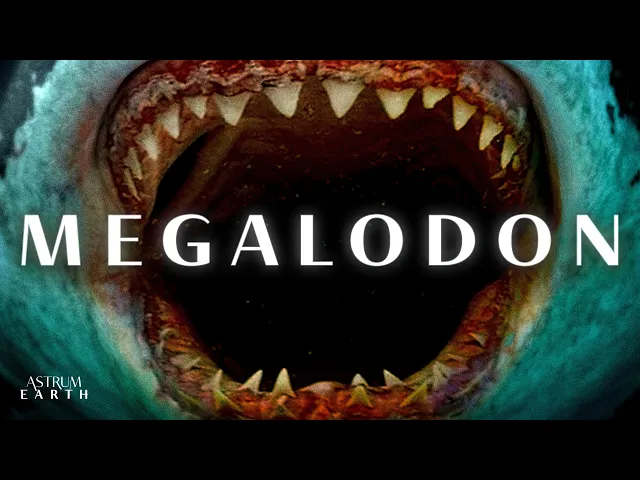
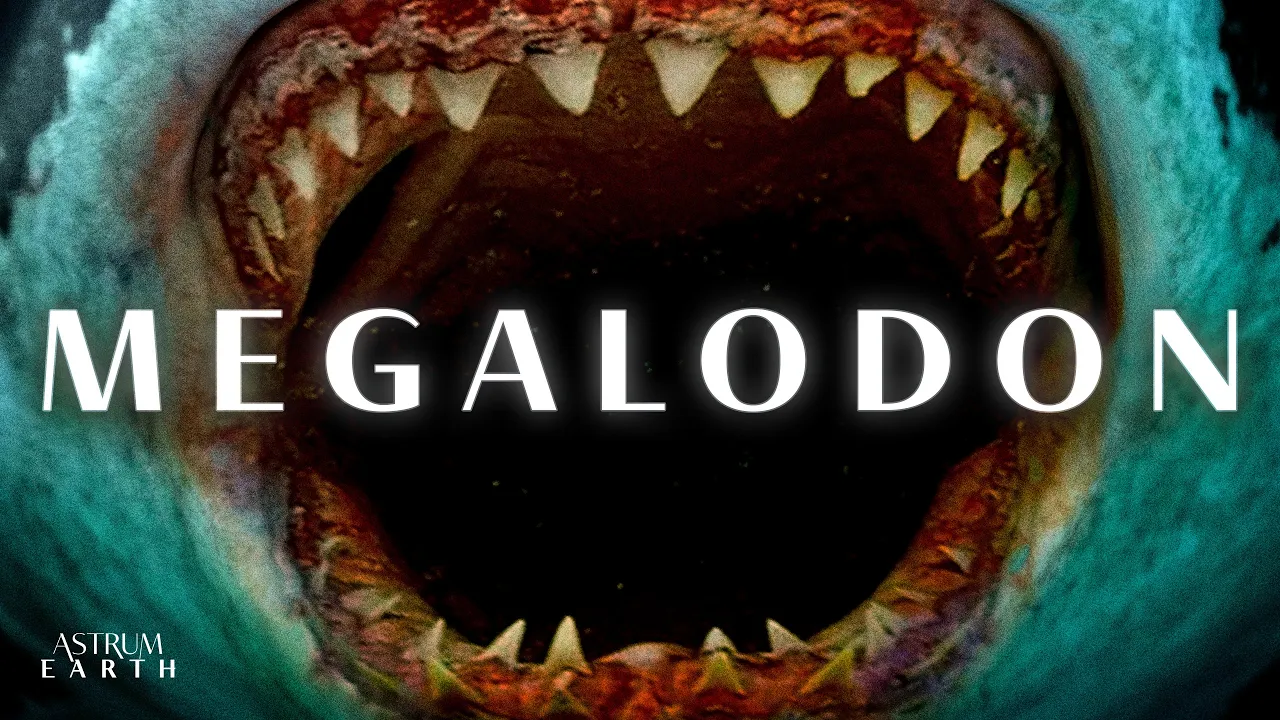
Everything you think [music] you know about megalodon is wrong. New 2025 research reveals it wasn't just a giant great white. It was something far bigger.
For nearly 19 million years, this apex predator ruled the oceans. The largest shark to ever exist. Bigger even than a T-Rex.
With jaws so massive it could crush a whale in a single bite. And then one day it just vanished, leaving behind only teeth the size of your hands and questions big enough to fill an ocean. What happened to this nightmare of the deep?
Could it still be out there lurking? Because more terrifying than the idea of Megalodon surviving somewhere in the abyss, is the possibility that we never truly understood it at all. But new evidence is suggesting we were very, very wrong.
Could Megalodon not just have been faster, but far bigger than we thought? I'm James Stewart, and you're watching Astram Earth. Join me on this journey back to a time when Megalodon was at its peak.
We'll uncover the truth about this colossal predator and find out how and why scientists got things so wrong. Imagining our oceans patrolled by something three times the size of a great white shark with jaws easily big enough to swallow two people side by side is irresistible. But is [music] it real?
To find out, we need to go back to a fateful day in 1666 when two fishermen caught a giant shark off the coast of Levono in Italy. The locals were so shocked by their discovery that the Duke at the time ordered that this curiosity be sent to Neil's Steinson, better known as Stino, a Danish anatomist working in Florence. Curiously, it wasn't the size of the shark that most interested Stino, but rather its teeth.
He was struck by how much they resembled tongue stones, triangular pieces of rock that since ancient times, many thought to be petrified snake or dragon tongues. Instead, Steno postulated that they were the remains of ancient sharks in rock. He argued that rock layers formed slowly over time and that an object like the teeth could give us a snapshot of a particular moment in history.
The significance of this observation would change the course of paleontology forever. He had discovered what fossils really were. This was a revolutionary idea.
And whilst great for the future of paleontology, what's the link to megalodon? Well, because sharks don't have bones, their teeth are often the only part that survives, making them our best clues. And Megalodon had a lot of teeth, 276 to be exact, some of which were up to 18 [music] cm long.
Like modern sharks, Megalodon's teeth were being constantly replaced. They were arranged so [music] that every time a tooth fell out, one in the row behind would push forward. One megalodon could get through 40,000 teeth in its lifetime.
In other words, over Megalodon's 19 million-year existence, the sea floor became absolutely littered with old nashes. And each one stood a chance of becoming a fossil. And those fossilized teeth hold the key to nearly everything we know about this enormous shark.
We even named it for them. The word megalodon itself simply means big tooth. So, in order to determine what Megalodon was, biologically speaking, paleontologists have long tried to use these massive teeth to [music] identify its closest living relatives.
Megalodon was first formally described in 1835 by Swissborn American naturist, geologist, and teacher Louie Agassiz, who named the species Cararadon Megalodon. It was placed here in the genus of sharks within the lamniday family almost entirely because its large triangular serrated teeth were pretty similar to that of modern-day great whites known as carcarodon carcarius. A skeletal reconstruction led by Mike Godfrieded in 1996 backed this up.
He gave Megalodon the look of the stockier [music] great white we know and fear today. extrapolating megalodon size from the dimensions of its teeth. Which is all pretty handy, isn't it?
Case closed. Giant great white shark incoming. Jason Staithm's delighted and the Megres wres havoc in Hollywood.
Well, not quite. In the early 2000s, distinct differences between the teeth and a closer look at the fossil record suggested something a bit more complicated. So during the mid 2000s, Kevin Nyberg and his colleagues conducted a series of morphometric analysis between megalodon and great white sharks.
They found no overlap in shape variants of the teeth, nor in the shape of their roots. In simple terms, the serrations of white shark teeth were irregular and triangular, whereas those of megalodon were finer and rounder. Essentially, it seemed very unlikely that the great white evolved from Megalodon as originally thought, but something else.
In 2019, Donna J. used this new evidence to officially allocate megalodon [music] within the extinct Otodontday family, aka the megatthed sharks. Other sharks in this family include Ottous obliquequis megalodon's earliest ancestor that lived during the eosene times about 60 to 37 12 million years ago.
So today we arrive at the middle ground of ootus megalodon the [music] scientific name megalodon now generally goes by although it should be noted not everyone agrees with this and some still prefer to use cararacles. There's a bit more dental drama in amongst all of that to [music] be honest. But I think that gives us a good overview of Megalodon's lineage.
But that's not the only thing scientists were mistaken about though. And something even more sinister was about to come to [music] light. Every depiction of this prehistoric shark you've seen in theaters, online, and in your nightmares is very likely wrong.
Because the largest shark to have ever lived was actually bigger than we first thought. Much bigger. For a long time, the estimates for how long Megalodon was were based purely on lots of fossilized teeth and the occasional very rare fossilized vertebrae.
No complete skeleton has ever been found. Now, from that evidence we had, we thought its body was between about 15 and 18 m in length at most until now. Because this year in 2025, a group of 28 international scientists led by paleobiologist Dr Kenshu Shimada reshaped how the world thinks about this prehistoric giant.
Central to this reimagining is one particularly rare set of vertebrae discovered in Belgium and now safely cataloged in the Royal Belgian Institute of Natural Sciences Conservatories in Brussels. It measures a whopping 11 m in length, but that only represents the trunk of the shark. Its head and tail are still missing.
So to try and fill in the gaps, Shimada's team compared it to the bodies of 165 other living and extinct shark species. This enabled them to extrapolate the animal's true size, and they found that Megalodon's head likely made up about 16. 6% of it, while its tail accounted for around 32.
6%. Applying this to the Belgian vertebrae specimen, the shark's total length would have been roughly 16. 4 4 m with a 1.
8 m head and a 3. 6 m tail, which was pretty much in line with what the current estimates were. But here's where things get really interesting because there's another even larger fossilized vertebrae from Denmark, 23 cm wide.
Now, that suggests that some individuals may have been even larger than that 16. 4 4 m. Perhaps even reaching an astonishing 24.
3 m, nearly 10 m larger than we previously thought, rivaling the size of a blue whale and weighing in at a mindblowing 94 tons. But the revelations don't stop there. Not only were megalodons bigger than we previously thought, they also looked vastly different, too.
Whilst reviewing a paper from August 2022 in which scientists built a digital 3D model of Megalodon, Shimada and his team realized that some of the maths behind the sharks proportions didn't seem to add up. Using the same 145 species of living sharks and 20 ext, they built a database logging the proportions of their heads, bodies, and tails. The researchers then compared them to the parts of Megalodon's body that have been found, and what they found changed everything.
Megalodon was not a stout tankike great white shark at all, but rather a more streamlined fish with a much shorter nose when compared with the great white. It had a flatter, almost squashed jaw equipped with extra-l long pectoral fins to support its weight and size. It was more like a lemon shock.
The same study also revealed something deeply disturbing. Fossilized vertebrae suggested that baby megalodons were born huge, measuring between 3. 6 and 3.
9 m long. But that's not the gross part because like modern-day great whites, they also likely practiced a form of inutro cannibalism where embryos ate unfertilized eggs to fuel their early development. Survival of the fit is personified.
We've seen what happens when we lose large predators. The damage to ocean ecosystems is catastrophic. And sadly, human activity today doesn't help that with things like over fishing and bottom trolling.
But that's where our friends at Planet Wild come in. They're a community-based nature protection organization fighting back. Think of them like crowdfunding, but for nature.
Each month, their community funds a project to restore nature around the world and then documents it with a YouTube video report so you can see the impact of your contribution. It's actually their transparency that inspired us to become members in the first place. They had this amazing project recently where an underwater sculpture museum had been created to help combat bottom trolling in the Mediterranean and of course restore the surrounding ocean.
And there's loads more projects just like that. Actually, I'm so passionate about what they do, I'm going to put my money where my mouth is here. The first 100 people to sign up to Planet Wild using my code Astramm 12 will get their first month paid for by me.
Yep, just scan the QR code on the screen right now or click the link in the video description. And the best part, you'll immediately have an impact and see the results in less than 30 days. As we head back to the video, all of those revelations about Megalodon's shape also led to Shimada's team stumbling upon a larger pattern in marine biology.
This new, more streamline, more menacing shape makes sense as to why Megalodon was able to grow to the whopping 24. 3 [music] m his team had estimated. Stocky bodies like that of the previous iterations of megalodon create far more drag, making it much harder to move efficiently through the water.
These constraints are why our current modern-day great white sharks tend to cap out at around 7 m. Any bigger and they would lose the speed that makes them such dominant predators. The same logic applies to other animals such as blue whales.
They can grow up to 30 meters long, owing to their sleeker, more hydrodnamic shape, [music] allowing them to traverse hundreds of thousands of miles of ocean. Megalodon's new lightweight frame may also go some way to explain why it was able to pop up all around the globe, too. The species was so widespread that megalodon teeth have been found on every continent except [music] Antarctica.
Based on what we've just discussed, it seems very much like Megalodon was superior to the great white shark in every single way. Not only unrelated, but more refined, fitter, bigger, better. It makes the fearsome great whites we have today feel pretty feeble.
But don't write off the great white shark just yet, because it has one last card up its sleeve. One that's about to deal a fatal blow. So, now we finally know what this creature was.
How did something so dominant, so powerful, just disappear? What went wrong for Megalodon? How did the ocean's most fearsome predator just vanish from history?
We know when Megalodon went extinct because we've only ever found teeth that are roughly between 20 million and 3. 6 million years old. But why Megalodon went extinct is not as straightforward.
It had [music] spent millions of years flourishing in the nutrient-rich waters of the Meioene epoch, and it certainly had a good run. But all good things come to an end. One theory that has popped up time and time again is that as the planet got closer to the ice age, it brought about colder water temperatures and it simply became too cold for the giant shark to cope.
However, data from scientists Catalina Pimeento and Hberto G. Feron seem to suggest otherwise. When analyzing Megalodon's global distribution through time, Pimento found that Megalodon was capable of inhabiting colder latitudes and its distribution through time did not correlate with any warming or cooling temperature trends we know of.
These findings fit nicely into the work of Ference, who has theorized that Megalodon was likely a mistherm, a type of warm-blooded animal that keeps its body temperature somewhat warmer than the surrounding water and therefore able to cope quite well with a wide range of temperatures. So, if the planet itself couldn't see Megalodon off, then what did? Pimeento's research showed that Megalodon's global abundance and distribution peaked in the middle meioene roughly 11.
6 to 16 million years ago before going into [music] decline. Now, interestingly, this correlates with a huge loss of whales, dolphins, and porpuses, i. e.
megalodon's favorite foods. Extinction [music] rates of marine megapora, the largest genus or species of a particular group of animals, were incredibly high in the pioene. Among those lost included 55% of large marine mammals, 43% of sea turtles, and 9% of sharks with a total of 36% of large marine species [music] going extinct.
Changes in sea level may have also impacted megalodon indirectly. Fluctuations were common during the plyio [music] scene and could have spelt bad news for a giant shark if coastal habitats where there's a lot of food available were impacted. As all of that occurred, Megalodon was likely forced to compete harder for what remained [music] with guess who?
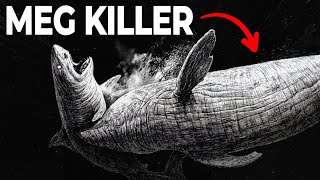
Jaws himself, the great white shark. After all that, Megalodon's size could well have been its undoing. The evolution of the great white, [music] a smaller creature that needed less to eat, meant megalodon never really stood a chance, a deep sea version of David versus [music] Goliath.
So, how is it that 3. 6 million years after it went extinct, there are numerous eyewitness accounts and documentaries suggesting it's still out there? Could Megalodon really be seeking refuge in the dark depths of the ocean?
Is it possible even that it's hiding in the Mariana Trench, waiting for the perfect time to reveal itself to the [music] world again? Well, for a brief moment, they almost had us. One of the best known fuelers of the Megalodon Alive Fire was a 2013 documentary which revolved around an investigation into the huge shark's continued [music] existence.
Watched by millions, it was, I must admit, quite compelling. It showed a blue whale carcass beed off the coast of Hawaii that looked to have been brutally attacked. A scientist in the program explained that the culprit had to be the size of a megalodon.
And other scenes claim to show 6-ft tall fins poking out of the ocean near similar blue whale attacks. Unfortunately, or fortunately, depending on your view, many people missed the disclaimer at the start of the show, which [music] stated the potential return of the species was not based on fact. As it transpired, the entire documentary was full of faked photos, [music] footage, and even actors hired to portray scientists.
There have, of course, been other unconfirmed sightings of living megalodons. In 1918, a fisherman off the eastern coast of Australia claimed [music] to have seen a shark 31 to 95 meters long making off with some lobster pots. And as recently [music] as 2022, NBC Boston led with the headline, "Two megalodon sightings off New England.
" [music] Spoiler alert, it was a basking shark. Another common argument for megalodon being out there somewhere points to the fact that some large animals such as the giant squid took [music] a while to be discovered by scientists. However, their remains have been washing up on shore and caught by fishermen for decades if not longer, giving us real hard evidence that [music] they existed before we had ever seen or recorded a full specimen.
By far and away the most common argument you'll see for megalodon survival is we've only explored [music] 5% of the oceans. Whilst that may be true thanks to science, we don't really need to explore all that much to know that a giant whale killing shark isn't in there. Megalodon was an apex predator and if they were still out there, orcas and great white sharks would never have taken up their mantle.
It's also no coincidence that from around the same time megalodon went extinct, the size of whales exploded. In the absence of large predators like megalodon, whales in the plea scene were twice the size of those in the plyene. [music] Hence the appearance of the blue whale.
But I've saved the best theory for last. Don't you worry, I hadn't forgotten. What if the megalodon is just hiding in the Mariana Trench?
Love this. A theory popularized of course by Jason Staithm's film The Meg. That story was actually based on the fact that Megalodon teeth were discovered near the trench by the HMS Challenger in 1873 and were considered new because they were unusually white, [music] dated to between 24,000 and 11,000 years old.
The reality though is much different. Instead, it's likely the fresh pearly whites were just uniquely [music] well preserved by a thick mineral crust of manganese dioxide that significantly reduced the decomposition rate. Megalodon teeth absolutely recent.
No way. There are other issues, too. If we've learned nothing else from this video, it's that Megalodon likes to eat and eat a lot.
We made a video on the Mariana Trench. Please do check it out on the channel. and we showed exactly what is there.
And the reality is there's not loads. Certainly not enough food to sufficiently feed a 24 m mega shark. Incidentally, snail fishes are the deepest dwelling fishes, but we don't find them until much deeper than 8,000 m.
Quite possibly for the same reason. They're just isn't enough to eat, and they're only 20 cm [music] long. So, there we have it.
Our journey back in time to the true land of the giants and one of the most gloriously monstrous beings ever to exist comes to an almost anticlimactic end. Something so mysterious and so powerful feels like it deserves to bow out amongst fireworks and explosions. But instead, the reality is rather meek.
Despite that, it doesn't make the megalodon any less intriguing. It seems fitting that something so elusive was able to keep a 19 millionyear-old secret. And that leaves me feeling [music] very satisfied indeed.
Actually, yes, Megalodon is most definitely extinct. But it's mystery still lives on. There's just one way to know for certain what Megalodon was.
And like any good murder mystery cliffhanger, they've still never found a body. So until then, giant lemon shark it is. Let me know you've got this far in the video by leaving a lemon emoji in the comments as a tribute to Megalodon's lemon shark makeover.
And I'll see you in the next one.