What if we lose a a fifth thruster is going through my mind. If we lose a fifth thruster, will I be able to control? I don't know.
I've never We never even dreamed up this scenario. I just know what I feel in my hands. And losing a fifth thruster, I don't know what's going to happen cuz this is the mindset.
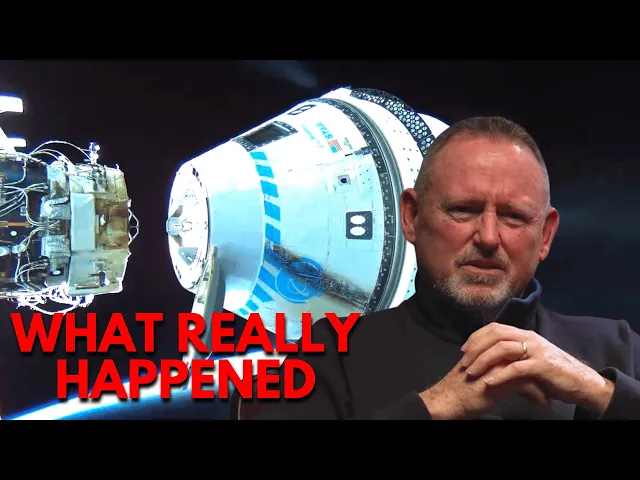
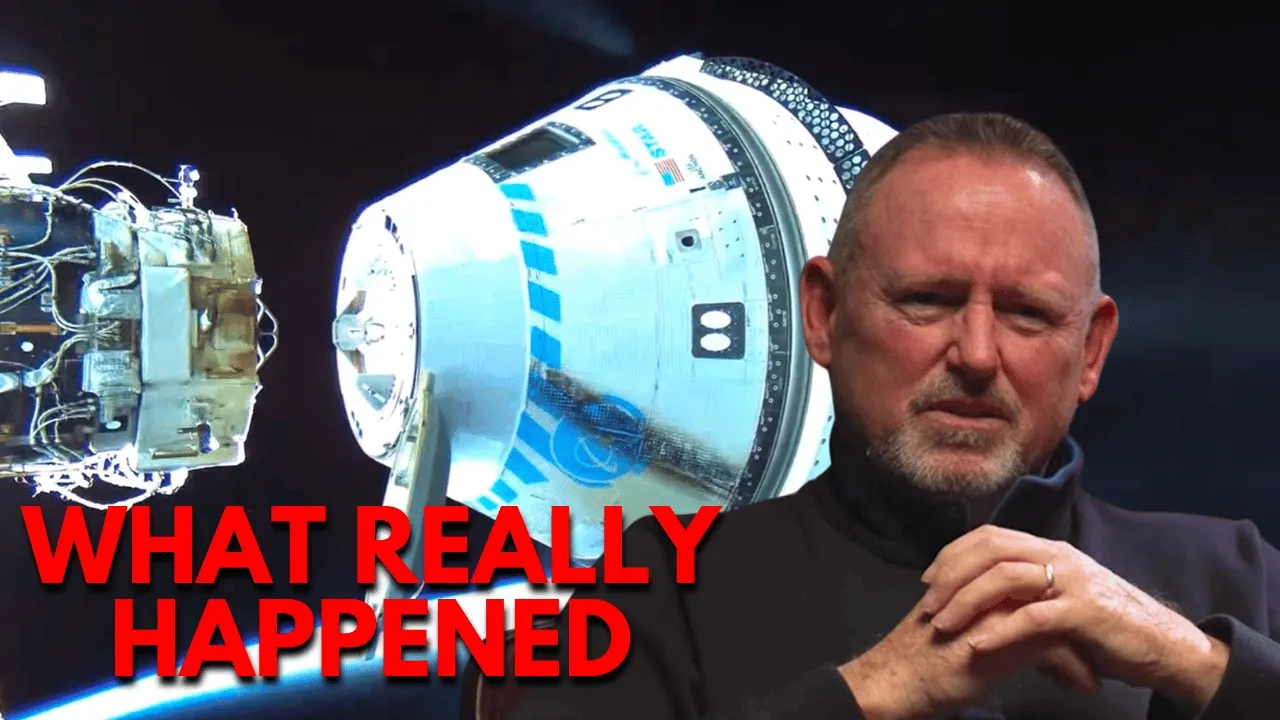
The way it's bred into us in aviation and certainly at NASA, we're always looking to the next worst failure. This is Butch Wilmore. And you guys remember when he was stuck in space for much longer than planned due to the Starlininer saga that I've covered many times on this channel.
He was recently featured in an over threehour interview on the Shaun Ryan show, but I wanted to watch this interview specifically to hear what he had to say about Starlininer. And still I'm learning new information about this crazy story. In fact, no surprise, Butch is even releasing a book about his experience piloting Starliner and making it home safely, although of course not on Starlininer.
But now he's had a lot of time to recover and reflect. He also talks about his reaction to hearing the original classification for the Starlininer flight and now the amended version which actually puts it in the correct category as pretty catastrophic a typea mishap. So he's asked first of all what was the point of the Starlininer mission.
Starliner. Great. Where do we start?
Oh my where do you want to start? I can explain what happened. Well, let's let's let's start with what was the point of the mission.
Starlininer was the sixth first crude spacecraft in the history of US space program. Mercury, Gemini, Apollo, Space Shuttle, SpaceX Drgon, Starlininer number six. It was the first crude flight.
I I was a commander and the only reason I was a commander because we talked about the test pilot stuff background. I had that background and for a first flight, it's a first flight. It's a test flight.
All space flights are test flight, but certainly the first one is significant in that you're trying out new capabilities. You're certifying capabilities. What you say see on paper, what you see in the engineering, how you put it all together, you're certifying it all works as and and goes as as designed.
and there were only two on board, Butch Wilmore and Sunonny Williams, making it a very small test flight crew compared with other missions. But he points out that they didn't want to risk more lives than necessary and so they only really needed two people. In this interview, Butch acknowledges multiple failures occurred during the mission.
He even talks about shortcomings in testing and assessment by not only NASA but also Boeing. When I got back, I was very open. I said, "We had some failures.
" It's obvious we did. You don't have this play out the way it played out and say nothing happened. We obviously had some failures.
We obviously didn't have sufficient assessment of some some of the spacecraft capabilities. It's obvious. I mean, I don't know why we wouldn't say that, but we we did.
And like I said earlier, we're going to find out why it happened. We're going to find out what happened and then we're going to put steps in place to rectify it. That's our pl that's our process.
That's what has to take place or we're not doing it right. He says the first day of flying Starlininer, it felt like a sports car. And mind you, this is someone who has the most experience in the most amount of vehicles.
He's flown in Soyos. He's flown Space Shuttle. He's flown Drgon.
and he said Starlininer was awesome and precise and smooth and like a sexy sports car until it wasn't. But Starlininer was a sports car. That's day one.
It was unreal. I mean it was we were over the Indian Ocean. One of my tasks was to see if I could point my velocity vector, the vector in which we're going in the same direction as the direction we were going.
Could I point it directly in line with how we were orbiting the planet without any other cues on the displays or anything? Just looking out the window and we were over the Indian Ocean, [clears throat] no moon, minimal stars because I'm looking down at the Earth. So that I can't hardly see the Earth.
I can only see very vague impressions of clouds that are going by. So we're traveling 17,500 miles an hour. That's five miles a second, right?
Boom. Second. We just went five miles.
So, you're orbiting the planet every 90 minutes. At this phase, we're over the middle of the Indian Ocean. No ground lights.
No lights on it. It's nighttime. No ground lights.
No moon. And I'm trying to orient the spacecraft to see if I can get it exactly in line. Because you think about it, if you lose your computers and our thermal, you know, our our solar array, basically how we gain our electrical power is on the back of the space shuttle.
I mean, it's the back of the star liner and I want to point that at the sun. If I've got no system, how am I going to ensure that I point it at the sun directly so I can maximize my ability to gain gain power if I got no system? What about if I lose communication and I don't have a system?
How do I point my antennas at the satellites out there so I can regain communication? How do I do that? These are part of the test that we were doing.
Part of this was how can I orient myself with my lick vector if I'm in a randoo scenario where I need to get away from the from the space station. I need to make sure that I'm in line with the velocity vector which the space station and we are going so I can make sure that I make the correct control inputs to make me leave the station and not run into it. So, this was we weren't at the station, but we're doing these tests in case we get in a scenario to make sure we can do these things.
I almost nailed it. I was a couple of degrees off, but with no visual, no light, no nothing, I almost nailed it exactly on line with that velocity vector just looking out the window. That's a sports car.
That's a sports car. So capable. So capable.
The first day might have gone well, but as we know, it is the second day when we started to see a lot of problems. And in fact, Butch was kind of wondering if they would ever even dock to the ISS. That's because the spacecraft relies on thrusters located in four doghouse clusters.
There's one on top, the bottom, the port, and the starboard. And these are on the service module to control attitude and translation in six degrees of freedom. But during the approach to the ISS, multiple thrusters were automatically disabled by the flight computer's fault detection system.
This is because their performance dropped below expected levels, making the spacecraft really sluggish and difficult to control. We had lost some thrusters on the service module in the previous uncrrewed test flights. We'd had two.
There was only supposed to be one, but we had two. We'd lost some on both of them. But the bad thing about the service module itself, you got the crew module on top where the crew is.
You got the service module on the bottom. You do your de-orbit burn, use the service module engines to do your derbit burn to slow down. You go from 25,000 ft per second to about 24,700.
So now you start to come back to Earth. Once you do your deal burn, you detach that service module and it burns up in the atmosphere. The only thing that comes back is the the module.
So, you don't get these thrusters back. The ones that failed on the first two uncrrewed missions, we don't get them back. We can't inspect them.
We just know they failed. You're down linking as much data as you can. You take the data, you do your best engineering assessment of what happened because you can't inspect the thruster.
So, we had failures on the previous two missions. So, we lose this thruster. I'm like, that's not good.
But fault tolerance. We build multiple fa layers of failures into our systems, our capabilities. So dual fault tolerance what most of our systems are.
I can lose two things in whatever the system is and still be able to affect whatever is I want to do. For control, we build dual fault tolerance. I lose this one thruster, I still have two fault tolerant.
I'm still dual fault tolerant. So not a big deal. Not good, but not a big deal.
We start to get closer. We get the velocity vector of the space station as it's orbiting the planet. We get right out in front of the space station which is part of the rendevous process and we lose a second thruster.
Now I'm thinking, okay, now we lost the level of fault tolerance. We went from dual fault tolerant to single fault tolerant and it was a bottom thruster still after firing and I'm thinking, oh this isn't good. This has happened and you got to realize what's going through my mind.
I've got thousands of iron simulator. I know the spacecraft is good or better than anybody in an integrated fashion. not as deep in certain areas as some others, but broadly and I'm thinking automation, we're under the automated sequences.
Does automation have something to do with this? Should I take over manual? How are we going to get these thrusters back if we need them?
How are we going to do that? All this going through my mind. I'm thinking maybe I should take over manual.
And the ground calls up, take over manual control. So I take over manual control. We're on the VB bar, the velocity vector of the space station.
260 m out and we'll lose a third thruster. Now we're zero fault tolerant to maintaining six degree of freedom control. This six degree we're zero fault tolerant now.
And the control even with three thrusters down is not what it was the day prior. Nowhere near. It's sluggish.
So Butch was fully focused on flying. He continued flying toward the station, evaluating whether he could even maintain control. He planned to stop at 10 mters from the ISS to determine if docking was still safe given the degraded thruster capability.
When we did our test after the fact, there's a piston basically. I'll just try to do it just very basic. There's a piston that keeps the propellant and the oxidizer from entering the combustion chamber.
These are hypergolic fuels, meaning there's no ignition source. These two chemicals meet, boom, they fire. So there's a piston in there and [snorts] the piston will pull back, let some fluid through.
It gets in the combustion chamber and the fire takes place. The thrust occurs and then it closes. Right?
There's a teflon seal on the end of that piston that we surmise was deforming due because it got it got overheated. So it's it's not the same shape. It actually deforms and and when it pulls back, it's not allowing sufficient fluid to flow into the combustion chamber.
It's restricting it some. So, we're getting less thrust, reduced thrust in these thrusters. Oh, good.
So, we surmise that's what's happening. When the thrust level goes with certain below a certain level, the computer goes, "Huh, you're not operating right. Let me take you out of the out of the mix.
" It's called fitter, flight, uh, fault detection indication response. Fitter. So, fitter says, "Nope, you're not working.
You go below that level, you're you're out. You're done. " So, fitter is what's taking these thrusters out.
We don't we don't know why. Have no idea in the real time. I just know that control is not what it was a day prior.
It's challenging. I can't prove this, but I would have to say that other thrusters were reduced in their cap in their thrust level because of what the control was like, but not low enough to fail. So, we've got eight air firing thrusters.
I would say they were all reduced thrust. Just to give an example audibly what we were hearing, you could hear day prior that day as the piston would move. You know, sound doesn't travel in a vacuum.
It has to have air for sound to travel, but it sat travel through the structure of the service module into the air that's in the crew module. And we could hear the thrusters fire, meaning you could hear that piston move. Mhm.
And the day prior and every and up until this point, we could hear. Now what we're hearing is like a machine gun. [clears throat] Oh man.
I know that probably looks funny on camera, but that's the way it sounded. Yeah. We're hearing machine guns fire, which we hadn't heard before.
So the spacecraft is laboring. We're down three thrusters. We're zero fault tolerant now to maintaining six off control.
I'm on the controls manual trying to maintain control. And then we lose the fourth thruster. We're already in the process with the ground to get the thrusters back to try to work a plan to come back with the thrusters.
But now we've lost four. We're past six do. I don't have six off control.
We went past zero fault tolerant. Now we lost six degree of freedom control. That's not good.
That's way not good. And the control in my hands was very challenging. I'm at I'm to the point now of I mentioned orbital mechanics, how spacecraft fly in proximity to each other.
Now we're in that that area of what if I if I make this control input, what's that going to do with respect to orbital mechanics and my ability to maintain position? I have to maintain my my distance. I have to maintain my attitude because we have sensors on the spacecraft that see the space station.
cameras, infrared systems, radar. They're seeing the space station and they're building a digital picture. That's how how you can rendevibu and dock manually because the system builds a visual picture comes in using this this visual picture.
It's built based on these these sensors and it can and affects the docking. Mission control then commanded test firings of the failed thrusters and the crew successfully recovered several of them, restoring enough redundancy to proceed with docking. At one point, the spacecraft entered a scenario seen in simulators where automatic, manual, and backup control modes all failed, leaving no clear flight mode available.
Even before docking, Butch believed the chances of returning to Earth in Starlininer were very slim. He was right. Anticipating that the spacecraft might not be certified for for their return trip.
Apparently Boeing knew about a small helium leak in one of the eight manifolds before launch, but engineers assessed the issue and decided it was acceptable to proceed. And this is of course, you know, a typical risk trade in space flight. And so, as I mentioned, we get his reaction about the recent bombshell that Jared Isaacman dropped about, yes, in fact, this mission being classified now as a type A mishap and Butch said it should always have been classified as that.
And now it sits in the same severity category used for major accidents like Challenger in Colombia due to the loss of control risk. Initially they called it a low high visibility close call and um I was veheminently against it. How can this be?
And I'm going to share this thought. I mean this is this is part of the process is not right. Um the this classification is based on the NASA proc procedural requirements document NPR and in the NPR it talks about controllability of the spacecraft as part of the assessment of is it a close high visibility close call or is it a type A mishap.
mishap classification gives a completely different avenue of of of assessment and they gave it a and it was it was a long time before they gave it this high v visibility close call and from the beginning I was like this is a mishap of course it's a mishap and they gave it this and I'm like if if if the NPR if the NPR says it's has to do with controllability of the spacecraft Who controlled the spacecraft? That would be me. Don't you think you'd you'd ask the guy that was controlling the spacecraft about the controllability of the spacecraft if you're trying to make an assessment of classification?
You you'd talk to that guy, right? Wouldn't you? I would.
Yeah. This is this is part of the sadness of processes and culture and all that that they didn't Wow. And I even voiced that up the chain.
I'm like, "How do you how do you make this call without talking to me? " I mean, I'm not that I'm special, but I'm I'm the guy that was on the controls. How do you make that assessment?
Um, what was the answer? It was the wrong answer because that's what's happened now. They changed it.
It is now a type A mishap. So, one thing that Butch credits a lot in this interview is divine intervention. This is a man of tremendous faith.
And it sounds like this really helped him stay calm and cool during the situation and helped him survive and come home safely to his family as well as Sunny. And that led to 9 and 1/2 months of extra time and space. 286 days stranded.
You packed for eight? We did. I wore the same shirt for two months.
I mean, what [laughter] the what the what do you I mean, it was okay. I mean, there's so many questions. I mean, you pack for eight, you're there for 286 days.
What do you even eat? You know, the Lord's provision. I'm telling you, it's everywhere in this story.
I keep saying it, but it's true. I got up there. There were four and a half bags of food that had been, I say, trashed, set aside.
crews before us didn't want it. So, they put the food in these bags and eventually they will go into cargo air, you know, spacecraft that don't return to Earth. They burn up in the atmosphere.
It's just put away as trash because we got new food, right? So, these bags of food were there. They had me parse it out into the different uh categories, you know, meats, vegetables, whatever.
And that's really basically what I ate for the first four months. I'm still so blown away by this story and I'm I'm glad that we got such a long interview with him on the Shaun Ryan show. I will put the link to this interview in the description of this video as well as a link to the book that Butch will be releasing because you know it's going to be interesting.
So, thank you again for watching this episode. This is just a reaction video. There's a lot of other really interesting things that Butch talks about this in this interview, but I wanted to focus on Starlininer because again, this is like the story that just keeps on giving, the gift that keeps on giving.
Uh, but you know, not a gift. It's like we keep getting details that just blow my mind. And so, it was nice to hear some real emotion from Butch about it.
I think that the initial interviews when he came home, you know, he was still kind of going through a lot, maybe didn't feel fully like himself and now he has, you know, all this time um to reflect and think about the fact that this could have gone much different. So, thanks for watching this video. If you liked it, please subscribe to my channel.
It's free. And I'll see you in the next one.