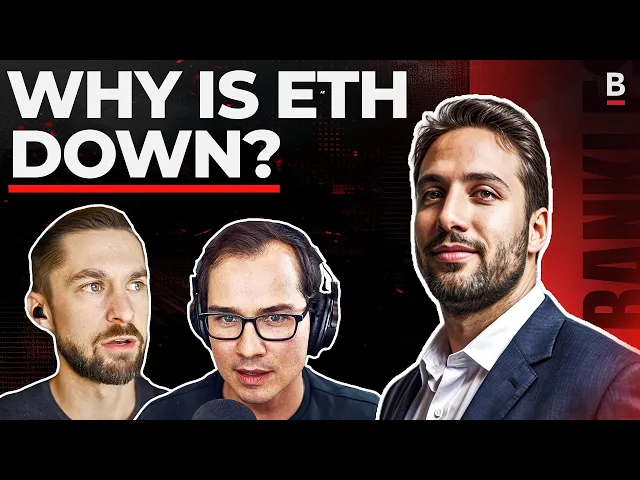
Kyle let's I want to give you a simulation all of your bags magically turn into eth the only thing that you hold now is eth that's called a nightmare not a dream what do you do next welcome to Bist we explor the frontier of Internet money and internet finance and today on the show we are exploring the frontier of why the eth price action has sucked so bad for at Least a year it's bad yeah just to put some numbers on it soul eth is up 300% year-over-year eth BTC is down 50% over the last
two years losing half of its market cap valuation versus Bitcoin in the last two years and we went on a quest to answer the question why and so we were looking around me and Ryan were like all right who's the right guest to help answer this question and a light bulb just came to one of us and turns out it's Kyle Sani to answer this Question you know e holders are in shambles when we go to Kyle to answer this question this episode bankl station is intended to be more of a listening episode Ryan and
I are here to kind of just sit back and hear Kyle's perspective and to reasoning as to why eth is underperforming to see what what there is to learn right now the current valuation around the price action of salana suggests that Kyle and the salana Investment thesis has been more correct than what earlier years of banlists would have suggested and we want to discover why I said this at the end of the episode and I think I want to say it again uh I think this is probably going to be a frustrating episode for eth
Bulls in uh several different ways and I think that's good medicine for you I mean listen to The Counter case this is why we are doing this episode I don't think it's the end of the conversation So I think there can be future debates maybe with Kyle perhaps the community could set suggest someone else to uh enumerate Kyle's points and have a follow-up episode on the counter side so I don't think this is the end of the conversation also an investment disclaimer from multi-coin that they need us to say Although our guest this week is
a managing partner of a registered investment adviser nothing in this podcast should be considered an Offer of multicoin investment advisory services or should otherwise be confused for investment tax legal or financial advice they wanted us to say that all right guys let's get right to the episode with Kyle Sani but before we do we want to thank the sponsors that made it possible including our recommended exchange Kraken go create an account if you want a crypto trading experience backed by worldclass security and awardwinning support teams then head Over to Kraken one of the longest standing
and most secure crypto Platforms in the world Kraken is on a journey to build a more accessible inclusive and fair Financial system making it simple and secure for everyone everywhere to trade crypto kraken's intuitive trading tools are designed to grow with you empowering you to make your first or your H hundredth trade in just a few clicks and there's an award-winning client support team Available 24/7 to help you along the way along with a whole range of educational guides articles and videos with with products and features like Kraken Pro and Kraken nft Marketplace and a
Seamless app to bring it all together it's really the perfect place to get your complete crypto experience so check out the simple secure and Powerful way for everyone to trade crypto whether you're a complete beginner or a seasoned Pro go to kraken.com slbank lists to see What crypto can be not investment advice cpto trading involves risk of loss the Unis swap extension is here the self- custody wallet created by the most trusted team in Def Unis swap Labs designed to make swapping feel effortless this extension lives in your browser's sidebar letting you swap sign transactions
and send or receive crypto without ever losing your place on the internet plus with human readable transaction messages you'll always know Exactly what you're signing navigate a multi-chain world effortlessly with support for 11 chains like ethereum main net base arbitrum and optimism no more chain switching or token importing all your assets are right where you need them to be the Unis swap extension is designed to level up your swapping experience with other Unis swap Labs products as well easily on board to the extension using the uniswap mobile wallet to begin managing your asset ACC Across
platforms and take advantage of smooth seamless synergies with the Unis swap web app so go and download the Unis swap extension today by clicking the link in the show notes just another way Unis swap is helping you swap smarter arbitrum is the leading ethereum scaling solution that is home to hundreds of decentralized applications arbitrum technology allows you to interact with ethereum at scale with low fees and faster transactions arbitrum has the Leading defi ecosystem strong infrastructure options flourishing nfts and is quickly becoming the web 3 gaming Hub explore the ecosystem at portal. arbitrum doio are
you looking to permissionless launch your own arbitrum orbit chain arbitrum orbit allows anyone to utilize arbitrum secure scaling technology to build your own orbit chain giving you access to interoperable customizable permissions with dedicated throughput whether you a developer an Enterprise or user arbitr from orbit lets you take your project to new heights all of these Technologies leverage the security and decentralization of ethereum experience web 3 development the way it was always meant to be secure fast cheap and friction free visit arbitrum doio and get your journey started in one of the largest ethereum communities bankless
Nation happy to introduce you to Kyle Sani the managing partner and co-founder Of multicoin capital Kyle and multicoin have been one of the largest investors in and proponents of salana have been in spearheading the integrated blockchain investment thesis even before the success of salana completely redefined that corner of crypto Kyle welcome to bankas hey guys good to be on the show it's fun to be here David that was really nice of you to call it in blockchain rather than monolithic blockchain I I know that this is the Word that Kyle prefers thank thank you very
much I feel very welcome at home yeah well done so KY kind of set the stage here soul eth is up 300% year over year meanwhile eth BTC is down 50% over the last two years like the Bitcoin eth ratio I think is on its like 700th day down in a row I mean has had some depth days but really the trend is the trend is strongly downwards uh and so talking about like ethereum first we'll bring in the conversation of Just like how salana has impacted the ethereum valuation but I want to start perhaps
with like ethereum just like in a vacuum when you see the weaker price performance of ether compared to it's like approximate competitors what's like the first thing that comes to mind as to like to explain this price action that is been in a trend for like over a year now yeah I think probably the most important variable is is what I'm going to call gravity um making a large asset Go up is hard um and ether is today what call 300 billion is plus or minus there are not that many Assets in the world worth
300 billion you know like I don't know like if you exclude Commodities but like just look at like equities there's like 20 maybe 40 there's just not that many um and law of large numbers is a thing and like most companies or you know things as they get to that size it just gets harder to to sustain Revenue growth and and profit growth at at Large Scale I've got a data point for you guys so it's actually number four you ever go to that um like total crypto or sorry number 34 you ever go to
that uh total um assets largest Assets in the world kind of web page it's on like companies market cap so it's number 34 in the world whereas uh um Bitcoin is number 10 there's only 33 assets that are larger than you know what what is the eum right now 320 billion yeah right for I think Visa's 400 or 500 right so it's kind of Like in the same general ballpark something like that so like I think that's actually the thing that eth people probably don't appreciate it's just like it's just hard uh to grow at
at that size um obviously there are exceptions Nvidia like is is the most recent high-profile exception the went from like 200 billion to two trillion like real fast um but like you're Fighting Gravity and that's kind of one part of it is I'll call it the gravity Is just a function of size or law of large numbers uh and then the other part of it is a tweet that I put out maybe a couple weeks ago uh which is like the higher your market cap by definition the higher the markets expectations of you to produce
incremental performance in the future um or very very simply like someone who makes 200,000 or makes $500,000 a year you expect them to be more economically productive than someone makes $50,000 a year like Obviously um and the same is true of of market caps of companies or of equities or of tokens um you should have hold it to a higher standard and so um it's just hard to to you know I I think given Etha call it 300 billion which is pretty exceptional it's number 34 in the world as Ryan just said and then you
you know if you're at that scale you want to really have a pretty clear understanding of what the risks are at to support an asset of that scale and in my opinion Like eth is a fundamentally open question about is Da and settlement valuable or or is consens as and execution valuable I've OB been very clear about my My Views there we can dive into that um but like from my vantage point being a $300 billion asset and like not having Clarity around your basic mechanism of value capture to me is is very tenuous and
and I think that's really weighed on on eth for the last year or two just to P put a pin in that first conversation about gravity that's that's not anything exclusive to ethereum you're just saying anything of that size is going to experience difficulty passing some sort of like you know 300 500 billion dollar level no matter like it's not exclusive to ethereum it just happens to be that is in this like Valley that like all assets that will eventually have to like go through this trial of like trying to figure out how to get
to the first T Level yes that I want think about it as a valley is just like it's harder to grow from a base of 300 than from a base of 50 mathematically that must be true the only actually weird exception to that is is Bitcoin um because bitcoin's whole thing is like oh store value medium like and so weirdly it's like the special snowflake again I have my my views of Bitcoin which I think Bitcoin is nonsense but that's that's a whole separate thing but like if you subscribe To bitcoin's value proposition then it
is actually the only thing that is exempt from the the kind of not perfectly exempt but I'd say at least partially exempt from the the gravity Theory all right so Kyle this is why I want to dig in here so um yes uh it is an exception to the rule but I will say that that this is kind of the expectation of the average eth holder bull case uh like proponent including probably like David myself which is like Um Bitcoin is number 10 in the world right ethereum's number 34 and its market cap at the
time of recording is like 1.2 trillion with a t It reversed gravity or entropy or whatever external force is on the world with large market cap assets and it got to the trillions and the Bitcoin bull says it's actually on track to surpass the number one asset on this chart in the world which is gold at a$ 16.7 trillion market cap and so it's on that trajectory and I think a Lot of eth bulls have been wealth Bitcoin you know can uh achieve these Heights then why not ethereum because ether is like Bitcoin except better
except more programmable I guess maybe this gets into your take on whether Bitcoin is actually worth 1.2 trillion but I'll just open up that question and uh get you to respond why is this possible for Bitcoin and not ethereum yeah so so the entire value opposition of Bitcoin is that it is a special Snowflake it's you know sound money um it's the first one it's simple it doesn't do anything risk of breaking is low proof of work is like objective whereas proof of stake is fundamentally subjective you can like slice this cat in a bunch
of ways but like the there's the net of all of them is Bitcoin is special and even like among crypto people it is generally taken for granted that Bitcoin is special I reject that premise I don't think Bitcoin is special But like I understand that I am the weird one and that everyone else in the world thinks Bitcoin is special so I I for now I'm like not interested in trying to convince the world that Bitcoin is not special I will take on that fight at some point but that time is not today but like
look for now I'm under I understand that everyone else thinks Bitcoin is special so like fine whatever that that is what it is like don't hate the play or hate the game That that's the game everyone think like cool fine it is what it is ethereum and salana are obviously not Bitcoin um and like they are not special in in in the way that Bitcoin is um like very definitively and ethereum and salana are explicitly discussed as like functional things and we're talking about finance and we're going to reshape Global finance and democratization of access
and like all these other fun you know asset insurance and tokens and all these Things so like they the fundamental lens through which you talk about ethereum and salana um is like they are changing Finance like the rails of finance and the rails of of payments and so naturally uh well if you look at like Black Rock Visa stripe there's all these obvious companies that are like relevant in in the discourse of you know those two major parts of of the economy and so uh it's quite reasonable to think of Ethereum and salana as tech
stocks or as growth assets that are competing against in weird different ways the list of names I described as well as some others and so I think it is fundamentally correct to think of ethereum and salana as equities not in the literal sense of like the C Corp and the CEO and the comp structure and all that stuff but in terms of like they have a function they like they have a product there's needs that users have in the world they serve Those needs and like they produce cash flows as a result of that um
and so I think of ethereum and salana as equities in in that kind of sense yeah one framing that David and I have used in P for this is just like you have the difference between capital assets which uh produce cash flow so these are things like equities or maybe you have property and like kind of rental income and so that asset is a productive asset it's a capital asset right and then you have Other types of assets like uh Commodities and these are consumption type Goods so these are generally used in the course of
making another product and then uh you have finally store value uh types of assets and these are things that are the special snowflakes of the world so gold is a special snowflake uh you might say because it doesn't you know throw off any cash it's not a capital asset it's not really used that much when it comes to um you know uh Commodity types of ingredients to build other products uh and it's mainly valuable because people think it's valuable I I actually want to just double click on that really quick like I I don't know
how much this will come up again in the course of the rest of this this episode but I think it's it's worth asking because you are a bear at Bitcoin it sounds like at a 1. uh2 trillion market cap I assume you'd be a bear uh of Bitcoin sorry at uh like a 10 Trillion doll market cap as well like you'd be even more bearish but like then my question to you Kyle is like um isn't it enough to have the narrative and the story for an asset like Bitcoin if enough people believe that it
is a special Snowflake and if the crypto World believes it's a special and if Larry think starts believing it's special and if the the the new incoming president of the United States starts believing it's Special and puts it on uh the US Treasury balance sheet like in a permanent way and starts purchasing it if enough people think an asset is special then it actually becomes special and this is like a reflexive Loop that like it's pretty hard to deny isn't it like if is it this explanation that would account for the like one .22 trillion
in Bitcoin right now and are you like disputing that kind of um I guess law that we've seen in uh asset Markets uh to date do do you think that there's something wrong with this to answer your question I I need to actually refute something you said as part of it which is talking about Commodities Capital assets and store value um Commodities are distinct we have oil we have wheat we have whatever all obviously inputs into the basic economy uh we have Capital assets things that just produce yield right and then you said store value
is separate and Distinct and I reject the premise that the third category should exist because I I don't I don't believe we should have a reason to have nonproductive assets uh with the one exception is is like cash because you need a denominator to like denominate things people need to know coffee is $2 and not four bushels of wheat or whatever it's actually useful to have an abstract concept that is a universal unit of account which happens to be what the government's tell us it Is and like I'm not here to fight the government but
I reject the premise that store value should be separate the the fundamental argument that like gold is valuable or Bitcoin is valuable is it the government can't print more of it and I'm like okay yes I understand but I think that's that's a silly way to think of store value because um there are plenty of assets that are naturally inflation resistant um and that produce yield um the most obvious of which in Just in the context of United States would be Walmart and Amazon um if the price of goods go up like they raise the
prices of the goods um and so like there like excluding AWS I'm talking just like the retail business and like it's not a perfect hedge in the sense that like they could become more competitive or less competitive against other retailers like sure but like you if you believe that you can buy a basket of retailers but like there are are very obvious Businesses um the most obviously are retailers that are intrinsically inflation resistant in like the scope of what they do um again not in exactly the same way that gold is or bit Bitcoin theoretically
is but in a way that is like very mechanical and tangible to how the businesses operate um and I I I think of like the theory that like gold or Bitcoin are inflation resistant is like strictly on a memetic basis and like yeah like the gold chart like has Some more reverse correlation with inflation than certainly than Bitcoin does it has Bitcoin has no effective anti-correlation with inflation over any long period of time gold arguably does but like I don't I cannot tell you why that must hold true um other then like hopefully we all
keep doing that same trade over and over again in the markets at many trillion dollar scale which I I I think will fall apart um so I reject the premise of the sov as a standalone C Again I understand other people you know believe it and like I don't really care you do it it's fine I just for my own balance sheet management don't believe that to be the case having said all that I own some Bitcoin and the F mcoin fund own some Bitcoin um which I can get it separately but I am intellectually
short Bitcoin on that premise I'm not mechanically financially short but I'm I'm an intellectually short Bitcoin um at 1.2 trillion I will continue to be Intellectually short Bitcoin at 10 trillion um if it there's something a little bit like Buffet like about that in that investment strategy which is like very value driven like I I think you're you're just like a uh a productive asset kind of guy like you understand value and that's just kind of like the frame of reference that you invest in and you kind of think that that can actually the productive
asset framework can actually swallow the store Of value framework correct yes absolutely and and by the way I I I wrote a blog post about this in 2018 I think it was called paths to 100 trillion or paths to tens of trillions or something I'll find the link and I'll send it to you guys but basically I that's the the store value thesis the utility thesis or the stable coin thesis of like how to get crypto assets to that to that kind of scale it'll be fun to Reflect on that from six years ago yeah
and I I think another way to to think about what you said is you still believe that like humans will want to store their value they'll just kind of spread it over those two other asset classes of like you know Capital assets and it'll kind of be built into the price of capital assets and also commodity assets and we don't need a distinct separate category of all of these assets that have this one function which is a store Of value like I I get that and I get that that's kind of like your world and
uh you know Kyle's way of thinking about it and it's also Warren Buffett's way thinking about it as well but it strikes me a little bit like it's almost like an uh kind of like an atheist like um going and telling all of the religious people like there is no God you just you have to convince them of that right and so like I think that because story value is such a mimetic uh human consensus type Of game it's like likely that we'll always have it uh this is maybe just how humans are hardwired like
would you accept that uh that idea even though you're not into it personally uh I guess this this plays out in your Fund in that you don't you don't intend to short the store value religion do you of of Bitcoin and you can understand why it goes up I mean I think at some point we will short Bitcoin in size definitely not in the foreseeable future but like On Long some the long enough Horizon I expect to have a massive Bitcoin short um but that's that's still pretty far away so I I just sent you
all the link to the utility hypothesis blog post so you should probably include it for the the podcast when it goes out it's 6 years old so I'm sure a lot of the terminology is going to read read pretty weird and stuff um because pretty old but I think it actually kind of captures the core of the belief which is that Crypto is funny in that like we have this weird path dependency that happened which is like Bitcoin came out and like it is kind of functionally incomplete um low transaction throughput no defi all these
other thing like proof of work doesn't give you fast finality so it's like very hard to build a functioning Financial system on top of Bitcoin and then the story became uh you know because of like size Wars like digital money hard gold doesn't change stable Like cool Bitcoin here special snowflake yay meanwhile there's an ethereum thing happened um like some number of years later and ethereum thing was like we can make Finance better um because it turns out that having heterogeneous Financial rails for payments of different sizes like whether it's a versus credit cards versus
wires and then obviously across all the various countries with different fxs and then they have all the asset markets Bond stocks equities Comm Commities all of those things that I just you know alluded to are all managed on separate rails like there are separate database servers with separate apis and it is really [ __ ] heterogeneous and is really confusing and there none of them are 247 and obviously you have time zones and so like when you need to move between them across time zones it like gets very slow and miserable and terrible and it
crypto like naturally is global and like the Apis are permissionless and you have this like core notion of ownership via cryptography um and it turns out that like when you have this cryptography thing with this permissionless consensus you just have an arbit and you have an arbitrary API to represent assets um whether those assets are Commodities bonds stocks equities fake tokens meme coins what it doesn't matter and it turns out that like it's just much simpler to have a Universal API for all assets right like it's just that by definition is is true um and
and so I I think the story of crypto when we look back 20 years from now will be this Bitcoin thing came out and we're like ah digital gold cool but really the story will be we built better Financial roils um and it will take 10 to 20 years to basically get the rest of the world to acknowledge we have better Financial rails um and to start moving assets over we can see just the Beginnings of that happening now with their black rock bid fund and Hamilton Lane and PayPal and you're starting to see this
in in you know little increments here and there and I think that that will that will be a a story you'll see over the next 20 years because crypto rails are just objectively way way way better than the traditional rails and so as more and more of that activity moves over to crypto and then we're also going to have Like maybe gaming crypto gaming was a thing I don't know I haven't really seen it yet but maybe dpin is definitely a thing and I think will continue to be a thing um and I think most
of that stuff is going to happen on ethereum and salana or maybe Aptos Oru or whatever else some defi smart contract thing and I think at some point it you know call it 5 years from now maybe 10 years from now U most people in the world will look at ethereum Su Aptos whatever and They'll say wow like this clearly runs the world in in in like a very literal sense like all of the world's assets and and and finances will be represented on these systems and then look at Bitcoin and Bitcoin will beat the
same thing it is today which is funny it's just this digital you know rock it sits under your bed doesn't do anything and they'll start to wonder they'll say you know these things have some common thread and that like the assets don't you know like Live in the dtcc and don't come from that World um and like we they use a lot of the same terminology cryptography permissionless consensus like hum like I don't know like why is Bitcoin special and it does nothing and it's worth two trillion five trillion 10 trillion whatever be worth at
that moment in time and Salon or ethereum is here it's worth 300 billion or 50 billion or whatever at some point I think people will say wait a minute Like one of these is a super set of the other and one of them is dumb and one of them is useful um and at some point that I think will become the consensus view I I don't think we're anywhere near that moment in time uh and that point you're going to short Bitcoin at that point not until yeah like I got to see how the discourse
evolves but I I do expect to put on a large Bitcoin short at at some point this part of the conversation that We just uh have gone through the last like 20 minutes actually wasn't uh an intended part of our agenda but I think it actually kind of does frame how you think and how you model things and I think will help illustrate um the the meta question that we're trying to answer here which is like according to this valuation framework and understanding of how crypto will evolve why is the eth price sucking eggs over
the last like two years uh there's like A a list of reasons as to ethereum shortcomings that I think might be relevant here and I'm just going to run through them maybe it's missing some which you can bring up Kyle maybe you think some are more important than others um pick one out of the six that I'm about to read and we'll pick we'll um we'll start with that one first whichever one comes to mind and and I think is the most interesting first and then we can pick through the rest as we So choose
afterwards um number one is ethereum layer 2s Force application developers to have to bet on the success of that layer two that they choose salana devs don't have to think about this at all they just build on salana number two devs don't care about blockchains they just care about speed and latency number three the salon of virtual machine over the ethereum virtual machine is just better to to build on the salon of virtual machine Number four layer tws are not ethereum and they do not benefit ethereum's value capture number five a lack of clarity on
what ethereum scaling plan actually is because 4844 is insufficient by several orders of magnitude and then number six broken layer to interoperability um there's perhaps more uh like I said but like which of these kind of like stands out to you the most which which you want to unpack first I I think the one that's probably most directly impacting price Is number six which is the interoperability problem um and and This and like the derivative or I should say the downstream impact of that is a lot of people use ethereum obviously and they hate bridging
and they hate paying the fees uh and they hate waiting and they're waiting for the thing to confirm to get over there and they have to you know every asset Ledger is distinct your binance asset Ledger is distinct from coinbase which is distinct from eel1 Which is distinct from arbitrum and bass which is distinct from salana these are all just asset ledgers um each of those systems keeps track of what you own and it turns out to really convenient that when you're on salana like everything just works um and then when you're on ethereum that's
just not the case obviously we have like lii and some other systems that like try and you know offer that um but like for anyone who understands how lifi or any of these Other bridge bridge aggregator things work like you are paying slippage for the privilege of doing that and like that's a shitty feeling um and so I think the lived experience of most crypto users today is interoperability sucks uh I don't like it and like on Salon I don't have to deal with it and I think that's probably the root cause of what's caused
a lot of people to rotate their eth position into their sole position is their lived experience using Both systems so an eth bull might respond to that and say yeah but Kyle ethereum is going to fix that in fact there's a there's a road map to fixing that they could name a number of different things on the road map they could talk about you know different layer twos creating their own you know super chain some consolidation in layer tws they could talk about uh shared sequencing they could talk about um based rollups you know vitalic
put out a Tweet and he said hey we're actually pretty close all we need is kind of the adoption of a few EIP uh type standards to just make the wallet experience smooth and for this to feel like the same ethereum chain how do you respond to that do you think ethereum will yeah this a there's a problem right now and I think most eth bus would concede but it won't be a problem in the future yeah few comments there one I don't think there is a solution to this problem um Because polygon and optimism
and starkware and arbit and all these guys they're all building their own little like interop standards within their own ecosystems uh which is obviously true uh there is none that I understand Works across all of them yeah none that I'm aware of uh and like even if like vitalic proposes one which by the way I'm not actually sure is possible given like how assets are stored in the underlying Bridge contracts between ZK Sy and starkware and Optimus and arbitrum I'm not sure it's like possible to like get to a point where interop between all of
them feels like salana um I I I could be wrong there but like it's it's just extremely difficult uh but even if that the proposal exists there's no guarantee that it's going to get implemented and manifest because you need all of those guys to agree to implement it and like there's no guarantee that they're going to agree um So like you have a fundamental like this is fundamentally a standards problem and it turn the problem with standards is you have to get everyone to agree to the standard and like there's actually very obvious incentives why
people will not agree to the same standard so I don't take it for granted that it's even doable even to the extent it is doable there's very obvious diverging economic incentives of why it won't get implemented um and then the third and Actually arguably maybe the most important is uh ethereum is 9 years old it just turned nine like a few ago and that's a long time for contact SpaceX like got the first rocket out in like six years I think like the successful one not I think the first three blew up but like the
fourth one which was successful was six was like six years maybe six and a half years on like a total of $100 million of capex or maybe $80 million of capex like again in that In that General range um because Elon only had 180 million and he was the only money in SpaceX at the time um and you know ethereum is 9 years old and there's like I don't know how many billions have gone into crypto R&D so so I I think there's like a a fundamental General sense of impatience of just like guys like
why is this taking so long like we've been here forever you know and then the second part of it is like it's not in production and like I think if You're a $300 billion do asset like don't tell me show me and like why should I you know it's like that's the bar that you have to operate at at when you have $300 billion in market cap behind you um so it's no longer just five researchers running around in London like you know Devcon zero kind of a thing you made some emphasis on the lived
experience of people uh and this uh broken L2 interop operability is like when when users come to touch the chain This is the thing that they like run into it's in their face it's like a choice that they are confronted with and so it's very much like you know it's the part of the iceberg that's like above the surface how much how important do you think that part is in like actually pricing like the eth Bitcoin ratio the eth salon ratio the eth dollar price when it comes to like actually being like the way like
users actually engage with These chains and like the frustration that they feel when they see like slippage and bridging frictions like how much of that actual like in your faceness about um about this experience on ethereum actually shows up in the price I think that is the largest input is dollars that are in crypto or I should say wealth that is in crypto that is using ethereum and is using salana and obviously in some sense 100% % of capital was ethereum and not Salana like if you go to like prior to the salana chain launching
and like that that ratio has like adjusted generally speaking in One Direction Over basically since the launch of salana and the I think very obvious reason that Capital has gone from 100 Z to call it like 8020 is is like roughly the split in in relative wealth is I think because of lived experience um I think I think it took a long a lot of people a long time to come To two conclusions one bother to use salana and like have enough stuff to do there are enough nfts enough assets enough stuff to play around
with that like it's even worth getting out of bed set up a wallet and go do it and again different people have different thresholds for experimentation at which they will bother to go do those things uh and then to realize like very definitively one is just a better experience than the other and then the Second is to then also look at the road map of ethereum and say well I can see why ethereum has all these advantag um but I I cannot understand how it's going to compete with salana in my basic lived experience and
I think there's been a just a general progression of different people coming to that realization at different points in time over the last call it four years and once again for Bitcoin it's just like different rules apply because I don't Know if any users are like using the actual Bitcoin chain or using Bitcoin wallets but it's just like it's not very pleasant but people are buying Bitcoin for other reasons correct Bitcoin is a special snowflake like I don't think it is like intellectually but like I understand why socially it is and again like I'm not
going to fight people on that today we can go into bcoin L2 thing I think they're interesting I think they will do Some stuff I don't understand how any Bitcoin L2 thing is going to compete with salana or even ethereum in their respective like long-term States okay so that was the broken L2 interop uh interoperability part of this conversation um I named five others I can rename them if you want but you know off the top of your head like which one you might want to be uh put as the second most impactful on this
whole like price lagger yeah I think the second Would be uh the the I think it was number three which is the da is value capture da and set as value capture versus consensus and execution um or maybe the way you framed it was like l2's capturing value instead of l1's or the parasitic thing um I have been very public and said on many occasions l2s are parasitic l1s I stand by that claim we all use software all day every day I mean if you're listening to this podcast you're obviously on an iPhone or on
your Computer or whatever you're using software um the lived experience of everyone who uses software all day every day is that the marginal cost of software is zero um and software is free and beautiful and accessible and like that is the economic revolution of software is marginal cost of software is zero and like we all this really understand that and then blockchains came around and we're like ah scarcity of throughput can't have marginally free Software we're going to have fee markets and like that was like very obviously had to be economically true especially in the
earliest days when like the scalability was absolutely with garbage Bitcoin is like four TPS or whatever and E like L1 was like seven or you whatever it was um and and so like it had to be true given the like extreme technical inefficiencies of the v1s of these systems today obviously we're by no means in some perfect theoretical uh you You know um state where like transaction costs are zero but very clearly transaction costs are going towards zero and like any the whole point of L2 is oh it's cheaper than L1 it's like getting close
to zero obviously um I believe transaction costs I model them as zero for the purposes of valuation obviously today they are mechanically not zero on salana Oru or Aptos or eth or whatever or LTS um but like for the purposes evaluation the intellectually Conservative approach is to model them as zero because that is the history of software and the lived experience of using software every day is that the marginal cost of software is zero um so I don't believe da under that pretense I don't believe execution is worth anything and I don't believe da is
worth anything and like yeah look maybe I'm like being a little hyperbolic and like the costs don't get to zero they're like ASM totically approaching zero but Like whatever do like you're close enough to zero that it doesn't matter just model it as zero for the purposes of of finances now if you're a market maker you need to manage a balance sheet of how much so you're paying for gas fine but like as a soul versus ethh holder and the valuation model for those assets model transaction cost is zero it's the conservative assumption the only
other fundamental input to valuation is Meev um and Mev is just a function of entropy in in financial markets uh and entropy will always exist in financial markets um and and the more assets you have and the more people trading assets the more entropy the more M that will always be true uh there's obviously ways to mitigate MV you can direct the value capture of MV to different places depending on system design and there's a bunch of people working on that in both ethereum land and Salon land these days Um but MV will always exist
and uh I think MV is the only value driver for L1 assets or L2 assets uh and the L2 centc road map for ethereum is very explicitly forgoing MV um now you might say this base rollup thing is going to solve the problem I don't fully understand how base rollups work but uh I kind of think it's it's it's path dependently unlikely to happen because we have all these big L2 teams now they raised all this money they have resources they have brand they Have assets um they they are now attracting customers whether it's bass
or arbitr or whoever else and like they're not going to forgo MV back to eel1 so so like yes the EF may make base rollups and like they may have some nice libraries and they may tell people please come use my Bas rollup but like the leading teams we're building l2s today are not going to opt in because they would just destroy their own Revenue so go back to your question of Like valuation like that's the core thing that matters yeah and I don't think anyone can really deny like the uh just cash flows that
are going into to like the arbit from treasury the optimism Collective like we talk about the revenues that coinbase is making off base on like the the weekly rollup like at least once a month uh and uh whether or not it is stealing this value away from the ethereum layer one is like I think perhaps like Up For Debate I think The way that like an ethereum bull the way that we have framed it is that we are creating like induced Demand right this is actually net new economic activity that has been created uh for
these layer 2os that like ethereum wouldn't have been able to capture in the first place yet nonetheless I totally take the point that like it's it's a one-way Street um and the the argument that that I think the ethereum bull would would make is that like well We've got Bas we've got arbitrum we've got optimism uh and then soon we're going to have like all of the ZK EVMS like the polygon the ZK sync like eventually the whole idea of like uh ethereum just turns into a blockchain for blockchains is and that creates all of
the tropy like all look at all this entropy that's like flying around optimism arbitr maybe they're fragmented but nonetheless they are still growing Their their revenue they are cash flow positive and just by in proxy of just like producing this network eth has a value associated with it that's kind of like the ethereum uh like thesis in a nutshell perhaps like not to to perfectly articulated but how how would you like refute that or like are you against that well yeah I mean he you're not capturing the m the m is going to all of
the l2s and that that's my fundamental problem and I believe Transaction costs go to zero the notion of of of paying an ethereum transaction is what like 50 bytes of data 100 bytes of data I mean is is truly a rounding error um given what you can buy a terabyte hard drive for you know it's very close to and yeah you have a replication factor of like a THX or even 10,000x like on the network but like it doesn't matter like it's still zero and and so I don't understand how the transaction Fees are support
the Val it's a 00 billion asset so like what are like what are the fees to support that asset and the generic answer is Oh e is money and I'm like all right man it's look you're not telling me it's special snowflake it's Bitcoin and like right it's it's it's not very circular but the problem is is that like bit Bitcoin there's enough social consensus that it is a special snowflake uh and like it kind of is like reflexively fine the problem With ethereum is ethereum faces competition and like there is salana and there is
Aptos and there is s and there is say and these other guys are like look my system is better and like you may disagree that it's better or not but the point is that there's something that there's enough other things that exist that explicitly um uh reject the framework that eth is a special snowflake because these systems are functionally equivalent and like I think That's the empirical proof that eth is not a special Snowflake and I don't think anyone thinks eth is a special snowflake in the way the Bitcoin is okay so the yeah you
kind of like skipped to right to the end of that conversation which uh like I was going to bring up like penia has developed this thesis of like all the execution moves to layer twos and then eth becomes the unit of account that exists in all these layer twos and even though ethereum layer one Value capture isn't all that high the unit of account uh it value is is money he he would they would say that like money is like the biggest value that exists uh and but like we already went through 20 minutes of
this first entire podcast where we we determined that you do not accept that that valuation whatsoever uh and so do you just fundamentally disagree with the rollup Centric road map as like an arch texure yeah look people can do Roll-Ups there May very well be places for Roll-Ups the most obvious of which may be a perex um so like I'm not like fundamentally opposed to their existence um there may be a there may be very bespoke applications that can like intelligently leverage them uh TBD if that is the case or not the most obvious category
to me is a perex so like they may exist betting the farm on the L2 synic road map for ethereum and then specifically making a bunch of design decisions that Forego scaling the L1 with an explicit intention of pushing activity to L2 I think was a catastrophically bad decision um and like it's look we don't know if the EF is going to try and roll that decision back or try and like reverse course a little bit it certainly is believe being discussed now in public ciew who knows what decisions will end up being made but
even to the extent they like assume that the Fairly aggressive case of like they meaning try And undo that and like say no no no no no come back to L1 and we're going to fix all these things and whatever I kind of think this the ship is sailed like all of these other teams are incentivized like if if if if the EF is like no no no guys everyone come back to L1 JK L2 road map not going to happen if they say that well now all of the L2 teams are now in explicitly
direct conflict with L1 in the way they like right now They're like Kumbaya we're friendly eth is good whatever fine I I've always said that's nonsense I don't think it's true but like there's been this Kumbaya thing like that Kumbaya is gone uh I think what you're saying Kyle if I were to summarize it it's like and and there is intellectual consistency to it like at least from my perspective what you're basically saying is that uh the ethereum layer one has outsourced all of its me me all of its execution to Layer twos and that
was a bad idea actually sorry sorry one one more important it's notv it's specifically is State like the source of me is is State and that that that is very directly uh fundable assets so stable coins a eth whatever it's nfts it's LP positions it's borrow lens but the state of ethereum is explicitly leaving and going up it's execution States specifically so that includes smart contracts that includes assets all of this and that is The source of me and it's outsourced that to layer 2os and that was a bad idea uh like according to your
telling because um all of the money uh if you value these assets as cash flowing assets all of the value is made from block ordering it's basically made from me it's made from execution so this entire game is about which chain can go acquire the most state to then um like like uh extract rent let's say maybe that's a Negative connotation but in the form of me and pay back asset holders that's what makes an asset worth value and etherum just woke up one day and said hey this cash cow giving that to other chains
you think that was a bad idea and even if they swing the pendulum the other way and ethereum basically says okay we did the L2 thing now we're going to bring execution back to mainnet you know we're going to enshrine some ZK uh evm or something like that your point Will be well now you've just empowered a whole bunch of uh different chains that actually don't want that to happen and they have kind of an adversarial relationship so that's going to be a hard thing to get through and anyway that's not in the near-term uh
road map and because you don't believe ether is money and you don't believe in the uh notion of monetary premium for any like asset period whether it's gold or or crypto or anything else you don't take The eth bull line that yeah ethereum has traded off this temporary cash flow position in exchange for being the monetary unit in the ethereum economy what's the ethereum economy it's all of these layer 2os and eth as an asset will have special status in those layer twos because they have to pay settlement fees da fees back in eth and
so it's kind of like a form of a tax uh as as it were and it's the only kind of decentralized uh neutral money in these systems and Therefore it will uh will Elevate to the status of the asset that receives monetary premium you think that's all hogwash because there's no such thing really as store value or monetary premium am I capturing this yes with one additional statement which is money is what you buy coffee with like like in if you ask a normal person like what is money and like you go forget about getting
to the intellectualization of like unit of Account mean even exchange for value they're just like I don't know like I go to the coffee shop and I buy coffee like in like a very basic sense that that is what people understand money as and eth will never be that because eth is volatile against dollars and like if we're talking about the world where like dollars are no longer a thing I'm like all right dude that's that's a different world and you can talk about this world I'm not interested in that state of the World and
I don't want to live in that state of the world um I think in that state of the world we have a lot of big problems um so under the pretense that as a minimum US dollars exist eth is not money it it it is psychologically in congruent for normal people to denominate daily lifestyle expenses in an asset that is volatile against what they perceived to be the asset that they denominate their wealth in which is dollars um this is actually further Codified in terms of the contracts which have are done over time that have
liabilities that are in unit of fixed unit of account um because that those then basically re like a network effect of money is long-term contracts denominated in that asset and there's been a lot of disc discussion of like oh um China is trying to get like oil contracts to nominated an R&B and stuff is like all under the same pretense um daily lifestyle expenses and certainly Major commodity inputs are not going to be denominated and E which therefore means that it is financially incorrect to denominate your wealth and eth even if you choose to say
eth is money like you were just ignoring the reality of everything else that's happening around you so I actually think that these two uh topics that we've brought up so far the first the broken layer 2 interoperability which is users lived experience and then layer twos are not Ethereum they don't benefit eth value capture is kind of like more of the the wealth and investment uh the underbelly of the iceberg part of the conversation these two actually kind of pretty well cuz it's like users and how they feel and it's investors and how they value
and when you pair these things uh how much do you think this explains the whole entire story because there's like four other things that I also listed but if we were to address a talk about these Two like are we talking about 80% of the story behind the lagging e price over the last two years how much do you think this accounts for yeah 80 90% those two variables that sounds right to me new projects are coming online to the mantle layer 2 every single week why is this happening maybe it's because mantle has been
on the frontier of layer 2 design architecture since it first started building mantle da powered by technology from Igan da maybe it's because users Are coming onto the mantle layer 2 to capture some of the highest yields available in Defi and to automatically receive the points and tokens being acred by the $3 billion mantle treasury in the mantle reward station maybe it's because the mantle team is one of the most helpful teams to build with giving you grants liquidity support and Venture Partners to help bootstrap your mantle application maybe it's all of these reasons all
put together so if you're a Dev and want to build on one of the best foundations in crypto or your a user looking to claim some ownership on Mantle's defi apps click the link in the show notes so getting started with mantle the obal collective is up and running and is maybe one of the most important collectives that you've never heard of obal is bringing distributed validators or DVS to the ethereum staking stack distributed validators allow multiple parties of people running Multiple nodes to create a single virtual ethereum validator together this makes participating in ethereum
consensus more accessible more affordable and more inclusive it is a drift Improvement to the ethereum staking Tech stack with collaboration from Lio ethery enan lir and 50 other entities and thousands of individuals the obal collective is working to scale and decentralize ethereum using DVS and now you can get involved introducing the Obel contributions program visit ob.org bankless to stake on DVS either through a partner staking protocol or at home earn access to Future governance and ownership in obal while contributing to retroactive funding for projects that are actively decent centralizing ethereum this is your opportunity to
secure inclusion in one of the most important projects working to scale ethereum's foundation for future growth visit ob.org banlist to get started That's ob.org banlist launching a token don't let complex legal and tax issues slow you down toku provides specialized support to optimize your launch and ensure that you as a founder and your team and your investors get the most tax efficient outcomes the toku team understands the crypto space inside and out and will ensure your token launch is fully compliant while maximizing tax tax efficiency toku can connect you with the Best attorneys if you
need them to make sure that you have the best advice and toku can help optimize your taxes so you pay the least possible amount of taxes while still maintaining legal compliance with tok's guidance you can concentrate on building your company while toku handles the logistics token launchers don't have to be complicated talk to toku today to get a free initial token valuation okay so Kyle let's I want to give you a Simulation all of your bags magically turn into eth the only thing that you hold now is eth that's called a nightmare not a dream
what uh what do you do next how what do you want to see change to the ethereum road mapap how how do you want to see the trajectory of ethereum changed wait David in the simulation is he locked into those bags does he have to hold them is he or is D for something El kle 10 10 year Vest uh in that state of the world I would ask vitalic to reassume the role of benevent dictator and to uh attempt to build an interoperability standard that figure out how to get all of the L2 guys
to agree on a common and drop standard that would be objective number one and then the other thing I would do is I would actually no I take that back that's incorrect um I was trying to figure out how to Scale L1 I don't appreciate the mechanics of what you know falic and EF core how they would approach that technically I'm not here to prescribe the technicals to those guys because they're way more technical than me uh but I would tell them figure it out and he figure it out now uh and then the other
thing I would do is I would talk to your customers um Mark Zeller just went on a I think the bell curve podcast like Recently like in the last week or something I just listened to it yesterday and in the podcast he said I've never spoken to anyone who works at the the foundation I've never spoken to italic none of them have ever reached out to me and like he today is like the primary person stewarding a and a is the number one application on etherium in terms of like sheer dollars in the system it's
like 20 billion tvl or something it's Massive number um and I I find that totally Preposterous like how can the core people who were supposed to supposed to be building the future of ethereum do so without talking to their core constituents and like a they is in my opinion a and Unis swap are like the top two and like you're not talking to them uh and I think that's insane uh the salana foundation there are people who Are like you know the defi team and the dpin team and the stable coin team and like there's
like very obvious like groups of people who like are designed to interface with all these various stakeholder groups to like take their input and figure out what you need to build and stuff and you see that manifest very clearly with token extensions and other things that they've launched are like a directly a fun like an output of those functional units out Of the salana foundation so I would tell the EF talk to your [ __ ] customers and like listen to them and figure out what they want I can tell you for sure if you
did that in 2020 then like a would have been like wait a minute you're going to have 10 or 20 or 50 instances of a they're going to be separate collateral pools that's going to be really weird and messy and if you tell Unis swap they would have Been like so they're going to have a I'm going to have an eth usdc xyk curve but I'm going to have 50 of them and not one they would have been like what what are you talking no that's not good and like look maybe you would have ended
up going the L2 road map I don't know but I can promise you just like very objectively from the perspective of those two applications they would have been like this is bad for the functioning of my app no again you could have chose to Overo them or not but like uh the fact that that that engagement is not even happening I think is pretty damning I think one of the reasons for all of this um Kyle is is um this word that maybe i' I'd love to get your take on which is um decentralization and
I I um totally agree that this is a charged word it and there's almost some like um uh Purity tests that occur with it and yet it's not a useless word because it is a a term and a feature that does have Some function when it comes to preserving censorship resist resistance or inflation resistance or some sort of corruption resistance those are the actual valuable features that I think fall out of a concept like decentralization and I think if you talk to an ethereum bull or even the EF about the decisions that they made with
respect to rollup Centric road map it would come back to some form of this word it's basically like we're looking To preserve a decentralized validator set we can't let the node requirements get too large execution and state and many of these things are a heavy task so we're were put in this position to Outsource that to layer 2os and have them like use ethereum as a you know like da like we all know kind of how we got here and it strikes me that when you were kind of describing the use case for blockchains earlier
in the conversation when we were talking a little bit about Bitcoin you're kind of describing this world that ethereum and promised I think the the phrase that came to mind I was typing in David in chat was like Kyle very much believes in open finance but I'm not sure that he believes in decentralized finance and here's kind of what I mean by that is basically like we were talking about this world of open AI uh open Financial AI like a sorry API where all of the apps and all of kind of the atomic units could
you know talk to One another but I'm not sure that you were describing a world that um was like decentralized and had like property rights imbued in the way that a bitcoiner might describe them like they can't be censored or snatched up by the state I think you were describing something a bit more like NASDAQ plus all of trafi if it had one API that everyone that was permissionless that everyone could Connect into and so I think there might be a difference in in Vision here but I I'll just get you to kind of respond
to uh that line of thought this idea of decentralization that's embedded in ethereum and the concept of defi real decentralized Finance versus just open finance what what do you say to this I agree with your fundamental diagnosis which is a difference in what I actually call values um and ethereum Bitcoin has a set of values um and like you can like the promise of Bitcoin there's like a Few promises of like censorship resistance and transaction inclusion and stuff but like the defining promise of Bitcoin is 21 million like that that is like if you read
to sum up all of Bitcoin into one word like that is it fix Supply 21 million and Bitcoin definitively offers the strongest future guarantees about monetary um in like inflation policy um if you wanted to get into like quantitative terms you you would say Bitcoin provides like 99 of Certainty about the future Supply schedule it can't be 100% because like what if there's a bug in the system or some crazy [ __ ] happens but like call it 99 like just like an exceptionally high amount of certainty about the supply schedule and Bitcoin offers a
higher guarantee about a stronger guarantee about future Supply schedule than any asset in human history including gold because we don't know how many gold units are in this Cross of the earth and We don't know if we're gonna mine gold from asteroids so like definitively Bitcoin offers a higher guarantee around Supply schedule than anything else um and it's very clear in that promise now I I I take contention with that because I think optimizing for nine nines of guarantee around future Supply schedule is just unnecessary like each incremental nine of certain future certainty you provide
is by definition 10x less important than The prior nine because you're ASM totically approaching 100% And like I don't know if the correct answer is two NES or three NES or four N I don't really know I don't particular care I think ethereum and salana today both offer somewhere between two and four NES of certainty about future Supply schedule um and yeah I think ethereum to be clear offers probably more well it probably offers higher degree of Certainty around future inflation obviously given the burn Dynamics and stuff you don't know what the other side of
it is but let's ignore the burn side for a second just just talk about the the inflation side if you're off is probably a higher guarantee than salana does I agree with that statement I think both of them are somewhere between two and four NS and I think that's a good enough and I think optimizing beyond that for Guarantees on future Supply schedule is just unnecessary it's the wrong optimization you you need you do need a base level of certainty because otherwise it's like well now we're just back to Fiat and people are [ __
] randomly printing money and stuff and that's obviously bad want to couch all that in the context of values um bitcoin's value is clear ethereum and Sal I think on that that Arc are you know in that range two to four Nines um then the next question what other values Beyond Supply schedule and it seems like the core value that drives ethereum is decentralization of validator set and like if you wanted to maybe capture that in one word you'd probably call it like solo staking um you know at home or at home staking or whatever
I'm not sure that's correct but I think that's probably a fair characterization based on my understanding I might add the the Feature that corresponds with that maybe is um censorship resistance and like no invalid kind of like State changes well yeah cens resist and valid State changes are are mechanically very different things like obviously the L2 is there's currently today single entities that are controlling all censorship for all of those obviously and they may may change we'll see if they figure out the decentralized sequencer sets or whatever but as of today very definitively on the
L2s like they're n of one I don't want to get into that that that semantics my my point is that like it seems like ethereum's core value prop is um maximal node count uh which includes at home solo staking for validation of the L1 chain thing um um that is a value to like optimize for um I think that is if if your goal is to win I think that is the wrong value to optimize for these systems are Financial systems at their core um from day one and it to was clear Decentralized NASDAQ like
we are here to build the world's uh best most permissionless accessible Financial Market in the world and a byproduct that that is also you can just do payments because like what is what is a financial Market is like two Atomic payments is like a trade so so like payments is implicitly included in financial market for everyone in the world to access and we will make and salana has been very explicitly designed making decisions Architecturally to try and be the world's largest Global Financial exchange with permissionless access and you know cryptog cryptographic cryptographically secured asset ownership
and all that stuff and like those are two different value sets one is like about the validator set and that may potentially provide certain guarantees maybe it's around censer resistance although given the L2 road map that's not the case maybe it's Around valid State transitions which is like is fundamentally rooted I think correctly in you know increased validator account um versus like hey let's build the best Atomic State machine or fin financial markets so that everything just magically Works atomically in a single state and like and so one's a very user Centric perspective of like
functionally what do users want or we think they may want and one is like there's more abstract notion Of like CR and um State transition validity um one final comment I'd make there is like I just said Bitcoin offers let's say nine NS of certainty on future Supply schedule which I believe is unnecessary um you can argue ethereum is optimizing for let's say nine n of guarantees around State transition validity right kind of implicit in this this Frame uh this is again one of those things that I think is in intellectually And academically like a
way a way to think about the world but I think is like the incorrect way to think about the world what matters the most important actors as it pertains to the validity of the state of any um chain are the centralized entities that interact with the chain so that was primarily stable coin issuers and centralized exchanges because like those are the people who are taking user deposits crediting the user account and Then letting the users withdraw Fiat or anything else that's offchain and so like those entities have a very important place in the functioning of
these systems because trafi Fiat systems are going to exist for a while maybe not in 50 years who the [ __ ] knows I don't know but like for the foreseeable future let's say minimum five I mean minimum probably 10 if not 20 years and who knows how much longer those other systems are going to exist and the Majority of wealth in the world will be denominated in those other systems and we have this crypto thing and the crypto thing is growing obviously and like there's a very important bridge that connects those two things and
like the two most important stakeholder groups are stable coin issuers and CI exchanges that very obviously provide those bridges and like the reason coinbase runs a node to accept your deposits and then ultimately allow you To withdraw dollars to a bank account or the reason Circle runs nodes to accept stable coins and then if you want to redeem a stable coin for the dollars then they'll send you the dollars coinbase and circle do not care how many other nodes there are they only care about what the state of their local node says as it pertains
to consensus and the business logic of all of those organizations is explicit in that they have some web to database That keeps track of whatever and they say way what does what does my local blockchain note tell me about the state of the salon Network or the state of the ethereum network or the state of the arbitr network or whatever uh and they use that to determine what um will go in or out and they don't care how many other nodes say well they care about consensus obviously the state needs to be updated so you
you do care about the two3 threshold to get to what that stake Weight so that you get the consensus finality but like once you get the consensus finality they don't care if there's one there's five other people or 5,000 or five million other people who agree with them so long as they know they're on the the tip of the chain and those people are the bridge to to reality for all practical purposes uh and so I believe that optimizing for the the my ability at home to know my own valid state is the incorrect variable
to Optimize for given the need for this bridge thing back to trfy I remember when I went to um salana breakpoint uh in Amsterdam not terribly long ago I was I it was my first foray into the salana community meeting what like a salana builder was like and like understanding the archetypes of these different crypto tribes is like one of the more fascinating things that I think uh this crypto industry offers people like bitcoiners or bitcoiners ethereum or Ethereum and now Salon salonan salonin are salonin I don't know I don't know whatever what word that
is um uh and like one thing I've noticed is that like salana and the builders on salana uh tend to be much more business oriented uh they they understand their customers they talk to their customers at that kind of archetype as you've said they they they do that very very well whereas builders on ethereum like I'll pull out like run Christensen for example even though like eventually meerow will will Fork like uh uh it's been a little bit more of a cipher Punk archetype where trying to actually like maybe for example I don't think you
would ever see Rye being built on salana like why would you build Ry on salana this super governance minimized like censorship resistant not stable stable coin uh for those who know what what Ry is and there's like there's a cipher Punk ethos to some of the defi Apps that you find built on ethereum that I don't think the salana Builder would build because I think they're more interested in building a business on salana and starting to like chop away at some of the nines away from decentralization moving it slightly towards centralization because it allows them
to move fast and break things and that's kind of I think like the salonic culture uh with one I think you're kind of like alluding to uh and maybe to uh Even when for example when I think run Christensen proposed like the maker Dow New Path the endgame part of it was uh spinning out a brand new blockchain and kind of like leaning in towards centralization and that was the same day like falic like sold all of his mkr as kind of like planting the flag of like I don't really agree with these choices uh
there's an old article of italic uh in defense of Bitcoin maximalism which he wrote on uh April 1 which he talked About like having these nine n for security which I think ethereum is truly optimizing for security uh is like a file of gadriel where it's a light that will light the dark for you when all other lights go out uh and so I think maybe this is kind of like the values difference between the salana Builder uh that I think the ethereum critiquer would say like you can only build salana when times are good
uh but when times get dark you need ethereum and you need Like kind of the cipher Punk values uh because those extra nines of security are going to like make or break whether the network actually like operates and whether the apps on top of ethereum actually operates like uh that was a bunch of Vibes thrown at you like how reflect on on any of that as you see fit I mean optimizing actually this comes back very mechanically to the rant I just went about coinbase and circle like look did Sal's validator account Decrease in the
wake of Ft like that's the let's talk about crisis like the valid account decrease I assume the answer is yes I don't actually know but let's just say it's yes for Simplicity um did the number of Assets in market cap go down obviously by a lot tvl went down by a lot I think stable coins is should R like um a lot of things went down a lot of soul was unstaked um if you look at like the December period this actually was like a huge amount of Fud on Twitter right in December of 22
of like huge amounts of solar being unstaked so that people presumably could sell it there we internally were like oh my God you know huge amounts of solar coming on stake is is there going to be a consensus problem is consensus going to fail is some other catastrophe is there be some sort of you know cascading failures or whatever none ended up happening and so I guess my point to you is like it's like optim like optimizing For that the solo Staker at home I don't think is like functionally useful you obviously you want there
to be bug free code obviously you want you want things to like collapse and break um if there are things around like rate of unstaking that can impact and sense of safety you you want to understand those and like to be clear eth has actually a much more rigorous framework around that than SOL SOL has no framework around that it's actually very primitive uh around Unstaking and consens of safety um turns out at least so far empirically that's not that important maybe that changes in some future crisis I don't know but like we demonstrably liveed
through one and like it was irrelevant and uh you know like what what matters is what do the C5 Bridges think like that that is actually the the correct anchor of trust in a blockchain weirdly is the CI Bridges and that's a very unintuitive thing to tell crypto people because we all want to Believe it's like no our cons it's like it's endogenous to like this cryptoeconomic security of our system and the consensus and all this [ __ ] and like in in a very mechanical sense that is true obviously because like the network has
to come to consensus which is strictly an endogenous function of the state state of the network based on a previous St system but it is it is incomplete because what matters these systems live in isolation they live in The context of planet Earth in 2024 and the vast majority of economic activity is happening in the old rails and like the the bridges from the old rails to new rails are paramounts to the functioning of the new system uh and so those players are the ones that matter and so um coming back to like your whole
values thing of like well like you can optimize those values and like fine but I just don't think that's the functionally relevant set of values to Optimize four I think there's generally a most empirical evidence would support my side of that again you can always say well there's weird tail risks and whatever and like yes you can keep getting down going down the nines towards the ASM totic failure cases but like there's also certain point of like well if we're trading off functionality and we're trading off value capture and we're trading off ecosystem agility as
a whole for like the fifth nine and the Sixth nine and the seventh nine or whatever you're trying to guarantee like is that is that the correct optimization Kyle this has been uh really good and I I I can already read the the tweets coming out of this episode it's going to be a bunch of um eth bulls that were uh super mad at David and myself for not pushing back at various times during this episode and I actually think the the purpose of this episode and maybe by the way that this marks the uh
um the Bottom of the this is the bottom tick okay for you eth Bulls out there now we're doing an episode with Kyle Sani and he's he's telling us what we got wrong about ethereum so maybe there's hope here um but I I think the purpose of this episode was just to get kind of your take on it because like the markets right now at least at this point in the cycle are sort of showing ether being squeezed between Bitcoin and the strength of its monetary premium type Narrative and yeah yes the snowflakessnowflakes David so
maybe we got to revise that they really d uh yeah and then the the slana side which is coming at with like meme coins and utility and it's easy to use and there's no fragmentation so this has been very helpful from that perspective I'm going to get you to do one last thing for us Kyle if if you're willing and that is to steal man the opposite argument for a second here so um if you're wrong about Ethereum and the strength of its road map and the value of ether as an asset how might you
be wrong what are the best arguments against yours eth has privileged regulatory status that Soul does not have that obviously correct um the total size of the ethereum ecosystem is larger than salana ecosystem and specifically actually I think I like size of tvl is actually not like what I Think matters uh what matters is human capital and like there is clearly more raw IQ points in the ethereum camp than there is in Sal Camp just as a function of like number of people um I'm not making any comments about medians or averages that I don't
know or even is actually the relevant variable um but there's just like clearly way more super high IQ people in ethereum than there are in salana that has been true and is still true today I'm not sure it will be true tomorrow but but is true today and look like what drives the world forward is like super smart people like doing things quite frankly average people doing things does not what like drives incremental progress in the world it's like super [ __ ] smart aggressive motivated people working really hard and making [ __ ] happen
that that is like how Innovation happens and ethereum has more of those people than salana does I think The human capital argument is like a legitimate one uh no I think that human capital argument faces these constraints around system design that I think like fundamentally hinder the human capital but like the quantum of human capital is definitively still um in favor of ethereum yeah those are probably the two I think they're probably the two best ones do you think there's anything to the layer TW do you think salana is going to start adopting layer twos
in Any form people will ship layer twos on salana well I guess eclipse is like bridging to eth or whatever but like there's people working on Sal l2s we've obvious got a bunch of pctures for them we've passed on all of them um look will they exist yes uh will they be used in any meaningful scale I'm quite skeptical but like their permission systems so obviously they will exist I suspect they will find I suspect they will find some Niches I actually think that's like reasonably likely outcome um I am quite skeptical they will replace
a meaningful amount of the total economic activity Kyle what's your favorite ethereum layer to they're all to me the same which is actually I think like one of the most damning things about all of them is like they they like spend all this energy trying to be different and like dude they're all like almost 100% the same Evm with the same apps and like the so like they're functionally they're fun they're fungible to me Kyle d is trying to get you to say something nice about ethereum towards the end so so why why do we
end with that question say something nice about ethereum okay at least metallic say something nice um I I like the intellectual Capital part that was pretty nice I think the EF these are assets are not like I Talked about thinking about them in terms of equities in the context of valuation which I do think is the correct way to think about them but like there are very real social and political and mechanical differences between being a steward of an L1 or an L2 versus being the CEO of a company and I think the EF very
much led the way in creating a lot of the correct norms and standards around being the steward of a system that is ostensibly credibly Neutral at least credibly neutral-ish I think they went too far in a lot of them but like I mean like the original split of the core ethereum Founders like Charles versus metallic was like corporate versus like nonprofi kind of a thing right and I think that they made the definitely the right decision at that fork in the road moment in time and created a lot of the the norms and standards that
are valid and that most L1 foundations Have adopted and should adopt um and I think that was actually quite um preent well Kyle thank you so much for joining us on Bank list today this has been a fun episode we appreciate you giving your take as an ethb myself I hope this is the bottom tick but you never know of course these are opposing thesis but uh thank you so much for for spending some time with us today guys thanks for letting me come on the show and pollute the minds of all your Audience well
uh we got to end with of course our usual disclaimers none of this has been Financial advice crypto is risky you could lose what you put in but we are headed west this is the frontier it's not for everyone but we're glad you're with us on the bankless journey thanks a lot [Music] [Music]