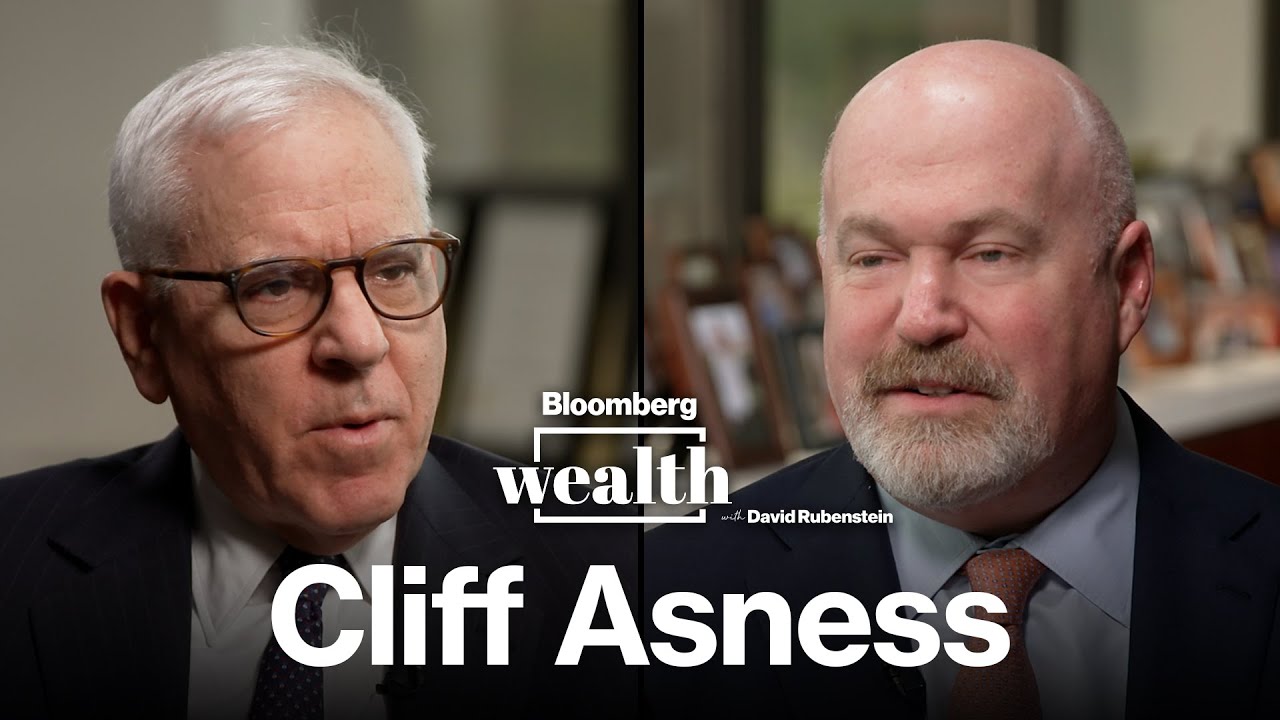
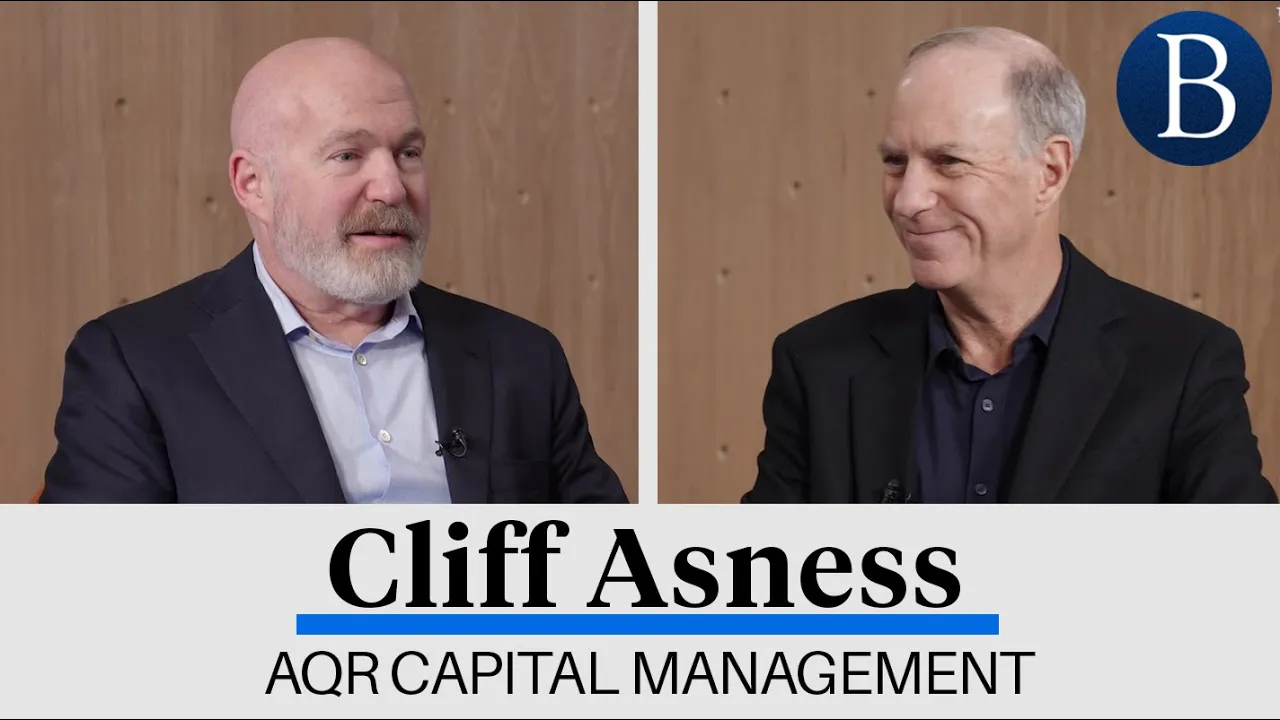
[Music] hello everyone and welcome to at barens I'm Andy serwer and Welcome to our guest Cliff asnes who's the managing and founding principal of the hedge fund aqr Cliff great to see you thanks for joining us thank you Andy it's great to be here so tell us about aqr it's a Quant hedge fund very big 123 billion or so under management what do you guys do um we grew up out of really Academia three of the four founding Partners met in the PHD program at the University of Chicago in I shutter to say the 1980s
um a lot of the original research there on what we now call Factor investing we didn't have that term back then it's funny you always look at history and you use today's terms for it um things like uh low multiple stocks beating High multiple stocks good momentum beating bad momentum that's what I wrote my dissertation on it's grown tremendously from that both a number of factors and other things we do things like machine learning the world has changed but it's all an outgrowth of that original academic research um and we use it to run portfolios
both hedge funds as you say um where we take pride in actually hedging meaning we're long and short a pretty similar amount trying to be really uncorrelated um but we also do run uh long only beat The Benchmark accounts essentially using the same models just to to know what to over and underweight and we're 27 years in and uh you know some ups and downs but life's been good yeah I want to talk about that 27 years because longevity in the business is not necessarily a given cliff and how do you uh explain that then
that you guys have done so well for so long you have had ups and downs though yeah yeah of course um this sounds uh you know too Rah for us but we're true believers in in what we do so when you have Downs even if other people lose Faith we've had a lot of people stick with us which is always nice but but even if that's not perfect if you actually believe in what you're doing it's not that hard 27 years goes by shockingly fast I'm still intellectually fascinated uh by both what we do already
and the chances to always improve I know my partners and colleagues are uh so it's fun and my wife tells me that I'm never going to quit because when it's going well which is most of the time I'm having too much fun and the rare times it goes pretty poorly I feel too much responsibility to leave so so so there is a little bit of a you might never retire how should I plan for this sounds like a Full Employment Act basically so um I want to dig into more of this Quant hedge fund manager
kind of thing and understand that a little bit more is it is it relationships between say two Securities and noticing discrepancies in pricing and leveraging off of that can you explain a little bit more what it is sure um I'm going to I'm G to make it I'm a little nervous I know you could get it but I'm going to oversimplify and I get nervous people will think this is all we do when I give these but here's the simplest one out of Academia if you buy more profitable stocks measured by Roe Roa what's called
gross profitability the better ones going for tend to outperform the worst ones that's something almost any active manager would like if you went to a gram and DOD manager yeah we like we like profits where Quan's a little different is if we were only doing that and we do way more than that but but if we were only doing that we would probably own a thousand of the world's more profitable stocks globally and we'd probably be short in a hedge fund World a thousand of the less profitable on because we're not about knowing a lot
about a specific company you don't come to a Quant to go you know after palente earnings are they worth it we don't know we bet on statistics but when you have a thousand against a thousand statistics starts to rule um now let now imagine you had many such rules you also like low multiples and you didn't like high multiples and you also liked both price and fundamental momentum you like to be on the right side of recent event events you don't like high beta High volatility you can think of those all as separate trades put
them all together you end up long and short many stocks around the world betting on averages and you end up building a portfolio some Modern things we're doing again in the ml world and what's called alternative day to start to stray from this a bit but a lot of the core Factor investing ends up looking very much like the things a traditional Graham and DOD manager would like so it sort of suggests the market is not efficient oh them's fighting words um I you probably know this but I was Jee F's PhD student um I
at the University of Chicago I ta his class for two years and he he was co-chair of my dissertation um I was immediately a bit of a Drifter from from even Jean I wouldn't call a pure efficient marketer he he he very intellectually honest he admits that's a very extreme hypothesis perfect is Extreme but but clearly he's on the towards the the the efficient market side but in a big way I wrote a dissertation for him um one of the very early papers showing that momentum also works so F and French had really looked at
uh cheap minus expensive using simple multiples and small versus large I was a part of uh a few other authors but I was very early in adding hey the last 3 to 12 months seems to keep going that's not a great great result for fishing markets um I remember one of the scarier things I ever had to do was tell Jee F that I have these results I want to write a paper on on simple momentum investing and I distinctly remember mumbling the second part and it works very well and he was like what was
that and I'm like it works very well and this is a warm story because he looked and he just said if it's in the data write the paper MH um and he was very supportive of it um so I was straying from Pure efficient markets early on right it's interesting because a lot of times you talk about people who believe in inefficient markets are more people like Warren Buffett who can identify value very different from what you do using fundamental analysis maybe that's more of a losers game generally speaking than believing in inefficient markets and
being a Quant yeah well in some sense active management deviating from cap weighted indices is always a losers game on net Bill Sharp did this arithmetic a long time ago um all of us add up to the market um so if you and I are both active managers and we're the whole Market together one of us wins one of us loses and if on net we're paying the trade and paying an advisor it is a losers game there is an arrogance which I have I have to tell you to active management of any kind even
though we're Quant I consider us active managers uh there's an arrogance believing that you will be on the right side of that that other people are making mistakes um a lot of what Warren Buffett believes is not that dissimilar from from us he doesn't think markets are perfect he thinks he's identified opportunities I think he's it's pretty good evidence that he's he's been good at that um we believe we would call it behavioral Finance we put fancy geeky terms on it but behavioral Finance is a term uh that really just means markets are not perfectly
efficient and we think we understand some of the biases um and so where Warren Buffett will take that philosophy and we actually wrote a paper it was one of our most downloaded papers ever called Buffett's Alpha where we said let's close our eyes and pretend Buffett was a Quant what would he look like and it turns out the Quant value Factor the Quant profitability factor and the Quant stable low volatility Factor explained a lot of his returns right that doesn't mean he's not a genius he was doing it 40 years before the quants right uh
but I think the similarity between very good active management where you don't believe in a perfectly efficient market doesn't mean the market easy to beat um and good good Quant and good Warren Buffett style stock picking is more similar in philosophy even if the implementations look can look wildly different that's fascinating I didn't even make that connection interesting I want to shift gears and ask you about the current political environment and knowing that you don't take that into account necessarily because you're just looking at the numbers having said that do you or have you or
are you going to change your thinking at all given what's going on in the current Administration what Donald Trump is doing with tariffs and government and bringing Elon Musk does that affect your thinking at all um very little but not zero and let me give you two examples one and and we tell our clients this is as good quants we have models for what risk looks like and we target a certain amount of risk through time that can be defined differently it could be defined as absolute risk risk versus a benchmark um we give ourselves
the latitude which we very we a handful of times in our history to take less risk than the standard process would say we do not give ourselves a Latitude to take more risk I don't wake up and say I feel pretty good today let's let's take it up a notch but these would be um examples like uh if we're one day away from the debt cealing possibly being violated or or something maybe fixed income is a little more volatile than our risk models think um we looked into this was just last week because it was
pretty timely how sensitive we were to uh tariffs um and this is actually complicated to figure out if you have th a thousand stocks around the world long and short what's your bet on tariffs did a I think we did a good job we went through and we looked at where each company sells where they buy came up with a model that said we are slightly long tariffs I'm personally not a tariff guy that Quant models come out to a little bit long tariffs doesn't mean I like tariffs and then Monday we had a not
a blowout but a pretty good day um models don't work that well uh they're noisy uh but that one happened in nail it um if we had found last week in this analysis that we through not explicitly doing it just through the natural process had a massive bet either that tariffs wouldn't happen or would we would at least consider probably still wouldn't do it there a high bar to do this but we'd at least consider saying maybe we should take a little less risk same bets we don't go change them but maybe a little a
a little bit less um the other way I think it matters is we do think and we love to geek up the terms all the time but macro uncertainty chaos for want of a better word is higher than normal we thought that even before um the Trump reelect we we've thought that for a few years that there's a lot of uh more uncertainty than normal in the trajectory of the macroeconomy and um this is hard to quantify Quan hates saying something hard to quantify but if you don't believe the uncertainty whether you love what he's
doing or hate what he's doing if you don't think the macro uncertainty is higher now I don't think you've been paying total attention and one of the things we do and I'll I will now do a brief commercial moment um is we've taken that early stuff that I did on momentum for stocks applied it to markets uh and one of the many things things we do quantitatively at aqr is we're Trend followers um cta's manage Futures has been around forever I we've been doing it now for about 15 years it has a property of doing
better usually it's not a guarantee but usually when the world goes a little crazy so I all else equal I like those a little bit more than I normally do because I do think we're in a world of of high macro uncertainty so like I said it rarely matters mostly we're trying to be very hedged and not take big positions on what politicians are going to do but at the edges in those small ways it can matter all right so on the margin you have um either identified or moved a little bit um and speaking
of politics you're not afraid to mix it up on X right I mean you like going out there and getting into it a little bit right yeah as you asked me that I can feel all of aqr saying oh God what's he going to say now um but I just want to ask you about the process not about what your opinions necessarily okay you know I get drawn back to X all the time cuz the what they call Fin twit um when it used to be called Twitter just Financial Twitter is really great there are
a lot of really good people uh and then once you're on it and if you are cursed right or wrong with thinking that you're at all funny and sadly I I delusionally occasionally think that I think we'll get to that it becomes irresistible to occasionally wait in um so yeah uh my firm and my wife probably wishes I would do it less uh but I do it largely because it's fun or speaking of funny you wrote what I think is a pretty hilarious piece recently called 2035 an allocator looks back over the last 10 years
what was the thinking behind that Cliff um it was basically what I thought was a cute fun way to softly say what I think is going to happen in the next 10 years the central conceit and arrogance is it's looking back over 10 years so I don't if I were to make forecasts I might say I I expect somewhat less out of us equities given their price to very high levels I don't expect disaster but icept expect a smaller risk premium than normal but a wide range in forecasts you can say I expect lower but
you don't know uh but when you look back over 10 years you can say exactly what happened um so I'm able to say you only made a couple percent over cash um I can say that uh that Bitcoin went to zero but and I'm going to say this I can't believe on your video but fcoin dominated the world um so that was pure humor I actually don't believe that one's going to happen yeah I want to get into the crypto thing was you said we had thought it quite silly that just leaving computers running for
a really long time created value but then it turned out it really did build digital gold and we learn scarcity of something leads to anything scarce going up forever even if it's useless yeah that was that was total sarcasm so that so you're not a big believer in crypto I'm not um I'm fallible there's some chance I'm wrong about this and it becomes money um but short of that I I don't see a use case for it I I see three uses as of now uh one to speculate on crypto itself um two War torn
countries people talk about that and three to pay cyber Ransom I we have never had to do that but occasionally I hear people have to do that in crypto other than that the crypto people used to talk about it becoming a currency now they've tamped that down and they talk about it being a quote store of value I I just don't get it and maybe I'm getting too close to 60 to understand crypto uh and there is some chance that I'm missing something I wouldn't short crypto by the way um you don't short near 100%
volatility things and sleep well at at night that doesn't mean my convictions any less um I every once in a while particularly on X someone will go well why don't you short it I'll go just because I think you're so nuts that it could triple tomorrow doesn't mean I think you're right um so I'm a cynic um who acknowledges he might be who who who acknowledges he might be wrong another thing you've written recently is about private Investments which you characterize as volatility laundering what does that mean going through like a roll call of everything
obnoxious I've ever said your B your Greatest Hits come on CLI it's um what I mean there and I've invested privately um private Equity managers I know many of them they're they're a lot of them are just some of your best friends literally true I live in grench Connecticut so it's not a coincidence um I've made that joke that that the cliche is true in my case but there a lot of them are brilliant investors to understand more about individual companies than a Quant can ever dream about um and a lot of them are very
honest that they do risky things there is a rather large corner of that world that is less honest that Reports say volatility numbers you know quants love stuff like that so the S&P tends to be in geek speak without it defining at 15 to 20% annual volatility you will see charts come out saying that's the S&P private Equity is half that is seven eight% volatility and if I had hair I'd be ripping it out at at that point um if you're invested in privates because you think you have amazing managers whose skill at choosing companies
and then improving those companies can overcome the rather massive fees that they charge more power to you if you're investing in privates because you think or even worse you think others will think they don't move around a lot so they're really like super safe they're just equities they're a mildly l CED concentrated portfolio of equities their real volatility is probably you know 25 30% in a portfolio um and obviously individual firms will will vary so if someone as much of the industry is is honest and upfront about it I have no problem with it um
but there is a segment of the world that is using it to take risk that they probably shouldn't be um and they're using the lack of Market to Market as kind of cover and and partly it's just my competitive juices we don't get to hide uh in the LI in the liquid world when we're down we say we're down we don't go well we're right so we're going to mark it to where we think it's worth which they seem to get to do right quickly you you're not a big fan of high hedge fund fees
uh no I was writing about this we wrote a paper in 2001 I think don't hold me to the exact plus or minus 5 years I remember two periods well the last two weeks and high school everything else in between is some amount of years ago uh but I think it was around then we wrote a paper called do hedge funds hedge um where we concluded the hedge fund world was actually very correlated to just long only equities uh they hedge about half they end up with a beta again more geek speak of about 0
four5 um but what's left over most of their risk is from that beta um so they given that 2 and 20 which I don't know if very few actually get that anymore some of the multi strats get more than that but traditional hedge fund fees I think have come down 2% a year 20% of The Upside yeah but the classic 2 and20 fee um will even charge it when we when someone ask us to do a very aggressive fund meaning a lot of our capacity is used up uh with many of our strategies but rarely
most of the things we do are considerably lower fee than that and I don't think many funds can justify 2 and 20 and the empirics bear that out uh data on the whole hedglin industry is always lousy um very small subset of firms report to the public databases but the data that we have says they make after fees about their betas they make they match the market they don't seem to outperform or underperform there we go and final question cliff and it's kind of a big one what mistakes do investors make oh god um I've
made all these so I'm not just preaching from on high the the the the grandparent of all mistakes is having too short of a Time Horizon that's too easy to say uh I'll be a little more specific I have written about Investors um having a a momentum having a momentum orientation at a value time Horizon put very simply momentum seems to be quite powerful at a 3 to 12- month kind of horizon good things happening both price and fundamentals on average not for every single company of course tend to continue value probably rules at a
longer Horizon uh let's just pick five years uh buying what's beaten up and looking cheap on a five-year basis seems to work what a lot of investors and some of them are very smart very good investors but I've been on a lot of investment committees where I've been part of it and I've seen this happen look at that 5year Horizon and go in the direction of what has worked they are investing as moment investors at a horizon where it is smarter to be a contrarian investor on average it's pretty easy to see five years of
something going one way and be convinced that's that's the truth when sadly in statistical terms five years doesn't actually often tell us that much so that is one major one um another one I like to bring up is overfocused on each line in the portfolio don't get me wrong you should know what you own but often people put together a portfolio precisely because each part doesn't wiggle at the same time the other one Wiggles they Zig when the other zags um and then and I again I've been on a lot of committees that do that
we'll spend all our time on the the three losers in the portfolio so one thing I do if I'm appointed to an investment committee and if I get involved with a new organization they instantly stick me on the investment committee often to everyone's regret um but I'll say all right I'm not going to I know I'm not going to stop that but can we also examine the two or three biggest winners uh um because that's as anomalous and often can can reverse finally I'll give you one more um over any Horizon don't mistake a valuation
change for truth if something has gotten doubly as expensive and you just you know a classic way to estimate something is to look at a long Horizon 20 30 years and say what's the average Equity return if the end points are fairly similar this could be useful but if it started out at a PE of five in the equity Market in 1981 uh and ended up at 30 years later at a PE of of 25 you you had a five times revaluation over that period the returns over that period will grossly overestimate what you really
should expect longterm and that seems really obvious when I say it but that sneaks in a lot of places fascinating stuff Cliff ases thank you so much for joining us oh thank you this was fun Andy this is at Barons I'm Andy serwer we'll catch you next time