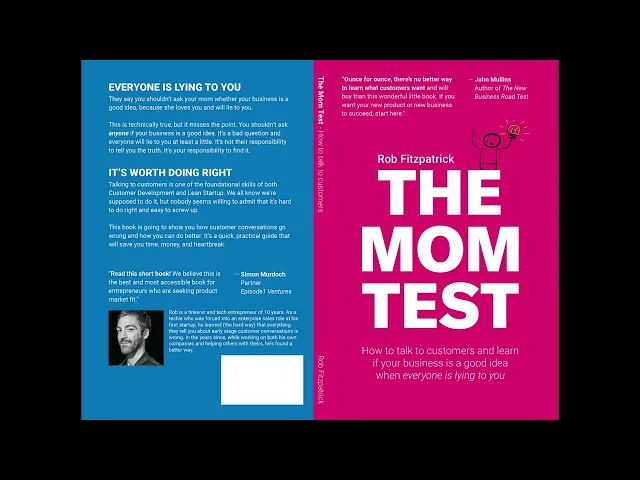
The mom test how to talk to customers and learn if your business is a good idea when everybody is lying to you PDF introduction trying to learn from customer conversations is like Excavating a delicate archaeological site the truth is down there somewhere but it's fragile while each blow with your shovel gets you closer to the truth you're liable to Smash it into a million little pieces if you use two blunt an instrument I see a lot of teens using a bulldozer and crate of dynamite for their excavation they are in one way or another forcing
people to say something nice about their business they use heavy-handed questions like do you think it's a good idea and shatter their prize at the other end of the spectrum some Founders are using a toothbrush to honor facility flinching away from digging deep and finding out whether anything of value is actually buried down there we want to find the truth of how to make our business succeed we need to dig for it and dig deep but every question we ask carries the very real possibility of biasing the person we're talking to and rendering the whole
exercise pointless it happens more than you'd ever imagine The truth is our goal and questions are our tools but we must learn to wield them it's delicate work and well worth learning there's treasure below is this book for you hello you've read about customer development or Lean Startup and aren't sure how to actually go about having your first customer conversation You're a traditional business or salesperson aiming to be more effective within a young company which hasn't yet found its business model you Mentor support or invest in startups and want to help them have more useful
customer conversations you've fallen in love with a new business idea and want to figure out if it has legs before quitting your job you're raising funding and the investors want to see more evidence that you're Solving a real problem you find this whole process incredibly awkward and really wish there was an easier way to do it you've got a vague sense of an opportunity and want to figure out exactly what it is you've always wanted to build your own company and want to start making real progress today this book is for you talking to customers
is hard We know we ought to talk to customers many of us even do talk to customers but we still end up building stuff nobody buys isn't that exactly what talking to people is meant to prevent it turns out almost all of us are doing it wrong I've made these mistakes myself and seen them happen a hundred times over with other founders despite the recent explosion of startup Knowledge the process of figuring out what customers want too often unfolds as it did at my first company habit we were building social advertising Tech and I was
distraught we'd spent three years working our hearts out we'd nearly run out of investor money and it didn't look like we'd be getting more we've relocated internationally to be closer to our market and had survived a Co-founder being deported I'd been talking to customers full time for months and then after innumerable days of slog and an exhausted team I learned I'd been doing it wrong I may as well not have bothered the advice that you ought to be talking to your customers is well intentioned but ultimately a bit unhelpful it's like the popular kid advising
his nerdy friend to just be cooler They forget to mention that it's hard these conversations take time are easy to screw up and go wrong in a nefarious way bad customer conversations aren't just useless worse they convince you that you're on the right path they give you a false positive which causes you to over invest your cash your time and your team even when you're not actively screwing Something up those pesky customers seem hellbent online to you this book is a practical how-to the approach and tools within are gathered from a wide range of communities
including customer development design thinking Lean Startup user experience traditional sales and more it's based on working with a bunch of Founders and from my experiences both failing and succeeding at customer Learning as well as from the support of innumerable peers and mentors it's a casual approach to conversation based on chipping away the formality and awkwardness of talking to people and taking responsibility for asking good questions why another book on talking and selling does your shelf really need another book on selling and talking and does it need one written by me in particular Well yes yes
it does here's why firstly I'm a techie not a sales guy I'm introverted and naturally bad in meetings every other sales book I've read is written by and for folks who are already pretty good at dealing with people they know the unspoken rules of the meeting I fumbled through from scratch You know that line don't call me I'll call you people have actually said that to me and I believed them with much help from peers and advisors I eventually started figuring it out and we closed deals with companies like Sony and MTV but I learned
that there's a big gap between textbooks and checkbooks secondly before we can start doing things correctly we need to understand How we're doing them wrong through my own projects and my work with new Founders I've built up an exhaustive list of how it can go wrong throughout the book I'll try to help you figure out where you might be messing stuff up in unnoticed ways finally this is a practical handbook not a theoretical tone for example how do you find people to talk to and set up the meetings how do you take notes while still
being Polite and paying attention it's all in here I can't teach you how to make your business huge that's up to you but I can give you the tools to talk to customers navigate the noise and learn what they really want the saddest thing that can happen to a startup is for nobody to care when it disappears we're going to make sure that doesn't Happen a note on scope and terminology this book isn't a summary or description or reinterpretation of the process of customer development that's a bigger concept and something Steve blank has covered comprehensively
in four steps to the Epiphany and the startup owner's manual this book is specifically about how to properly talk to customers and learn from them Talking is one of the big aspects of customer development but shouldn't be confused with the whole process to keep the distinction clear I'm going to refer to chatting with people as customer conversation lowercase instead of customer development uppercase for the most part I'm assuming you already agree that talking to customers is a good idea I'm not trying to convince you again so this book is more how than why Let's get
involved chapter one the mom test people say you shouldn't ask your mom whether your business is a good idea that's technically true but it misses the point you shouldn't ask anyone whether your business is a good idea at least not in those words your mom will lie to you the most just because she loves you but it's a bad Question and invites everyone to lie to you at least a little it's not anyone else's responsibility to show us the truth it's our responsibility to find it we do that by asking good questions the mom test
is a set of simple rules for crafting good questions that even your mom can't lie to you about before we get there let's look at two conversations with Mom and see what we can learn about our business idea Digital cookbooks for the iPad failing the mom test Sun mom I have an idea for a business can I run it by you I am about to expose my ego please don't hurt my feelings mom of course dear you are my only son and I am ready to lie To protect you son you like your iPad right
you use it a lot mom yes you led me to this answer so here you go Sun okay so would you ever buy an app which was like a cookbook for your iPad I am optimistically asking a Hypothetical question and you know what I want you to say mom um as if I need another cookbook at my age son and it only costs forty dollars and that's cheaper than those hard covers on your shelf I'm going to skip that lukewarm signal and tell you more about my great idea mom Well aren't apps supposed to cost
a dollar Sun and you can share recipes with your friends and theirs and iPhone app which is your shopping list and videos of that celebrity chef you love please just say yes I will not leave you alone until you do mom oh well yes honey that sounds amazing And you're right forty dollars and is a good deal will it have pictures of the recipes I have rationalized the price outside of a real purchase decision made a non-committal compliment and offered a feature request to appear engaged Sun yes definitely thanks Mom love you I have Completely
misinterpreted this conversation and taken it as validation mom would you have someone I am concerned that you won't be able to afford food soon please eat something our misguided entrepreneur has a few more conversations like this becomes increasingly convinced he's right quits his job and sinks his savings into the app Then he wonders why nobody even his mom buys the app especially since he had been so rigorous Doing It Wrong is worse than doing nothing at all when you know you're clueless you tend to be careful but collecting A Fistful of false positives is like
convincing a drunk he's sober not an improvement let's fix the conversation and show that If we do it right even mom can help us figure out whether our business is a good idea passing them on test Sun hey Mom how's that new iPad treating you mom oh I love it I use it every day Sun what do you usually do on it whoops We asked a generic question so answer to this probably won't be terribly valuable mom oh you know read the news play Sudoku catch up with my friends the usual Sun what's the last
thing you did on it hit specific about examples in the past to get real Concrete data mom you know your father and I are planning that trip I was figuring out where we could stay she uses it for both entertainment and utility which didn't come up during the usually answer Sun did you use an app for that a slightly leading question But sometimes we need to nudge to get to the topic we're interested in mom no I just used Google I didn't know there was an app what's it called younger folks use the app store
as a search engine whereas your mom waits for a specific recommendation if that's true more broadly finding a reliable marketing channel outside the App Store is going to be crucial Sun where did you find out about the other ones you use dig into interesting and unexpected answers to understand the behaviors and motivations behind them mom the Sunday paper has a section on the apps of the week you can't remember the last time you cracked open a paper but it sounds like Traditional PR might be a viable option for reaching customers like your mom son makes
sense hey by the way I saw a couple new cookbooks on the Shelf where did those come from business ideas usually have several failure points here it's both the medium of an iPad app and the content of a cookbook mom They're one of those things you just end up getting at Christmas I think Marcy gave me that one haven't even opened it is if I need another lasagna recipe at my age aha this answer is gold dust for three reasons one old people don't need another generic Set of recipes two the gift Market may be
strong free younger Cooks may be a better customer segment since they don't yet know the basics Sun what's the last cookbook you did buy for yourself attack generic answers like I don't buy Cookbooks by asking for specific examples mom now that you mention it I bought a vegan cookbook about three months ago your father is trying to eat healthier and thought my veggies could benefit from a pinch more zaz more gold experienced chefs may still buy Specialized or Niche cookbooks The conversation continues if it's going well I would raise the topics of whether she ever
thought to look for recipes on the iPad or for cooking videos on YouTube overall your mom can't remember the last time she had such an enjoyable conversation with you you were so interested in her life for once you thank her for the lasagna pet the dog and head home You've learned that building an app and waiting for people to find it on the App Store probably isn't a good plan but you've got some good insight about your customer segment and a few promising leads to look into that was a useful conversation a useful conversation the
measure of usefulness of an early customer conversation is whether it gives us concrete facts about our customers lives and World Views These facts in turn allow us to improve our business our original idea looked like this old people like cookbooks and iPads therefore we will build a cookbook for the iPad it's generic there are a thousand possible variations of this premise with an idea this fake we can't answer any of the difficult questions like which recipes to include or how people Will hear about it until we get specific it always seems like a good idea
after just one conversation with our mom of all people we have a higher Fidelity vision we now see that there are at least two specific customer segments we might serve Each of which needs a slightly different product we've also identified some major risks to address before we commit too heavily One we could offer Niche recipes ethnic diets which experienced Cooks may not already know our biggest question is how to reach them when they don't search for apps we have a possible lead with newspaper and magazine PR 2. alternately we might make generic recipes for younger
Cooks who are easier to reach via the App Store and Who haven't memorized all there favorites yet we haven't talked to any so we have loads of questions but one big one is whether a customer segment who isn't already in the habit of buying expensive cookbooks will pay a premium for hours the first conversation gave us rope to hang ourselves the second gave us actionable insight why what was different about the second Conversation mom was unable to lie to us because we never talked about our idea that's kind of weird right we find out if
people care about what we're doing by never mentioning it instead we talk about them and their lives the point is a bit more subtle than this eventually you do need to mention what you're building and take people's money for it However the big mistake is almost always to mention your idea too soon rather than too late if you just avoid mentioning your idea you automatically start asking better questions doing this is the easiest and biggest Improvement you can make to your customer conversations here are three simple rules to help you they are collectively called drumroll
the mom test The mom test Juan talk about their life instead of your idea too ask about specifics in the past instead of generics or opinions about The Future Three talk less and listen more it's called the mon test because it leads to questions that even your mom can't lie to you about when you do it right they won't even Know you have an idea there's some other important tools and tricks that we'll introduce throughout the rest of the book but first let's let's put the mom test to work on some questions rule of thumb
customer conversations are bad by default it's your job to fix them good question slash bad question let's play a game Are the following questions good or bad do they pass or fail the mom test if they fail at y and how could we improve them work your way through the list and then read on for some discussion do you think it's a good idea would you buy a product which did X how much would you pay for X what would your dream product do why do you bother what are the implications of that talk me
through the last time that happened talk me Through your workflow what else have you tried would you pay X for a product which did why how are you dealing with it now where does the money come from who else should I talk to is there anything else I should have asked do you think it's a good idea awful question here's the thing only the market can tell if your ID is good everything else is just opinion Unless you're talking to a deep industry expert this is self-indulgent noise with a high risk of false positives let's
fix it say you're building an app to help construction companies manage their suppliers you might ask them to show you how they currently do it talk about which parts they love and hate ask which other tools and processes they Tried before settling on this one are they actively searching for a replacement if so what's the sticking point if not why not where are they losing money with their current tools is there a budget for better ones now take all that information and decide for yourself whether it's a good idea rule of thumb opinions are worthless
Would you buy a product which did X bad question you're asking for opinions and hypotheticals from overly optimistic people who want to make you happy the answer to a question like this is almost always yes which makes it worthless let's fix it ask how they currently solve x and how much it costs them to do so and how much time it takes Ask them to talk you through what happened the last time x came up if they haven't solved the problem ask why not have they tried searching for Solutions and found them wanting or do
they not even care enough to have Googled for it rule of thumb anything involving the future is an over optimistic lie how much would you pay for x Bad question this is exactly as bad as the last one except it's more likely to trick you because the number makes it feel rigorous and truthy how to fix it just like the others fix it by asking about their life as it already is how much does the problem cost them how much do they currently pay to solve it How big is the budget they've allocated I hope
you're noticing a trend here rule of thumb people will lie to you if they think it's what you want to hear what would your dream product do sort of okay question but only if you ask good follow-ups otherwise it's a bad question a question like this is like the set before the spike in a volleyball game not too helpful on its own but it puts You in a good position as long as you're ready to exploit it let's improve it the value comes from understanding why they want these features you don't want to just collect
feature requests you aren't building the product by committee but the motivations and constraints behind those requests are critical rule of thumb People know what their problems are but they don't know how to solve those problems why do you bother good question I love this sort of question it's great for getting from the perceived problem to the real one for example some Founders I knew were talking to finance guys spending hours each day sending emails about their spreadsheets The finance guys were asking for better messaging tools so they could save time but why do you bother
question led to so we can be certain that we're all working off the latest version uh-huh the solution ended up being less like the requested messaging tool and more like Dropbox a question like why do you bother points toward their motivations it gives you the why Rule of thumb you're shooting blind until you understand their goals what are the implications of that good question this distinguishes between I will pay to solve that problems and that's kind of annoying but I can deal with it problems some problems have big costly implications others exist but don't actually
matter it behooves you to find out which is Which it also gives you a good pricing signal I once had someone keep describing the workflow we were fixing with emotionally loaded terms like disaster accompanied by much yelling and arm waving but when I asked him what the implications were he sort of shrugged and said oh we just ended up throwing a bunch of interns at the problem it's actually working pretty well rule of thumb Some problems don't actually matter taught me through the last time that happened good question your high school writing teacher may have
told you that good stories are meant to show not tell whenever possible you want to be shown not told by your customers learn through their actions instead of their opinions if you ran a burger joint it would be stupid to survey your customers about Whether they prefer cheeseburgers or hamburgers just watch what they buy but if you're trying to understand why they prefer one over the other you'll have to talk to them folks can be wishy-washy when you're watching them do the task in question get as close to the real action as you can seeing
it firsthand can provide unique insight into murky situations But if you can't get in there asking them to talk you through the last time it happened still offers many of the benefits being walked through their full workflow answers many questions in one Fell Swoop how do they spend their days what tools do they use and who do they talk to what are the constraints of their day in life how does your product fit into that day which other tools products software and Tasks does your product need to integrate with rule of thumb watching someone do
a task will show you where the problems and inefficiencies really are not where the customer thinks they are what else have you tried good question what are they using now how much does it cost and what do they love and hate about it How much would those fixes be worth and how big of a pain would it be for them to switch to a new solution I was checking out an idea with a potential customer and they excitedly said oh man that happens all the time I would definitely pay for something which solved that problem
that's a future promise statement without any commitment to back it up so I needed to learn whether it was true or not I asked when's the last time this came up turns out it was pretty recent that's a great sign to dig further I asked can you talk me through how you tried to fix it he looked at me blankly so I nudged him further did you Google around for any other ways to solve it he seemed a little bit like he'd been caught stealing from the cookie jar and Said no I didn't really think
to it's something I'm used to dealing with you know in the abstract it's something he would definitely pay to solve once we got specific he didn't even care enough to search for a solution which do exist incidentally it's easy to get someone emotional about a problem if you lead them there don't you hate when your shoelaces come untied while you're carrying groceries Yeah that's the worst and then I go off and design my special never come untied laces without realizing that if you actually care you would already be using a double knot rule of thumb
if they haven't looked for ways of solving it already they're not going to look for or buy yours would you pay X for a product which did why bad question The fact that you've added a number doesn't help this is bad for the same reasons as the others people are overly optimistic about what they would do and want to make you happy plus it's about your idea instead of their life let's fix it as always ask about what they currently do now not what they believe they might do in the future Common wisdom is that
you price your product in terms of value to the customer rather than cost to you that's true and you can't quantify the value received without prodding their financial worldview another way to fix it if you're far enough along is to literally ask for money if you have the deposit or pre-order in hand you know they were telling the Truth how are you dealing with it now good question Beyond workflow information this gives you a price anchor if they're paying ps100 slash month for a duct tape workaround you know which ballpark you're playing in on the
other hand they may have spent PS 120 000 this year on agency fees to maintain a site you're replacing if that's the case you don't want to be Having the ps100 conversation sometimes both of the above will be happening simultaneously and you get to choose how you present yourself do you want to be a replacement for the web app at a yearly value of PS one point talk or for the agency at 100x that rule of thumb while it's rare for someone to tell you precisely what they'll pay you they'll often show you what it's
worth to them Where does the money come from good question this isn't something you would necessarily ask a consumer though you might but in a B2B context it's a must ask it leads to a conversation about whose budget the purchase will come from and who else within their company holds the power to torpedo the deal often you'll find yourself talking to someone other than the budget owner Your future pitches will hit unseen snags unless you learn who else matters and what they care about this knowledge of their purchasing process will eventually turn into a repeatable
sales roadmap who else should I talk to good question yes and every conversation like this lining up the first few conversations can be challenging but if you're on to Something interesting and treating people well your leads will quickly multiply via intros if someone doesn't want to make intros that's cool too just leave them be you've learned that you're either screwing up the meeting probably by being too formal pitchy or clingy or they don't actually care about the problem you're solving take anything nice they say with an Extra grain of salt is there anything else I
should have asked good question usually by the end of the meeting people understand what you're trying to do since you don't know the industry they'll often be sitting there quietly while you completely miss the most important point asking this question gives them a chance to politely fix your line of questioning And they will this question is a bit of a crutch you'll discard it as you get better at asking good questions and as you get to know the industry rule of thumb people want to help you but will rarely do so unless you give them
an excuse to do so using the mom test you'll notice that none of the good questions were about asking what you Should build one of the recurring criticisms about talking to customers is that you're abdicating your Creative Vision and building your product by committee given that people don't know what they want that wouldn't be a terribly effective approach deciding what to build is your job the questions to ask are about your customers lives their problems cares constraints and Goals you humbly and honestly gather as much information about them as you can and then take your
own Visionary leap to a solution once you've taken the leap you confirm that it's correct and refine it through commitment and advancement which we'll look at in chapter five it boils down to this you aren't allowed to tell them what their problem is and in return they Aren't allowed to tell you what to build they own the problem you own the solution before we move look at ways to confirm that you're building the right product to fit your customers lives we're going to look at fixing some of the ways conversations go wrong chapter 2 avoiding
bad data they say that to bankrupt a fool give him information practically everyone I've seen talk to Customers including myself has been giving themselves bad information you probably are too bad data gives us false negatives thinking the idea is dead when it's not and more dangerously false positives convincing yourself you're right when you're not there are three types of bad data one compliments too fluff generics hypotheticals and The Future Three ideas sometimes we invite the bad data ourselves by asking the wrong questions but even when you try to follow the mom test conversations still go
off track it could happen because you got excited and started pitching because you had to talk about your idea to explain the reason for the meeting or because the conversation is just stuck in hypothetical Outland These things happen once you start to notice it's easy to get back on track by deflecting compliments anchoring fluff and digging beneath ideas deflect complements most of your meetings will end with a compliment it feels good they said they liked it unfortunately they're almost certainly lying Not necessarily intentionally they might want to be supportive or to perfect your feelings or
your excitement might be rubbing off on them even if they really do like it that data is still worthless for example Venture capitalists professional judges of the future are wrong far more than right if even a VC's opinion is probably wrong what weight could that of some random Guys possibly have with the exception of Industry experts who have built very similar businesses opinions are worthless you want facts and commitments not compliments the best way to escape the misinformation of compliments is to avoid them completely by not mentioning your idea if they happen anyway you need
to deflect the compliment and get on with The business of gathering facts and commitments before we look at how to properly deflect compliments here's what happens when you take them at face value a bad conversation you and that's it it's like X for y but better because of Z bam totally nailed that pitch Them that's cool love it how is this relevant to me compliment you it's going to totally change the way you work we're predicting cost Savings of 35 percent I am so great them sounds terrific keep me in the loop I can't believe
I keep agreeing to these startup pitches complement plus stalling tactic EU awesome thanks and just like Steve Jobs accept more handsome you back at the office that meeting went really well they said they loved it In fact everybody loves it I really think we finally found our big idea we found something people want it's margarita time your team six months later why do we have zero customers I you said everybody loved it wasn't this your job you I don't know I talked to like a thousand People I must have missed one of their buying criteria
don't worry I'll go talk to them some more and we'll get it next time doomed let's try that again while properly deflecting the confounding compliments you and that's it it's like X for y but better because of Z Rats I just slipped into pitch mode let's try to recover this and learn something them that's really cool I love it how is this even relevant to me compliment you whoops really sorry about that I got excited and started pitching Listen you guys seem to be doing a good job in this space do you mind if I
ask how you're dealing with this stuff at the moment that compliment made me suspicious let's deflect it and find out whether they're a potential customer or just trying to get rid of me them was oh well sure We've got a couple people who manage the process just to make sure we're all in sync and then we use Excel and a lot of emails to keep it all moving anyway I really like your idea I'm sure it will do well if you want facts here they are but your idea still isn't a good fit for me
and there's no way I'm going to express an interest in buying notice the sneaky compliment at the end you I haven't heard of anyone solving it quite like that that's interesting can you talk me through how it actually all fit together Let's ignore and deflect that compliment to focus on the fact that they're spending a lot of money to solve this two full-time staff I didn't know it was worth this much Them more delicious workflow data you what sort of difficulties have come up with that solution this is a bit generic and isn't the world's
greatest question but I'm trying to find an anchor to learn about workflow inefficiencies and bumps when I find one I'll dig around that signal with more follow-ups them even more workflow and alternate solution data If we're early in the learning process the meeting could end here quite happily we have the learning we came for if we were slightly later stage and already had a product we might continue by zooming in and pushing for commitments or sales remember though you don't need to end up with what you wanted to hear in order to have a good
conversation you just need to get to the truth Here's a good conversation with a solid negative result a good negative conversation them that's really cool I love it compliment you how are you dealing with this stuff at the moment deflect back compliment and get to the real facts Them oh it's really not that big of a deal for us we kind of just ignore it the implications of the problem are non-existent so I'm not in the market for a solution you can always be happy with a conversation like the above you saw through the false
compliment and found the facts behind the Mirage If the conversation is going well I try to have them talk me through their process anyway so I can try to figure out whether it's an industry-wide non-problem or something specific to their particular situation did you notice that in the conversations above practically every response contains a sneaky compliment they are pervasive constantly trying to trick us into thinking the conversation went well Ignoring compliments should be easy but it's not we so desperately want to hear them that we are often tricked into registering them as positive data points
instead of vacuous fits sometimes it's easier to spot the symptoms than to notice the original compliment symptoms in the meeting thanks I'm glad you like it symptoms back at the office That meeting went really well we're getting a lot of positive feedback everybody I've talked to loves the idea all of these are warning signs if you catch yourself or your teammates saying something like this try to get specific why did that person like the idea how much money would it save him how would it fit into his life what else has he tried which failed
to solve his problem If you don't know then you've got a compliment instead of real data rule of thumb Compliments are the Fool's Gold of customer learning shiny distracting and entirely worthless anchor fluff fluff comes in three cuddly shapes generic claims I usually I always I never future tense promises I would I will hypothetical maybes I might I could When someone starts talking about what they always or usually or never or would do they're giving you generic and hypothetical fluff follow the mom test and bring them back to specifics in the past ask when it
last happened for them to talk you through it how they solved it and what else they tried the world's most deadly fluff is I would definitely buy that it just sounds so concrete As a Founder you desperately want to believe it's money in the back but folks are wildly optimistic about what they would do in the future they're always more positive excited and willing to pay in the Imagine future than they are once it arrives the first startup I worked at FAL for the I would definitely buy that trap and subsequently lost about 10 million
bucks they mistook fluffy future promises and excited compliments for commitment Wrongly believed they had proven themselves right and wildly over invested the worst type of fluff inducing question is would you ever of course they might Sunday that doesn't mean they will fluff inducing questions include do you ever would you ever what do you usually do you think you might you could you see yourself You don't need to avoid these questions one hundred percent of the time they aren't exactly toxic it's just that the responses are useless the mistake is in valuing the answers not asking
the questions in fact sometimes these questions can even help you transition into more concrete questioning transitioning from a fluffy question to a concrete one you Ever X a Fluff inducing question them oh yeah all the time a fluffy answer which has no value in itself but which we can anchor from EU when's the last time that happened we use the mom test and ask for concrete examples in the past them Two weekends ago we've successfully anchored the fluff at a ready to get real facts now instead of generics and hypotheticals you can you talk me
through that back to asking good questions to use a more tangible example let's say you're designing some sort of inbox management tool a good conversation anchoring generic fluff Them I'm an inbox zero zealot it's totally changed my life a generic for example fluffy claim you ah nice I'm an inbox zero failure what's your inbox at right now let's get specific to see if this fluff holds up Them looks like about 10 that have come in since this morning facts you okay wow so you're on top of things I have like 200 right now when's the
last time it totally fell apart for you he's still claiming to be on top of his email so I'm going to look for concrete Examples where he wasn't them three weeks ago I was traveling and the internet at the Hotel totally didn't work it took me like 10 days to get back on track you can you talk me through how you handled it successfully anchored Now we're talking about what actually happens instead of what usually happens in this case we took the generic claim my inbox is always under control and added the important caveat except
when it's not in which case it's a total nightmare to recover from while using generics people describe themselves as who they want to be not who they actually are you need to get specific to bring out the edge cases Let's say You're Building A mobile loyalty app to help stores give deals and discounts to their most loyal customers and you hear the guy in line in front of you complaining a bad conversation pitching and accepting fluff them which idiot decided it was a good idea to make me carry around a thousand Cafe Loyalty cards you
Whoa hey I'm building a mobile app to help stores give add discounts to their most loyal customers so you'd never need to carry paper cards again do you think you would use something like that this is pretty much as bad of a question as you can find you've revealed your ego and asked a would you ever question You're begging for a false positive them heck yes it's about time I would definitely use that fluffy hypothetical future promise by switching into pitch mode we just wasted a perfectly good opportunity for Learning and instead got a fist
full of fluff let's try again them what idiot decided it was a good idea to Make me carry around a thousand Cafe Loyalty cards you it's crazy Ray my wallet is like two feet thick hey have you ever tried any of those loyalty apps for your phone anchor to past behaviors them those exist perhaps my rage is misplaced EU yeah I'm sure you've seen the little signs for that one in the campus Cafe them oh yeah I remember that I'm always kind of in a rush this is a nice bit of customer insight about their
state of mind and circumstances when you're trying to advertise to them you Why don't you download it now if someone's being flaky put them to a decision if they don't care enough to try solving their problem already they aren't going to care about your solution them I'll do it next time not a real problem you can't help but laugh when you hear this one someone should definitely make an x have You looked for an ex know why there are like 10 different kinds of X well I didn't really need it anyway long story short that
person is a complainer not a customer they're stuck in the La La Land of imagining they're the sort of person who finds clever ways to solve the petty annoyances of their day Beyond rousting some poor souls consumeristic hypocrisy anchoring the fluff can also yield useful signals You have you ever tried any of those loyalty apps for your phone them yeah I downloaded a couple of them you need a different one for every chain I don't want a hundred apps clogging up my phone any more than I want a bunch of cards in my wallet so
Eason actively searching potential user but we'd need to get critical mass With the stores he goes to Before He'll Be Happy maybe we could take over a small University Town first or he might say them I looked into it but you only end up getting like a 10 percent discount that seems less like a loyalty reward and more like a cheap way for them to collect a bunch of data about me So he was on the fence but needs better perks maybe we could find a way to force Merchants into deeper discounts like Groupon was
able to do he also has privacy concerns or he could respond with them have you ever actually tried using that app it's abysmal it Takes me longer to find the stupid button than to buy my coffee so all we need to do for this particular user is to out execute and simplify we could try to be the Instagram to their flicker the list goes on there are tons of useful responses you can get even learning that the person is a non-customer is useful to get toward this truth you just need To reject their generic claims
incidental complaints and fluffy promises instead anchor them toward the life they already Lee and the actions they're already taking dig beneath ideas entrepreneurs are always drowning in ideas we have too many ideas not too few still folks adore giving us more at some point during a good conversation The person you're talking to May flip to your side of the table this is good news they are excited and see the potential so they'll start listing tons of ideas possibilities and feature requests write them down but don't rush to add them to your to-do list startups are
about focusing and executing on a single scalable idea rather than jumping on every good one which crosses your desk Let's say your mid-conversation when this idea drops them are you guys going to be able to sync to excel I really think that's the killer feature what do you do here the ROM response is to write sync to Excel on your to-do list and then move on that's the fast lane to feature creep Instead take a moment to dig into the motivations behind the request you what would syncing to excel allow you to do Maybe there's
an easier way I can help you achieve the same thing then we've got all these Legacy reports and we need to go through them every now and then It would be nice to have everything in one place you know don't worry it's not a key buying criteria or they might say them we've tried a bunch of these things and it's always the sinking that kills it they're actively searching for Solutions which are all missing a must-have feature This could be your major differentiator if it's important enough to the segment and difficult enough for your competitors
to emulate or them we have a decent workaround as you saw but it takes nearly a week at the end of each month to pull all the reports together in one place it's a big pain and totally stalls our Work if cobbled together a Homebrew solution know it's costing the money and are ideally suited to become an early customer at my first company habit we were adapting our product to sell to Enterprise companies and TV told me they needed analytics and reports for their campaigns I made a big mistake by accepting the feature request and
face value and Beginning the next meeting with a demo of our shiny new analytics dashboard custom built to solve their request of course they ued and ayad appropriately and I left thinking we'd nailed it it offered a sillion options and could carve up your data every which way it was technically an aesthetically lovely unfortunately ninety percent of what we had built was irrelevant We just didn't know that yet they started calling every Friday asking me to email over a csb data file of the week stats so we added CSV export to the dashboard later they
asked for the report as a PDF instead of in CSV so we obediently build PDF export that took longer salt was rubbed in the wound when weeks later they were still calling me every Friday and asking me to export and send Over the same stupid analytics report and every week I would do so while politely explaining that you know we built this awesome self-serve dashboard so they could have their data whenever they wanted and then the next Friday they'd call me it turned out we had entirely missed the real reason they'd been excited about our
analytics demo in fact we'd missed their whole motivation for wanting Analytics The memory of being burned by feature requests was still fresh in my mind when they asked if we could add their logo and colors to the reports I asked a couple incredulous questions about why in the world they wanted this feature when they didn't even use the ones I had already built like an exasperated dad at Christmas but you don't even play with the toys I bought for your birthday so I finally and inadvertently did the Smart thing when I asked why do you
want this feature what do branded reports get you that unbranded ones don't it's the same data right she replied oh yeah of course I mean nobody even reads these our clients just like to get something emailed to them at the end of every week and we think they'd be happier if it was a bit fancier you know I knew exactly they had asked for Analytics We had jumped to the conclusion that they wanted to better understand their data but they had really wanted a way to keep their own clients happy if we had properly understood
that we would have built a totally different and much simpler set of features consider how much easier our lives would have been if we'd understood the motivation behind the request instead of enabling the exploration and Export of all campaign data we could have just always exported the few high-level numbers a Big Brand manager would be interested in and instead of a self-serve dashboard we could set up a little scheduler to send it them every Friday in fact we didn't even need to build a dashboard at all instead of coding up a layout and branding system
for the reports we could Have had an intern hand build them each week all wasted because I didn't ask the right question I sure wish I had those three months back when you hear a request it's your job to understand the motivations which led to it you do that by digging around the question to find the root cause why do they bother doing it this way Why do they want the feature how are they currently coping without the feature dig you should dig in the same way around emotional signals to understand where they're coming from
just like feature requests any strong emotion is worth exploring is someone angry dig embarrassed Dig overjoyed day I once overheard a Founder interviewing someone at a cafe table next to me the founder mentioned a problem and the guy responded yeah that's pretty much the worst part of my day the founder jotted something down in his notebook and then moved on to the next question what It's the worst part of his day and you're not going to figure out why that's insane you've got to dig questions to dig into feature requests why do you want that
what would that let you do how are you coping without it do you think we should push back the launch add that feature or is it something we could add later how would that fit into your day questions to dig into emotional signals Tell me more about that that seems to really bug you I bet there's a story here what makes it so awful why haven't you been able to fix this already you seem pretty excited about that it's a big deal why so happy go on these nudges don't need to be complicated people love
talking about their opinions and emotions digging into a signal is basically just Giving them permission to do a brain dump rule of thumb ideas and feature requests should be understood but not obeyed stop seeking approval as we've seen Compliments are dangerous and sneaky so if we can nip them in the bud before they bloom so much the better the main source of complement creation is seeking approval either intentionally Or inadvertently doing it intentionally is fishing for compliments you aren't looking for contradictory information you've already made up your mind but need someone's blessing take the leap
symptoms of phishing for compliments I'm thinking of starting a business so do you think it will work I had an awesome idea for an app do you like it Accidental approval seeking is what I call the pathos problem it happens when you expose your ego leading people to feel they ought to protect you by saying nice things this comes up when you tell someone about an idea you obviously care about which is pretty much always since otherwise you wouldn't be asking even if you give folks permission to be honest and ask for criticism they're still
going to pull their punches Symptoms of the pathos problem so here's the top secret project I quit my job for what do you think I can take it be honest and tell me what you really think to deal with the pathos problem keep the conversation focused on the other person and ask about specific concrete cases and examples once someone detects that your ego is on the line they'll give you fluffy Mistruths and extra compliments disregard that data and use the mom test to refocus on the person their life and their goals people rarely lie about
specific stuff that's already happened regardless of your ego some famous entrepreneurs don't suffer the effects of the pathos problem but you should ignore their advice since it's not reproducible if you aren't them guys like Elon Musk read Hoffman and Gordon Ramsay are all notorious for actively seeking negative feedback it evidently works for them but nobody is worried about hurting a lawn red or Gordon's feelings you and I must be more circumspect in short remember that Compliments are worthless and people's approval doesn't make your business better keep your idea and your ego out of the conversation
until you're ready to ask for commitments Rule of thumb if you've mentioned your idea people will try to protect your feelings cut off pitches being pitchy is the dark side of the seeking approval coin instead of inviting Compliments by being vulnerable you're demanding them by being annoying it's when you hold someone hostage and won't let them leave and so they've said they like your idea Normally Compliments are well intentioned in this case they're just trying to get you out of their office won't take no for an answer is generally a good quality for a Founder
to have but when it creeps into a conversation that's meant to be about learning it works against you symptoms no no I don't think you get it yes but it also does this If you slip into pitch mode just apologize you're excited about your idea that's good otherwise you wouldn't have taken this crazy leap in the first place but suddenly you find yourself five minutes into an enthusiastic monologue while the other person nods politely that's bad once you start talking about your idea they stop talking about their problems Cut yourself off and say something like
whoops I just slipped into pitch mode I'm really sorry about that I get excited about these things can we jump back to what you were just saying you're telling me that if they say they really want to hear about what you're working on promise that you'll tell them at the end of the meeting or Loop them in for an early Demo and that you just want to talk a bit more about their stuff before biasing them with your idea rule of thumb anyone will say your idea is great if you're annoying enough about it talk
less you can't learn anything useful unless you're willing to spend a few minutes shutting up even if you have something really smart to say after you introduce your idea either Intentionally or accidentally they're going to begin a sentence with something like so it's similar to or I like it but it's tempting to interrupt and fix their understanding about how it's totally different and actually does do that thing they want alternately they'll raise a topic you have a really good answer to 4. example they'll mention how important security is and you'll want to cut in And
tell them you've thought about all that already this is also a mistake in both cases The Listener was about to give you a privileged glimpse into their mental model of the world losing that learning is a shame you'll have the chance to fill them in later plus it's annoying to people if they start trying to help you and you cut them off to correct them Rule of thumb the more you're talking the worse you're doing chapter three asking important questions once we know about the mon test and start trying to ask non-biasing questions sometimes we
overcompensate and ask completely trivial ones asking someone how old they are isn't biasing but it also doesn't move your Business forward you have to apply the mom test to the questions which matter otherwise you're just spinning your wheels in addition to ensuring that you aren't asking trivialities you also need to look for the world rocking scary questions you're shrinking from the best way to find them is to run thought experiments imagine that the company is fail and ask Why that happened then imagine it as a huge success and ask what had to be true to
get there find ways to learn about those critical pieces you can tell it's an important question when the answer to it could completely change or disprove your business if you get an unexpected answer to a question and it doesn't affect what you're doing it wasn't a terribly important question Every time you talk to someone you should be asking a question which has the potential to completely destroy your currently imagined business one of my companies had some legal ambiguities around content ownership it was okay in theory but lacked strong precedence I was always a bit nervous
we would get found out their exacts were excited their creatives were thrilled We had even brought the stubborn Tech Team around to our side but in all my early customer conversations I never asked to talk to their lawyers for whatever reason that was an important question which I shrunk from and not asking it cost us at least half a million bucks there's no easy solution to making yourself face and ask these questions I once heard the General Life advice that for unpleasant tasks you should imagine what you would have someone else do if you were
delegating it then do that and remember you're allowed to ask about money you're a startup it's okay rule of thumb you should be terrified of at least one of the questions you're asking in every Conversation love bad news one of the reasons we avoid important question is because asking them is scary it can bring us the upsetting realization that our favorite idea is fundamentally flawed or that the major client is never going to buy although it seems unfortunate this we need to learn to love bad news it's solid learning and is getting us Closer to
the truth if you've only got one shot then bad news is bad news if your bungee jump doesn't work that's bad if you've sunk your retirement savings into opening a cafe and it doesn't work that's bad if you hustle together fifty dollars and K to start your business and spend all fifty dollars and K on your first idea only to see it fail that's bad On the other hand if you have fifty dollars in K and spend five dollars and K to learn your running down a dead end that's awesome you can use the rest
to find a viable path to your goal similarly if you have an exciting idea for a new product and go talk to a couple customers who don't actually care about it then that's a great result you just saved yourself however much time and money it would have cost to try Building and selling it we go through the feudal process of asking for opinions and fish for compliments Because We crave approval we want to believe that the support and sign off of someone we respect means our Venture will succeed but really that person's opinion doesn't matter
they have no idea if the business is going to work only the market knows You're searching for the truth not trying to be right and you want to do it as quickly and cheaply as possible learning that your beliefs are wrong is frustrating but it's progress it's bringing you ever closer to the truth of a real problem and a good Market the worst thing you can do is ignore the bad news while searching for some tiny grain of validation to celebrate You want the truth not a gold star some of the most informative and US
best responses you can get are along the lines of um I'm not so sure about that and that's pretty neat both are lukewarm responses which tell you they don't care in this context best means learning not selling if you're a sales guy going door-to-door selling gadgets and someone doesn't care then that is a bad result You're not getting paid but if you're trying to decide whether to invest your time and money in developing building and promoting that Gadget then lukewarm is a terrific response it gives you a crystal clear signal that this person does not
care it's perfectly reliable information you can take to the bank the classic error in response to a lukewarm signal is to up your game and Pitch them until they say something nice unless they're holding a check the only thing to gain from convincing them are false positives you're not here to collect compliments you're trying to learn the truth their lukewarm response already gave you that if they're still engaged in the conversation it's worth asking a couple follow-up questions to understand the nature of their apathy Is the problem not actually that big of a deal are
they fundamentally different from your ideal customers do they not care about the specific implementation are they worn out and skeptical from hearing too many pitches like Cafe owners in the aftermath of Groupon are they just plain tired today after that say a big thanks and leave then to their day They've probably helped you more than the guy who said he loved it rule of thumb there's more reliable information than a wow you can't build a business on a lukewarm response look before you zoom another way we miss the important questions is by instead spending our
time on ultimately unimportant details This can happen when we get stuck in the details before understanding the big picture most people have lots of problems which they don't actually care enough about to fix but which they'll happily tell you the details of if you ask them before you have solid evidence that you're fixing a meaningful problem for your customer segment you can really mess yourself up by zooming in too quickly A really really bad conversation you hello thanks for taking the time we're building phone and tablet apps to help people stay in shape and just
wanted to understand how you stay fit this isn't a terrible opening but I generally avoid mentioning the idea immediately since it gives them a good idea of which answers you're hoping to Hear them okay I never exercise so this should be quick you how often do you go to the gym this sort of demographic data doesn't give you any new insight but can still be useful at the start of a conversation to figure out what sort of person you're talking to so you can ask relevant follow-ups Them not really ever well looks like we're done
here then you what would you say your biggest problem with going to the gym is this is where the conversation goes horribly wrong instead of figuring out whether staying fit is actually a real problem we're prematurely zooming in on it Any response we get is going to be dangerously misleading them I guess the time it takes to get there I'm always kind of busy you know wait who says I have a problem with going to the gym I thought I just told you I don't care about the gym but if I had to choose one
I guess I'd go with convenience Not that I've done a push-up in five years push-ups are pretty convenient you perfect that's great and could you rank these four inches terms of which is most important to you in a fitness program convenience personalization novelty or cost Note that we're still assuming we're talking to a person who actually cares about getting in shape questions like this don't actually tell you if the person cares about any of it at all them probably convenience then costs then personalization then novelty since you asked I'll answer hypothetically speaking of course You
it's okay awesome thanks so much we're working on an app to help you exercise in the convenience of your own home I think it's going to be a great fit for what you care about totally missing the point and misinterpreting the conversation as validation Now fishing for compliments them cool I'd love to try it when it launches half-hearted complement plus non-committal stalling tactic you crate I'll send over one of our beta keys so you can check it out we got a user Them thanks I am literally never going to type that in the reason this
conversation is so very bad is because if you aren't paying attention it seems like it went well if you focus the conversation too quickly on one problem area you can think you validated a top problem when you haven't you just LED them there If you ask me what my biggest problem with staying fit is I'll probably tell you it's the time cost of going to the gym but then if you build me a workout at home app I'm going to ignore it even though commute time is the biggest problem with getting in shape the whole
area of Fitness just isn't something I care about enough to act on my number one Fitness problem is still An unimportant one let's start the conversation again and fix it when it starts to go off track ew how often do you go to the gym them um not really ever looks like we're done here you why not instead of taking for granted that staying fit is one Of their top priorities let's dig into the motivations them I don't know it's just not something I'm that worried about you know not trying to fix this so unlikely
to buy or use an app you when's the last time you did try have you ever joined a Jim are taking up jogging or anything Let's anchor the generic just to make sure them oh yeah I used to be into sports in high school it just hasn't been a big deal since I settled down running around after the kids gives me all the cardio I need you haha gotcha thanks for the time this was a pleasant Conversation and we learned what we came for so we can abandon ship and leave him to his day the
premature Zoom is a real problem because it leads to data which seems like validation but is actually worthless in other words it's a big source of false positives let's rerun the same conversation but instead of immediately zooming in on exercise we'll start more generic since We aren't sure that Fitness is a must-solve problem you what are your big goals and focuses right now products which solve problems on this list are infinitely more likely to get bought we might alternately ask for major annoyances costs or joys them the big one is finalizing that promotion At work
and we just bought our first house so I've got to get that all fixed up and ready to go exciting times and I want to find a bit more time for the Mrs you know things have been pretty busy lately work house and marriage not looking good for us you you're buying a new house and expect to Be less busy them can't blame a guy for hoping you is getting healthier on that list we probably already know the answer but it doesn't hurt to ask leading questions when you're about to abort the conversation anyway if
they come back with a positive just be a little extra careful in making sure they aren't lying Them I'm actually feeling pretty good at the moment not a customer however we don't always need to start the conversation from the square one of do they care at all sometimes we know the problem exists as a top priority and we can safely zoom in immediately for example let's say we help Drive Qualified leads to small business websites we know that marketing is always a top three problem for small businesses so we can focus on it and start
the conversation by zooming in with a question like you what are your big problems with marketing we can immediately zoom in on the problem if we Are one hundred percent certain it's a must-solve problem which people are ready to pay for versus EU what are your big problems right now if we aren't sure it's a must-solve problem we start more generic to see if they care at all about the problem category in which case they'll mention it now imagine you've built the Aforementioned marketing tool for small businesses and realize it could also be used to
help bloggers get more attention you're wondering if you have another strong customer segment however since blogs have a harder time monetizing traffic than small businesses we can't necessarily assume that they're also going to happily pay for traffic for example I have a Blog which I quite like but which I don't take seriously as a business If you're talking to me and you ask hey Rob what are your top problems with marketing your blog then you've just prematurely zoomed on a non-problem I'm going to tell you some sort of answer which sounds legit but is actually
misleading I might say that my keywords are all kind of generic so it's hard to attract the right people or that I walk a fine line between Writing beginner and advanced articles so it's tough to attract the right people whatever problems exist with my blog marketing but the whole Space just isn't something I'm too fussed about I write because it's fun not because it's how I pay my rent to have a useful conversation you need to Zim back out to ask about my blog in general rather than marketing my blog You hey Rob what are
the top problems with your blog me I'm pissed that Google Reader is disappearing I feel that I'm going to lose like half my followers and this book is consuming all of my interest in writing so I haven't really posted in months and WordPress seems so slow these days Of the topics here one of them Google Reader and audience size is related to marketing so you can anchor on that and figure out whether I'm a customer or just a complainer you that Google Reader thing is a mess what are you doing about it now that you've
let me raise the topic you know it's on my mind and can more safely zoom in to talk about that Specifically as before try to figure out what I'm already spending time and money on me nothing really I don't know what to do but it sucks I'm not appearing terribly motivated but the fact that I don't know what to do could give you hope you have you looked into what your options Are continue anchoring and digging me no I just caught the drama on Hacker News I knew the reader-pocalypse was coming and didn't even search
around to properly understand the implications and my options this just isn't a big deal for me Despite how annoyed I claim to be you are you going to make a serious effort to build your audience backup you are digging into the audience size signal since it's relevant to your space it's a Fluff inviting question hypothetical future tense so you should be skeptical of the answer but it's hard to see a better way to get at the information you want from here Not every question can be perfect sadly me probably just keep on writing when I
have something to say it's more of a hobby than a business really at this point you might be suspicious about how much I actually care about my blog when it's not clear whether a problem is a must solve right now for example you're selling a painkiller or a nice to Have you're selling a vitamin you can get some clarity by asking cost slash value questions like the following does this problem matter questions how seriously do you take your blob do you make money from it have you tried making more money from it how much time
do you spend on it each week do you have any major aspirations for your blog which tools and services do you use for it what are you already doing to improve this what are the three big things You're trying to fix or improve right now some of these questions are generic but give us signals that we can anchor on and dig around the bulk of them are about finding out whether the person we're talking to is taking this space seriously are they spending money or making money is it in their top three are they actively
looking for Solutions when you fall into a premature Zoom you Can waste a ton of time figuring out the minutia of a trivial problem even if you learn everything there is to know about that particular problem you still haven't got a business rule of thumb start Broad and don't zoom in until you found a strong signal both with your whole business and with every conversation look at the Elephant lastly sometimes we Comfort ourselves by Asking questions which don't actually de-risk the business or resolve those critical big scary lurking questions we ignore the elephant in the
room let's say we suspect that teachers from the poorest schools are completely overloaded and that our tools would save them time so they could better educate their students we go talk to them and confirm that yes they are completely overloaded we then spend weeks with them figuring Out exactly what their dream tool would do unfortunately we've missed the elephant which is that the poorest schools may not have the budgets available to pay us what we need reliable to spend a huge amount of time exploring a real and Urgent problem only to hop into the Deadpool
due to our customers budgeting issues successful startups tend to depend on multiple failure points In this case it is both the needs of the teachers and the ability of the schools to pay us if any of these conditions doesn't exist we have to significantly overhaul our idea it's tempting to obsess over the most interesting of several failure points and ignore the others it's a great way to miss important questions beyond the risks of our customers and Market we also have challenges with our own product overlooking the product risks is just as deadly as overlooking the
goals and constraints of our customers take the following conversation with the professional public speaker is it full of good data or bad data an ambiguous conversation them I get paid two or three grand per talk sometimes more if it's Corporate work some good pricing and value signals you where do you get your gigs do you have an agent trying to understand the alternatives them yeah he kind of sucks though most of my work comes through people who just know me from my Blog or have seen my other talks hardly a must-solve problem since he has
a reliable workaround but at least it's high value you what's wrong with the agent and why do you still work with him dig them I'm one of the lowest paid people they work with so I get Ignored a lot but sometimes he brings in deals so whatever it's free money good information on his motivations and goals at this point let's say I'm confident that getting gigs is important to him I also know what it's worth and how he's currently accomplishing it so I zoom in to introduce the problem I'm solving and the way I want
to Approach it you I'm building a Marketplace to cut out the agents and connect event organizers directly with speakers it should help you get more gigs and keep the agent fees how would that fit into your speaking life them man that's awesome if you could get me more more gigs Or better paid ones I'd happily drop my agent and pay you twenty percent of the Boost I know a bunch of other people who would love to as well this is the important bit is it good so what's the result Beyond being excited we got some
concrete data about how valuable this could be to him plus it involved a commitment to be one Of our early users it sure seems good but what did he actually tell us he said that if we can get him more gigs then he'll pay a cut well obviously who doesn't want free money his needs are clear he wants to make more money by speaking if we can send him work he'll share some of it with us this was never really in doubt The key phrase of if you could get me more gigs is basically Shifting
the burden from the customer to your product even though you found a pain your success is dependent on a bunch of other factors such as your ability to grow a healthy supply of paying gigs which are a good fit for him will you be able to do that it remains to be seen this situation is easier to spot in the online advertising industry Imagine running customer conversations with an Advertiser to try to understand their pains so you can convince them to advertise on your site they'd sort of look at you blankly and say listen if
you can get enough page views we'll pay you for them in fact it's such a well-established would pay to solve problem that you don't even need to talk to them to set it up you just plot in an ad Network and you're done Similarly with affiliate commissions if you sell a company's products you get a cut that's just how it works you don't need to explore or validate or understand their problems the risk resides in your ability to get lots of traffic and sell lots of products if you can they'll pay you in all of
these examples the risk is in your product not in the market or the Customer the customer will pay if your product gets big enough product risk can I build it can I grow it will they keep using it Market risk do they want it will they pay are there enough of them you don't want to overlook one or the Other I met a Founder who had wasted three months on worthless customer conversations he wanted to start a company building gadgets to track the fertility of farm animals ultimately boosting birth rates and thus Revenue when he
talked to Farmers he asks questions like would you switch trackers if something cheaper and more effective was available That's the same as asking someone whether they would like more money the answer is always yes the farmers responded along the lines of if you can build what you say you can build I'll equip my whole herd the problem is he couldn't build it the risk was in the product I've also seen this strike several of the recent companies who want to use mobile slash real fun deals to drive foot traffic to bars and clubs They run
customer conversations with bar owners who confirm that yes they would like more customers on the slow nights and yes they would pay you if you could send customers on demand the founders take this as strong validation they have the problem and committed to pay without recognizing that the vast majority of the risk is in the product not the market bars will pay but only if you can amass A huge audience of consumers then the founders talk to Consumers and ask if they would use an app which always pointed them to booming parties with cheap booze
again obviously yes but that doesn't tell us whether we can actually get to that critical mass of users video games are pure product risk what sort of question could you ask to validate your game idea Do you like having fun would you like to have even more fun practically one hundred percent of the risk is in the product and almost none is in the customer you know people buy gains if yours is good and you can find a way to make them notice it they'll buy it you don't need to ReDiscover people's desire to play
video games this isn't to say that you shouldn't talk to anyone if you're building Something with product risk in the case of the farm fertility monitor it's good to know that the farmer isn't opposed to switching tack once he's already got something installed for example for the nightclubs it's good to know that they're at least theoretically willing to pay for promotion it would be tragic to succeed at the hard work of creating the technology or Community only to learn nobody will pay For it what all this does mean is that if you've got heavy product
risk as opposed to Pure Market risk then you're not going to be able to prove as much of your business through conversations alone the conversations give you a starting point but you'll have to start building product earlier and with less certainty than if you had pure Market risk prepare your list of free Always pre-plan the three most important things you want to learn from any given type of person pre-planning your big questions makes it a lot easier to ask questions which pass the mom test and aren't biasing it also makes it easier to face the
questions that hurt if we go through an unplanned conversation we tend to focus on trivial stuff which keeps the conversation comfortable Instead decide what to ask with your team in a calm environment your three questions will be different for each type of person you're talking to if you have multiple types of customers or Partners have a list for each don't stress too much about choosing the right important questions they will change just choose the three questions which seem murkiest or most important right Now doing so will give you firmer footing and a better sense of
direction for your next three you might get answers one to three from customer a answer 4 from customer B answers five to seven from customer C there's overlap and repetition but you don't need to repeat the full set of questions with every participant don't feel obliged to repeat questions you already have reliable data on Pick up where you left off and keep filling in the picture knowing your list allows you to take better advantage of serendipitous encounters instead of running into that dream customer and asking to exchange business cards so you can grab a coffee
exactly like everyone else you can just pop off your most important question and that goes a long way toward keeping it casual Rule of thumb you always need a list of your three big questions chapter 4. keeping it casual we know that zooming prematurely and introducing your idea too early creates biases and can get you stuck on a local maximum in his original book on customer development four steps to the Epiphany Steve blank solves this by recommending Three separate meetings the first about the customer and their problem the second about your solution and the third
to sell a product by splitting the meetings you avoid the premature zoom and biasing them with your ideas in practice however I've found it both difficult and inefficient to set them up the time cost of a one-hour meeting is more like four hours once you factor in The calendar dance commuting and reviewing it's also a big time commitment to ask from the customer before you're in a position to show them anything in return in the early days asking for the first conversation was simply impossible for me I wasn't credible enough so nobody wanted to take
a meeting just to talk to me about their day Steve recommends starting with friendly first contacts Definitely do that if you have them thanks to the mom test the fact that their friends won't buy us your data so long as you ask good questions in my case though I was entering a new industry with high walls brand advertising and no friendly first contacts as my credibility built after a couple years in the industry I found I was now able to get meetings without any real reason The three meeting structure was finally viable but once I
started doing it it felt like a bad use of my time the most precious resource a startup has is its Founders time and attention you have to put yourself where you matter most and I wasn't finding early customer meetings to be that place I wished I could get the learning without all the overhead if the solution isn't a three meeting Series then what is it you may have noticed a trend throughout the conversation examples we've seen so far keeping it casual let's say I'm trying to build tools to help public speakers get more speaking gigs
and I bump into one at a conference I'm not going to try to set up a meeting instead I'm just going to immediately transition into my most important question Hey I'm curious how did you end up getting this gay as a side bonus we're also now having an interesting conversation and I'm far more likely to be remembered and get a meeting later when you strip all the formality from the process you end up with no meetings no interview questions and a much easier time the conversations become so fast and lightweight that you can go to
an Industry meet up and leave with a dozen customer conversations under your belt Each of which provided as much value as a formal meeting the structure of separate problem slash Solutions slash sales conversations is critical for avoiding bias but it's important to realize that the first one doesn't actually need to be a meeting rule of thumb learning about a customer and their problems works better as a quick and Casual chat than a long formal meeting the meeting anti-pattern the meeting anti-pattern is the tendency to relegate every opportunity for customer conversation into a calendar block Beyond
being a bad use of your time and setting expectations that you're going to show them a product over Reliance on formal meetings can cause us to overlook perfectly good chances for serendipitous learning Imagine that you're in a crowded Cafe tapping away at your keyboard when your dream boy slash girl sits down next to you they're wearing a Charming hat and give you a friendly nod before cracking open a dog-eared old novel which just totally completes the mood you slam down a quick espresso too psych yourself up and fumble through some sort of awkward monologue about
how they seem like a really nice person and This is kind of weird because you don't even know each other but maybe they want to go get a coffee sometime like a different coffee at a different place we know this is a silly situation after all the purpose of a date is to talk to each other and see if you get along therefore for all intents and purposes you are already on a date and then you messed it up by trying to Over formalize it when you could have just chatted a bit and skipped that
whole first date completely we're going to pull exactly the same trick on our early customer conversations we're going to strip the Pomp and Circumstance and reduce it from a meeting to a chat if we do it right they won't even know we were talking about our idea I was considering a product idea to make Office managers more efficient I played with the possibilities on Friday figured out the big questions over the weekend and then went to an industry event on Monday a handful of office managers were there and without any of them realizing weed had
a meeting I'd learned that the big problem was really about debt collection rather than efficiency I got there by just being interested in chatting with them over a beer X seems really annoying how do you deal with it is why as bad as it seems you guys did a great job with Z where did you get that from being too formal is a crutch we used to deal with an admittedly ambiguous and awkward situation instead of leaving wiggle room for the unexpected everything becomes a process symptoms of formality so first off thanks for agreeing to
this interview I just have a few questions For you and then I'll let you get back to your day on a scale of one to five how much would you say you learning from customers doesn't mean you have to be wearing a suit and drinking boardroom coffee asking the right questions is fast and touches on people find quite interesting you can talk anywhere and save yourself the formal meetings until you have something concrete to show At their best these conversations are a pleasure for both parties you're probably the first person in a long time to
be truly interested in the petty annoyances of their day rule of thumb if it feels like they're doing you a favor by talking to you it's probably too formal how long are meetings early conversations are very fast the chats grow longer as you move from The early broad questions is this a real problem toward more specific product and Industry issues which other software do we have to integrate with to close the sale it only takes five minutes to learn whether a problem exists and is important learning how someone currently achieves a certain goal or solves
a problem is also quick soon you'll find yourself asking Questions which are answered with long stories explaining their workflow how they spend their time or what else they've tried you can usually get what you came for in 10 to 15 minutes but people love telling stories about themselves so you can keep this conversation going indefinitely if it's valuable for you and interesting for them at the longer extreme learning the details of an industry takes an hour or More thankfully those are easier conversations to manage since the other person usually some sort of Industry expert can
go into a monologue once you point them in the right direction the duration of formal B2B meetings the kind you schedule is determined more by the arbitrary calendar block than by what you actually want to learn of course you've liable to burn 15 minutes just to get a cup of tea and say Hello once you have a product and the meetings take on a more sales oriented feel you'll want to start carving out clear blocks of 30 plus minutes you might lose five minutes due to miscellaneous tardiness spend five minutes saying hello five minutes asking
questions to understand their goal slash problem slash budget 10 minutes to show slash describe the product and the last five minutes figuring out next steps and Advancement that's your half hour the potential speed of the early conversations one of the big reasons I like keeping it casual and skipping the meeting scheduling and going to a meeting has a lot of overhead for a 10-minute chat even explaining that you're starting a company and would love to ask a couple questions can take 5 or 10 minutes You'll make progress a lot faster if you're able to leave
your idea out of it for as long as possible putting it together even within a more formal meeting you still might want to keep it casual if you're hoping to get non-biased feedback I once had a product idea to help busy investors to manage their deal flow I knew they got hundreds of applications per month and figured it must be a spreadsheet nightmare I lined up a couple meetings to ask about the industry I showed up to the first meeting and while making small talk said something like I was thinking you guys must get a
ton of leads right the guy laughed and said yeah it was crazy how in the world do you deal with all of that he sort of shrugged and pointed at a cluster of about a dozen sticky notes on The wall each held a name and a phone number our analysts kill most of them before they ever reach us and then we throw out a bunch more we only end up with about 10 a piece that are serious contenders we just call every couple weeks to see how it's going well that doesn't sound so bad I
said yeah it works pretty well he replied anyway what do you want to talk about they don't have the problem At successful learning we disproved our idea before the guy even realized we were talking about it it took five minutes avoided biases and didn't feed us any bad data in the form of compliments fluff or ideas instead we got concrete facts about our customers which are directly relevant to our Core Business questions of course it took me a two-hour commute to get to those five minutes it can't be perfect every time In the aforementioned case
we proved ourselves wrong sometimes however it goes in the opposite direction and everything we learn from customers makes us even more excited in that case we stand at thop all that we've learned and take the Visionary leap of coming up with a specific product and business to make our customers lives better and then we ask them to commit to it Rule of thumb give as little information as possible about your idea while still nudging the discussion in a useful Direction chapter 5. commitment and advancement once we've learned the key facts about our industry and customers
it's time to zoom in again and start revealing our idea and showing some product the bad news is that this invites Nefarious compliments the good news is that since we have the beginnings of a product we're now in a position to cut through the false positives by asking for commitments in sales moving a sales relationship to the next stage is called advancement it's like pushing a customer into the next step of your real world acquisition funnel they'll either move forward or make it clear that they're not a customer Both are good results for your learning
when you fail to push for advancement you end up with zombie leads potential customers or investors who keep taking meetings with you and saying nice things but who never seem to cut a check it's like your startup has been friend-azoned thankfully you caused it and that means you can fix it it's a consequence of being clingy and fearing rejection By giving them a clear chance to either commit or reject us we get out of the friend zone and can identify the real leads as always you're not trying to convince every person to like what you're
doing when you've got the information you came for even if it's that they don't care you can leave but at some point you do need to put them to a decision in order to get it symptoms A pipeline of zombie leads ending product meetings with a compliment ending product meetings with no clear next steps meetings which went well they haven't given up anything of value as I use them in a customer learning context commitment and advancement are separate Concepts which overlap quite a lot and tend to appear together commitment they're showing they're serious by giving
up something they value such as Time reputation or money advancement they are moving to the next step of your real world funnel and getting closer to a sale commitment and advancement often arrive hand in hand for example to move to the next step advancement you might need an introduction to your contacts boss reputation commitment as such they are functionally equivalent For our purposes and I'm going to blur them into one concept for the following sections rule of thumb customers who keep being friendly but aren't ever going to buy are a particularly dangerous source of mixed
signals meetings succeed or fail it took me years to learn that there's no such thing as a meeting which just went well Every meeting either succeeds or fails you've lost the meeting when you leave with a compliment or a stalling tactic while we might spot something as blatant as let's talk again after the holidays don't call me I'll call you we accept the more subtle versions every day a meeting has succeeded when it ends with a commitment to advance to the next step but you have to force this resolution or the meetings drift along in
la la land While performing their ancient Duty wasting everyone's time if you leave with worthless wishy-washiness I'd bet you're falling for one or both of the following traps Juan you're asking for their opinion about your idea for example fishing for compliments 2. you're not asking for a clear commitment or next steps You know how to deal with Compliments by now deflect ignore and get back to business commitments are similarly easy to master once we know what we're looking for when we leave without a commitment sometimes it's because we asked and got rejected that's sad but
it happens not everyone is going to convert and at least you now know where you stand you have a strong negative data point The real failure is listed above is number two not even asking and never consider rejection to be a real failure but not asking certainly is this can happen because you avoid the scary question or because you haven't figured out what the next steps should be commitment is important it tells us whether people are actually Telling the truth the more they give us the more we can trust what they say rule of thumb
if you don't know what happens next after a product or sales meeting the meeting was pointless the currencies of conversation commitment can be cash but doesn't have to be think of it in terms of currency what are they giving up for you A compliment costs them nothing so it's worth nothing and Carries no data the major currencies are time reputation risk and cash a time commitment could include clear next meeting with known goals sitting down to give feedback on wireframes using a trial themselves for a non-trivial period reputation risk commitments might be intro to peers
or team intro to a decision maker boss spouse lawyer giving A public testimonial or case study Financial commitments are easier to imagine and include letter of intent non-legal but gentlemanly agreement to purchase pre-order deposit sometimes strong commitments combine multiple currencies such as someone agreeing to run a paid trial with their whole team thus risking their time money and reputation just like compliments aren't data when You're trying to learn about a problem they also aren't progress when you're trying to validate a product hearing a compliment can still be useful though it's a warning flag that the
person you're talking to is trying to get rid of you rule of thumb the more they're giving up the more seriously you can take their kind words good meetings slash bad meeting Game time again we just had a meeting but how did it go were they good meetings or bad meetings why and if they're bad what can we do to fix them have a think about the meetings listed below and then turn the page for further discussion that's so cool I love it looks great let me know when it launches there are a Couple people
I can intro you to when you're ready what are the next steps I would definitely buy that when can we start that trial can I buy the Prototype when can you come back to talk to the rest of the team that's so cool I love it bad meeting pure unadulfurated compliment this may make you feel good but there is precisely zero data here but at least you won't hurt yourself on This one since it's so obviously fluff to fix it deflect the complement and get back to business looks great let me know when it launches
bad meeting a compliment plus a stalling tactic is the classic way to end a pitch for something you're never going to buy this comes in a lot of flavors but they're all basically a polite way to say don't call me I'll call you the big error you can make here is to Mistake this compliment stall for a pre-order he said he'll buy it when it launches to fix it I'd look for a commitment I could ask for today if I was very early stage I might ask for an introduction to his boss or Tech Team
or the budget holder so I can make sure I fully understand their needs if I was slightly further through development I might push him to agree to be one of our Alpha users and to roll it Out to some subset of their team and be a case study for launch if I've hit on a real problem he'll jump at the chance to start making progress today and get Early Access there are a couple people I can introduce you to when you're ready nearly a good meeting but right now it's bad there's some data here but
probably not as much as you initially hope on the bright side at least you know he Doesn't think you're completely nuts or he wouldn't have even made the fluffy offer unless he's just name-dropping the problem is that the promise is so generic that it's a worthless signal to fix it try to convert fuzzy promises into something more concrete the more specific it is the more seriously you can take it for example who does he want to introduce you to and what does ready mean And why can't he make the intro now this isn't about being
pushy you don't have Manifest Destiny over his Rolodex but you do need to distinguish between legitimate offers and polite gesturing knowing what ready means can also give you a better sense of what your short-term goals should be what are the next steps good meeting a classic good meeting conclusion To succeed a meeting doesn't need to end with a check in your pocket it just needs to advance to The Next Step whatever that is it's worth noting that you need to know your next steps to benefit from this if you have to say let me have
a think about that and get back to you then you've ruined a perfectly good meeting of course even clear next steps can be a lie everything can be a lie But with next steps in your pocket you've got a Fighting Chance I would definitely buy that that meeting Danger there's admittedly some signal here but the false positive danger is off the charts this is the misinterpreted answer which sunk the first startup I worked at to the tune of 10 million bucks to fix it you need to shift from fuzzy Future promises into concrete current commitments
for example you could ask for a letter of intent a pre-purchase or deposit or intros to other decision makers and team members Kickstarter is so wonderful because it forces customers who say they would buy it to actually pull out a credit card and commit when can we start the trial maybe a good meeting Unlike when does it launch which is usually a stall when can we start is a step forward setting up new software and training staff to use it is a big deal for most businesses even a free trial can cost them serious money
however in some cases trying software costs nothing especially for individuals for example I've tried countless CRM contact management apps It takes 10 seconds to log in look around and never think about it again as always think in terms of currency what are they giving up to try it out if your trial is too cheap to try you can try to increase the cost of it for example you could ask to write a case study about them after they've spent two weeks using it or you could get them to promise to try using it with their
team for at least a week If you've got a more developed product you can take their credit card and just charge them nothing if they cancel within 30 days the more they are giving up for you the more seriously you can take their validation can I buy the protocyte great meeting the best meeting conclusion I've seen is the rarely heard but always appreciated can I buy the Prototype A product designer was once showing me a brilliant smartphone tripod he was designing he demoed the 3D printed prototype unit for me and I immediately asked him how
much it would cost to buy the Prototype he laughed and said he'd gone through about a dozen prototypes already because people kept buying them that's a good sign when can you come back to talk to the rest of the team Good meeting bingo if you are selling anything to companies you're going to have to talk to multiple people if they won't introduce you then it's a sure bet you're at a dead end Enterprise sales is tedious but one of the perks is that you can get really accurate signals like this one quite early in the
process building consumer products is a lot Murkier since the customer conversation process doesn't mimic the purchase process how to fix a bad meeting the worst meetings are the wishy-washy ones that you leave with nether rejection nor advancement you are in no man's land and you won't learn anything until you fix the meeting by forcing a next step or rejection a lost meeting can often be saved by just pushing for a commitment at the end While you're being brushed off with a compliment but don't be annoying you aren't trying to strong-arm folks into handing over their
wallet you are trying to cut through some of the polite rejections and find out if they're actually going to become a partner slash investor slash customer if they aren't excited then good news you got the information you came for assimilate it decide if it matters Enough to change your strategy and then keep on keeping on the goal is just to put them to a decision so you can learn whether you found a must-have product and a real customer rule of thumb it's not a real lead until you've given them a concrete chance to reject you
don't pitch blind even once you've moved on to more product focused sales meetings you still Want to start with some open-ended learning to get your bearings you may know what the market cares about but figuring out what's unique about this particular person feels it will make the rest of the conversation much smoother increases your chances of closing the deal and also gives you ongoing learning even after you've got a product startup sales meetings too often go like this You we do ax want to buy it them no thanks those rejections aren't helpful heart pitching gives
binary feedback you either nailed it or you didn't that's okay when you're making fine adjustments tweak this feature but bad for bigger questions does anybody care at all about what I'm doing ask learning questions which pass the Mom test then confirm by selling it this happens over both the life of your company and during a single meeting crazy customers in your first sale it's pretty weird that anybody buys anything from Young startups in all likelihood before the year is up you're going to either go out of business abandon the product or sell the company and
even if you stay the course there's No guarantee you can actually do what you say you can do first customers are crazy crazy in a good way they really really want what you're making they want it so badly that they're willing to be the crazy person who tries it first keep an eye out for the people who get emotional about what you're doing there is a significant difference Between yeah that's a problem and that is the worst PRT of my life and I will pay you right now to fix it Steve blank calls them Earl
evangelists early evangelists in the enterprise software World they are the people who have the problem know they have the problem have the budget to solve the problem have already cobbled together their own makeshift solution They're the company who will commit way before it makes rational sense to do so it's the guy who will give you cash right now from his discretionary budget to run a trial or who will fight for you against his boss and lawyers when they're saying the tech is unproven in the consumer space it's the fan who wants your product to succeed
so badly that they'll front you the money as a pre-order when all you've got is a duct Tape prototype they're the one who will tell all their friends to chip in as well they're the person reading your blog and searching for workarounds we've got two takeaways firstly when someone isn't that emotional about what you're doing it's pretty unlikely that they're going to end up being one of the people who is crazy enough to be your first customer keep them on the list but don't count on Them to write the first check secondly whenever you see
the Deep emotion do your utmost to keep that person close they are the rare precious fan who will get you through the hard times and turn into your first sale in summary after you've learned the facts of your industry and customers and designed the solution you start pushing for advancement and commitments to separate dead leads from real customers Rule of thumb in early stage sales the real goal is learning revenue is just a side effect chapter 6. finding conversations now that you know how to ask good questions and fix bad meetings you know enough to
have good customer conversations take this opportunity to go flex your Conversational muscles and talk to some people if you're scratching your own itch with this business you likely already know your customers crate go talk to them now that you're armed with the mom test they won't be able to lie to you even though they know you but if you don't already know folks where do these conversations and Meetings come from going to them drumming up good conversations from cold leads is hard it's doable and sometimes you have no choice but it's far from ideal the
goal of cold conversations is to stop having them you hustle together the first one or two from wherever you can and then if you treat people's time respectfully and are genuinely trying to solve their problem Those cold conversations start turning into warm intros the snowball is rolling cold calls what does it mean if you reach out to 100 people and 98 of them hang up on you well nothing except that people don't like getting cold calls no surprise there more importantly it means you've now got two conversations in play unless your plan is to sell
your app via Cold calls the rejection rate is irrelevant I know one team who successfully used cold LinkedIn messages to reach c-level execs of several major UK retailers they were ignored by practically every exec in the country but you only need one to say yes to start the intro train Beyond hard hustle you should also stay open to Serendipity there are lots of ways you can get lucky when you're in the mood for it Seizing serendipity I was mulling over the idea of building tools for professional speakers and found myself at a friend of a-fram's
engagement party I heard someone across the room say my talk in Tokyo next week and made a beeline over to her she left the party thinking I was a nice guy who was super interested in her career and I left with a bunch of useful customer insight and a commitment to use The Prototype at her next talk if it sounds weird to unexpectedly interview people then that's only the case because you're thinking of it as an interview instead of a conversation the only thing people love talking about more than themselves is their problems by taking
an interest in the problems and minutia of their day you're already being more interesting than 99 of the people they've ever met rule of thumb If it's not a formal meeting you don't need to make excuses about why you're there or even mention that you're starting a business just have a good conversation find a good excuse I was chatting to an aspiring entrepreneur in a cafe among other things his product helped Cafe owners educate potential customers on the origins and backstory of their beings He had been hitting the pavement for the past two weeks and
getting turned away from cafe after Cafe he wanted to talk to me about his customer interview process 10 minutes into the conversation I cut in who have you talked to so far nobody I don't know the owners and the staff won't help me have you talked to this Cafe no I don't know them A waitress walked by and I flagged her down excuse me can I speak to the owner um don't worry it's nothing bad this coffee is amazing and I wanted to ask him about the story behind the beans the owner wasn't around but
with a good excuse in hand we were soon chatting with the manager and a manager in turn gave us the owner's contact details and said he'd be in on Tuesday Eve go the ultimate excuse if you have a PhD student on your founding team hello I'm doing my PhD research on the problems around X it would be a huge help if I could ask you a couple questions for my dissertation rule of thumb if it's a topic you both care about find an excuse to talk about it your idea never needs to enter the equation
and you'll both enjoy the chat immerse yourself in where they are I wanted to build tools for public speakers and Conference organizers I knew a few at the lower and middle tiers but none of the big names who charge five dollars and a 50 per talk who I thought might be a good customer segment for obvious reasons I hit the conference circuit and gave free talks everywhere I could permanently on the road everywhere I went was an opportunity to meet new speakers do favors for event organizers And learn what they care about by immersing myself
in the community I met a load of people and soon had all the connections and conversations I could handle I ultimately decided that big speakers and big conferences were bad customer segment and walked away not every conversation has to end in finding out your idea is awesome landing pages Joel gascoigne did a classic landing page test with his startup buffer Describing the value proposition and collecting emails but contrary to popular understanding it wasn't the metrics or conversion rate which convinced him to move forward instead it was the conversations which resulted from emailing every single person
who signed up and saying hello I'm skeptical of the quantitative validation of landing page metrics but they are certainly a great way to collect emails of qualified leads for You to reach out to and strike up a conversation with Paul Graham recommends a generic launch for the same purposes get your product out there see who seems to like it most and then reach out to those users this is starting to bring the customers to you instead of going to them but still involves sending a mostly cold email next we'll look at how to run with
this Principle to make our lives even easier bringing them to you when you are finding ways to sneak into customer conversations you're always on the back foot you made the approach so they are suspicious and trying to figure out if you're wasting their time instead we can look for ways to separate ourselves from the crowd so they can find us Beyond saving you vast sums of time and Frustration bringing people to you also makes them take you more seriously and want to help you more how can you plan to flag your customers can see what
can you offer them that will make them want to talk to you organize meetups for marginally more effort than attending an event you can organize your own and benefit from being the center of attention want to figure out the Problems HR professionals have organize an event called HR professionals happy hour people will assume you're credible just because you happen to be the person who sent the invite emails or introduced the speaker you'll have an easy time chatting to them about their problems nobody ever follows this recommendation but it's the first thing I would do if
I got moved to New industry or geography It's literally the most unfair trick I know for Rapid customer learning as a bonus it also instantly bootstraps your industry credibility speaking and teaching teaching is undervalued as both a learning and selling tool let's say you're making better project management software in that case you probably have both expertise and a strongly held opinion about how things could be better That's the magic combination for being an Effective Teacher spend the time to teach you'll find chances at conferences workshops through online videos blogging or doing free consulting or office
hours you'll refine your message get in touch with a room full of potential customers who take you seriously and will learn which parts of your offering resonate before you've even built it then simply chat up the attendees who Are most Keen industry blogging if you have a reasonably sized and relevant blog audience lining up conversations is a total non-issue you just write a post about it and ask people to get in touch of course not everyone has a relevant audience that's one big reason to start blogging to your customers today even when I had no
audience I still Found blogging to be helpful when I sent cold emails from my blog email address folks would often meet with me because they had checked my domain see my industry blog and figured I was an interesting person to talk to in other words the traffic and audience were irrelevant blogging about an industry is also a good exercise to get your thoughts in a row it makes you a better customer Conversationalist get clever I once heard a brilliant hack from a guy who wanted to sell to top tier universities like Stanford and Harvard but
first he needed to understand their problems difficult and be taken seriously by the decision makers even more difficult his solution was to organize a semi-monthly knowledge exchange call between the department heads of free top Universities to discuss the challenges around his topic of choice furthermore it was set up as a conference call where any other universities could dial in and listen to the best practices of The Big Three by simply organizing the call and playing host he immediately absorbed all the credibility of the top universities and got direct phone access to a pile of great
leads every business is different Don't just copy what someone else is doing consider your own situation and then get clever creating warm intros warm intros are the goal conversations are infinitely easier when you get an intro through a mutual friend that establishes your credibility and reason for being there seven degrees of bacon the world is a relatively small place Everyone knows someone we just have to remember to ask I was talking to a team of recent graduates who needed to reach McKinsey style Consultants they were pulling their hair out we were in a coworking space
full of other young entrepreneurs so I just stood on a chair and yelled excuse me does anyone here know anyone who works at McKinsey can we talk to you for a second We'll buy you a beer you could really help us out they bought three beers at three quick chats and left with a diary full of intros this is even easier for Consumer products not everyone knows Folks at McKinsey but everybody does know for example a recent mom or amateur athlete or theater enthusiast rule of thumb Kevin Bacon's Seven Degrees of Separation applies to customer
conversations you can find anyone you need if you ask for it a couple times industry advises I relied heavily on advisors in my first company we didn't know the industry and nobody took us seriously our five advisors each had around a half percent of equity and basically just Made credible intros I met with each ones per month so I ended up getting a fresh batch of intros weekly without it being a huge time burden for any of them on a bit of a tangent you'd be surprised by the quality of the folks you can get
to join your Advisory Board the first conversation with a good advisor looks similar to the first conversation with a flagship customer you get along and are talking about a Space you both care about you can sometimes poach killer advisors from your early customer conversations universities I'm jealous of Founders who are still in or recently out of University professors are a gold mine for intros they get their grant funding from high-level industry folks they're on good terms with and since they're investing in research those industry folks are self-selected To be excited about new projects professors are
easy to get in touch with if you don't know them yet they post their emails and you can just wander into their office investors top tier investors are awesome for B2B intros beyond their own Rolodex and Company portfolio they can usually pull off cold intros to practically any industry investors can also help you close higher Tier advisors and directors then you'd be able to Wrangle on your own who has bought into your idea already who could they connect you to cash in favors remember all those people who brushed you off by saying sounds great keep
me in the loop and let me know how I can help Now's the Time to call in those favors yes they might not have actually meant it but who cares Reply back to that ancient email and tell them you're ready for an intro to that guy they know use the format in the next section to make their lives easy and reassure them that you aren't going to waste anybody's time you'll get ignored a lot but again who cares you are trying to minimize your failure rate you're trying to get a few conversations Going the person
you're being introduced to won't know the back story anyway so it's a clean start from there I wouldn't make a habit of doing stuff like this since it's a bit annoying and can burn Bridges but sometimes you're backed into a corner and need to get started somehow asking for and framing the meeting sometimes a proper meeting can't be avoided For example you might want the full hour or need to talk to someone senior outside of your peer or networking group but since you don't necessarily have anything to sell it's unclear what the meeting is for
in those cases the right explanation and framing can do wonders if you don't know why you're there it becomes a sales meeting by default which is bad for three reasons first the customer closes up about some Important topics like pricing second attention shifts to you instead of them and finally it's going to be the worst sales meeting ever because you aren't ready symptoms um so how's it going there are a lot of bad ways to frame the meeting both when first asking for it and once it begins questions like can I interview you or thanks
for agreeing to This interview both sets set off alarm bells that this meeting is going to be super boring I don't want to be interviewed I want to talk and help the common can I get your opinion on what we're doing sets expectations of neediness and that you want compliments or approval no expectations at all are set by do you have time for a quick coffee slash lunch slash chat slash meeting which suggests You're liable to waste my time the framing format I like has five key elements one you're an entrepreneur trying to solve horrible
problem X usher in wonderful Vision y or fixed stagnant industry Z don't mention your idea two frame Expectations by mentioning what stage you're at and if it's true that you don't have anything to sell Three show weakness and give them a chance to help by mentioning your specific problem that you're looking for answers on this will also clarify that you're not a Time waster 4. put them on a pedestal by showing how much they in particular can help five Ask for help or in shorter form Vision slash framing slash weakness slash pedestal slash ask the
mnemonic is very few Wizards properly ask here's what it might look like before you have a product hey Pete I'm trying to make desk an office rental less of a paying for new businesses vision we're just starting out and don't have Anything to sell but want to make sure we're building something that actually helps framing I've only ever come at it from the tenant side and I'm having a hard time understanding how it all works from the landlord's perspective weakness you've been renting out desks for a while and could really help me cut through the
fog pedestal do you have time in the next couple weeks to meet up for a chat Ask sometimes the five parts will be combined into just one or two sentences or they can be in a different order for example the next email sounded a little too pitchy and I was worried he would delete it s sales spam before getting through the first two sentences as such I moved my admission of weakness as early as I could get it hey Scott I run a startup trying to make advertising more playful and ultimately Effective vision we're having
a load of trouble figuring out how all the pieces of the industry fit together and where we can best fit into it weakness you know more about this industry than anyone and could really save us from a ton of mistakes pedestal we're funded and have a couple products out already but this is in no way a sales meeting we're just moving into a new area and Could really use some of your expertise framing can you spare a bit of time in the next week to help point us in the right direction over a coffee ask
people like to help entrepreneurs but they also hate wasting their time an opening like this tells them that you know what you need and that they'll be able to make a real difference once the meeting starts you have to grab The reins or it's liable to turn into them drilling you on your idea which is exactly what you don't want to do this I basically repeat what I said in the email and then immediately drop into the first question if someone else made the introduction I'll use them as a voice of authority hey Tim thanks
so much for taking the time as I mentioned in the email we're trying to make it easier for universities to Spin out student businesses vision and aren't exactly sure how it all works yet Framing and weakness I think Tom made this intro Authority because you have pretty unique insight into what's going on behind the curtain and could really help us get pointed in the right direction pedestal introductions continue I was looking at your spin out portfolio and it's pretty impressive especially company X how did they get from your Classroom to where they are now grab
the reins and ask good questions these conversations are easy to screw up as such you need to be the one in control you set the agenda you keep it on topic and you propose next steps don't be a jerk about it but do have a plan for the meeting and be assertive about keeping it on track it's worth noting that this is how I set up meetings from warm intros The main goal is to clarify what I need and how they can help cold approaches are a totally different beast and are much more of a
Gamble again the point of cold calls is to stop having them find a clever ways to generate warm intros and tell those people how they can help you'll have a much easier time to commute or to call one of the solutions to the time cost of These conversations is to move them onto Skype or phone calls in most situations I don't think the added volume is worth the information you lose by not being in the room I get confused enough by what people are telling me in person losing access to their face and body language
feels like shooting myself in the foot more subtly calls damage the delicate power Dynamic of these conversations When someone is having a coffee with you there's the potential to chat as friends you can just shoot debris about the industry for a bit you can keep it casual they're enjoying the conversation the same is decidedly not true on the phone or Skype people try to squeeze calls in between other activities wondering how quickly they can finish with business and hang up Folks on the phone are super annoyed when you just want to chat so you need
to make the whole thing more formal which is one of the exact mistakes we're trying to avoid phone calls end up sounding more like scripted interviews than natural conversations because they are it's a constraint of the medium plus nobody becomes friends over the phone which means you aren't going to get the warm intros and future meetings You need setting up a call feels like less overhead in the short term but that's because you aren't yet able to see all the time saving in business saving benefits of in-person relationships with your customers that being said some
other great people in the field like and recommend phone calls use whatever works but I will say that you should start in Person it's too easy to use surveys or phone calls as an excuse to skip the awkwardness of meeting in person rather than as a considered trade-off The Advisory flip in terms of mindset don't go into these discussions looking for customers it creates a needy Vibe and forfeits the position of power instead go in search of industry and customer advisors You're just trying to find helpful knowledgeable people who are excited about your idea with
that mindset switch you'll know why you're there and instead of it being a customer learning but I really want to do sales meeting it's a let me find out if you are a good advisor by asking lots of questions meeting willpower is a finite resource the way to overcome difficult situations Isn't to power through but rather to change your circumstances to require less willpower changing the context of the meeting to looking for advisors is the equivalent of throwing out all your chocolate when you start a diet you change the environment to naturally facilitate your goals
you don't need to explicitly tell them you're looking for advisors in fact I wouldn't unless you already Quite like them and it happens to come up in conversation it's really about orienting your state of mind to give you a helpful internal narrative and consistent front somewhat counter-intuitively the sales advisor switch also puts you firmly in control of the meeting since you're now evaluating them even if the topics of discussion are basically the same you and they will notice the difference how many meetings Every meeting has an opportunity cost while you're sitting in a bus on
your way there you aren't writing code or generating leads or drinking wine if you're running a sales driven business especially Enterprise sales the opportunity cost of early conversations is low since many of them will become sales leads you're doubling up on learning and deal flow the ux community who knows their Customer conversation says you should keep talking to people until you stop hearing new information in my experience that could take as few as three to five conversations if you have a relatively simple industry and a focused customer segment if you've run more than 10 conversations
and are still getting results that are all over the map then I guess that your customer segment is too fuzzy and could stand to be tightened up This isn't about having a thousand meetings it's about quickly learning what you need and then getting back to building your business you should be able to answer almost any customer question and move on to new ones within a week rule of thumb keep having conversations until you stop hearing new stuff chapter 7. Choosing your customers they say that startups Don't Starve they drown you never have too few options
too few leads or too few ideas you have too many you get overwhelmed you do a little bit of everything when it comes to avoiding drowning and making faster progress good customer segmentation is your best friend Segmentation when we look at the big successes they seem to serve the whole world Google lets anyone find anything helps anyone send money anywhere Evernote backs up all the writing of everybody but they didn't start there if you start too generic everything is watered down your marketing message is generic you suffer feature creep Google helped PhD students find obscure
bits of code eBay helped collectors buy and sell Pez dispensers Evernote helped moms save and share recipes when you have a fuzzy sense of who you're serving you end up talking to a lot of different types of people which leads to confusing signals and three problems 1. You get overwhelmed by options and don't know where to start to you aren't moving forward but can't prove yourself wrong one you receive incredibly mixed feedback and can't make sense of it babies or bodybuilders I talked to a woman who had developed a very cool powdered condiment it was
sweet like a cinnamon brown sugar but had all the nutrition of a Multivitamin in fact it was an all-natural SuperFood you could eat nothing but that powder and survive indefinitely she said that it had countless uses you could sprinkle it on your breakfast or mix it in with your protein shake moms could trick their kids into being healthy restaurants could leave it on the tables as a healthy sugar alternative however she was running in circles Because the bodybuilders wanted one thing the restaurants wanted another and the moms needed a third making one of them happy
always disappointed the others she didn't know how to start before we can serve everyone we have to serve someone by thinking about who would be most likely to buy she realized it was moms with young kids who are currently shopping at health food stores She also knew where to find them in the health food stores but the stores were an important partner and she didn't know what they would want she decided to kill two birds with one stone by going into only the small independent health food stores sliced that segment and asking them to place
a few bottles of her condiment beside the breakfast foods it's a great way to cut through opinions by asking for a commitment some shelf Space and she would come back in a week to ask them about their experiences if the stores were happy and the product sold she could begin finding ways to talk to their customers and her end consumers perhaps via an in-store tasting by getting specific she was able to cut through the noise Stop drowning and start making progress big brands are Mom and Pop I was once thrilled that my customer Segment was
advertisers everyone advertises somehow so naturally this was very exciting our Market was practically infinite I talked to Mom and Pop shots e-tailers big Brands creative agencies smes music labels and more everyone I talked to had different needs constraints problems and desires everything we did ended up sort of working Everything was somewhat promising some people were talking about paying us ten thousand dollars in slash month While others scoffed at the idea of paying ten dollars and every feature was more or less well received but if we tried to cut any of those middling features we would
get an uproar it was always someone's favorite part in reality our customer segment was just too broad We were trying to serve everyone simultaneously we said yes to every request every debate over a new feature could be won by claiming well those guys would love it the reverse argument could be made to prevent any features removal the big trouble was that we could prove ourselves neither right nor wrong we could never say that a new idea had really worked or totally failed We were paying attention to so many customer segments that there was pretty much
always someone it worked for but making a so-so product for a bunch of audiences isn't quite the same as making an incredible product for one hitting specific about who your ideal customers are allows you to filter out all the noise which comes from everyone else in our case we eventually noticed unusually strong signals from creative Agencies who wanted to be edgy we cut a bunch of features and we're finally able to get a sense of what was working and what wasn't but what does it mean I recently spoke to a couple Founders who have been
working hard on their customer conversations they were doing a great job of ensuring they use every sales meeting as an opportunity to learn they're asking good questions which pass The mon test and are pushing for advancement and commitment whenever it's relevant and yet they have no idea what is going on and aren't sure how to move the business to the next level they don't know which features to build and which to cut they don't know how to improve their marketing language why aren't customer conversations helping them To make matters worse the feedback they're getting is
absurdly inconsistent if they run 20 conversations they end up with 20 different must-have features in 20 separate must solve problems the more people they talk to the more confused they get what's going on here their customer segment was incredibly broad but in a sneaky way imagine I tell you my customer segment is students okay you say with a picture of an American undergraduate University student in your head maybe it's a male student he sits down in a lecture hall cracks open his Mac adding to the Sea of blowing apples the professor's view has recently become
and fires up Reddit to help him survive the next 90 minutes so I've built a product for students and feedback starts coming in but it's not what I expect one user needs to add formal citations Another wants practice questions a third needs it to run on the iPad a fourth needs 80 pupils to be able to use it on the same computer the next needs to use the app through an intermittent internet connection we're looking at this list of requirements and our soul feels like it's being forced through a colander this will literally take us
years to build where do we start It turns out that students is a broader segment than we initially expected the first is a PhD student the second is an ambitious jungling at a prep school the third is a homeschooling parent who wants to use it with her kid the fourth is a rural Village in the Indian rice belt where all the local kids are self-educating through the one Village computer the fifth is in Africa running the app Off a shaky cell phone connection all our students the founders I mentioned were having the same experience but
for sales organizations instead of students there are countless different kinds of sales organizations with fundamentally different needs and workflows and tools and goals but from the outside they all look like companies who do sales even if you narrow it down with a Demographic constraint as these guys did sales organizations with 25 to 250 salespeople you're still facing unfathomable diversity they weren't having 20 conversations with their customers they were having one conversation each with 20 different types of customers that's why the feedback was so inconsistent it was as if they were exploring two dozen business ideas
simultaneously In these cases talking to an industry expert can be hugely informative to provide you with the taxonomy of the industry that will give you a better starting point for choosing where to begin if you don't have access to this high level view you still want to take your best guess and get specific the next section on customer slicing will show you one way to approach it over time your understanding of the Industry will improve and you can adjust your mental categories as needed when a feedback is all over the map it's really hard to
extract value once you get specific you can learn rule of thumb if you aren't finding consistent problems and goals you don't yet have a specific enough customer segment customer slicing if you've already got a product and users you can explore your way to a good Segment by seeing who likes it and focusing on that group the other approach is to just make a best guess in both cases you're ending up with a specific idea of who you're serving so you can really make the features and language resonate for them you'll want even more specific segmentation
for your conversations than for your whole business going out and talking to people is that It takes time if you talk to five people who each have different goals you're going to get mixed signals which don't give you the confidence you need to move forward this drilling down into ever more specific groups is called customer slicing you take a segment and then keep slicing off better and better subsets of it until you've got a tangible sense of who you can go talk to and where you can Find them start with a broad segment and ask
within this group which type of this person would want it most would everyone within this group by Slash use it or only some of them why do they want it for example what is their problem or goal does everyone in the group have that motivation or only some of them what additional motivations are there which other types of people have these Motivations we now have a two groups of segments the first is a collection of quite specific demographic groups and the second is a series of motivations when we look at them some will be more
generic than others though back through the generic ones and keep slicing just repeat the questions above within that subgroup who wants it most next we're going to look at our group's Behaviors and figure out where to find them what are these people already doing to achieve their goal or survive their problem where can we find our demographic groups where can we find people doing the above work around behaviors are any of these groups unfindable if so go back up the list and slice them into finer pieces until you know where to find them A customer
segment isn't very useful if there's no way you can get in touch now that we have a bunch of who wear pairs we can decide who to start with based on who seems most one profitable too easy to reach three rewarding for us to build a business around for example if we were thinking about building an app to help students become More confident speakers we might decide the best case students are graduating students nervous about their first big job interview they're motivated not to screw up their big day other folks with those motivations might be
first time TV slash radio guests someone giving a wedding speech or new offers who are about to go on book tour additional motivations Beyond coping with nervousness about a particular Event might be to improve at a valuable long-term skill or to fix some of the quirks of being a non-native speaker that gives us some additional demographics such as young professionals who have to talk a lot such as teachers and salespeople or foreign exchange students who are about to graduate or non-native speaking PhD students who have an upcoming conference talk as we get specific it becomes
easier to Imagine where to find these groups instead of the generic students I guess I'll walk around campus we can easily find non-native speaking PhD students through the admissions office or the department advisors we know exactly who to look for and won't waste our time talking to a bunch of irrelevant folks or we can find people online we might reach new offers by searching Amazon's upcoming release list and then Reaching out to them on Twitter now that we've got some focused demographics we also want to look at existing behaviors a lot of people are terrified
of speaking and just ignore it they probably aren't going to be our customer others talk to a therapist about their anxiety in general While others try to improve speaking in particular by Googling for tips reading books or going To workshops and meetups like Toastmasters there are more existing solutions for example new salespeople might get on the job training but you get the idea once we know a group's existing behaviors it's incredibly easy to get in touch with them nervous wedding speakers might be Googling for examples of great wedding speeches we could advertise on those Search
terms And offer a bit of reassurance and support in exchange for a quick chat if someone is listening to a podcast about speaking skills we could sponsor it or propose to the host that they run a call-in to talk about your speaking fears and solutions live event if this was my business I would probably shift my preferred customer segment from students to people scared of public speaking who are trying to get better I would start by going to a Toastmasters Meetup since I could have a dozen conversations over the course of the evening by keeping
it casual that one evening would give me a great starting point for understanding the motivations worldview and needs of a large group of totally ideal customers who are already spending time and money to try to get better on the other hand if you were attacking the same vision and happen to be a secret bibliophile you might choose to Start by tracking down some offers who are about to go on book tour you needn't be planning and theorizing all day about this stuff use it to quickly get to a specific best possible customer so you can
go grab a few of them and move the business forward since you'll spend a lot of time talking to your customers it's worth choosing someone who is both accessible and fun for you to be around This stuff is hard work and can be a real grind if you're cynical about the people or the industry you're trying to understand and serve as we mentioned you can broaden your segment back out later make your life easy for now by choosing someone who is specific and who also and meets the three big criteria of being reachable profitable and
personally rewarding rule of thumb Good customer segments are a who wear pair if you don't know where to go to find your customers keep slicing your segment into smaller pieces until you do talking to the wrong people you can't get the data you need if you're talking to the wrong people there are three ways to end up fall into this clearly unhelpful trap one you have too broad of a segment and are Talking to everyone too you have multiple customer segments and missed some of them one you're selling to businesses with a complicated buying process
and have overlooked some of the stakeholders we've already talked about number one if you talk to everyone many of them are inevitably going to be the wrong people you can miss segments and Overlook buyers in lots of ways The first important step is to know they exist sometimes it's obvious if you are a multi-sided Marketplace you obviously have multiple customer segments other times it's sneakier if you're building an app for kids need to sell to both them and their parents if you're building something for public schools you could potentially be affected by the concerns of
the teachers The students the administration the parent teacher Association and the taxpayers you'll also need to worry about multiple groups if you rely on an important partner whether for manufacturing distribution or promotion if your business relies on a certain partner you'd better understand their goals and constraints just as well as you understand your customers don't just talk to the most senior or Important people you can find you want to talk to people who are representative of your customers not ones who sound impressive on your status report when I was building interactive advertising products I spent
lots of time talking to guys in suits and very little while none talking to the teenagers we were assuming would enjoy using our products telling my board that I had successfully Talked to 10 children that week just didn't seem like the most important thing I could be doing in retrospect it clearly was chapter 8. running the process even if you do everything else right you can get bad results if you don't have the right process wrapped around your conversations if you just show up to meetings and hope for the best you aren't making a good
Use of anyone's time you need to do a little bit of work before and after to extract full value a common anti-pattern is for the business guy to go to all the meetings and subsequently tell the rest of the team what they should do bad idea telling the rest of the team what I learned is functionally equivalent to telling them what you'll do therefore owning the customer Conversations creates a de facto dictator with the customer said so as the ultimate trump card but as we've seen it's easy to misinterpret what the customer said when all
the customer learning is stuck in someone's head instead of being disseminated to the rest of the team you've got a learning bottleneck avoid creating or being the bottleneck to do that the customer and learning has to be shared with the entire founding Team promptly and Faithfully that relies on good notes plus a bit of pre and post-meeting work the most extreme way to bottleneck is to go to the meetings alone and take crappy notes which you don't review with your team at that point your head has become the ultimate repository of customer truth and everyone
just has to do what you say in my case I bottlenecked so hard that our CTO quit while saying we're never Going to succeed if you keep changing what we're doing in my defense the stuff I've learned was true at least I think it was but it didn't matter anyway since I hadn't properly communicated it to the rest of the team symptoms of a learning bottleneck you just worry about the product I'll learn what we need to know because the customers told me so I don't have time To talk to people I need to be
coding avoiding bottlenecks has three parts prepping reviewing and taking good notes prepping your most important preparation work is to ensure you know your current list of three big questions figure them out with your team and make a point to face the scary questions if you've already learned the facts of your customer and Industry then you Should also know what commitment and next steps you are going to push for at the end of the meeting it's easier to guide the conversation and stay on track if you have an existing set of beliefs that you're updating spend
up to an hour writing down your best guesses about what the person you're about to talk to cares about and wants you'll probably be wrong but it's easier To keep the discussion on track and hit important points if you've created a skeleton if you have an appropriately focused segment then you'll only rarely need to do this while prepping if you come across a question which could be answered with desk research take a moment to do it you want to move past the obvious stuff and spend your conversations finding answers the internet can't give you Similarly
if you're about to meet with a business to your basic due diligence on LinkedIn and the company website it takes five minutes and will save you from borking the conversation and looking like an idiot sit down with your whole founding team when you prep you want both business and product to be represented if you leave part of the company out of the prep then you end up missing their Concerns in the customer conversations some Founders react with hostility to the whole idea they'll say something along the lines of we need to be building the gosh
darn product not fuffing around talking to people on the surface it appears to be a refusal to face the reality that there might be something wrong with the product's foundations but having seen it in several teams now I think it's actually the desire for Speed where speed is measured by building features instead of by de-risking and validating the business Beyond asking a grumpy co-founder to humor me there are two questions to help tease out hidden product risks the first is asking if this company fails what is most likely to have killed it if we had
asked that about my very first product a user-generated cartoon Community we would have answered that either nobody wants to create cartoons or that their cartoons will be so bad that nobody wants to watch them this gives us a good starting point to begin exploring with a combination of Technical and conversational tools prep questions to unearth hidden risks if this company were to fail why would it have happened what would have to be true for this to be a huge success The second question is a flipped version of the first from laughly slash Martin's strategy book
what would have to be true for this to be a huge success in this case I might have answered that we need lots of hilarious cartoons plus scaling revenue from Brand advertisers these aren't long involve strategy discussions your gut reaction is enough you don't need to be too rigorous All you're really trying to figure out is what we want to learn from these gas in fact if you're tight for time asking this question is the only prep you really need rule of thumb if you don't know what you're trying to learn you shouldn't bother having
the conversation reviewing after a conversation just review your Notes with your team and update your beliefs and three big questions as appropriate the goal is to ensure the learning is now on paper and in everyone's head instead of just in yours talk through the key quotes and Main takeaways of the conversation as well as any problems she ran into I also like to talk about the meta level of the conversation itself which questions worked and which didn't how can we do better next time Were there any important signals or questions we missed this stuff is
more craft than science you have to actively practice it to get better it's a valuable skill for your team to have so it's worth spending a bit of time improving just like prepping reviewing is so simple that it sounds like a non-step it's tempting to skip it don't The review is important disseminate learnings to your team as quickly and as directly as possible using notes and exact quotes wherever you can it keeps you in sync leads to better decisions prevents arguments and allows your whole team to benefit from the learning you've worked so hard to
acquire who should show up everyone on the team who is making big Decisions including Tech decisions needs to go to at least some of the meetings The Tech Guys don't need to go to most of the meetings but you'll all learn a ton from hearing customer reactions first hand occasionally you'll also be able to help each other catch and fix your conversation mistakes and biases meetings go best when you've got two people at them one person can focus on taking notes and The other can focus on talking as the second person sometimes you'll notice the
lead asking bad questions or missing a signal they should be digging into just jump in and fix them don't send more than two people unless it's Groupon group or you've got a particularly good reason to do so free folks interviewing someone can be a little overwhelming going in Solo is fine once you get good At taking concise notes the main problem of running solo is that it's harder to catch yourself and recover once you start going off track asking bad questions or missing the point if you're shy and have no co-founder to take the Lee
call in a favor with a friend to come to your first couple conversations with you you can just play the role of the note taker until you're comfortable If there's no workaround and you have to bite the bullet remember that confidence is domain specific instead of suffering through focus on getting better and understanding the process it will get less scary as you improve you can't Outsource or hire someone to do customer learning there are exceptional Team Dynamics where it works but generally speaking the founders need to be in the meetings Themselves when a Hired Gun
brings you bad news this problem isn't real and nobody cares about what we're doing properly assimilating it is difficult more insidiously if the signal is lukewarm it's tempting for a higher to gloss over it hiring out your learning is a guaranteed way to get bad signals until you've got a working business model and a repeatable sales or Marketing process the founders need to be in the meetings themselves on the bright side even though you have to be in the room to process the learning you don't necessarily have to be the one setting up or leading
the meetings you can hire people to help as long as you're there with them listening how to write it down taking good notes is the best way to keep your team and investors and Advisors in the loop plus notes make it harder to lie to yourself and when months later you decide to adjust the business's Direction you'll be able to return to your notes instead of having to go to a whole new set of interviews when possible write down exact quotes wrap them in quotation marks so you know it's verbatim you can later use them
in your marketing Language fundraising Dax and to resolve arguments with skeptical teammates other times the exact quote isn't relevant and you just write down the big idea in either case add symbols to your notes as context and shorthand I use 12 main symbols and make up more in the field as I need them you probably won't exactly copy mine so don't worry about memorizing them you'll build your own go to list as you Have more conversations emotions excited angry embarrassed someone saying that's a problem should be interpreted totally differently depending on whether they are neutral
or outraged any strong emotion is worth writing down for example depending on your industry you might also choose to make symbols For lust or laughter capture the big emotions and remember to dig into them when they come up their life obstacle workaround background or context symbol is a distant Mountain these five life symbols are your bread and butter combine them with emotion symbols where appropriate pains and obstacles carry a lot more Weight when someone is embarrassed or angry about them obstacles are preventing A customer from solving their problems even though they want to they're important
because you'll probably also have to deal with them for example a lot of corporate folks would love to use cloud services and hate their current options but can't use anything else because their company's I.T policy is an obstacle Their workaround might be to use their personal phone as a secondary computer or by doing certain work at home also worth noting specifics feature requests or purchasing criteria dollar money or budgets or purchasing process mentioned a specific person or company follow-up task as we discussed feature requests usually get ignored but they're a good signal to capture and
explore Must have purchasing criteria are obviously more important money signals are also key write down specific names and companies if it's someone they know ask for an intro at the end of the conversation if it's a competitor or alternate solution write it down to research it later put a big star on items to follow up on after the meeting especially next steps you promised has a condition of their Advancement slash commitment where to write it down you want to take your customer notes so that they are able to be sorted mixed and re-arranged able to
be combined with the notes of the rest of your team permanent and retrievable not mixed in with other random noise like to-do lists and ideas in practice I've found that taking notes in my primary notebook is practically Useless over the course of several months sprawl you set an insurmountable search and retrieval task for yourself if you won't look at your notes they aren't much good if you do end up taking notes in non-ideal places you just need to spend a little extra post meeting time moving them over into your permanent format otherwise you'll be kicking
yourself when you remember that amazing quote Someone gave you which you can't quite remember well enough to convince those skeptical investors what is a better note-taking medium Google Docs spreadsheets and Evernote are both great for team sharing search and retrieval spreadsheets are wonderfully sortable if you write your key signals in their own column the downside is that it comes across as rude to take notes directly on a Computer during a meeting so you add a bit of mandatory post-meeting work to transfer your notes I always found this a bit annoying but it's way better than
losing your learning in an off-topic notebook a dedicated notebook is fine if you can remember to carry it with you and use it for a while I would use my regular notebook for my customer notes and then just tear out every page which wasn't from an interview so it was easier to Find them later hardly the most elegant my favorite medium is index cards hosted notes also work I carry around blank cards and take notes on them with one quote or learning per card along with a signal icon of course after the meeting I jot
down the date and name of the person on each card it takes a couple minutes but it's faster than moving over all your notes When we review We Lay the cards out on the table and sort through them cards are great because of the random access and sorting if you learn that the problem you're solving doesn't really matter you can just pull out all the cards marked with a lightning bolt and find yourself a new problem that's already been confirmed when I first started I would make audio recordings but that suffered from the same problem
as notebooks I'd end up with a ton of content and no real way to sort it or find the bit I want it so I ended up ignoring the recordings if you do want to use audio you'll find people are surprisingly willing to be recorded put your phone on the table as you sit down and say hey is it cool if I record this because I'm always paranoid I'll miss something important in my notes it won't get shared with anyone or posted Anywhere almost everyone says yes but it does blow your cover if you're trying
to keep it casual if you Embrace keeping it casual you'll find customer conversations appearing out of nowhere and catching you by surprise Just Go With It I've got notes written on paper plates from a pizza party on beer mats from the pub and on newspapers from a cafe You'll want to transfer them over to your main storage system once you get back to the office but it's better to capture what's set on something weird than to try to remember all the important bits if it's totally inappropriate to take notes during the chat just have the
conversation and then immediately Retreat to a corner to write down what was said this is how I usually handle customer Conversations at the pub or conferences regardless of the medium the most important thing is that the notes are lightweight enough that you'll actually review them yourself and with your team rule of thumb notes are useless if you don't look at them the process talking to customers is a tool not an obligation if it's not going to help or you don't Want to do it for whatever reason just skip it I'm sure you've been on the
receiving end of a half-assed survey sent out by some new startup to tick the box Mark learn from customers on their startup to-do list there are better ways to waste your time without figuring out what actually matters to your company and how to deal with it effectively you're just going through the motions When it comes to conversations it looks like this signs you're just going through the motions you're talking more than they are they are complimenting you or your idea you told them about your idea and don't know what's happening next you don't have notes
you haven't looked through your notes with your team you got an unexpected answer and it didn't change your idea you weren't scared of any of The questions you asked you aren't sure which big question you're trying to answer by doing this the persistent presence of any of these problems suggests that you're doing something wrong and wasting your time here are the steps I go through to keep on track feel free to ignore or tweak as needed given your situation and Company it's as lightweight as I've been able to get it and should reduce rather than
Increase the amount of time you need to spend on conversations the process before A bash of conversations if you haven't yet choose a focused findable segment with your team decide your big three learning goals if relevant decide on ideal next steps and commitments if conversations are the right tool figure out who to talk to create a series of best guesses about what the person cares about if a Question could be answered via desk research do that first during the conversation frame the conversation keep it casual ask good questions which pass the mom test deflect compliments
anchor fluff and dig beneath signals take good notes if relevant press for commitment and next steps after a batch of conversations with your team review your notes and key customer quotes if relevant transfer Notes into permanent storage update your beliefs and plans decide on the next three big questions the goal of this process is twofold firstly to make sure you're spending your time well by attacking the questions which really matter and using the whole founding team's brains secondly to spread any new learning through your team as quickly and completely as possible they go Now you
know everything I do about how to learn from conversations combine this process with the mom test keeping it casual and advancement for maximum learning and minimum time but even if it goes wrong don't worry so much eternity will forgive this stuff is fast the time scales of the process are important the point is to make your business move Faster not slower don't spend a week prepping for meetings spend an hour and then go talk to people anything more is stalling don't spend months doing full-time customer conversations before beginning to move on a product spend a
week maybe two ditch your bearings and then give them something to commit to you'll keep talking to customers for the life of your company of course I'm not advising you to become a recluse after the first two weeks your customers are a crucial source of ongoing insight and will help catch any Badgers in the bush so to speak with the tools in this book especially keeping it casual you should be able to keep benefiting from customer learning without spending any real time on it you can do it alongside growing your business rather than in place
of it This stuff moves really quickly when you're doing it right this book isn't meant you an excuse to squander precious months on theorizing it's meant to help you extract maximum value in minimum time from conversations so you can get back to what really matters building your business rule of thumb go build your dang company already conclusion and Cheat sheet I still ask dumb questions all the time you will too don't beat yourself up over it in fact just yesterday I screwed up a particularly important meeting by slipping into pitch mode this was yesterday at
the time of writing hopefully not again at the time of reading it happens it's okay Review with your team don't beat yourself up or your co-founders over mistakes work on getting better as a team I make tons of mistakes at least now I notice and have a chance to fix them most bad conversations can be fixed you're trying to do something difficult you're never going to be perfect but it always helps to be better people love startups Startups do cool stuff and make their lives better everyone supports the entrepreneur when entrepreneurs screw up people want
to forgive them they want the entrepreneur and the startup to succeed by asking good questions we can fix many flawed ideas before they get us in trouble but still sometimes it doesn't work out it's okay Go to the people who believed in and supported you and thank them if relevant apologize they'll say something like hey don't even worry about it I know how it goes eternity will forgive our Earthly blunders everyone loves an entrepreneur after all you're putting it on the line to try and make their lives better rule of thumb Is going to be
okay hack it in ancient times it was prophesied that whoever undid the convoluted gordian not would rule the land coming across the knot Alexander drew his sword and with a single stroke cut the knot in half the knot was undone and he became the Great struggling to untie the knot was the proper process Cutting through it was a hack be a dumb Tish Alexander jumped straight to the end result without any of the work when we find a new and exciting process it's easy to spend hours obsessively geeking out about exactly the right way to
untie this big gnarly knot at a workshop about customer segmentation a personal trainer said he was spending most of his time on the non-billable commutes between his Clients at some point it was suggested that the police might be a better customer since he could go to the station and spend all day working with different officers no commute more billable hours and a less price sensitive customer sounds good in theory we all started geeking out about how he was going to validate this who could he talk to did anyone have family in the police What should
his interview questions be what was the market size etc etc he looked at us like we were all idiots and held up his phone why wouldn't I just call them it's not like he didn't know their number we all stood around a bit dumbfounded while he went outside and called the police 20 minutes later he came back in with a Trial session scheduled having a process is valuable but don't get stuck in it sometimes you can just pick up the phone and hack through the knot she cheat just in case you like lists key skills
asking good questions chapters 1 and 3 avoiding bad data chapter 2 keeping it casual chapter 4 pushing for commitment and advancement chapter 5 framing the Meeting chapter 6 customer segmentation chapter 7 prepping and reviewing chapter 8 taking notes chapter 8. the mom test one talk about their life instead of your idea too ask about specifics in the past instead of generics or opinions about the future 3. talk less and listen more Getting back on track avoiding bad data deflect complements anchor fluff dig beneath opinions ideas requests and emotions mistakes and symptoms Juan fishing for compliments
I'm thinking of starting a business so do you think it will work I had an awesome idea for an app do you like it Juan Exposing your ego akka the pathos problem so here's the top secret project I quit my job for what do you think I can take it be honest and tell me what you really think one being pitchy no no I don't think you get it yes but it also does this Juan being too formal so first off thanks for agreeing to this interview I just have a few questions for you and
then I'll let you get back to your day on a scale of one to five how much would you say you let's set up a meeting one being a learning bottleneck you just worry about the product I'll learn what we need to know because the Customers told me so I don't have time to talk to people I need to be coding Juan collecting compliments instead of facts and commitments we're getting a lot of positive feedback everybody I've talked to loves the idea the process before during and after the meeting if you haven't yet choose a
focused findable segment with your team decide Your big free learning goals if relevant decide on ideal next steps and commitments if conversations are the right tool figure out who to talk to create a series of best guesses about what the person cares about if a question could be answered via desk research do that first frame the conversation keep it casual ask good questions which pass the mom test deflect compliments anchor fluff and dig beneath signals take good notes If relevant press for commitment and next steps with your team review your notes and key customer quotes
if relevant transfer notes into permanent storage update your beliefs and plans decide on the next three big questions results of a good meeting facts concrete specific facts about what they do and why they do it as opposed to the bad data of Complements fluff and opinions commitment they're showing they're serious by giving up something they value such as meaningful amounts of time reputational risk or money advancement they are moving to the next step of your real world funnel and getting closer to a sale signs you're just going through the motions You're talking more than they
are they are complimenting you or your idea you told them about your idea and don't know what's happening next you don't have notes you haven't looked through your notes with your team you got an unexpected answer and it didn't change your idea you weren't scared of any of the questions you asked you aren't sure which big question you're trying to answer by doing this you aren't sure why you're having the meeting Writing it down signal symbols excited angry embarrassed obstacle workaround background or context symbol is a distant Mountain feature requests or purchasing criteria dollar money
or budgets or purchasing process mentioned a specific person or company follow-up task Signs you aren't pushing for commitment and advancement a pipeline of zombie leads ending product meetings with a complement ending product meetings with no clear next steps meetings which went well they haven't given up anything of value asking for and framing the meeting Vision half sentence version of how you're making the world better framing where you're at and what you're looking for weakness show how you can be helped Pedestal show that they in particular can provide that help ask ask for help the big
prep question what we want to learn from these guests