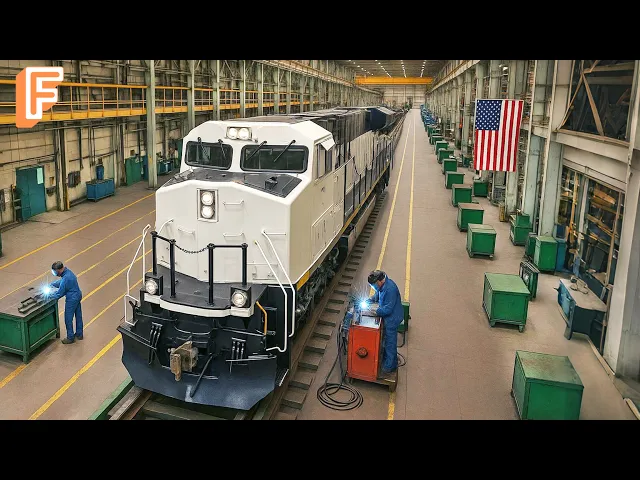
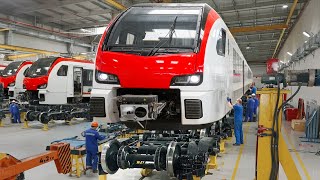
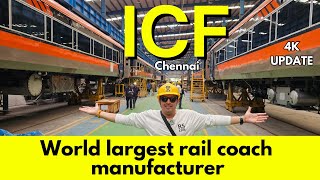
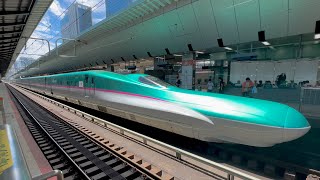
[Music] Trains, the iron horses of humanity, have the power to haul thousands of tons of cargo while racing at hundreds of miles hour. Behind that immense strength lies a rigorous manufacturing process. From massive steel plates stamped and welded into frames to the assembly of bogeies and engines, then the installation of electrical systems, drivers cabs, and interiors finished with remarkable precision.
The journey culminates in punishing tests before a train is allowed to roll onto the tracks. This is more than an industrial product. It is a testament to human engineering, labor, and creativity.
Join us as we explore how these iron horses are born inside colossal factories where cold steel is transformed into the force that moves the world. [Music] Did you know that trains were once the machines that changed the world? When the steam locomotive emerged in the 19th century, it didn't just help people travel faster.
It tore down frontiers, allowing nations like the United States to expand westward, Europe to connect its cities, and India to build a vast network of trade. Today, in the United States alone, the value of goods moved by rail exceeds $700 billion every year, turning the endless tracks into the steel arteries of the economy. That number shows that the weight of a train is not only in its hundreds of tons of steel, but in the vital lifeline it provides every single day.
In the journey of building a locomotive, steel is the fundamental material. Massive coils of steel are lifted by overhead cranes into automated storage, then fed into flattening systems. But the step that truly defines their shape is CNC cutting with high power lasers.
Here, instead of mechanical blades, a concentrated beam of light at temperatures exceeding 6,000° pierces through steel up to 1 in thick. The cut it leaves behind is so smooth that it requires almost no further treatment with an error margin that is extremely small. Every component, whether a bolt hole or a side panel stretching several feet, is programmed directly from a digital blueprint.
CNC machines can operate 24/7, cutting thousands of pieces continuously with only brief pauses for maintenance. The power required to sustain the cutting path typically ranges between 15 and 20 kW, equivalent to the electricity consumption of an entire small workshop. This precision ensures that all parts fit together seamlessly, reducing assembly time later in the process.
For large steel sheets, once they leave the laser cutting machines, they are transferred to massive hydraulic presses. There, forces of thousands of tons shape the steel into the locomotive's underframe, sidewalls, or roof sections. Each finished piece is then numbered, sorted, and placed on conveyors awaiting transport.
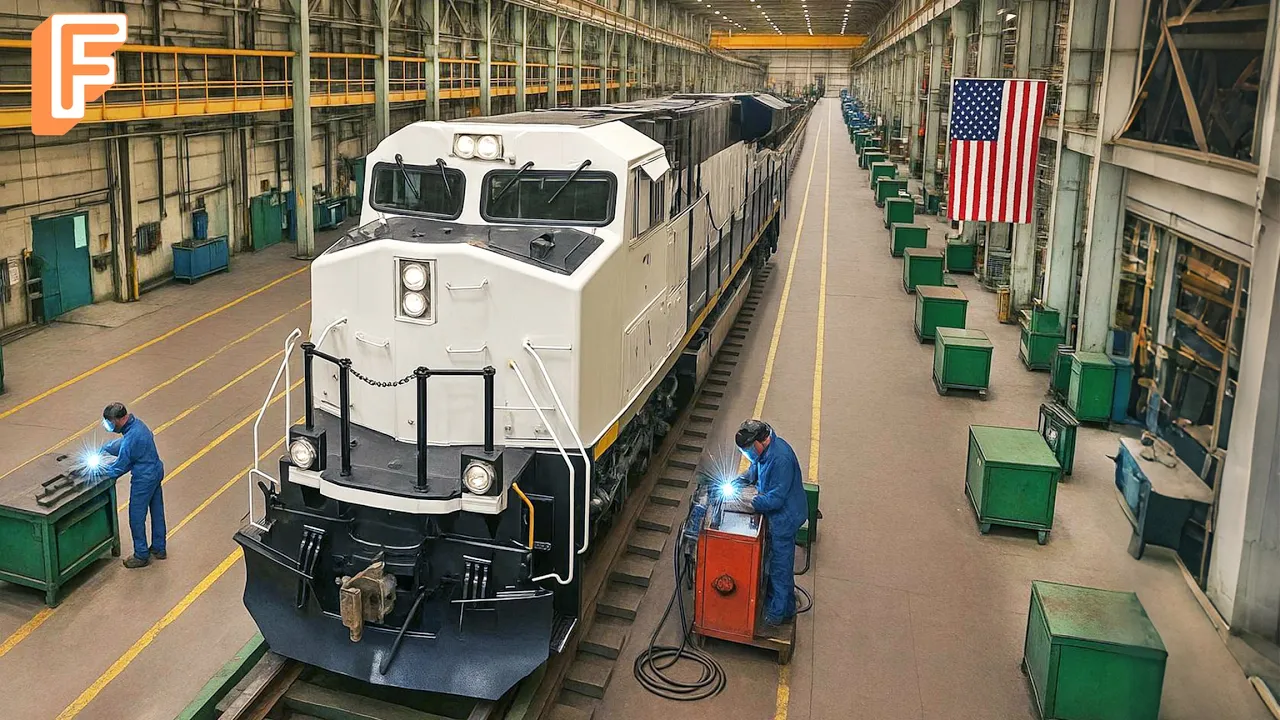
The result of this stage is a fully formed steel framework ready for the precise welding phase where everything will be joined into the recognizable body of the locomotive. [Music] After the steel has been cut and pressed into individual parts, the next stage is welding together the underframe and body shell. The main loadbearing structure of the locomotive inside workshops spanning hundreds of thousands of square feet.
Steel plates weighing several thousand lbs are placed onto specialized jigs. Hydraulic clamps secure each piece exactly according to the blueprint, while automated arc welding robots move along the designated paths, generating molten seams at temperatures exceeding 5,000° F. Each weld functions like a steel thread, binding separate elements into a unified block.
The process begins with assembling the lower floor structure, followed by the longitudinal beams, crossmembers, and load bearing ribs. Each module is welded into a solid unit, then joined together to form the underframe, the section that carries the entire weight of the bogeies in the engine. Once the floor frame is complete, the side walls, roof framework, and longitudinal reinforcements are erected, creating an integrated spatial structure that is rigid yet resilient enough to withstand vibrations.
Every weld is inspected with 3D laser sensors and industrial ultrasound systems capable of detecting gaps smaller than 100th of an inch. Frames that meet the standards are then lifted by overhead cranes with a lifting capacity of more than 100,000 lb and transferred to the surface treatment area. Once the body frame has been welded into a solid block, the next step is installing the bogeies and wheel sets, the components that determine the train's ability to move.
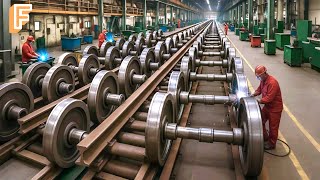
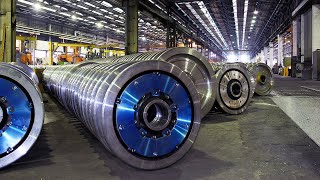
On the workshop floor, each precisely machined wheel set is placed on a balancing rig. Laser sensors scan the circumference to check roundness and alignment, ensuring that deviations remain within just a few thousand of an inch. This is essential because even the slightest error can cause vibrations when the train runs at high speed.
The welded steel bogey frame is lifted by overhead cranes and positioned on specialized jigs. At this stage, large hydraulic shock absorbers and coil springs are mounted designed to absorb the forces from the track and provide stability during operation. The wheel axles are then pressed firmly into the bearings by heavy hydraulic machines creating a mechanical fit.
so tight it cannot be separated under real operating conditions. Disc brake assemblies and clamping mechanisms are also installed directly onto the bogey, ready to control the speed of a mass weighing hundreds of tons. When the bogey assemblies are complete, massive overhead cranes lower them beneath the underframe.
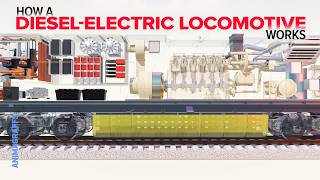
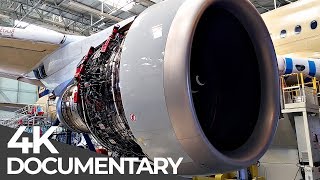
High strength bolts and elastic couplings secure the underframe to the bogeies, transforming the static steel framework into a mechanical system capable of rolling on rails. This marks the moment when the locomotive's frame first begins to take the form of a working machine. In the center of the locomotive body lies a dedicated compartment for its most critical components, the diesel engine and the accompanying generator.
This is where fuel is converted into the energy needed to power the entire locomotive. Inside the assembly hall, large parts such as the cylinder block, crankshaft, and turbocharger are lowered onto mounting bases by overhead cranes and then secured with hundreds of heavyduty bolts. Engineers then connect the cooling system, oil pumps, and air intake lines, creating a closed circuit that allows the engine to operate reliably over long periods.
Directly attached to the engine is the alternator. Its role is to convert the engine's rotational motion into electrical power. This electricity is rooted through a rectifier and distributed to the traction motors housed within the bogeies.
These traction motors drive the wheels, enabling the train to move along the tracks. During installation, every electrical connection and drive coupling is subjected to strict inspections. Vibration sensors and industrial ultrasound systems are employed to detect even the smallest flaws, ensuring the entire system operates safely.
With the combined function of the diesel engine, alternator, and traction motors in the bogeies, the locomotive gains the power to pull dozens of cars weighing thousands of tons. At this point, the assembled steel framework begins to function as a complete machine ready to take on long-d distanceance journeys. If the engine and bogeies provide the power and mobility, then the electrical system is what controls every operation of the locomotive.
From the engine compartment, large bundles of cables are routed through the steel frame and connected to the central electrical panels. Each high voltage cable is crimped securely with hydraulic presses and then tested with specialized instruments to ensure there is no leakage or loss of energy. From the panels, electrical power is distributed to the traction motors, braking systems, lighting, air conditioning, and many auxiliary circuits.
At the core lies the train control and monitoring system, which oversees and coordinates all functions. This system monitors thousands of signals simultaneously from engine speed and braking force to the status of doors and climate control. Every command from the driver's cab, whether accelerating, braking, or activating an emergency signal, is processed and transmitted through the system.
When the frame and main systems are ready, the cab is put into place. The cabin, weighing several tons, is lowered inch by inch by overhead cranes and secured with heavy duty bolts. To ensure safety, engineers check the joints multiple times, making sure the cab is firmly attached to the locomotive body.
Once the cab frame is fixed, technicians install protective features inside. Soundproofing layers are added to reduce noise from the engine and the tracks. Shockabsorbing seats and an air conditioning system are also integrated, creating a stable and comfortable working environment for the operator.
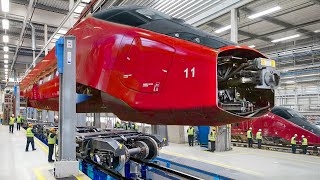
With the cab in place, the locomotive begins to take on its nearly complete form. This marks the stage where the steel frame, the engine, and the cab come together into a unified structure, ready for the final finishing processes. With the cab and technical systems completed, the locomotive moves into the testing phase.
In the static test, engineers supply power to all electrical circuits, brakes, and signals, checking them with specialized instruments to eliminate any errors. Next comes the dynamic test. The locomotive runs on massive roller benches where resistance is simulated as if it were pulling an entire train of cars behind it.
After passing these tests, the locomotive enters the finishing area for painting. The entire steel surface is cleaned by shot blasting or high pressure sand blasting to remove rust and oil. Then an anti-corrosion primer coat is applied evenly to protect the structure.
Once the primer dries, several layers of color are sprayed with high-pressure guns inside sealed paint booths with humidity and temperature carefully controlled. Finally, a transparent clear coat is applied to preserve the finish and keep the colors vibrant for many years. When the paint is fully cured, the locomotive is numbered and fitted with its logo, marking its complete appearance before delivery to the railway line.
[Music] No matter how perfect a locomotive may be, it only finds its true purpose once it rolls on the rails. And those massive steel beams have their own production journey, no less complex. So, are you curious about how these steel rails are made?
Let's find out right now. The journey of producing a rail begins with iron ore deep underground. In open pit mines, hydraulic excavators and ultraheavy dump trucks work continuously to extract thousands of tons of orbearing rock.
Before extraction, drill holes several feet deep are made and filled with industrial explosives with the blast carefully calculated to break the rock apart without damaging the ore inside. The excavated rock is then hauled to preliminary crushers or in underground mines transported to the surface by conveyors and mine carts. At the plant, the ore is crushed into particles only a few inches in size, then screened and blended with coke and fluxes in precise proportions.
Massive mixing drums operate non-stop to ensure a uniform composition. This combination step is critical because only when the raw materials are consistent can steel be produced that is strong enough to bear heavy loads and last for decades on railway lines. The processed raw materials are fed into the furnaces, the very heart of the rail production line.
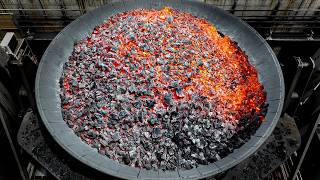
Massive electric arc furnaces and blast furnaces operate at temperatures of more than 2,900° F, hot enough to transform ore and additives into uniform molten steel. The automated charging system weighs each batch with precision while thermal and spectrographic sensors continuously monitor the chemical composition. Heat resistant robots stir the mixture and remove impurities before alloys such as manganesees or chromium are added at exactly the right moment to increase strength and resistance to wear.
Only when the temperature is kept stable and the composition meets strict standards is the molten steel ready for the next stage. The quality achieved at this stage determines the lifespan of the rails as each one must withstand millions of train passages over many years. After leaving the furnace, the molten steel is poured into molds and transferred to the soaking pits.
Here, a temperature of more than 2,200° F is maintained continuously to prevent the steel from solidifying too early. From the soaking pits, the steel enters the rolling line. Heat resistant rollers driven by hydraulic systems compress and stretch the steel into initial billets several feet long.
Once the steel reaches the ideal level of plasticity, the glowing billets pass through roughing, intermediate, and finishing mills. Massive alloy steel rolls, each weighing dozens of tons, quickly reduce the thickness, extend the length, and precisely shape the high-profile cross-section that characterizes railway rails. Throughout the rolling process, high pressure water jets cool the surface and keep the temperature stable.
The result is long steel rails stretching dozens of yards with the strength and uniformity required to meet strict standards before moving on to quality inspection. [Music] When leaving the rolling line, the rails, each stretching dozens of yards, are transferred to the quality inspection area. High-speed cameras and optical sensors record every detail of the surface.
Inside, industrial X-rays and ultrasound systems scan the internal structure to detect cracks or hidden defects. Some samples are subjected to tensile, compression, and hardness tests to evaluate loadbearing capacity. Only rails that meet all criteria receive certification marks, after which they are cut to standard lengths before packaging.
From there, the finished rails are transported by specialized rail cars or cargo ships to construction sites ready to be installed into the railway network. The process of building a locomotive is a closed chain of operations where every steel plate, every weld, and every electrical system is strictly controlled to create a machine weighing hundreds of tons. The result is not just a means of transportation, but a foundation of industry and modern social connection.
Behind every passing train lies an immense production line working without pause. If you found this journey impressive, don't forget to like, share, and subscribe to the channel to keep exploring more stories of large-scale industry.