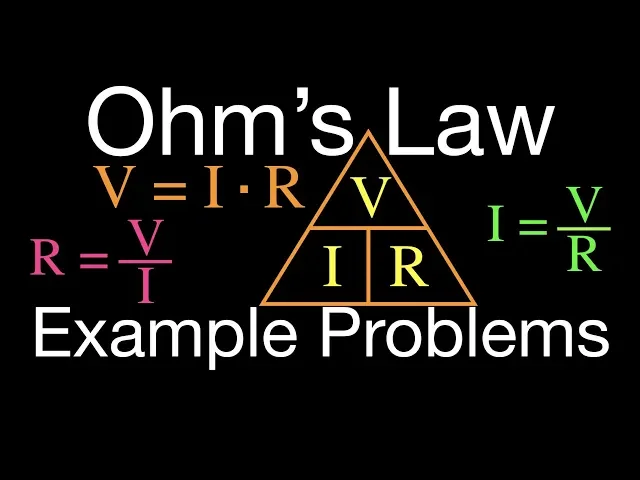
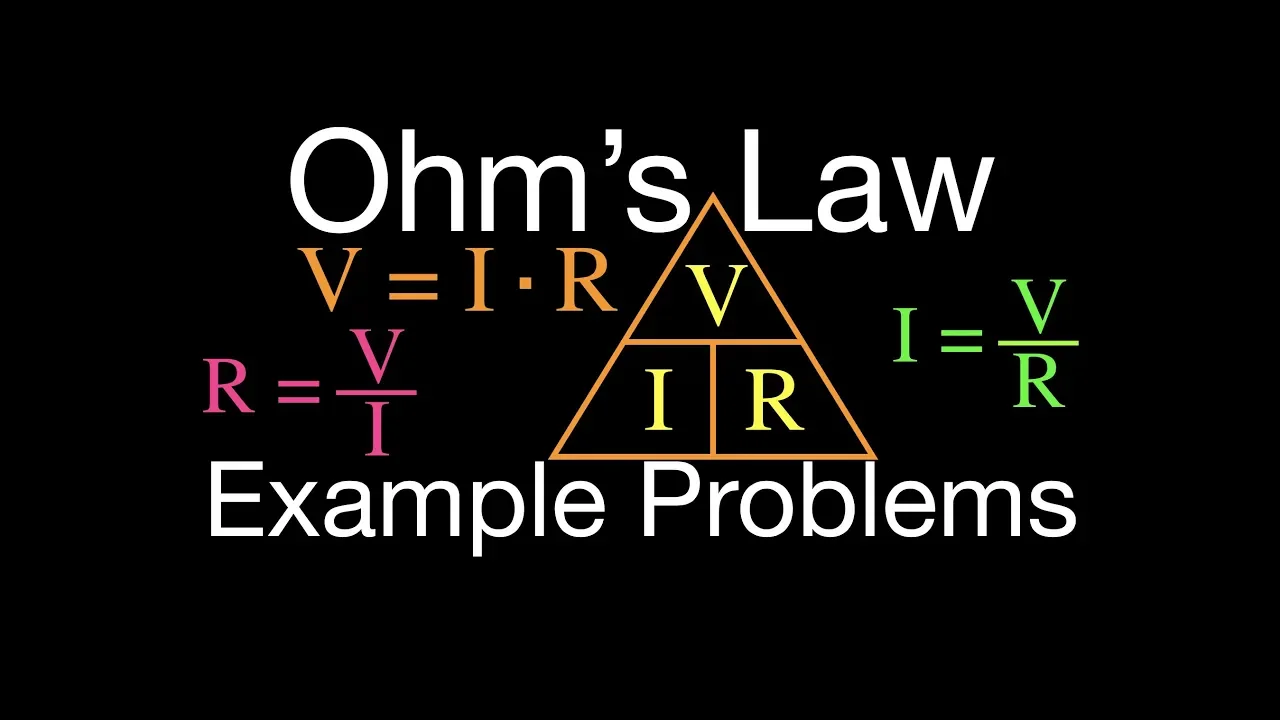
in today's video we are going to go over some example problems for Ohm's law in a previous videos I'm in explanation from Ohm's law and also for electric current and resistance and resistivity you can link to all of those videos in the upper right hand corner of this video before we get started please don't forget subscribe to my channel get all my excellent physics chemistry and math videos please help me reach my goal of 100 thousand subscribers please subscribe and don't forget leave me a comment also in the comment section below and let me know to think of the videos and the channel thank you very much and here we go we're gonna go over some example problems I think I have five or six problems here it says here what is the voltage what voltage will produce a 0. 35 ampere current when that is hooked up to a resistor that has a resistance of 750 ohms now remember this is Ohm's law which is simply V equals I times R or as my mother used to sing to me at night before I would go to bed twinkle twinkle little star don't forget V equals I times R we're given the current we're given the resistance and therefore we know that the voltage that would produce that current across or through 75 750 ohm resistor would be 263 volts okay there you go number 2 now this time we have a hair dryer and the hairdryer is drawing 6. 5 amps of current and it's plugged into a standard 120 volt outlet and we want to know what is the resistance of that hairdryer the heating element or the hairdryer and we want to know how much charges would pass through that hairdryer with that current in five minutes we're gonna do two things here minutes start off with V equals I times R Ohm's law we want to know what is the resistance of the hairdryer so that means that our the resistance is equal to the voltage divided by the current and put the voltage in there 120 volts six point five amperes and we get that the resistance of the hairdryer is eighteen point five ohms the second thing is just how much current IC much charge passes through in five minutes now we're going to use our current equation which we talked about you know an electric current video if you could link to in the upper right hand corner of this video and it says that the current is equal to the change in the charge divided by the time so that's kind of definition of current is charge divided by time okay we're not using V equals I times R this time we're using the other equation we have or one of the other equations we have for the current and that tells us that the charge is going to be equal to the current times the time because we want to know right here it says be how much charge passes through so we have six point five amperes remember that the current has to be in seconds the time has to be in seconds and we have five minutes and six times five is because 60 seconds in a minute is thirty and that would give us 300 seconds because the current is in coulombs per second the seconds will cancel and we get that that would be nine hundred and fifty coulombs of charge would pass through that hairdryer in five minutes number three is simply the heating element of an electric heater has a resistance of 10 point 6 ohms what will be the current when it's charged when is plugged in to a 240 volt source so in this case we're in sin again we're gonna start out with Ohm's law V equals I times R and we want to know what the current be now in this case we're given the voltage and the resistance so we're gonna use our Ohm's law equation rearranged for current as the voltage divided by the resistance and that gives us that 240 volts divided by the resistance of 10 point 6 ohms and that tells us that current is twenty-two point six amperes okay coulombs per second okay the next one says here that the what voltage okay so we have a voltage and must the battery had to produce half an amp through a four ohm resistor kick now and to do this one again be equals I our current 0.
5 resistance 4. 5 times 4 is simply going to be equal to 2 volts all right now this one we have okay we're gonna do a little bit of research on the human body and the resistance and the current for the human body we have to research the electoral properties of the human body one electrode is placed on the patient's risk so you place an electrode on your wrist tape it on there and another one on your shoulder and you have your arm it's kind of like a wire okay and we're going to put across those two electrodes 100 millivolts and we gonna we're gonna measure that when we do that we get 12. 5 milliampere milliamps we want to know what is the resistance so we're gonna start off with V equals I times R we have that R is equal to V divided by I the bullish now we're gonna convert we don't really necessarily have to do this but I did this because we're both in milliamps but it should be just in the volts so I have 100 and milli is times 10 to the third minus 3 because it's milli as 1,000 and so we have 100 times 10 to minus 3 volts and we have twelve point five times ten to minus three amperes so it's milli amperes we have bolts and amperes our base units there and then we can see that these would actually cancel and it's just going to be 100 divided by 12.
5 and that would be 8 ohms of resistance along your arm there when you place that voltage across the arm you get that current because your arm has resistance of 8 ohms okay no we have I think this went to the last one now you're gonna be the screaming you're in the shower and of course you come another shower and you gotta grab the hairdryer to dry your hair and you notice that you touch the wire because the wire is frayed and bright and coming off of that what insulation is coming off the wire so you get through your body 120 volts okay now your body when it's wet especially has a resistance of about 400 ohms you want to know what will be for your by Sakura flows through the out the wall along the wire out the wire through your body and into the full or into the ground and that means that the current is going to be the voltage divided by the resistance and that's 120 volts divided by 400 ohms and you get a current of 0.