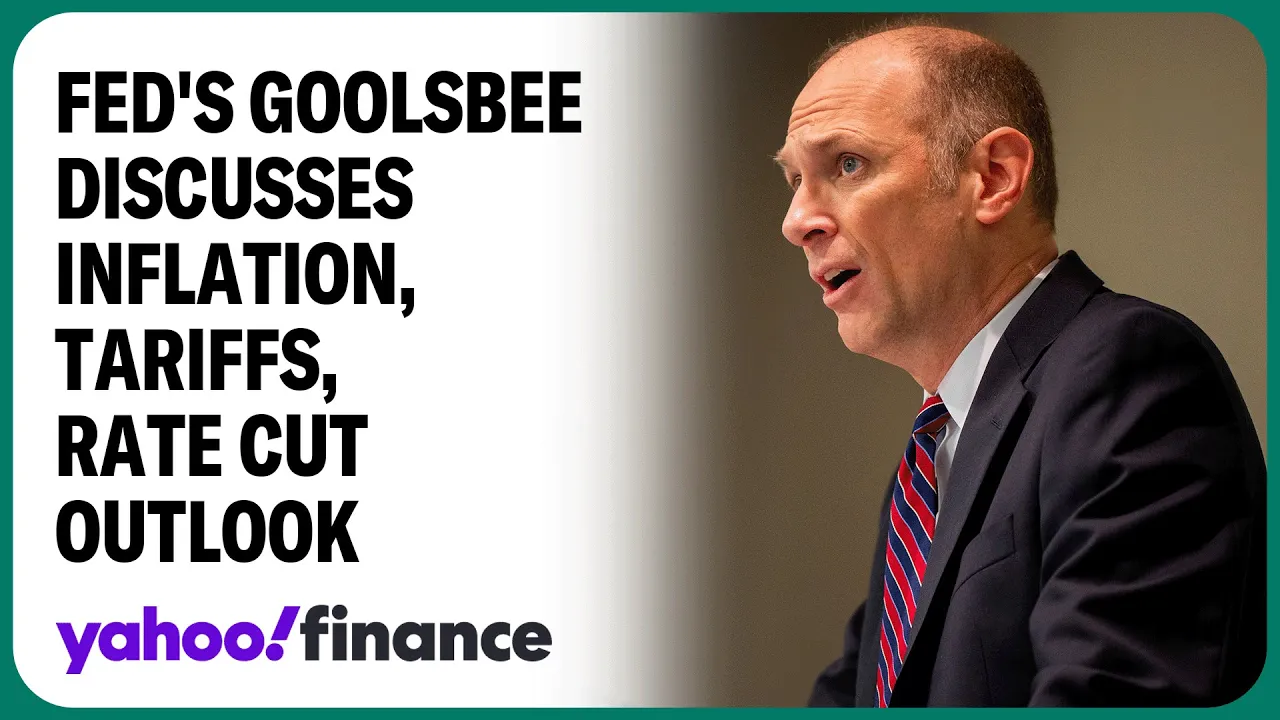
[Music] the January jobs report showing that the labor market remains resilient with unemployment falling to 4% and wages Rising more than expected and we saw job growth was even stronger than previously reported to end 2024 with those latest revisions let's send it over to our very own Jennifer shamberger who's joined by Chicago fed president Austin gby Jen thanks so much sha and thank you Austin for joining me today on jobs Friday it's great to see you absolutely it's great to see you Austin I want to kick things off with your reaction to this morning's jobs
report what really stood out to me was that the unemployment rate dropped to 4% even as we saw that non-farm payroll number cool on the top line meanwhile wage growth surprised to the upside and we had some major revisions revised upwards so given all of this data that we got this morning how are you viewing the state of the job market now and do you think that employment can be sustained at these levels all of those are important questions as you know every time I come on here on jobs day I say let's not get
too worked up over any one month and that's especially true for January because there are a whole bunch of revisions that take place in January for the for the previous year now that said I think this was a solid report it was close to what was expected the unemployment rate tick down a little bit taking all the broad measures together because we got some question marks on any one of them taking them all together to me it really feels like it shows we're settling into something like full employment and that's that's a better spot to
be than the one we were at let's say six months ago where unemployment was just creeping up and creeping up and we were trying to figure out are we about to continue and and move into something worse you said we're settling into full employment here uh president Trump announced 25% tariffs on Canada and Mexico only to pause those for 30 days but we have seen 10% tariffs on China implemented and remain in place given the potential uncertainty for tariffs to come back on Canada and Mexico for tariffs on China to be even ratcheted higher and
the fact that we already are seeing tariffs implemented on China how do you think that impacts the outlook for the job market uh but adds a little uncertainty as you know the Chicago fed is the Seventh District we're hard of the Midwest you know and as I say is we're we're like the Saudi Arabia of Auto production so I was just in Detroit talking to Major Auto suppliers and some of the major auto companies the issues of the potential for escalating trade War being a a wrench thrown into the supply chain is very real it's
it's on their minds um I I'm hopeful that we have more experience like what we saw this past week or so that for all of the argument it ends up not being a big impediment to to actual trade I think if you look underneath the surface of this uncertainty that really this the the the job market looks like stabilized at full employment we have solid growth we have very solid productivity growth wage growth is about consistent with 2% inflation and as as I view the new months coming in we've been getting good news on inflation
that it looks like the path to 2% so if we don't have too much policy uncertainty about tariffs about geopolitics and that sort of thing I'm still pretty comfortable with with the path that the economy is on a couple follow-ups there one we are seeing inflation expectations ratchet higher this morning does that impact how you view the path for inflation and all and what that means for rates it could but let me just emphasize the the inflation expectations measures that are moving are these consumer survey of inflation expectations and they're just for the short run
just for this coming year that's less influential on my thinking than the long run expectations and I've been I've highlighted the market-based measures as being what I look at if you started to see those market-based measures of long run inflation going up I would be I I would I would put a lot of weight on that but th those have been anchored absolutely solidly at exactly the target the market believes and the long run expect expectations are not changing believe that we are going to get back to 2% Austin you said in a speech this
week that if we see inflation rising or progress stalls it's going to be challenging for the FED to try to discern whether it's coming from overheating or from tariffs and that quote the distinction will be critical for deciding when or even if the FED should act so if inflation is indeed coming from tariffs would the FED not act well I my my argument was if you just look within the let's call it economic theory in principle if it's a one-time tariff that increases cost but doesn't keep going and it's there's no retaliation that's that's a
transitory inflation shock and I use that word with a little hesitation in in a way you're supposed to look through as a central bank something that's only a transitory shock but the hard part if we were to get big tariffs the hard part is trying to figure out well which which part of the inflation is transitory and which part is permanent that that you should be paying attention to as I say what my My Hope Is that we don't see a rebound of inflation but if we're going to add this policy uncertainty and we do
start seeing a rebound of inflation that's going to be a a much more difficult situation A foggier dustier kind of environment it's going to be hard to see the through line do you worry that the 10% tariff on China is going to increase supply chain costs and what are you forecasting in terms of the overall impact on inflation you spoke to that in your speech this week I I look I have some worries um but it's kind of that's a job of central Banker if you say what keeps you up at night you're not supposed
to sleep at night you're supposed to be up running through every scenario that could happen the the we still have to see what goods these tariffs would apply to how long they would last is it just going to be on China is it just going to be 10% we do have the experience of 2018 in which tariffs on China did not have a very big material impact on overall inflation um so it could be similar it could follow a similar pattern if we just stayed where we were but that's the one where I as I
said you brought up this speech I gave in that speech I said the only thing we could do is just get out there as data dogs and pursue the industry expertise talk to the people in these businesses and use our industrial expertise from within the FED to try to figure out under the hood how how big are the supply chain impacts going to be uncertainty aside it seems like you said we're at full employment here the economy is in solid shape you you know given of that where do you see the path for rates now
does that mean that you may be on hold for some time we look we may be on hold but I see over the next 12 to 18 months if we can get out of the uncertainty from coming from policy or from from geopolitics and commodities I view the long run settling rate of for for the FED funds rate to be fair bit below where it is today and and if you look at the Dot Plot there's pretty wide consensus that the neutral settling point for rates is down um I do think the speed at which
rates would come down is going to be a little slower the more uncertainty and fogginess we we add to the to the picture here but overall I still think we're on path to get back to two 2% inflation we've had couple of months of pretty solid readings in this 12mon trailing average on inflation is the only thing that's seemed to in my mind show that that we've stalled out a two higher level and that's mostly because of Base effects that in the first quarter of last year we had a bump up and inflation so if
numbers keep coming in like the ones we've seen in recent months that will start dropping pretty significantly as as we go through the first quarter so that's that's kind of where on inflation my eye is is is watching that hey Austin shaa just jumping in here so it sounds like there is still a very strong case end to cut rates again this year I look I I I have said over a 12 to 18month period my view of where is neutral is well below where we are now in the summer I said it was hundreds
of basis points we then cut a 100 basis points so that was a good way to start and I said I thought it would be natural if there's disagreement if we're trying to figure out what is the stopping point that we might start slowing down having some pauses trying to feel our way to where is neutral because as you know monetary policy works with a lag so you can't just uh precisely hit it and do it all in one month but I I still think that left to its fundamental devices the natural settling point for
rates is below where they are today and we just we we got to get there on a judicious timetable Austin I'm curious just to get your thoughts on some of the commentary that we got from treasury secretary Scott Besson earlier this week and he very much said he's not worried about the fed or the Trump Administration isn't focused on the FED they're more focused on lowering yields and and I bring this up in the context of how do you view Market rates in context to policy and and and and what is necessary yeah I I
I was I found myself in agreement uh with with most everything that the Secretary of the Treasury was discussing that he said there uh they they had an eye on trying to get long rates down and the way they wanted to do that was upping productivity growth deregulation trying to increase the growth rate of the United States on a sustainable basis that it wasn't an argument with the FED about what the short rates should be as you know the long rates which are the most impactful on business investment decisions on mortgages on things like that
there are a lot of Market factors that influence it what are the expected long run inflation how much treasury issuance is there going to be what is it going to be a shallow or a steep uh rate cut path on short rates going into the future and then what's productivity growth what's happening in the rest of the world all of those factors are driving long rates I I don't think the the fed's Mandate is about setting these the FED funds rate and the short rates based on maximizing employment stabilizing prices we take fiscal policy as
a underlying condition in the economy and conditions change all the time so our job is to process run through scenarios process that information and set the short rates what's happening in Long rates is in our forecast and is in our evaluation of the conditions but that's not our Target our policy Target is not to to go uh move the long rates it it sounds like that's more treasury's Target Austin how far are we given what you just said from neutral and you said that you think that we're to end the year with rates lower assuming
we don't have any um major changes in policy that could affect the path forward so given that you know would we end the year at neutral or is that something that's going to take more time I think it's going to take a little more time um Loosely if you take the long run settling point out of the dot plots there's disagreement over where it is but it's still a fair bit below where we are today and most of the dots suggest that this if nothing else changed or what they would view would be appropriate is
that over one to two years we're getting back to something like neutral what's going to determine how fast we can do that is what happens to conditions and I think we're on path back to 2% on the inflation side and as that inflation comes down we can commensurately be cutting the interest rate that that's where my starting point where my head is but as I say we there's uncertainty about what the truly neutral rate is monetary policy works with a leg so we're going to slow down and kind of feel our way down to neutral
and I think that's perfectly appropriate there's there's nothing wrong with that Austin Before I Let You Go what are your thoughts on the proposition of a US Sovereign wealth fund and would the FED play a role in that I don't think the FED would play a role in that I mean that that's a fiscal policy decision um if I've ever if we've ever heard of one that's a that's something to be decided by Congress and the president um as you know the fed's balance sheet there are laws that restrict what we're allowed to invest in
and of course of course our idea is always safety safety safety uh you you've seen the statement put out by the fomc that we're trying to move the balance sheet to be all treasuries um not even uh MBS and so I I don't I would not think that the FED would naturally be asset manager of the Sovereign wealth style Austin I want to thank you so much for all of your Insight today so appreciate you coming on on jobs Friday hope to talk to you soon yeah it's always fun seeing you