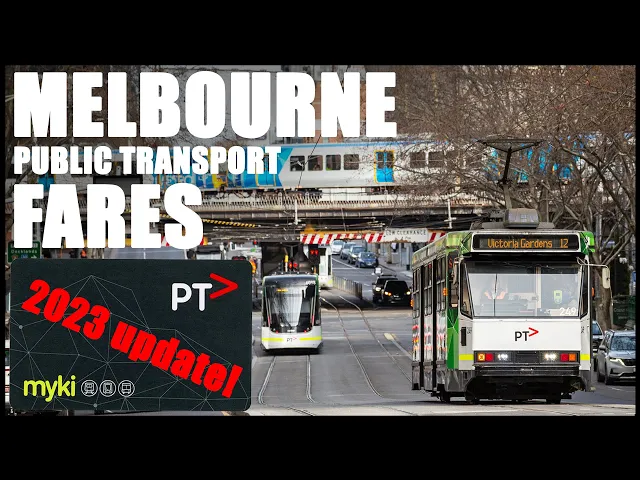
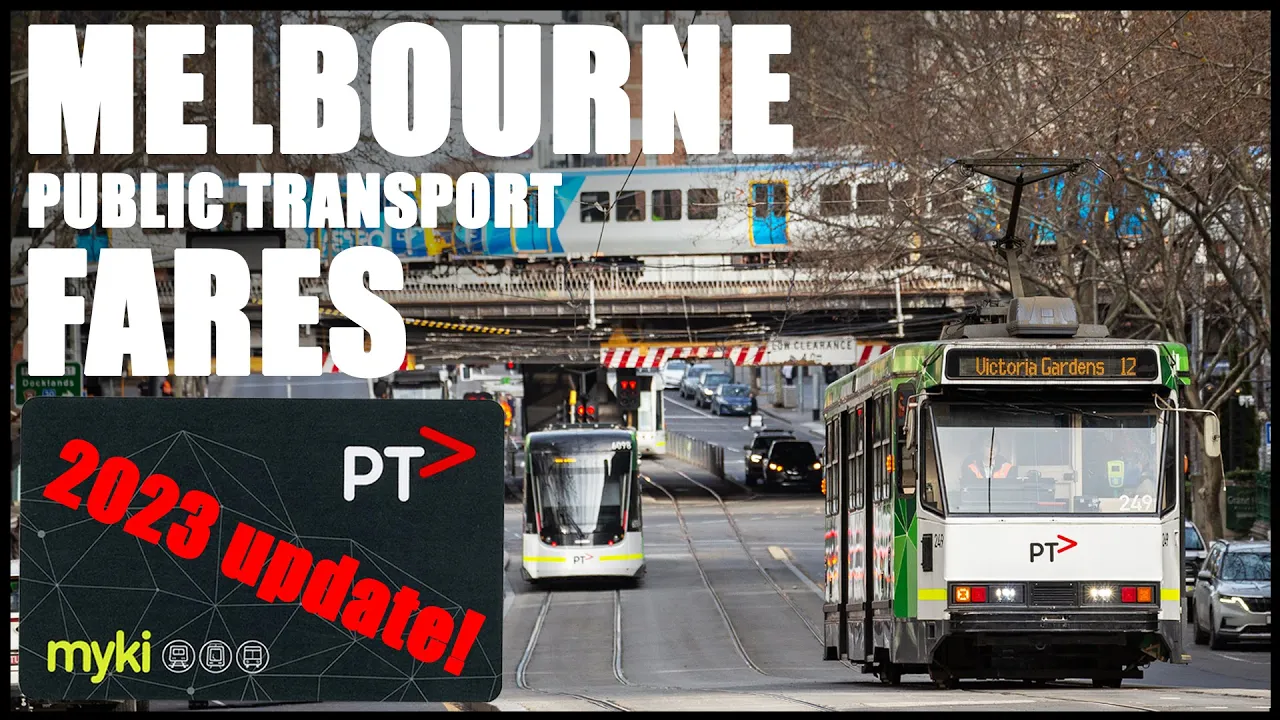
Hey there, in this video I'm going to talk about public transport fares in Melbourne – why some journeys are much better value than others, how the system is designed to encourage certain behaviors, and why many public transport advocates don't actually like the Free Tram Zone. This is an updated version of a video I first published in 2022, covering some changes that have happened since then and also covering a few points I might have missed last time. Up until the early 2010s, anyone public transport in Melbourne needed to have at least a basic knowledge of how the fare structure worked, because you had to know what ticket to buy.
But since the introduction of the myki smartcard system, which automatically calculates the fare for your journey, there are now plenty of people using the network with no real understanding of how much they are being charged or why. Fortunately public transport in Melbourne is mostly very cheap, so it doesn't really matter to most people if they don't know the exact details of their fare – in fact, no matter how far you travel in the state of Victoria, you won't spend more than $10 in a single day – and just $5 if you're on a concession fare. So first of all, let's just clarify exactly what I'm talking about here: the myki system covers all of suburban Melbourne as well as a large part of regional Victoria.
This video is mostly about how it works in the metropolitan area, but I will cover the regional situation a bit later on. The fares I'm quoting in this video are the 2023 prices which are current at the time of writing - usually all fares creep up slightly at the beginning of each year. Concession fares are available to a wide range of people, and are exactly half of full fares.
Ok so let's look at some of the basic principles. Melbourne has integrated ticketing across trains, trams and busses, so changing modes part way through your journey won't increase the cost of your fare. The fares have very little relationship with distance, but instead are broken up into blocks of time.
The smallest block of time is 2 hours, so when you touch on your myki for the first time on any given day, it doesn't matter if you travel for 2 minutes or 2 hours, you will be charged the same flat rate. If you make a return trip within those two hours, you won't be charged anything extra – so it could be that you make a five minute trip, then return an hour and a half later, and that would still just be a single two hour fare. Because changing modes doesn't affect the pricing, you might take a bus to a suburban station, change to a train into the city then finally reach your destination by tram, and you'll still just pay that same old 2 hour fare.
You could catch a train for just one stop – say the 50 second journey between North Richmond and West Richmond – or all the way from say, Pakenham to Williamstown – and as both those journeys can be done within two hours, the cost is the same. So what happens after two hours? Well as soon as you make a trip more than two hours after entering the system, whether that be 2 hours and 1 minute later, or 10 hours later – you then pay for a Daily fare.
This is exactly double the 2 hour fare, so you just pay the same amount you paid for your first journey again. A Daily fare is valid until 3am the next morning, so it's possible to get a huge amount of value out of it. One thing that's great about having a Daily cap like this, is that if you're out for the day and you know you're going to be paying for a Daily fare, then any additional spontaneous travel you might do is completely free.
For instance when I'm at work I often catch a tram during my lunch break, and because I travel to and from work by train I'm committed to a Daily fare anyway, so catching the tram at lunch doesn't add any extra cost – even if I'm not in the Free Tram Zone. In fact the other day after work, I went down to shoot some trams around the St Kilda area, enjoyed a sunset on the beach, then headed to an event in Docklands before taking the train home all effectively free, covered by the daily fare of my normal commute. Now the other factor in fare calculation is Zones, and this is where distance kind of comes into it.
. but less so now than it used to. In the 90s and early 00s there were three fare zones, which used to be prominently displayed in three bright colours on the network map.
Under that system, fares incrementally increased depending on how many zones you traveled through, with zones 2 and 3 being individually a bit cheaper than Zone 1. So a 2 hour Zone 2 ticket was pretty cheap, but anyone commuting to the city from the far south-east needed a Daily Zone 1+2+3, which was comparatively fairly expensive. Zone 3 was dumped and replaced in 2007 by an extended Zone 2 which made things cheaper for long distance commuters, but there was still a bit of a flaw in the Zone system.
If you were making a short trip in the middle suburbs, but had the misfortune of having to cross into a different zone during that trip, you would have to pay quite a bit more than anyone making a much longer journey entirely within one zone. They more or less solved this in 2015 when the overlap between zones 1 and 2 was extended all the way to the edges of the system, giving us the layout of zones we still have today. This was broadly advertised to the public as 'abolishing Zone 2,' but that's not what it was at all.
Zone 2 still exists, but essentially as a slight discount for anyone travelling exclusively in the outer suburbs. This basically means that travelling to or from Zone 2 doesn't add anything to your Zone 1 fare, so a commute from the outer suburbs now only costs you a single fare zone. The only time Zone 2 comes into play is if you make a journey entirely within the 1 & 2 overlap area, then you will be charged a Zone 2 fare only, which is about 34% cheaper than a Zone 1.
I'm not exactly sure what the thinking was here rather than just eliminating Zone 2 altogether, but it does possibly encourage people to use the outer part of the network which often has capacity to spare, and also provides a small compensation for anyone using some of the very poorly served outer suburban bus routes. There are also a number of measures designed to incentivise travel outside of peak times. This includes a weekend and public holiday fare cap, which drops the daily fare down to $7.
20 – that's $3. 60 for concession. When I was a teenager there used to be a Sunday Saver Metcard which cost $2.
50, and we used to travel literally hundreds of kilometers on it. Then there is the Early Bird Fare, which I've found almost nobody knows about. Early Bird means that travel on suburban trains before 7:15am on weekdays is completely free.
This is aimed at encouraging any commuters who can, to travel into the city before the morning peak. You still have to touch your myki on and off as usual, but you won't be charged. One odd thing about this is that it applies to trains only – not trams or busses, so you will only avoid paying if your entire journey is by train – this is extremely stupid, as it discourages use of connecting buses and trams during that time.
I travel in the Early Bird hours quite a lot, and my impression is that most people don't actually realise they're not being charged. Another little quirk to encourage off-peak travel, is that if you make your first trip of the day after 6pm, the 2 hour fare extends all the way until 3 am – let's call it the. .
9 hour 2 hour fare. Back in the Metcard days at my home station of Eltham, people used to stand by the validators with their 2 hour Metcards at the ready, waiting for the moment the display rolled over to 6pm then attempt a dash onto the 6pm Flinders Street train – not always successfully. This doesn't seem to happen any more – I assume because most people are no longer aware of this rule.
There is also a system of long term myki passes, ranging from one week to one year in length. This is where you pre-pay for a pass, which over time works out cheaper than if you had paid individual fares during this period. I think this approach is a bit dated, and really only worthwhile for full time commuters, who are confident their commute isn't going to change any time soon.
I've never bought one because my future travel plans and work have never been that predictable. A far better way of doing this would be to have an inbuilt weekly or yearly cap, where it just stops charging you after a certain amount of travel in that timeframe – no different to the way the Daily or Weekend caps work. In fact, Sydney has an automated weekly cap, and while we don't traditionally like to learn from other states, this is one concept definitely worth stealing.
Ok now I know everyone wants to hear about the Free Tram Zone. So in 2015 this thing called the Free Tram Zone was introduced, which. .
is exactly what it sounds like. A zone covering the CBD and Docklands where trams are completely free, and you DON'T NEED TO TOUCH ON YOUR MYKI . .
or even have one. This was partly to make it easier for tourists to make short spontaneous journeys in the city, without having to figure out where or how to buy a myki. Now most people initially reacted quite positively to this, and I think free public transport can be a good thing in some circumstances, but the way it was implemented raises some real questions about who actually benefits.
As I said earlier, if you're a commuter who is already committed to paying a Daily fare, then any incidental travel in the middle of the day is already free. So the Free Tram Zone doesn't benefit regular users of the system who are already paying for a day's worth of travel. Even most tourists are unlikely to spend their entire day within the Zone, and a myki will still be needed to reach many of our major attractions such as the Zoo, St Kilda Beach and Puffing Billy.
Meanwhile, people who actually live in the CBD certainly do benefit – no question about that. But there's one more category of people who can take advantage of 'the zone' – and that is people who have driven into the CBD, but might use a tram for a short trip while there. So the people who contribute the most to traffic congestion and pollution in the city, are some of the biggest beneficiaries of this free travel incentive.
In fact there are several private car park operators which actively advertise their proximity to the free trams, while simultaneously charging significantly more than a daily public transport fare. The other problem is that free travel encourages people to make really short trips – like just 1 or 2 stops, where they otherwise might have just walked. This would be fine if there was capacity to spare, but in reality it means the trams get heavily congested with people who could easily be on foot, crowding out passengers making longer journeys.
Alright so let's have a look at how fares work outside the suburbs. The inner part of the V/line network is included in Zone 2, and therefor the fares function exactly the same as they do in the Melbourne suburbs. Fares beyond Zone 2 are based on a much more complicated system, which used to result in wildly varying fares which grew higher the further you went, however in early 2023 the state government simplified things by extending the daily fare cap to cover the entire state.
This means you can now travel anywhere in Victoria for no more than $10 a day, which is really quite remarkable and would be saving some regional travelers well over $100 a week compared to the previous system. To really put this in perspective, if you are completely mad you could travel 17. 5 hours from Mallacoota to Mildura, and it will cost you $10.
For another example, what say I take a 5 minute tram ride at breakfast time, then take a bus three stops at lunch time. . that's my $10 daily cap paid, so in the afternoon I can go anywhere in the state for no extra cost.
Maybe I'll just make a quick 300km trip up to Albury for free. However there is currently one catch to this, which some of you might have picked up on in that example. The outer-most reaches of the V/line network are not yet integrated with the myki system and still use paper tickets, which are cool if you collect tickets.
. but not really for any other reason. In the case of that spontaneous Albury trip, there's no way of converting the daily fare from my myki into the paper ticket I need, so in reality I would need to spend another $10 buying that ticket.
Paper tickets are expected to be phased out soon so this problem will eventually go away, but in the meantime, it's still only an extra $10 to make that unplanned trip. So, public transport in Victoria is very cheap, but as a general rule, longer journeys are much better value than shorter ones. The contrast between a 5 minute tram trip costing $5, but an 18 hour trip crossing the entire state costing only twice that, is certainly very stark.
But overall, the various fare caps mean a lot of travel is effectively free, and understanding the system can help you make the most of that. Thanks for watching!