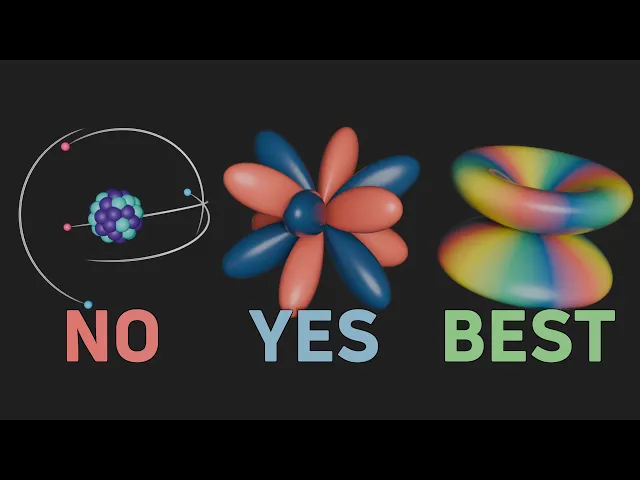
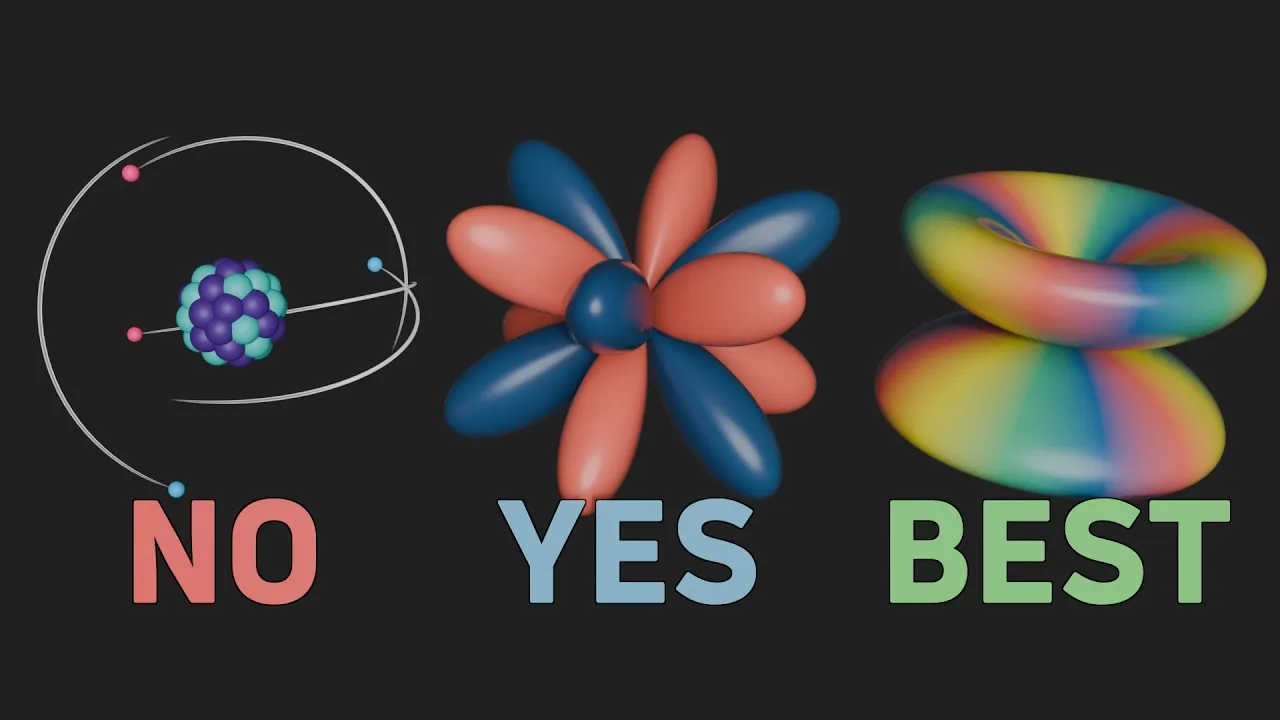
Although often depicted as little balls orbiting the nucleus like planets in the solar system, electrons actually exist in these strange globules we call orbitals, but they seem very strange. Why would they just be like this orbital? How can they possibly look like this?
That's what we're going to try to tackle today. To begin, the first thing I need you to know is that everything is waves. Electrons, protons, photons, you and me, we're all waves.
But at large scales, these waves behave more like particles. So it makes sense why we don't really discuss the wavelike nature of reality. But at very small scales, like the volume around an atom, we can no longer ignore the wavelike nature of all things.
and waves behaves or there are limitations to how a wave can manifest in these very small environments. Let's start by looking at a basic one-dimensional wave. A wave is characterized by its wavelength and amplitude.
But honestly, the amplitude doesn't really change the wave itself. If I play a 600Hz sine wave and another with greater amplitude, I still call them 600 htz. We really only care about the wavelength.
A traveling wave can exist on a spectrum of infinite possible wavelengths. However, what if I clamp this edge of a wave? As I start the oscillation, everything looks normal.
But when the wavefront reaches this end, well, the wave medium is clamped and can't move. The wavefront wants to excite this point but instead suddenly this excitation is resisted which causes a snap or force applied with the opposite amplitude. This force propagates backwards down the wave.
This is often visualized as a reflecting wave. If we repeat and I keep the initial wave visible, we can see that as the initial wave reaches this point at its maximum amplitude, the wave should be here. but instead it's here.
The only way for that to happen is if an equally strong negative force is exerted on the wave medium. This strong negative force propagates [music] backwards. When it aligns with a negative amplitude of the initial wave, it constructs with [music] the total amplitude.
As you would expect, when it aligns with a strong positive amplitude, they destruct. If we keep this going, eventually we stop seeing moving wave fronts and instead a standing wave materializes. Standing waves occur anytime you constrict the boundaries for waves.
We still have infinite potential standing waves as we can freely adjust the wavelengths. But what if I also clamp the other edge? Now our wave is going to behave.
Because we have clamped both edges, there are a finite number of waves that can exist here. Mathematically, there are still an infinite amount, but in reality, it's very much a finite number. Because confined waves become standing waves, the only standing waves that will exist in this space must be motionless at the edges.
That means all standing waves will be some multiple of this wave here or the fundamental frequency. [music] You can create half fourth and so on wavelengths. Each one is a quantized variation of this fundamental frequency.
But if you introduce a frequency that is not a quanta of the fundamental frequency, well, no you didn't. Everything you can imagine here is just some combination of quantized waves that fit in this space. This is why a guitar string always plays the same tones.
Along with wavelength, standing waves possess two more characteristics to describe them. These are called nodes and anti-nodes. Nodes are loces on the wave that don't move at all.
Whereas anti-inodes are the locations where the most movement occurs. The number of nodes is how we characterize this wave's mode of vibration. Adding more nodes changes the mode of vibration and increases the wave's total energy.
For a one-dimensional standing wave, mode of vibration is characterized by a single parameter. We'll [music] call it n for nodes. Let's move to the second dimension.
In the second dimension, we work with a drum head. Just like in the one-dimensional example, when we constrain the vibration of our drum head, any wave traveling towards the clamped boundary will reflect and interfere with itself. A drum head is really just an infinite number of one-dimensional waves.
This means there also exists a fundamental or base frequency. This is the easiest to conceptualize [music] as it is just the fundamental frequency of a one-dimensional wave with radial symmetry. The biggest change between one and two dimensions occurs with our nodes.
Nodes are one dimension behind the wave. [music] So in our one-dimensional wave, the nodes were zero dimensional points. And now in two dimensions, our nodes become one-dimensional lines.
The vibrational modes of our 2D waves are also defined by the number of nodes or the parameter n. But when we increase this parameter, we see we always get radial symmetry. If a drum head truly was an infinite amount of one-dimensional waves, then we should be seeing a wave like this somewhere.
This would mean the center of our drum head would be motionless and a node. But we can't have a point node at the center since nodes in two dimensions are lines. We can however draw a line straight across.
Now we find the waves we are expecting. This new line is called an angular or linear node. And just as we can have multiple radial nodes, we can have multiple angular nodes.
The vibrational mode of our 2D surface is characterized by two parameters. N dictates the number of radial nodes and M dictates the number of angular or linear nodes. I want to highlight that a vibrating drum head doesn't just vibrate in one of these patterns.
In fact, it's almost certainly a combination of dozens of different patterns. [music] But whatever is happening in a drum head, you will always be able to decompose those vibrations into these modes of vibration. Here's a nice website that lets you monkey around and see how that would look like if you add different modes of vibration together.
[music] Let's move to the third dimension. Here things get a little difficult to conceptualize. Earlier when we talked about one-dimensional waves, we visualized their excitations in the second dimension.
[music] And for two-dimensional waves, we visualize those excitations in the third dimension. So with three-dimensional waves, how do we visualize those excitations? As we have moved up a dimension, so too have the nodes.
Now nodes exist as two-dimensional surfaces. And just like with our drum head, there are two types of nodes. radial and angular except these are no longer the parameters for the vibrational mode like we saw in the previous dimensions.
I'll come back to that. Radial nodes are simply shells. These are easy to imagine as they're the radial nodes of the drum head rotated into a sphere.
Each shell means a spherical surface where the amplitude of the wave is always zero. If we were to cut our sphere in half and visualize excitation with color, then this behavior would look like a drum head. However, this kind of radial behavior is only found in acoustic spherical harmonics or within a physical medium.
This wave oscillates between higher and lower pressure as the particulates of the medium compress against and expand away from each other. In quantum mechanics, we're not dealing with a physical medium or collections of particles. Instead, we're working with a single quantum object or electron, which does behave like a wave, but also behaves like a particle.
In order for us to say the amplitude at a given point is positive or negative, we need to know about the phase of the electron's wave function. However, when we measure an electron, that interaction collapses this wave function into a tiny region we call a particle. This isn't really useful for determining the phase of the wave function.
So, we can't. For this reason, spherical harmonics in quantum mechanics represents the probability that at any given moment in time, if we measure the location of the electron, it will be in that location. These values are called probability densities.
If we look at an oscillating wave, we see that it spends an equal amount of time positive as it does negative. So, if we can't know the phase of the wave, we can just square our wave's maximum amplitude. Now, we know where the wave is oscillating most even if we don't know the phase.
This represents the probability density and is what we do for electrons. These waves or probability densities are static and do not change with time. If I now solve the radial component of the Schroinger equation for hydrogen electrons and spawn points based on these probability densities, we can visualize electron orbitals.
These spheres correspond to the s orbitals around a nucleus. I've got s1 through 3 plotted here. We now have the same dilemma with our drum head.
We have these clear nodes with radial symmetry, but none that go through the middle. Well, just like how we could trace a line through the middle of our drum head, we can place a plane or angular node in the middle of our sphere. Adding angular nodes is when spherical harmonics start to get complicated.
Spherical harmonics or the solution to these 3D waves is the product of the radial and angular components for those waves. Visualizations almost always exclusively focus on this angular component because as we saw the radial components are kind [music] of trivial. However, if we look at this equation here, we see that the angular component does not depend on the radius which is a very important caveat to [music] highlight.
What do I mean by this? Previously on a drum head, we can see that as we move away from the center, the amplitude of the wave changes with the radius. We also see this in the radial component of the spherical form.
The amplitude changes with radius. However, what if I change the equation to be solely based on the radial angle or a variable called theta? Well, now the value is constant as I move away from the center.
This function is no longer dependent on the radius. This is what is going on with the angular component of spherical harmonics. Solving the function here or here gives you the same value.
Which means these visualizations are confusing. This style is nice for showing the internal oscillation of the amplitudes. But where is the sphere?
And this style is great because it shows the sphere. except I thought the radius of a sphere was a node. So why is the amplitude not zero at the sphere's surface?
Let's answer this by visualizing the angular component of this equation. We have our sphere. We place an angular node in the middle.
This now means the pressure or amplitude of our acoustic wave will oscillate back and forth. Not super exciting. animating this oscillation in volumetrics isn't very convenient and so no one does it.
Instead, what you do is take a sphere, solve the angular component for this location, then you either color that part of the sphere based on that value, displace that part of the sphere along the normal by that [music] value, or you can set the radius of the sphere equal to the magnitude of the angular component, but color it to indicate if it's positive or negative. [music] Now you can see why each style is valid and also why they are misleading. They represent how vibrations within a sphere are oscillating along the azimuthal and polar axes but don't actually illustrate the internal 3D structure.
What about when we add additional angular nodes? The vibrational mode of electron spherical harmonics is dictated by three values or quantum numbers N, L and M. These three numbers describe the angular and radial nodes.
N represents the principal quantum number. We can think of this as the energy level or number of radial shells. You can also think about this as a row on the table of elements.
L is the azimuthal quantum number and represents angular momentum of the electron. It defines the total number of angular nodes and also corresponds to the S, P, D, and F orbitals. You may be familiar with m is the magnetic quantum number and represents the degree to which the angular momentum of the electron is situated along the z-axis as well as the number of angular nodes along the z-axis.
I realize that probably doesn't make sense. So, let's walk through each number and I can explain along the way. We're going to ignore the principal quantum number since it doesn't change the shape.
We will just look at how changing L and M affect the orbitals. We begin with L equals 0. This is the S orbital.
As L represents the total number of angular nodes, there are none. As there are no angular nodes, M is also zero. Since M represents the number of angular nodes along the Zaxis at L= 1, we now have one angular node.
This divides our sphere into two loes, and our wave oscillates back and forth. This is the P orbital. Since we now have angular nodes, it's possible they can be oriented differently.
M represents the number of angular nodes along the z-axis. So we can have either one or zero z-axis aligned angular nodes. Now m equals 1.
But this value can equal positive or negative 1. Why is that? This is because the magnetic quantum number represents the alignment of the angular momentum along the zaxis.
If we trace an axis along an orbital, we can see how similar that is to the zaxis. Imagine a yo-yo. If we provide no angular momentum, the yo-yo dangles straight down along the zaxis.
This is m equals zero. If we provide some angular momentum, the yo-yo starts to move and point away from the zaxis. Conceptually, this is what is happening with the magnetic quantum number.
However, the amount of angular momentum we can supply is quantized. So with L equals 1 or one angular node, the yo-yo either dangles or spins completely horizontally. There's no in between state.
The reason this value is either positive or negative is because although this shape is symmetrical, the actual equation says one lobe is positive and one is negative. But this is arbitrary. There's no reason it should be this way or this way.
Despite being the same shape, these are two different states. Each suggests the electron should be located at opposite poles which have completely different angular momentum. Therefore, despite occupying the same volume, this orbital represents two different angular momentum.
Why then call it the magnetic quantum number when it describes angular momentum? This is because physicists measure m by applying a magnetic field to the atom. This would either increase or decrease the energy of the electron in the orbital.
Hence, positive or negative values. Orbitals aligned with the z-axis would experience no change in energy. So that is why m=0 refers to orbitals aligned with the zaxis.
Horizontal orbitals experience the greatest change in energy in a magnetic field and so the maximum value of M refers to this horizontal orientation. Let's add another angular node with L equ= 2. We have two angular nodes.
This state represents the d orbital. And since we have two angular nodes, we can now move one or both of these to align with the z-axis. As we move nodes to the Z-axis, the orbitals start migrating out like our spinning yo-yo.
When all nodes are aligned with the Z-axis, all of the orbitals are found oriented horizontally. With L= 3, we have three angular nodes. This is the F orbital.
Again, moving nodes to the Z-axis causes orbitals to fan out. If we continue this process, we see a clear pattern emerge. The m=0 orbital is simply this vertically oscillating state.
And as we increase m, the orbitals spread out and align themselves more with the horizontal plane. But since in chemistry, natural elements don't go past L= 3, this pattern isn't clear and obvious, especially if chemistry is the context in which you are learning about these orbitals. The last caveat to clear up is the difference between complex and real orbitals.
What you've seen so far, the familiar dumbbell and cloverleaf shapes that are used in every chemistry textbook are what we call the real orbitals. However, they aren't the direct mathematical solutions of the Schroinger equation. Let's go back to our L= 1 or P orbitals.
We said m= 0 corresponds to an orbital aligned along the zaxis. [music] Simple enough. But we also said m plus or minus1 corresponds to orbitals that are oriented horizontally.
If you solve the math directly, the orbitals for nonzero m values don't look like dumbbells. Instead, they look like donuts or tauruses. These are the complex orbitals.
The reason they're called complex is because they are described by complex numbers. Numbers that have both a real and an imaginary part. You don't need to understand the math.
But when you rotate real waves or waves described by s or cosine, their amplitude changes [music] at 90°. There is no wave. There is no symmetry.
If we give a wave rotational symmetry, then we can decompose that wave into two complimentary components. We can use these two waves to describe this wave no matter the rotation. Adding the y component of this wave to this wave causes them to construct or destruct into our original wave.
These complimentary components are the real and imaginary parts of spherical harmonics. Both are the exact same wave but just rotated 90° from each other so as to preserve symmetry. However, as you may have noticed, rotating the wave causes the phase to change.
Earlier I said we can't know the phase of electrons. [music] But with this solution, since rotation represents a change in phase, we can represent phase by coloring a continuum rotating around the orbital. positive values going one way and negative values going the other.
Now that we can visualize the rotational symmetry of electron orbitals, it's a little easier to apply our yo-yo example from earlier to describe how angular momentum reshapes them. These complex orbitals are a more fundamentally accurate depiction of the state of electrons around a nucleus. So why don't we use these doughut shapes in chemistry?
While they are mathematically pure, they don't point in specific directions like the x and y axis. This makes it hard to visualize how they would overlap to form chemical bonds. Generally, there's more utility in visualizing the orbitals like this.
So to come back to our original question, why do electron orbitals look so strange? It's because electrons are waves and when you confine a wave to the tiny 3D space around a nucleus, it can only exist in specific standing wave patterns. [music] These patterns are dictated by mathematical solutions called spherical harmonics.
The weird lobes and spheres we see are simply the regions in space where you are most likely to find the electron for a given standing wave pattern. And the familiar shapes used in chemistry are just convenient real valued combinations of the more fundamental complex rotating wave solutions. They are two different but equally valid ways of describing the weird wacky world of the electrons quantum nature.