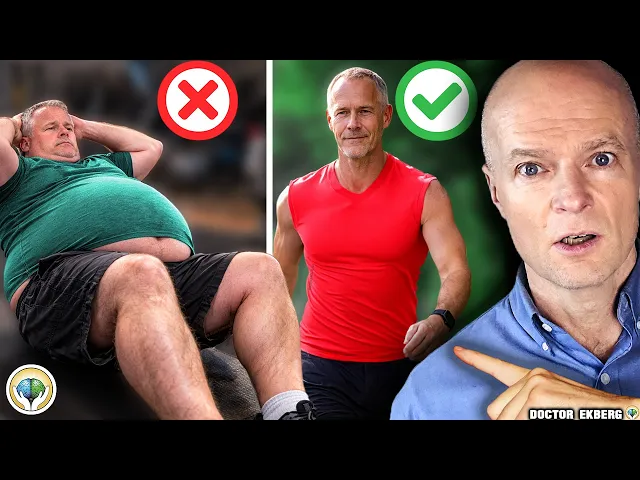
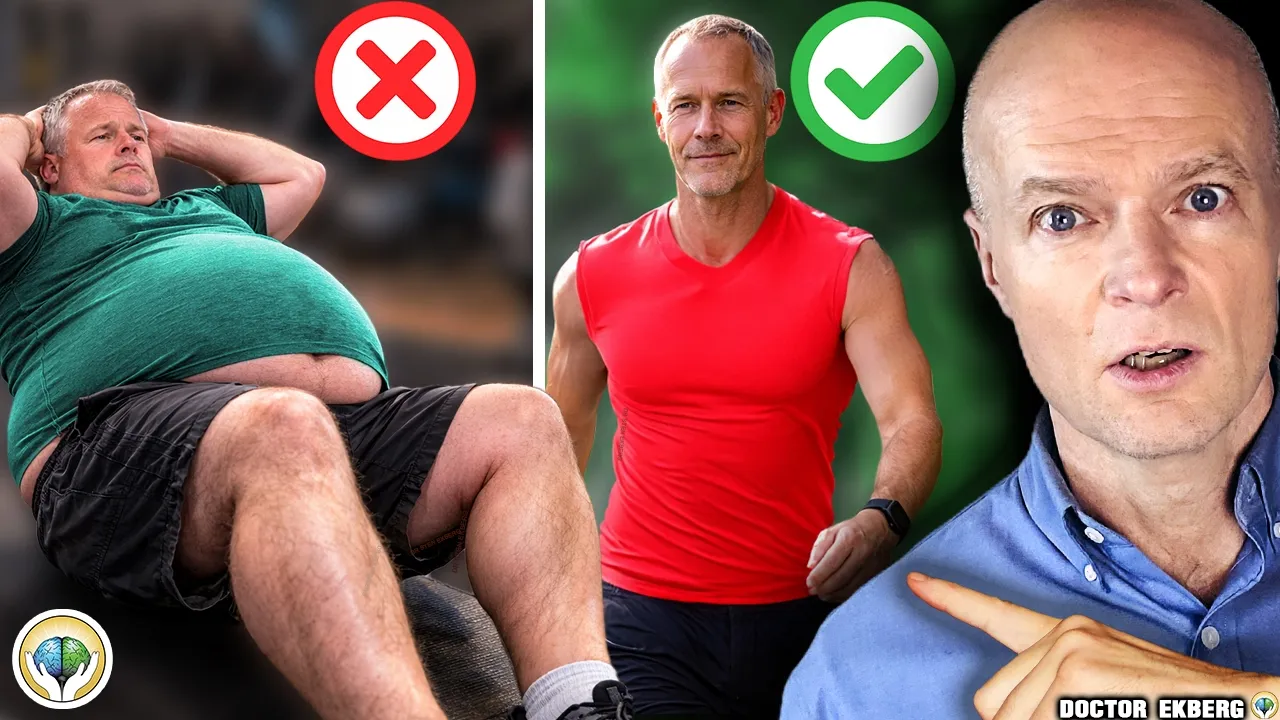
So, I analyzed the top 75 videos on YouTube. I did a search for how to lose belly fat. And these 75 videos have 1.
5 billion views between them. And 97% of those videos promise that you will lose that belly fat in 7 days by exercising a few minutes per day. Now, the problem is they're lying.
Not because they're bad people, because they simply don't understand that belly fat is a symptom of a broken metabolism. It's not about calories and you can't exercise your way out of a broken metabolism. You have to heal it.
Hello, health champions. Today we're going to talk about why you won't lose belly fat until you stop falling for the delusion of quick fixes and you start addressing root causes. So I looked at the top 75 videos and like I said they have 1.
5 billion views between them and I kid you not they were all promising amazing miraculous results in seven to 14 days on doing just a few minutes of exercise. Just do a few crunches. Just create a little burn for a few minutes and it will be gone.
And some of the videos weren't even about exercise. They were just about some magic drink or some magic trick. You didn't have to change anything.
Don't exercise. Don't change how you're eating. Just use the magic trick.
And about 3% of the views came from videos that mentioned diet. But these videos still tended to promise amazing quick results. usually in a matter of days.
And on this list, you had to get down to video number 76 before you found the first one that actually talked about root causes and how to heal metabolism, and that was this guy. So, when we compare the volume of views, there were 250 people looking for a quick fix for everyone that was looking to address root causes. But as I analyzed these results, I thought, you know, it's not really all that strange because that is who we are as a society.
That is who we are as an entire world. We want quick fixes. We want to spend minutes on solutions, even if it took decades to get to that problem.
So last year in the US, we spent $5. 6 6 trillion dollar on sickness treatment, on sick care, on managing consequences. And at the same time, we spent $2 billion on prevention.
So again, comparing that ratio, for every dollar that we spend to teach or try to prevent something, we spend $2,800 managing consequences. But if you think about it, there's not really much of an incentive. Why would they want to change?
Because if they spent $10 on prevention per person, now they could stand to lose trillions. The healthier you get, the less you're going to need the sick care system. And unfortunately, I think these videos represent the same kind of thinking.
It's the same mentality. Quick fix, temporary improvement at best. and no fundamental changes.
And then if you're one of those billions of people that have watched the video and you say, you look at these healthy, fit people and you say, "I'm going to give that a shot. " And then you don't get the results. You don't look like they do.
Then you're thinking, "What's wrong with me? " And maybe you didn't try hard enough or maybe there's something fundamentally flawed. But that's not what it's about.
It's about what they are not telling you. And the real problem is that it is a metabolic dysfunction. Belly fat is nothing more than a symptom of that dysfunction and it basically comes from overeating.
Yes, we eat too much but it's because we eat the wrong things at the wrong time. When we eat sugar and white flour and processed foods, we're eating things that have a very strong stimulating drive. It's very rewarding.
While at the same time, it is depleted of nutrients. So now we get the reward, but we don't get any nutrients. We compensate by eating more and more and more food.
And now we're driving up the insulin. We're becoming insulin resistant. And that insulin resistance puts us in a state of fat storage.
And once this process goes on for a while, now we get chronic inflammation. And that in turn makes us more insulin resistant and so on and so on. And we need to understand that while calories matter, it's not about calories.
It's how the calories are influencing your hormones, especially insulin. And stubborn belly fat is nothing more than visceral fat responding to hormones. So, it's not the number of calories per se.
It's the fact that you're driving insulin with those calories and that type of food makes you overeat. So, we have to realize once and for all that there are no shortterm fixes that can undo long-term damage. And when we think about it like that, it makes so much sense.
Any 5-year-old would get that. And yet, we keep falling for the delusion of these quick fixes. And here's what's really critical that you understand.
If you have belly fat, then you are probably insulin resistant. And if you exercise, your body is not going to respond. It's not going to function.
It's not going to generate energy the same way that those thin young people in the videos are doing. And I'm not opposed to exercise. If you watch some videos, you know that I'm a very strong proponent.
Exercise is not optional. But if you're insulin resistant, you can't do it the way that they're doing it. And here's why.
When you're insulin resistant, it locks your fat away. There is a net pressure of keeping the fat in storage. And if you don't have access to your fat stores, you put all that energy in storage for the purpose of retrieving it.
But once you're insulin resistant, now you can't get to it. And what happens now is if your body needs extra energy, it's going to rely on glucose for energy. So initially when you start an exercise program, what happens is you're going to be burning through your glycogen stores.
That's how your body store carbohydrate, the glucose, but that glycogen also binds water. It for every gram of glycogen, you bind about three to four grams of water. Once you burn up the glycogen, now you're going to be losing that water.
Your body's going to let go of it. And the initial weight loss is from water loss and glycogen. You haven't burned a gram of fat yet.
But here's the key that you also need to understand. It's not just that you're out of shape. It is that you are going to be burning glucose for fuel, which means you're going to create lactic acid.
That's what happens when you're relying on glucose and you're going at a higher level than your body is used to. you're going to make lactic acid. And that lactic acid, that's the stuff that builds up in your muscles and it causes a burning sensation and it causes pain.
And guess what happens next? Well, you're using up your glycogen stores. Your body is losing the only source of energy that it knows it can rely on.
So, it's going to create more hunger for carbs. is going to try to make you replenish those carbs that you burned up, which means you're going to get cravings. And here's the problem.
You have plenty of fat stored. However, your body can't get to it. So, it's as if it wasn't there.
And now, when you start using up energy, your body is going to try to protect itself. So, it'll lower your basil metabolic rate. it'll lower down your metabolism to protect those stores because you can't get to them as it's as if they weren't there.
So, in a nutshell, what happens is that you lose some water weight and then once you've lost the water weight, you plateau, you get frustrated and then you quit because it hurts and it's not giving you results and then you regain the weight. the few ounces that you lost and you gain some more. So, I'm sorry if this sounds really bleak, but I'm basically just describing what a lot of you have probably experienced already.
And we'll get to the solutions, I promise. But part two of insulin resistance and exercise is that if you exercise on a broken metabolism, when your body can't generate energy properly, that's a tremendous stress on the body. And now what happens when you try to increase your energy expenditure through exercise, but you're relying on glucose because you can't get to the fat.
Now you're going to release extra cortisol. Your body produces cortisol for the purpose of increasing blood sugar during stress. That's what it is.
It's a stress hormone to raise blood sugar. And what it does, it also gives you cravings because the cortisol will make the liver increase a little bit of glucose production. But a really smart way to increase glucose is to make you eat more, especially sugar.
And of course the number one hormone associated with specifically belly fat is cortisol. So insulin will increase it generally all over the body. But visceral fat is specifically correlated with cortisol.
And now what very often happens is that you get some stressed adrenals as well. You get adrenal fatigue because they're the glands that have to manufacture the cortisol. And if you are increasing your stress levels and your cortisol levels, then you're basically putting the burden on the adrenals.
And what very often happens as a result is that you're going to downregulate your thyroid activity and further lower your metabolism. And I mentioned it before, but I want to point this out again that when you're insulin resistant and you're relying on glucose, you're going to make much more lactic acid than someone who is metabolically healthy, who can generate energy from fat. And what this means is what seems like a simple exercise or they're telling you in the video that, oh yeah, you're going to get some burn.
Well, your burn is going to be much worse and it's going to seem like you're incredibly out of shape, which you may be, but the lactic acid is going to make it seem much worse and you're going to have really painful workouts. So, realize that it is much harder for you. Exercise really is torture with insulin resistance.
And this is why you cannot out exercise a broken metabolism. You have to start with fixing the metabolism first. It's not that you have to do that alone.
You can start incorporating other things, but you can't just try to exercise really hard and think that's going to fix it. Now, I want to point something out, and it seems like I'm going to contradict myself, but realize that at the same time with everything I've said, exercise is never optional. Okay?
Humans have to move. We need to move. And I'll get back to that.
We just have to understand what is the correct exercise for the state that you're in. And that exercise has to be aerobic and it needs to be aerobic and stay aerobic at whatever level of fitness you are. So now let's talk about what really works.
And it's not all bleak, but you can't punish yourself and try to get out okay on the other end. So first of all, you have to improve your insulin sensitivity. You have to become less insulin resistant.
And the simplest way to do that is to release less insulin. How do you do that? Well, whenever you eat, especially something sugary, something that increases blood sugar quickly, your insulin rises.
So do less of that. Lower your meal frequency. And if you have one to two meals per day, the more insulin resistant you are, the more you should lean toward one meal.
And if you're moderately insulin resistant, or if you get results anyway, then you can probably stick with two meals a day. And a good rule of thumb is to start with the 168 rule. That means you eat your meals within an 8 hour period and therefore you go 16 hours without food.
And that seems like a really long time, but if you sleep for eight hours, then half of that is going to be spent sleeping. And either you wait a few hours after you get up to have your first meal, or you have your last meal, like at 2 or 3 in the afternoon. So, either you could eat at noon and 6 or 7, or you could have breakfast and then have your last meal at 3:00.
It's whatever suits your lifestyle or what works best for you. But the key there is if you go 16 hours without food, then that's 16 hours where your body does not have to produce any insulin. And if you have that highest level of insulin after your second meal, then it's going to keep dropping for the next 16 hours.
and you will be starting to heal your metabolism, becoming more insulin sensitive. The second easy part to this is that if sugar and processed foods increase insulin the most, then stay away from those. So eat whole food, eat low carb, highfat.
And that again means different things to different people. It doesn't mean everyone has to follow a keto diet, even though I think that's a good idea for some people some of the time, but for most people, it probably means that you could eat something like a paleo type diet, which simply means you eat whole food. You don't eat anything that your ancestors didn't have 10,000 years ago, which is pretty simple.
It just means don't eat packaged food. Don't eat sugar and white flour. And people love throwing labels on it and calling it a fad.
So low carb, what is that? Keto, what's that? Paleo, what's that?
Mediterranean. Well, it doesn't really matter. It's just it's not a diet.
Whatever your ancestors ate, those are the human basics. And they because that's all the food they have, they ate low carb, highfat. And because they didn't have a breakfast buffet to wake up to, they probably ate one to two meals a day.
And then what's critically important that most people miss because we love to think that diet or exercise is going to fix everything. But a lot of us are missing the other hormonal balances, the other contributors, which is sleep quantity and quality. If you sleep poorly, if you don't sleep enough or if you have restless sleep, then you could wake up after a single night of poor sleep, you could be wake up 25% more insulin resistant.
Meaning your insulin levels are going to be higher just because of the poor sleep. Because as a result, you're going to be driving much higher levels of cortisol. And the other thing that drives cortisol of course is stress.
So if you have a plan for stress reduction, that's a very important component as well. So now we get to the exercise part. And don't watch the videos.
Don't do crunches. Don't try to create a burn to create a solution. You do appropriate movement.
And you can start this from day one. You can do this any time. But like I said, it has to be right for your situation right now.
So, I did a video a little while back about doing squats. I think that's a great place to start to have some resistance training because exercise is critical. Muscles are critical for well-being and quality of life and longevity.
So, do some resistance training. You can do bands, you can do dumbbells, but do it at a level where you can get a little bit of burn, but don't try to solve your problem by a huge burn. And then here is the key.
When you are insulin resistant, you have to do aerobic training, which for most people means nothing more than walking. So the key, the way that you can tell if you're doing it right is you should be able to speak a sentence during walking or maybe break a sentence into two fragment. But if you start huffing and puffing now, you're not burning fat.
And that's the whole point that a functioning metabolism burns fat. It uses oxygen, which means it's aerobic. And if you can meet those criteria, then you are starting to burn fat.
So at whatever level you have to do, whatever slow level you have to start at, that's what you want to do because that means you're starting to use some fat, you're starting to tap into those fat stores and you're healing your metabolism. You're teaching your body to utilize that fat. And even at a low level, that exercising muscle does not need insulin.
If you do it slow enough, it'll start learning how to absorb that glucose from the bloodstream without the insulin. And then fat over time becomes a part of the fuel as well. And the next important thing is a realistic time frame.
If this took 20 years to develop if you have broken your metabolism, it's not going to be a quick reset. The changes can start happening immediately. You can be on a course to something better immediately, but you're not going to see dramatic results.
So in the first two to four weeks, all you're doing is you're starting a metabolic adaptation. It's like I said with the walking, you're teaching your body to start that trickle of fat, using that trickle of fat for energy. You're upregulating enzyme pathways so that your body start understanding the healthy pathways, the healthy sources of energy.
But it's going to take time. And in two to four weeks, you're just beginning that adaptation. And if you keep this up, you eat right, you exercise in the right way for you, within two to three months, you're going to start seeing some visible changes on your body, and you're going to start seeing some changes in your blood work.
If you test fasting insulin, there should be a difference. For some people, it's extremely stubborn. And then you have to watch some other ones in my videos to do some more drastic things.
But for the vast majority of people, you will start seeing some changes in your blood work. And your A1C will typically come down, your triglycerides will come down, liver enzymes might come down, along with a bunch of other factors indicating that you're moving toward health. And if you keep this up for six to 12 months now, you're going to start seeing some sustainable fundamental healing.
You're going to start feeling better and you will actually be healing your metabolism. You will become metabolically flexible. And now, of course, as you're healing your metabolism, as you're building some muscles, as you're improving your oxygen utilization, now you can increase the intensity.
And if you enjoy those videos where they do the crunches, then you could probably do some of that as well if you enjoy those. So, we need to realize that for the majority of people with belly fat, especially if it's visceral, we're dealing with metabolic disease, metabolic dysfunction, and we're dealing with exhausted hormones and enzyme pathways that are the results of decades of adaptation to an unhealthy, unnatural lifestyle. But most of these YouTubers that produce these videos, they have absolutely no idea of the things that we have talked about.
Most of them are going to be in their 20s and 30s. And when were they supposed to have their decades of breakdown and metabolic breakdown? They are at their peak already because they're in that age group where if you did anything, you're going to be okay.
So, here for example is one of the thumbnails of one of the people making these videos. Does this person really look like she had significant metabolic dysfunction at any point in her life? Of course not.
So, when she's promising to get a belly for you to get a belly like that in 14 days, she has no knowledge. She has no reference. These people simply do what they do best.
They smile a lot and they push you into a muscle burn, which again can be okay once you've gotten past the worst of your metabolic dysfunction. The problem again is that the way that they're presented, they feed into this quick fix mentality that we think that we can solve long-term fundamental root causes in a very short time and it just doesn't work that way. and more so what they're doing could actually be very healthy for them.
Even if they get a burn, they're still metabolically healthy. They're still using energy the way they're supposed to. And that may not be the case for you.
So, let's talk about bad news and good news. And we'll start with the bad. And the worst news is that no one is interested in you getting healthy because the sick care system is one of the largest industries in the world and they will lose a lot of money anytime you get healthier.
I hate to be so blunt and crass but that's just the reality of it. Even if there are doctors, individual doctors who really have their heart in the right place and will actually teach you as a whole, the system does not want you to get healthy. There is a prevailing quick fix mentality and again they don't want any of that to change because the quick fix mentality is the foundation of the health care or sick care system.
And therefore, virtually all the information out there is going to be disease oriented, not health oriented. And the misinformation is probably going to dominate about 100 to one. But here's the really good news.
You found this video. For some reason, something led you here and now you know more than most people. And this channel has hundreds of similar videos.
And there are thousands of excellent videos out there. Just make sure that you look for things that address root causes. And here's what I believe.
I believe that people are brainwashed into a thinking of quick fixes. But once you understand how it really works, how health works and what the qu consequences are of not supporting your health, I think that you are willing to take the steps necessary to not just look at quick fixes, but to heal your body and create long-term solutions. If you enjoyed this video, you're going to love that one.
And if you truly want to master health by understanding how the body really works, make sure you subscribe, hit that bell, and turn on all the notifications so you never miss a life-saving video.