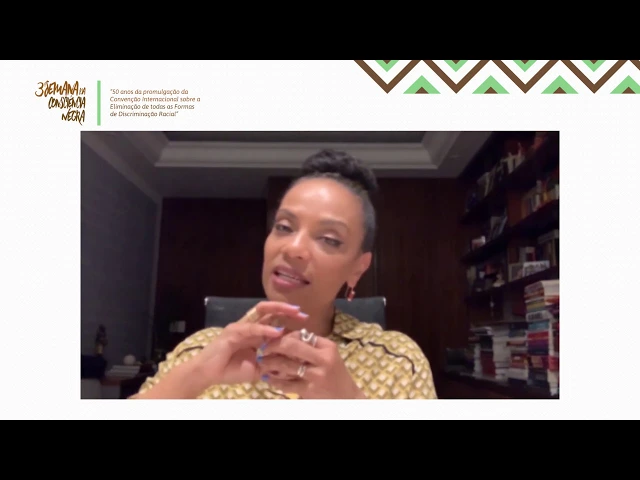
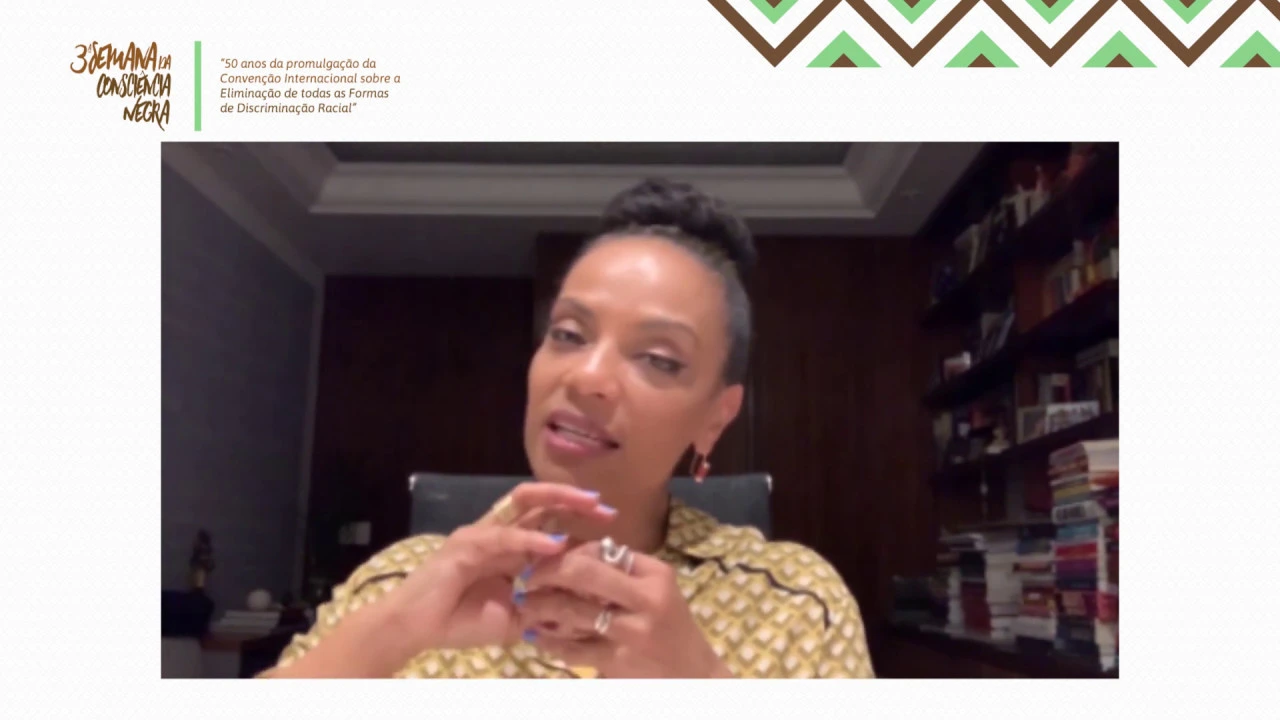
Hello everyone, I'm Flávia Oliveira, journalist. First of all I'd like to thank for the invitation. It's really a joy to participate of the Ajufe's 3rd Black Awareness Week.
I think that this important agenda of racial equality construction, of fighting racism, of anti-racist policies they go unyielding through a counscious Judiciary and aware of these bad things. They asked me to talk about the situation of black women "Black Women and the economy: supporting the pyramid" supporting the Brazilian social pyramid. It is a subject that delights me at the same pace that makes me sad, because what we realize in Brazil throughout the centuries, even after the Brazilian Slavery period, is a place where black people faces difficulty in being included, of rise socially, of social mobility to black people, but especially for the Brazilian black women.
And I say that based on statistics very objective that show us that black women, in Brazil, they are overrepresented, for example, in housework, are black the most housekeepers in Brazil, workers who only recently, in 2015, had their their right to incorporate all the workers' benefits from the Brazilian "Workers Law Consolidation", in force since the 40's from the 20th century. Even so, until nowadays, between 2/3 and 70% of the total of housekeepers in Brazil do not have employment papers. So, the odd jobs rushes specific segment, well formed by black women, but also reaches all of the other functions.
Every type of insertion of black women in the labor market. They are more affected by unemployment rates, by the odd jobs' index - whether it is the odd jobs, whether it is "self-employment", of the autonomy - they have the lowest levels of income, making in some cases less than a half of the average income of white men, that are at the top of the labor market's pyramid. They are secondary, from the point of view of holding positions and higher paying functions and of greater power in economic structures.
In politics, this also happens and, however, the capacity of working, of creativity, of methods or of webs, of web's constructions and solidarity networks, of afection, off support, of surviving and of professional insertion, especially in the field of of entrepreneurship, it is undeniable in black women. By the way, I'd I'd like to, I have the chance to show you guys a Debret's illustration named after "Angu da quitandeira", let me get a little closer, that shows exactly, this illustration is from 1826 and gives the real measure of the entrepreneurial force that these women have. Women that in an age where this logistic didn't exist of transport or installation, to get to create an entrepreneurial activity in the middle of a public square, carrying these great cauldron, preparing this dish, and trading, selling it on rush hour.
Debret also describes that the rush hour is at 7 a. m. Imagine in 1826 taking three cauldrons to a public square and to prepare an "angu", to serve it, to sell it, in the public square?
I think that if Brazil at that moment had seen the entrepreneurial power of these women, their capacity of creating a routine, a complete productive cicle, the Brazil we know today might be other, right? Having recognized this productive capacity, we would have built an entire different society, more equal and including more prosperous. The inclusion, the visibility, the recognization of the professional power of black women would make Brazil a country closer to the prosperity, because they accomplish so much.
I have a data from the "Instituto Locomotiva", for instance, showing that black women move R$ 704 billions. They are responsible for 16% of national consumption in Brazil. It's not that much.
It is only expressive from stock's point of view, but is not enough given their capacity. If we imagine that black women are 28% of the Brazilian population, and therefore, the most numerous slice of the population and they are ahead of the most families of women with children, without husband, if they had a little push, from the point of view of support, of formation, of access to credit, of the access to the labor market, of the appreciation of their professional capacity and of the technologies, social and economics, that throughout the history they have showed that they are capable of formulate, the income level potential, well-being, of inclusion of these women and these families would have make Brazil a nation much more fuller from the socioeconomic point of view I think that it's the key that Brazil needs to ignite in the direction of recognizing the potential, talent, the entrepreneur capacity, productive and redistributive of these women. Before I say goodbye, I'd like to remind you this: it's never trivial to think that to a black family, and the most part of the Brazilian black families are headed by women, so any income improvement, any professional insertion result, it's never individual, it's collective.
It's shared: inside the family, family's nucleus, inside that residence, or inside acessory families, from others residences, like extended families, or inside the local community. So you have a redistributive effect that is absolutely healthy and desirable to the construction of a truly equal nation, balanced and socially and economically developed, which is what we wish and believe that Brazil needs and deserves. I thank you for the attention, your attentives eyes and ears and I hope to get an extra chance to be with you guys for more time, but definitely to debate about this, that is an absolutely essential agenda for Brazilian community: fighting racism.