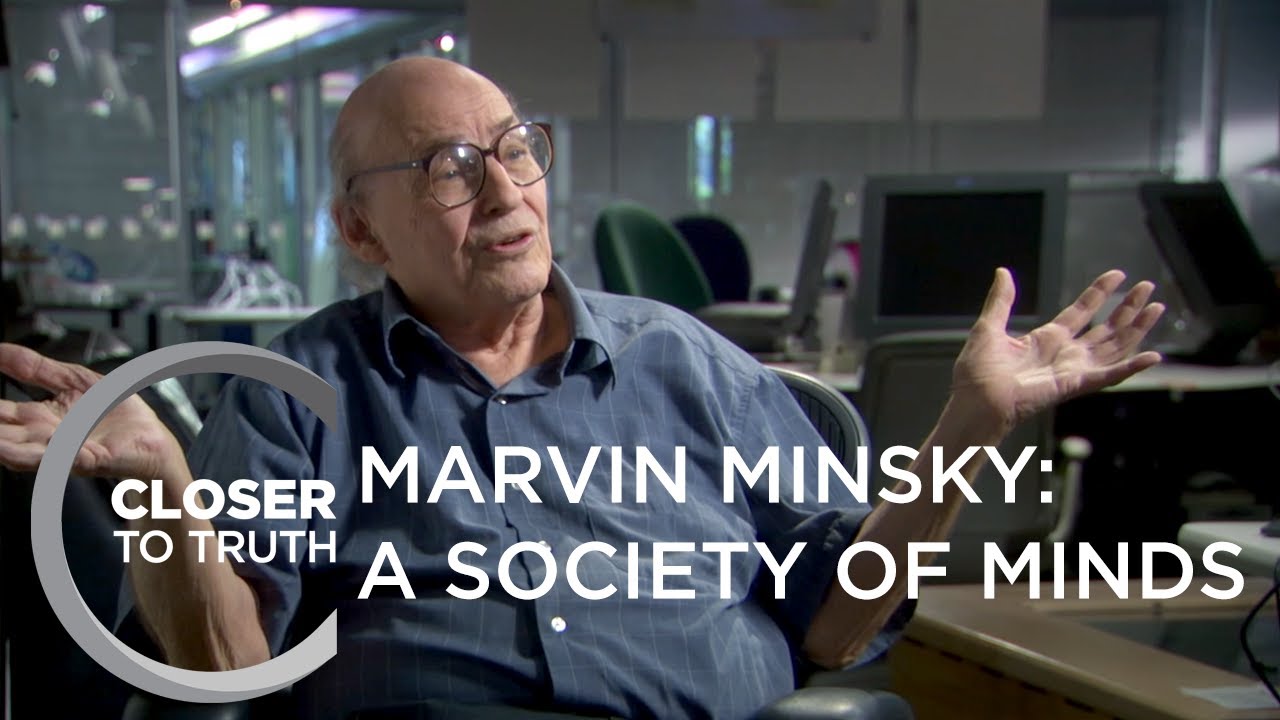
Marvin the concept of Consciousness is now hot because everybody's using it scientists philosophers theologians all look to Consciousness as the key part to to enable us to understand what we're all about you have called Consciousness a suitcase word what do you mean by that well I think the word Consciousness is a clever trick that we use to keep from thinking about how thinking works and what we do is we take a lot of different phenomena and we give them all the same name and then you think you've got it it's just so packing a lot
of separate stuff into a suitcase yes because uh if you look in a dictionary you'll find things which description saying a person is aware of themselves or something like that but what does it mean to say you're aware of yourself and if you think in terms of uh the brain as a whole bunch of uh different kinds of Machinery with various connections then it it's easy to see that it would be very hard for any one part of the brain to know what's happening in all the rest because uh there's just too much so in
fact each part of the brain has connections to some other parts of the brain and can get some idea but there's no place that knows everything uh just as the manager of the president of a company I believe the president of some technology companies are lawyers they haven't the slightest idea what the company makes or how it works but they uh they know little things like uh we're not making enough money what should we anyway when people use the word Consciousness I think it's a very strange idea that there's some wonderful property of the brain
that can do so many different things uh such as is to remember what you've been doing recently or uh remember who you are and uh and why you're able to talk about yourself and just so many things like that we use the word conscious for uh example when you know why you did something uh sometimes you just do something without even remembering that you did it or knowing a reason and then we get into sort of the world of eth things we love the idea that some things are done deliberately and some things are done
automatically because that that's convenient for legal and ethical and other operations so the word conscious is very valuable socially it's all right to punish someone if they know what they did and perhaps why because because what because they might be able to learn if they have a representation of what caused that that then they might be able to change it and so uh the idea of punishment or reward is valuable for things that people were quote aware of but there are hundreds of kinds of awareness there's uh remembering something as an image there's remembering something
as a string of words there's remembering the the tactile feeling of something and uh most of the time you don't remember those things sometimes you have made a representation in storing it and we use the word conscious for for dozens of different mental activities and that's what you mean by suitcase because you take all these dozens of mental activities and try to stuff them in this one this one place right and there's no harm in that for social purposes because it's very good uh when when a word has multiple meanings that ambiguity is often very
valuable but if you're trying to understand those processes and you've put them all in one box then you say where in the brain is consciousness located there's a whole society of scientists who are trying to find the the place in the brain where Consciousness is but if it's a suitcase and it's just a word for many different processes they're wasting their time they should try to find out how all those process each of them work and how they're related you've talked about a dozen some as many as 20 different major processes that are part of
this what we call Consciousness what what are some examples of those higher categories of things which we we uh uh sometimes uh uh uh mask by this word Consciousness well for example if there was a sequence of events that happened and you can talk about them then what you've done is you've taken these very complicated processes and images and uh so forth and you've represented them symbolically using these little things called words and uh for example the verb is a word that describes the difference between between two situations if John gave Mary the book MH
gave means first John had the book and then Mary had the book so the single word describes a transformation of representations of two different situations now it would be nice to know what brain structures uh are used to represent this the meaning of the word like give or take or hit or so forth and I call these transf frames in my book but uh I haven't met a a neuroscientist who says gee that's really important where are the trans frames and so I have a there's a big Gulf between the kinds of theories I'm making
which are more like those of William James and Freud except that they're using modern computer science ideas about complicated processes which those Old-Timers didn't have and the neuroscientists who are trying to see how how could a How could a a bunch of synapses and nerve cells have a goal well there's something in in between and I have I don't think I've ever met a neuroscientist who has a good mechanical idea of what a machine would have to have in order to have a goal and there is a nice theory of that that we don't have
time for here Le let's talk about the nature of self I feel like I'm a Unity that I am a self and I am conscious and I have different aspects of me that one point or another I I'm more aware of than others but at all times whatever I'm aware of my glasses on my face talking to you now I'm focusing on but at all times I have the same self same sense of self Unity where does that come from the idea of self is a wonderful and ancient idea and uh it reminds me of
the story of somebody who has a knife uh but they lost the blood played once and they lost the handle another time and they replaced them and it's still the same knife but of course it's not and it seems to me that this idea of self comes from it's almost a verbal mistake it comes from the naive idea that that a person is two things a body and a mind and we know that the body changes we don't but once we just divide into two parts then it's e to say what's a self it's a
body and a mind and you don't break those up but what happens are you the same person you were five minutes ago of course not you're mostly the same are you the same person you were when you were three years old well no that's very much like the knife and and handle that have been replaced here's what I think there really is each person and I don't think most animals do maybe the primates are also able to do this we build in our brain a model of what we are and the simplest model is a
body and a mind and a more complicated model is the body is split into lots of Parts there's a torso and Limbs and a head and in the head an educated person knows there's a face and a sensory eyes and ears and there's a brain and they know that the brain has 400 modules which do different things called cognitive processes and uh but we don't have just that model the beautiful thing about the idea of Self in each person is that we have dozens of them I have a model you have a model of yourself
as a member of a family as a member of a profession you're a neuroscientist you're a TV uh producer everything and those are each different you're a man you're a uh an American and for each of these you have a different structure uh each of those is very complicated but when you look at it from the outside you don't see all that stuff and you say oh that's myself but when I look at it from the inside I feel all those things you said are true but I still feel a sense of of of of
of undivided Unity well I think the sense of undivided Unity comes because the first marel you made is that I have a body and a mind you got that when you were one year old or two and that's still there as sort of the index of the others but uh it's not very useful except socially uh if you give if you loan somebody a book you expect to get that book from the same person so for all everyday purposes the idea of self is very important and very wonderful from a cognitive point of view uh
it's a very stupid idea and it's an obstacle to understanding how our minds work