I think one thing that's clear now is that L2, you know the space we're in, layer 2 Technologies, not only has arrived but is increasingly coming to be the place where most of the activity in the Ethereum stack happens. So right now, L1 Ethereum is about 3% of the total activity in the Ethereum stack. The other 97% is Layer Two and Layer Three.
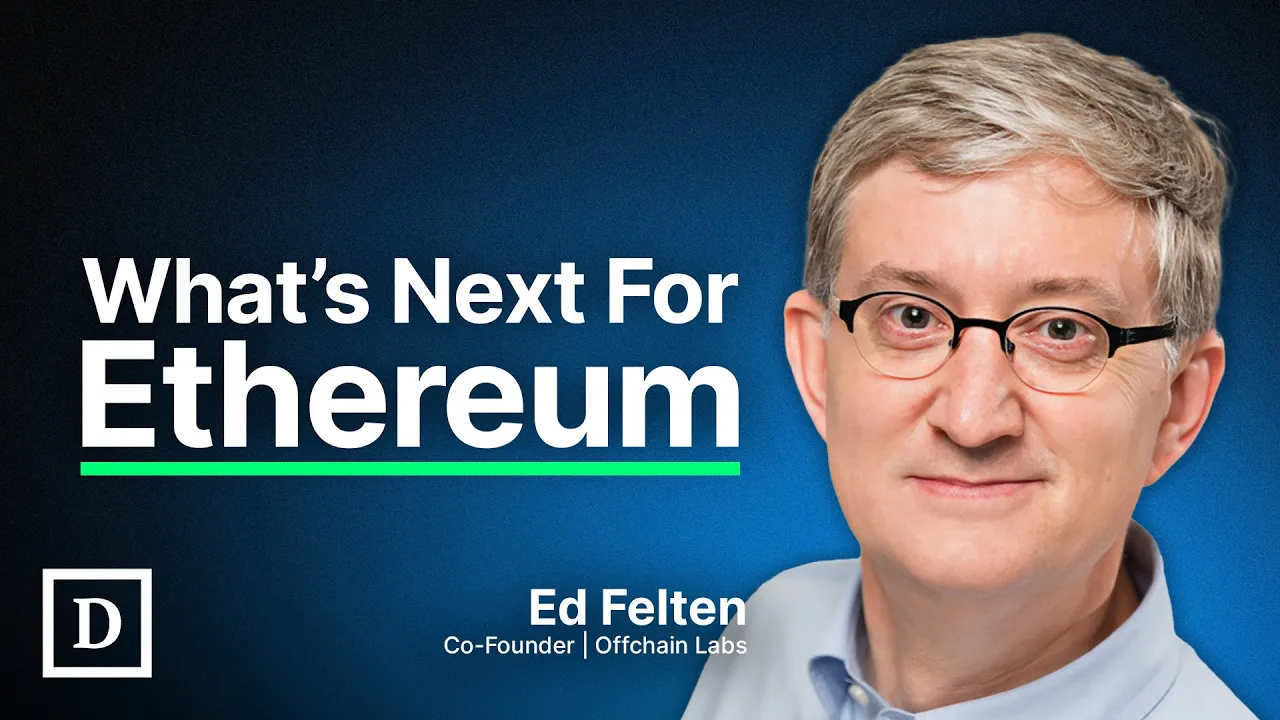
The idea, you know, which you can trace back to Vitalik's post in 2020 about a rollup-centric road map for Ethereum, so that Future has arrived now. Now, the conversation about Layer 2 has shifted from how big is this going to be to L2 has arrived, and now the question is, where is this going, and what is the next evolution that's going to take Ethereum to the next level in terms of speed and adoption? Hi, I'm Ed Felten.
I am co-founder and chief scientist at Offchain Labs, developers of Arbitrum. Thank you very much once again for being here. I want to start by going all the way back to before your time in web 3.
You were a professor at Princeton, you worked with the Obama Administration, and then, you know, fast forward a few short years, here we are. We're going to talk about Arbitrum, which is now the leading Layer Two in terms of TVL. Can you just briefly talk me through that rather unique set of experiences that have got us here?
Yeah, so I spent many years as a professor at Princeton, 20 years altogether. In that role, in around 2011 or 12, I started to get interested in blockchain, did some research, some teaching in the area. It was in that context that the original idea for Arbitrum came in early 2014.
We were running a conference on blockchain Technologies at Princeton, and I got really excited about smart contracts and what they would be able to do. This was before Ethereum was out, people were talking about it. It was clear it was going to be a huge deal, but it was also clear to me that scaling it, how to make it big enough, fast enough, affordable enough for the audience that I thought it was going to attract, was a problem.
So that led to the development of ideas that eventually became Arbitrum. That was 2014. In late 2014, some Princeton undergraduate students built the very first sort of proto version of Arbitrum as a class project, and I worked with them as they did that.
But then there was this swerve where I got invited to work in the White House as an adviser to the President. So you don't say no to that, and so I went off and did that job for two years, and Arbitrum was sort of on the shelf during that time. Then, in January 2017, there's a turnover, a new Administration.
I go back to Princeton, I'm a professor again, trying to decompress after a very amazing and intense White House experience. These two graduate students, PhD students, walk into my office one day and say, "Hey, remember that Arbitrum thing? That's cool.
Let's work on that some more. " And so they eventually became my co-founders in Offchain Labs, and we're still sort of the trio that is running the company today. How would you say the talking points of these conferences have shifted over the years in relation to what it is that you do?
I mean, every year is different. I think one thing that's clear now is that L2, you know, the space we're in, Layer 2 Technologies, not only has arrived but is increasingly coming to be the place where most of the activity in the Ethereum stack happens. So right now, L1 Ethereum is about 3% of the total activity in the Ethereum stack.
The other 97% is Layer 2 and Layer 3. The idea, you know, which you can trace back to Vitalic's post in 2020 about a rollup-centric road map for Ethereum, so that Future has arrived now. Now, the conversation about Layer 2 has shifted from, you know, how big is this going to be to L2 has arrived, and now the question is, where is this going, and what is the next evolution that's going to take Ethereum to the next level in terms of speed and adoption?
In terms of that evolution, then, what's the sort of the most significant news or updates or innovation that you've come across at ETCC or maybe? I mean, I think it's hard to put my finger on one thing. Because one of the takeaways for me is how many exciting things are happening.
You know, that's what you expect right. You have this ever-growing Community, you have more and more smart researchers, developers coming into the space, and there's just this huge set of ideas. And for me, a lot of the challenge in thinking about what's happening is sort of thinking about what is it that's really going to serve the needs of end-users and developers?
What are the core problems that we need to address? And then how can these pieces of technology, these pieces of ideas, get put together to really meet those needs? Would you say it's.
. . or rather in terms of privacy, security, scalability, these sort of three pillars, what are the most significant advancements that you've seen across DeFi over the years?
Last 12 months, let's say, um, so I think a move increasing move to L2 and L3 is a big deal, and um, also, Ethereum's change with EIP 4844 to change the way Ethereum handles data and the way that really pays off for end users is in much lower fees on L2s. So, the cost of a transaction on L2s and L3s is way down by more than 10x over the past year, and that's a huge game-changer. We're only now starting to see the consequences of that as more and more people come in, but also, new types of applications become possible, become feasible, and affordable.
Cost is obviously a big driver for that, but since 2021, Arbitrum has seen a massive amount of adoption in the DeFi space, and now you've got the leading TVL. I think it's around $15 billion. What has been the main driver of that growth?
I think it's been a few things, um. It's partly been, I think, the community has built, has grown in confidence that Arbitrum will deliver, it will be reliable, it will be secure. We, as a team building it initially just within Offchain Labs and now as a broader community, um, have really focused on trying to be a leader among L2s in security, in decentralization, in reliability.
I think that partly pays off. Some of it is some technical advantages of Arbitrum, and you know we could get into the weeds about that, but I think the bottom line, the most important differentiator on the technical side is very fast block time, right. Um, Arbitrum has a block time that is a quarter of a second, and that means if you're a user, your transaction will execute very quickly, you'll get a result back very quickly.
People early on, at least, were surprised that this was even possible with the blockchain, but that pays off for users in that you get this really snappy response time, but it also, in a more subtle way, pays off by making online markets more efficient, right. There's some research showing that when you have this really fast block time, markets are more efficient, prices are more accurate, and there's less extraction of value by arbitrageurs and other kinds of, um. So, you touched on a few topics there, and, um, I'm sure for the more technically inclined audience members, they'd maybe like to hear your sort of take on the main technical advantages of optimistic rollups compared to other L2 solutions and why you think personally that optimistic rollups are far ahead of, let's say, ZK rollups in terms of TVL currently.
I mean, optimistic rollups are simpler, um, because you can explain everything about how an optimistic rollup works, you know, if I had a blackboard in 5 minutes, uh, but there's no hope that a non-expert can understand the deep and complicated and ever-debated mathematics under ZK proving, right. ZK advocates like to say it's just math, but really, it's incredibly complicated math that's still being debated by the math community. I think that's number one.
Number two is, um, if you, from where I sit, you can prove one way, you can prove another way, it matters a lot that you do prove and that you have that proof of correctness, um, but if you're proving, the question is what does it cost and can a regular end user with a regular machine actually participate in that proving process, right? The big win of optimistic rollup is it has lower cost, simpler, and a regular user can be a first-class citizen can do everything in that protocol, which is not the case with ZK because, uh, you tend to need arrays of, um, arrays of often of special purpose equipment to do it because all that math is super expensive to do. Mhm.
If I was to, perhaps cheekily ask you to extrapolate the development, the level of adoption that we've seen in the L2 space, let's say over the next 10-15 years, do you think the current trends are going to continue or might, you know, the ZK team sort of overtake in TVL in any way? So, I do think I want to correct one misimpression that people sometimes have about this, which is that Arbitrum will forever use only optimistic proving. One thing that's unusual about Arbitrum, the name Arbitrum and the name Offchain Labs in the sector is it doesn't build in the name of any technology because our approach has never been we have a technology we want to apply it.
Our approach has been we have needs of users and developers and we're going to use the technology that best satisfies that, right. So, we did not build the name optimistic or in into our title, right. If and when we use ZK, we're not going to change our name to have ZK or Stark or anything in the name of the product.
We're about meeting users' needs and we're looking very carefully at ZK technology, evaluating its feasibility, and I think it's, you know, I think it's very foreseeable that Arbitrum will migrate to a proving approach that makes some use of ZK. There's a whole universe of different proving approaches, and you know, we're evaluating all of them, and I think the Arbitrum tech will continue to use what makes the most sense. There's no barrier to switching to entirely ZK proving if that turns out to be economical and practical.
I don't think that will happen in the even in the medium term, but I do think that there's. A: There's a decent chance of some sort of hybrid ZK optimistic approach that really is designed to have low cost, full participation by every user. Are there any specific sort of technical or strategic updates in the medium term that I me.
There's a ton of technical Advance happening now in Arbitrum. The Arbitrum DAO is in control of what gets adopted and what doesn't get adopted. Our team or others might propose something, but ultimately the DAO is in control.
The things that are before the DAO right now, I think, is a good sort of sample. There are three big upgrades that are being discussed: Bold, Stylus, and Time Boost. Bold is an update which is the next generation proving technology that's still optimistic style of proving but which makes proving part of the system fully permissionless.
Stylus is a technology that allows you to write smart contracts in any programming language, not just solidity. Time Boost is a way for Arbitrum chains to capture the value of things like arbitrage. These upgrades are currently being debated by the DAO, and there are more significant upgrades behind them.
The pace of innovation in the Arbitrum space is accelerating, with performance improvements, more cross-chain functionality, and faster withdrawals coming soon. One of the main criticisms of L2s, including Arbitrum, is the potential for centralization. We have strategically put steps into place to ensure decentralization and trust.
When Arbitrum started, a roadmap for decentralization was put in place, and most boxes have been checked off. This includes full decentralization of proving and creating a DAO that controls chain upgrades and software management. The DAO directly controls these aspects, unlike other systems where a DAO vote is advisory to a multisig of insiders.
There is a security council that oversees some aspects of security, but they are elected by the DAO. The last piece of the decentralization roadmap, currently in the research and building pipeline, is decentralizing the sequencer. The sequencer is a very limited role in the protocol.
Um already, which is why it is last on the decentralized decentralization roadmap because all the sequencer does is record which transactions arrived and in what order. Nothing else. Um nonetheless, right full decentralization means even that is decentralized.
So um, we Offchain Labs announced a joint project with Espresso Systems to build a decentralized version of the Arbitrum sequencer. Make that software available open source and, uh, that project is ongoing. Um, the engineering is.
We've, we've moved sort of from research to the engineering phase of that project so that one is on the roadmap. That's one of the major upgrades that'll be available to the DAO. Um, I'm not, I'm not promising any dates, but the work is ongoing and it is a priority to get it there.
Clear. What would you say are the top priorities of Offchain Labs in terms of, you know, announcing new partnerships, getting technical work done, bringing in maybe new engineering talent into the space? Um, what are the things that, you know, get you out of B and said these are the strategic goals that we're working towards?
I mean, I think I think of it in a couple ways, right? Um, one of the big goals because you know the success of Offchain Labs is really goes along with success of Arbitrum, right? Um, we, you know, we've built our business around the around opportunities that are enabled by Arbitrum and so we're thinking about you know how we can best contribute as a member of the Arbitrum ecosystem.
Um, and my own role as the head of research at Offchain Labs is to think about what are the hard technical problems, what are the barriers that are going to need to be broken down over the next six 9 12 18 months in order for the technology to keep advancing, um, and so, you know, I think we're trying to push a bunch of things. Now that we've gotten to the point where the decentralization roadmap is well in hand there's this last piece to push across the finish line. Um, we're, we're, we're focusing on efficiency, we're trying to understand how to scale the technology up, we're trying to one of the big trends recently has been the growth of orbit chains and orbit is the name that we use for the ability to people to have their own chain that uses the Arbitrum technology.
There's currently around 50 orbit chains that are announced and more in the pipeline and in fact Arbitrum orbit chains account for the majority of transaction count, gas used and data in the Arbitrum ecosystem today so it's a really robust really robust community and but one of the lessons from working with orbit is that people want their own chain because they want to customize something, they want to do something differently maybe they want different economics, they want different something like a different block time maybe they want to customize the technology in some way to serve their application whatever it is one of the big goals is to make sure that the technology is as agile and customizable as possible. I think that's another one and and we're really sort of pushing on issues of cost and how to work with other services there's a demand for working with alternative data availability services many chains want that different chains may have different ideas about proving cost versus delay time and so on and we're really trying to push those those technical technical limits and then finally there are concerns about user experience right it's one of the complaints that people have about web 3 technology generally and they should because we're not where we need to be on UX and although I'm not a UX person by background we you know I talk a lot to UX people and I think there are some technical areas some technical things we can improve to create new opportunities for better UX often the limits to web 3 UX sometimes they're just cuz you know people aren't working hard enough and paying enough attention talking enough to users but sometimes there's actually sort of technical root causes that make good UX not more difficult or not possible we're trying to knock down those barriers as a leader in the space talk to me about your top predictions for the for the L2 space in general um perhaps over the next 12 to 18 months what are the developments that you're expecting to see from outside of of chain Labs um I mean I think we're going to continue to see the growth of custom chains and we're going to start to see it'll start to become clear sort of what kinds of app chain strategies make sense um I think that'll be number one number two is there'll be a focus on interoperability on the ability to coordinate across chains of um making it easier for applications to operate across multiple chains in a way that is where there's less fragmentation of the user experience we're not going to get to a place I think where there's no friction in moving or coordinating across chains nor frankly from a security standpoint should we because there are security trade-offs there but I think that'll be a big thing interoperability cross-chain multi-chain functionality and I also think we're going to continue to have a robust discussion about governance how governance should be done who should be in charge of what because you do see Some differences between different L2 teams in how they approach governance considerations in a multi-chain world. In the Arbitrum space, we're very big on the principle "your chain, your rules," which means that the sort of flagship DAO govern chains like Arbitrum One and Arbitrum Nova.
Those are governed by the DAO app chains should be governed by each app chain, and each app chain should be free to make its own decisions. We're really big on that principle. Others take more of a sort of "well, there should be one governance that has significant power over all the chains in the ecosystem.
" And I think we're going to see that issue play out as the app chain world becomes more mature. I think that's a big thing. Scalability and gas limit and cost are going to continue to be factors that people pay a lot of attention to.
That is just like a continuous struggle to keep up with the growth in demand. Speaking of that growth, not too long ago, we interviewed an L1 founder, and he used a rather interesting term. He said he was at a conference, and there was "no shortage of trash L2s.
" I'm curious as somebody who's in the L2 space, as a leader in the space, you're very familiar with the technology, very familiar with the developments. First of all, do you agree with the term "trash L2s"? Do you think there are trash L2s out there, and do you think we're heading towards potentially a period of a major shakeout where a majority of these L2s might not survive?
Well, I would not use that term. But I do think, first of all, many of these L2s are startups, and we know that most startups don't succeed and survive in the long run. You're taking a chance when you launch a thing.
So, you know, that's normal, and it's not really about L2s, it's just about sort of tech entrepreneurship in general. That said, you know, there are trade-offs. If you want to launch something new, or if you're an established project and you want to come into the L2 space, you can do it by being an application on top of one or more of the high-traffic, high-userbase, high-TVL chains, or you can launch your own chain.
And there are trade-offs there. If you go where the value, where the activity is, you have a natural user base, it's easier for users to adapt to what you're using, it's easier for what you're doing to compose with other things, and you don't have the overhead of running your own chain. So, there is a trade-off there, and I think the community is generally getting smarter about how to make those choices.
Certainly, there are probably people who have made that mistake, made that decision incorrectly in either direction as well. So, I think the community is getting smarter about this. But there's no question, right, that if anyone thought that everyone should have their own chain, it was easy and cheap, and you were going to succeed, I think that's not the case.
People should be thinking carefully about this trade-off, what are the pros and cons. For me, what it comes down to is that if you're going to have your own chain, you should do that because you need to customize something. If there's something that doesn't work the way you need it to work for your technology or your business on an existing chain, like we see, for example, chains that want to use different economic models, someone wants to have a subscription model rather than charging their users gas, right?
Maybe they want some very different kind of tokenomics that's key to what they're doing, maybe they want to have a super fast block time that's faster even than Arbitrum One. We see that with some gaming chains, for example. If you need something that isn't available or doesn't make sense on a chain that's designed for everyone to use, then you can consider an L3.
And you can ask how much does this cost, what friction is it going to add for onboarding users, and all of that, and then make a decision. I think the community is getting smarter about that. But no doubt, I think, you know, we will see in every evolution of technology, there's always a shakeout, and that's going to happen here too.
If I. . .
if I said put your finger on a time frame, you know, is it 12 months, is it 24 months, is it 5 years? It's continuous. Yeah, I mean, you see people starting projects, and this is true again across the whole tech ecosystem.
You see people starting projects that don't get traction, right? You see areas where multiple projects start, and then some of them survive and some of them don't. It's a continuous process.
I don't. . .
I mean, sometimes the market, the broader market or the discourse will have a mood swing, and I tend to think that those mood swings are more extreme than the reality. And so, there may come a moment when there's a lot of talk about a shakeout of app chains, but I think really, probably the reality is more likely to just be this sort of constant winnowing of what works versus what doesn't work.