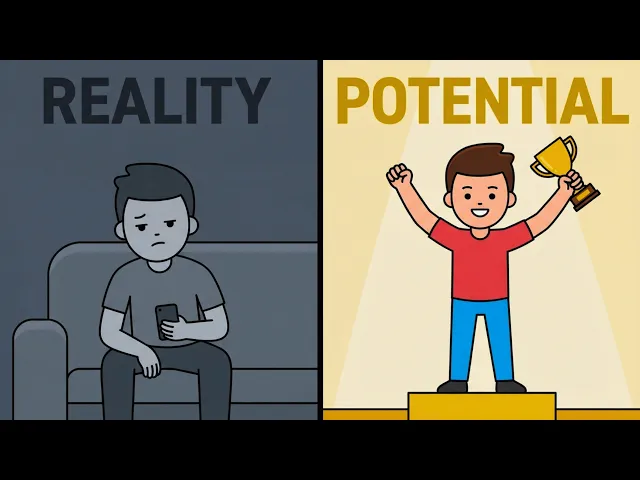
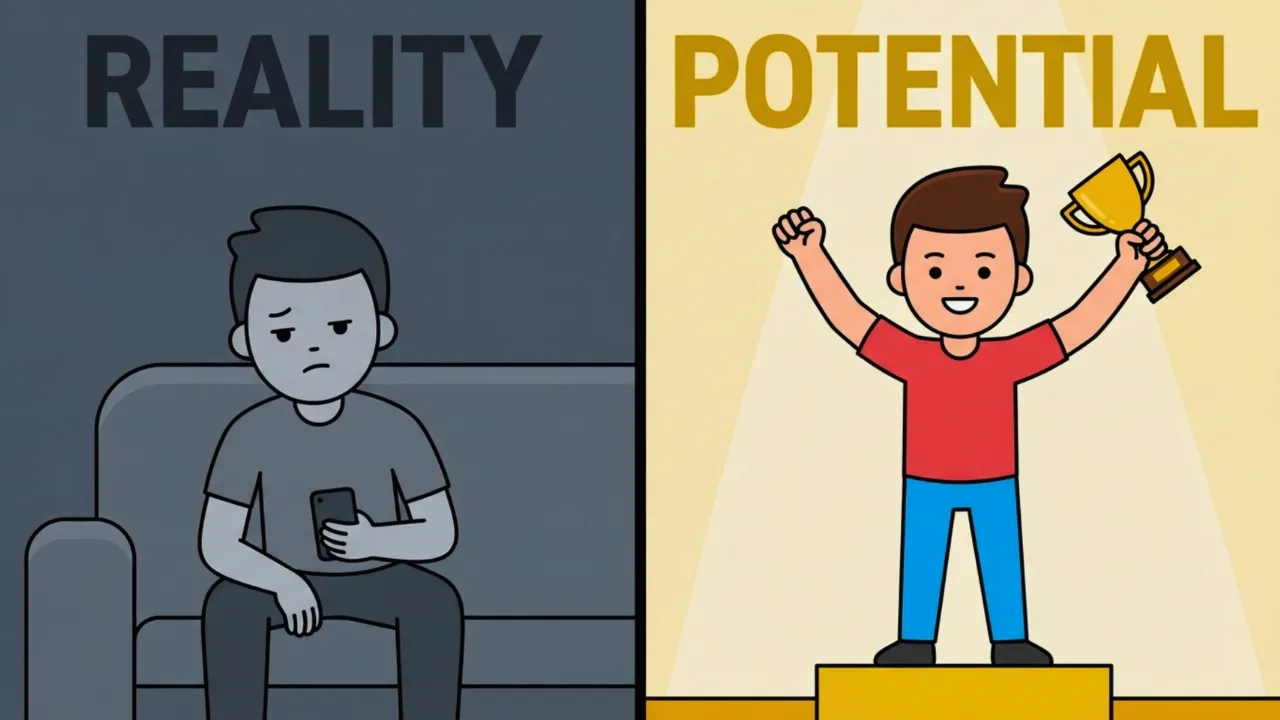
You are not lazy. You know that because doing nothing bothers you. You lie awake thinking about what you should be doing, what you could build, and how different your life could look if you actually followed through.
You know what you need to do. You've known for months, maybe years, and yet you keep waiting, planning, researching, and telling yourself you'll start when you feel ready. Meanwhile, people with less experience, less knowledge, and sometimes less talent are moving forward.
They're publishing. They're building. They're taking risks.
And you're still thinking about what you could become. So, here's the uncomfortable question. Why would someone with real potential spend years choosing the smaller, safer version of their own life?
It is because potential feels amazing as long as it stays imaginary. When a goal exists only inside your mind, it is flawless. Inside your head, you can write the book, and the book is brilliant.
You can start the business, and the business never loses money. You can launch the channel, and every video hits. You can change your life, and nobody rejects you.
As long as you keep a dream safe inside your head, you get to enjoy all the pride of being someone who could do it without ever paying the price of finding out if you actually can. Think about the difference between two statements. The first statement is, "I could do it if I really tried.
" The second statement is, "I tried my best, and this is what happened. " The first statement protects your ego. It lets you keep believing in what you could become without having to test it.
The second statement puts you on the line. It gives reality a vote. Reality does not measure how much talent you have waiting in reserve.
It measures what you actually put on the page, on the screen, or into the world. So, without even realizing it, you make a deal with yourself. You decide that staying a person of great promise is safer than becoming a person who tested that promise and found its limits.
You protect an image of yourself. You would rather live with the quiet disappointment of not trying than face the terrifying possibility of trying with everything you have and coming up short. Because as long as you do not try, you always have an excuse ready.
You can tell yourself you were too busy. You can tell yourself the timing was wrong. You can tell yourself you needed to learn a little bit more first.
That story keeps your dignity intact. It lets you look in the mirror and say, "I am not here yet because I have not really started. " But if you finally give it everything you have, if you put every ounce of your energy into the attempt and it still falls flat, that excuse vanishes.
You're left with no shield facing a question that terrifies you to your core. What if my absolute best is simply not good enough? There is another possibility you may not want to admit.
Maybe you like being the person who's naturally talented because talent feels valuable when nobody measures it. The moment you start producing, competing, publishing, or selling, you get a score and a score gives reality a chance to dis- agree with the story you have about yourself. Staying untested means you never have to find out whether you're exceptional, ordinary, or somewhere in between.
To avoid facing that question, you build hiding places. But you do not build obvious hiding places like playing video games all day or sleeping until noon, you build productive hiding places. You research, you buy another online course, you buy a fresh notebook, you spend three days organizing your desk until it looks perfect.
You draft another outline, you save 20 videos on how to stay disciplined and you watch every single one of them while taking careful notes. You tell your friends that you're preparing. You tell yourself that you're getting ready.
You wait for Monday. You wait for the new year. You wait until you feel a sudden surge of confidence.
You wait until you know just a little bit more about the process. You call all of this preparation. But deep down, you know the truth.
This is not preparation. This is delay that feels productive. It's a clever trick you play on yourself so you can feel like you're moving forward without ever stepping into the danger zone.
>> You open the blank document. You write one sentence. You read it over.
You decide it sounds terrible. You delete it and then you switch over to checking your phone for 30 minutes. You tell yourself you just need to get in the right mindset.
But what you're really doing is running away from the discomfort of being a beginner. As long as you are preparing, the dream remains perfect. The moment you start making something real, it gets messy, imperfect, and flawed.
There is another reason you stay still. One that almost nobody talks about. You are not just afraid of failing.
You're quietly terrified of what happens if you actually succeed. Think about what success really demands. If you actually step up, if you build the thing, if you make the move and it works, everything changes.
Success brings responsibility. It means people start expecting things from you every single day. It means the bar is permanently raised.
You cannot hide behind the story of your unused potential anymore. You have to show up, maintain the standard, and deal with the exposure that comes with being seen. If you stay stuck, your life is predictable.
It might be frustrating, it might be disappointing, but it's safe. You know how to navigate your current level of misery. Success threatens to destroy that comfortable predictability.
It forces your life to actually change. And even positive change is uncomfortable when your life has been the same for a long time. Staying small allows you to remain hidden in the crowd.
Stepping into your ability pulls you out into the open where everyone can see you, judge you, and hold you accountable. Then you make it worse by looking around at other people. You pull out your phone and scroll through people who are already miles ahead of you.
You look at their finished, polished, successful work, and then you look down at your raw, clumsy, unfinished draft. The comparison is brutal. You ignore the fact that they spent five years making terrible things in the dark before anyone paid attention to them.
All you see is their success compared to your starting line. You feel instantly behind. You feel a heavy wave of discouragement wash over you.
So, what do you do? You put the work away. You decide that you are not ready yet, or that the market is too crowded, or that other people are just built differently than you.
You step back from the edge. But, because you put the work away, weeks go by without any progress. That means you fall even further behind where you wanted to be.
And the further behind you feel, the more discouraging it is to think about starting. So, you stay still even longer. It becomes a loop that feeds on itself.
You avoid the work because you feel behind, and feeling behind keeps you from doing the work. While you're trapped in that loop, time keeps moving. This is where the cost of unused potential becomes truly dangerous.
The danger is not that you try something and it fails for a few months. A single failure is just an event. It hurts for a little while, you adjust, you learn, and you move on.
The real danger is much quieter and far more painful. It's the slow, silent process of becoming someone who spends decades saying, "I know I could have done more. " There is a very specific, strange kind of pain that comes with knowing you had the talent, the intelligence, and the vision to build something great, but you never gave yourself a real chance to see it exist.
It's the weight of watching your life pass by while your best ideas remain locked inside your head like museum exhibits that nobody will ever see. Failure hurts for a moment, but the quiet weight of regret can follow you into every room for the rest of your life. It settles into your chest when you watch someone else execute an idea you had 3 years ago.
It sits with you on Sunday nights when you realize another week is about to start where you play small. You don't get those years back. The energy you spend managing the discomfort of staying stuck takes just as much effort as the work required to build something real.
You're already paying a massive emotional price every single day. You're just paying it to stay in the exact same place. So, how do you actually break out of this?
So, the way you think about yourself has to change. You need to stop asking whether you have potential. You need to stop looking for proof that you're smart enough, creative enough, or talented enough.
Having potential is completely meaningless on its own. The world is full of brilliant, highly talented people who accomplish nothing with their lives because they spend all their time managing their fears. Stop asking, "Am I good enough?
" That question is a trap because it keeps your focus locked on your identity instead of your actions. Start asking a completely different question. What would I do today if I accepted that I might fail and I chose to do it anyway?
You do not need a massive heroic transformation. You do not need to rewrite your entire life by tomorrow morning. A massive transformation sounds exciting, but it also gives you another excuse to keep planning instead of acting.
What you need is cold, hard evidence that you are willing to use your ability in the real world. You need to gather small, undeniable proof that you are no longer protecting an imaginary image of yourself. Write one terrible page today and leave it terrible.
Do not edit it. Do not rewrite it 20 times to make it sound smart. Just let it exist in all its messy reality.
Record the video even if your voice sounds slightly awkward and you do not like how the lighting looks. Send the application even if you feel under qualified. Make the phone call.
Submit the proposal. Spend 30 focused minutes building the actual physical thing instead of sitting there thinking about the ideal version of the thing. When you do these things, you strip away the safety of the imaginary world.
You force yourself to interact with reality. And yes, reality will sometimes hit back. Some of the things you make will be bad.
Some people will not like what you put out. You might get rejected. But something incredible happens when you actually face that rejection.
You realize you did not break. You realize that making a mistake or getting turned down does not destroy you. It just gives you data.
It gives you a real starting point that you can actually build from. You also have to change your relationship with your feelings. You are waiting to feel confident, but confidence is not something you get before you start.
Confidence is the result of having survived the discomfort of starting multiple times. If you wait until you feel ready, you will be waiting for the rest of your life. You have to accept that feeling uncertain, feeling embarrassed, feeling scared, and wanting to run away are completely normal parts of doing anything that matters.
The goal is not to become a person who feels no fear. The goal is to become a person who stopped using fear as an instruction manual. When that familiar wave of hesitation hits you, when your mind starts telling you that you need to do more research or wait until next week, you do not argue with it.
You do not try to debate your brain into feeling brave. You simply acknowledge that the discomfort is there, and you take the action anyway. You do not need to feel ready.
You just need to stop using the absence of that feeling as a valid reason to stay still. Look at the gap that exists right now in your life. On one side of that gap is the person you are today, thinking, planning, waiting, keeping your best energy inside your head where it feels safe.
On the other side is the person you keep telling yourself you could become. And maybe that gap feels comfortable now because as long as it stays open, you can keep believing the best version of you is still waiting somewhere ahead. You can keep saying you have potential without ever having to test it.
So, ask yourself one question. What part of your life are you keeping theoretical because making it real would force you to find out what you're actually capable of. You already know the answer, so stop looking for more confidence.
Stop making more plans. Stop protecting the idea of who you could be. Give yourself one real attempt.
Write the page. Make the call. Publish the video.
Start the thing. You don't need to prove that you have potential. You need to stop protecting it because potential only feels impressive while it stays untested.
At some point, I could has to become I did.