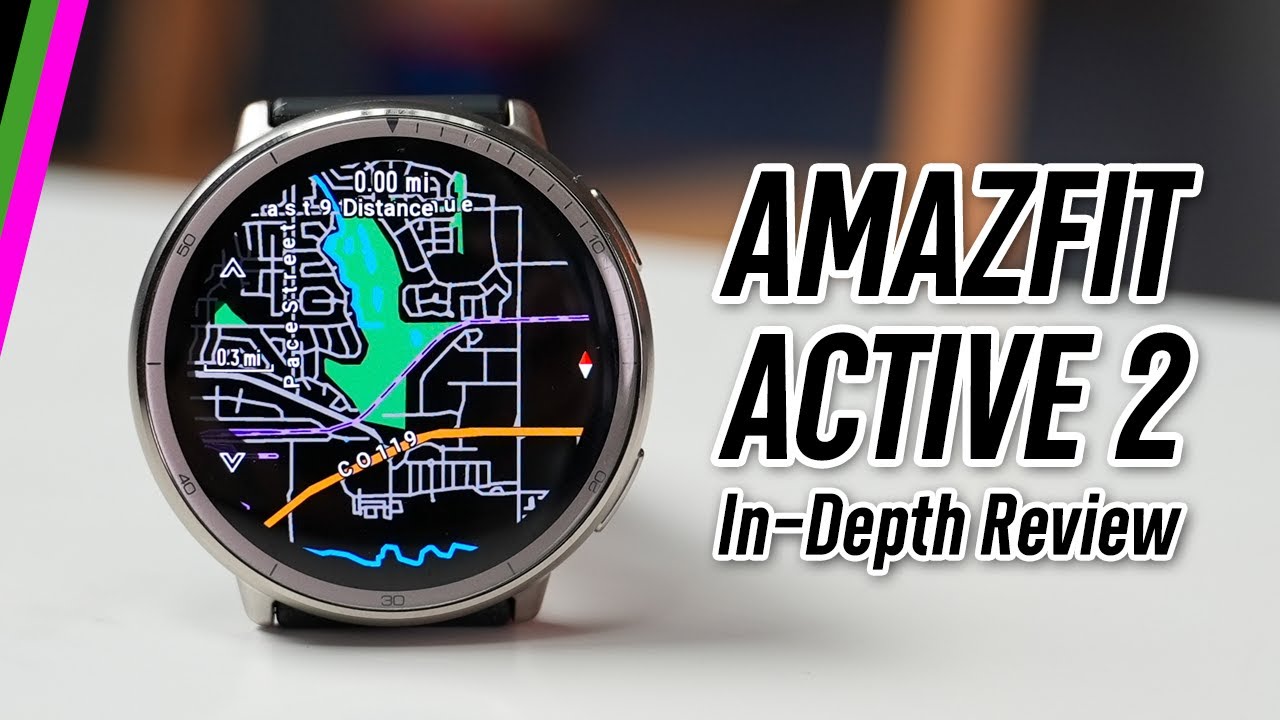
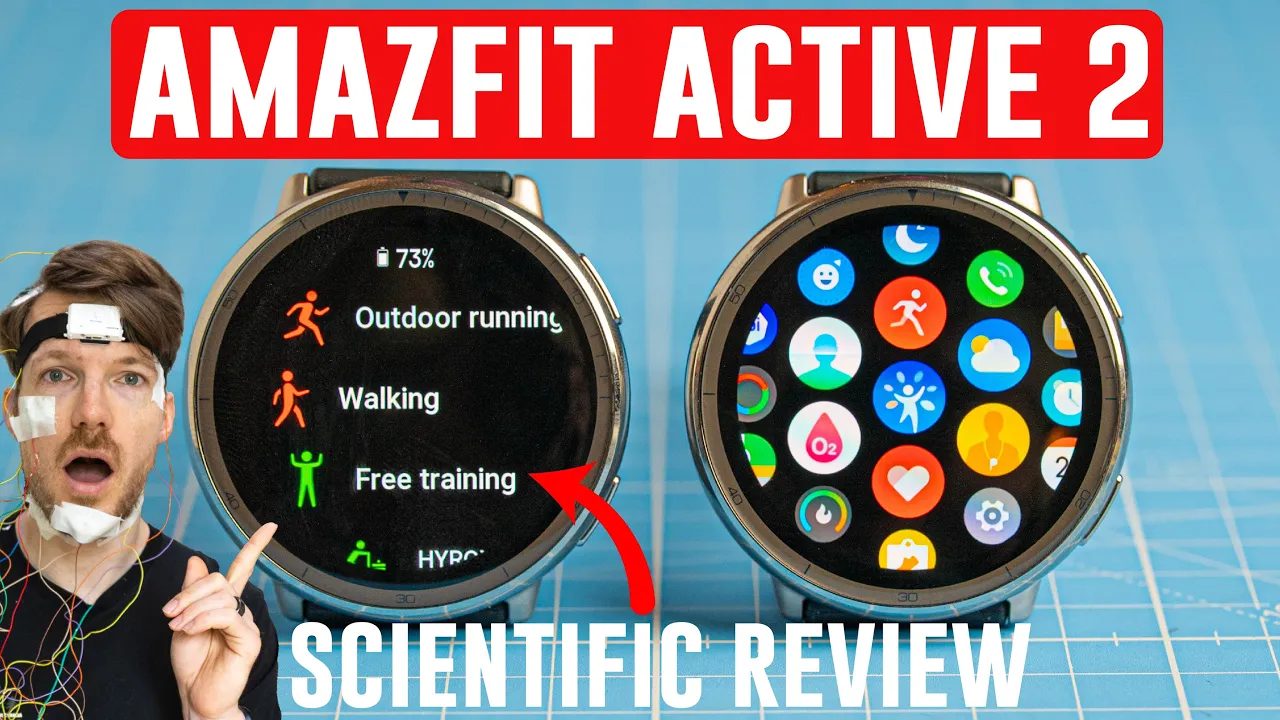
This is one of the devices most requested to review over the last few months, the Amaze Fit Active 2. It's only $99 and has all functionalities you might want and it looks great. Honestly, it has one of the best screens out there of any smart watch. So, that's why many of you have been asking for it. However, I've had a lot of problems testing this device. I started testing it several months ago already, did all the analysis, but I ran into some issues and I couldn't really explain why they were happening. But, let me sit
down for a moment so I can explain. Now, for those of you who don't know me, my name is Rob and I'm a post-doctoral scientist specializing in biological data analysis. Now, the Amaze Fit Active 2 is actually one of the prettiest watches I own and is not that expensive. For $99 or euros, you get one of the most beautiful smart watches. With this same sensor set as the Amaze T-Rex 3 that is well in many of my testing. So, when I received the Amazefitit Active 2, I expected similar performance and would be an easy recommendation
from many of you. However, I ran into some issues. The heart rate tracking wasn't as good as I expected, as you'll see in the test in a moment. So, through the magic of buying two of them, I retested the second device and also gave the other one to my colleague Rafael for testing. And the results are still a bit confusing to me. So, let's get to those results in a second. But first, a few remarks. First of all, I said I had the magic of buying two of them, but actually amaze sent them to me
for testing. So, I didn't pay for them with my own money. Still, Amazefit didn't see this video before. they don't have any influence on the contents or me making a video altogether. I could not make it if I wanted to. And this video is not sponsored in any way. So, I just wanted to get that out of the way. And second, how are my tests actually structured? And how do I try to make them as fair as possible? Well, I usually do three types of testing. Heart rate tracking performance during different exercises, sleep stage tracking
performance, and GPS testing if the device actually has GPS like the Amazement Active 2 does have. So for the heart rate tracking performance, I actually use an ECG chest strap as a reference. So these straps you wear around your chest that actually measure the electrical activity of your heart. So the most reliable way of measuring heart rate tracking, much different from the light sensors or optical sensors used by smart watches and smart bands. For the sleep stage tracking, I use an EEG device that measures brain waves and is one of the most reliable ways of
measuring sleepstaging. It's also not perfect, but the best scientific or systematic test I can do. And third, for GPS tracking, I cycle the exact same route several times. And if the GPS tracks don't overlap very well, it's very likely that the GPS tracking performance isn't very good. Though, if they are similar, that isn't a guarantee that the GPS tracking is good, but it's the best I can do for the moment since I don't really have a gold or silver standard for testing GPS tracking performance. So, this type of testing I try to do on any
device, mostly in the same way, at least as similar as I can make the test. Of course, there's limitations to this. So this is only true for my physiology, but still I was so surprised when I tested the Amazefitit Active 2 that the results were so different from similar devices or at least devices from Amaze with the exact same sensor set. So for instance, the Amazefitit Bip 6 recently and the Amaze T-Rex 3. So I asked Amazfit for a second device because the first one was still pre-production. So in principle that shouldn't have made such
a difference. And then as an extra test, I gave this second device to the original one to my colleague Raphel for additional heart rate tracking. So, let's take a look at that heart rate tracking performance first. Then, we'll take a look at the sleep stage tracking and then the GPS tracking. And I really encourage you if you own the Amazefit Active 2 and you're actively using it at the moment or you've used it in the past and you've gotten similar results or very different results, please let us know in the comments below because multiple testing
results would be really valuable, especially for other people considering buying this relatively affordable, beautiful watch, but in addition, they also care about the health and sports tracking performance. and in my studio. So, on the other side of this door, we can actually look at all the results and see how good or bad they are because it isn't all bad news. There's actually some good news as well. And also, the GPS tracking might surprise you. So, let's take a look at those results. I have them organized partially right here for you. Oh, and if you're wondering
why I have a black nail right here, I was at a party last night. Don't ask me about it. So, everything is set up now to do the analysis. And here you can see an overview for the results for one of the easiest exercises for a device to track indoor cycling. And as I said, we'll use an ECG chest strap, in this case, the Polar H10 as a reference. And we'll compare those measurements against the heart rate measurements of the Amaze Active 2. And these are just the results for spinning or indoor cycling. And as
regular viewers will know, each dot in this plot is a matching measurement between the reference device and the Amazement Active 2, where we want those points to be as close to the blue line as possible because the blue line means perfect agreement. Now, luckily, at least for indoor cycling, most points are on or close to the blue line. So, that looks good. There is this deviating cloud right here. So, at least for a while, the Amaze Fit Active 2 was detecting a two low heart rate, but overall, this doesn't look bad. And I think this
is for a total of five indoor spinning sessions. So I have quite a bit of data. And the correlation in this case is okay, though also not great at 0.91. This could definitely be better. But still, just looking at this overview, I would think this is good enough. But let's take a look at those individual indoor biking sessions to see what's going on and why sometimes detected a too low heart rate. Now looking at it, I actually did a total of six indoor cycling sessions with both the reference device and the Amazement Active 2. And
here you can see the results for the first spinning session. Along the horizontal axis is the clock time and my heart rate is along the vertical axis with in blue green the polar H10 reference and in red the heart rate according to the Amazefitit active 2. And as you can see I did several intervals and mostly here the Amaze Active 2 in red agrees quite well at the reference device. Only right here in the middle for a while did it detect a slightly too low heart rate but otherwise it actually isn't that bad. This second
session already shows some issues. So here in this initial phase for a while it detected a too low heart rate. So it wasn't able to quickly detect that increased heart rate but otherwise near the end of the ride it was actually quite good. Then this third session looks almost perfect here. I have nothing to complain about. This fourth session is actually the main reason we had quite a few points below that blue line. So again in the middle it kept detecting a too low heart rate. This first part is quite good. This last part is
quite good but this middle part really had some struggles. This fifth session again is quite good. And this sixth session also isn't that bad. Though again, there's a moment where I detected too low heart rate. So overall, actually for indoor cycling, this isn't too bad, but it's also not amazing. There's quite a few better devices out there. But let's now take a look at how these results compared to that of many other devices I've previously tested. And you can see that in this overview right here. So here we rank the devices from worst to best
along the vertical axis. And we use that correlation value we're looking at before. So that R value for this, which is along the horizontal axis, which means that the further to the right and the higher devices, the better is its correlation with the reference device. And here I marked the Amazefitit Active 2 in red. And as you can see, it's sort of in the middle of all devices. It's not terrible like some older Amazefitit devices like the GTS4, which really weren't doing that well. But then it's also not doing as good as for instance the
Amaze with BIP 6 did. At least one of the two did on me or let's see the Amaze with T-Rex 3 is right here. This also did quite a bit better. So even though it's not bad, there was only one major section where I detected a too low heart rate and a few shorter moments where I did. So it might still be good enough for many of you, but I'm not super happy with this performance. Okay, so those are the results for one of the easier exercises out there. But what about a harder exercise, running
outside? because with running there's much more bumpiness making the signal much more noisy on the wrist and in addition there's potential also light interference from the light outside. So let's take a look at those results. And here we have those results for running. And here I'm honestly already a bit worried. So even though most points are still somewhat close to the blue line, so we don't get a terrible correlation, there's quite some deviation away from it. So there's quite a few points above the blue line right here, but also some below the blue line right
here. I really get the feeling that for quite a while it will likely be about 10 BPM above or below the actual heart rate. The correlation is also not great honestly at 0.81. It's not absolutely terrible, but there's many better devices out there. But here I really want to look at the individual sessions to see what's going on. And these are the results for the first run that I did. And this one actually looks quite good. The Amazefitit Active 2 and Red mostly follows along quite well with the reference device. So for this running session,
nothing to complain about. The second session already shows some more issues. So here in the beginning it detects a too low heart rate. Then it sort of gets on track and detects the correct heart rate. Then near the end it detects a too high heart rate. So maybe my cadence was actually close to 150 SPM and it confused that cadence. So the running frequency with the heart rate frequency which can happen because the watch is actually rocking on your wrist at that frequency and that confuses the heart rate signal of the device. But let's take
a look at the third and final run. And this really doesn't look good at all. So in the beginning, it's sort of okay. Then it already gets confused a bit, detecting a two high heart rate, and near the end, it just goes bonkers. It just takes away too high heart rate. And this might be cadence lock again. So not a super good result for the Amaze Active 2. I don't really know why something like this would happen near the end. All of a sudden, this drastic increase in detected heart rate, even though in reality, my
heart rate was relatively stable. So this was a slow, stable run. But let's again put these results into the context of many of the other devices out there. And those results are displayed right here. Again, the correlation is along the horizontal axis. And I ordered the watches from worst to best along the vertical axis. And the Amaze Fit Active 2 is marked in red, which is really among some of the lower performing watches. For running on average, deviation of devices don't appear to be that bad. So, we don't have really low correlations. And amongst all
the devices out there, the Amazefitit Active 2 really isn't doing that great. It's actually not that far though, still a bit away from some of the older Mazefit devices like the GTS4 and GTR4 which really weren't doing that well. And again, I don't really know why, for instance, the Amazefit T-Rex 3, which supposedly has the exact same sensor, is doing a lot better. This is really something I cannot explain. I don't know if something could be interfering with the sensor or maybe the way that the actual sensor connects to the wrist is different because of
the shape of the device, but I'm just sharing the results with you as I have them. Luckily, we'll also have a second test subject and a second watch in a moment. For that second watch, I couldn't do all the activities because of an injury, but those results are actually super interesting. But before moving to my second copy of the Amaze Active 2, let's take a look at the results for a much harder exercise for a device that track outdoor cycling. And again, you're familiar with this overview, but now, of course, we have it for outdoor
cycling. Now, outdoor cycling is much harder because there's much more bumpiness, so much more rocking off the device on my wrist. And I also tend to hold on to my handlebars quite tightly which can really interfere with the heart rate signal as well because it just cannot detect the blood flow change in the wrist as well as it can when it's more relaxed. So let's have a look at those results. We see first of all that the correlation is quite a bit lower now at 0.75 compared to the 0.91 I believe it was for indoor
cycling. So quite a bit lower now. And we also see many points here below the blue line sort of forming this triangle-like shape really showing that quite often is detecting a way too low heart rate. But here it's super important to take a look at the individual bike ride. So let's get to it. And here we have the first bike ride I wanted to share with you which doesn't look the worst. So there are many devices out there that have shown worse results than this particular bike ride. Still the Amaze Fit Active 2 missed this
entire section of increased heart rate right here. But this second example is really a lot worse. So basically for the first half of the cycling session, it kept detecting away to low heart rate. Then here it lost the signal for a while and then it improved for some reason. This session right here again doesn't look very good for mostly the first half of the ride. It really messed up the heart rate, detecting a way to low heart rate. Similar for this session right here. Again, a way too low heart rate, missing seconds as well. Then
this ride right here might be a bit better. also not by much. So for part of the ride, it was able to detect my heart rate. Still quite often detecting a too low heart rate or just weird heart rate like right here. This one right here also doesn't look very good. And basically most of the rides look something like this with quite a lot of missing data and just not very good results. And if you put these results into perspective, you'll be surprised. Or at least I have to say I was surprised. So here I
marked the Amaze Fit Active 2 in red with the better devices to the top right. Now, it's not the absolute worst device. It's somewhere in the middle. So, for instance, the Amazefit GTS4 right here and the GTR4 right here, both did a lot a lot worse. So, it's still improved performance compared to those generations. But, for instance, the Amazefit T-Rex 3, which we have right here, did quite a bit better. Let's see if we can find the Amaze BIP 6. So if the Mesa Dip 6 on my left hand at least did quite a bit
better. So the sensor at least has the potential for better performance. But maybe on me in this particular configuration, the Active 2 just isn't performing very well. But as I mentioned before, this was all done on sort of the pre-final production model of the Amazefit Active 2 that I received as a reviewer. So we'll also take a look at the results for the other final production model that I got. But before doing that, two things. I want to look at the weightlifting results. But I also wanted to ask you a quick favor. If you want
to support this channel, there's multiple ways of doing that. One way is, of course, by commenting on this video, liking it, or subscribing if you haven't already. And the second thing is I actually affiliate with several products that I like and use myself every day. One of them is, for instance, the levels app. This helps me keep track of my glucose levels when paired with a continuous glucose monitor to gain insights, for instance, into what foods cause big glucose spikes in me in particular because everybody has a different physiology in that regard. So, I want
to find out which foods for me cause big glucose spikes, especially during my working days because I personally really don't deal well with these big fluctuations in energy levels. It really makes me sort of lethargic. There's actually an affiliate link for the levels app below if you want to get the best deal possible and at the same time support the channel. Or if you're into running, but you're not the best at making running plans and getting a running coach during your runs to make sure you're running at the correct pace for each segment of your
training run, then I would recommend the Runner app. my personal favorite app for running which I use as my running coach myself because I just don't know how to make running plans. I'm originally actually more of a cyclist. I did a lot of road biking for the last 15 years or so and there I have a better feel for what my body should be able to handle and how to train for it. I'm also not perfect at that, but for running I'm really a disaster. If you want to get a personalized running coach and running
plan, I recommend the Runna app for which you can also find an affiliate link down here or up here. But back to the testing and let's take a look at the results for weightlifting. And here we have the overview for weightlifting still for that pre-production model. And this looks okay though sort of as expected for almost any device out there. So at first glance it might actually not look that bad because most points are on or close to the blue line. However, as you can see here in the higher heart rate range, there's quite a
few points below the blue line indicating that in these moments the Amazed too low heart rate. Now, the reason it's in the higher heart rate range is because in those moments, I was actually actively doing a set. So, there was a lot of tension on my wrists. And basically, this indicates to me that the Amaze Fit Active 2 in these moments wasn't able to correctly detect my heart rate. But let's take a look at the individual weightlifting sessions to confirm or actually deny or well, the opposite of confirm those results. And here we have the
results for the first weightlifting session where you can clearly see each time I did a set of exercises my heart rate increased as indicated by these blue green peaks and the Amazefitit active 2 in red really wasn't able to keep up with that. Sometimes it partially detected a peak but it honestly really wasn't good enough for this session. This second session shows similar results again not being able to detect the peaks in my heart rate. And the same goes for this third and also fourth session for the most part. So, this really doesn't look that
great for the Amazefit Active 2, but as I said, almost any device out there isn't good enough for tracking your heart rate during weightlifting. Only potentially the Apple Watch is good enough. So, the Apple Watch generally when it detects a heart rate, it will be correct for the most part at least, but it will also stop detecting your heart rate sometimes. So, the Apple Watch is also sort of good at knowing when it isn't getting a reliable signal and just dropping out those results in those moments. But, it also means that you're still missing that
data. If you want the most reliable heart rate tracking during weightlifting, just get yourself an HD chest strap. So, those results really aren't that great for the Amaz. For some reason, other Amaze devices with the same sensor did better in my testing. But, as I said, I was so confused by these results that I contacted Amaze and asked them if they could send me a post-prouction or I don't know what the word is, but like a normal production model of the Amaz. And they kindly did. Now, we're only going to look at the results for
cycling outdoors in this case because I had an injury which meant that for a while I couldn't do indoor cycling or running outside because those were too impactful on my body. I could do calm outdoor cycling sessions. So, I kept doing those. So, we're going to take a look at those results. But, as an extra confirmation, I also gave the other watch to my colleague Rafael. So, as a third sort of confirmation of the results, we'll also take a look at the data for him. And here we have the results for my second Amaze Active
2. to the normal production model with again the heart rate according to the watch along the vertical axis and the reference device along the horizontal axis and this actually looks quite similar to the results we had for my other MAS with active 2. So quite a few points here below the blue line sort of forming this triangle- like shape so really not looking very good. We have an even lower correlation now at 0.59. And this is not just for one cycling session. This is for quite a few. Let me count. It's actually for a total
of 18 outdoor cycling sessions. So this really isn't looking very good. Correlation of 0.59 is quite low. And just to remind you, these are the results for the first model I received. So a bit of a higher correlation, but the general patterns look the same with many points here below the blue line forming this triangle-like shape. So going back to the second one, this is what that one looks like. So very similar results, but let's take a look at the individual bike rides to see what that looks like. So here are the results for one
example bike ride where the patterns are suspiciously similar to what we saw for my first pre-production model. So sometimes the red line follows along quite okay with my heart rate, but quite often it detects a too low heart rate. For this session, for instance, it just looks horrible. No idea what's going on here. This one is a tiny bit better, though. Still showing quite a bit of deviation. Also right here, a lot of deviation, especially here in the beginning, detecting a way too low heart rate. The same is true for this session. Also with some
missing data right here. Also right here, not looking very good. Also a way too low heart rate right here. So this to me makes it seem that there's nothing wrong with the production of the first one I received. For some reason, in this particular watch, the same sensor is struggling a lot more on me at least. So let's again put these results into the perspective of many of the other watches we've tested before. And again, that's displayed in this O view right here where you want the devices to be as far to the top right
as possible. And this second Amazement Active 2 is marked in red. And you can see it's really among some of the poor performing watches. And it's actually doing quite a bit worse than the other one, the original one we tested. Though I would still say they're somewhat in the same neighborhood of not that well performing watches. I would hope the correlation would be at least around 0.9 or higher. and the Amazement T-Rex 3 isn't that far away from that. Now, regular viewers will know that some of the best performing watches out there are different Apple
watches, also the Pixel Watch 3 and different Huawei devices. So, if you either have a bit more money to spend, you could get an Apple Watch or a Pixel Watch. Or if you still want a relatively cheap device with decent heart rate tracking, different Huawei Watch Fit models, so sort of a cheaper line, but not the cheapest line of watchfit, has decent heart rate tracking. So, we have the Huawei Watch Fit 2, Huawei Watch Ffit 3, and also the Huawei Watch Ffit 4 Pro I recently tested. All have pretty decent heart rate tracking and definitely
a lot better, at least on me, than the Amazement Active 2. But those are the results on me. Let's now take a look at the results on Raphael. And for Raphael, I want to focus on two different types of exercises mostly. So, running outside and cycling outside. Now, I'm not going to show you the overviews with correlations because there were some time syncing issues, which makes the correlations artificially a little bit lower. But looking at the individual sessions, we can draw actually the same conclusions we could have if I fixed the time syncing issues. Let's
first look at running. So this first running session that Rafael did, the results are pretty good. I would say the red line of the Amazement Active 2 follows along quite well with the reference device. So no complaints here. This second session right here actually shows similar issues to me where there's some kind of drift away from the actual heart rate, probably due to his cadence. Rafa has a lot higher heart rate than I do and probably his cadence was lower and the red line of the Amazefitit Active 2 likely locked onto his running frequency and
not his heart rate frequency. This third session is again quite decent here. It didn't have major issues, but then again, this fourth session had a way too low heart rate for most of his run. And this fifth session is a bit mixed. Sometimes detected too high heart rate, sometimes it missed the heart rate, but also sometimes it was quite good. So, similar to me, the results for running are mixed on Raphael, but probably not good enough because quite often the heart rate drifted away from the actual heart rate. But let's now take a look at
the results for cycling outside. And here we have the first bike ride that Rafel did. And this doesn't look that terrible. Mostly the red line of the Amazfit 2 followed along quite well with the reference device. Some of the details are lost, so some of the peaks and dips. Also here there was a slight delay in picking up on an increased heart rate but otherwise not terrible. This would be good enough. Also this second session is mostly good enough. Donady and the amaz detected the too low heart rate. This third session right here also has
quite a few parts of Raphael's right where I detected a way too low heart rate. So honestly this especially on Raphael would not be that great cuz somehow watches on Raphael tend to do a little bit better than they do on me. This fourth session is a bit better. Again, some deviations, but nothing drastic. But then there are also sessions like this one right here, for instance, where detected a way to low heart rate for much of the ride. And right here, while it was still cycling, it just detected a drop in heart rate to
basically resting levels almost, which is really weird. And also for this cycling session right here, we can see that for the beginning of the ride, it was quite good. But then near the end again, it had a major drop in heart rate. also for Rafael detecting a way too low heart rate. So honestly to me these results are not looking great for the Amaze Active 2, at least for heart rate tracking. Both on me with the original watch and the extra second watch, the results weren't great. Though I could only test the results with the
second watch for cycling outside, though that was the most important exercise I wanted to check. Those results were really confirming what we saw for the first watch. And then also looking at the results for Raphael for both running and cycling outside and how similar those results are to how the Amazefitit Active 2 performed on me. I really think the Amazefitit Active 2 is having some issues. At least the two devices I have where at least these two devices in my testing were performing worse than other Amaze devices with the same sensor. And I have no
idea what's going on there. If you have any ideas, please let us know in the comments below. I'd be happy to discuss this because I'm so confused. But okay, those are the heart rate tracking results. What about the results for sleep stage tracking? Another very important health metric or at least very interesting health metric. So, let's take a look at those. As always, we'll use the Zmax EG device as the reference, which actually measures my brain waves on my forehead during the night, which is one of the most reliable ways I have of measuring my
sleep stages. So, let's take a look. And here's that overview of the sleep stage tracking results where on top we have the sleep stages as measured by the ZMAX EG reference device. And on the left we have the sleep stages as recorded by the Amazefitit active 2. And the results are based on a total of eight nights of sleep where were both the reference device and the Amazefitit active 2. Now each column here sums to 100%. Meaning that we can see what percentage of each of the sleep stages according to the reference device was detected
as a sleep stage by the Amazed Active 2. And if the two devices would perfectly agree, all values along this diagonal right here should be 100%. Now, let's first take a look at deep sleep. About 55% of what was deep sleep according to the reference device was also detected as deep sleep by the Amazefit Active 2, which isn't that great. It's not horrible, but definitely not good. There are better devices. And if there was any disagreement, this was mostly with light sleep at about 40%. Now, light sleep agreement actually isn't that bad. About 80% of
light sleep according to the Zmax was also detected as light sleep by the Amaze Active 2. Though as we saw just now for deep sleep a bit of extra light sleep is detected as well which was deep sleep according to the reference device. And if there was any confusion of light sleep with other sleep stages this was with either deep sleep or RAM sleep. And RAM sleep is actually by far the worst sleep stage tracked by the Amazefit active 2 with only 34% of what was RAM sleep according to the reference of eyes also being
detected as RAM sleep by the Amazefit active 2. Almost double that was instead predicted as being light sleep instead at about 63%. So really quite poor RAM sleep detection and that again means some extra light sleep was detected by the Amazed Active 2 which in this case was set to be RAM sleep according to the reference device. Now as always we won't be focusing on awake time because the Zmax tends to detect a lot of short awake moments that aren't real awake moments which really skews the statistics but just for completeness about 34% of awake
time according to the reference device was also awake time according to the Amazefit Active 2. But let's take a look at some example nights to see what's going on here. And here we have the first night I wanted to share with you with on top the sleep stages as detected by the reference device and on the bottom the sleep stages as detected by the Amaze Active 2 with the clock time along the horizontal axis and the sleep stages along the vertical axis with here the deep sleep as detected by the reference device marked in blue
purple in both of the graphs. And as you can see for this night, most of the deep sleep detected by the EEG device was also detected by the Amazed Active 2, but just some extra deep sleep was detected. But overall, this doesn't look that bad, at least for this particular night. And we see something similar for this second example night right here. So quite a bit of the deep sleep detected by the EEG device was also detected by the Amaze Active 2, but again, some extra was detected and not all of it was detected. So
deep sleep is not great but also not that bad. But as we saw before, RAM sleep was quite a bit worse. And you can see that quite clearly in this OV right here. So here I marked the RAM sleep as detected by the reference device in both of the graphs and the RAM sleep as detected by the Amazefitit active 2. So this row with sort of the red lines right here. You can see there's quite little overlap between the RAM sleep as detected by the EEG device and that detected by the Amaze Active 2. In
general, a lot less REM sleep was detected. And I would say that for this night, if we're being generous, maybe three out of the five REM sleep segments were detected. So, the exact duration was also not correct according to the Amaze Active 2. And if we take a look at this second night, it's even quite a bit worse. So, a lot less RAM sleep was again detected. Though, maybe if we're super generous, four out of the five segments were sort of detected, but this one was way too short. This one was too long. This one
here is way too short. This one is shifted a bit. And then here near the end when I was sort of alternating between being awake and asleep, the Amazefitit Active 2 just detected me as being awake. So overall, not the best sleep stage tracking, especially RAM sleep stage tracking appears to be quite bad. But let's put these results into the context of many of the other devices I've tested in the past. And you can see that in this overview right here. So along the horizontal axis, we have the average agreement over the individual sleep stages.
And on the vertical axis we have the agreement of the worst sleep stage. So the better the agreement with the reference device, the more to the top right the device is. Now this overview is slightly complicated because use different reference devices. The devices not marked in any color were tested against the Dream to EEG headband. Unfortunately Dream went bankrupt so I cannot use the device anymore. Devices marked in blue purple were tested against polyomnography which is the gold standard in sleep stage tracking. And the devices marked in green were tested against the Zmax EG headband.
So the one we used in this video. And as I just said, the more to the top right the device is, the better is its agreement with the reference device. And you can see the Amazefitit Active 2 in green right here. It's really sort of in the lower middle end of devices. So not the absolute worst performance like some Xiaomi devices or some Huawei devices, but there's definitely many better devices out there. So, it's actually not that far away from the performance of the Amazefit T-Rex 3 for instance or the Amaze Bip 6. Both devices
are sort of recently tested. So, that makes me think that both these devices, so the Amaze T-Rex 3 have the exact same sleep stage tracking algorithm as the Amazefitit Active 2. So actually for sleep stage tracking the algorithm that sort of transforms the raw data into sleep stage is one of the most important parts and usually different devices from the same manufacturer have the same performance just because it's not about the raw data that goes in so much which is relatively easy to measure during sleep but it's more about the processing that is done to
this. So you actually need to train a really good model based on really good reference data to get good results for sleep stage tracking and the MFIT just doesn't appear to have invested the time or money into doing this. Now, I would say there are four brands that are really good at sleep stage tracking. One of them is eight sleep. One of my favorite sleep improvement devices, but also the most expensive device I own. So, if you want sleep stage tracking without wearing anything on your body, just having your bed itself track you, and in
addition cooling and heating you during the night to the correct temperatures, I really love my eight sleep pot, but only buy it if you can actually afford it. And if it's just sleep stage tracking you care about, there's definitely cheaper options out there if you don't mind wearing something in your body. Especially Apple watches are very good. Also, the Aura Ring is a pretty good sleep stage tracker. And the NOR app or Sleep 2 is also quite good. So, those are my top four. Eight Sleep, Aura, Sleep 2, and Apple. Now, in sort of the
second tier of devices, there's two main brands that do quite well in sleep stage tracking. Maybe not quite as well in my testing at least as the top four, but are still quite close. And those are Whoop and Fitbit/G Google. So Google actually owns Fitbit and uses the same sleep stage tracking as Fitbit devices have in their Pixel Watch lineups. So both Pixel watches, Fitbit devices, and the Whoopstrap have pretty good sleep stage tracking and I can still recommend those to you. And some of these can be quite cheap. So if you get a cheap
Fitbit device, you'll get pretty decent sleep stage tracking. But again, the Amaze Fit Active 2 is not a device I would recommend for sleep stage tracking in particular. So far, both in terms of heart rate tracking performance and sleep stage tracking performance, I don't think the Amaze Fit Active 2 has been doing a great job. It's somehow doing less good for heart rate tracking than some other models with a similar sensor. And it's doing as expected in terms of the sleep stage tracking performance. Again, I cannot really explain why the Amazed Active 2 would do
less well than, for instance, the Amazefit T-Rex 3 or the Amazed Bip 6. These are just the results as I have them and I'm sharing them with you. But maybe the one way that the Amaze Fit Active 2 can redeem itself is by looking at the GPS tracking performance. So, when you're going out on a ride or a run, you want the GPS tracking performance to be good to get accurate pacing and also the total distance traveled. So, let's take a look right here at the GPS tracking performance of the Amaze Active 2. The way
I tested the GPS tracking performance is by cycling the exact same route several times and checking if the signals overlap really well, which likely indicates that the GPS tracking performance is pretty good. Or at least with the testing, we can confirm we haven't shown it's bad. And specifically to test it, I recorded four bike rides going from home to work and four rides going back from work. And here we can see the results for four times I cycled back from work where twice I left from right here on the left and twice I left from
right here on the right. And that's actually the first thing we want to look at. How quickly is the signal acquired? And it does seem to be acquired quite quickly because always the signal was acquired in the regions where I started my ride. So those are those green markers right here which indicate the first signal that was acquired. So that's quite good. But let's now see if the signals are consistent between each other because that's what we want to see. We want to see those signals to be nice and close to each other. So if
we go along the right right here, we see quite good agreement between the four signals. So the four signals are quite close together, following along quite well with the road. So here is looking quite good. There's a bit of deviation right here. So this isn't quite perfect, but still quite decent. Right here we have a bit more deviation. So this is less good than I would like to see. And also right here we have a bit of deviation. So this area right here is a bit less optimal. They come together for a moment right here.
But then here there's a bit more deviation. Here it's looking quite okay. This part right here also isn't terrible. Sometimes right here some watches struggle. But here the Amazement Active 2 does quite well. This might have been because I stopped at McDonald's two times. So let's ignore that part right there. Also, I did actually take two different routes right here and right here because of a traffic light situation. And then here again, there's a bit of deviation. We often see some deviation right here near the radio station. I don't know if there's a lot of
antennas right there, but here watches often seem to struggle. And then here, it's looking quite okay. Again, this is okay performance, though not amazing. At least the signals were acquired quickly, and they're decently close together. They're not the absolute best out there. Also, not the absolute worst, but okay performance, I would say. But let's now take a look at four times I cycle to work to see if the results are good or even better. And here you can see the results for four times I cycle to work. So again, a fast signal acquisition. I cannot
actually show you the markers because twice I actually started them close to where I live and I don't want to show you where I exactly live, but I can promise you the signals were acquired almost instantly. And let's now take a look at the consistency between the signals. So if you look at that consistency here, they're quite close together. There's a bit of deviation. I'd like to see even a bit of a better performance, but this isn't that bad. Also right here, not terrible, though. Definitely some deviation. Right here we also see some deviation but
I think actually there was something going on here. So I had to go around. So this is actually a real signal. Then here we see a bit of deviation but nothing too bad. Here the signals are getting quite consistent. So this is looking good with a tiny bit of deviation right here but overall good enough for me. Also here reasonably consistent with a tiny bit of deviation. Then here super consistent. So in this area looking really good. here. A bit more deviation than some other devices have though still good enough for me for sure. Then
right here, this is actually a slightly different route that I took. So again, this is a real signal. So overall for riding to work, the results actually look really good or at least good enough for me. It's not quite as perfect as some Garmin devices for instance, but already quite good for the price point. So overall, I would say pretty decent GPS tracking performance. Out of all three metrics we've tested so far, the GPS tracking is pretty good, whereas the other two weren't that good. Okay, so that was a lot of data I showed you
in the video today. And it was honestly a lot of work to get this video done. Mostly because I was really worried that I was doing something wrong in my testing or that potentially my particular unit of the Amazefitit Active 2 had some issues. So I had to wait for a second one to be delivered. But overall, I'm not that happy with the performance of the Amazefit Active 2. It's not the worst worst I've seen, but given that other Amaze devices at least seem to do better, I'm a bit confused. I'm still a bit worried
that there's something in my testing or my particular units or my particular physiology that made it perform worse. For the heart rate tracking, we did do that test on Raphael and the results seem to be mostly similar to the way they were on me. At least that they're not a complete fluke. And I've just shown you all the data that I have and based on that you can make your decision if the Amazed Active 2 is the way to go for you because the price isn't that bad. It's really quite cheap and it looks amazing.
I'm really impressed with what they're now able to do for a h 100red bucks. And if you really don't care that much about the heart rate tracking performance and the sleep stage tracking and you just want pretty good GPS tracking performance, then it might still be the watch for you. But just be aware that the heart rate tracking and sleep stage tracking might be suboptimal. So don't rely too much on that. So what is my overall conclusion with the Amazefit Active 2? Let me put you right down for a second. My arm is getting tired.
It's honestly a really good-looking watch for the price. It feels solid, but the performance of the tracking is just not the best you can get. So, if you care at all about the heart rate tracking performance or the sleep stage tracking performance and you really want to rely on that for your training or your sleep, then I wouldn't recommend it. It's just not good enough, at least based on my testing for those purposes. However, if you don't really care too much about it or you're going to wear an external chest strap anyway and connect that
to different apps or however you want to track yourself and you just want to rely on your total time in bed potentially and get pretty decent GPS tracking, then it might still be good enough. It really depends on what you want from your device. Now, if you do decide to get the Amaze Active 2 or maybe the Amaze T-Rex 3, which did do better in my testing, the Hight Sleep Pod, a Whoop strap, an Aura Ring, another device, or anything at all on Amazon for that matter, even something as small as toilet paper. You want
the best running coach out there, which is Runna, or you want to track your glucose levels with a continuous glucose monitor, and you need a good app for that. I would recommend the Levels app for that. You'll find an affiliate link for all of those below. you'll be supporting the channel and getting the best discount possible. Now, given that you watch this whole video on the Amazefit Active 2, I think you'll like this video on the Amazefit T-Rex 3 or this video on the brand new Whoop Strap. Thank you so much for watching and catch
you in the next video.