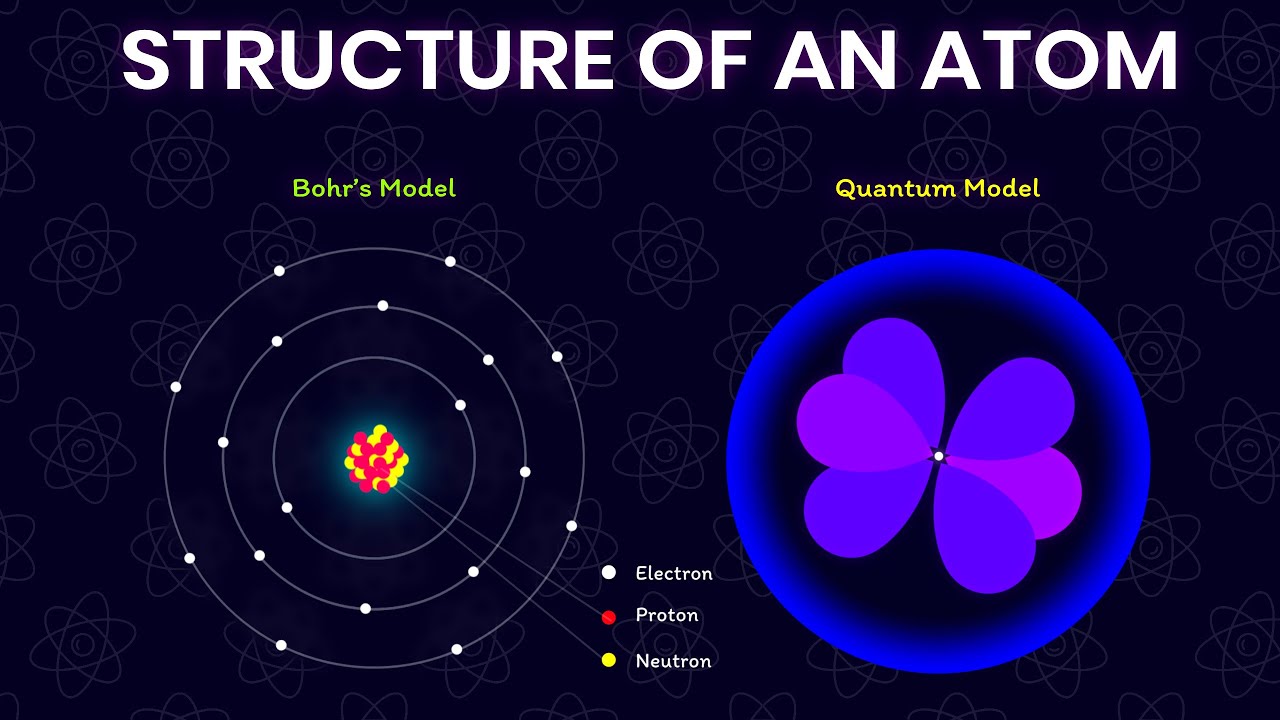
Our entire universe and existence is built up of atoms they are like the building blocks of everything we know but how did atoms form in the first place where did they come from our understanding of atoms is that they are extremely tiny but could the entire universe somehow be one single atom picture an atom in your mind it's like a tiny Hub called a nucleus and around it there are super fast electrons zooming Around now let's dive into a curious thought how do these electrons manage to keep spinning around the nucleus without slowing down this
question stirred up quite a puzzle back in the early 20th century and led to the fascinating development of quantum mechanics physicists were on a mission to unravel the secrets of atoms they figured out that each atom has a nucleus kind of like a center with a positive charge and considerable Mass around this nucleus There are these incredibly small electrons with a negative charge armed with this basic Insight scientists set out to craft a more detailed model of the atom at first they drew inspiration from our solar system thinking of a dense nucleus similar to the
sun with tinier bits like planets orbiting around it however this model faced a couple of big challenges first when charged particles speed up they shoot out electromagnetic radiation now electrons Are charged and zoom around during their orbits so according to this model they would be constantly emitting radiation this would mean they lose energy and quickly spiral inward eventually crashing into the nucleus but we know atoms stick around for way longer than a tiny fraction of a second making this model not very practical second atoms were observed emitting radiation at specific distinct frequencies which is different
from the continuous emission Expected if electrons followed the Solar System model quite a head scratcher right Neils bore a highly regarded physicist from Denmark stepped into the scene as the Pioneer in resolving the perplexities surrounding electrons behavior in atoms it was in the year 1913 when he presented a groundbreaking idea electrons in an atom aren't just randomly spinning around instead they are restricted to specific quantized distances from the nucleus bore went Further by proposing a minimum distance that an electron could stay away from the nucleus Beyond this point it couldn't get any closer B's Concepts
weren't mere hunches they were solidly grounded in the earlier work of German physicist Max plank about a decade before B's breakthrough plank introduced the idea of quantization of radiation emission according to plank objects could only absorb or release radiation in distinct Fixed amounts not in any arbitrary value these fixed amounts were defined by a constant value known as Plank's constant similar to angular momentum bore took inspiration from from Plank's work and applied it specifically to electrons whirling around a nucleus he asserted that the smallest orbit an electron could have would possess an angular momentum exactly
equal to one plank constant larger orbits on the other hand could exhibit multiples of the plank Constant like twice or three times its value but they could never have fractions like 1.3 or 2.6 B's intricate model laid the foundation for a more precise understanding of atomic structure unraveling the mysteries of electrons Behavior within the microcosm achieving a comprehensive grasp of why electrons adopt specific orbits and adhere to well-defined energy levels necessitated the full-fledged development of quantum mechanics Electrons akin to other particles constituting matter exhibit dual characteristics acting both as particles and waves while our conventional
perception might liken an electron to a miniature planet circling a nucleus an alternative perspective envisions it as a wave encompassing the nucleus when waves are confined within a delimited space they are bound by special regulations they cannot exhibit arbitrary wavelengths but must conform To standing wave patterns that precisely fit the given space consider this akin to playing a musical instrument when you fasten the ends of a guitar string only specific lengths produce distinct notes similarly the electron wave encircling a nucleus must align with the available space and the nearest orbit is dictated by the first
standing wave of that electron as quantum mechanics Advanced refinements were made to this model but the fundamental concept remained Consistent an electron cannot approach the nucleus Beyond a certain point due to its quantum mechanical limitations which restrict it from occupying a smaller spatial realm this intricate analogy likening electron Behavior to musical harmonies offers a bridge for comprehending the fascinating ating interplay between quantum mechanics and the Dynamic dance of particles within the microscopic realm another way to understand this doesn't involve quantum Mechanics at all it looks at the various energies involved an electron orbiting a nucleus
feels an electric pull towards the nucleus always trying to get closer at the same time the electron has kinetic energy pushing it away for a stable atom these forces are balanced the total energy of an electron in orbit combining its itic and potential energies is negative so to remove the electron energy must be added to the atom this is similar to planets orbiting The Sun adding energy is needed to remove a planet from the solar system picture an electron falling toward the nucleus due to the electric charge but because of quantum mechanics it can never
reach the nucleus staying in orbit physics allows this because the system's total energy is negative showing stability and holding the components together to to make a lasting atom let's delve into the Intriguing journey of the first atom's formation a process Intricately woven into the fabric of our vast universe everything surrounding us from the tiniest Speck to the grandest celestial bodies is composed of an astonishing multitude of atoms surpassing a staggering 10 quadrillion vigintillion in the observable Cosmos these atoms the fundamental building blocks of matter consist of electrons protons and neutrons which in their minuscule Essence
Harbor even smaller constituents known as quarks the origins Of these particles can be traced back to a Monumental event known as The Big Bang The Big Bang Theory serves as our Cosmic Compass guiding us through the cosmic Narrative of the universe's Inception this Theory posits that a colossal amount of energy condensed at the universe's birth leading to the formation of atoms however this is merely the tip of the scientific Iceberg as unraveling the intricacies of the Big Bang Demands a more nuanced exploration Of the early universe's events regrettably the precise moment of the universe's commencement
remains an enigma and we are left pondering whether it truly began at all our most reliable guide in this Cosmic Quest the standard model of cosmology allows us to trace time back to the vicinity of the beginning where the theory predicts a singularity a moment of infinite density where all matter and energy were compressed into an infinitesimally small Point however many physicists Harbor reservations about the absolute accuracy of this prediction our scientific Odyssey takes us back to a time close to one plank time approximately 10 to the power ofus 43 seconds but beyond this juncture
the veil of uncertainty shrouds our vision before this Cosmic blink of an eye The Narrative of the universe's Genesis eludes us and the secrets of the the primordial Epoch remain concealed in the cosmic tapestry in our pursuit of Understanding we come remarkably close to the dawn of time yet The elusive moment at T equals 1 remains a tantalizing mystery inviting further exploration and contemplation embarking on the cosmic journey to comprehend the universe's early chapters necessitates delving into the realm of a quantum theory of gravity an intricate merger of the principles governing gravity which El iates
the behavior of substantial entities and Quantum mechanics which unravels the behaviors of infinitesimally small particles this Cosmic Odyssey unfolds during a segment known as the plank Epoch transpiring at an astonishingly minuscule scale of 10 to the power of minus 43 seconds within this Epoch a tapestry of cosmic Dynamics unfolds with the conjecture that all fundamental forces including electromagnetism the weak Force the strong force and gravity coales into a singular Grand Force now Let's embark on the chronological exploration of The Big Bang Theory setting our temporal clock before the plank Epoch ushering in a narrative marked
by Cosmic Evolution however to circumvent the enigmatic Singularity at T equals 1 we tread cautiously acknowledging the uncertainty surrounding the state of the universe during this elusive Epoch and the events preceding it our theore iCal Journey commences with the epoch of Inflation stretching from approximately 10 to the power of minus 36 seconds to about 10 to the power of minus 33 seconds post Big Bang during inflation the cosmos undergoes an extraordinary expansion transcending the limits of our conventional understanding this expansion occurs at a velocity surpassing the speed of light catapulting the cosmos from a minute
point to a scale akin to a large orange it's crucial to note that that while Information transmission is Bound By The Cosmic speed limit Cosmic inflation involves the expansion of space itself this allows distant points to move away from each other at a pace faster than light can Traverse the distance between them while the period of inflation provides a tantalizing glimpse into the cosmic Chronicle our most substantial understanding originates from the phase succeeding inflation here we witness the Big Bang not as a solitary point in Space and time but as an Epoch when the early
Universe pulsated with extreme heat density and Rapid expansion as we Traverse this Cosmic timeline we navigate the complexities of the universe's formative epochs unraveling the secrets of its infancy and pondering the enigmatic dance of forces that shaped the cosmos inflation is thought to have occurred from 10 to the power of - 36 to about 10 to the power of - 33 seconds The energy behind this expansion is unknown and Cosmic inflation erases any information about what existed before it the standard model of cosmology is well understood from about 10 to the power of minus 12
seconds as the universe's energy levels can be recreated in current particle accelerators before this time we can only speculate about the events from about 10 to the power of minus 33 seconds to 10 to the power of -12 seconds where the forces of gravity The strong strong force and electromagnetic and weak forces called the electro weak Force were still unified the origin story of the first weightless Elementary particles presents itself as a cosmic Enigma with multiple potential narratives one possibility places their Genesis in the energetic Maelstrom of the Big Bang while another hypothesis suggests a
transformative dance within an inflation field wherein inflaton metamorphosed into the Elementary particles that populate our Cosmic Landscape today this Cosmic Overture unfolds around the epoch of 10 to the power of - 11 seconds marking a pivotal juncture as the temperature takes a plunge to approximately 10 to the power of 15 Kelvin inaugurating the Quark Epoch during this Epoch the cosmic stage Witnesses a dynamic interplay between the fundamental forces of electricity and the weak Force leading to a separation known as Electro weak Symmetry breaking this intricate Cosmic ballet is accompanied by the higs field acquiring a
non-zero potential endowing Mass to the elementary particles delineated by the standard model of particle physics at this juncture the foundational components required for the eventual formation of atoms fall into place and the temperature of the burgeoning universe hovers around an astounding 1 quadrillion Kelvin as the cosmic Tapestry unfolds with the universe expanding and cooling the once scorching temperatures in impede quarks from coalescing into composite particles like protons and neutrons however a cosmic Alchemy transpires as the temperature gradually descends to approximately 1 trillion Kelvin around 10 to the power of minus 5 Seconds the Quark plasma
Metamorphoses into a hadron gas featuring protons neutrons and specific misons subsequently these misons undergo Transformations culminating in the emergence of photons and electrons with each sequential drop in temperature a Symphony of particle antiparticle Annihilation ensues engendering pairs like neutrinos and photons intriguingly a subtle asymmetry in this Cosmic dance allows an excess of particles over their antiparticles providing a cosmic loophole for certain quarks and electrons to endure this endurance paves the cosmic path for the creation of Protons neutrons and electrons the elemental building blocks essential for the formation of the first atoms in the grand Cosmic
drama this incate choreography sets the stage for the cosmic narrative to evolve with particles forces and temperatures orchestrating a Celestial ballet that shapes the very fabric of our Cosmic existence the cancelling out process finishes with the leptin Epoch around the 1 second Mark when temperatures drop To about 5 billion Kelvin during this time lepton finish the cancelling out process after this impressive display most matter particles turn into photons and neutrinos but because of the difference between matter and its opposite a small amount of protons neutrons and electrons remain becoming the basic building blocks for atoms
around a few minutes after the universe starts the era of big bang nucleo synthesis BBN begins with equal numbers Of protons and neutrons produced free neutrons are naturally unstable and change into protons through beta decay in about 10 the^ of -5 minutes while the temperature stays High the conversion between protons and neutrons stays balanced but as the universe cools more Neutron Decay becomes more common free neutrons try to combine with other hadrons and create larger nuclei before breaking down this process results in the universe being made up of about 75% Hydrogen nuclei and 25% helium
4 nuclei with small amounts of dyum helium 3 and Tiny traces of lithium 9 nuclei in this Cosmic Chronicle a significant chapter unfolds as the universe navigates the photon Epoch a period lasting for approximately 380,000 years during this Epoch the cosmic tapestry is woven with predominantly ionized nuclei devoid of companion electrons the cosmic Alchemy required for the formation of stable neutral atoms hinges on the essential Interplay between electrons and positively charged nucleons however the universe in this EP remains ensconced in an intense heat rendering electrons temporary companions to nucleons before the Relentless force of their
high energy propels them into separation this persistent separation perpetuates a cosmic cloudiness where photons bearers of light engage in continuous interactions with nucleons and electrons slowing their Celestial Journey Through The vast Cosmic expanse as the cosmic drama unfolds the photon Epoch persists until the universe under goes a transformative cool down reaching a temperature of 3,000 Kelvin at this Cosmic juncture electrons now endowed with diminished energy succumb to the electromagnetic force forging enduring bonds with nucleons in a process heralded as recombination this Cosmic Alchemy Heralds the birth of stable neutral atoms liberating photons from Their entanglement
amid the cosmic tumult of positive nucleons and negative electrons henceforth these photons embark on an unbridled sojourn through the cosmic canvas for Cosmic Spectators situated in the cosmic theater this luminal journey offers a visual spectacle in the present day the inaugural light of the universe christened the cosmic microwave background CMB unfolds in all directions this luminous Emissary captures the Moment when the first stable neutral atoms make their Cosmic debut unveiling crucial Revelations about the nent universe and the intricate Genesis of atoms as we navigate these Cosmic Revelations an intriguing inquiry surfaces do atoms ever truly
touch each other this question delves into the fundamental nature of atomic interactions inviting us to contemplate the profound Mysteries that govern the behavior of these Elemental building Blocks in the grand tapestry of the cosmos atoms are constantly engaged in a dance of interaction but grasping the intricacy of these interactions requires us to redefine our understanding of interact our conventional comprehension of interaction stems from the observable world around us consider the scenario where you push a magnet towards another magnet when the magnets Come Close You observe an interaction between them alternatively think about two Differently charged
balloons one positively charged and the other negatively charged as you bring them near each other there's an interaction ction between the charged surfaces of the balloons in these cases the magnetic forces between the magnets or the electrostatic forces between the charged balloons showcase interaction between distinct entities the magnets poles or the charge on the balloons represent properties that influence the nature of Their interaction creating a dynamic exchange at the microscopic level however when we venture into the microscopic realm our conventional understanding encounters challenges leading to a certain bewilderment about interactions at the atomic scale if
we could zoom into the atomic level we'd witness a bustling scene where atoms and molecules are in perpetual motion colliding twisting and spinning in a chaotic Symphony amid this microscopic Tumult a significant Revelation emerges atoms lack a distinct boundary at the nucleus is heart a cluster of protons and neutrons electrons exist in a cloud of probability indicating potential location they might occupy the principles of quantum mechanics Empower us to calculate these probabilities revealing that they extend across the vast expanse of the universe yet in most observable scenarios electrons tend to remain in close proximity to
the nucleus Consequently unless we're engaging in high energy experiments delving too deeply into these intricacies isn't a pressing concern since atoms don't have a solid surface in a way there's no physical touch because there's never a direct meeting of surfaces however touch also means a close and influential interaction and in that sense atoms are always in contact atoms interact because of the electromagnetic force coming from the electric charges of electrons and Protons inside them technically this Force has an infinite range but it only becomes important when atoms are close enough sometimes atoms repel each other
due to the electromagnetic force between their electrons in that brief moment it's hard to describe their interaction as anything but touching even if it's not instant it still counts as touching for example when we look at the cup on the table at the atomic level we see that the electrons on the Cup's Outer Edge are pushed away by the electrons on the table's Outer Edge despite the gap between the layers of electrons which is usually there the atoms are close enough to significantly affect each other this is clear from the fact that the cup doesn't
fall through the table and the electromagnetic forces between the atoms counteract gravity's pull on the cup on the big scale when we say two objects are touching it reflects the same interaction on the small scale atoms can Interact in various ways and it's not as simple as always being pushed away by the electromagnetic force when atoms approach each other there's a force called the Vander WS Force which is part of the electromagnetic force surprisingly this force can create bonds between atoms leading to the creation of molecules in a molecule the atoms are essentially in contact
with each other interestingly even the nuclei within atoms have the potential to touch Although it's challenging due to the strong electromagnetic repulsion between the positively charged protons in each nucleus quantum mechanics comes into play in this scenario if two atoms are brought close and held together for a certain period there's a chance albeit randomly that their nuclei can mix this process is known as nuclear fusion where two separate atoms merge into a single larger atom when the atoms involved are lighter than iron this Fusion releases Energy this fundamental process is how Stars including our sun
generate the power that sustains them now let's explore the concept of identical atoms within the same element no two atoms of the same chemical element are usually not identical firstly electrons in an atom can be in different states so two atoms of the same element can be different if their electrons are in different states for example one copper atom with an excited Electron and another copper atom with all electrons in the ground state are distinct the excited copper atom will emit light when the electron returns to the ground state while the copper atom in the
ground state will not the way an atom chemically bonds depends on the states of its electrons so two atoms of the same element can react differently if they are in different states chemists know this well and to fully describe and predict a reaction it's necessary to Specify the ionization and excitation states of the electrons in the atoms furthermore when left undisturbed an atom commonly does not possess an equal count of protons and electrons even when two atoms of the same element have their electrons in identical States they are not truly identical factors such as their
movement or rotation at different speeds can influence their ability to form chemical bonds atoms with slower movement like those found in Solid ion have sufficient time to establish stable bonds conversely atoms with higher speeds such as those in liquid ion struggle to form stable bonds consequently a slowly moving tin atom displays different Behavior compared to a rapidly moving tin atom now consider a scenario where two atoms of the same element not only have their electrons in the same States but also move and spin at the same speed would they be indistinguishable then the answer is
no Similar to electrons the neutrons and protons within the nucleus can exist in various excited States Additionally the nucleus as a whole can rotate and vibrate at different speeds therefore even if all other aspects are identical two gold atoms might have their nuclei in different excited States leading them to beh differently in nuclear reactions in essence achieving perfect identicality between two atoms of the same kind is an exceedingly challenging Task even when dealing with two atoms that are essentially the same chemically and exhibit identical chemical reactions they cannot be deemed completely identical this assertion extends
Beyond considerations of electrons to Encompass the nucleus of an atom the nucleus is composed of tightly bound neutrons and protons it's essential to recognize that atoms of the same type May possess a different number of neutrons and still belong to The same atomic species these variants known as Isotopes have implications particularly in nuclear reactions and more specifically in processes like radioactive decay while the involvement of a particular isotope does not impact an atom's chemical reactions it significantly influences the atom's behavior in nuclear reactions various Isotopes have different rates of Decay and exhibit distinct characteristics in
radioactive processes the prevalence and Significance of nuclear reactions such as decay vary among Isotopes some Isotopes Decay rapidly transforming into other elements while limitting radiation While others remain stable in contexts like carbon dating it becomes crucial to differentiate between isotopes of the same element for instance a carbon 12 atom is not equivalent to a carbon 14 atom simply counting the total number of carbon atoms in a sample does not provide information about the sample's Age instead a comprehensive analysis involves counting the number of different isotopes of carbon present in the sample however it's important to
understand that atoms don't have individual identities beyond what has been mentioned here if two carbon atoms are in the exact same molecular Atomic electronic and nuclear States then those two carbon atoms are identical regardless of their origin or past History atoms being the basic building blocks of reality might also have a color right or do they when you group many atoms together you get the screen you are currently looking at which definitely has color so does that mean each individual atom has its own color too if so is it the nucleus or maybe the electrons
that are colored and if so which color the colors you see are created by the human brain they don't really exist outside of your visual Perception so what exactly is color to understand that you need to grasp the nature of light light consists of particles called photons however this behavior is only noticeable when observed otherwise they act as electromagnetic waves this phenomenon is known as the wave particle duality concept and yes it is strange these waves have specific frequencies and are classified into seven primary wavelength sections ranging from radio waves as big As Earth to
gamma rays as small as atoms the human eye can only perceive this small section known as visible light while everything else remains invisible you might wonder why this particular region is important it's because the first eyes evolved while organisms lived in underwater environments and this part of light is transparent in water infrared and ultraviolet light on the other hand make water somewhat opaque if the first organisms evolved in Sulfur Lakes on a planet orbiting a neutron star there eyes might have adapted to see something like x-rays now that's clear how does light form and how
does it help us see color in the core of the Sun hydrogen nuclei undergo nuclear fusion due to immense pressure transforming into alpha particles and emitting gamma radiation this radiation bounces around the Sun colliding with other hydrogen atoms over thousands of years losing energy in the process until It eventually emerges as visible or ultraviolet light which then reaches Earth Light behaves in two ways when it encounters a material it can either be soaked up or bounced back this depends on what the material is made of take a blue piece of fabric for instance it looks
blue because it reflects the blue part of light while soaking up all the other parts so it's every color except blue because blue gets reflected and not soaked up that's why things that are Black get really hot in the sun they soak up all the light and don't reflect much on the flip side white things reflect most of the light and don't soak up much all of this is called bulk reflection and absorption when a beam of light meets a bunch of atoms at the same time things like how far apart the molecules are or
how they're arranged can affect the colors of the reflected light for example even though snow and ice are made of the same kind of Molecules they're arranged differently making Snow White and Ice seethrough meanwhile water doesn't soak up much light and most of it goes through you'd have to dive deep into the ocean to avoid sunlight think about Carbon Let's revisit our initial query can atoms be attributed with colors in the context of bulk reflection the straightforward answer is no this is because the wavelengths of light are significantly larger than the dimensions of a single
Atom making it impossible to discern colors at such a minute scale however when we delve into thermal radiation a fascinating phenomenon unfolds upon upon heating a substance the atoms within it experience heightened agitation resulting in the release of photons surprisingly regardless of the substance being heated the emitted light adheres to the same color spectrum it's important to note that this colorful display occurs only When there is a Congregation of particles individual atoms in isolation do not exhibit any discernable color through thermal radiation now let's shift our Focus to gas discharge when Electric courses through a
group of atoms it induces a state of excitement prompting the release of photons the emitted light manifests in various colors contingent on the specific substance involved thereby creating a distinctive emission Spectrum for each element hydrogen atoms for example emit distinct colors a characteristic shared by elements like iron in essence each element possesses its own unique color fingerprint defined by its emission spectrum while one might conceptualize this as the color of the element from our everyday perspective atoms are infinitesimally smaller than the wavelength of light consequently the concept of color doesn't hold at the atomic level
in our conventional Perception now let's turn our attention to a fresh query how is it that protons within the nucleus don't expel each other in nature there are four fundamental forces Gravity the weak Force electromagnetism and the strong force while we're familiar with gravity on larger scales at the quantum level the other three forces take over electromagnetism which is about 10 to the power of 37 times stronger than gravity is responsible for attracting Electrons to protons in atoms now you might wonder why multiple protons in atomic nuclei don't strongly repel each other due to electromagnetism
according to kul's law in a helium atom two protons should experience erence a repulsive force that would make them fly apart instantly however protons stick together because of an even stronger Force called the strong nuclear force this Force about 100 times stronger than electromagnetism Operates at the scale of atomic nuclei while it works differently from electromagnetism it's the key reason protons stay bound within the nucleus this Force might not be as familiar since it's usually not covered before college level studies the world of quantum chromodynamics tells us how protons and neutrons stick tightly inside Atomic
nuclei resisting the strong push from electromagnetism the strong nuclear Force responsible for holding Atomic nuclear together makes up about 99% of the mass of everyday things which might be surprising since people often think the higs field contributes more to delve into the intricacies of the strong force let's delve into the composition of protons and neutrons Within These subatomic particles we encounter quarks minuscule entities that constitute matter and gluons particles entrusted with carrying the force the Configuration of a proton involves two up quarks and one down Quark while a neutron comprises two down quarks and one
up Quark the gluons responsible for maintaining the proximity of quarks possess a color charge distinct from Optical colors that comes in red green and blue amalgamating to create the neutral color of white in order to achieve neutral charges one can either blend the three colors or employ color anti-color charges the connection Between gluons and quarks plays a crucial role in binding them together it's noteworthy that only quarks and gluons are susceptible to the strong force with gluons functioning as Messengers analogous to photons in electromagnetism when quarks attempt to move too far apart a metaphorical rubber
band comes into play instead of allowing the Quark to go freely the required energy gives rise to a new Quark antiquark pair known as a Mison this Stipulation ensures that free quarks cannot exist independently they are invariably Tethered to at least one other Quark the role of misons is pivotal in understanding how protons and neutrons interact within the atomic nucleus despite being weaker than the force acting within nucleons the strong nuclear force substantially surpasses the repulsion arising from the positively charged protons due to electromagnetism the Intrigue of the Strong nuclear force lies in its operation
at remarkably short distances roughly equivalent to the diameter of a proton however its potency diminishes rapidly with increasing distance this characteristic holds great significance imposing a constraint on the size of stable Atomic nuclei preventing them from expanding Beyond a certain threshold to delve deeper into its role the strong nuclear force facilitated by misons plays a pivotal role in tightly Binding protons and neutrons within Atomic nuclei this force collaborates harmoniously with the strong force which is responsible for holding quarks together within nucleons understanding the intricacies of the strong force is crucial for unraveling the nature of
matter and comprehending the existence of the objects and life forms we are familiar with now let's explore the size of a proton a fundamental particle in the Subatomic landscape while one might assume that our understanding of atomic properties including proton size has reached a satisfactory level after extensive study a groundbreaking experiment in 2010 introduced a significant twist this experiment challenged our existing Notions by providing a marketly different measurement for the size of a proton prompting a reexamination of our understanding after nearly a decade of Careful scrutiny and Analysis scientists believe they have addressed this intriguing
puzzle often referred to as the proton radius mystery before delving into the intricacies of the latest discoveries it's crucial to dispel some oversimplified Notions about atoms contrary to being a smooth billiard ball a proton is more accurately described as a cloud of quarks held together by gluons adding a layer of complexity to our understanding of these fundamental Particles quarks play a crucial role in shaping the proton's characteristics particularly its positive charge understanding the dimensions of this positive charge boundary essentially provides insights into the size of the proton for several decades scientists have employed two distinct
approaches to determine the radius of the proton's boundary engaging in intricate investigations that unravel the mysteries of these subatomic Particles the first method involves directing electrons at atoms frequently focusing on hydrogen due to its Simplicity alone proton in the nucleus orbited by a single electron through careful observation of the interactions between electrons and the nucleus scientists discern where the proton's positive charge begins to diminish effectively marking the boundary of its size the second method delves into the energy Dynamics within an atom Specifically by measuring the energy required to excite an electron from one state to
another hydrogen serves as a common subject for this study with its electron not merely orbiting the proton in a lower energy state but occasionally spending time within the proton itself the intricate dance between the negatively charged electron and the positively charged proton affects their electrical attraction influencing The energy needed for the electron to Transition to a higher energy level consequently a larger proton is theorized to allow more time for an electron to reside within it resulting in a weaker Atomic binding in the an of scientific exploration the determination of the proton's size has undergone a
fascinating Evolution traditionally researchers reached a consensus using electrons estimating the proton's radius at around 0.876 fmom however a seismic shift occurred in the scientific landscape roughly a decade ago when a new approach emerged departing from the conventional use of electrons scientists embarked on an Innovative trajectory by employing muans in high hen casting fresh light on the investigation into the proton's dimensions this intriguing departure prompted a re-evaluation of our comprehension of proton size reigniting The Quest for precision within the captivating domain of particle physics muans akin to their electron counterparts in many aspects diverge significantly due
to their Mass which is 207 times greater than that of electrons this unique characteristic results in muan spending a more sub substantial amount of time within the proton the heightened mass and prolonged interaction time make mu millions of times more sensitive to the proton size Compared to regular electrons in hydrogen in a groundbreaking experiment involving monic hydrogen scientists uncovered a proton size approximately 4% smaller than the previously accepted value derived from conventional electron-based experiments this captivating anomaly prompted a reassessment of Prior measurements casting a spotlight on tant izing questions about potential new physics or undiscovered
Elementary particles the Exploration of the proton size has thus evolved into a dynamic Journey challenging and expanding our understanding of the fundamental building blocks of the universe in September 2019 researchers at York University in Toronto conducted an experiment using standard electronic hydrogen employing an advanced measuring technique known as frequency offset separated oscillatory Fields by by exciting the electron into a higher Energy State they obtained results aligning with the muonic hydrogen experiment conducted in 2010 indicating a proton radius around 0.833 fmom this convergence of results from different methodologies provided a more cohesive understanding of the proton
size suggesting that the previous discrepancy was likely a result of measurement errors rather than heralding novel Realms in particle physics in contemplating the seemingly cont Tradictory nature of atoms where the majority of space is considered empty a macroscopic analogy proves Illuminating Envision a table magnified to a billion times its size rendering its atoms comparable to melons despite this significant scale the nucleus at the atom Center remains minuscule and invisible as do the electrons in their orbital dance the question arises why don't objects simply pass through this apparent emptiness and why isn't light Able to permeate
these atomic gaps to unravel the mystery behind the solidity of objects especially the tactile experience of touching a table it is essential to delve into the intricate behavior of electrons within atoms our initial understanding of electrons might be oversimplified unlike the analogy of planetary orbits electrons do not orbit the nucleus like planets around the Sun instead picture electrons as a dynamic swarm akin to the Swift and Unpredictable movements of bees or Birds while tracking individual motions within this swarm is practically impossible due to their rapid Pace their Collective Behavior forms distinct patterns resembling a synchronized
dance this electron dance is far from arbitrary it adheres to specific predetermined patterns comparable to steps in ballroom dancing governed by Irvin Schrodinger's mathematical equations these electron patterns shape The character of their movements the patterns themselves exhibit a spectrum of Dynamics some are graceful and gradual resembling a waltz While others are spirited and Rapid reminiscent of a Charleston dance each electron strictly adheres to its unique pattern and the Exclusion Principle ensures that no two electrons within an atom perform the same step by envisioning electrons as participants in a complex dance we gain Insight into the
organized chaos at the atomic level contributing to the overall understanding of the physical properties that Define the solidity of everyday object while electrons don't Tire transitions between dance patterns involve the exchange of energy elevating to a FAS a dance pattern requires energy input while moving to a slower pattern results in energy release often in the form of light when external energy in the form Of light interacts with electrons they absorb some energy transitioning to a higher more energetic dance pattern for a light beam attempting to Traverse through a material like a table the electrons in
the atoms constituting the material eagerly absorb energy from the light hindering its progress after a brief interval these electrons release the gained energy potentially as light again the interplay of absorbed and reflected light coupled with changes in Dance patterns manifests as Reflections and colors this intricate process collectively contributes to the perception of the table as a solid object yet this prompts the question if light does doesn't penetrate far into the table how does the table feel solid to touch the sensation of solidity when touching an object like a table is intricately tied to the dynamic
interactions of electrons within atoms As you extend your hand to touch the table the electrons in the atoms of your fingers come into proximity with the electrons in the atoms of the table when the electrons of one atom approach the nucleus of another atom the established dance patterns of their movements undergo a transformation this transformation arises because an electron in a lower energy level around one nucleus cannot replicate the same dance around the other nucleus as that Particular slot is already occupied by one of its own electrons consequently the incoming electron must transition into an
unoccupied more energetic role this shift in dance patterns demands energy and unlike the absorption of light this time it is supplied by the force from your probing finger pushing to two atoms in close proximity necessitates energy as all their electrons must transition into unoccupied high energy states attempting To bring together all the atoms in the table and those in your finger requires a considerable amount of energy more than what your muscles can readily provide the resistance you feel while pushing against the table with your finger is a result of this energy demand explaining why and
how the table imparts a solid feel to your touch now Del solving into the question of why atoms form molecules it's essential to recognize that the visible Universe primarily consists of fewer than 100 naturally occurring elements however the remarkable diversity of chemical substances we observe in the cosmos and within living organisms arises from the fact that atoms seldom exist in isolation instead they avidly engage in chemical bonding combining with other atoms to form molecules this propensity for bonding gives rise to an extensive array of chemical combinations and materials contributing not only to The Myriad phenomena
observed in the universe but also to the intricate structures essential for Life energy sources Consciousness and various macroscale processes in essence the universe avoids monotony because atoms form bonds resulting in complex chemicals with properties that are fundamentally distinct from their individual constituent atoms this fascinating occurrence unfolds due to the pivotal role that Energy plays in the intricate process of molecule formation a phenomenon deeply rooted in the principles of quantum mechanics in the realm of essential chemicals that shape our everyday experiences such as the air we breathe molecules take precedence over individual atoms for example oxygen
presents itself as O2 featuring two oxygen atoms bound together similarly nitrogen manifests as N2 and water adopts the composition H2 2 o comprising Two hydrogen atoms and one oxygen atom the prevalent existence of atoms in the form of molecules can be attributed to their innate inclination to assume a state of lowest energy akin to a marble a top a hill that effortlessly rolls down to the bottom across the Natural World Systems consistently strive to minimize their potential energy elucidating phenomena like the unidirectional flow of rivers from elevated terrain to lower ground energy A key player
in the orchest registration of molecular structures becomes particularly significant when examining the simplest atom hydrogen comprising one proton and one electron hydrogen typically manifests as H2 or hydrogen gas quantum mechanics provides valuable insights into the rationale behind atoms forming molecules as they seek lower energy states the introduction of a second hydrogen atom brings forth intriguing interactions as these atoms Draw closer the negatively charged elect repelling each other due to their shared charge are simultaneously influenced by the positive charge emanating from the protons in the neighboring atom resulting in an attractive force a delicate equilibrium is
established marked by an optimal distance where protons prefer to reside allowing for the sharing of electrons while minimizing repulsion it's crucial to recognize that the attraction between Atoms isn't solely dictated by the repulsion within their electron clouds rather a multitude of intricate interactions comes into play shaping the dynamic landscape of molecular formation in essence the dance of electrons and the interplay of charges at the quantum level pave the way for the cohesive existence of atoms as molecules each striving for a harmonious balance of energy states the intricate dance of atoms Shaping the formation of molecules
is intricately governed by the overarching concept of total energy within a system this all-encompassing energy Factor intricately guides the bonding interactions between atoms orchestrating the emergence of cohesive molecular structures delving into the exploration of the lowest energy state in a two atom system exemplified by the formation of a hydrogen molecule entails a comprehensive consideration of various Elements the kinetic energy inherent in each atom intertwined with the potential energy Dynamics between protons and electrons contributes to the system's total energy framework work in the realm of quantum mechanics these complex energy calculations find encapsulation in the hamiltonian
a fundamental representation of the system's energy however the unraveling of this energy tapestry involves the intricate solving of the time independent Schrodinger Equation with the hamiltonian as its guiding force while this equation poses a formidable challenge to direct resolution its Essence is often graphically portrayed providing a visual Narrative of energy fluctu ations as two atoms draw closer within this graphical representation a distinctive dip emerges symbolizing the systems lowest energy State when the atoms attain an optimal proximity the optimal State encapsulates a harmonious Union where the two atoms In this coales configuration find themselves in a
more contented State at a lower energy level than when existing in isolation this phenomenon elucidates the natural tendency of hydrogen atoms to syg energize forming molecules of H2 rather than persisting in a solitary State this electron sharing pact between atoms known as a calent bond extends its reach to forge similar calent bonds between a myriad of other atoms unraveling the stability secrets of Atoms involves an exploration of the electron Arrangement within their orbital shells in circling the nucleus particularly stable configurations emerge when atoms possess specific electron counts such as 2 10 18 36 54 or
86 these magic numbers align with the electron tally of naturally occurring noble gases characterized by chemical inertness and an inherent reluctance to readily bond with other atoms in essence the stability and bonding proclivities Of atoms unfur a captivating narrative woven intricately into the intricate tapestry of quantum mechanics atoms embark on a quest for stability aspiring to achieve a complete valence shell of electrons this Pursuit manifests through either the collaborative Endeavor of sharing electrons in covalent bonds or the transformative Act of transferring electrons in ionic bonds the magnetic interplay between the attractive Force propelling electron sharing
for the Attainment of a full valence shell encounters a delicate equilibrium with the repulsive forces emanating from electron clouds and protons within the atomic nucleus delving into the rationale behind the intriguing magical numbers guiding Atomic stability unveils a captivating narrative rooted in the Realms of quantum mechanics specifically the Schrodinger equation and the poorly Exclusion Principle contribute Significantly to deciphering the underlying order the poorly exclusion principle asserts that no two firmians such as electrons can occupy identical Quantum States necessitating opposite spins for electrons sharing the same orbital the amalgam of these principles culminates in the identification
of specific numerical sequences these sequences emerging as magical numbers dictate the configurations resulting in the lowest potential energy within Chemical systems in navigating the complexities of multi-atom systems like water H2O comprehensive calculations become imperative the Morse potential equation often employed as an approximation proves instrumental in determining Bond length conducive to the molecule's lowest potential energy quantum mechanics with its intricate principles and mathematical formulations emerges as The Guiding Light Illuminating the intricacies of Nature's Behavior however it's crucial to note that while quantum mechanics offers profound insights into the mechanics of the natural world it doesn't inherently
provide a profound understanding of the fundamental why behind the inherent nature of existence transitioning to the Intriguing realm of neutron neon Stars a compelling inquiry surfaces is a neutron star akin to a colossal atom neutron stars stand out as some of the most extraordinary entities in the vast Expanse of the universe they manifest as colossal Atomic nuclei boasting diameters that extend over several kilometers and possess mindboggling density and inherent violence the sheer existence of such a phenomenon prompts a profound question how can something of this nature possibly exist the life of a star is a
delicate balance between the Relentless force of gravity and the counteracting radiation pressure generated by the fusion reactions Occurring at its core deep within a star's core hydrogen undergoes fusion metamorphosing into helium as time progresses the hydrogen Supply dwindles and if the star is sufficiently massive helium begins its Fusion Journey eventually transforming into carbon in The evolutionary process of these massive stars their cores undergo successive layering with progressively heavier Atomic nuclei accumulating at the core carbon Fusion initiates a Cascade leading to the formation of neon which further evolves into oxygen and silicon the fusion journey culminates
in the creation of ion an element incapable of undergoing further Fusion upon the cessation of the fusion process the radiation pressure undergoes a rapid decline disrupting the star's equilibrium if the core Mass exceeds approximately 1.4 times that of the sun solar masses a catastrophic collapse ensues the outer layer of the core Accelerates at velocities soaring up to 70,000 km/s collapsing toward the star's Center at this critical juncture only the fundamental forces within an atom come into play working to counteract the gravitational collapse however due to the effect of the weak force in this hot dense
plasma newly formed protons can easily change identity to become neutrons and vice versa only as the temperature drops even further when the universe is approaching 1 second old Does this particular Quirk of the weak Force become ineffective and the protons and neutrons eventually slow their switching during this so-called freeze out the hadrons choose an identity once and for all it is during this period that the seemingly arbitrary fine-tuned constants of nature in this case the masses of up and down quarks have their first real opportunity to shape the future of our Cosmos since down quarks
are heavier than their up counterparts And neutrons contain two downs the mass of a neutron is slightly greater than that of the two up containing proton as the final identity switches take place in an Ever cooling Cosmos the downhill energy slope from the heavy Neutron to the lighter proton is favored over the energy intensive Hall in the opposite direction this slight Mass difference ultimately results in an imbalance in the number of protons to neutrons in the universe from that point On with roughly seven protons to every Neutron and this ratio as it turns out plays
a crucial role in the formation of the universe as we understand it protons serve as the foundation for hydrogen and helium the fuel for stars and the essential components for all other heavier elements in the universe the prevalence of these charged particles over the uncharged neutrons is what enables Elemental interactions Paving the way for chemistry and biology If the initial conditions were different if the down Quark had been assigned a slightly lower Mass during the fine tuning of our reality the universe we observe today would be markedly different if neutrons weighed less than protons then
they would have been favored during freeze out with more uncharged neutrons than protons the possibilities for chemistry would be limited hydrogen cons consisting of only a proton with no neutrons wouldn't be Stable for extended periods some of the heavier protons could have been preserved by binding to neutrons before decaying away forming helium atoms however helium is often considered the most inert of all elements it is inherently stable and reluctant to react with an excess of generally unreactive neutrons it would be challenging to Envision how nuclear fusion could function in such a universe we would be
left with a cold dark Expanse devoid of stars galaxies planets and most certainly Life as we know it therefore we can Express gratitude for the universe's unexplained preference for protons over neutrons however this is not the only a symmetry that becomes embedded in the cosmos during this stage of its Evolution another mysterious yet fortunate imbalance is the absence of antimatter in the future as we gaze into the sky we might catch a glimpse of an alien civilization Self-destructing though not as visually striking as the explosion of a massive star it would signify the release of
energy from a weapon capable of leveling an entire world throughout Earth's history conflicts territorial disputes and Discord have been common among civilizations and there's no reason to believe this wouldn't be the case elsewhere in the Galaxy on a belligerent alien planet similar to Earth the pursuit of dominance leads to an arms Race from primitive weapons to Advanced Technologies like nanom machinery and atomic bombs seeking even more potent sources of energy these extraterrestrials more technologically advanced than Humanity harness the power of antimatter they learn to produce and isolate antimatter particles suspending them in a vacuum using
electromagnetic forces until the moment of deployment unlike Conventional Weapons antimatter requires no substantial fuel or triggers Upon contact with the prevailing normal matter on their home World antimatter particles would annihilate releasing immense energy and destroying themselves in the process just one gram of antimatter has the potential to unleash as much energy as a traditional nuclear weapon using around 90 kg of fuel the ongoing arms race on this alien world leads to the accumulation of stockpiles of antimatter Weaponry whether triggered by anger confusion or a simple accident The de ation of this antimatter Arsenal is catastrophic
day turns into night in an instant scorching winds lay waste to entire cities eradicating both Waring factions and all other life on the planet the entire world undergoes a transformation that Echoes for centuries this illustrates the devastating consequences when antimatter comes into contact with matter yet astonishingly we are surrounded by antimatter every day now let's embark on a cosmic thought Experiment what if the entire universe resembled an atom the observable universe vast and challenging to comprehend May according to certain theories be relatively insignificant current calculations suggest that the unobservable Universe could surpass even the immense
size of 20 trillion light years in diameter despite its colossal scale a substantial portion of this Cosmic expanse might be devoid of matter akin to The sparsity observed in the Observable universe matter the building block of everything we know is composed of countless atoms too small to be directly observed by our most advanced microscopes scientific evidence supports the existence of atoms composed of subatomic particles like protons neutrons electrons and quarks intriguingly there are theories proposing a grander reality where everything humans the entire observable And unobservable universe resembles an atom in a larger Cosmic context one
such concept is the one one electron universe theory suggesting that our perception of multiple electrons might originate from a single particle moving swiftly back and forth in time creating the illusion of Multiplicity while this idea lacks robust scientific support it serves as a thought-provoking starting point for other similar concepts with more scientific Backing a more widely acknowledged variation is rooted in the Multiverse Theory which posits that every atom electron and property of matter in our universe could be equivalent to an atom in a grander cosmic scheme this notion expands our understanding of the universe's intricacies
inviting us to contemplate the vast possibilities that lie beyond the boundaries of our observable Cosmos the notion of our universe being a mere Speck in a broader Realm has intrigued the Realms of Science Fiction in these imaginative scenarios our universe might be viewed as a tiny entity on a higher plane of existence or each atom within us could potentially Harbor entire other realities Infinity becomes a crucial element in these Concepts suggesting that no matter how vast our universe appears the Multiverse Theory postulates the existence of potentially infinitely larger universes from the perspective of These hypothetical
vast Realms our universe could seem as minuscule as subatomic particles appear to us when we observe the universe we witness the intricate dance of minuscule subatomic particles coming together to form progressively larger structures from celestial bodies to intricate living organisms this prompts a profound question could the universe itself be just a component of something even more grandiose the merging of the microscopic And macroscopic Realms urges us to withhold judgment until we develop a comprehensive Theory of Everything That seamlessly unifies the principles of quantum and classical physics according to the prevailing theory on the universe's origin
it it began as an infinitely dense Singularity before expanding through the Monumental event known as The Big Bang this implies that everything we currently comprehend was once unimaginably small however it's Crucial to distinguish this initial Singularity from an actual atom as it contained the fundamental components necessary for the formation of atoms while these Concepts May challenge our conventional understanding of reality they serve as valuable thought experiments encouraging contemplation of our place in the vast Cosmic tapestry although they might be mind-bending they don't diminish the Wonder and significance of our Existence one leading Contender for a
comprehensive Theory of Everything is string theory which seeks to unravel the true scale of reality in this theoretical framework atoms are not envisioned as spherical objects but rather as string-like structures that vibrate giving rise to all interactions in the universe including the fundamental laws of physics gravity and quantum mechanics however String Theory grapples with challenges particularly in Addressing Dark Energy a substantial constituent of the universe that remains a puzzle yet to be fully unraveled many String Theory models face a significant challenge in elucidating the prevalence of dark energy when compared to observable matter in recent
efforts to reconcile these disparities researchers from Upsala University in Sweden have proposed A variation within String Theory this novel perspective suggests that our universe might reside On the periphery of a perpetually expanding bubble where everything familiar to us constitutes a small segment of a much larger Cosmic structure within this bubble and possibly extending Beyond its limits Uncharted Dimensions could exist and the infiltration of dark energy from the broader bubble Universe offers a potential explanation if this unconven IAL portrayal of reality were accurate it Would revolutionize our current scientific understanding positioning human beings as infinitesimally small
components within a vastly intricate and incomprehensible structure nevertheless it's crucial to acknowledge that this concept serves as a thought experiment a captivating way to contemplate our role in the vast Cosmic expanse even if our perspective proves limited and our understanding imperfect the potential insignificance from an alternate View Point doesn't necessarily diminish the intrinsic value of our existence now let's Ponder a Timeless question what happens to your atoms after you die throughout human history over 100 billion individuals have departed this life considering the law of conservation of matter which posits that matter cannot be created or
destroyed one might wonder about the fate of these countless atoms surely their atoms must still persist in some Form right let's explore an intriguing idea that the atoms of your departed loved ones haven't simply vanished but have in fact become an integral part of you the world around us and are presently embarking on a captivating Journey Across the Universe delving into this concept we can unravel the fascinating ways in which this transformation occurs the human body is a complex composition consisting of approximately 60% water 20% fat 15% proteins 2% carbohydrates and 2% salts and minerals
along with 1% other elements like oxygen gases and vitamins the majority of the molecules within our bodies take the form of water H2O when an individual passes away this water undergoes a transformative process it either evaporates from the body entering the atmosphere or seeps into the ground the speed of this process hinges on various factors including temperature and Environmental conditions even if the water remains in liquid form it eventually becomes a part of Earth's water cycle transitioning from liquid to Vapor ascending to the clouds and eventually returning as rainwater a significant portion of this rainwater
Finds Its way into rivers lakes and eventually becomes part of our drinking water your body utilizes this water for diverse purposes such as integrating it into cells regulating Temperature and sustaining various bodily functions some of the rain water is absorbed absorbed by plants playing a pivotal role in photosynthesis this chemical reaction involves water carbon dioxide and sunlight producing carbohydrates and oxygen the oxygen released by plants is then breathed in by you and other living beings to support life moreover the carbohydrates resulting from water and photosynthesis become a crucial part of Your diet as well as
the diet of other animals through the consumption of fruits and vegetables this intricate cycle demonstrates how the atoms that once constituted your departed loved ones continue to contribute to the vibrant tapestry of Life highlighting the interconnectedness of all living things and the Perpetual journey of atoms through various forms and functions as we explore the intricate journey of atoms and molecules let's Delve into the fascinating realm of metabolism when you consume carbohydrates from Plants an essential process occurs the production of substances vital for plant life namely carbon dioxide and water this sets in motion a continuous
cycle where the very elements you generate contribute to the growth and sustenance of plant life now that we've uncovered the fate of water molecules H2O in your body let's unravel the destiny of your soft tissues Composed of carbohydrates fats and proteins these crucial tissues undergo metabolism with the assistance of an astonishing approximately 100 trillion bacteria residing in your body these bacteria have been constant companions primarily in your gut throughout your life normally your body's robust immune system keeps these countless bacteria in check however upon death the immune system ceases to function presenting these bacteria with
the opportunity to Consume the tissues within your body in this intriguing process as these bacteria metabolize your soft tissues they utilize them for energy and reproduction picture it as a gradual burn where the molecules digested by the bacteria ultimately transform into water and carbon dioxide identical molecules formed through the process of burning furthermore proteins in your body give rise to other gases like nitrogen oxides and ammonia during this metabolic Process what makes this process even more remarkable is that these gases especially nitrogen oxides are potent greenhouse gases nitrogen oxides for instance are approximately 300 times
more potent than carbon dioxide in contributing to the greenhouse effect in the atmosphere this emphasizes the intricate interplay of chemical processes within the body showcasing how even after death the elements within our bodies continue to participate in Complex Cycles with broader implications for the environment as we delve deeper into the fascinating realm of post-mortem processes the Journey of atoms within our body takes a unique turn as the initial bacteria continue their metabolic activities and oxygen becomes scarce a new set of bacteria known as anerobic bacteria sees the opportunity unlike their aerobic counterparts these bacteria don't
rely on oxygen for Metabolism instead they produce byproducts such as methane hydrogen sulfide and ammonia during the metabolization of tissues these byproducts are notorious for their unpleasant odors and and interestingly serve as potent greenhouse gases gradually these substances exit the body and disperse into the atmosphere so when you step outside and detect an unusual scent in the air there's a chance that you might be inhaling atoms originating From your great grandmother or others who came before furthermore additional atoms and molecules from your body are released into the underlying soil during decomposition for every kilogram of
dry body mass approximately 32 G of nitrogen 10 G of phosphorus 4 G of potassium and a gr of magnesium are eventually contributed to the soil remarkably these components act as natural fertilizers for the plant surrounding the burial Site playing a positive role in the local ecosystem now let's shift our Focus to the alternative process of cremation what unfolds after your body undergoes cremation the intense Heat Of The Cremation process leads to the conversion of the majority of atoms in your body hydrogen carbon nitrogen oxygen and sulfur into gases this transformation represents a remarkable change
in the state of these atoms marking another chapter in the intricate Journey of elements within the cosmic cycle as we explore the aftermath of The Cremation process various gases including water vapor carbon dioxide nitrogen oxides and sulfur oxides are released into the atmosphere it's essential to note that a considerable portion of your remains amounting to several kilog transforms into Ash during this process intriguingly the weight of these ashes is roughly equivalent to your birth weight underscoring the Cyclical nature of life now let's delve into the composition of these ashes an analysis reveals that the bulk
of the ashes consists of phosphate and calcium this composition makes sense as these elements are integral to the structure of your bones consequently these atoms predominantly originate from your skeletal framework but What Becomes of these ashes they are likely to find their way into the soil becoming integrated into the structure of plants In turn these plants may become a source of nourishment for animals and humans essentially facilitating the return of the remnants of your existence to human bodies in a fascinating twist small fragments of you could end up in the morning cereal or Burger of
your great grandchildren allowing you to persist in contributing to the sustenance of Life on our planet however it's crucial to note a significant exception your body contains Trace Amounts of radioactive elements some of these elements undergo spontaneous fishion through radioactive decay transforming into other elements before entering the biosphere for example radioactive potassium May transition into calcium while minute quantities of thorium and uranium within your body will eventually evolve into lead alongside this Decay process certain helium atoms are generated due to the insufficient gravitational force On our planet helium tends to escape into space although a
fraction of this helium may be captured by Massive celestial bodies like the Sun and Jupiter this intricate interplay of elements adds a layer of complexity to the cosmic journey of atoms highlighting the dynamic processes at play in the broader universe as we contemplate the cosmic Destiny of atoms a notable portion embarks on an extraordinary Journey beyond the conf of our solar System these atoms once part of your composition set forth on an or inspiring Voyage drifting amidst the stars and venturing into the vastness of the cosmos their trajectory carries them to the farthest reaches of
the universe where they persist in perpetual motion transcending time itself now a captivating question arises do atoms last forever while life on Earth appears constant and predictable marked by the rhythmic EB and flow of Tides the daily cycle of the sun and the unchanging progression of months the larger Cosmic Panorama reveals a dynamic tapestry of changes and activities each day Witnesses the birth and demise of millions of stars and even our own son billions of years in the future is destined to face a similar fate as our son under goes a transformative process transitioning into
a red giant Earth will experience Rising temperatures ultimately leading to the extinction of Life a few billion years later the sun will exhaust its nuclear fusion fuel initiating its inevitable demise in this Cosmic spectacle the sun will cast off its outer layers gradually Fading Into Darkness the cosmic truth emerges nothing in our universe endures eternally or does it enter atoms the elemental building blocks of matter that form the very fabric of our universe when we contemplate the end of our individual existence it's crucial to Recognize that our bodies composed of these enduring atoms do not
simply vanish into nothingness instead they undergo a profound transformation embarking on an intricate Journey that extends beyond our mortal coil instead of Disappearing our bodies undergo a transformative process breaking down into their fundamental components and seamlessly becoming integrated into the ecosystem once again in simpler terms the atoms that Constituted us persist long after our physical presence has ceased now the question arises how long can atoms endure is there a point at which they cease to exist to unravel this question we must delve into the inner workings of atoms atoms as you might be aware comprise
protons and neutrons encircled by a cloud of electrons the stability of an atom is intricately linked to the balance between the number of electrons and protons within this cloud Ultimately the atomic number which determines the atom's identity is dictated by the number of protons for instance helium occupying the second position on the periodic table boasts an atomic number of two due to its two protons while the number of neutrons in an atom is typically constant exceptions exist in cases where an atom lacks the correct number of neutrons it may shed a neutron akin to misplacing
a sock in the wash this imbalance renders the atom Unstable prompting it to emit subatomic particles often this emission involves the release of an electron ushering in changes within the atom when dealing with heavy atoms there's a likelihood that they might spontaneously break down into smaller particles a phenomenon known as radioactive decay this process is fundamentally random making it challenging to predict the precise moment of breakdown or the emission of subatomic particles nevertheless St Statistical analysis allows us to estimate the average time it takes for half of the atoms in a sample to undergo Decay
termed the halflife given that atoms possess a finite number of protons and neutrons they generally emit particles until they reach a state where their Half-Life is so extensive that they essentially become stable take for instance bismuth 209 believed to have the longest Decay rate undergoing alpha decay its halflife Is over a billion times longer than the current estimated age of the universe this showcases the enduring nature of certain atoms emphasizing that despite their Dynamic nature they can persist for unimaginably long periods in Practical terms bismuth 209 exhibits remarkable longevity to the point where it is
often considered nearly Eternal however the concept of true eternal life for subatomic particles raises intriguing questions about the potential Decay of protons scientists have proposed hypotheses related to proton decay a theoretical form of radioactive decay one such idea known as the Gori glaso model suggests that protons could undergo a transformation into a positron and a neutral peon subsequently this neutral peon decays into two gamma ray photons the estimated halflife for protons in this model is an astronomically extended 1.29 * 10 to the power of 34 years this duration is Exceptionally long creating a hypothetical pathway
towards eternal life for protons however it's important to note that as of now there is no experimental evidence to substantiate the occurrence of proton decay despite the absence of conclusive experimental support ongoing research at some of the world's leading Laboratories holds the promise of potentially shedding light on this intriguing aspect of particle physics through a Combination of luck and rigorous scientific investigation Future Insights May emerge unraveling the Mysteries surrounding the potential decay of protons and offering New Perspectives on the concept of eternal life at the subatomic level from Stars being born in the sky to
tiny particles quietly fading away the universe shows us a beautiful dance of creation and disappearance right in the middle of it all atoms stick around changing over a really long Time and connecting the past present present and future as we think about some atoms possibly living forever and the tricky idea of true eternal life the universe asks us to think about really tiny things and really big things maybe in the dance of tiny particles we see people trying to figure out what life means and how things last in this huge Dance of the cosmos our
search for understanding is a lot like how atoms keep changing from old thoughts about Life to new scientific questions people are always trying to understand what existence and forever really mean atoms These Quiet Things That carry stuff around quietly tell us that everything has a beginning and eventually an end but even in this pattern of things being made and breaking down there's something beautiful there's a kind of connection that ties us to the universe the atoms in us have seen a lot ancient times stars and whole galaxies they've watched The universes dance that keeps changing
an everlasting dance that goes beyond time and space limits as we travel through the huge space of the universe and the really small world of atoms let's appreciate how everything is connected in the dance of tiny particles we find similarities with our own short-lived time here reminding us that like atoms we're part of the big story of the universe that unfolds over a very long time thanks for Watching