Russian President Vladimir Putin is in crisis mode. After approximately two and a half years of fighting, his military still hasn’t been able to take Ukraine. In fact, for every territorial gain comes an even fiercer Ukrainian response.
Worse yet for Putin, that response is increasingly being backed by the rest of the world. Hundreds of billions of dollars in military aid have been sent to Ukraine, with commitments being made for many billions more. Plus, Putin now has to face up to the fact that his actions have resulted in many NATO members taking steps to rearm themselves so that they’re prepared for a possible conflict with Russia.
This was not how the annexation of Ukraine was supposed to go. Russia anticipated storming in and taking the country in a matter of weeks, with the West not even having a chance to respond. That didn’t happen.
Still, at least it’s just the West Putin has to worry about, right? It’s no surprise that Russia’s age-old enemy has come to Ukraine’s defense. To Putin, this is just another example of the West trying to exert geopolitical control over the rest of the world by sticking its collective nose into business with which it has nothing to do.
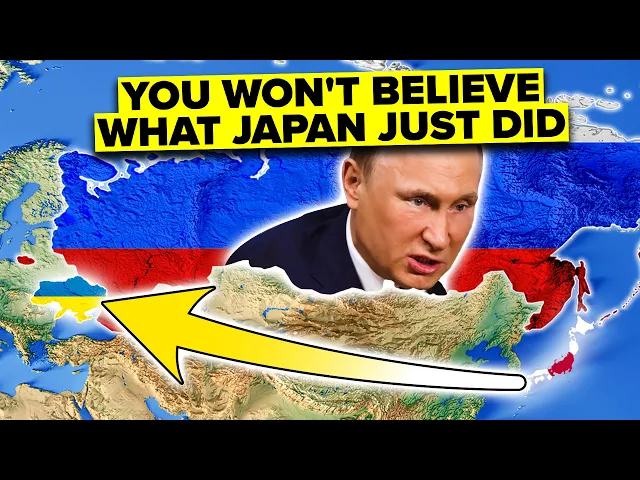
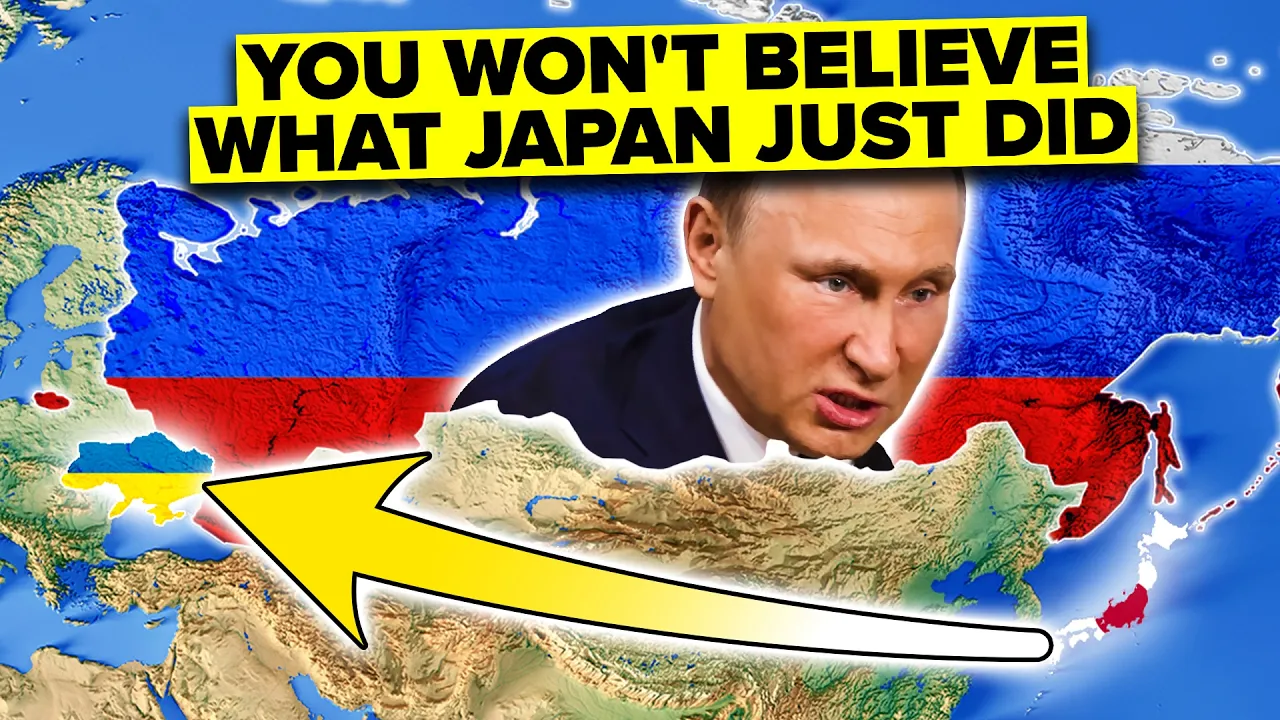
Except it’s not just the West that opposes Russia. Since the outbreak of the Ukraine war, Japan has positioned itself as not only a partner to Ukraine but an increasingly viable enemy to Russia. Now, the country has dealt another devastating blow to Putin’s ambitions and, with further changes to its internal policy, could become an even bigger thorn in the Russian president’s side.
That brings us to this video. We’re going to dig into the latest devastating blow Japan has dealt to Russia, along with exploring everything else Japan is doing to oppose Putin’s regime. You’ll also learn why all of this is happening in the first place before we explore the key debate that rages about Japan’s approach to the Ukraine conflict.
But first – the devastating blow. In February 2024, officials from Japan and Ukraine met to discuss a new investment treaty that could essentially act as a way for Japan to funnel money into Ukraine even as it faces constant bombardment from Russia. During those treaty negotiations, Japan reaffirmed a vow it made at the beginning of the conflict to continue providing support to reconstruct Ukraine.
Those talks were extremely productive. Japan’s Prime Minister – Fumio Kishida – announced a bilateral tax treaty, in which both countries will codify a set of tax rules that prevent double taxation of companies and individuals. In other words, Japanese investors who want to pour money into Ukraine no longer need to worry about being taxed by both Japan and Ukraine.
While this may seem small, it’s a sign that Japan is increasingly committed to helping Ukraine by making it easier for its investors to spend money in the country. Money that Ukraine sorely needs to rebuild and fund its fight against Russia. Japan will support these new tax rules by easing visa controls – again, making it easier for Japanese investors to enter and invest in Ukraine – in addition to providing more support to Japanese venture capital countries in Ukraine.
Though Kishida didn’t provide further details at the time, his Ukrainian counterpart – Denys Shmyhal – later posted on the social media platform Telegram that Japan would create a two-part program through which it would provide $1. 35 billion in support to Japanese investors working in Ukraine. That’s $1.
35 billion that could turn into many more billions over time, all money Ukraine can use to fund both its war effort and its future reconstruction. According to Shmyhal, the new tax treaty also opens the door for major Japanese carmakers, such as Toyota and Honda, to open factories in Ukraine. Again, these production facilities are future-focused, providing work for Ukrainians after the war while showcasing how international companies are far more willing to do business with Ukraine than they are with Russia.
A devastating blow for Putin. And it’s not the only blow that Japan has landed in recent months. According to Voice of America, Japan had already provided $10 billion in aid to Ukraine as of February 2024.
It’s important to note that this aid has been both humanitarian and financial – not the type of military aid that many other countries have provided. Following the conference between Ukraine and Japan’s Prime Ministers, it was also revealed that Japan has pledged to provide a further $12 billion in financial assistance, of which $4. 7 billion would arrive in Ukraine by the end of February 2024.
That places Japan among the top five countries in the world in terms of providing financial aid to Ukraine, only falling behind the U. S. , Germany, the U.
K. , and various European Union institutions. The message being delivered to Putin by Japan is clear – Tokyo supports Ukraine.
And if Putin hadn’t received that message from this new volley of financial commitments, he’d have certainly gotten it when Fumio Kishida stood in front of the U. S. Congress to deliver a speech on April 11, 2024.
On that day, Kishida told Congress that U. S. leadership on the global stage is “indispensable,” reinforcing Japan’s commitment to what Putin would consider the Western global hegemony.
Pointedly, Kishida also told those assembled: “As I often say, Ukraine of today may be East Asia of tomorrow,” before further lauding the U. S. for the support it provides not just to Ukraine but the Indo-Pacific region.
He characterized Putin’s “special military operation” as an “onslaught from Moscow,” and asked how long it would be before countries in the Indo-Pacific – Japan included – would face similarly harsh realities were it not for American intervention. Kishida wrapped the speech up with a simple message to Putin: “Japan will continue to stand with Ukraine. ” If Putin believed he had any hope of repairing his relationship with Japan, at least while the Ukraine war is ongoing, those even words put an end to that notion.
But in truth, the relationship between the two countries has been tense for decades, with Japan’s announcement of more financial aid to Ukraine being just the latest in a series of disagreements that have built up to this moment. Disagreements such as those over a small collection of islands that Russia calls the Kurils and Japan dubs the Northern Territories. In the wake of World War II, the Soviet Union seized these islands, which are just 810 miles northeast of the northernmost Japanese island of Hokkaido.
That seizure has been disputed ever since, with Reuters pointing out that World War II hostilities between Japan and Russia have still not ended due to their differing stances on these islands. These stances have only grown more resolute due to recent Russian actions. According to the Center for Strategic and International Studies, or CSIS, Russia appeared to be on the verge of handing the Northern Territories back to Japan during the early 2010s.
That possibility actually had an impact on Japan’s foreign policy, claims CSIS, as former Prime Minister Shinzo Abe spent much of his tenure working to improve relations between Japan and Russia to create enough goodwill to enable an agreement to be reached. Diplomatic talks, joint tourism projects, and even Japanese investment in local Russian economic development all stemmed from this approach. But Russia essentially took all of that goodwill and tossed it aside.
Since 2015, Russia has been steadily increasing its military presence in the Northern Territories, with satellite imagery showing Putin has been building infrastructure that CSIS claims reaches as close as 14 miles away from Hokkaido. These developments include the building of barracks large enough to host a population of 7,000 on Kunashiri, along with the storage of Bal anti-ship missiles, or ASMs, on the island. That island’s southernmost point lies just 10 miles away from Japanese territory.
Similar developments include the construction of barracks and installation of Bastion ASMs on Etorofu – just 50 miles outside Japanese territory – along with the expansion of a base and development of a Russian airfield on Paramushiri. That island is just 380 miles from Japan. The Bal and Bastion ASMs have ranges between 185 and 310 miles, leading to Russia essentially sending a message to Japan that it could strike practically any ship near Hokkaido if it wished to do so.
Tensions were being raised throughout the 2010s. Then came Russia’s invasion of Ukraine, which led to Japan showing that it wouldn’t be cowed by Putin’s aggression. Even with a growing Russian threat looming to its north, Japan has consistently provided financial aid to Ukraine.
Furthermore, the country was one of the first to coordinate with the U. S. and other members of the Group of Seven, or G7, nations – a collective of the world’s seven strongest economic powers – to implement punitive sanctions.
These initial sanctions included asset freezes, restrictions on Swift payment access, and restrictions on the import and export of various controlled items. More sanctions have followed. April 2022 saw Japan revoke Russia’s “most-favored nation” status.
More asset freezes and export bans were implemented, including bans on luxury goods from Russia. Even in 2024, Japan continues to build on its sanctions. February 2024 saw it join with the G7 to place a price cap on Russian oil, with even more asset freezes and export bans coming in March, April, and June.
Japan has also shown its support for Ukraine in other ways. For instance, Fumio Kishida was the president of the G7 in 2023, a position he used to ensure that global attention remained on Russia’s actions in Ukraine, according to CSIS. His actions included visiting Kyiv in March 2023 – the first time a Japanese leader has visited an active conflict zone since World War II.
Uncoincidentally, that visit to Kyiv happened around the same time that Putin held a summit in Moscow with China’s President Xi Jinping, with the two events seeming to be the drawing of lines in the sand between the four nations. Kishida’s wartime visit also marked a break in Japanese tradition, in which it generally focused on diplomacy rather than directly supporting sides in conflicts. Japan was no longer keeping out of the war.
Through Kishida, Ukraine has also been given an opportunity to build relationships with Asian nations it may not have otherwise worked alongside. For instance, May 2023 saw Japan’s Prime Minister invite Ukraine’s President Volodymyr Zelensky to a G7 summit to which Kishida has also invited representatives from India, the African Union, and the Association of Southeast Nations. It was another blow to Putin, as he saw his current rival engaging in diplomatic conversations with countries he would like to curry favor with.
So, we see the latest blow Japan has dealt to Russia – the promise of billions of dollars in ongoing financial aid – is actually just the largest following several diplomatic jabs Japan has delivered. All of this leads us to a question: Why has Japan chosen now to fully support Ukraine in its efforts against Russia? Some of the reasons have already been explained.
Japan’s relationship with Russia has always featured a certain amount of tension, even during the periods when Japan was trying to extend the diplomatic olive branch. Putin has only added to those tensions by militarizing the Northern Territories, transforming the islands into very real threats to Japan and its sovereignty even if we disregard Japan’s territorial claims on the islands. Nevertheless, these issues alone wouldn’t be enough to explain Japan’s slow moving away from attempted diplomacy to full-blown support for Ukraine.
There are other factors at play. For instance, Japan is taking a different approach to its foreign policy than it has in many decades. Following World War II, Japan made the purposeful decision to focus on pacifism and passivism in its foreign policy.
We see that in its dealings with Russia – until the last two years, the nations never came to blows even with Russia claiming territory that Japan believes rightfully belongs to it. In a piece titled “Historical Parameters of Japanese Foreign Policy,” Brookings points out that this approach has been extremely lucrative for Japan. The institution of the Bretton Woods system – which required currencies to peg themselves to the U.
S. dollar – led to extended periods of economic success. Plus, by taking a more passive role, Brookings claims, Japan has been able to weather the various crises, revolutions, and wars seen in the Indo-Pacific and East Asia since World War II, coming out practically undamaged in all cases.
However, international circumstances are slowly pushing Japan away from its policies of passiveness and pacifism. The increasing modernization of China since 2000 is one such issue, with Japan likely believing that it’s slowly losing its position as one of the chief powerbrokers in the Indo-Pacific as China’s influence grows. That growth in Chinese influence can also explain Japan’s approach to Russia – Putin and Xi are clearly allies in many respects.
That’s evident from the previously mentioned summits. Couple that with Russia’s militarization of the Northern Territories and Japan now has two countries that are subtly – and sometimes not so subtly – threatening its sovereignty. In the face of these issues, Japan has needed to change its national strategy.
According to CSIS, this change is actually the result of an evolution that began during the Gulf War in 1991. At that time, Japan heavily relied upon the Middle East for its oil imports, though it also contributed $13 billion to support the coalition forces fighting in the Gulf. At the time, Japan’s actions were criticized as “checkbook diplomacy,” with many wondering why the country refused to dedicate any of its own forces to support the coalition soldiers.
CSIS notes that this criticism marked a change in how Japan approached the concept of international cooperation. The years that followed saw it forming and expanding partnerships with its allies, in addition to boosting its defense spending. The latter efforts culminated in Japan’s cabinet approving a request for the country’s largest-ever defense package.
That package will see Japan invest $55. 9 billion into its military in 2024, with the number increasing annually until it reaches a peak of $62. 5 billion in 2027.
Add Japan’s inclusion in a trilateral defense agreement with the U. S. and South Korea into the mix – in addition to strengthening its ties to NATO, India, and Australia – and you have a country that’s shifting its foreign policy.
Passivity couldn’t work in the current global landscape. CSIS notes that these changes in approach appear to be generally supported by the Japanese people. For instance, a survey conducted in March 2022 – a month after Russia invaded Ukraine – revealed that 77% of Japan’s citizens believed that the international community needed to band together to stop the Russian invasion.
If they didn’t, the respondents worried, the territorial changes Russia enforced could pave the way for future attempts at change, such as a Chinese invasion of Taiwan. Again, it comes back to Japan becoming increasingly concerned about power plays by other nations. Russia taking Ukraine would make China more confident in attempting the same in the Indo-Pacific with Taiwan.
So, it was crucial for Japan that it became part of the collective effort to prevent Putin’s “special military operation” as doing so means it could justify being part of future collective efforts to stop Chinese expansion. It's a complete turnaround in policy. And a turnaround that hit hard with Putin, who may have believed that he could maintain cordial relations with Japan even as he invaded Ukraine.
That could have been a possibility were it not for another change happening in Japan: The politicians who had spent so long trying to build a stronger relationship with Russia are gradually aging out. That’s according to an October 2023 report by The Carnegie Endowment, which noted that even as Japan expressed its support for Ukraine, various pro-Russia lobbies inside the country were making headlines. These older politicians were claiming NATO’s responses to Russia were “provocative” and that Ukraine had misguided policies.
However, those lobbyists have been growing quieter since the 2010s, when pro-Russia policies in Japan were at their peak. The assassination of Shinzo Abe was the trigger for this turnaround. The man who had often referred to Putin as “dear Vladimir” was responsible for Japan’s failure to sanction Russia following the annexation of Crimea in 2014.
He also created plans to strengthen economic cooperation between Japan and Russia in 2016. Even when he stepped down from his role as Prime Minister in 2020, The Carnegie Endowment says, his influence within Japan’s Liberal Democratic Party would likely have led to more pro-Russian policy. Abe’s July 2022 assassination meant Putin lost his biggest Japanese ally.
He’s also had to watch as other allies, such as former Prime Ministers Yukio Hatoyama and Yoshiro Mori, have grown too old to have any true influence on Japanese policy. They are now retired. Another pro-Putin influence in Japanese politics – Muneo Suzuki – was the first foreign politician Putin received after he became Russia’s president.
Suzuki even served as an unofficial advisor in Russia’s policies under Abe, showcasing just how strong his ties with Russia became. But Suzuki is now working under a cloud of internal suspicion. His imprisonment for corruption in the 2000s hasn’t helped, with every effort he’s made to visit Russia since February 2022 being blocked by his own party.
There’s a new generation of politicians coming to the fore in Japan. And with each loss of the old guard, Putin’s influence has waned to the point where it’s almost impossible for him to maintain a relationship with Japan. Signing a mutual defense pact with North Korea in June 2024 was essentially Putin putting an end to any chances of rebuilding that relationship.
To Japan, that pact will be little more than another sign of aggression to go along with Russia’s actions in the Northern Territories and its allegiance with China. After all, North Korea represents another major threat to Japan in the Indo-Pacific, as well as a threat to Japan’s South Korean allies. As the Council on Foreign Relations highlights, allying with Russia makes North Korea even more dangerous, adding to Fumio Kishida’s claims that Russia’s aggression in Ukraine can’t be seen as a “Europe-only” problem.
All of this brings us back to Japan’s decision to send even more financial aid to Ukraine. Putin’s responses to this powerful blow indicate just how far Russia’s relationship with Japan has fallen. In June 2024, Kyodo News reported on the Russian President’s comments that the current conditions between the countries aren’t conducive to them coming back to the negotiating table to create a peace treaty for the post-World War II era.
Japan would likely agree, though not for the same reasons as Putin expresses. According to Putin, the blame firmly rests with Japan and its support of Ukraine. “Everything that has been done has been done by Japan,” Putin claimed, seemingly ignorant – likely purposefully – of the fact that Japan’s decisions are being informed by his actions and his “special military operation.
” These comments came after the suspension of peace pact talks with Japan in March 2022. Putin went even further, claiming that he will not shy away from visiting the islands that make up the Northern Territories, essentially telling Japan that he is happy to instigate by reinforcing their status as Russian islands. Reading between the lines, we can see that Japan’s deepening support for Ukraine dealt a body blow to Putin.
It’s no coincidence that he ended the peace treaty talks in March, by which point Japan had already been supporting Ukraine for two years. The pledge of a further $12 billion in aid seems to be the straw that finally broke his back, with that money sending a clearer message than ever before that Japan is no longer an ally to Russia. It is an enemy.
That status as an enemy leads us to the final question we’ll ask in this video – will Japan’s pledges of financial aid ever turn into pledges of military aid? Debates have raged over whether Japan should take the final step in solidifying its support of Ukraine. If it does, the blow would be even more devastating to Putin than the deterioration of relationships he’s had to watch over the last two years and Japan’s financial aid packages combined.
Still, Japan remains reluctant to provide weapons…to an extent. In truth, Japan has already found a handful of diplomatic workarounds that allow it to indirectly provide weapons to Ukraine without actually providing them itself. For instance, there appear to be no conditions placed on the billions in financial aid it has provided, meaning Ukraine is likely free to use that money to purchase weapons with the money if it so chooses.
If nothing else, that aid is helping to keep Ukraine’s economy afloat during a period when it would be at risk of collapsing. Again, that can help Ukraine to purchase weapons, as well as enable it to keep its manufacturing base running so it can build weapons of its own. More interestingly, Japan has found several workarounds in the weapons department.
For instance, Nikkei Asia reported in July 2024 that Japan had agreed to sell $19 million worth of Patriot missiles to the United States, supposedly to help the U. S. replenish its numbers after it had provided hundreds of these missiles to Ukraine.
There are no conditions on how the U. S. uses these missile systems once they land in Washington.
It’s very possible – perhaps even likely – that the Patriot systems Japan is providing to the U. S. will eventually find their way into Ukrainian hands, with the U.
S. essentially acting as an intermediary so Japan doesn’t have to deliver the weapons directly. Russia is aware of this.
Its Foreign Ministry claimed that the appearance of any Japanese missiles in Ukraine would lead to “consequences” for Russia’s relations with Japan. However, given the status of those relations, it’s likely that Japan isn’t too worried about what those “consequences” might be. It’s also worth noting that Japan has provided protective gear to Ukraine as part of its aid packages.
Deliveries of non-lethal equipment – including body armor, helmets, and about 100 non-military vehicles – show that Japan is willing to support Ukraine a little more directly. Still, it draws the line at sending weapons directly. Some argue that Japan needs to change this policy.
For instance, an April 2023 article published by The Japan Times pointed out that Japan was the only member of the G7 that had yet to send weapons directly to Ukraine. However, the same report noted that Japan had made changes to its guidelines, allowing it to make the previously mentioned donations of helmets, body armor, and vehicles. At the time, talks were being arranged to discuss the possibility of making further amendments to those guidelines, which would allow Japan to provide Ukraine with lethal weapons.
Those talks didn’t lead to a change. However, the same report suggests that there is a growing appetite inside Japan for the country to take a more active stance. Nippon Ishin no Kai – a right-wing populist party in Japan – showcases that appetite.
In 2023, the party’s Upper House Secretary-General, Naoki Inose, chose to send 20 pickup trucks, each loaded with canned food and other supplies, to Ukraine. He paid for this using a portion of his party member’s stipends while delivering a message about the delivery: “As long as these pickup trucks aren’t used to transport machine guns, there should be no problem. It’s up to the receiver if they use them in that way.
As long as we ourselves do not offer the trucks with that intention, we are fine. ” In other words, it’s the same approach Japan potentially might take with the replenishment of Patriot missile systems over a year later. Others argue that Japan may not be delivering weapons directly because it has a deficit at home.
One of those people is Atsuko Higashino, who is a professor at the University of Tsukuba studying the Ukraine war. She comes out in favor of Japan delivering Patriot missiles to Ukraine, though she also believes such deliveries are unlikely in the near future because Japan still has a “serious deficit” when it comes to its defense systems. A deficit that the recent military budget approvals could see it rectify.
Perhaps the future will see Japan lending more direct military aid to Ukraine once it believes it’s in a position to defend itself against Russia and China in the Indo-Pacific. If nothing else, the $12 billion it pledged in February 2024 will be a serious blow to Putin, both in terms of increased support being lent to Ukraine and the further collapse of Russia’s relationship with Japan. Should Japan choose to start sending weapons, that blow will be followed up with a haymaker signaling Japan’s intent to truly oppose Russia.
And not just in Ukraine, but also in its efforts to expand its influence in the Indo-Pacific, as well as its work to militarize the Northern Territories. But what do you think? Is Japan edging ever closer to a point where it’ll start sending weapons to Ukraine, or is it still too stuck in its passivism policies to do so?
How do you think Russia would react if Japan crossed that line and went beyond merely providing financial aid to Ukraine? Share your thoughts in the comment section and thank you for watching this video. Now go check out Australia Just Dealt Russia a CRUSHING Blow!
or click this other video instead!