Together we have seen that business and biodiversity are connected. Your business depends on biodiversity. AND it impacts biodiversity.
Let's take a simplified example: a large fishing port. Its economic activities depend on the ocean and its resources. But they also impact the ocean.
It’s the same for your company. Let's take a closer look, starting with dependencies: businesses need what are known as ecosystem services. These are all the advantages and resources that humans gain from ecosystems.
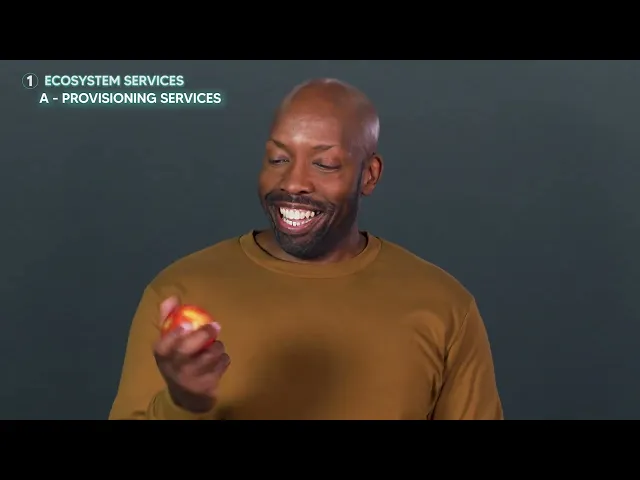
There are several types. Firstly, biodiversity gives us SUPPLIES. Food, natural materials.
. . all this exists thanks to living species.
Yum! I'Il save this for later. Clearly, this is vital for sectors like agri-food, construction, textiles, pharmaceuticals.
. . But also for cosmetics and agrofuels.
. . In fact, a VERY LARGE share of production activities rely on biodiversity for its supplies.
Biodiversity also ensures ecosystems FUNCTION correctly, with what are known as "regulating services". For example, forests, oceans and soils absorb CO2, helping regulate the climate. If we damage them, we exacerbate climate change, with consequences for our societies and our businesses.
Researchers have calculated that coral reefs cause a 97% reduction in wave force, which protects coastlines. If these reefs were to become just one metre shorter, the costs of storms would double. These natural defences prevent more than 4 billion dollars’ worth of storm-related damage annually worldwide.
Biodiversity also gives us what we call "cultural services". These are the intangible benefits we derive from ecosystems: the well-being from a walk in the woods, taking inspiration from landscapes to create things. .
. Several sectors, such as tourism, depend on this dimension. In fact, when you think about it, even the activities that primarily need human brains – like consultancy or graphic design - would be impossible if these humans were not fed and in good health.
And again, it depends on biodiversity! In short, if it continues to collapse, our whole economy - and society - are at risk. The paradox is that our economic activities need biodiversity but .
. . also tend to destroy it!
The IPBES has defined 5 major direct drivers of biodiversity loss. Let's start with the first: changes in land and sea use, which lead to habitat destruction. Deforestation is a case in point: some companies are destroying the Amazon rainforest to plant thousands of hectares of soya for cattle farms.
However, this rainforest is the habitat for many species. . .
and it is being destroyed. So, these agri-food activities threaten these species directly. The second driver is the direct exploitation of natural resources.
If we source too much from plants, fish, or any other resource, soon they can no longer replenish themselves and risk disappearing. Then, there's climate change. Yes!
It directly affects living species. And it may cause a third of them to disappear by 2070. This brings us back to our link with climate change: it is one of the drivers of biodiversity loss.
So if you've started reducing your CO2 emissions, you've already taken the first step in your biodiversity strategy! Another driver to bear in mind is pollution. Pesticides, microplastics, chemicals.
. . all poison animals and insects, as well as kill plants.
And we often forget others, like light and noise pollution. For example, offices, factories or shops that are kept lit at night disorientate migratory birds, kill insects and disrupt the growth of certain plants. The last driver of biodiversity loss is the proliferation of invasive species, particularly due to trade, and climate change.
These species affect and threaten the ecosystems in which they live. Examples include the tiger mosquito. Or another is sargassum in the Caribbean.
This invasive seaweed suffocates corals, sea urchins and crabs. . .
But also, the tourism sector. A study shows that the presence of sargassum on a beach reduces local incomes by over 11%! All this shows us the paradox: our businesses impact biodiversity in a myriad of ways.
. . .
. . even though they depend on it in, equally, so many ways!
Hmm. . .
destroying something you need is a bit like sawing off the branch you're sitting on, right? But it also means that you and your company are particularly well placed to preserve biodiversity. You CAN take action, and the following videos will help you do just that.
See you soon!