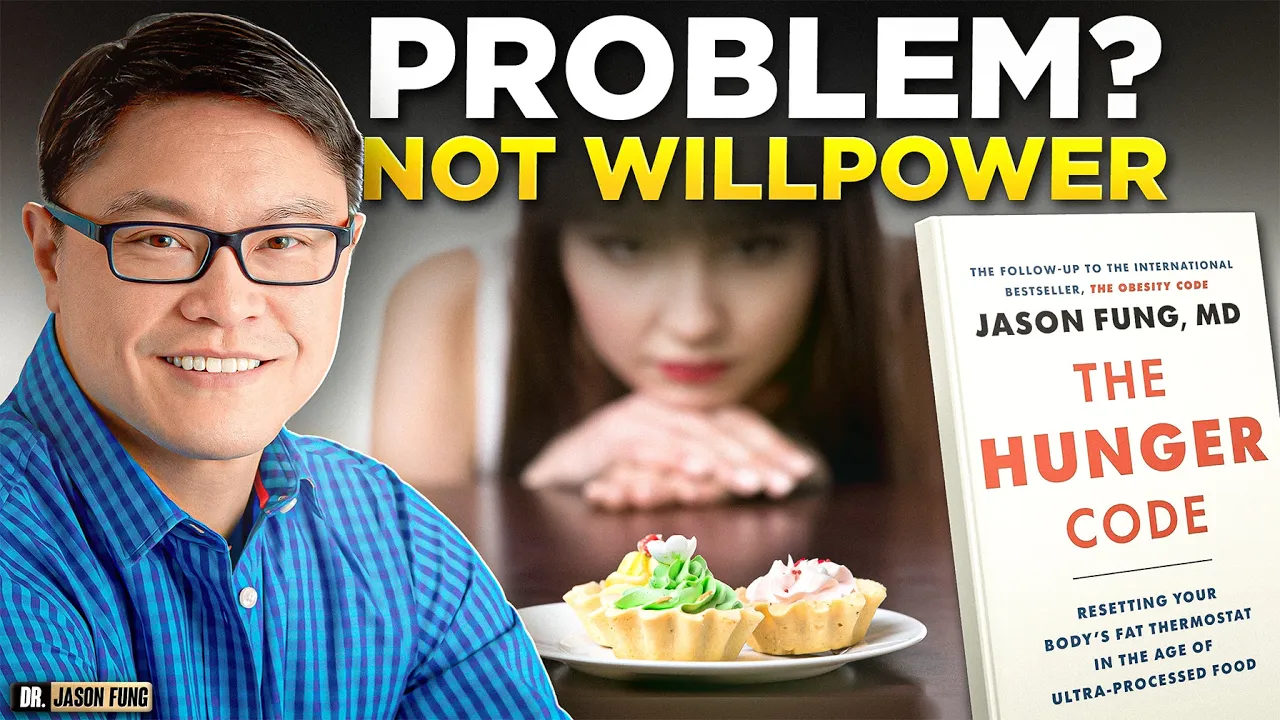
Controlling calories is useless if you can't also control the hunger. That's why I focused on it in my upcoming book, The Hunger Code, the follow-up to the Obesity Code, which is a really deep dive into our eating behavior. I'm going to go into some key concepts and it's coming right up.
[music] If you think weight loss is all about your diet, then you've probably already lost. You've tried this diet and that diet, but it's not really. You have to influence eating behavior, which means you have to understand the underlying reason people eat.
And the concept is not difficult. We eat because we're hungry and we stop eating because we're full. It's a fundamental truth.
So why ignore it? Why focus on the eating part of it while neglecting the underlying hunger? That's the focus of my new book, The Hunger Code.
And it's really a common sense look at what drives eating behavior. Think about what happens when you try to control calories, which has been the standard of uh care, the standard advice people got. Cut some calories.
Okay? Well, think about it this way. You've got your hunger, you've got your calories.
You know that the hunger is driving the calories. When you eat fewer calories, but don't change the types of food you eat, then hunger goes up, of course, because you're eating less. But you're fighting with yourself constantly.
You're trying to eat less, but your hunger is trying to make you eat more. So, either you're going to give in or you're eventually going to break because you just can't take it anymore. Well, what happens on the other hand, if you control the hunger, it goes down and then calories goes down.
But notice that you're no longer fighting with yourself. you're actually working with your body instead of against your body. The advice to simply eat 500 fewer calories or portion control is wrong because our portions were eaten based on how it made us feel.
When we felt full, we would stop. You can physically control your calories. You can wire somebody's jaw shut.
And that was very popular in the 1950s and60s. However, what happened was that the hunger would go up and they would find ways to get around it. They would drink smoothies, eat ice cream, and eventually they regain all that weight.
And that's why nobody does it anymore. In the 2000s, the modern version of wiring your jaw shut was to put a lap band or put a band around the stomach that physically restricted how much you could eat. You could also do a sleeve gasterectomy where you cut out like 90% of the stomach and you could also rewire the intestine so that any food you did eat wouldn't get absorbed.
Did it work? Not really. It did at first, but again, what happened was that people would find ways around it and get those calories anyway because they were so hungry.
It was driving them crazy. And because they never learned how to eat, they simply regained all that weight. This surgery simply wasn't working because it was focused on calories and not on the underlying hunger.
You eat because you're hungry. You stop eating because you're full. Now, think about the lessons from the weight loss drug OMIC.
Ompic does not restrict your calories. Even if you take ompic, you can take as many calories as you want. There's no physical restriction.
Your stomach hasn't been cut out. But what has it done? It's affected the hormone GLP1.
And that decreases hunger. When you decrease hunger, then you eat fewer calories and you're able to lose weight. The uh other drug, Munjaro, affects not just GLP1, but also GIP.
And both are hormones because it's the hormones that control your hunger, not the size of your stomach. When you cut out somebody's stomach, the hunger didn't really decrease. But when you start to look into the past into uh other drugs, you see exactly the same pattern.
You can control hunger through different hormones. For example, the sympathetic nervous system. The autonomic nervous system is composed of two parts.
the sympathetic which is the fightor-flight response and the parasympathetic which is the rest and relaxation. When we activate the sympathetic nervous system, appetite goes down and if you do it synthetically through drugs such as amphetamines, you can reduce hunger. You can also use this in the old drug speed and you can also see this in crack which is also a stimulant to sympathetic tone.
Their appetite decreases and these drugs actually were called anorexians. That's the class of medication that is they induced anorexia or induced loss of appetite. Controlling the hunger causes weight loss and it was extraordinarily successful.
In fact, when you look at the most common drug, nicotine, you see that smokers weigh less than non-smokers. It's a real effect. When people stop smoking, they gain weight.
Why? They tend to eat more. And the reason is because the nicotine stimulated the sympathetic nervous system to decrease hunger.
So, it's all about controlling that hunger. It wasn't about controlling calories. That's the result.
That's not the cause of the problem. You also saw it in the old drug fenfen which is a combination of fenfluramine and fentamine and it got discontinued in the '9s because it caused heart problems but it was an extraordinarily successful weight loss drug. It caused the loss of 17% of body weight which is on par with modern miracle weight loss drugs like ompic.
It was a combination of fenflloramine which stimulated this the sympathetic tone but also fentamine which affected the serotonin or reward signaling. Again, you reduce the hunger not just through the sympathetic tone but also through the serotonin system thereby decreasing hunger and reducing how much people wanted to eat and therefore they ate less. It's just logical.
But it's all about controlling the hunger which means controlling the hormones not about controlling the calories. And to understand it at a deeper level, there's a concept in logic called the three W's. That is, if you really want to get to a clear understanding of what causes something, you have to ask the question why three times.
For example, if I were to ask somebody, why did the Titanic sink? The most common but incorrect answer is because it hit an iceberg. Yes, it is technically true.
But if you were to say that's the best advice we can give to prevent future marine disasters is don't hit icebergs. Nah, that's not really very good advice because you haven't gotten to the deeper understanding. You've only gotten to the first why.
You might start with why did the Titanic sink? Because it hit an iceberg. The second why would be why did it hit the iceberg.
And the answer is the captain couldn't avoid it. And the third why is why couldn't the captain avoid it? And the answer is because it was going too fast.
Now, if you're to say, hey, how do you prevent future marine disasters? The answer is slow down. The answer is not don't hit icebergs.
That's the superficial um first order thinking of that that that doesn't result in getting to the deeper understanding. Calories in calories out is exactly that. If you say to somebody, why did you gain weight?
It's because calories in is greater than calories out. Yes, that is technically true, but not useful. Just like if you're to say, well, how do you cure cure alcoholism?
Well, alcoholism is alcohol in minus alcohol out. So therefore, just drink less alcohol. Is that good advice?
Not really. It's almost the worst advice you could give. It's almost stupidly childish.
And calories in, calories out is also at that superficial level of understanding. I don't need to know that calories in is greater than calories out. I know that already because somebody's gaining weight.
I want to know why. So why is calories in greater than calories out? And the answer is because you're hungry.
That's the reason your overeing is better understood as overhunger. And if you understand that, you're far far ahead of the game. But the third why is even more uh interesting.
The question is why are you hungry? And this is where you have to say well hormones are one thing. So you have GLP1, GIP, uh insulin, cortisol, leptin, gorellin, testosterone, estrogen, all of these different hormones that I discuss in the hunger code.
But that's not the only thing that that causes us to eat. We also eat because it's pleasurable. And this is so-called hedonic hunger.
It's not the physical hunger you see in homeostatic hunger, but the emotional hunger. We eat because it makes us feel better. That's literally why we have comfort foods because we eat foods that make us feel better.
And this is where ultrarocessed foods and food addictions can be very important. If you are an emotional eater, you need to deal with those emotions, not just eat fewer calories. That's the don't hit icebergs or drink less alcohol advice.
Superficial and not useful. But it's even more interesting because there's a third type of hunger. And that's conditioned hunger.
That is we can stimulate hunger when we pair it together with other things. So now, if you're used to going to your car and eating something, then as soon as you get in the car, you're going to be hungry. And that's real because now we've paired food with everything in modern life.
We eat in the car. We eat in front of the TV. We eat at the movie theater.
We eat in the boardrooms. We eat during meetings. We eat while we're reading.
We eat while we're walking. Well, every time we do this, we get this this little uh message. Hey, you need to eat.
Hey, you need to eat. We eat when we wake up. We eat at the midm morning.
We eat at lunchtime. We eat after school. We eat at dinner time.
We eat before bed. Every single minute is just going and going and going. And people wonder, why do you have so much food noise?
That's the conditioned hunger. Stay with me. I'm going to go into the homeostatic, the hedonic, and the conditioned hunger deeper in my next few videos.
But also check out The Hunger Code, which is available for pre-order. It's a it's a groundshaking book.