"- Who wrote this? Who wrote this? Who wrote this extraordinary rubbish.
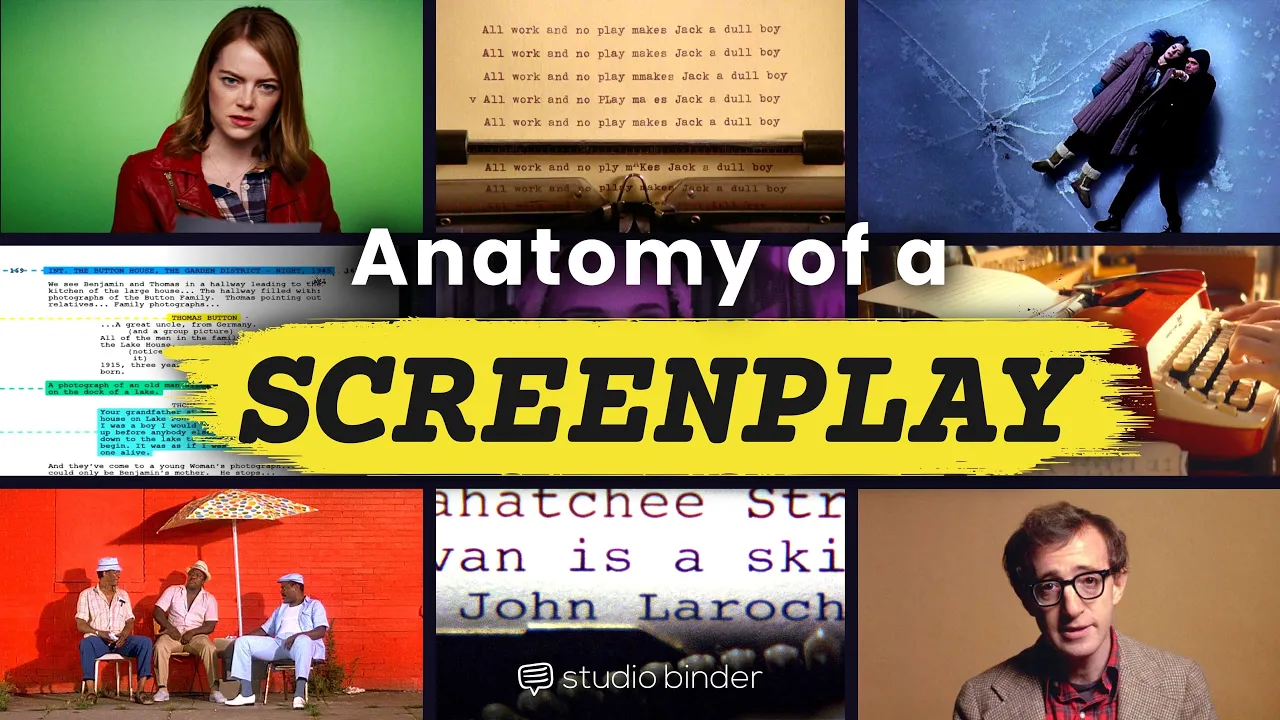
" - The screenplay is the backbone of narrative filmmaking. "- That's some great writing. " - Even the smallest nuances of its formatting and contents are crucial to the functioning of the film industry.
What are these script elements? Where do they come from? And why are they vitally important?
This is "Anatomy of a Screenplay". Before we get started, don't forget to subscribe to StudioBinder and click the bell to get notifications for our videos and all things filmmaking. We'll use StudioBinder screenwriting and script breakdown software to illustrate the elements and industry-standard formatting of a screenplay.
Let's begin. "- That's them, Officer. I'm a writer.
I'm trying to write in here, alright? - They're making noise! - Right.
Okay. " To understand the modern screenplay, one must understand its history. "- You know your history?
Very good. " - And to understand its history, one must understand the history of film production. "- And cut.
- Cut. " - The first written outlines for movies were called 'scenarios' because films at the time were barely a few minutes long. These scenarios were short synopsis that summed up a film in a few sentences.
As filmmaking techniques grew more complex, so did their written documents. Films like 1902's "A Trip to the Moon" contained multiple cuts and scenes. And by 1903's "Great Train Robbery" filmmakers were writing out their stories in a master scene format, which contained a series of descriptions for each scene.
Scripts continued to change with the rise of the studio system in the 1920s. This resulted in the continuity script, which allowed executives to track costs and shooting times. Industrious executives applied the assembly line production technique to filmmaking, which required a script that was far more detailed specifying the required shots and cuts in writing.
In 1948, antitrust actions by the US government made the studio system give way to the package unit system, which meant producers would organize film projects into packages, often including a script, talent, and other creatives in order to secure funding. In this new context, the script shifted once more, now focused on readability and sellability. It still contained some of the elements of the continuity script, but it focused on telling a story and was less technically specific giving directors more control over the process.
This form is called the 'Master Scene' script and is the format still used today. So what are the elements of the master scene script? "- The script is amazing.
" - Over time, a very specific format has emerged for screenwriting. Screenplays are written in 12 point 'Courier' font. A standard which was set in the 1980s since it was accessible to both typewriters and computers.
The font is also monospaced, meaning every character and space is the same width, making the length of writing more consistent. Margin should be 1. 5 inches on the left and 1 inch on the right.
Top and bottom. Each page except page one, should be numbered in the top right corner. The first page of the script is the title page.
The title should be written in the center of the page in capital letters, and sometimes underlined. Under the title 'Write by' or 'Written by', and the name of the writer or writers under that. If the script is based on a preexisting property, write 'Based On' under your name.
And include the name of the property. In the bottom left corner, include your contact information or the information of your representation like a manager or agent. An optional draft date can be added to the bottom right.
"- It's gonna be a hot time on the cool town tonight. - You got kind of a dark side, don't you? - No darker than yours, Bruce.
" After the title page, a script contains six basic elements. The first is the scene heading, otherwise known as the 'slug line'. The slug line contains the most vital information of a scene, location, and time.
If your location is outside, your heading will begin with an 'EXT' for exterior. If inside use 'INT' for interior. If your scene is both at once, use 'INT.
/EXT. ' This will be followed by a succinct title for the location. Sometimes you may use a dash and more specific location if your characters are moving through a larger space.
Finally, add the time after a dash. "- Holy smokes. It's morning.
" - This can be the time of day. "- You can't tell if it's night or day. " - Or the time in relation to the previous scene, like 'Continuous' or 'Moments Later'.
Keep your scene heading to one line for maximum readability. "- Now you're in the sunken place. " - You can also use subheadings to shift locations or time without breaking up a scene.
These are in uppercase but lack interior or exterior information. The next element is 'Action'. This is anything that's in the scene which isn't dialogue.
Action should be written in the present tense and usually should only describe the visual nature of a scene. Describing a character's thoughts or using flowery language is normally avoided since it can't be depicted on camera. "- What are you thinking, mama?
" - Certain components of action should be an upper case, including a character's name the first time they appear, Sound effects, key details, and props can also be capitalized, but only when necessary. "- Here, it's golden ticket number three, and it's all mine. " - Don't overdo it.
And unless you are also the director, don't write any camera shots into the script. The third element is 'Character'. When a character has dialogue, their name should appear in uppercase, indented 3.
7 inches. This is also called a 'Character Cue'. "- Get away from her, you bitch.
" - Next comes 'Dialogue'. Dialogue should appear 2. 5 inches from the left side of the page.
Directions placed next to a character's name can indicate voiceover. "- I hope to see my friend and shake his hand. " - Off screen.
"- We'll try to temp the Rex now. " - Or pre-lap when a character's dialogue begins before a scene does. "- Tonight, a son lost a father.
A wife lost a husband. And I lost a friend. " - If a character speaks twice or more in a row, or if their dialogue is split up by a page break, 'Continued' will be added.
"- You know what I am? - Ugly all day. This ain't happening.
Not here, not now. - What's happening? " - Parentheticals under a character's name in dialogue are a separate element.
These are used to indicate a performance. "- Yes, hurts. Ouch.
" - Or when in the middle of a longer piece of dialogue, a pause or shift. "- That guy bumped into my feet when he walked by. I don't know why but that kind of creeped me out.
" - Parentheticals are best used sparingly. Only employ them when totally necessary. "- That shirt better not give her nightmares.
" 'Transitions' are another screenplay element to use sparingly. A holdout from the continuity script era, transitions are formatted on the right side of a page with a colon. Examples include 'Cut to:', 'Dissolve To:', and 'Match Cut To:'.
Because these decisions are best left to an editor only use a transition if it is crucial to the story. If you want to indicate a montage, you can write 'Begin Montage' on the left side of the page above the scene heading. And when the montage concludes write "End montage" in the same place at the end of the scene.
If you want to include text on the screen, you can write an uppercase chyron, or title with a colon and then write the text you want to include. Note that this is not for credit sequences. Don't worry if you're not able to remember all these formatting conventions.
"- Well, it's hard to remember anything at that age. " - Screenwriting programs take care of formatting for the writer. Check out StudioBinder screenwriting software linked in the description below.
But what is the purpose of the script standardization? Let's look at why formatting is important. "- How did you get a copy of my screenplay?
" - If you are a screenwriter early in your career, correct formatting is crucial for one main reason. It signals to a reader that you know what you're doing. "- I know exactly what I'm doing now.
" - Remember, the history of the master scene screenplay is rooted in sellability. "- It's very easy to sell a product when people like it so much. " - Producers, agents and production companies comb through countless screenplays, and a script which is incorrectly formatted, provides a quick excuse for them to discard it.
"- I think what's wrong with the script is you. " - But there are other reasons why formatting is important. "- Yeah, do tell.
" - The format of a screenplay is designed to represent one minute per page on average. A 120-page script roughly translates to a two-hour movie. This allows filmmakers to have a good sense of the length of their film before they start rolling.
"- That's how much time we have. " - Standardization also allows for a script to be useful for a variety of departments. For a director, the master scene script gives them just enough information they can understand the story.
But they aren't told how it should be shot or edited. "- That girl is not in my film. - It's no longer your film.
" -. . .
giving them freedom that they often didn't have in the studio system. "- See what goes up on the screen is the director's vision of what the story is all about. " - Once the master scene script is finalized and ready for pre-production, "- I was born ready, motherf*cker.
" -. . .
it becomes what's called a shooting script. This draft of the screenplay is locked, becoming the definitive version for the crew to reference. Once a script is locked, scene numbers are added with 0.
75-inch margins on the left and 1-inch margins on the right side of the page. Should future revisions be required each successive draft is designated by a color in accordance with the WGA standard. The original is white.
Then blue, pink, yellow, and so on. The revision date and corresponding color are written in the top right corner of each edited page and on the title page. Rather than reprint the entire script for each minor change "- PC load letter?
What the f*ck does that mean? " -. .
. only the pages with edits are printed in these respective colors. You might end up with a script with many different colored pages, which is why they're called 'rainbow scripts'.
These revisions are carefully distributed to the entire crew to ensure everyone has the most current version. If scenes are added, they are given letters to avoid affecting the preexisting scene numbers. In this draft of John August's script for "Charlie and the Chocolate Factory" the added scene before scene '44' is labeled a 'A44'.
If a scene is removed, its number remains with the word 'Omitted' as you can see in David K's draft of "Carlito's Way". The modern screenplay format is also ideal for an assistant director who often does a script breakdown before a shoot. Dividing each page evenly into eighths to estimate both screen and shooting time and ultimately the budget.
"- It's very expensive. - I know, I'll pay. " - A script breakdown will also take into account all of the elements required in each scene.
An AD often tags these items with different colors. And the screenplay makes these elements easy to identify and keep track of. Including characters, costumes, extras, stunts, and sound.
Writing important props and set dressing in uppercase helps a production designer do their own breakdown. A script's bare-bones writing style means that production designer knows if something is mentioned on the page, they should include it while still allowing them enough room to bring their own ideas into fleshing out the set. A screenplay and its elements are designed to be the ultimate blueprint for a film crew.
Not a finished product in and of itself. That's why standardizing a format and writing conventions is so important. "- Did anyone read the script?
" - And many great screenwriters use these conventions in unexpected manners. Let's look at some creative applications of the screenplay format. "- What's this?
- That's the script? " - Just because the screenwriting rules are strict doesn't mean a screenplay has to be by the numbers. In the script for "Eternal Sunshine of the Spotless Mind", Charlie Kaufman formats his montages in a unique way.
Including all the different scenes and images in one paragraph rather than breaking them up. Normally, each scene and location should be clearly delineated for readability and convenience for the assistant director. But here the lack of separation more effectively delivers the feeling Kaufman wants to evoke.
These decaying memories are blurring together. And Joel is quickly cycling through brief moments with Clementine. Aaron Sorkin stuffs his scripts with dialogue, often going pages without a single line of action.
In other circumstances, this approach could leave a reader wondering what is happening visually in a sequence. For Sorkin omitting action allows him to build the unique rhythm that is key to his dialogue. "- You don't think I deserve your attention?
- I think if your clients wanna sit on my shoulders and call themselves tall, they have a right to give it a try. But there's no requirement that I enjoy sitting here listening to people lie. You have part of my attention.
You have the minimum amount. " - Spike Lee uses action lines, not just to indicate visuals, but also to establish his distinct voice and point of view. "- Always do the right thing.
- That's it? - That's it. - I got it.
I'm gone. " - For the introduction of the Cornerman in "Do the Right Thing", Lee elaborates on the type of people the characters are. Every day on this corner, summer or winter, spring or fall, a small group of men meet.
They have no steady employment. Nothing they can speak of. They do, however, have the gift of gab.
"- Well, gentlemen, the way I see it, if this hot weather contains, it's going to melt the polar caps and the whole wide world. " - Lee bends the rules of sticking to visuals when writing action, but this kind of zoomed out diatribe indicates what will be so special about do the right thing. It is not just a story, it's a commentary on race relations at large.
"- Hey, Sal, how come you got no brothers up on the wall here? - You want brothers on a wall? Get your own place.
You can do what you want to do. " - Todd Field infuses his voice into action in a different way. In his screenplay for "Tar", his action lines are often long and dense, including minute details about the music fitting for a film, which revolves around a conductor.
Although the screenplay is only 94 pages long Field includes a disclaimer at the beginning, warning prospective funders that the film will be much longer and not reasonable. In her script for "Lady Bird", Greta Gerwig also addresses the reader. During this driving scene early in the script, Gerwig explicitly notes in bold to remember this moment of Marion driving through Sacramento.
This calls attention to a short scene that otherwise may be skimmed over and gives the ending of the film an even sweeter payoff connecting Lady Bird with her mom. They are more similar than either may admit. "- Hey, mom, did you feel emotional the first time that you drove in Sacramento?
" - John Carpenter and Deborah Hill use underlining in their screenplay for "Halloween". The underlining emphasizes any important actions and indicates what is going to frighten the audience in a given scene. The strict screenwriting conventions are there for a reason.
Having been shaped by the production processes of countless films. And following these conventions doesn't have to feel restrictive. "- Are you sure?
- Yeah, I'm sure. Yeah, I'm sure. " - A screenplay can fit within formatting rules while still being wildly experimental and original.
"- Highly experimental. " - Write and break down your next screenplay with StudioBinder's pre-production software. That's all for now.
Remember, it all starts with page one. "- Anyway, you gotta read my script. - Did you by chance read my script?
- Have you read my script yet? - I know you're busy, but have you had time to read my script? - Are you gonna write about this in your screenplay?
- I really don't know what this is.
![Ultimate Guide to Camera Movement — Every Camera Movement Technique Explained [The Shot List Ep6]](https://img.youtube.com/vi/IiyBo-qLDeM/mqdefault.jpg)

![Ultimate Guide to Film Composition & Framing — Key Elements Explained [Shot List Ep. 11]](https://img.youtube.com/vi/hUmZldt0DTg/mqdefault.jpg)

![6 Ways to Edit Any Scene — Essential Film & Video Editing Techniques Explained [Shot List Ep. 10]](https://img.youtube.com/vi/FVR8zz8ci2k/mqdefault.jpg)
![21 Ways To Structure A Screenplay [WRITING MASTERCLASS]](https://img.youtube.com/vi/OPxxJ2wBNTA/mqdefault.jpg)