okay everybody we are talking today about inclusions for Road buses we talk about what it is why it matters a little bit about what it entails just remind you on our third pit principle so what is inclusion we're going to Define it as a procedural principle for broadening through diversification all the values concerns and perspectives that are integrated into technology development and public interest articulation so it's a broadening of the pit grade and all the things that go into it in the constitute it but it's a special type of broadening through diversity through diversification okay
so who is involved well obviously stakeholders are involved but who is a stakeholder what does a stakeholder mean stakeholders can refer to anyone and everyone who has a stake in the technology development or the policy development okay that is hopelessly broad okay that's very general um sometimes it's valuable to keep this notion open but more times than not in industrial and business setting stakeholders often just refer to the immediate Partners uh Supply chains collaborators Regulators okay doesn't refer to the General Public sometimes doesn't even refer to the people in the company other times you've got
internal stakeholders and external stakeholders so employees would be an internal stakeholdering during the external stakeholder except that again that may exclude the General Public so the term is used in different ways ah another way that we can sort of come at the idea of stakeholders maybe try to make it a little more focused is to use the Scots notion the social construction technology of relevant stable okay these are people who are either pushing or pulling the technology development process they're somehow influencing it they're somehow exerting an influence and so we want us to not formalize
these people and give them a chance to come together and discuss more explicitly this is exactly uh what is uh what was the inspiration for CTA constructive technology assessment to take all the people that are going to be involved anyway and just get them talking at an earlier stage or at all okay but then we're leaving out this very special group and that is the people who maybe are not exerting influence on the technology development process but who will be affected by it so affected stakeholders or potentially affected stakeholders especially those that are underrepresented and
or are the most vulnerable so why is it important to practice inclusion well there are both sort of deontological reasons and consequential reasons apologies if you're not familiar with these terms this is from ethics if you ever took a class on ethics then you were probably told that there are two or maybe three types of ethical Frameworks deontological ethical Frameworks are things that say well you should do it for the right reason it doesn't matter what the consequences are going to be you got to do it for the right reason right remember good intentions consequential
this framework say no do it because you want to get the results right right maybe you tell the truth today but then you lie tomorrow because in both cases you want to save innocent people from dying rather than tell the truth all the time okay they both are limited they both have something to represent them but we want to we want to think about them both and then um then there's what I call social robustness which is sort of a combination of both of them and a combination of other things as we'll see in a
moment so in terms of principles deontologies we can say well we should be inclusive because it's the fair thing to do it's the just thing to do justice according to Plato was the most important political value it's at least one of the top five first order political values diversity is a more recent formulation of Justice and legitimacy legitimacy has different concepts and connotations there's political legitimacy there's legitimacy to operate in the market uh there's a scientific and Technical legitimacy okay um and uh one way that you can apply legitimacy in this kind of um business
setting is the idea of the social license to operate this is a familiar concept sometimes it's called SLO or simply social license and I just pulled this from a commonplace website Investopedia they say that SLO refers to the ongoing acceptance of a company or industry's standard business practices and operating procedures by its employees it's stakeholders and the General Public so this is really a focus on acceptance okay which is really a consequential reason it's not a it's not a deontological reason acceptance isn't something that is good in and of itself acceptance is if you don't
have acceptance you can't sell your product okay um so it's really just an instrumental value but notice how the three categories of employees stakeholders in the general public relates to what we're talking about on the previous slide we are going to want to include the General Public part of stakeholders if we're practicing public interest anyway um the concept of social robustness so it pulls from both of these it pulls from both you know let's do the right thing but also um Let's do let's do it for reasons that are going to sort of give us
a payoff as you'll see in a minute it also pulls from both political and Technical senses of thinking about the technology development process so how does inclusion work how does it get implemented well we'll talk more about this in the second half of the module but basically there's three sort of inputs three forms of inclusion there's direct participation this is similar to democracy direct participation uh there's mediated participation which we call representation there could be a representative from A specific group or somebody outside of that group is designated to represent the group that can't speak
for themselves in this process and then we're just going to sort of throw an other category in there other forms of input this could be uh inferring principles intuiting uh concerns extracting values it could be taking participation or representation from a previous technology and playing it forward and saying let's say that that applies today how would it apply today um okay maybe not the most uh desirable form of inclusion because it's filtered and it's mediated it's got all the problems that that individual thinking does and all the barriers to reflexivity come up here but still
a possible form of inclusion maybe it's the lowest quality but it's better than nothing it's better than nothing and we've got to work with you know what the resources are with what's possible we've got to work within the constraints of what is possible so um and then where and when does inclusion happen well as with anticipation it's multi-level and multi-phase and then there's this question of well how close is it how proximate is it to the technology development okay and there we're going to encounter something called the Synergy dilemma so we'll look at that in
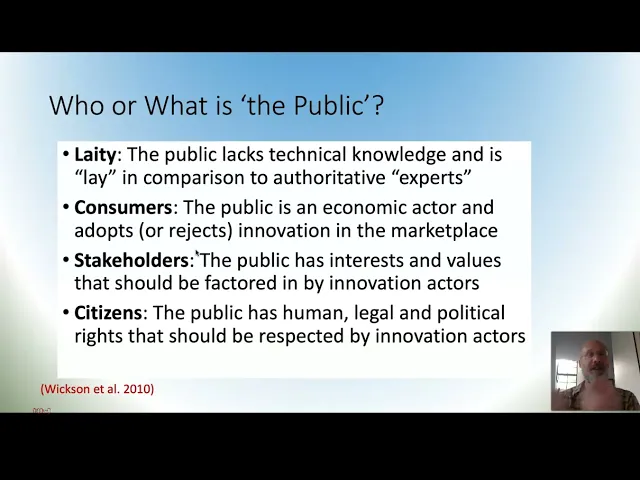
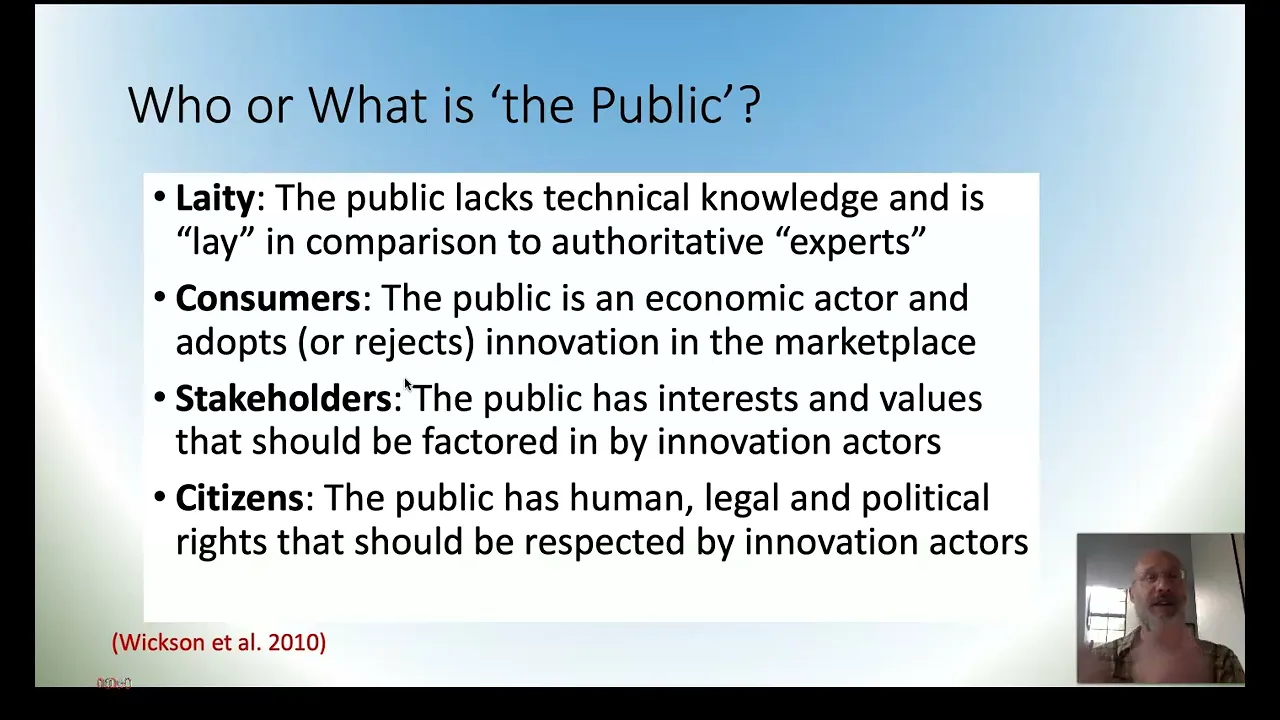
a couple slides this is the overview so let's get back to this question of who is a stakeholder and particularly the public because we want to say public the public is a stakeholder should be a stakeholder at least some members of the public should be consulted or considered in order to diversify in order to broaden um and in this reading that I've given you by wixon at all they identify four meanings of the public when the word the public or the phrase the public is used according to wixon and authors it can mean one of
four different things public might mean the public lacks technical knowledge okay and that the implications that we need to educate the public we need to tell them this stuff is safe trust us now they understand how math works now that you understand that the sun isn't going around the earth the Earth's going around the Sun aha now now you'll be ready to fund our technology to invest in our technology to let us keep selling our technology because now you see that what we say is true and it's not risky kind of speaking tongue-in-cheek here and
I hope you can recognize that but this is the idea that the public is lay it's the laity okay now we can contest that and say on the one hand yes look you know members of the public when they're lay they do not have phds or master's degrees or even bachelor's degrees in science they don't necessarily understand Mathematics and Technology that's true but they do have what's called lay knowledge and ironically experts often lack lay knowledge so even if the public lacks knowledge and they're the lay public there's still a rationale to bring them in
to the process okay the idea of the public is consumers is similar except that this is more of an economic standpoint and it's more about accepting and rejecting a technology stakeholders the public has interests and values that should be factored in by technology and Innovation actors okay that's pretty much where we were on the last slide when we were talking about consequences The consequential View you should think about what's going to happen and to do that if you have a more diverse input you'll be better at anticipating this stuff okay you'll be more reflexive you'll
be better able to be responsive so I guess it's a good idea because then we'll sell more widgets okay and then there's the idea of the public as Citizens this is the deontological reason this is the political reason it's a question of Justice legal rights political rights human rights that we need to respect citizens values okay when we're developing technology so any of these can be invoked when you read the word public and when you use the word public when you use the word public to policymakers to technology developers to other stakeholders realize that it
may be interpreted in one of these four ways and it might be ways in which you do not intend so you'll want to be clear because these four meanings or imaginaries as I like to think of them also have implications okay so above the first two we have to educate the public it's a one-way direction we're not going to listen to the public we're going to tell the public what to think we need to educate them whereas the bottom two meanings or oh maybe we should we should receive some input from the public and this
is the idea of of inclusion okay why does inclusion matter well we've already sort of gone over some of the high level reasons consequentialist reasons and deontological reasons but as we like to say in pit foundations gosh technology development and public interest articulation are constantly giving rise to the conditions for unintended consequences to emerge later okay and therefore our ability to detect these conditions and respond to these conditions in politically legitimate manners is enhanced through a diversity of perspectives and why would we care about doing that well because we want to sort of Ensure political
and social justice or not be on the wrong side of that uh but we also want to ensure Technical soundness and Market viability okay so somehow there's an argument here that inclusiveness and diversity is actually going to help us both do the right thing politically and do the right thing technically now we've seen this diagram although sadly the public interest braid is missing it fell out we've lost our our pigtails okay or our pigtail okay but we know that the technology development and public interest articulation are each processes and that we want to entwine integrate
these processes so that they can align and their outcomes can align and we can we get public interest outcomes and we know that both of these processes as well as their integration give rise to unintended consequences what inclusion does is it helps us be more diverse in our ability to sense and anticipate unintended consequences and to be reflexively aware of the conditions that give rise to them okay it helps us go outside of the box so maybe we change our notion of what an unintended consequence is or where it come they come from or where
the conditions that give rise of them come from okay so helps us broaden our ability to detect and respond to unintended customers so what does inclusion involve well on a very basic level it and this is I think pretty inclusive it involves broadening the diversity of inputs to and actions in the pit processes and there are two of them as we just saw technology development and public interest circulation but it also allows us to broaden the diversity of the other pit principle okay so awareness from reflexivity is broadened assessment from anticipation is broadened and as
we'll see in the next module action from responsiveness can also be broadened that's the idea okay so so diversity and and broadening and inclusion can in theory help everything okay but we're going to run into a wall here in a minute because on the one hand it can help everything because it can help us do a better job at considering unintended consequences and what I'm calling their indicators the indicators of uh unintended consequences can be things like issues concerns values dilemmas worries um as well as the governance conditions uncertainties complexities value conflicts all of these
can point to the potential for unintended consequences and if we've got a more diverse set of lenses that we're looking at the world through we're more likely to okay um and then it can also help improve the measures that we take to address the unintended consequences whether we're addressing them now immediately by taking action to be ready to be prepared or taking action later to directly address them this can refer to both measures that we take to enhance accountability and measures the use that we take to enhance Readiness and if you think about it accountability
and Readiness which are of course the outcomes of reflexivity and anticipation they assume that we've already taken action so there's a little bit of responsiveness there's a little bit of action already in accountability and Readiness so again the idea that inclusion can help both the process and the outcome of the process when it comes to the pit principles and we want to point out that measures that are taken that refers to capacity capacity to act so inclusion not again we'll say it like this but they sort of imply oh if you're more inclusive you're going
to make better decisions you're going to take better actions you might even prove your capacity to act well that can be true in some respects but sadly it can also work against the capacity to act and we need to we need to understand this this is a design constraint okay we'll come back to that design constraint in a minute um we just want to sort of round this out by saying inclusion should result in helping us be more integrative helping us be more aligned and therefore increasing the diversity of inputs processes and outcomes and actions
that enhance the conditions for social robustness so what is social robustness well it comes from the idea of robustness which is the ability to withstand or overcome adverse conditions or rigorous testing that's kind of an engineering definition um but we're going to add social in and what that does is it brings up ideas of stakeholders it brings up ideas of the market it brings up the ideas of citizens and the political process okay which now we've got this notion of Technology development and politics that somehow there's a political process going on uh around the technology
development process and of course we know from STS Scholars like Langdon winter that the technology development process itself can be analogous to a legal process the development of law so technology as law just as law can change the public sphere change the way we interact change our moral relations to one another put constraints on us so can technology they both affect the public interest therefore we need to recognize that citizens have rights in both cases and that the public interest is important so Peter Weingart actually refers to a concept that that will introduce called socially
robust knowledge that comes from actually he's referring to something earlier that's called mode to knowledge production so this is the idea that was articulated in the 1990s there was the sort of mode one knowledge where knowledge is developed through disciplines and it's separate from application and what makes it important is that it's good science and everything else comes later to the idea that no no knowledge production and application are integrated and disseminations through all sorts of Partnerships and collaborators and networks and there's this Dynamic process of research and development that's focused on problem solving at
the time it was really a new insight and so this idea of mode 2 knowledge production is also one of the pit precedence the look at but just we keep finding them right there are many of them this is another one so anyway mode two dollars production comes up with this idea of socially robust knowledge and Peter Weingart here is saying ah socially robust knowledge is trying to address the Dilemma between Democratic legitimacy by representation or vote and a different type of legitimacy that's conveyed by rationality on the basis of certified knowledge and he says
well of course this is an old dilemma there's nothing new here this goes back to ancient Greece okay but the term he calls it new even though it's 10 years old at the time when he's writing uh he's writing in 2011. the term social robust knowledge refers to the underlying epistemological issue epistemology just is sort of the science of knowledge how we know things and here's the underlying issue it's a it's on one hand on the other hand it's a it's a it's a balancing on one hand we want to accommodate Democratic procedures of representation
and decision by compromise and on the other hand we want to accommodate legitimacy as credible knowledge reliable knowledge and high quality scientific knowledge claims okay so how do we accommodate both sort of political messiness uh and realities and the technical reliability and quality that both are involved in technology development okay well socially robust knowledge is the idea and I'm shortening that to Social robustness and the reason I put social in parentheses at the high level is because I want to just give you guys a one-word term robustness that way you can just walk it out
of this classroom and walk it into a design team you can walk that into a board meeting you can walk that into a strategic discussion okay and you don't have to talk about all the theory that's behind it okay and if you need to you can add social robustness right we've got technical robustness we want that we need social robustness too we also want economic robustness but we need all three or you can say that if you don't have social robustness you won't have economic robustness and you might even make the argument that if you
don't have social robustness you don't have technical robust but in any case what is social robustness it's the ability to forestall withstand or overcome unintended consequences all right we've seen that already but unintended consequences that are broadly understood through the perspectives of diverse Citizen and public groups okay so the Assumption here is that there's something called value pluralism the different citizens in different public groups are going to have different values they're just not all going to agree they're going to see things differently they've all got a different form of reflexivity you might say reflexive awareness
and they've had different experiences with value pluralism which by the way is a U.S political value in Europe it's much more of the idea of consensus let's get everybody to agree with value pluralism is no everyone's knocking would agree but if we get everybody's vote then we can sort of add it up and aggregate in the end they may resolve the same thing but they have very different standpoints so why is inclusion so difficult well as we know with all the other pit principles attention is a limited resource it's continually competing with other priorities some
of these priorities have more Authority than others there's also culture expectations and imaginaries we talked about the four imaginaries of the public um and especially the first one tends to view the public as irrational they don't know what they're talking about so why should we listen to their concerns right this is very powerful unfortunately it undermines a lot of efforts to conduct inclusion and it's related to this idea of the public understanding of Science and its idea of the deficit model this is sort of a complement to the linear model the idea that the public
has a limited understanding of Science and the lower their understanding is the less likely they are to make rational decisions okay and there's this deficit so we need to fill the deficit we need to give them more more lectures on hey guys the sun does knock around the earth the earth goes around the Sun got it okay now great now you're gonna buy this product okay okay now you're going to listen to us when we tell you it's not risky because we're experts we know you shouldn't be worried about that right I'm being a little
facetious um and certainly we can argue both sides you know should we listen to The Experts they're Tech not they know what they're talking about scientifically or should we listen to the citizens they've got a legal and a political and a human right to say I don't like putting this into my child's mouth okay well they're both true right we've got this is wine gardeners wine Gardens point that we have political legitimacy and technical credibility okay but the deficit model and the pus understanding public understanding of science idea concept both say that now we should
we should just listen to Technical and scientific knowledge okay this is a problem because it tends to say we don't need to be inclusive and of course resources just like anticipation it's expensive it takes time you have to get participants there's lots of steps of knowledge and you have to take this knowledge and somehow synthesize it into something that can input into decision making and this is where we encounter what I call the Synergy dilemma is the idea that The Closer you get to technology development and public interest articulation the more proximate you are to
these core processes the fewer the decision makers you'll encounter the more specific the discourse that they're going to be using and language and talk and the quicker the pace at which they're moving okay but these three things go against inclusiveness and inclusion exercises right because a good inclusive exercise is going to be very diverse you can have a lot of people talking okay and you have to have a kind of a more General conversation you can't really talk specifics because you want to include everybody's understanding everybody's values everybody's language and you want to give them
time to think and deliberate and change their mind and talk to one another and learn all right so you can see how oops right if I want to sort of move technology development forward versus have a nice diverse conclusive inclusion exercise I'm kind of pulling into different directions right so you know this is your problem my friends I'm giving you this problem because I want you to realize these are your design constraints you're dealing with how you know on the one hand and on the other hand here and uh it's not that you can't find
the midstreams not that you can't find The Sweet Spot you will uh but you'll have to make compromises you'll have to be context specific this is not a one-size-fits all this is just simply realizing that what's more important is it more important to get a super uh representative group deliberating or is it more important to get just something and put that into the process of the process is more or do you want to have sort of a stage process or a multiple touch Point process right and so the the Synergy dilemma right how to get
synergy I can get Synergy with technology development but with not a lot of diverse input or I can get this great diverse stuff but it'll never turn into an input to this thing that wants to move at its own speed right so the capacity to act is now a limitation on how inclusive I can be okay because the idea is that the more inclusive I am the less capacity to act I have uh and as we always do we look at inclusion and the other pit principles so inclusion and reflexivity can support one another inclusion
and anticipation can support and lead to one another and inclusion can lead directly to responsiveness or action which is what we'll talk about in the next module after the next lecture which will be about the practices of inclusion it's a nice day stay human [Music]