okay so uh station power design ideas for solar powered monitoring stations so this is uh part A or part 105 and we're going to talk about tools for Designing sizing and and maybe troubleshooting your 12 volt DC power supply let me go to the next slide here um I was doing a search on the on the internet the other day and I I ran across this and it said how to make a fast fill slow release irrigation dripper and I thought well that's kind of cool for the garden you know you could fill up this
little bottle and let it slowly drip out the next slide shows a different version of that where you kind of fill it up with your hose and then maybe the lid is a little loose or has some little holes in it or something in the water slowly feeds the plants or the bushes or something and so you can get a deep soaking or something like that on your garden I found this one too and I thought well this one you can control the amount of drips on it so that's kind of cool you you have
a very few drips coming out and some kind of drip system and you don't you only need a medicine dropper to fill it back up because you're just not using very much water or slowly maybe for succulent plants or something the other one's using a beaker to refill it because it's it's letting a lot of drips out so this might be a plant that requires a little bit more water and so I thought that was kind of cool and then I thought well why don't you put a funnel on there and just have it automatically
feel when it rains or something so maybe uh the analogy here is you've got some kind of rain capture device to capture the rain that's the input into the system the bottle is your Reservoir or where you store the water it drips is the that are coming out is the consumption which is feeding your plants and the knob is is your control you can control the output rate of that so the analogy here to to stretch it a little bit here is let's say that the rain is kind of like sunshine coming into your system
and the funnel would be what would collect those photons and turn them into electrons that would be your solar panel and then the bottle well maybe that's where you store the energy from your solar so that would be a battery that drips well that's how much power you're using that's your power usage or your milliamps or amperage or something coming out of your battery to your loads and then the valve well that's the decisions you make about your scan rate on your program the duty cycle of the sensors the frequency of communication and things like
that so but to understand some of this we need to define a couple of terms so one of those is called an amp hour and what in the world is an amp hour well when they first started building um batteries in the late 1800s early 1900s they started to build them in mass production a little bit different than and um Alessandra and Perry or whatever his name was well what they kind of figured is what if we um what if we charged up a battery for four hours and then let it discharge for 20 hours
how much can we get out of that and they said well why don't we see how many milliamps we can pull out of that for 20 hours without the battery voltage going below 10.5 volts now 10.5 is a really dead 12 volt battery but uh that's what they determined it to be so if this particular battery could deliver 350 milliamps for 20 hours straight you just multiply those two terms together and you've got seven thousand milliamp hours or if you convert that to amp hours by dividing it by a thousand that would be a seven
amp hour battery okay and so that's how they determined what that that's uh that rating would be but the funny thing is that if you take one amp out of us of an amp hour battery it will not last seven hours because they don't they deliver uh longer and more energy with a smaller amount of current pulled out of them so it's not exactly linear um equation so it's kind of a curve so but they picked the C20 the 20 hour capacity and so we'll we'll actually stick with that because that C20 seems to work
for us okay and uh and so that is what uh the definition of is an amp hour or a battery now these batteries that we have have a depth of discharge and the lead acid in particular but even the Lithium-ion batteries have this a little bit and the problem is that if you take all of the energy out of your battery in those 20 hours and then you recharge it the next day or something and then it's back to full charge and you keep doing that well the number of cycles of your life will be
limited okay so if we go down here on this graph we would have maybe 250 Cycles so not even a year of Life of that battery before it will be expended and that's the same as having a one-day Reserve right if we had a two-day reserve and we had uh took only 50 out per day and then it recharged and then 50 and I recharged it well we'll get you know closer to 550 days so a year and a half a year and three quarters or something like that life out of the battery if we
had a three-day Reserve so we're only taking out one third of the battery energy per day then we'll get roughly 1200 Cycles so a little bit closer to four years or something like that right well uh in in autonomous systems you usually want a system that would be even longer than that so maybe seven to ten days so we're hoping that with the systems that you guys are installing out in the in the boonies out in the in the wilderness to capture this data you have you know something like a seven to ten day or
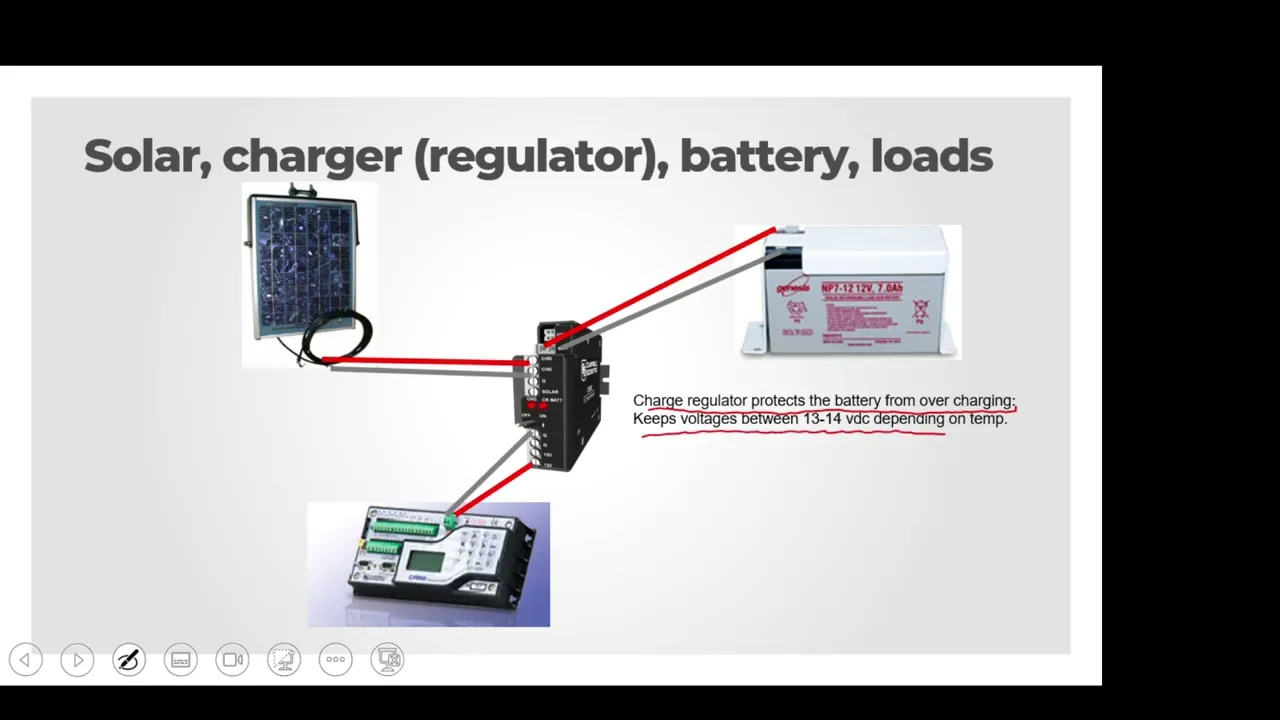
15 day Reserve time and your battery should last you many years without any problems um a power budget we want to try to design this system so that it does a good Reservoir it's got a good reservoir for us and the funnel is kind of like the solar panel the bottle is kind of like the battery and then the drips are kind of like the lows the Data Logger and other equipment will be using okay and there's uh this is a picture of a solar panel and that's hooked up to the charge inputs of some
kind of a regulator now what is a regulator well a charge regulator is what protects the battery from over charging we don't want to get the cells really hot and the electrolytes boiling out of there are converting into vapor and escaping so we always keep the voltage because the regular does that for us below the 13 14 Volt um limit based upon the temperature of the cell at the time and this 7 amp hour battery right here um when the when the solar panel starts putting energy in there it will it will try to keep
it below that level so that it doesn't damage the battery on the first day or the second day rather than four or five years down the road so how does this work well the sun energy comes in goes through the regulator and if the first thing it does is try to carry the loads so it tries to supply power to the loads and then if there's any surplus it will go into the battery to charge the battery and then maybe it's night time and the Sun goes away well the battery flow reverses and now it
comes out of the battery to keep those loads going so this is what's called an uninterruptable power supply a UPS it's a system where the solar panel keeps it going during the day and the recharged battery keeps it going during the night now this is a diagram of the amperage going the net power going into or out of the battery like we saw in the previous display this presentation the battery uh discharging at night is where we're starting so it's like 8 p.m at night right here and the first thing that happens is when the
Sun goes down the the battery will start discharging slowly just to keep the system running throughout the night well the Sun starts to rise and starts to deliver energy to load so partial load is being taken by the Sun and part of us being carried by the battery still mostly by the Sun a little bit by the battery and then we get to this equilibrium point where the sun has taken over the solar panel is delivering all the power to the load okay but then it quickly usually just quickly delivers more than the system needs
and so that positive energy will start charging the battery as well so the the solar panels being split here between the power to keep the system running and also the power to start charging the battery okay and so it goes into high high charge mode or or you know just dumping all the energy it possibly can but when that happens the battery voltage starts to climb and when the battery voltage starts to climb close to the Limit then the charge regulator must step in and say well we're getting close to our limit let me back
off a little bit and so the amperage going into the battery will back off and to a point where it goes into a maintenance charge where it's just trickle charging and finishing topping off the battery during the day so most of your charging happens first thing in the morning and then as it gets close to the peak we don't want to ruin the battery so it goes into the maintenance mode now on this particular day let's pretend like there was a storm cloud that came over some kind of thunderstorm or something monsoon season or something
and when that happens wow it just dramatically dropped the power output of the solar panel when those thick clouds came over and it dropped down to equilibrium for a moment and then it couldn't keep couldn't didn't have enough to keep the system running as well so it started leaning on the battery to take up the difference and pretty soon it was just about like night time all the energy was coming from the battery and then the the clouds the storm kind of dissipate a little bit this clouds breaking up a little bit it went back
up to the point where it carried all the load and they'd even have a little Surplus and started to recharge the battery again but then more clouds came and it kind of dwindled a little bit and then the sun went down and it was just pulling fully from the battery okay so that's kind of the introduction um on on some of the definitions and how batteries work