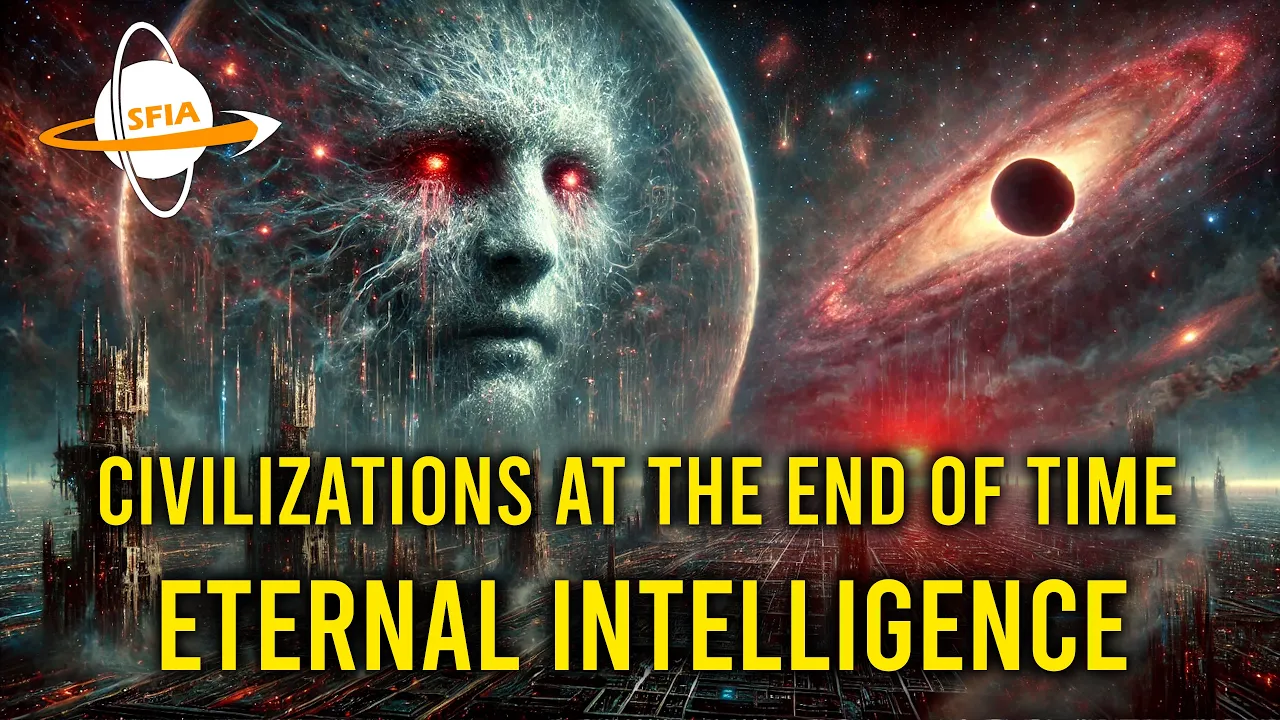
in a universe stretched thin by eons where stars have long faded and even atoms face therein a single question remains can intelligence find a way to outlast time [Music] itself imagine a universe countless eons from now stripped of Starlight and emptied of warmth the Galaxies have drifted apart into isolating in silence and even the fundamental particles that once danced in radiant complexity have begun to fade yet in this boundless dark a spark remains a glimmer of intelligence that has adapted persevered and evolved to endure Beyond time itself this is the realm of Dyson's Eternal intelligence
a vision where civilizations pushed to the very edge of existence defy the universe's slow Decay not merely surviving but flourishing these Minds stretch beyond the limits of entropy grasping at eternity refusing to be swallowed by the inevitable cold Darkness what would it take to persist in such an unforgiving Cosmos and What would life be like in a world where thought must Outlast the Stars themselves welcome to science and futurism with Isaac Arthur and I am your forementioned host Isaac Authur and today we're ask what it takes to survive in a dark era at the end
of time where even the most basic elements of matter itself might have decayed and entropy overridden all this is not our first Venture into civilizations at the end of time it's a series we've been revisiting about once a year since our early installments black hole farming and iron stars back in 2016 and 2017 respectively in indeed we even discussed the basic workings of Freeman Dyson's Eternal intelligence concept there in episodes since we've discussed methods of postponing the heat death of the universe and alternative theoretical Fates to heat death like the big rip or big crunch
the latter even has a mere image approach to Dyson's Eternal intelligence tip Thor's Omega Point cosmology that similarly might permit an escape from entropy we've looked at ghost universes left over from cyclic cosmology dying Stars the end of Earth and even the last planet most recently though we were looking at Postell civilizations trying to survive in the period known as the degenerate era on Stellar remnants like white dwarfs and neutron stars while they awaited the distant black hole era and this includes a worrisome Gap because somewhere between the period where natural black holes can be
founded and when those other Stellar remnants disappear not only do we have a long time Gap we also have the possibility that all protons the most fundamental building blocks of atoms may have ceased to Exist by then so today we will also discuss surviving in a universe in which protons Decay but before we get to any of that we need to talk about timelines and logarithmic ones at that our universe is staggeringly old and is divided into many different epochs each very significant and some much shorter than even a second so too our universe is
huge and growing bigger all the time and nothing is really helped by saying that the Moon is just over a billion feet from you and me that Pluto is 25 trillion feet away or that a trip to Alpha centari is 135 quadrillion feet the Andromeda galaxy is 86 trillion feet away or that the current observable universe has a diameter of almost 3 septian fet these numbers just don't mean anything to us and it recalls a favorite comment of mine from Richard fman that one of my own mentors quoted Us in his astrophysics class the sun
is much much bigger than even an elephant because our minds simply are not wired to these kinds of scales of space and time that the cosmos present us with at a certain point huge is simply huge our Theory today comes from Freeman Dyson to whom Richard fan was a mentor too so it's probably no surprise how often his own work featured truly massive Concepts and structures perhaps the best known of which is the Dyson Sphere we spent a lot of time on this channel discussing Mega engineering projects like Dyson spheres and indeed our original episode
on this channel the mega structure summary from way back in 2014 introduced a few different scales for trying to contemplate and categorize these besides the better known but not really ideal cter show scale we included options for physical size possible population energy use and so on like most First episodes it left a lot to be desired and I've avoided introducing scales since then but I think it will help us a bit for today so we will introduce the t- scale and as a simple exponential scale for time in years t0 would be 1 year T1
10 years T9 would be 109 years or a billion T12 a trillion and t00 would be a Google year her 10 to the 100 and this is about how long we think it would take to get to the first dark year of the universe when the last super massive black hole of around 100 billion solar masses would finally evaporate if I just said that proton decay might begin around t34 and Stellar Mass black holes would begin evaporating around t67 our minds would be tempted to think you could divide this time into three equal chunks as
34 and 67 are about a third and 2/3 of 100 but it isn't so the time from t67 to t00 is a billion trillion trillion times longer than from t34 to t67 and t67 itself is 10 million million million million million million million million million million years t34 by itself is a period of time a trillion trillion times longer than the universe has been around and we would currently be in the T10 era the first Stars probably arose around the t7 or T8 era Cosmic microwave background radiation is the T5 era and ended the photon
Epoch of the universe during which there were more particle collisions and events than the entire subsequent billions of years and whose remnants will still be kicking around all the way into that dark era after t00 so to we have several epochs of our universe that took place in less than a single year those epochs didn't last long and in order after the big bang were the plank Epoch t50 the grand unification Epoch t43 the inflationary Epoch to perhaps t39 then the electro weeky poac voting till t19 and the quarky poac till t-13 which itself ended
just one microc after the big bang and last an eternity compared to the previous four this is when protons first appeared T -13 and they should last until at least t34 you will often see those early epochs given in units of seconds rather than years so for clarification a second is in the T -7 scale which is from 0.32 seconds to 32 seconds after the big bang the next Epoch the sixth age of the cosmos we've identified was the hron epoch this is things made of quarks like the Proton or Neutron or maon and lasted
just 1 second and would be a million times longer than the Quark era and a trillion times longer than the 4 hes before it combined then comes the lepton era leptons are things like electrons and neutrinos and would go on from that first second to that first minute prior to this era matter was still so dense that neutrinos tended to interact with other particles only as this lepton era draws to a close do we see the proton begin merging or fusing in the nucleosynthesis events that formed virtually every atom around the universe although virtually none
of the atoms on Earth this was T5 and very nearly every atom of hydrogen helium and lithium formed during this period of a few minutes some of the helium in our sun was made by Fusion in the Sun the overwhel majority was there when it formed over 4 billion years ago and had been drifting around for nearly 10 billion years before that our son appeared late in T9 and will die sometime in T10 and its white dwarf form will persist until becoming a black dwarf sometime around T15 a quadrillion years from now it's a bit
strange to think of our sun being on its main sequence lifetime of about 10 billion years spending another billion or so as a subgiant then red giant then spending about 10,000 times as long as a slowly cooling white dwarf about the size of Earth and more than 100,000 times more massive this is also about the time we would expect the last stars to die but we think Stellar formation will go on more or less at the Modern Pace till a couple trillion years from now the T12 era and slump off till T14 with think star
formation should finally Peter out and this takes us into the degenerate era this isn't a time of zero light though for instance if Earth was still intact by gravitational radiation it would slowly spiral just a little closer to that dead son of ours till crashing in cira T20 10 billion times further in the future than the universe is old when it did that would reignite things for a while Jupiter would fall in later and its vast supply of hydrogen would also reignite that dead Sun for a bit there were also a lot of brown dwarfs
and binary remnants lying around still from t23 to T30 this is what is happening binary white dwarfs or neutron stars both long since cooled will fall into each other as we reach T30 all that is left in the galaxy is those cooled and isolated remnants of neutron stars and white dwarfs and black holes slowly emerging and from a practical perspective still not decaying themselves black hole evaporation is just very slow this whole insane time length is less than a trillionth of a trillionth of a trillionth of the time till black hole evaporation begins once they
begin evaporating in urest we have an immense power source will'll be able to tap but it's a long way off still it's also only a 10,000th a time to the bottom estimate for proton halflife which will tease again but return to you later as I think it's time we get to explaining Eternal intelligence I want to emphasize though that this concept works well on paper with no new science required the difficulty just comes in trying to tap ever smaller amounts of energy and trying to maintain your machinery for it on time scales so long that
the basic building blocks of matter those machines are made out of May themselves cease to exist this is the daunting skill involved as if we imagined a machine made out of an entire galaxy one so immensely efficient that only about one atom a month was lost to some sort of wear and tear or Decay just one atom that it would just barely survive to the beginning of the blacko era at about t67 because there are only around 10 to the 68 atoms in our whole galaxy but we were getting ahead of ourselves because our Journey
Begins back in the T10 and t11 era over the course of the next 10 billion years or so we should assume that if Interstellar space travel can be made even a little bit practical that planet and star in our galaxy indeed our supercluster would be colonized by Humanity or some Divergent Splinter or creation of ours this assumes no other aliens have already claimed those places and we might assume that even if we were the first species to develop in the whole universe that within 10 to 100 billion years it should have Arisen everywhere and that
every Star has been claimed by someone whether they originated from Earth or some older or younger alien home War today's discussion is taking us to the end of time itself exploring the concept of Eternal intelligence and the ultimate Destiny of civilizations but before civilizations can last forever they need to survive their Beginnings this month we explore how atmospheres act as a crucial filter for life and long-term Survival on my new firy Paradox video air firy Paradox air is now streaming on nebula where all SFI episodes air early and AD free nebula is the largest Creator
owned platform and home to exclusive content from countless amazing creators while you're there check out faithless a sojourn story this exclusive Audio Drama follows Cassian vri's palis Journey Through the sanctum the sojourn stories are set in a distant future in the Tantalus cluster in The Intergalactic void where Humanity finds itself without allies or resources and barely h on it's a captivating Edition to nebula's Library of premium sci-fi content sign up at go. nebula.com memberships and gift cods so you can share awesome content like faithless and sfa's monthly exclusive episode available at go. years other than
those galaxies closest to us a dozen or so every other Galaxy will have drifted away from us over the cosmological Event Horizon moving away from us faster than light can reach us from them every little cluster of galaxies is now its own Island slowly emerging into a conglomerate Galaxy which in truth all Milky Way already is surrounded by more than 100 billion light years of mostly empty void we've contemplated extreme galactic scale engineering that might let us save thousands or even tens of thousands of galaxies and this is a very legitimate thought because once you've
been colonizing space for a long time even just a million years you've probably settled your whole galaxy meaning trillions of planets and probably far more Mega structures whether occupied by people like you or me or some super evolved post humans or AI they should be accomplishing more units of scientific research in a single second than we have in our whole history and have been at it for a million years odds are good if there are ways around entropy or light speed or tricks for traveling to younger or more valuable realities they have found it and
if not they have billions more years to try but it would seem likely that if they hadn't figured out the cheat codes for the universe by then they will try to figure out how to most efficiently keep things going for as long as possible with a finite amount of resources this might be with the intent of maximizing research time or they might have decided that it's futile and they simply want to enjoy their quasi retirement for as long as possible probably a lot of folks in factions doing both neither or points in between in reality
this is the period Where Stars probably go dark in T10 to T12 not later at T14 because you probably are surrounding all your stars in dice spheres to catch all their energy and you probably AR letting new stars form in favor of capturing their matter for use in your own power plants or trickle feeding to Stars you've optimized as we noted in dying Stars it is possible to harvest helium and other elements heavier than hydrogen from Stars especially the smaller Mass fully convective ones that bubble all their material around even from their core and remove
the buildup of heavy elements that kill them this allows even stars like our own to be able to live trillions or even quadrillions of years by feeding them new matter and harvesting the heavier elements to build things out of though you might need to occasionally yank most that stars matter off for a good cleaning thus a star system might tend to keep a few stars going at a time so they could repair and regenerate one thoroughly occasionally this is a bunkered and cach civilization no dystopian reality is implied here they have vast resources and probably
n Immortal lifespans so whether or not it's a Utopia or some paranoid machine M sitting like dragons on their personal resource hordes is more reflective of their character than the laws of physics but everything is accounted for and was either classified as too much effort to grab or has been grabbed and stowed for future use those finite stockpiles can buy you so much life how much depends on your technology and lifestyle and how big a population you want at any given time that lifestyle is probably posthuman Minds the beond digital substrates but never mind that
your substrate be it neuron or silicon wafer or paper probably does matter to your core makeup and mind but probably isn't the totality of it Shakespeare is still Shakespeare whether it's written on OD parchment stored on a flash drive or printed on a t-shirt or poster or cved into an asteroid somewhere for posterity sake needless to say your mileage may vary and we don't really have enough information to know yet we don't really understand Consciousness let alone its limitations but odds are good that they can be understood by mortal minds or even postmortal Minds then
by the end of our Stellar era they figured it out if not it gives them something to think on as the Stars wink out this is where the dubiously named heat death of the universe comes in the name is Right heat is not the same as temperature it is the type of energy we get when particles are moving around randomly and you can measure how fast they are moving around as temperature but a bucket of ice has more heat energy in it than a cup of warm water so too space is not very cold and
indeed the areas on the dark edge of the Galaxy are often around a million de but there's very little matter there so very little heat just hide temperature when the universe began there was a very high temperature but not much heat compared to now relatively speaking anyway those pivotal or forc nanc long epochs of the universe would generate more entropy per instant than nowadays and as a system turns from other types of energy into heat the entropy of the system Rises it's generally felt there is no way to get around this that entropy never decreases
only increases with time the percentage of energy in the universe which by Einstein's equal MC squar includes matter is Shifting slowly but steadily from those other types of energy to heat energy and will presumably one day reach 100% bwing some Techo phenomena that violates the laws of th Dynamics this moment is the heat death of the universe and it's a long way off indeed the rate at which entropy increases may always be positive but will decrease over time trending to zero and a lot of our entropy got generated in that primordial era long before Stars
even formed but the temperature goes down the percentage of energy that is heat rather than mass or potential energy or any of the others Rises but temperature Falls the universe expands and cools much like any gas in expanding volume under the normal gas laws of chemistry everything runs down and there is no such thing as a free lunch no perpetual motion machines things end in a freezing cold and empty heat death Dyson's Eternal intelligence hypothesis proposes a way for intelligent life to survive indefinitely even as the universe heads toward an increasingly cold and sparse heat
death in this scenario where all the stars eventually burn out and energy becomes scarce Dyson speculated that intelligent beings or civilizations might adapt to use energy ever more efficiently finding ways to extend their thinking and existence indefinitely all be at a slower and slower Pace how Freeman Dyson proposed the concept of Eternal intelligence in 1979 in his paper titled time Without End physics and biology in an open Universe published in the reviews of modern physics a generation earlier Ralf landow proposed what's now called the landow limit the idea that computers or any similar machines for
crunchy numbers or processing or thinking have their maximum efficiency controlled by their temperature the lower it goes the more efficient it becomes half the temperature twice the efficiency for the same energy input a th000 the temperature a th000 times the calculation for the same energy so if you have a finite stockpile of resources that you plan to translate into a calculator or thought or virtual environment it behooves you to do this where it is the CEST or when it is the CEST and this is the basis for formy Paradox Solutions like the estivation hypothesis where
we assume civilizations go digital and migrate to the cord extragalactic regions with resource stockpiles they will hibernate near till the cold times come this is not a very good firy Paradox Solution by itself since it implies they left to hibernate and didn't bother taking most of the matter in their Galaxy with them and no it's not dark matter which is plentiful beyond the Galaxy's Edge because we can see back in time and it was just as much dark matter when the universe was barely a billion years old as now so not likely be secretly composed
of ancient civilizations the universe was way hotter than too indeed at the end of the photon era the universe was about the temperature of your typical star surface and closer to that in density too it's a little under 3 Kelvin these days about a 100th of temperature here on Earth it will be down to a single Kelvin in around 100 billion years when Star formation is still in its prime but when we are down to just those large conglomerate galaxies surrounded by 100 billion light years of void those are napkin calculations so grain of salt
please and anyone calculating out there on The Fringe Of The morg Galaxy ought to get about three times more bang for their Computing book than if they did that now and 300 times more than if they were doing that on Modern Earth by about a trillion years in should be getting down to the Melvin scale depending on how we calculate it and star formation is just beginning to trickle off mind you it's not that cold near these stars and D to obtain these temperatures you probably need to get a good distance from the Galaxy as
those stars all die off we drop below the Melvin scale where a computer should now be about a million times more efficient than now at least as a theoretical maximum the universe presumbly keeps expanding and as the universe cools and energy becomes harder to obtain people or beings would reduce their energy usage by thinking intermittently with longer and longer pauses between periods of activity by taking these pauses they will consume less energy and preserve it for a sensual cognitive task allowing intelligence to stretch into the far future so let's say you have a million units
of energy left in the first period of time you use half of them this is done while you drop from say 1,000 micrin to 500 micrel half the temperature and you have half your energy left half a million energy units this translates into some amount of thought and experience we usually assume digital Minds that we inv virtual realities say a thousand years of subjective life whatever rate you're thinking is is how much subjective life you experience whether you did that same amount of thinking over 1 second or 1 billion years you decide you will spend
half of your remaining energy in the interval while the universe cools to half the temperature again 250,000 energy units but because it is half temperature you get twice the thought from each energy unit the same thought or subjective life as before so as interval 2 ends however long that's been the temperature is a quarter what it was before at the start and your energy stock power is down to a quar or two you have lived another Millennium though 2 years subjectively in total next interval half your remaining supply of energy is used while the universe
cools to half its temperature again another Millennium of life and we are down to an eighth the temperature and an eighth the stockpile at the end of the fourth interval those are down to 16th and you've reached 4,000 and so so on in practice we're not talking thousands of subjective years either but more like quadrillions but you could be dividing it up however you wish maybe one lone mega mind that thinks very fast subjectively or a handful of normal human Minds each living quintili of years or quintili of people living each many thousands and even
here I'm really lowballing the numbers and probably by a dozen orders of magnitude or more and you can keep cutting in half each time expending half your stock pile of energy to keep thinking while the temperature cools this also assumes energy for maintaining virtual environments and repairing equipment though as time stretches and the rate of thought slows these beings would perceive their existence in a way that feels continuous even though from an external perspective their thinking process might occur at extremely long intervals this way an in the sequence of thoughts could still unfold just more
slowly Dyson suggested that intelligence doesn't necessarily need a constant flow of energy to operate only enough to sustain thought processes periodically by adapting their metabolism so to speak these beings could continue indefinitely consuming ever diminishing amounts of energy per thought over time this is Dyson's Eternal intelligence because as the universe keeps Cooling and expanding you keep getting more efficient and thus never run out of energy or life you keep doing this all the way to the end of time your civilization is eternal and runs through the degenerate era and onto the black hole era sucking
life from slowly evaporating black holes from t67 to T100 then into the dark era till the ion stars begin forming around t500 and after that period into the second dark era and on and on civil civilizations lasting until the end of time and the inspiration for the series and those first two episodes black wh farming and ion stars that Chronicle those periods and how they operate as it is not likely to be a smooth process of continual having now needless to say this idea has limitations Dyson originally assumed the universe would expand and cool forever
providing infinite time and dimin ing temperature but more recent cosmological theories suggest that accelerating expansion in the universe might lead to conditions like the big rip or Quantum vacuum Decay and we looked at the Big Rip scenario and maybe we'll do Quantum vacuum decay in more detail in the future too though we've discussed the basic physics as a possible source of energy elsewhere if you're thinking that tapping vacuum energy gets you out of the heat death scenario well maybe but there's as much Reon to think that even if you could tap that it would train
out too eventually albeit it might buy you vastly more time a big rip does offer a parallel Escape method to Eternal intelligence much as tip's big crunch Mega Point scenario does though in both we instead reverse our process using Rising energy densities to ever more rapidly calculate getting twice as much done in half the time all three of those scenarios each tal intelligence big rip and big crunch probably have a real limitation on the plank scale we generally hold in physics that you can't get smaller than a plank length or shorter than a plank time
or higher than a plank temperature those are respectivly about 10 35 M 10 to 43 seconds or 10 to 50 years thus our t50 era the plank Epoch right after the big bang and about 10 to 32 Kelvin the plank temperature and the presumed temperature at the moment after the big bang if you want to view those as having intervals rather than units of 10 generally 10 Hales is roughly a thousandth so to go in half steps up to plank temperature from room temperature would be about 100 doubling intervals which is a lot but not
Infinity obviously so too you have problems running machineries at temperature so hot they rip fundamental particles apart much as it get very dubious you could run a machine so efficiently that it could not even lose an atom of century to wear and tear which is the kind of efficiency needed to operate deep into the black era even when building your machines out of many galaxies I have no idea how you would keep a machine working that long given your Limited stock piles when we're often talking about timelines longer and years then there are atoms in
the whole universe this doesn't mean it doesn't work to prolong civilizations just that it probably has its limits and we should keep in mind that wear and tear and damage don't just happen for no reason in an ultra cold slow and low energy environment there really are not many things causing wear and tear so it is entirely plausible you might have very slow loss and damage rates that this could be atoms a year on Galaxy siiz constructs does seem a bit much though and is not a subjectively short Epoch either a civilization that saves matter
up for the Post Cellar era might experience not just slow eons of stretched out existence but subjective time spans of their civilization vastly longer than trillions of years as we said in black hole farming it's only dark in a relative sense they would view their Stellar era time as this tiny energetic fraction of the universe that was brilliant but short to them the same way we view the Big Bang itself we to them are a civilization somehow existing in a rapid explosion but we have some other limits and those can include options like a power
source that simply cannot operate below a certain threshold you are not extending your civilization much if your Fusion reactors cannot generate below the megawatt scale for instance or cannot do it efficiently you might be flipping on for an hour or once of a quadrillion years or something it's easier to explain the concept of Dyson's ET internal intelligence as a smooth timeline where each stretch takes half as much energy and produces twice as much thought for each mode of energy but in practice what we're really suggesting is probably an intermittent civilization one that goes into near
complete hibernation between firing up their reactor again during which time their circuits cool those circuits had to be at those ultra low temperatures to take advantage of that Ultra cord efficiency and it takes a very long time to cool down to that next level temperature so huge times must pass between firing a circuit too when the circuits cooled down to that new base temperature which is lower each time and takes longer to reach each time they fire their circuits again to create calculation or thought or run their subv they dwell in or alternatively they fire
up their civilization as each new black hole in their stockpile each just a bit more massive than the last reaches that point where it produces usable levels of power after a long period of slow evaporation black holes produce vastly more power when they are lower Mass the relation is inverse Square so a tenth of mass 100 times the power output I should note that an intermittent civilization especially in this way where each thought has a long pause between it might run into some identity and Consciousness issues we don't really understand either of those but one
of the more common philosophical Notions of identity coming from John Lock is that it requires con continuity no sudden changes and maybe no Ultra long pauses though we take for granted that sleep maintains identity we don't wake a new person each day but civilizations might get philosophically uncomfortable about quadrillion year pauses between words in a conversation indeed for all that black horse have immense lifespans it is worth noting that if every drop of man was put into black holes of various sizes to stagger them out of the black hole era there would not be enough
mass in the whole known universe to let them run with one at a time perpetually producing even a single water of power because the mass energy of the whole universe is just shy of 10 to the 70 Jews which means even if you only try to operate to T70 not t00 you only get to have one Jewel a year about 30 nanowatt of power of course if you're operating at the Nan Kelvin temperature and indeed a lot lower by by then that would let you run quite a few mines and at a realtime speed again
the numbers are just so staggering that they cannot be intuitive and we saw them in more detail in those earlier episodes on black hole farming and iron stars but to get to those eras you have to survive the degenerate era and that's not necessarily an appropriate name just because the few SL your bodies remaining are dead stars made of degenerate matter or even that all orbits are are slowly degenerating to cause things to fall together we do not know that any particles are completely stable many have half- lives indeed from a certain perspective most particles
have half lives so short they could not make a trip at light speed outside their own Atomic nuclei as we discussed in our episode antimatter factories we only see those few types that can but a lot of things are stable and we think the electron and Photon for instance are both totally stable we think the neutrino is as well and probably the graviton if it exists but proton are made of quarks and gluons and may have a halflife neutrons do they last mere minutes by themselves we do not know if the proton does Decay but
we have reason to think it might particularly in super symmetry models which I should note I am not personally a big fan of though it is a brilliant and Det detailed Theory and my opinion probably should not matter regardless we know that if protons do have a halflife it is not less than 10 to 34 years it presumably takes a lot less time than that to determine if protons do Decay and how long they're halflife if any actually is but everything we normally think of as matter is made out of protons since they are at
the center of every atom even simple hydren that lacks a single Neutron in it and again neutrons do Decay when in isolation so do the bigger leptons like the muan and to particle but we think the other leptons electrons and neutrinos are Eternal and that presumably includes their anti- particles like the positron so what do protons Decay into well we don't know if they Decay into anything so we can't be sure what they would Decay into if they did but we have two main guesses option one the proton decays into a POS itron and a
neutral Pon that positron presumably lives forever unless it encounters an electron in which case they slowly orbit down attracted by their opposite charge until they touch and typically annihilate as a pair of photons of 511 K energy each which is how we discovered positrons and antimatter incidentally the neutral Pion or Pon is composed of two quarks one up and one down there's a positive and negative Pion 2 made of a pair of up or down quarks and they only have a half life of a few Nan seconds and the neutop Pion is even shorter lived
about a billionth of a nanc so not something you build an eternal Empire out of they turn into a pair of photons so proton decay this way ends up as photons if we imagine some hydrogen atom in the Deep void fall from a Galaxy decaying the proton decays into a positron which then collides with the electron the hydrogen atom had and leaves us to photons which is after the neutral Pion has decayed into two photons itself this might be a decent power source for civilizations trying to carry on into the degenerate era while their matter
runs out from proton decay and it's amazing how big an energy budget that really is given what the temperature of the universe would be by then something south of a trillionth of a trillionth of a Kelvin under land hours limit that's way more useful calculation from a single Stellar mass than you could get now from Dyson swarming entire superclusters of galaxies the other Decay mode suggested for protons is into a muon the electron's big brother and a photon and that muan will Decay into an electron or rather that positively charged muon left from the positively
charged proton it decayed from will Decay into a positron the positively charged anti- particle of the electron some suggested Decay modes instead result in lighter maons and neutrinos but we'll bypass that for now so is that it just positrons and electrons deing into each other and creating more photons to join the photons and neutrinos floting around the universe well photons and gravitons if they exist are massless particles so they experience no time and thus don't Decay over time while neutrinos might have some mass and thus experience time and might eventually Decay too potentially even faster
than protons as some models predict anywhere as low as 10 to 20 to 10 to 30 years as a neutrino halflife decaying either into a photon or a majoron majoron are a topic for another time so is dark matter which you might conceivably be able to build stuff out of and maybe very long lasting stuff we don't want to casually brush off weakly interacting particles like we think Dark Matter might be made of given how long the timelines involved for them to interact over might be maybe we could build data engines and computers from dog
matter but a positron and electron do not have to collide they are attracted by their opposite charges and in a normal Atomic distance we see in hydrogen or other matter they will fall into each other we call a positron electron pair positronium incidentally and it need not be shortlived this isn't just random speculation anymore either we've even made molecules out of it short lived though those were imagine a positron electron floating far apart in space far from other matter and orbiting very slowly this will Decay with time but you could build thinly spread devices out
of patronum perhaps indeed imagine for the moment that you spaced a positron and electron just far enough apart that the force of their attractive charge was exactly balanced by the push of dog energy seeking to separate them they might remain forever locked at that distance very hard to do possibly impossible but if proton decay is real people have about a trillion trillion trillion years to figure out how to make machines and computers out of patronum instead of regular matter or to create micro black holes or sip at vacuum energy if it is possible that is
a lot of time to figure it out and that's what it comes down to in the end if there's a way to make Dyson's Eternal intelligence practical to reach out for that tantalizing possibility that intelligence might adapt and survive eternally by slowing down in harmony with the universe's cooling to use ever more efficient energy conservation methods to exist at the univers farthest reaches of time then we have all the time to figure out how to either do it or to find some other alternative to escape to some other place some younger universe or one where
different rules apply so perhaps civilizations will persist until the end of time [Music]