There's a muscle in your neck that can cause a host of problems. Neck pain, headaches, dizziness, loss of equilibrium. It can cause tearing in your eye, throat pain, ear pain, ear popping, facial pain, poor posture, and a host of other things.
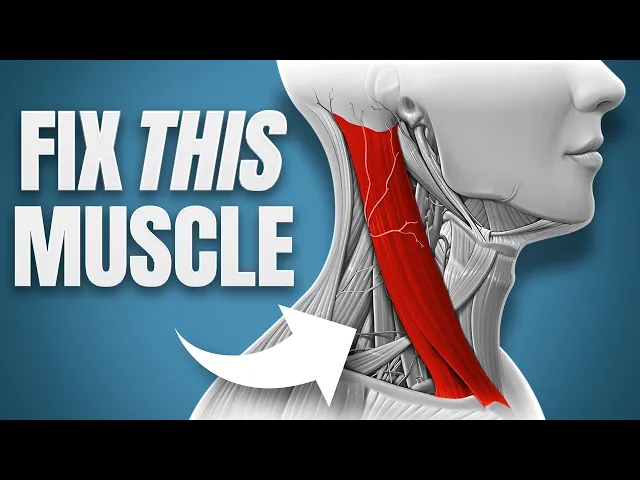
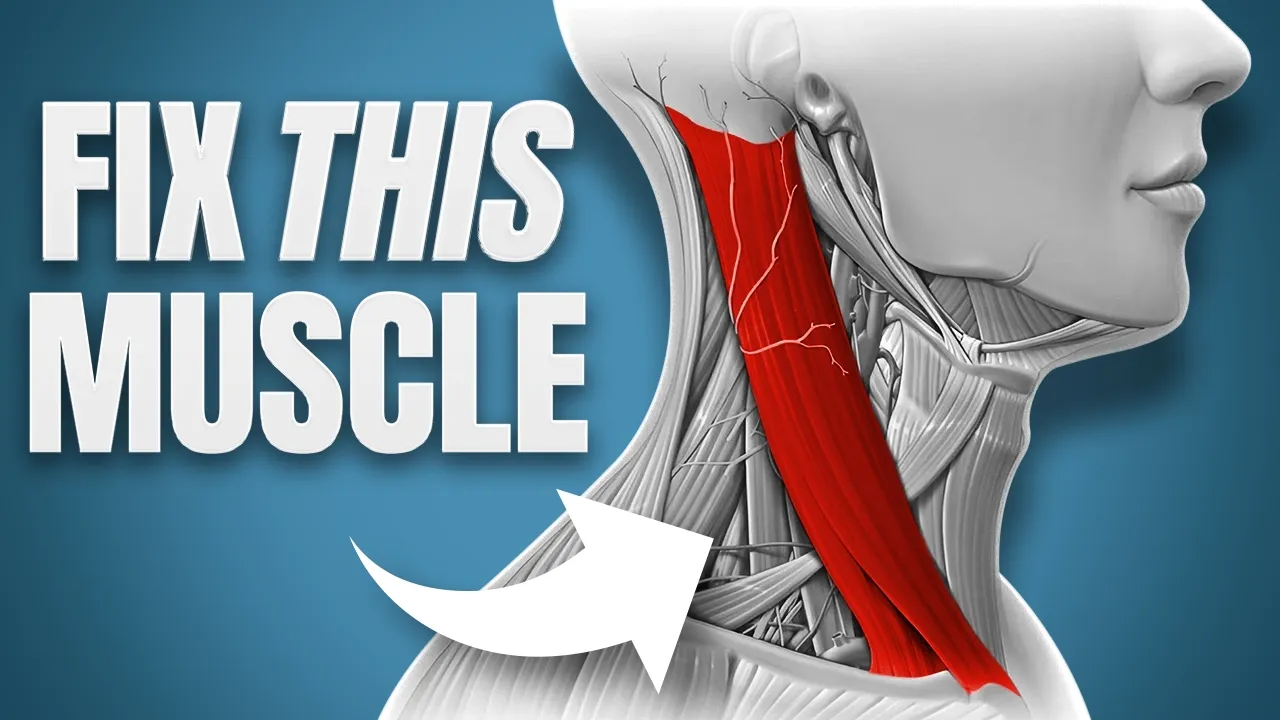
In fact, if you can fix this magic muscle in your neck, you just might be able to fix all those problems. Let me show you how. The muscle we're talking about is your sternoccllyomomas mastoid or short for SCM.
Now, this muscle is a fairly complex muscle because it lies from the back of your mastoid process and attaches down here in two spots. Now, there's a variety of sensitive tissues around it, blood vessels, nerves, which is why it can create a host of problems. How does it get irritated or damaged?
Well, we sit too long. Typically, the thing we see in practice is micro trauma over time. Poor posture and lack of movement leads to this muscle dysfunction.
This video is going to be divided into three parts. The first part I'm going to show you how to find trigger points and release them. The second part I'm going to show you how to release it through a myofascial release.
And finally, I'll show you how to stretch it as well to get it functioning better. Stick around because at the end I'm also for those people that have a weak SEM on one side, I'm going to show you a way to find out which side's weak and how to strengthen it. I encourage you to follow along because I want you to feel and walk through these three things with me so you know exactly what you're doing to make sure it's effective for you.
The very first thing we're going to find the SEM. So you're going to turn your head and later flex and then you're going to grab the muscle here. You can kind of see it bulge out.
We're going to start at the top. So once you've found it, start right at the top almost at your skull here and just feel right down. And often times you're going to find a trigger point at the top or right here in the middle for me.
And so you can either squeeze the muscle between your fingers or you can use one finger to find the trigger point. I like to get the muscle between my fingers. I can control I can feel this referring right up here around my head almost into my face with that trigger point.
I'm going to hold this trigger point for about 30 seconds. You can move it if you like in circular motions. You're going to know when you have it because you're going to feel something.
If you don't feel anything, then you're not on a trigger point. Continue to search all the way down. And some of you might feel it right above your clavicle.
There's two insertion points. And you need to feel around. Oh, there's another one right there.
So, this refers up to my neck as well, right along that SCEM. For this one, it's not a pinch or grasp, obviously. It's a either a trigger point with one or two fingers.
And this one you can make a circular motion again for about 30 seconds. Let me just show you again on the other side. So we want to find the muscle and then when you find it get it under let it relax I should say.
Oh yeah I found one right away on this side up top a little bit higher up. Again these muscles are under a lot of stress because we sit a lot. We don't move much and they are a very common culprit of dysfunction in the cervical spine causing like we talked about the beginning of a variety of symptoms just not just neck pain and headaches but some pretty interesting neurological symptoms.
There's another one down here. So for each you'll find it in a different place. You you might have to search a bit you know to find that muscle.
Just take your time and you know if you go deep enough you're going to probably find some trigger points beneath that muscle and your scalings as well. You can kind of hit them both at the same time but really our focus here is as I say this muscle here. So I hope you found that helpful with the trigger point.
We're going to go into a fascial release or a myofascial release. And this one is very similar. You're going to find the muscle and then we're all what we're going to do is rotate our neck as we pull the muscle down.
So, we're going to be pulling on an angle. Again, you can start at the top, rotate all the way to one side, and then as we turn, keep the muscle between your fingers and pull down. You can do this to anywhere between three to six passes.
It feels really good actually. And let me show you the other side. So, we're going to start here.
And again, you know, you can do one side, but I always encourage my viewers and patients to hit both just so we're keeping things in balance and equal. One more pass here. Again, if you're having trouble finding it, you really want to tilt your head forward slightly, turn away.
You'll feel it and see it. You might want to use a mirror the first few times, and you're going to realize that the muscle splits. And so, you might want to pull down in on one side and the other.
play around with it. But I know if you get the muscle between your fingers as you rotate your head and you're pulling down as you're stripping the muscle, it's going to really give you some relief instantly. I know if you've done the trigger point and the fascial release right now, you're already feeling warm.
Your neck's feeling good. We're going to move on now to this important stretch is going to really stretch this out and you're going to really feel the difference. This is simply going to take our fingers.
We're going to place it on top of our clavicle or collar bone. We're just slightly push down. And if you need your other hand to help you, you can do that.
But this is a very simple stretch. We're going to turn away already. Can I feel it?
And then just extend up. Now, this is going to stretch some of your other muscles as well as the SEM. But you, if you got the right spot, you're going to feel that all the way up there.
So again, flat fingers, lay it on top of your clavicle or collar bone. If you need a little bit more pressure, some of you will, some of you won't. Pull down.
turn away and then up. You're really going to feel that all the way up. And again, you're going to get some of the other neck muscles as well.
You're going to hold this for 30 seconds. And again, I recommend you do both sides three to five times. And as you get into the stretch, you can move up further as the muscle starts to relax to really get that muscle deep.
Now, for this exercise, when you're doing your head movement, some of you that may experience dizziness either from the inner ear or from your neck, you need to be careful with the movement so you're not stimulating or irritating your dizziness. So, just work with it slowly. Start to the side and then move up to make sure you can handle that.
Now, one of the final things we want to talk about is sometimes one of these muscles will create an imbalance because one will get weaker on one side. It might because you're favoring one side, you're always looking the same way. Whatever the reason, a simple trick to know which is which, you need to kind of visualize and maybe use a mirror.
You want to activate the muscle. So, you want to turn away and down. Just grab and feel the cross-sectional area of the muscle.
If you can really notice one that is thinner, it's not as prominent, then that can tell us two things. One, the one that's bigger might be tight, you need to stretch it, or two, the smaller cross-sectional area might be weaker. So, how do you stretch that?
Well, to strengthen it is very simple with an isometric stretch. So, let's assume this one's thinner and you know it's weaker. Then, we're going to go into the movement.
And all we're going to do, like I said, is push into the movement to get that muscle to fire. You're going to hold this for 5 to 10 seconds and then relax. Same thing.
Get the muscle to fire. 5 to 10 seconds and then relax. You can do this daily up to five sets.
Now, this would be a time if you're certain and you know that one muscle is smaller, weaker, you can do a unilateral movement cuz you're trying to strengthen that muscle. I hope you work through that with me. I know if you start with the trigger point and then you work into the fascia release and then the stretch and for some of you that need to strengthen, you work into that as a routine.
It doesn't take long. I know if you do that on a consistent basis, you're going to start to notice a change in some of the symptoms we talked about at the beginning of the video. If you have a comment or question, please leave it below.
I do my best to answer all those questions as soon as possible. And if you're new to my channel and you like the content I'm putting out, maybe you'll consider subscribing so you can be informed when I upload a new video. If you want further connection and more input in the channel, maybe you'll consider joining my membership as well.
I appreciate you taking the time to tune in with me today. I can't wait to see you in my next video. Until then, stay There's a muscle in your neck that can cause a host of problems.
Neck pain, headaches, dizziness, loss of equilibrium. It can cause tearing in your eye, throat pain, ear pain, ear popping, facial pain, poor posture, and a host of other things. In fact, if you can fix this magic muscle in your neck, you just might be able to fix all those problems.
Let me show you how. The muscle we're talking about is your sternoccllyomomas mastoid or short for SCM. Now, this muscle is a fairly complex muscle because it lies from the back of your mastoid process and attaches down here in two spots.
Now, there's a variety of sensitive tissues around it, blood vessels, nerves, which is why it can create a host of problems. How does it get irritated or damaged? Well, we sit too long.
Typically, the thing we see in practice is micro trauma over time. Poor posture and lack of movement leads to this muscle dysfunction. This video is going to be divided into three parts.
The first part I'm going to show you how to find trigger points and release them. The second part I'm going to show you how to release it through a myofascial release. And finally, I'll show you how to stretch it as well to get it functioning better.
Stick around because at the end I'm also for those people that have a weak SEM on one side, I'm going to show you a way to find out which side's weak and how to strengthen it. I encourage you to follow along because I want you to feel and walk through these three things with me so you know exactly what you're doing to make sure it's effective for you. The very first thing we're going to find the SEM.
So you're going to turn your head and later flex and then you're going to grab the muscle here. You can kind of see it bulge out. We're going to start at the top.
So once you've found it, start right at the top almost at your skull here and just feel right down. And often times you're going to find a trigger point at the top or right here in the middle for me. And so you can either squeeze the muscle between your fingers or you can use one finger to find the trigger point.
I like to get the muscle between my fingers. I can control I can feel this referring right up here around my head almost into my face with that trigger point. I'm going to hold this trigger point for about 30 seconds.
You can move it if you like in circular motions. You're going to know when you have it because you're going to feel something. If you don't feel anything, then you're not on a trigger point.
Continue to search all the way down. And some of you might feel it right above your clavicle. There's two insertion points.
And you need to feel around. Oh, there's another one right there. So, this refers up to my neck as well, right along that SCEM.
For this one, it's not a pinch or grasp, obviously. It's a either a trigger point with one or two fingers. And this one you can make a circular motion again for about 30 seconds.
Let me just show you again on the other side. So we want to find the muscle and then when you find it get it under let it relax I should say. Oh yeah I found one right away on this side up top a little bit higher up.
Again these muscles are under a lot of stress because we sit a lot. We don't move much and they are a very common culprit of dysfunction in the cervical spine causing like we talked about the beginning of a variety of symptoms just not just neck pain and headaches but some pretty interesting neurological symptoms. There's another one down here.
So for each you'll find it in a different place. You you might have to search a bit you know to find that muscle. Just take your time and you know if you go deep enough you're going to probably find some trigger points beneath that muscle and your scalings as well.
You can kind of hit them both at the same time but really our focus here is as I say this muscle here. So I hope you found that helpful with the trigger point. We're going to go into a fascial release or a myofascial release.
And this one is very similar. You're going to find the muscle and then we're all what we're going to do is rotate our neck as we pull the muscle down. So, we're going to be pulling on an angle.
Again, you can start at the top, rotate all the way to one side, and then as we turn, keep the muscle between your fingers and pull down. You can do this to anywhere between three to six passes. It feels really good actually.
And let me show you the other side. So, we're going to start here. And again, you know, you can do one side, but I always encourage my viewers and patients to hit both just so we're keeping things in balance and equal.
One more pass here. Again, if you're having trouble finding it, you really want to tilt your head forward slightly, turn away. You'll feel it and see it.
You might want to use a mirror the first few times, and you're going to realize that the muscle splits. And so, you might want to pull down in on one side and the other. play around with it.
But I know if you get the muscle between your fingers as you rotate your head and you're pulling down as you're stripping the muscle, it's going to really give you some relief instantly. I know if you've done the trigger point and the fascial release right now, you're already feeling warm. Your neck's feeling good.
We're going to move on now to this important stretch is going to really stretch this out and you're going to really feel the difference. This is simply going to take our fingers. We're going to place it on top of our clavicle or collar bone.
We're just slightly push down. And if you need your other hand to help you, you can do that. But this is a very simple stretch.
We're going to turn away already. Can I feel it? And then just extend up.
Now, this is going to stretch some of your other muscles as well as the SEM. But you, if you got the right spot, you're going to feel that all the way up there. So again, flat fingers, lay it on top of your clavicle or collar bone.
If you need a little bit more pressure, some of you will, some of you won't. Pull down. turn away and then up.
You're really going to feel that all the way up. And again, you're going to get some of the other neck muscles as well. You're going to hold this for 30 seconds.
And again, I recommend you do both sides three to five times. And as you get into the stretch, you can move up further as the muscle starts to relax to really get that muscle deep. Now, for this exercise, when you're doing your head movement, some of you that may experience dizziness either from the inner ear or from your neck, you need to be careful with the movement so you're not stimulating or irritating your dizziness.
So, just work with it slowly. Start to the side and then move up to make sure you can handle that. Now, one of the final things we want to talk about is sometimes one of these muscles will create an imbalance because one will get weaker on one side.
It might because you're favoring one side, you're always looking the same way. Whatever the reason, a simple trick to know which is which, you need to kind of visualize and maybe use a mirror. You want to activate the muscle.
So, you want to turn away and down. Just grab and feel the cross-sectional area of the muscle. If you can really notice one that is thinner, it's not as prominent, then that can tell us two things.
One, the one that's bigger might be tight, you need to stretch it, or two, the smaller cross-sectional area might be weaker. So, how do you stretch that? Well, to strengthen it is very simple with an isometric stretch.
So, let's assume this one's thinner and you know it's weaker. Then, we're going to go into the movement. And all we're going to do, like I said, is push into the movement to get that muscle to fire.
You're going to hold this for 5 to 10 seconds and then relax. Same thing. Get the muscle to fire.
5 to 10 seconds and then relax. You can do this daily up to five sets. Now, this would be a time if you're certain and you know that one muscle is smaller, weaker, you can do a unilateral movement cuz you're trying to strengthen that muscle.
I hope you work through that with me. I know if you start with the trigger point and then you work into the fascia release and then the stretch and for some of you that need to strengthen, you work into that as a routine. It doesn't take long.
I know if you do that on a consistent basis, you're going to start to notice a change in some of the symptoms we talked about at the beginning of the video. If you have a comment or question, please leave it below. I do my best to answer all those questions as soon as possible.
And if you're new to my channel and you like the content I'm putting out, maybe you'll consider subscribing so you can be informed when I upload a new video. If you want further connection and more input in the channel, maybe you'll consider joining my membership as well. I appreciate you taking the time to tune in with me today.
I can't wait to see you in my next video.