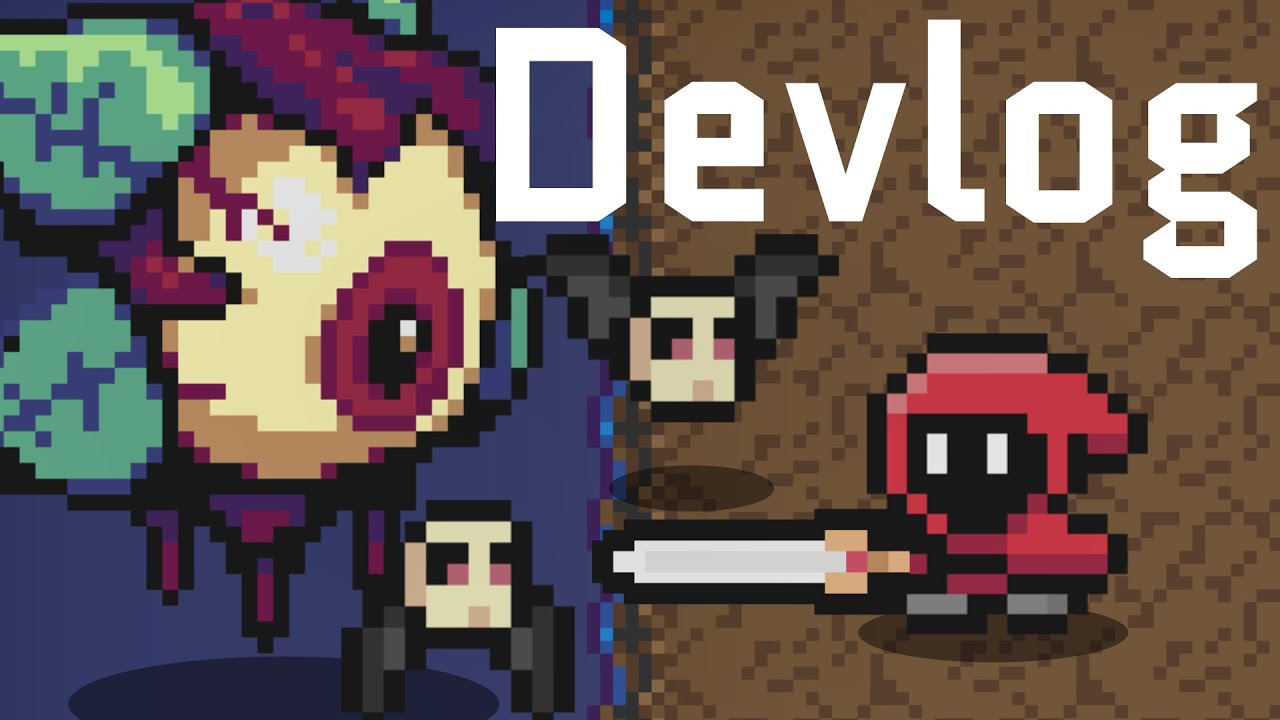
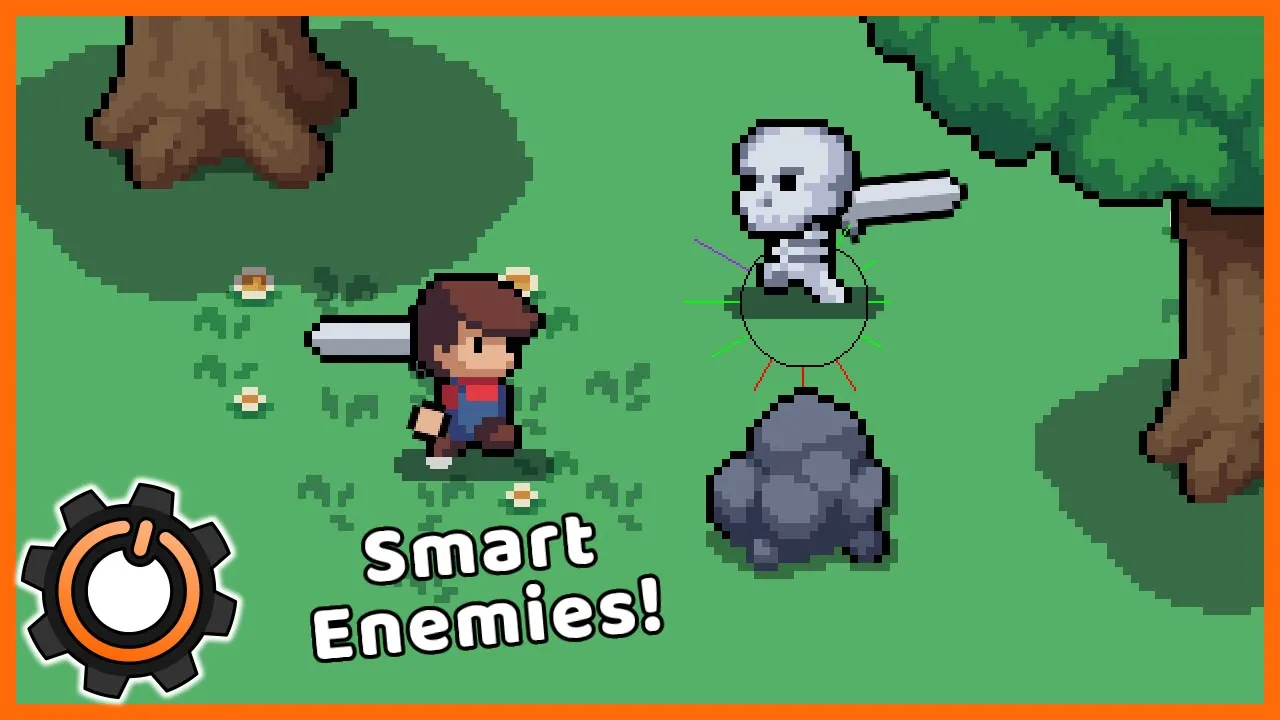
Oh no. I accidentally created a Newton’s Cradle of Skellies. Howdy!
And welcome to Game Endeavor. Where I make devlogs with an emphasis on game design and technique. I’m developing an open world RPG where you’ll meet lovable characters, explore dark and treacherous dungeons, and build a base to stash your precious cheese.
One of the more difficult tasks that I’ve ever come across as a developer is how to handle enemy movement in a way that’s convincing and engaging for the player. This is especially difficult because there are a lot of factors to consider such as what direction they should move towards to reach their goal. What entities are nearby so they don’t clump up together into a hyperdense singuskellety.
The nearby environment and everything else around them, and even once they have figured out how they should move, they need to do so smoothly so that they don’t jitter around like me after a long night of binge coding and coffee. Even though combat isn’t the primary focus of my game, not nearly as much as exploration and the roleplaying. I still want it to be enjoyable, because it is what builds tension and keeps the player engaged as they explore the world and uncovers its secrets.
If you look into AI movement, then one of the first things you may encounter is what’s known as boids and steering behaviors. This is not what I’m using to be clear, but it is where I started and is what helped me to develop the technique that I am currently using. Steering behaviors are where you combine simple actions such as move to this point, keep away from these points, and move in the same direction as these other points.
On their own these behaviors are very simple and unimpressive. But when combined and tweaked in specific ways, they create something that I was quite stunned by when I first encountered them. But after implementing this some time ago in a prototype for another game, I quickly noticed some major flaws with the system.
The biggest glaring one being how opposing vectors can cancel each other out to cause pretty silly situations where the AI needs to run away from the player, but there’s a wall immediately opposite to them. So they just stand there completely dumbfounded by the existence of this wall as they wait for their slowly impending doom. Ideally you would want them to realize that they have other options available to them, such as stepping ever so slightly to the side and continuing along that path for a bit.
But since there’s only one vector that has complete control over how they move, they just sit there barely moving if at all. I searched for a while about how I could improve this, or alternatives to AI movement and found a context based steering behavior that inspired what I am currently using. This is very similar to the behavior that I mentioned before, except it keeps a record of how desirable different directions are and chooses the preferred direction that it can actually perform.
For example, say I set down a carrot for Truffles to snack upon, odds are he’s going to move directly towards the carrot. That would be the obvious choice. But hold on there Truffles, not so fast.
He could, in theory, step off to the side for a bit, make a big half circle around the carrot, and then go in for the snack. It would be rather silly, yes. But it’s still an option.
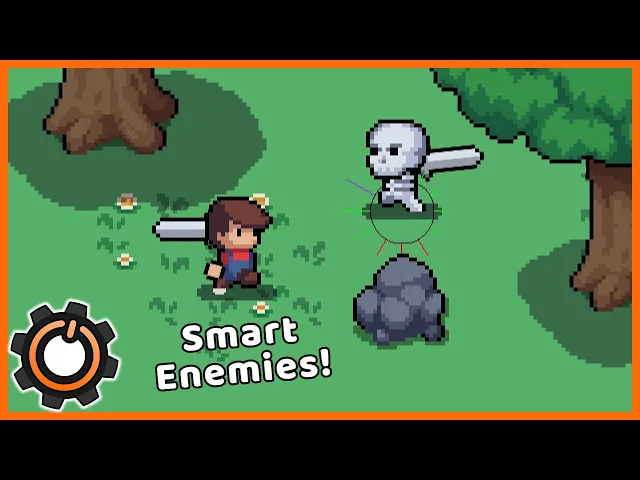
So to help truffles evaluate the different directions that he could take, I’m storing his options as weights that he can check and pick the most desirable path in the event that some of his options may be limited. To help me visualize these weights as I’m developing the movement systems, and help you visualize them while binging these devlogs and subliminally clicking little blue thumbs, I have created a gizmo that can draw what the AI is thinking. Each line represents a direction that they are considering.
Green lines showing a desire to move towards that direction with longer lines being most desirable, and red lines meaning that they have absolutely no desire to move in that direction. So as you can see, when one direction becomes obstructed then the AI will pick the next best option and move in that direction instead. In order for the AI to determine this, I need to tell it how likely a direction is to produce a desired result.
I’m using a dot product here between the direction being considered and a vector that the entity would like to move towards. For those unaware, dot product is a very useful thing that will return the cosine value of the angle between two normalized vectors. This value will be 1 in the direction of the normal, -1 in the opposite direction, and 0 perpendicular to it.
When normalized between 0 and 1, you get a scale of how desirable that direction is. The AI is using this to decide which direction it should move. This is great for moving towards a specific location.
I can simply take the highest unobstructed weight and move in that direction. But the true power of this system comes when you start shaping the weights and combining them to perform even more interesting behaviors. Skellies making a beeline for you is one way to prototype a simple combat system.
It is what I have used so far and it served its purpose as a placeholder, but it’s not nearly as engaging as it could be. A much more interesting behavior would be for the skellies to move in and out of combat, strafe around their target, all while keeping a safe distance. I have one set of weights that will move towards their target as normal, but as they get closer to their target, the value of these weights are lessened so that other behaviors can take over.
So I’m weighting the weights. Once they are within range to start strafing around the character, I apply a shaping function to the dot product that favors sideways movement instead of forward and backwards. This causes them to start circling around their target.
Except, oh no… I accidentally created a Newton’s cradle of skellies. I had to offset their following distance a bit otherwise they start making perfect circles around their target and bouncing off of each other. A big issue that I’ve had with this system though is tweaking the movement to eliminate a lot of jitteriness that I’ve been noticing due to entities rapidly changing their direction back and forth.
This is because I was having them move directly away from any nearby entities and so they would get caught up in this tug-o-war of pushing each other in an attempt to get to their desired target. I fixed this by also applying a shaping function to their separation logic so that instead of trying to move directly away from the nearest enemy, they would prefer to do so at a bit of an angle. When you combine this smarter form of movement with the overall tweaks to the skelly’s combat state machine, you get a very fun enemy to fight that even I spend my free time spawning a few in for a quick session.
And when I had a tester play this, they spent over an hour just fighting a handful of skellies and sprouts over and over. Combat wasn’t the only enemy behavior to receive a massive improvement though. One of the main design pillars for my game is immersion, having things feel natural and convincing.
And something I’ve been wanting to improve for a while now is the wandering logic for my enemies. Before now it has been a placeholder just so they’re not standing in one place when I record these devlogs. The logic was that they would pick a random point somewhere around their spawnpoint and move towards it.
If they were near the point or it became obstructed within a short distance then they would pick another point and start moving towards it. This is decent enough but it feels very erratic and unnatural. The AI changes direction sporadically and to me it feels a little off.
Rather than picking a random point to move towards, I would rather have them meander about. Gradually changing their direction, but remaining near their spawn point so that they don’t wander off too far. To have them wander about, I’m having them move in a direction, but over time this direction will gradually sway left and right which causes the entity to start changing direction.
I’m using OpenSimplex noise here to adjust the direction. There are a few benefits to using it here. Namely that the randomization it produces is smooth which gives the wandering a more natural feel to it.
But more importantly the values of OpenSimplex noise tend to be more heavily weighted towards 0, which means that if done right the entity isn’t going to spend too much time changing direction. Instead it will move straight for periods of time, and then every so often it’ll start changing its direction but then start pulling back towards 0, which causes it to again move mostly straight. To keep them near their spawn point, I’m weighing their wandering direction back towards their spawn point whenever they start getting too far away from it.
This causes them to gradually start turning around until they’re no longer moving away from the spawn point. To keep this looking smooth and natural, this isn’t a hard transition though. The weighting starts to take effect at a pretty short distance from their spawn point, currently at about a 2 tile radius.
But it’s weighted based on how far they are from the spawn point, so it’s much less effective until they start getting further and further away. But since it’s smoothed out over that distance, it can be difficult to tell where that point is, so to me it feels much more natural and convincing. After I added these movement tweaks and ai improvements, I started experimenting with a faction system for NPC targeting, I ended up making it so that enemies could target each other, which surprisingly enough led to this interesting battle royale behavior with the enemies.
I didn’t expect this to look nearly as amazing as it did with no additional tweaking, but this was an aha moment for me. If I can flip a switch and make NPCs fight each other, and have it look this amazing. Then I think I’m going to lean a whole lot more into the pet taming and raising system that I have planned next.
If you want to join me as I work on this, then I’ve been streaming development nearly every day on my Discord, there’s a link in the description to join our community. It has been a fantastic way to interact with everyone as we do everything from adding in new mechanics, drawing art, or just playing games together. We also got our first fanart of the spirit skelly which is absolutely adorable, as well as the two new NPCs that we designed during the Tuesday streams.
It’s always a treat when sco_otr draws along with me during these. Thanks for watching, and I’ll see you in the next one!