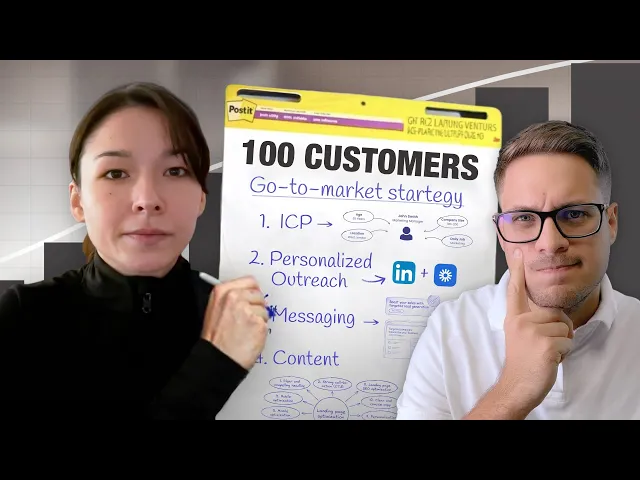
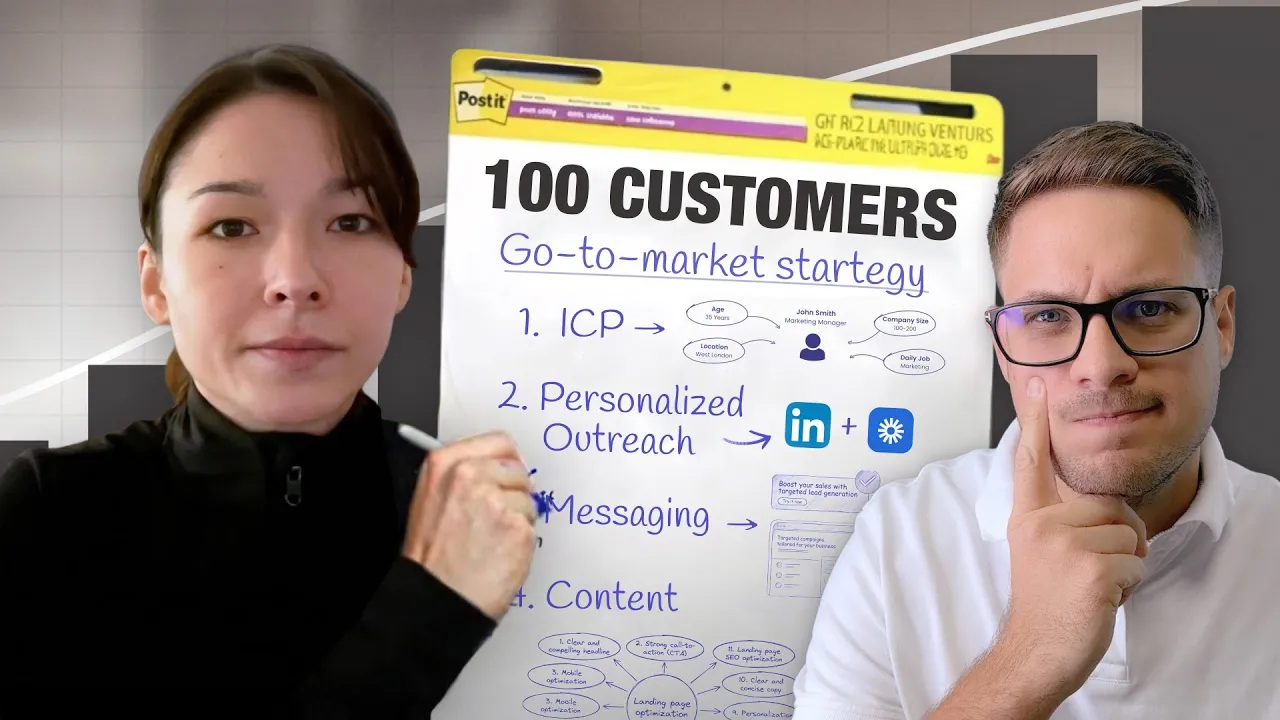
Today I sit down with Margot. We will reveal the exact working strategy here that can get a B2B SAS founder those first 100 customers. Margot, you work on go to market strategies with our clients here at SASMaster.
You have spent the last eight years helping early stage B2B founders find their first 100 customers. That's your thing. For example, there's one SAS.
you you helped scale from $400,000 in MR over to $700,000 in monthly recurring revenue in two years. You've worked with companies like uh the infamous SAS group uh scraper API call page and so you've tried it all productled outbound content you know exactly what moves the needle. So Margot let's start with the most common mistakes people make trying to get their first customers.
So for you to hit your first 100 customers first you need to avoid these three mistakes. So mistake number one uh targeting too bro. If you say we help any business be more productive you've already lost it.
Uh because if you target everyone you reach no one. >> Yeah that makes sense. They're saying don't try to be you know the next Amazon from day one.
Uh all countries all types of clients but instead the tool that solves one specific problem for one specific type of customer. Exactly. Now, the second mistake I see founders make is spend 6 months to a year building the perfect product.
Uh but they never talk to customers and they basically don't know if people even want this product. So, at the end, they wonder why they got no customers on the launch day because speaking with your real customers is the only way to validate the problem and the market. >> Yeah, 100%.
So you should have proof of interest, you know, whether it's conversations or signups, I guess, >> right? So mistake number three is generic messaging. If your website says things like we help businesses work smarter or the future of productivity, this basically means nothing.
>> Pretty sure I've seen those, >> right? Yeah. So it's just generic messaging doesn't directly speak to your customer's pain.
And this is why I mentioned that as the first point the messaging has to be a clear promise with proof and why it matters to them. >> So do you have like a real world fix for that something that used as an example? >> Yeah, I can give you an example.
So for example for an invoicing tool invoice ocean that I've worked for we made an AB test. So we modified the above default area of the page and this was about the headline and a tagline. H to focus on the direct benefit for the users and we structured it in a way generating an invoice in less than 30 seconds and previously uh there had been more generic messaging it was focused on the tool features instead of benefits for users.
The result uh after changing those page elements in the copy the conversion rate on the page increased by 2. 5 times. >> Wow that's that's actually an impressive result.
And so through customer discovery, you know that 30 seconds or less is that pain in creating invoices takes too long. And so uh that messaging is really improved getting customers. So were those the three big mistakes >> right?
Uh they all waste time, resources and delay achieving any kind of momentum. Uh but the good news is if you avoid these three mistakes, you are already ahead of 70% of firsttime SAS funders. >> So we've avoided those mistakes.
How do we get our first 10 customers? >> Okay, so the first 10 customers are the hardest because you have to do things that are not scalable. >> So for example, like what?
>> So you leverage your network. You start with your network. That's your lowest hanging fruit.
You don't need a huge Twitter audience. For SAS businesses, it's better to build a network of other founders and industry experts in communities like uh Microcon connect or the Dynamite Circle. At first, your main task is to have basically conversations.
You don't have to do all the selling. Now the goal at this stage is to get into conversations uh and uncover your potential customers challenges. These interactions together with early validation like uh launch list or actual prepayments uh turn into your first set of marketing materials as follows.
>> So basically my first 10 customers are more like my early adopter friends that I talk to a lot who also validate the product pay for it. But uh the currency is not just payment is also feedback. >> Exactly right.
Just a quick thing before we move on. If you're a non-technical founder and you don't want to spend months figuring out MVP validation, developers, marketing, and everything in between, at SASMastery, we've helped over 300 founders launcher MVP profitably. If you'd like that expert shortcut, just hit the first link in the description.
All right, back to Margot. Okay, but what happens when your network runs out? >> Good point.
So, that's where the repeatable gotomarket strategy comes in. and I'll show you the three outreach tactics that actually work in 2025 and beyond. But before we get to the tactics, you need to nail two foundational pieces first.
Now that you had the first a few conversations, we need a repeatable process to find and convert early adopters at scale. This is your core goto market strategy in five steps. First one is defining your ideal customer profile.
And I don't mean just like construction businesses. I mean a deep specific definition. Here's what you need to understand.
Thermographics. Uh this includes company size, location, tools your ICP uses. Then buyer personas, who has the authority to buy, uh who has influence but not the budget.
Then we move to pain points and desires, what keeps them up at night, the main goals, the fears, uh what they are suspicious of, who they see as an enemy. >> Mhm. So you're basically building a very detailed profile of your customer.
And uh because I can already see construction businesses trying to sell to as a SAS selling software to another construction business founder. It's like no that's not an ICP. That's a generic category.
You need to be specific than that. >> Yes. Because when you know exactly who you are talking to, every decision becomes easier.
Your messaging, your pricing, your feature prioritization, it all flows from a clear ICP. Your goal is to find the person who is most likely to need, want, and buy your product. >> Yeah.
Uh I would agree. This is also what I've seen from my experience. You know, having a clear ICP defined is what makes your overall marketing sharper.
And closely working with those 10 first customers, right? As we said, they're your friends. They're giving you feedback.
So, you leverage them as input to now understand, okay, what do those have in common? What do we put into that profile that you just mentioned? Who are they?
And that should give you a way to create a clear enough ICP to support your next growth I suppose. So what is step two? >> Uh step two is when you have the best product in the world but your messaging doesn't resonate.
So you have to crowd messaging that speaks directly to your ICP's pain points and then you test it. Try different email subject lines, different headlines and different ad copy. Next start tracking.
see how many people are opening, what are they clicking and how do they the conversation start. >> So you have to iterate the messaging and the copy continuously until you know what works >> more or less. Yes.
And once you find messaging that works uh that's when you scale outreach. So we move to step number three which is focused outreach for early adopters. Now most founders just blast cold emails but that doesn't work anymore because everyone is spamming.
So that's why I will share three creative tactics that work way better. And the first one is social engagement. This first strategy entails finding your target personas on LinkedIn or Twitter or other social media channels.
Uh you follow them, see what they post, leave comments, like their post. And the main goal here is that they've seen you, which builds trust. You build familiarity before you ever send a DM.
>> You're scaling the first thing, you know, with your network. You were making friends that you already knew and now you're still trying to make friends but now going into a more cold audience. >> Exactly.
And when you do reach out, you are not coming in with a pitch. You can frame it as I've built something for people like you and I'd love your feedback to see if it's actually useful. That angle feels genuine, non-salesy, and gets very high reply rates.
Uh you're not a stranger anymore. uh you are someone they've seen in the network and that already puts you ahead of 80% of other founders which then leads us to another element value. Instead of a generic cold email that goes like hello buy my product you give value.
You give them something that solves a specific problem they are facing. Maybe make a complete report of their competitors and tell them what they are doing differently and how they can improve as an example. So you're leading with value, not with a pitch, something actionable they can use.
>> Always you are proving you understand their world before you ask for anything. So this third strategy is my favorite. It actually has the highest response rate I've ever seen.
Sending interactive video outreach. Uh you can do this on Loom. In this method, you basically create a short four or five minute personalized video message.
You use their name. You have their website or their LinkedIn profile on your screen. You explain in 60 seconds exactly how your product helps solve their unique challenge.
In a world of thousands of automated text emails, a personal video is impossible to ignore. It adds that human touch. It builds the trust factor almost instantly.
It humanizes you. And you've got two quick tips for this. So, first tip I'd like to share is don't use this is bad uh when giving feedback.
Use yes and you're collaborating, not criticizing. Uh, and tip number two, if you can find two decision makers at that company, send a personalized video to both of them and mention in each email that you've also sent a video to their colleague. This creates a gossip effect and they will feel more compelled to watch.
>> Oh, that's sneaky. Okay, that makes sense. Uh, this level of personalization makes it very hard to ignore you.
>> Yeah, the video makes you stand out immediately compared to all other guys spamming inbox. The step number four is your landing page as a customer development tool. >> What do you mean by customer development tool?
That sounds very interesting. >> It means you are using your landing page uh to test ideas before you build. For example, sending mockups to your email list, ask them for feedback and see what they like.
And an even more important thing, when your ICP visits a website, uh it should feel like the copy is speaking to them and their exact pain points. It should include social proof and a strong call to action. to the landing page is part of the validation process obviously not just a conversion point >> of course it's a living document that evolves as you learn more about your customers so next I would suggest you to create a customer feedback loop this is the secret skill that separates good foundaries from great ones you have to obsess over feedback in the starting stages ask what's missing what frustrates them what features they wish existed they will help you way more than you can think in your messaging to attract more clients.
>> Yeah, this is uh crucial indeed. Many founders who run a SAS think they never have to talk to customers. Really, that's why we build software, not run services.
But ah that's not really how it works unfortunately. Right. >> Yeah.
Now once you've nailed these five steps, you've got a repeatable process for customer acquisition. But there is one more step scaling beyond the first 100 customers which brings us to the most demanding stage of this process. So, how do you actually go beyond those first 100 customers?
Build a library of success stories. You have to use that to get other clients while you use storytelling in your sales process for more impact. Something like one of our clients in your industry was struggling with the exact same problem.
Here is what they did and here is what happened. Instead of our client got to XY Z revenue, the first one basically has more impact. >> Cool.
So you're using your existing customers again to sell to new ones and the insight you got from those. >> Yeah, social proof is one of the strongest sales tools you have. And the second tactic that I also suggest is building a referral program.
You have to make it incredibly easy and offer rewards for your happy customers to bring you new customers. Build it into your onboarding process. Uh you can have an automated email that goes after a few months saying uh love our product share it with a friend and you both get 500 bucks.
The next one tactic number three position yourself through thought leadership. You need a method that will attract your clients instead of you going to them like you need to position yourself with thought leadership. You're creating top offunnel content tweets posting videos uh short form content etc.
Uh, the content should solve ICP's pain points, not just talk about your product. This will build you authority and in the long term get you more clients than you can ever handle. >> So, posting content is a long-term plan, right?
I see a lot of people doing that first or starting to do that right now. That's the long-term plan where you bring down customer acquisition costs because you stop paying or you can't send any more emails because that's getting too much. And this is now the final piece of the strategy, focusing on building a brand rather than conversion.
>> Exactly. It will pay off in the long run for sure. >> All right, that's the playbook for getting your first 100 SAS customers and beyond.
So first, avoid the three big mistakes. Targeting too broad, building before validating, and using generic messaging. Then land your first 10 customers through real conversations.
Network communities, cold DMs. Not selling, just learning and hoping somebody will need what you sell. Next, run the five-step go to market system.
Define your ICP, nail your messaging, personalize outreach, optimize your landing page, and keep that customer feedback loop alive, improving each everything with each iteration. And so once that is rolling, scale with proof. Case studies, testimonials, and content that builds authority.
Do this right and you'll win your first 100 customers fast. Now, if you're trying to build a SAS, but you're technical, you'll probably spend months trying to figure out everything on your own. At SAS Mastery, we help non-technical founders like you with expert guidance to get your MVP launch in 2 to 6 months.
We already have seven and 8 figure success stories. If you'd like to learn more, check out the first link in the description.