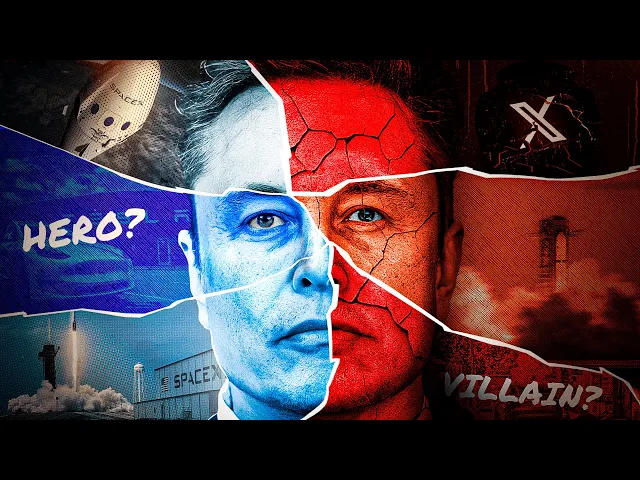
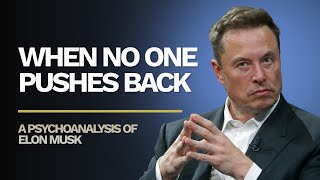
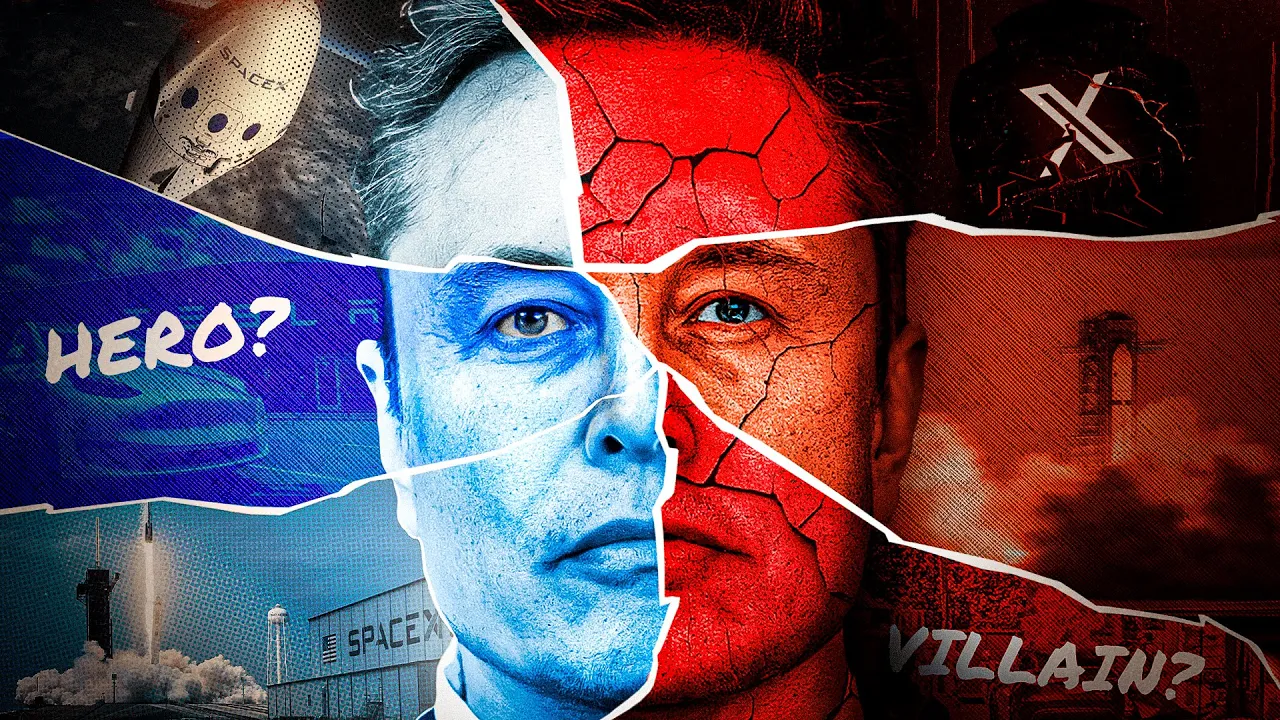
To some, he's the greatest innovator alive. >> People have called you the real Tony Stark. >> To others, the most dangerous man on earth.
But how can one person be both a savior and a villain? >> Are you sincerely trying to save the world? >> I Well, I'm >> from electric cars to colonizing Mars.
From saving the planet to reshaping free speech, Elon Musk is rewriting the rules of our world. But the question is whose future is he really building? Is he a visionary genius leading humanity to a brighter tomorrow or a dangerous disruptor willing to gamble with society itself?
This is the paradox of Elon Musk. And to understand him, we have to look deeper. [Music] Elon Musk was born in Ptoria, South Africa in 1971.
From the start, he was different. While other kids chased balls, Musk chased ideas, obsessed with computers, science fiction, and the future. By 10, he was lost in sci-fi worlds, dreaming of rockets, Martian colonies, and humanity's survival.
At 12, he coded a game called Blastar and sold it for $500. Small money, but a giant clue. Musk wasn't just playing with computers.
He was already bending them to his will. Why stick with oil when electricity could power cars? Why wait for governments to reach space when private companies could try?
Even as a teenager, Musk's mind lived in questions most people wouldn't dare to ask. In his 20s, Musk co-founded Zip 2, then helped launch PayPal, companies that redefined how cities shared information and how money moved across the globe. These weren't just businesses.
They were a preview of a man who didn't just see opportunity. He saw destiny. Climate change, space colonization, artificial intelligence, even the survival of humanity.
From the very beginning, Musk aimed at the biggest problems of all. Musk was never chasing incremental change. He wanted to rewrite the rules of what was possible, and soon the world would be forced to follow.
[Music] When Musk joined Tesla in 2004, electric cars had a reputation slow, ugly, impractical. The world was still addicted to gas. Musk wanted something different.
Cars that were sleek, fast, desirable. The Tesla Roadster wasn't just a car. It was a statement.
Electric vehicles weren't someday. They were now. But the rise was chaotic.
Production delays, missed deadlines, must tweets rattling investors and exhausting employees. Tesla was always on the edge, collapsing one moment, soaring the next. Yet that audacity forced the auto industry to wake up.
Suddenly, electric wasn't niche. It was the future. If Tesla challenged the roads, SpaceX challenged the stars.
Founded in 2002, it set out to do what many called impossible. Make rockets reusable and make Mars humanity's next home. Early failures were brutal.
>> The most powerful rocket ever built failed minutes after lifting off in Texas. The unmanned Starship rocket, you can see right there, exploded midair this morning. This was the maiden launch of the Starship rocket.
And despite that explosion, SpaceX claims the launch was still a success. CBS 13's Bradley Blackburn reports. Rockets exploded on live television.
Critics called Musk reckless, a billionaire burning money for science fiction fantasies. The first private company to deliver cargo to the ISS. A decade later, it launched astronauts into orbit.
What once belonged only to governments now belonged to a startup fueled by ambition and risk. Musk hadn't just reached space. He had redefined it.
Tesla and SpaceX weren't just companies. They became cultural symbols, proof that impossible ideas could become reality. But Musk's genius came with turbulence.
Every success carried controversy. Every breakthrough left chaos in its wake. [Applause] In recent weeks, Republican town halls have descended into chaos as protesters and angry voters have used the opportunity to berate their congressional reps about what is happening in Washington.
Most of the outrage has been directed at the expansive cuts in the federal government spearheaded by Elon Musk and his Doge team. Some saw a visionary pulling humanity into the future. Others saw a gambler pushing too far, too fast.
Either way, the world could no longer ignore him. But behind the achievements, another story was unfolding. One of pressure, power, and controversy.
[Music] Musk is brilliant, but brilliance comes at a cost. At Tesla and SpaceX, employees describe 80our weeks, relentless pressure, and a culture of exhaustion. For some, it was inspiring, a leader pushing them beyond what they thought possible.
For others, it was toxic, a human toll for the sake of progress. Musk demanded the impossible. Sometimes he got it.
Sometimes people broke. In 2022, Musk bought Twitter, renaming it X, promising a new era of free speech. Well, Elon Musk will not be deposed by Twitter's lawyers today after both sides agreed to a delay.
Musk and Twitter are working to close a $44 billion purchase of the social media network after Musk tried walking away from the original acquisition agreement earlier this year. Musk has now committed himself to completing the offer on its original terms. >> He argued that ideas should flow without censorship.
But with that freedom came a storm. Misinformation, polarization, and chaos. Supporters saw a defender of democracy.
Critics saw a billionaire destabilizing the public square. One man now controlled one of the world's most powerful platforms. And society felt the ripple effects.
It's quite good at doing this um reliably. And in fact, because we've never shown an end toend insertion of a robot in action, uh we're going to do a live demo of the robot doing surgery in our brain proxy. So, who wants to see some insertions?
>> So, here it is. That's our R1 robot with Neuralink seeks to connect brains to machines. Starlink connects the globe from orbit.
Tesla's AI aims to drive cars without humans. But every frontier raises questions. Who sets the limits of brain computer tech?
How much control should one company have over communication itself? And what happens if AI slips beyond our grasp? Musk thrives at the edge of possibility, but at the edge, risk is never far behind.
This is Musk's paradox. All paired with unease. He inspires and unsettles at the same time.
Some call him visionary, others reckless. Perhaps he is both. And that duality makes him one of the most polarizing figures of our age.
Musk doesn't lead one empire. He leads several. Tesla, SpaceX, Neurolink, Starlink, and X.
Together, they touch transportation, space, communication, energy, and even the human brain. Few individuals in history have wielded so much influence across so many fronts. He isn't just shaping industries.
He's shaping civilization. The stakes are enormous. If Musk succeeds, the rewards are breathtaking.
Sustainable energy, humans on Mars, global connectivity, breakthroughs in AI and neuroscience. But if he fails, if rockets collapse, if AI misfires, if communication is mismanaged, the fallout could impact millions, even billions. At Musk's scale, ambition and risk are inseparable.
He is both hope and hazard. A man whose dreams could save humanity or destabilize it. The world watches, caught between admiration and fear.
This is Musk's defining tension. His power to change the future is undeniable. But the consequences of that power remain uncertain.
And so the question lingers, hero, villain, or something far more complex. Elon Musk inspires like few others. He builds rockets, cars, and technologies once confined to science fiction.
But his decisions also spark chaos, straining workers, destabilizing platforms, raising ethical alarms. He is both the dreamer of futures and the disruptor of the present. Maybe Musk's story isn't just about him.
Maybe it's about us. A world where technology outpaces regulation. Where bold vision can reshape billions of lives?
Where ambition brings progress and peril? The real question, how much of our future are we willing to entrust to one man? So, is Elon Musk a hero, a villain, or something more complex?
The truth may never be simple. What's certain is this. His journey forces us to confront our own.
What kind of world do we want to build? And who do we want leading us into it? Elon Musk may be the greatest innovator of our time or the most unpredictable.
Perhaps he is both. The future he shapes won't just belong to him. It will belong to all of us.