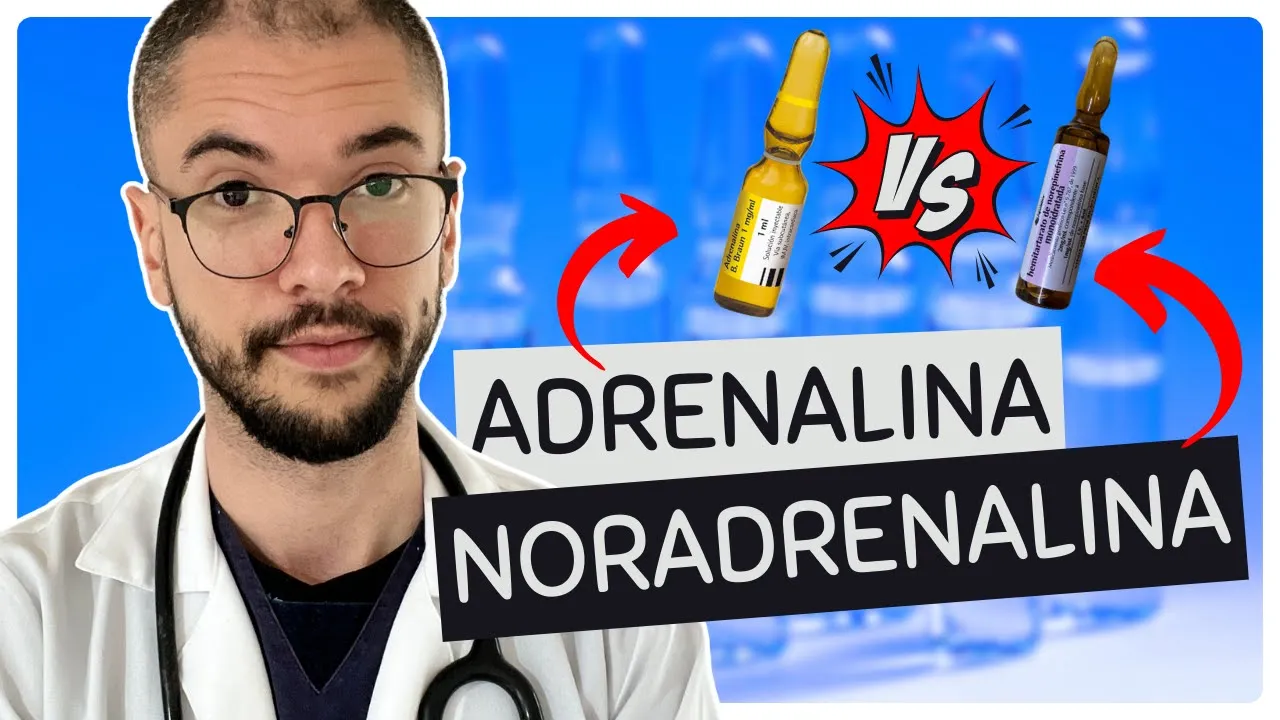
Nurse, administer norepinephrine! Doctor, I know that we need to apply this medication now, but I'm unsure whether it's adrenaline or noradrenaline. In fact, any difference at all.
. . Don't do what she does and don't let this doubt hit you.
Watch until the end of this class here and you will understand once and for all the difference between adrenaline and noradrenaline. So click the like button, subscribe to the channel, click the bell so you don't miss another video and welcome to another video from Enfermagem Total. We're going to start talking about the difference between the two, but first I need to talk quickly with those watching on TV.
I discovered that a lot of people, more than 70% of people, watch me on TV and I know that on TV it's a bit complicated to like and subscribe to channels and so on, but try to do it with your control, or if not, get it quickly. your cell phone in your pocket, subscribe to the channel and click the like button, that helps me a lot, right? But let's get to the content, grab your coffee or tea and let's go.
to study this difference here, which is extremely important. What are, in fact, epinephrine, or adrenaline, and norepinephrine, or norepinephrine? They are neurotransmitters, we already have these within our own bodies, okay?
This is not a medicine, of course it can be synthetic, externally, which we apply to the person, but, in general, we already have this in our body, okay? which serve as hormones and belong to the catecholamine class, okay? You might be thinking, Fábio, I already studied this thing, I think back in college I went crazy, crazy with this catecholamine thing.
Don't worry, what you need to know here today, at least about them, is extremely simple, okay? Catecholamines are substances that are essential for our body's adrenergic response . Fábio, another word you said that I don't remember exactly, which is adrenergic response.
Adrenergic response is nothing more than our fight and flight response, right? So the body in a situation, when identifying a dangerous situation, it has this stimulus, right? That's why we say, when we go on the roller coaster, that we get out of that situation, because we were in a situation that the body understood as if we were going to die, or were close to dying, it has to escape from that, So that's why we stay, right?
He starts to have a heart attack, he starts breathing faster, his muscle tone goes up a notch, he throws that adrenergic load up there. And whoever does this, whoever throws that adrenaline up high, whoever understands this, captures it from the outside and says, my God, I need to release the adrenaline, it's the catecholamines, right? And these catecholamines, for them to be able to act, for them to get this response from our body, for the body to understand that it needs to act quickly, they bind to specific receptors for systemic action.
So, they are receptors that when connected to them, they will carry out actions in the entire body, or in the system, in that specific system. So, the archaicovascular system forms an entire system, it won't just be in one organ, for example, of this system. It will always have a systemic action.
And what are these receptors that catecholamines bind to? These are alpha- and beta-adrenergic receptors. In other words, they are receptors made here to connect with catecholamines to have this adrenergic action , this adrenaline action , okay?
Who are the alphas, who were here for there is a little alpha symbol, and we clearly saw here that my PowerPoint doesn't identify it, and here the beta-1 and beta-2. What does this mean, Fábio? Wow, alpha, beta, it's already becoming Greek, literally that's it, calm down, calm down and I'll explain all this to you.
The adrenaline, it will connect to the alpha and beta sectors. I'm going to start here. The adrenaline will only be activated in the alpha, so here a big difference begins for us.
Adrenaline is linked to both alpha and beta, and daughter-in-law only to alpha. What are they responsible for, okay? The alpha receptors, alpha 1 and alpha 2, what are they very important receptors for?
In alpha, you will contract muscles. What muscles are these? Vessels, bronchi, uterus, bladder, kidneys, iris.
It also contracts, but relaxes the gastrointestinal tract. I can talk a little more about this here for you, because it says relax here, but if you're researching, you'll discover that it contracts too. It's the same thing as the situation.
. . Let's suppose we're on the roller coaster again , okay?
You got up, what's going to happen there with your year? You will. .
. right? As many would say, lock it up, right?
Then he will contract this muscle. However, this may, depending on this action, loosen. So, it both relaxes and contracts, and then it will depend a lot from organism to organism, but here it says relax, but it can also contract alfamor, it also contracts the gastrointestinal tract.
The pre-synaptic events, then the sending of synapses, the sending of these neurotransmitters is also done by alpha-2s. So, if noradrenaline, for example, does not bind to alpha-2s, it cannot carry out, for example, action on alpha-1, because it does not have an action before the synaptic end. So, it's kind of obvious that she'll end up calling both of them.
As for adrenaline, it also connected to these guys here, but it will also connect to these guys here, it's not beta-1 and beta-2. That in the heart will increase cardiac output and contraction force , so that's why it starts back-and-forth, right? Tachycardia and high volume, damn man!
And it will relax the muscles of vessels, bronchi, gastrointestinal tract, uterus, bladders, seminal and ciliary tracts. And look how cool! You say, damn, Fábio!
If the adrenaline. . .
If I'm going to even pay for my risks here so we can follow the best line of reasoning. Adrenaline will bind to both alpha and beta, right? Right.
So she will both contract and relax her muscles at the same time, how crazy! How does this happen? Nothing will happen.
Let's cancel each other out. If one is relaxing and the other is contracting, it will cancel out and have no effect. No, calm down.
I already explained this once here in a video where I talked about adrenaline inhalation. Why do we have to be careful with the dose? So, we have doses where adrenaline will mostly bind to alpha and doses where adrenaline will mostly bind to beta.
So, depending on the effect we want in the body, we will give certain doses for the adrenaline to bind to the receptors we want, right? So, that's why, for example, in a cardiorespiratory arrest, for example, the patient, at the moment of action, we give adrenaline, we do applications of intravenous adrenaline in this patient, because we need a greater output, we need a more relaxed body, right, this happens a lot, right, of course in a situation where we are, in general the person is already relaxed, but It happens much more often that we have sphincter release, etc. , during a stop, this is normal to happen.
Also because of the action of adrenaline, which is binding in the betas. But as soon as the patient returns, who do we call? An adrenaline rush.
To call where? In alpha, to contract the muscles and do what? The increase in my blood pressure.
Through what? From the contraction of the vessels. The vessel has contracted, blood pressure tends to increase, since cardiac output and contraction force are already greater due to codenture adrenaline.
Look here. . .
I'll even give due credit here, I'll even recommend you read this article. It's not a scientific article, but a blog article talking about Fernandes, I don't remember her name , Joyce, I think, something , Fernandes, she talks about adrenaline. .
. I didn't understand what he said. The difference between these two on the Jaleco blog, the link is here, but if you can't read it, there's no way now, write to me in the comments, I want the link and then I'll send you this link, I'll copy it for you below so you can access this material which is very well explained, it's really wonderful to understand.
Finally, what are the differences in practice that both will affect the heart? Sugar levels, blood vessels, both will happen , both in the daughter-in-law and the adrenaline. However, the daughter-in-law will also increase blood pressure due to vessel constriction, which is what I said previously.
In other words, adrenaline will have a more central effect, and norepinepherine will have a more peripheral effect, more on the blood vessels. So, that's why at the moment of the action, we want a more central effect through adrenaline and after the action, after a desperate stop, we enter, either to increase blood pressure, to maintain this in the AOTI, we It mainly administers norepinephrine, but not adrenaline. I hope you now understand all the differences between the two.
If you have any other questions that weren't answered here in this video, write to me in the comments and I'll maybe even bring a part two, even another video talking more, going into more detail about this subject. And if you watched this video until the end, I want you to leave me a comment called Nora Epi. If you write Nora Epi in the comments I will know that you watched this video until the end, I want to know how many people are watching this video until the end with me.
If you didn't do this at the beginning of the video, click the like button now that helps me a lot, subscribe to the channel and click the bell so you don't miss any more videos And always remember, whoever inspires knowledge, inspires up front professional autonomy. I'll see you in our next class. Bye Bye!


![[#1] Fisiologia do Músculo Esquelético: CONTRAÇÃO MUSCULAR | MK Fisiologia](https://img.youtube.com/vi/R-N-VFGWyGg/mqdefault.jpg)